tow FIAT BRAVO 2014 2.G User Guide
[x] Cancel search | Manufacturer: FIAT, Model Year: 2014, Model line: BRAVO, Model: FIAT BRAVO 2014 2.GPages: 275, PDF Size: 3.95 MB
Page 140 of 275
If the engine does not start at the first attempt,
return the ignition key to STOP before attempting to
start again.
If, when the ignition key is at MAR-ON the
warning light remains lit, turn the key to STOP
and then back to MAR-ON. If the warning light
remains lit, try with the other keys provided with the
car.
If you still cannot start the engine, contact a Fiat
Dealership.
Warning light
will flash for 60 seconds
after starting or during prolonged
cranking to indicate a fault with the glow
plug heating system.You can use the car as usual
if the engine starts but you should contact a
Fiat Dealership as soon as possible.
When the engine is switched off never
leave the key turned to MAR to prevent
useless current absorption from draining
the battery.
HOW TO WARM UP THE ENGINE AFTER IT
HAS JUST STARTED
Proceed as follows:
❒Drive off slowly, letting the engine turn at medium
revs. Do not accelerate abruptly;
❒Do not demand full performance at first. Wait
until the engine coolant temperature gauge starts
moving.
Never jump start the engine by pushing,
towing or coasting downhill.This could
cause fuel to flow into the catalytic
converter and damage it beyond repair.
EMERGENCY START-UP
Contact a Fiat Dealership if instrument panel
warning light
(or the symbol on the display) stays
on constantly.
STOPPING THE ENGINE
Turn the ignition key to STOP while the engine is
idling.
IMPORTANT After a taxing drive, you should allow
the engine to “catch its breath” before turning it
off by letting it idle to allow the temperature in the
engine compartment to fall.
A quick burst on the accelerator before
stopping the engine serves no practical
purpose; it wastes fuel and is especially
damaging to turbocharged engines.
136GETTING TO KNOW
YOUR CAR
SAFETYSTARTING AND
DRIVINGWARNING LIGHTS
AND MESSAGES
IN AN EMERGENCY
SERVICING AND
MAINTENANCE
TECHNICAL
SPECIFICATIONS
INDEX
Page 142 of 275
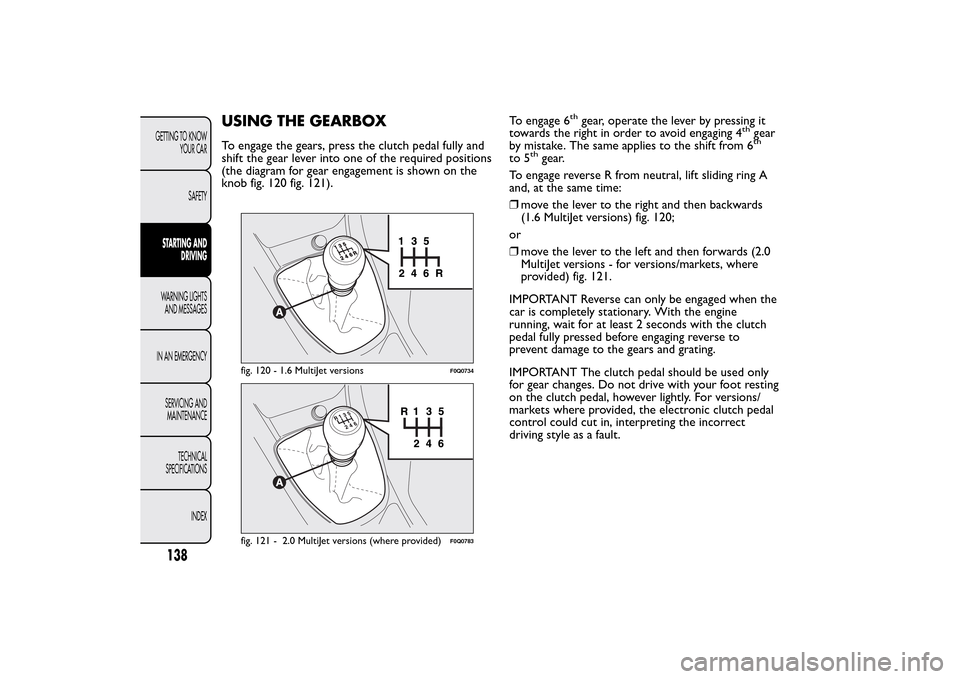
USING THE GEARBOXTo engage the gears, press the clutch pedal fully and
shift the gear lever into one of the required positions
(the diagram for gear engagement is shown on the
knob fig. 120 fig. 121).To engage 6
th
gear, operate the lever by pressing it
towards the right in order to avoid engaging 4
th
gear
by mistake. The same applies to the shift from 6th
to 5
th
gear.
To engage reverse R from neutral, lift sliding ring A
and, at the same time:
❒move the lever to the right and then backwards
(1.6 MultiJet versions) fig. 120;
or
❒move the lever to the left and then forwards (2.0
MultiJet versions - for versions/markets, where
provided) fig. 121.
IMPORTANT Reverse can only be engaged when the
car is completely stationary. With the engine
running, wait for at least 2 seconds with the clutch
pedal fully pressed before engaging reverse to
prevent damage to the gears and grating.
IMPORTANT The clutch pedal should be used only
for gear changes. Do not drive with your foot resting
on the clutch pedal, however lightly. For versions/
markets where provided, the electronic clutch pedal
control could cut in, interpreting the incorrect
driving style as a fault.
fig. 120 - 1.6 MultiJet versions
F0Q0734
fig. 121 - 2.0 MultiJet versions (where provided)
F0Q0783
138GETTING TO KNOW
YOUR CAR
SAFETYSTARTING AND
DRIVINGWARNING LIGHTS
AND MESSAGES
IN AN EMERGENCY
SERVICING AND
MAINTENANCE
TECHNICAL
SPECIFICATIONS
INDEX
Page 143 of 275
WARNING
Depress the clutch pedal fully to change
gear correctly. It is therefore essential
that there is nothing under the pedals: make
sure the mats are lying flat and do not get
in the way of the pedals.Do not drive with your hand resting on
the gear lever as the force exerted, even if
slight , could lead over time to premature
wear of the gearbox internal components.
SAVING FUELSome useful tips are given below for fuel saving and
reducing harmful emissions of CO
2and other
pollutants [nitrogen oxides, unburnt hydrocarbons,
Particulate Matter (PM) etc.].
GENERAL CONSIDERATIONS
The general factors that affect fuel consumption are
listed below.
Car maintenance
Have checks and adjustments carried out in
accordance with the “Scheduled Servicing Plan”.
Ty r e s
Check the tyre pressures at least once every four
weeks: if the pressure is too low, consumption levels
increase as resistance to rolling is higher.
Unnecessary loads
Do not travel with an overloaded boot. The weight
of the car (especially when driving in town) and
its ride greatly affects consumption and stability.
Roof rack/ski rack
Remove the roof rack or the ski rack from the roof
after use. These accessories lower aerodynamic
penetration and adversely affect consumption levels.
When transporting particularly large objects, use a
trailer if possible.
139GETTING TO KNOW
YOUR CAR
SAFETYSTARTING AND
DRIVINGWARNING LIGHTS
AND MESSAGES
IN AN EMERGENCY
SERVICING AND
MAINTENANCE
TECHNICAL
SPECIFICATIONS
INDEX
Page 145 of 275
Acceleration
Accelerating violently severely affects consumption
and emissions: acceleration should be gradual and
should not exceed the maximum torque.
USAGE CONDITIONS
The main usage conditions that negatively affect fuel
consumption are listed below.
Cold starting
Short journeys and frequent cold starts do not allow
the engine to reach optimum operating temperature.
This results in a significant increase in consumption
levels (from +15 to +30% on the urban cycle) and
emissions.
Traffic and road conditions
Rather high consumption levels are linked to
situations with heavy traffic, for instance when
travelling in queues with frequent use of the lower
gears or in cities with many traffic lights. Winding
mountain roads and rough road surfaces also
adversely affect consumption.
Traffic hold-ups
During prolonged hold-ups (e.g. level crossings) the
engine should be switched off.
TOWING TRAILERSIMPORTANT NOTES
For towing caravans or trailers the car must be fitted
with a certified tow hook and an adequate electric
system. Installation should be carried out by
specialised personnel who will issue the required
papers for travelling on roads.
Install any specific and/or additional rear view mirrors
as specified by the Highway Code.
Remember that when towing a trailer, steep hills are
harder to climb, braking distances increase and
overtaking takes longer depending on the overall
weight.
Engage a low gear when driving downhill, rather than
constantly using the brake.
The weight the trailer exerts on the car tow hook
reduces the car's loading capacity by the same
amount. To make sure that the maximum towable
weight is not exceeded (given in the car registration
document) account should be taken of the fully
laden trailer, including accessories and luggage.
Respect the speed limits specific to each country for
vehicles towing trailers.
In any case, the maximum speed must not exceed 80
km/h.
141GETTING TO KNOW
YOUR CAR
SAFETYSTARTING AND
DRIVINGWARNING LIGHTS
AND MESSAGES
IN AN EMERGENCY
SERVICING AND
MAINTENANCE
TECHNICAL
SPECIFICATIONS
INDEX
Page 146 of 275
WARNING
The ABS with which the car may be
equipped will not control the braking
system of the trailer. Particular caution is
required on slippery roads.
WARNING
Never modify the braking system of the
car to control the trailer brake.The
trailer braking system must be fully
independent of the car ’s hydraulic system.
INSTALLING THE TOW HOOK
The towing device should be fastened to the
bodywork by specialised personnel according to any
additional and/or integrative information supplied
by the Manufacturer of the device. The towing device
must meet current regulations with reference to
Directive 94/20/EEC and subsequent amendments.
For any version the towing device used must be right
for the towable weight of the car on which it is to
be installed.IMPORTANT The use of auxiliary loads other than
external lights (electric brake, winch, etc.) must
be used with engine running.
For the electric connection a unified connector
should be used, which is generally placed on a special
bracket fastened to the towing device, and a special
ECU should be installed on the car to control the
trailer's exterior lights.
7 or 13-pole 12 V DC connections should be used
(CUNA/UNI and ISO/DIN Standards). Follow any
instructions provided by the car manufacturer and/or
the towing device manufacturer.
An electric brake or winch should be powered
directly by the battery through a cable with a
cross-section of no less than 2.5 mm
2.
IMPORTANT Electric brakes or other devices must
be used with engine running.
In addition to the electrical branches, the vehicle's
electrical system can be connected only to the supply
cable for an electric brake and to the cable for an
internal trailer light, though not more than 15 W. For
connections use the preset control unit with battery
cable no less than 2.5 mm
2.
142GETTING TO KNOW
YOUR CAR
SAFETYSTARTING AND
DRIVINGWARNING LIGHTS
AND MESSAGES
IN AN EMERGENCY
SERVICING AND
MAINTENANCE
TECHNICAL
SPECIFICATIONS
INDEX
Page 153 of 275
Low engine oil pressure
The warning light switches on constantly together
(for versions/markets, where provided) with a
message on the display when the system detects that
the engine oil pressure is too low.
WARNING
If the warning light
turns on when
the car is travelling (on certain versions
together with the message on the display) stop
the engine immediately and contact a Fiat
Dealership.
Engine oil degraded
(versions with DPF only)
The warning light will flash and a specific message will
appear on the display (for versions/markets, where
provided). The warning light may flash in the
following ways, depending on the version:
❒for 1 minute every two hours;
❒cycles of 3 minutes with intervals with the warning
light off for 5 seconds until the oil is changed.
After the first indication, at each engine start-up the
warning light will continue flashing as described
above until the oil is changed. The display (for
versions/markets, where provided), shows a
dedicated message together with the warning light.The flashing of this warning light should not be
considered as a fault; it informs the customer that
the oil needs to be changed following normal car use.
Note that engine oil degrades faster under the
following circumstances:
❒mainly town use of the car which makes the DPF
regeneration process more frequent;
❒use of the car for short drives, in which the engine
does not have time to reach its regular operating
temperature;
❒repeated interruption of the regeneration process,
signalled by the DPF warning light coming on.
WARNING
If the warning light switches on, the
deteriorated engine oil must be changed
as soon as possible, and never more than 500
km from the first time that the warning light
switches on. Failure to observe the above
indication may result in severe damage to the
engine and invalidate the warranty. Remember
that the operation of this warning light is not
related to the amount of oil in the engine.
Therefore, never top up with oil when the
warning light starts flashing.
149GETTING TO KNOW
YOUR CAR
SAFETY
STARTING AND
DRIVINGWARNING LIGHTS
AND MESSAGESIN AN EMERGENCY
SERVICING AND
MAINTENANCE
TECHNICAL
SPECIFICATIONS
INDEX
Page 154 of 275
“DUALDRIVE” ELECTRIC POWER
STEERING FAILURE (red)
The warning light comes on when the ignition key is
turned to MAR-ON, but it should switch off after
a few seconds.
The electric power steering system will not work
when the warning light is on and considerably more
effort is needed on the steering wheel. The car
can still be steered. In this case, contact a Fiat
Dealership.
The display will show the dedicated message.“DUALDRIVE” ELECTRIC POWER
STEERING ACTIVATION (indication
on display)
The indication CITY switches on when the
"Dualdrive" electric power steering system is
activated by pressing the
button on the dashboard.
The indication CITY will switch off when the
button is pressed again.
EXCESSIVE ENGINE COOLANT
TEMPERATURE (red)
Turning the key to the MAR-ON position the
warning light switches on, but it should switch off
after a few seconds. The warning light turns on when
the engine is overheated. If the warning light comes
on, proceed as follows:
❒when driving normally:stop the car, switch off
the engine and check that the water level in the
reservoir is not below the MIN mark. If it is, wait
for the engine to cool down, then slowly and
carefully open the cap, top up with coolant and
check that the level is between the MIN and MAX
marks on the reservoir. Also check visually for
any fluid leaks. If, when restarting, the warning
light switches on again, contact a Fiat Dealership.
❒If the car is used under demanding
conditions(e.g. towing trailers uphill or fully
loaded): slow down and, if the light stays on, stop
the car. Wait for 2 or 3 minutes with the engine
running and slightly accelerated to further favour
the coolant circulation. Then stop the engine.
Check the correct coolant level as described
above.
IMPORTANT Over demanding routes, it is advisable
to keep the engine on and slightly accelerated for
a few minutes before switching it off.
The display will show the dedicated message.
150GETTING TO KNOW
YOUR CAR
SAFETY
STARTING AND
DRIVINGWARNING LIGHTS
AND MESSAGESIN AN EMERGENCY
SERVICING AND
MAINTENANCE
TECHNICAL
SPECIFICATIONS
INDEX
Page 166 of 275
WARNING
This procedure must be performed by
expert personnel because incorrect
actions could cause electrical discharge of
considerable intensity. Furthermore, battery
fluid is poisonous and corrosive: avoid contact
with skin and eyes. Keep naked flames and
lighted cigarettes away from the battery and do
not cause sparks.
BUMP STARTING
Never bump start the engine by pushing, towing or
coasting downhill.
IMPORTANT Remember that the brake servo and
electrical power steering system are not active until
the engine is started. A much greater effort will
therefore be required to use the brake pedal or turn
the steering wheel.
CHANGING A WHEELGENERAL INSTRUCTIONS
The car is equipped with the “Fix&Go Automatic
Kit”: see paragraph “Fix&Go Automatic Kit” for
instructions on how to use this device. As an
alternative to the “Fix&Go Automatic Kit” the car
may be equipped with a space-saver wheel: see
the instructions on the following pages for changing
the wheel.
WARNING
The space-saver wheel (for versions/
markets, where provided) is specific to
your car, do not use it on other models, or use
the space-saver wheel of other models on your
car.The space-saver wheel must only be used
in case of emergency. It must only be used
for the distance necessary to reach a service
point and the car speed must not exceed 80
km/h.The space-saver wheel has an orange
sticker that summarises the main cautions for
use and limitations. Never remove or cover
the sticker.The following information is
provided in four languages on the sticker:
"Important! For temporary use only! 80 km/h
max.! Replace with a standard wheel as soon as
possible. Never cover this indication". Never
apply a hub cap on a space-saver wheel.
162GETTING TO KNOW
YOUR CAR
SAFETY
STARTING AND
DRIVING
WARNING LIGHTS
AND MESSAGES
IN AN
EMERGENCY
SERVICING AND
MAINTENANCE
TECHNICAL
SPECIFICATIONS
INDEX
Page 172 of 275
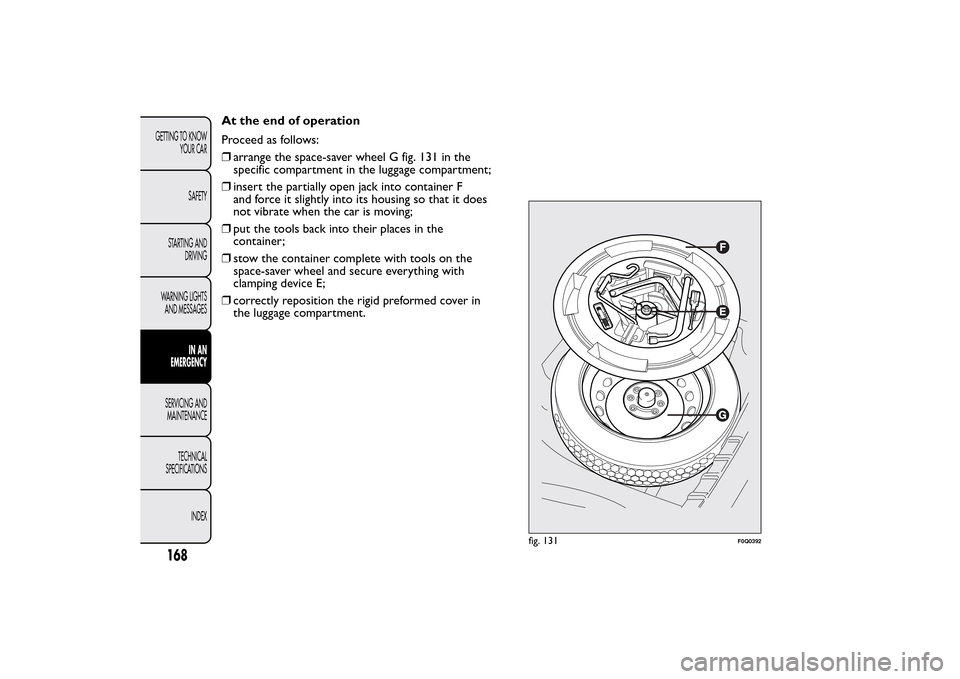
At the end of operation
Proceed as follows:
❒arrange the space-saver wheel G fig. 131 in the
specific compartment in the luggage compartment;
❒insert the partially open jack into container F
and force it slightly into its housing so that it does
not vibrate when the car is moving;
❒put the tools back into their places in the
container;
❒stow the container complete with tools on the
space-saver wheel and secure everything with
clamping device E;
❒correctly reposition the rigid preformed cover in
the luggage compartment.
fig. 131
F0Q0392
168GETTING TO KNOW
YOUR CAR
SAFETY
STARTING AND
DRIVING
WARNING LIGHTS
AND MESSAGES
IN AN
EMERGENCY
SERVICING AND
MAINTENANCE
TECHNICAL
SPECIFICATIONS
INDEX
Page 178 of 275
CHANGING A BULBGENERAL INSTRUCTIONS
❒Before changing a bulb check the contacts for
oxidation;
❒Burnt bulbs must be replaced by others of the
same type and power;
❒after replacing a headlight bulb, always check its
alignment;
❒when a light is not working, check that the
corresponding fuse is intact before changing a bulb.
For the location of fuses, refer to the paragraph
“If a fuse blows” in this section;
WARNING
Modifications or repairs to the electric
system that are not carried out properly
or do not take the system technical
specifications into account can cause
malfunctions leading to the risk of fire.
WARNING
Halogen bulbs contain pressurised gas,
in the case of breakage they may burst .
Halogen bulbs must be handled holding
the metallic part only.Touching the
transparent part of the bulb with your
fingers may reduce the intensity of the emitted
light and even reduce the lifespan of the bulb. In
case of accidental contact , wipe the bulb with
a cloth moistened with alcohol and let the bulb
dry.If possible, we recommend have bulbs
replaced by a Fiat Dealership.The correct
operation and aiming of the outer lights
are absolutely essential for the safety of the car
and of compliance with law.Due to the high supply voltage, gas
discharge bulbs (Bi-Xenon) (for versions/
markets, where provided) must only be
replaced by a specialist technician: danger of
death! Contact a Fiat Dealership.
IMPORTANT When the weather is cold or damp or
after heavy rain or washing, the surface of headlights
or rear lights, may steam up and/or form drops of
condensation on the inside. This is a natural
phenomenon due to the difference in temperature
and humidity between the inside and the outside
of the glass which does not indicate a fault and does
not compromise the normal operation of lighting
devices. The mist disappears quickly when the lights
are turned on, starting from the centre of the
diffuser, extending progressively towards the edges.
174GETTING TO KNOW
YOUR CAR
SAFETY
STARTING AND
DRIVING
WARNING LIGHTS
AND MESSAGES
IN AN
EMERGENCY
SERVICING AND
MAINTENANCE
TECHNICAL
SPECIFICATIONS
INDEX