fuel FIAT BRAVO 2014 2.G Owner's Manual
[x] Cancel search | Manufacturer: FIAT, Model Year: 2014, Model line: BRAVO, Model: FIAT BRAVO 2014 2.GPages: 275, PDF Size: 3.95 MB
Page 157 of 275
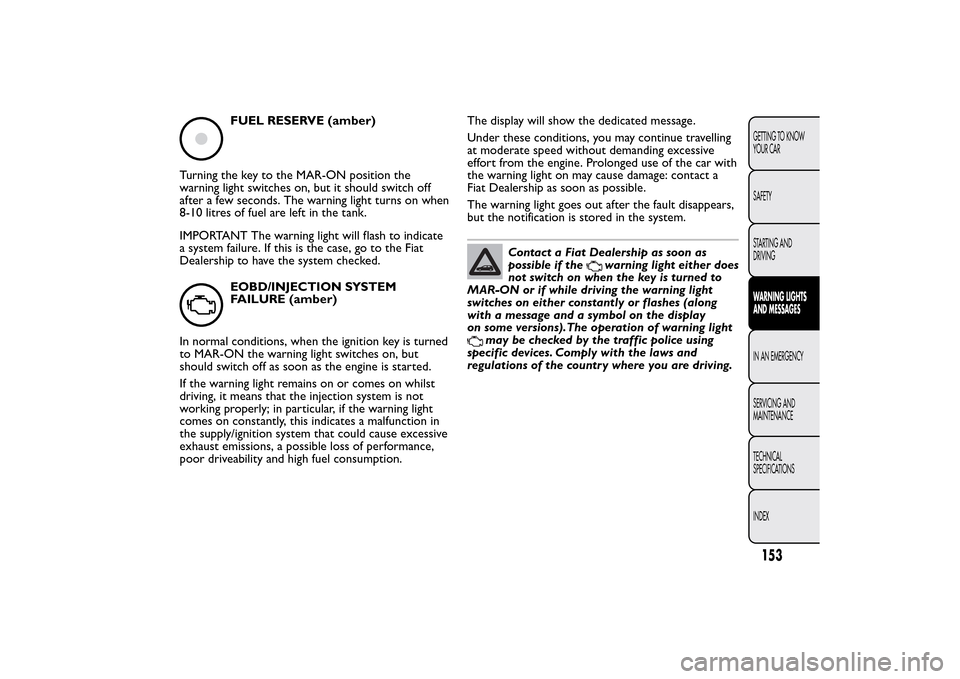
FUEL RESERVE (amber)
Turning the key to the MAR-ON position the
warning light switches on, but it should switch off
after a few seconds. The warning light turns on when
8-10 litres of fuel are left in the tank.
IMPORTANT The warning light will flash to indicate
a system failure. If this is the case, go to the Fiat
Dealership to have the system checked.EOBD/INJECTION SYSTEM
FAILURE (amber)
In normal conditions, when the ignition key is turned
to MAR-ON the warning light switches on, but
should switch off as soon as the engine is started.
If the warning light remains on or comes on whilst
driving, it means that the injection system is not
working properly; in particular, if the warning light
comes on constantly, this indicates a malfunction in
the supply/ignition system that could cause excessive
exhaust emissions, a possible loss of performance,
poor driveability and high fuel consumption.The display will show the dedicated message.
Under these conditions, you may continue travelling
at moderate speed without demanding excessive
effort from the engine. Prolonged use of the car with
the warning light on may cause damage: contact a
Fiat Dealership as soon as possible.
The warning light goes out after the fault disappears,
but the notification is stored in the system.
Contact a Fiat Dealership as soon as
possible if the
warning light either does
notswitchonwhenthekeyisturnedto
MAR-ON or if while driving the warning light
switches on either constantly or flashes (along
with a message and a symbol on the display
on some versions).The operation of warning light
may be checked by the traffic police using
specific devices. Comply with the laws and
regulations of the country where you are driving.
153GETTING TO KNOW
YOUR CAR
SAFETY
STARTING AND
DRIVINGWARNING LIGHTS
AND MESSAGESIN AN EMERGENCY
SERVICING AND
MAINTENANCE
TECHNICAL
SPECIFICATIONS
INDEX
Page 159 of 275
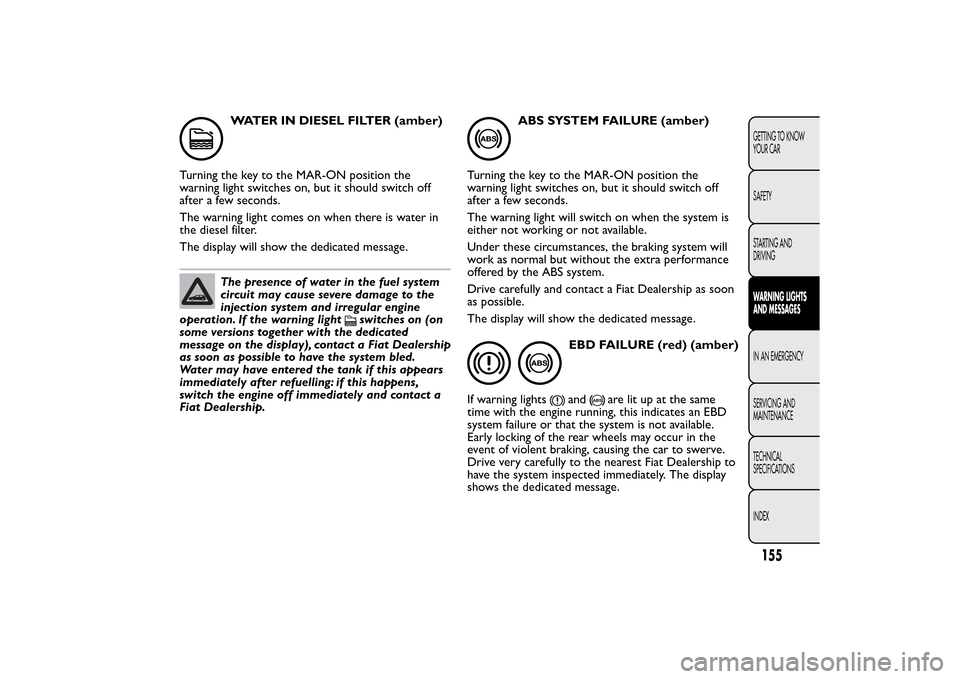
WATER IN DIESEL FILTER (amber)
Turning the key to the MAR-ON position the
warning light switches on, but it should switch off
after a few seconds.
The warning light comes on when there is water in
the diesel filter.
The display will show the dedicated message.The presence of water in the fuel system
circuit may cause severe damage to the
injection system and irregular engine
operation. If the warning light
switches on (on
some versions together with the dedicated
message on the display), contact a Fiat Dealership
as soon as possible to have the system bled.
Water may have entered the tank if this appears
immediately after refuelling: if this happens,
switch the engine off immediately and contact a
Fiat Dealership.
ABS SYSTEM FAILURE (amber)
Turning the key to the MAR-ON position the
warning light switches on, but it should switch off
after a few seconds.
The warning light will switch on when the system is
either not working or not available.
Under these circumstances, the braking system will
work as normal but without the extra performance
offered by the ABS system.
Drive carefully and contact a Fiat Dealership as soon
as possible.
The display will show the dedicated message.
EBD FAILURE (red) (amber)
If warning lightsand
are lit up at the same
time with the engine running, this indicates an EBD
system failure or that the system is not available.
Early locking of the rear wheels may occur in the
event of violent braking, causing the car to swerve.
Drive very carefully to the nearest Fiat Dealership to
have the system inspected immediately. The display
shows the dedicated message.
155GETTING TO KNOW
YOUR CAR
SAFETY
STARTING AND
DRIVINGWARNING LIGHTS
AND MESSAGESIN AN EMERGENCY
SERVICING AND
MAINTENANCE
TECHNICAL
SPECIFICATIONS
INDEX
Page 161 of 275
IMPORTANT Do not continue driving with one or
more flat tyres as handling may be compromised.
Stop the car, avoiding harsh braking and steering
manoeuvres. Replace the wheel immediately with the
space-saver wheel (for versions/markets, where
provided) or carry out a repair using the dedicated
kit (see “Changing a wheel” in the "In an emergency"
chapter) and contact a Fiat Dealership as soon as
possible.
Check tyre pressure
This warning light switches on in the instrument
panel to indicate that the tyre pressure is below the
value recommended to guarantee long tyre life
and low fuel consumption. It may also indicate a slow
loss of pressure.
Should two or more tyres be flat, the display will
show the indications corresponding to each tyre in
sequence.
Restore correct tyre pressures as soon as possible
(see “Cold tyre pressures” in the “Technical
specifications” chapter).Tyre pressure unsuitable for speed
Should you need to travel at a speed higher than 160
km/h, inflate the tyres to the pressures specified in
“Tyre pressures” paragraph.
If the TPMS system (for versions/markets where
provided) detects that the pressure of one or more
tyres is unsuitable for the current speed, the warning
light will turn on (together with the message on
the display) (see “Tyre pressure low” in this chapter)
and it will stay on until the car slows down to a
speed below the preset threshold.
IMPORTANT In this case slow down immediately
since tyre overheating could impair tyre performance
and life beyond repair, and even make the tyre to
blow-out.
WARNING
Particularly strong radio frequency
interference may cause the TPMS to
function incorrectly.This condition is indicated
to the driver by a message (for versions/markets
where provided).The message will disappear
automatically as soon as the interference ceases
to affect the system.
157GETTING TO KNOW
YOUR CAR
SAFETY
STARTING AND
DRIVINGWARNING LIGHTS
AND MESSAGESIN AN EMERGENCY
SERVICING AND
MAINTENANCE
TECHNICAL
SPECIFICATIONS
INDEX
Page 165 of 275
IN AN EMERGENCY
STARTING THE ENGINEContact a Fiat Dealership immediately if instrument
panel warning light
stays on constantly.
JUMP STARTING
If the battery is flat, the engine may be started using
an auxiliary battery with the same capacity or a
little higher than the flat one.
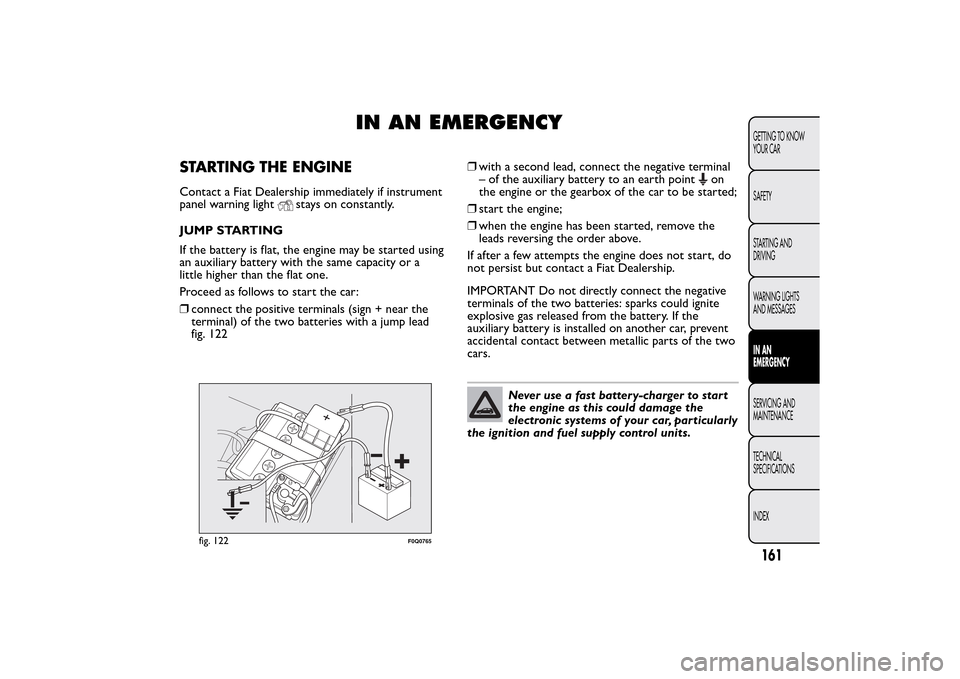
Proceed as follows to start the car:
❒connect the positive terminals (sign + near the
terminal) of the two batteries with a jump lead
fig. 122❒with a second lead, connect the negative terminal
– of the auxiliary battery to an earth point
on
the engine or the gearbox of the car to be started;
❒start the engine;
❒when the engine has been started, remove the
leads reversing the order above.
If after a few attempts the engine does not start, do
not persist but contact a Fiat Dealership.
IMPORTANT Do not directly connect the negative
terminals of the two batteries: sparks could ignite
explosive gas released from the battery. If the
auxiliary battery is installed on another car, prevent
accidental contact between metallic parts of the two
cars.
Never use a fast batter y-charger to star t
the engine as this could damage the
electronic systems of your car, particularly
the ignition and fuel supply control units.
fig. 122
F0Q0765
161GETTING TO KNOW
YOUR CAR
SAFETY
STARTING AND
DRIVING
WARNING LIGHTS
AND MESSAGESIN AN
EMERGENCYSERVICING AND
MAINTENANCE
TECHNICAL
SPECIFICATIONS
INDEX
Page 200 of 275
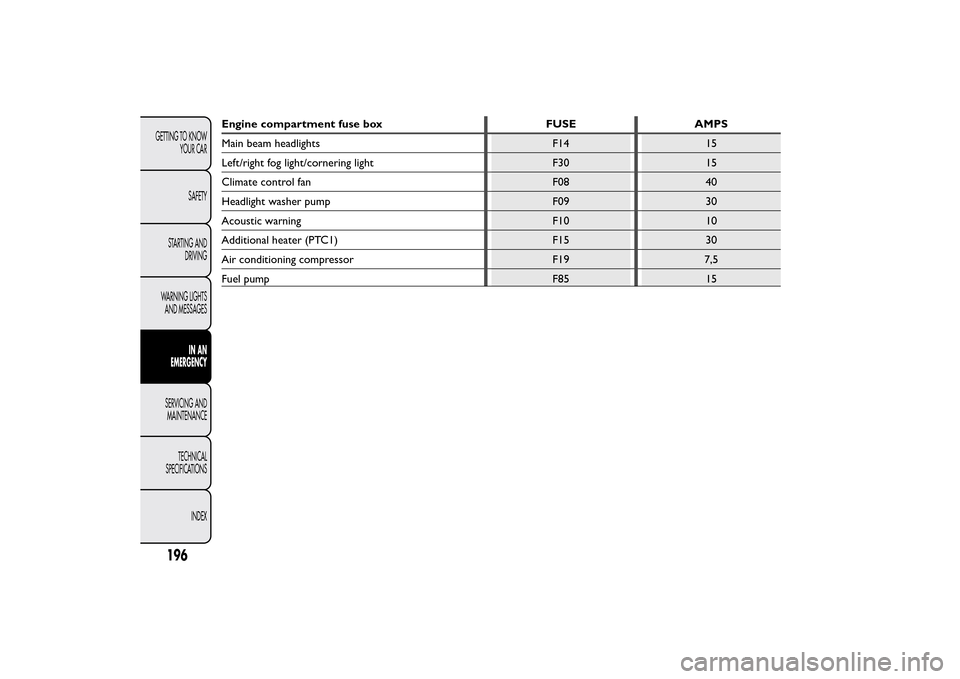
Engine compartment fuse box FUSE AMPS
Main beam headlights F14 15
Left/right fog light/cornering light F30 15
Climate control fan F08 40
Headlight washer pump F09 30
Acoustic warning F10 10
Additional heater (PTC1) F15 30
Air conditioning compressor F19 7,5
Fuel pump F85 15
196GETTING TO KNOW
YOUR CAR
SAFETY
STARTING AND
DRIVING
WARNING LIGHTS
AND MESSAGES
IN AN
EMERGENCY
SERVICING AND
MAINTENANCE
TECHNICAL
SPECIFICATIONS
INDEX
Page 207 of 275
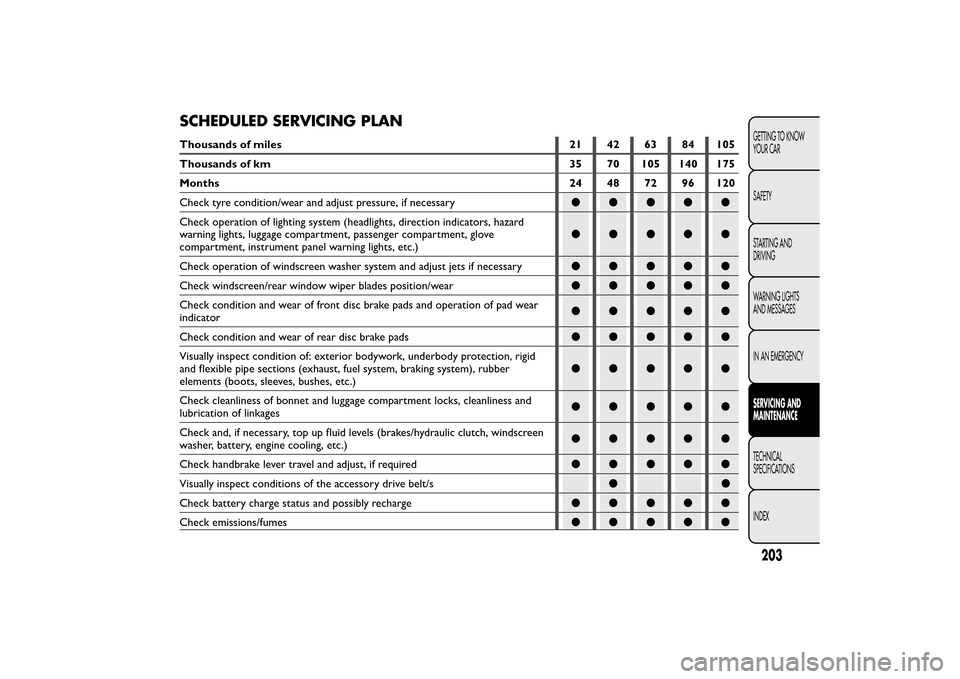
SCHEDULED SERVICING PLANThousands of miles 21 42 63 84 105
Thousands of km 35 70 105 140 175
Months 24 48 72 96 120
Check tyre condition/wear and adjust pressure, if necessary●●●●●
Check operation of lighting system (headlights, direction indicators, hazard
warning lights, luggage compartment, passenger compartment, glove
compartment, instrument panel warning lights, etc.)●●●●●
Check operation of windscreen washer system and adjust jets if necessary●●●●●
Check windscreen/rear window wiper blades position/wear●●●●●
Check condition and wear of front disc brake pads and operation of pad wear
indicator●●●●●
Check condition and wear of rear disc brake pads●●●●●
Visually inspect condition of: exterior bodywork, underbody protection, rigid
and flexible pipe sections (exhaust, fuel system, braking system), rubber
elements (boots, sleeves, bushes, etc.)●●●●●
Check cleanliness of bonnet and luggage compartment locks, cleanliness and
lubrication of linkages●●●●●
Check and, if necessary, top up fluid levels (brakes/hydraulic clutch, windscreen
washer, battery, engine cooling, etc.)●●●●●
Check handbrake lever travel and adjust, if required●●●●●
Visually inspect conditions of the accessory drive belt/s●●
Check battery charge status and possibly recharge●●●●●
Check emissions/fumes●●●●●
203GETTING TO KNOW
YOUR CAR
SAFETY
STARTING AND
DRIVING
WARNING LIGHTS
AND MESSAGES
IN AN EMERGENCYSERVICING AND
MAINTENANCETECHNICAL
SPECIFICATIONS
INDEX
Page 208 of 275
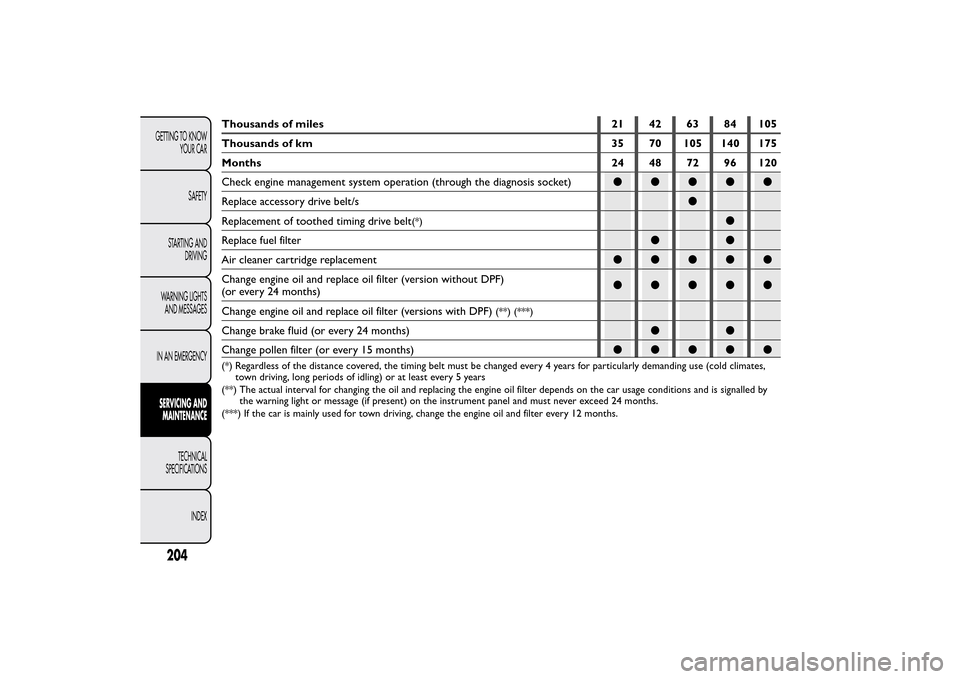
Thousands of miles 21 42 63 84 105
Thousands of km 35 70 105 140 175
Months 24 48 72 96 120
Check engine management system operation (through the diagnosis socket)●●●●●
Replace accessory drive belt/s●
Replacement of toothed timing drive belt
(*)
●
Replace fuel filter●●
Air cleaner cartridge replacement●●●●●
Change engine oil and replace oil filter (version without DPF)
(or every 24 months)●●●●●
Change engine oil and replace oil filter (versions with DPF)
(**) (***)
Change brake fluid (or every 24 months)●●
Change pollen filter (or every 15 months)●●●●●(*) Regardless of the distance covered, the timing belt must be changed every 4 years for particularly demanding use (cold climates,
town driving, long periods of idling) or at least every 5 years
(**) The actual interval for changing the oil and replacing the engine oil filter depends on the car usage conditions and is signalled by
the warning light or message (if present) on the instrument panel and must never exceed 24 months.
(***) If the car is mainly used for town driving, change the engine oil and filter every 12 months.
204GETTING TO KNOW
YOUR CAR
SAFETY
STARTING AND
DRIVING
WARNING LIGHTS
AND MESSAGES
IN AN EMERGENCYSERVICING AND
MAINTENANCE
TECHNICAL
SPECIFICATIONS
INDEX
Page 209 of 275
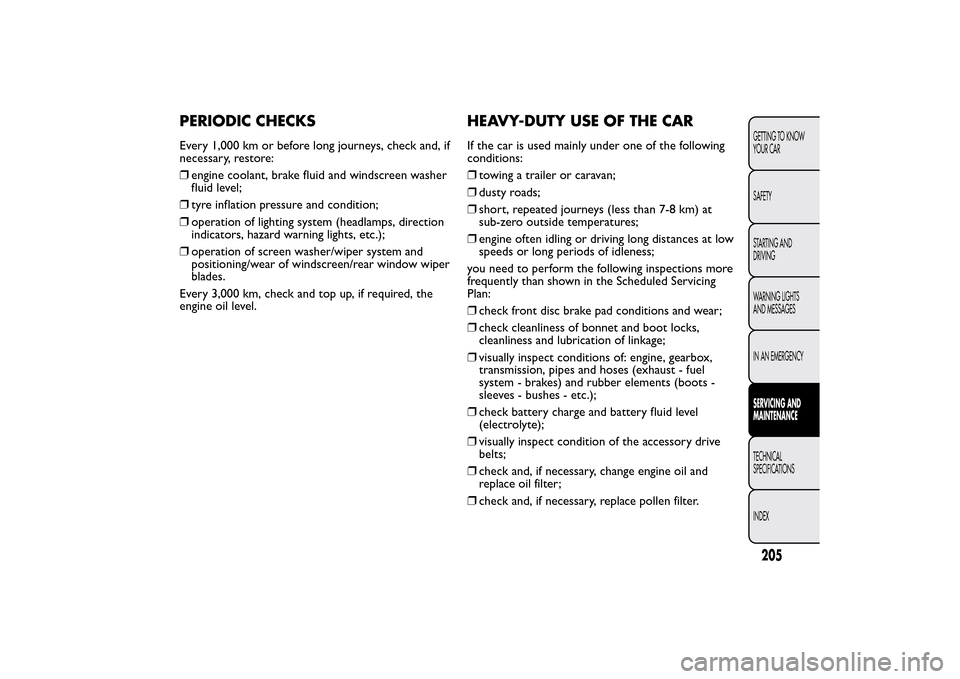
PERIODIC CHECKSEvery 1,000 km or before long journeys, check and, if
necessary, restore:
❒engine coolant, brake fluid and windscreen washer
fluid level;
❒tyre inflation pressure and condition;
❒operation of lighting system (headlamps, direction
indicators, hazard warning lights, etc.);
❒operation of screen washer/wiper system and
positioning/wear of windscreen/rear window wiper
blades.
Every 3,000 km, check and top up, if required, the
engine oil level.
HEAVY-DUTY USE OF THE CARIf the car is used mainly under one of the following
conditions:
❒towing a trailer or caravan;
❒dusty roads;
❒short, repeated journeys (less than 7-8 km) at
sub-zero outside temperatures;
❒engine often idling or driving long distances at low
speeds or long periods of idleness;
you need to perform the following inspections more
frequently than shown in the Scheduled Servicing
Plan:
❒check front disc brake pad conditions and wear;
❒check cleanliness of bonnet and boot locks,
cleanliness and lubrication of linkage;
❒visually inspect conditions of: engine, gearbox,
transmission, pipes and hoses (exhaust - fuel
system - brakes) and rubber elements (boots -
sleeves - bushes - etc.);
❒check battery charge and battery fluid level
(electrolyte);
❒visually inspect condition of the accessory drive
belts;
❒check and, if necessary, change engine oil and
replace oil filter;
❒check and, if necessary, replace pollen filter.
205GETTING TO KNOW
YOUR CAR
SAFETY
STARTING AND
DRIVING
WARNING LIGHTS
AND MESSAGES
IN AN EMERGENCYSERVICING AND
MAINTENANCETECHNICAL
SPECIFICATIONS
INDEX
Page 232 of 275
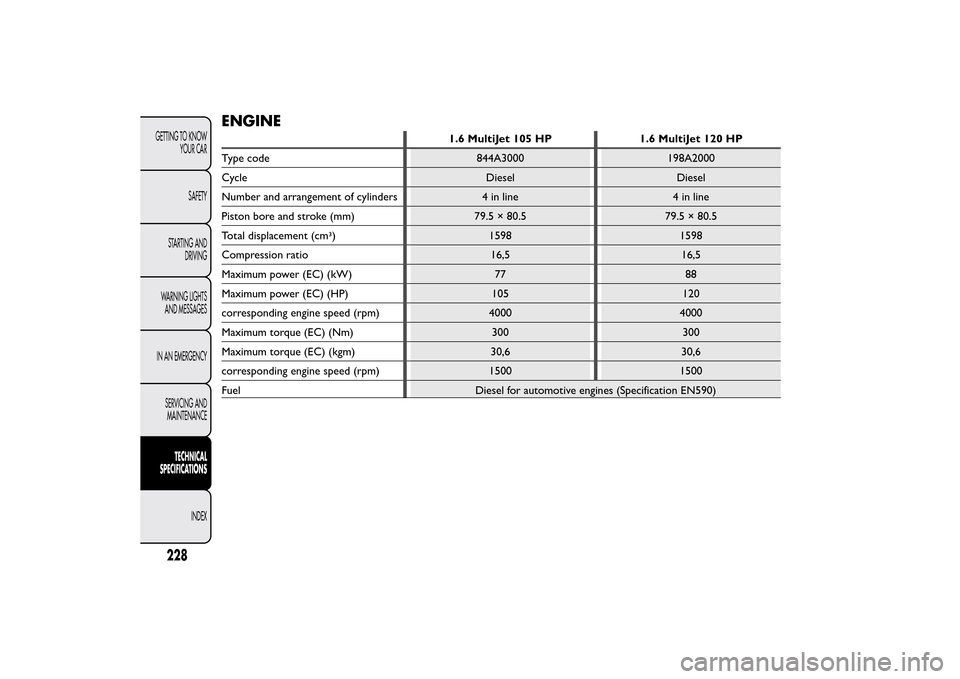
ENGINE
1.6 MultiJet 105 HP 1.6 MultiJet 120 HP
Type code 844A3000 198A2000
Cycle Diesel Diesel
Number and arrangement of cylinders 4 in line 4 in line
Piston bore and stroke (mm) 79.5 × 80.5 79.5 × 80.5
Total displacement (cm3) 1598 1598
Compression ratio 16,5 16,5
Maximum power (EC) (kW) 77 88
Maximum power (EC) (HP) 105 120
corresponding engine speed (rpm) 4000 4000
Maximum torque (EC) (Nm) 300 300
Maximum torque (EC) (kgm) 30,6 30,6
corresponding engine speed (rpm) 1500 1500
Fuel Diesel for automotive engines (Specification EN590)
228GETTING TO KNOW
YOUR CAR
SAFETY
STARTING AND
DRIVING
WARNING LIGHTS
AND MESSAGES
IN AN EMERGENCY
SERVICING AND
MAINTENANCE
TECHNICAL
SPECIFICATIONS
INDEX
Page 233 of 275
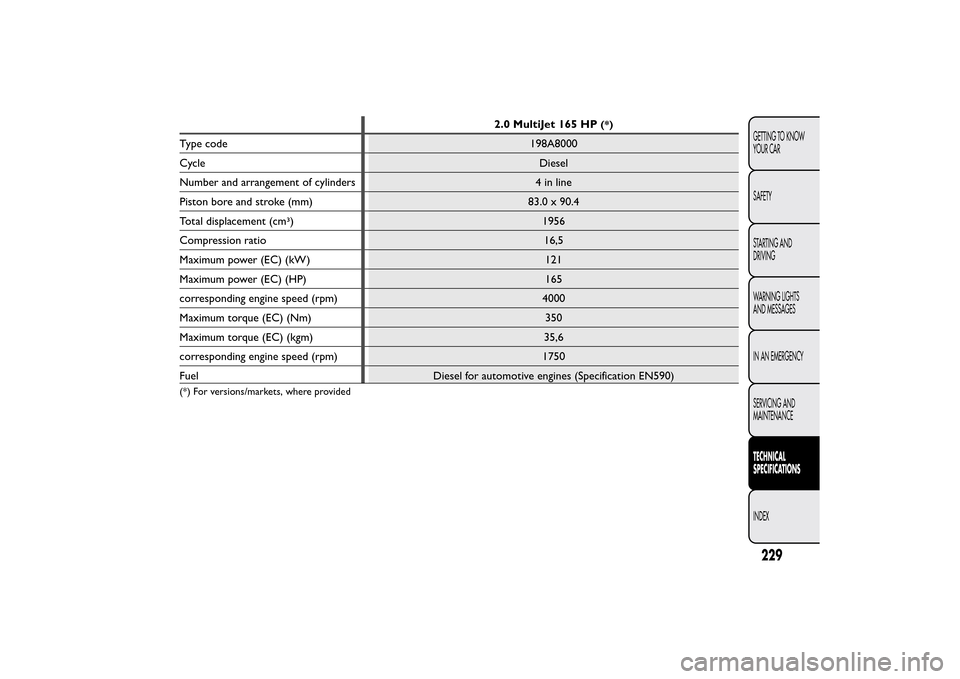
2.0 MultiJet 165 HP
(*)
Type code 198A8000
Cycle Diesel
Number and arrangement of cylinders 4 in line
Piston bore and stroke (mm) 83.0 x 90.4
Total displacement (cm3) 1956
Compression ratio 16,5
Maximum power (EC) (kW) 121
Maximum power (EC) (HP) 165
corresponding engine speed (rpm) 4000
Maximum torque (EC) (Nm) 350
Maximum torque (EC) (kgm) 35,6
corresponding engine speed (rpm) 1750
Fuel Diesel for automotive engines (Specification EN590)(*) For versions/markets, where provided
229GETTING TO KNOW
YOUR CAR
SAFETY
STARTING AND
DRIVING
WARNING LIGHTS
AND MESSAGES
IN AN EMERGENCY
SERVICING AND
MAINTENANCETECHNICAL
SPECIFICATIONSINDEX