fuel FIAT BRAVO 2014 2.G User Guide
[x] Cancel search | Manufacturer: FIAT, Model Year: 2014, Model line: BRAVO, Model: FIAT BRAVO 2014 2.GPages: 275, PDF Size: 3.95 MB
Page 89 of 275
WARNING
If you are travelling in an area with
limited opportunities for vehicle
refuelling and you wish to bring fuel with you in
a petrol can, you must do so in compliance
with current regulations and using an approved
can, appropriately secured to the load securing
attachments. Anyway, by doing so, you increase
the risk of fire in case of an accident with
your vehicle.
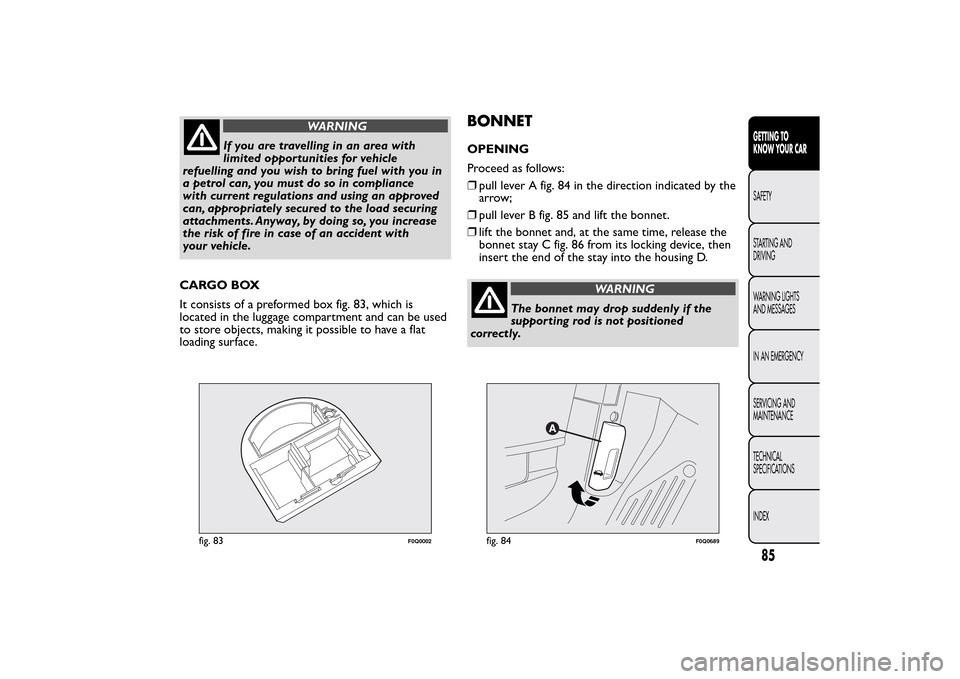
CARGO BOX
It consists of a preformed box fig. 83, which is
located in the luggage compartment and can be used
to store objects, making it possible to have a flat
loading surface.
BONNETOPENING
Proceed as follows:
❒pull lever A fig. 84 in the direction indicated by the
arrow;
❒pull lever B fig. 85 and lift the bonnet.
❒lift the bonnet and, at the same time, release the
bonnet stay C fig. 86 from its locking device, then
insert the end of the stay into the housing D.
WARNING
The bonnet may drop suddenly if the
supporting rod is not positioned
correctly.
fig. 83
F0Q0002
fig. 84
F0Q0689
85GETTING TO
KNOW YOUR CARSAFETY
STARTING AND
DRIVING
WARNING LIGHTS
AND MESSAGES
IN AN EMERGENCY
SERVICING AND
MAINTENANCE
TECHNICAL
SPECIFICATIONS
INDEX
Page 103 of 275
IMPORTANT When the SPORT button is pressed,
the function is activated about 5 seconds later.
IMPORTANT During acceleration, when the SPORT
function is used the steering may shudder which is
typical of a sports setting.
IMPORTANT During parking manoeuvres requiring a
lot of steering, the steering may become harder;
this is normal and is due to the intervention of the
system to protect the electric steering motor from
overheating; so, no intervention is required. When
the car is used again later on, the power steering will
work normally.Acceleration
Sudden acceleration has a very negative effect on fuel
consumption and emissions: accelerate gradually to
contain consumption.
When the SPORT function is used the consumption
figures will be slightly higher than those stated.
WARNING
Under no circumstances should
aftermarket operations involving
steering system or steering column
modifications (e.g.: installation of anti-theft
device) be carried out that could badly affect
performance and safety.This also causes the
warranty to become null and void and results in
vehicle non-compliance with type-approval
requirements.
WARNING
Before starting any servicing operation,
stop the engine and remove the key
from the ignition switch to operate the steering
lock, particularly when the wheels do not touch
the ground. If this is not possible (for example
if the key needs to be turned to MAR-ON or
the engine must be running), remove the main
fuse that protects the electric power steering.
99GETTING TO
KNOW YOUR CARSAFETY
STARTING AND
DRIVING
WARNING LIGHTS
AND MESSAGES
IN AN EMERGENCY
SERVICING AND
MAINTENANCE
TECHNICAL
SPECIFICATIONS
INDEX
Page 111 of 275
❒The performance of the parking assistance system
may also be affected by the position of the
sensors. For example, if the geometry is altered
(as a result of wear of the shock absorbers,
suspension), the tyres are changed, the vehicle is
too heavily laden or specific tuning is carried
out that lowers the vehicle.
❒The detection of obstacles at the top part of the
car may not be guaranteed because the system
detects obstacles that could cause an impact with
the car in the bottom part.
AT THE FILLING STATIONMOTORI DIESEL - Operation at low
temperatures
If the outside temperature is very low, diesel
thickens due to the formation of paraffin clots with
consequent defective operation of the fuel supply
system.
In order to avoid these problems, different types of
diesel are distributed according to the season:
summer type, winter type and arctic type
(cold/mountain areas). If refuelling with diesel fuel
whose specifications are not suitable for the current
temperature, it is advisable to mix TUTELA DIESEL
ART additive in the proportions shown on the
container. Pour the additive into the tank before the
diesel fuel.
When using or parking the car for a long time in the
mountains or cold areas, it is advisable to refuel
using locally available diesel. In this case, it is also
advisable to keep the tank over 50% full.
107GETTING TO
KNOW YOUR CARSAFETY
STARTING AND
DRIVING
WARNING LIGHTS
AND MESSAGES
IN AN EMERGENCY
SERVICING AND
MAINTENANCE
TECHNICAL
SPECIFICATIONS
INDEX
Page 112 of 275
For diesel engines, only use diesel fuel for
motor vehicles in accordance with EN 590
European specifications.The use of other
products or mixtures may damage the engine
beyond repair and consequently invalidate the
warranty, due to the damage caused. If you
accidentally refuel with another type of fuel, do
not start the engine, and drain the tank. If the
engine has been run for even an extremely
limited amount of time, you must not only drain
the fuel tank, but the rest of the supply circuit
as well.
REFUELLING CAPACITY
To fill the tank completely, top-up twice after the
first click of the fuel delivery gun. Further top-ups
could cause faults in the fuel feeding system.
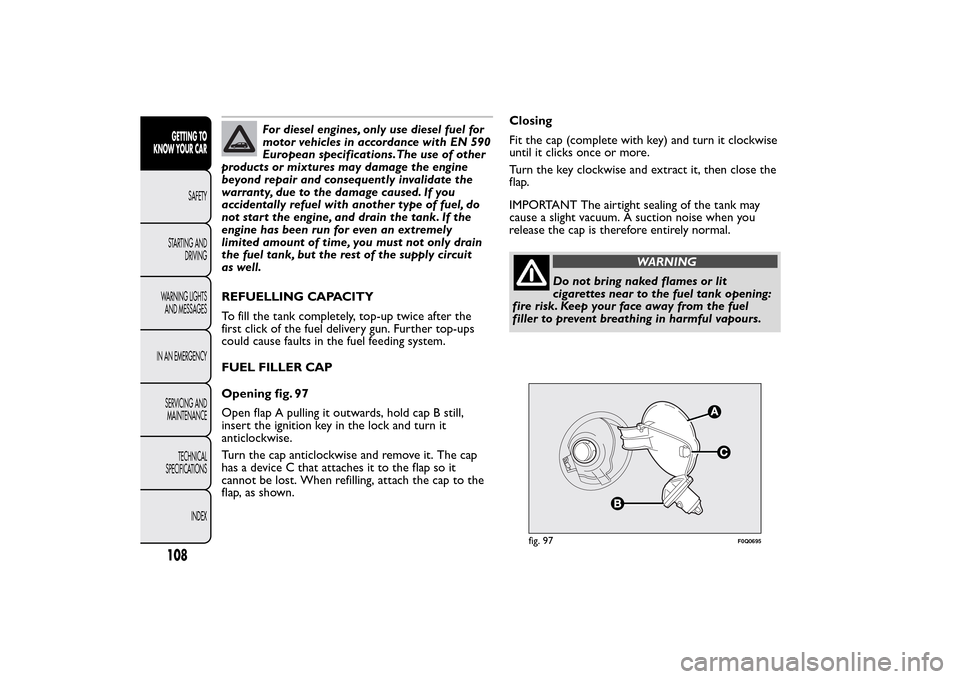
FUEL FILLER CAP
Opening fig. 97
Open flap A pulling it outwards, hold cap B still,
insert the ignition key in the lock and turn it
anticlockwise.
Turn the cap anticlockwise and remove it. The cap
has a device C that attaches it to the flap so it
cannot be lost. When refilling, attach the cap to the
flap, as shown.Closing
Fit the cap (complete with key) and turn it clockwise
until it clicks once or more.
Turn the key clockwise and extract it, then close the
flap.
IMPORTANT The airtight sealing of the tank may
cause a slight vacuum. A suction noise when you
release the cap is therefore entirely normal.
WARNING
Do not bring naked flames or lit
cigarettes near to the fuel tank opening:
fire risk. Keep your face away from the fuel
filler to prevent breathing in harmful vapours.
fig. 97
F0Q0695
108GETTING TO
KNOW YOUR CAR
SAFETY
STARTING AND
DRIVING
WARNING LIGHTS
AND MESSAGES
IN AN EMERGENCY
SERVICING AND
MAINTENANCE
TECHNICAL
SPECIFICATIONS
INDEX
Page 113 of 275
PROTECTING THE ENVIRONMENTThe following devices are used for reducing diesel
fuel engine emissions:
❒oxidising catalytic converter
❒exhaust gas recirculation system (EGR)
❒particulate filter (DPF).
WARNING
Under normal operating conditions, the
silencer becomes very hot .Therefore
do not park the car on flammable materials
(grass, dry leaves, pine needles, etc .): fire
hazard.
DIESEL PARTICULATE FILTER (DPF)
(for versions/markets, where provided)
The Diesel Particulate Filter is a mechanical filter,
integral with the exhaust system, that physically traps
particulates present in the exhaust gases of diesel
engines. The diesel particulate filter has been
adopted to eliminate almost all particulates in
compliance with current / future legal regulations.
During normal use of the vehicle, the engine control
unit records a set of data (e.g.: travel time, type of
route, temperatures, etc.) and it will then calculate
how much particulate has been trapped by the filter.Since this filter physically traps particulate, it should
be regenerated (cleaned) at regular intervals by
burning the carbon particles. The regeneration
procedure is controlled automatically by the engine
management control unit according to the filter
conditions and vehicle use conditions. There may be
a limited increase in the engine speed during the
regeneration, a limited increase in fumes and high
temperatures at the exhaust. These are not faults;
they do not impair vehicle performance or damage
the environment.
Particulate filter clogged
If the warning light switches on on the instrument
panel (along with the message on the display) refer
to the "Warning lights and messages" chapter.
109GETTING TO
KNOW YOUR CARSAFETY
STARTING AND
DRIVING
WARNING LIGHTS
AND MESSAGES
IN AN EMERGENCY
SERVICING AND
MAINTENANCE
TECHNICAL
SPECIFICATIONS
INDEX
Page 140 of 275
If the engine does not start at the first attempt,
return the ignition key to STOP before attempting to
start again.
If, when the ignition key is at MAR-ON the
warning light remains lit, turn the key to STOP
and then back to MAR-ON. If the warning light
remains lit, try with the other keys provided with the
car.
If you still cannot start the engine, contact a Fiat
Dealership.
Warning light
will flash for 60 seconds
after starting or during prolonged
cranking to indicate a fault with the glow
plug heating system.You can use the car as usual
if the engine starts but you should contact a
Fiat Dealership as soon as possible.
When the engine is switched off never
leave the key turned to MAR to prevent
useless current absorption from draining
the battery.
HOW TO WARM UP THE ENGINE AFTER IT
HAS JUST STARTED
Proceed as follows:
❒Drive off slowly, letting the engine turn at medium
revs. Do not accelerate abruptly;
❒Do not demand full performance at first. Wait
until the engine coolant temperature gauge starts
moving.
Never jump start the engine by pushing,
towing or coasting downhill.This could
cause fuel to flow into the catalytic
converter and damage it beyond repair.
EMERGENCY START-UP
Contact a Fiat Dealership if instrument panel
warning light
(or the symbol on the display) stays
on constantly.
STOPPING THE ENGINE
Turn the ignition key to STOP while the engine is
idling.
IMPORTANT After a taxing drive, you should allow
the engine to “catch its breath” before turning it
off by letting it idle to allow the temperature in the
engine compartment to fall.
A quick burst on the accelerator before
stopping the engine serves no practical
purpose; it wastes fuel and is especially
damaging to turbocharged engines.
136GETTING TO KNOW
YOUR CAR
SAFETYSTARTING AND
DRIVINGWARNING LIGHTS
AND MESSAGES
IN AN EMERGENCY
SERVICING AND
MAINTENANCE
TECHNICAL
SPECIFICATIONS
INDEX
Page 143 of 275
WARNING
Depress the clutch pedal fully to change
gear correctly. It is therefore essential
that there is nothing under the pedals: make
sure the mats are lying flat and do not get
in the way of the pedals.Do not drive with your hand resting on
the gear lever as the force exerted, even if
slight , could lead over time to premature
wear of the gearbox internal components.
SAVING FUELSome useful tips are given below for fuel saving and
reducing harmful emissions of CO
2and other
pollutants [nitrogen oxides, unburnt hydrocarbons,
Particulate Matter (PM) etc.].
GENERAL CONSIDERATIONS
The general factors that affect fuel consumption are
listed below.
Car maintenance
Have checks and adjustments carried out in
accordance with the “Scheduled Servicing Plan”.
Ty r e s
Check the tyre pressures at least once every four
weeks: if the pressure is too low, consumption levels
increase as resistance to rolling is higher.
Unnecessary loads
Do not travel with an overloaded boot. The weight
of the car (especially when driving in town) and
its ride greatly affects consumption and stability.
Roof rack/ski rack
Remove the roof rack or the ski rack from the roof
after use. These accessories lower aerodynamic
penetration and adversely affect consumption levels.
When transporting particularly large objects, use a
trailer if possible.
139GETTING TO KNOW
YOUR CAR
SAFETYSTARTING AND
DRIVINGWARNING LIGHTS
AND MESSAGES
IN AN EMERGENCY
SERVICING AND
MAINTENANCE
TECHNICAL
SPECIFICATIONS
INDEX
Page 144 of 275
Electric devices
Use electrical devices only for the amount of time
necessary. The heated rear window, additional
headlights, windscreen/rear window wipers and
heater fan need a considerable amount of energy,
therefore increasing fuel consumption (by up to 25%
in the urban cycle).
Climate control system
Air conditioning leads to higher fuel consumption (on
average up to +20%). If the temperature outside
permits, try and use the air vents.
Spoilers
The use of non-certified spoilers may adversely affect
air drag and fuel consumption.DRIVING STYLE
The main driving styles that affect fuel consumption
are listed below.
Starting
Do not warm the engine with the car at a standstill
or at idle or high speed: under these conditions
the engine warms up much more slowly, increasing
electrical consumption and emissions. It is therefore
advisable to move off immediately, slowly, avoiding
high speeds: in this way the engine will warm faster.
Unnecessary actions
Avoid accelerating when starting at traffic lights or
before switching off the engine. This and also double
declutching is absolutely pointless on modern cars
and also increases consumption and pollution.
Gear selection
As soon as the conditions of the traffic and road
allow, use a higher gear. Using a low gear for faster
acceleration will increase consumption.
In the same way improper use of a high gear
increases consumption, emissions an engine wear.
Max. speed
Fuel consumption increases considerably with speed.
Maintain a constant speed, avoiding unnecessary
braking and acceleration, which cost in terms of both
fuel consumption and emissions.
140GETTING TO KNOW
YOUR CAR
SAFETYSTARTING AND
DRIVINGWARNING LIGHTS
AND MESSAGES
IN AN EMERGENCY
SERVICING AND
MAINTENANCE
TECHNICAL
SPECIFICATIONS
INDEX
Page 145 of 275
Acceleration
Accelerating violently severely affects consumption
and emissions: acceleration should be gradual and
should not exceed the maximum torque.
USAGE CONDITIONS
The main usage conditions that negatively affect fuel
consumption are listed below.
Cold starting
Short journeys and frequent cold starts do not allow
the engine to reach optimum operating temperature.
This results in a significant increase in consumption
levels (from +15 to +30% on the urban cycle) and
emissions.
Traffic and road conditions
Rather high consumption levels are linked to
situations with heavy traffic, for instance when
travelling in queues with frequent use of the lower
gears or in cities with many traffic lights. Winding
mountain roads and rough road surfaces also
adversely affect consumption.
Traffic hold-ups
During prolonged hold-ups (e.g. level crossings) the
engine should be switched off.
TOWING TRAILERSIMPORTANT NOTES
For towing caravans or trailers the car must be fitted
with a certified tow hook and an adequate electric
system. Installation should be carried out by
specialised personnel who will issue the required
papers for travelling on roads.
Install any specific and/or additional rear view mirrors
as specified by the Highway Code.
Remember that when towing a trailer, steep hills are
harder to climb, braking distances increase and
overtaking takes longer depending on the overall
weight.
Engage a low gear when driving downhill, rather than
constantly using the brake.
The weight the trailer exerts on the car tow hook
reduces the car's loading capacity by the same
amount. To make sure that the maximum towable
weight is not exceeded (given in the car registration
document) account should be taken of the fully
laden trailer, including accessories and luggage.
Respect the speed limits specific to each country for
vehicles towing trailers.
In any case, the maximum speed must not exceed 80
km/h.
141GETTING TO KNOW
YOUR CAR
SAFETYSTARTING AND
DRIVINGWARNING LIGHTS
AND MESSAGES
IN AN EMERGENCY
SERVICING AND
MAINTENANCE
TECHNICAL
SPECIFICATIONS
INDEX
Page 155 of 275
INCOMPLETE DOOR LOCKING
(red)
The warning light switches on when one or more
doors are not completely shut. An acoustic signal is
activated with the doors open and the car moving.GENERIC FAILURE INDICATION
(amber)
Fuel cut-off inertia switch tripped
The warning light comes on when the inertial fuel
cut-off switch is triggered. The display shows the
dedicated message.
Engine oil pressure sensor failure
The warning light comes on when the engine oil
pressure sensor is faulty.
Dusk sensor failure
This warning light comes on when a dusk sensor
fault is detected. The display shows the dedicated
message.
Preset speed limit exceeded
(for Arab countries only)
The warning light switches on when the vehicle
speed exceeds 120 km/h.Rain sensor failure
The warning light switches on when a rain sensor
fault is detected. The display shows the dedicated
message.
Parking sensor failure
(for versions/markets, where provided)
The warning light turns on when failure is detected in
the parking sensors.
Tyre pressure monitoring system failure
(for versions/markets, where provided)
The warning light turns on when a failure is detected
in the TPMS (for versions/markets where provided).
Should one or more wheels without a sensor be
fitted, the instrument panel warning light will come
on and stay on until the initial conditions are
restored. The display shows the dedicated message.
NoteIf one of the above mentioned failures occurs,
contact a Fiat Dealership as soon as possible.
151GETTING TO KNOW
YOUR CAR
SAFETY
STARTING AND
DRIVINGWARNING LIGHTS
AND MESSAGESIN AN EMERGENCY
SERVICING AND
MAINTENANCE
TECHNICAL
SPECIFICATIONS
INDEX