air condition FIAT BRAVO 2015 2.G User Guide
[x] Cancel search | Manufacturer: FIAT, Model Year: 2015, Model line: BRAVO, Model: FIAT BRAVO 2015 2.GPages: 275, PDF Size: 7.55 MB
Page 130 of 275
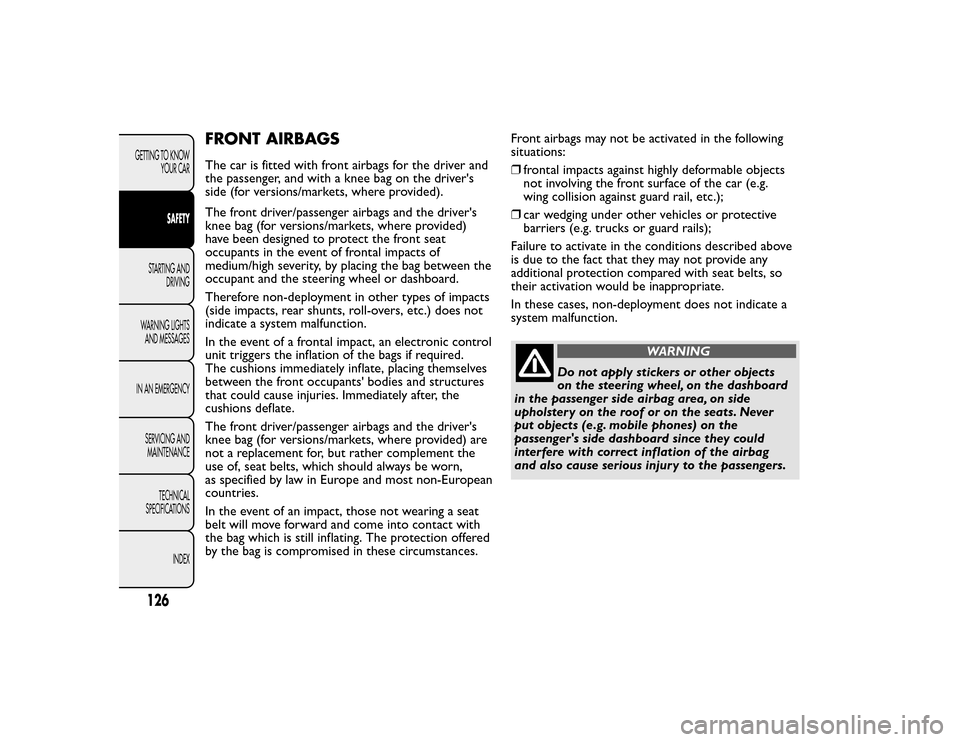
FRONT AIRBAGSThe car is fitted with front airbags for the driver and
the passenger, and with a knee bag on the driver's
side (for versions/markets, where provided).
The front driver/passenger airbags and the driver's
knee bag (for versions/markets, where provided)
have been designed to protect the front seat
occupants in the event of frontal impacts of
medium/high severity, by placing the bag between the
occupant and the steering wheel or dashboard.
Therefore non-deployment in other types of impacts
(side impacts, rear shunts, roll-overs, etc.) does not
indicate a system malfunction.
In the event of a frontal impact, an electronic control
unit triggers the inflation of the bags if required.
The cushions immediately inflate, placing themselves
between the front occupants' bodies and structures
that could cause injuries. Immediately after, the
cushions deflate.
The front driver/passenger airbags and the driver's
knee bag (for versions/markets, where provided) are
not a replacement for, but rather complement the
use of, seat belts, which should always be worn,
as specified by law in Europe and most non-European
countries.
In the event of an impact, those not wearing a seat
belt will move forward and come into contact with
the bag which is still inflating. The protection offered
by the bag is compromised in these circumstances.Front airbags may not be activated in the following
situations:
❒
frontal impacts against highly deformable objects
not involving the front surface of the car (e.g.
wing collision against guard rail, etc.);
❒ car wedging under other vehicles or protective
barriers (e.g. trucks or guard rails);
Failure to activate in the conditions described above
is due to the fact that they may not provide any
additional protection compared with seat belts, so
their activation would be inappropriate.
In these cases, non-deployment does not indicate a
system malfunction.
WARNING
Do not apply stickers or other objects
on the steering wheel, on the dashboard
in the passenger side airbag area, on side
upholstery on the roof or on the seats. Never
put objects (e.g. mobile phones) on the
passenger's side dashboard since they could
interfere with correct inflation of the airbag
and also cause serious injur y to the passengers.
126GETTING TO KNOW YOUR CAR
SAFETY
STARTING AND DRIVING
WARNING LIGHTS AND MESSAGES
IN AN EMERGENCY SERVICING ANDMAINTENANCE
TECHNICAL
SPECIFICATIONS
INDEX
Page 144 of 275
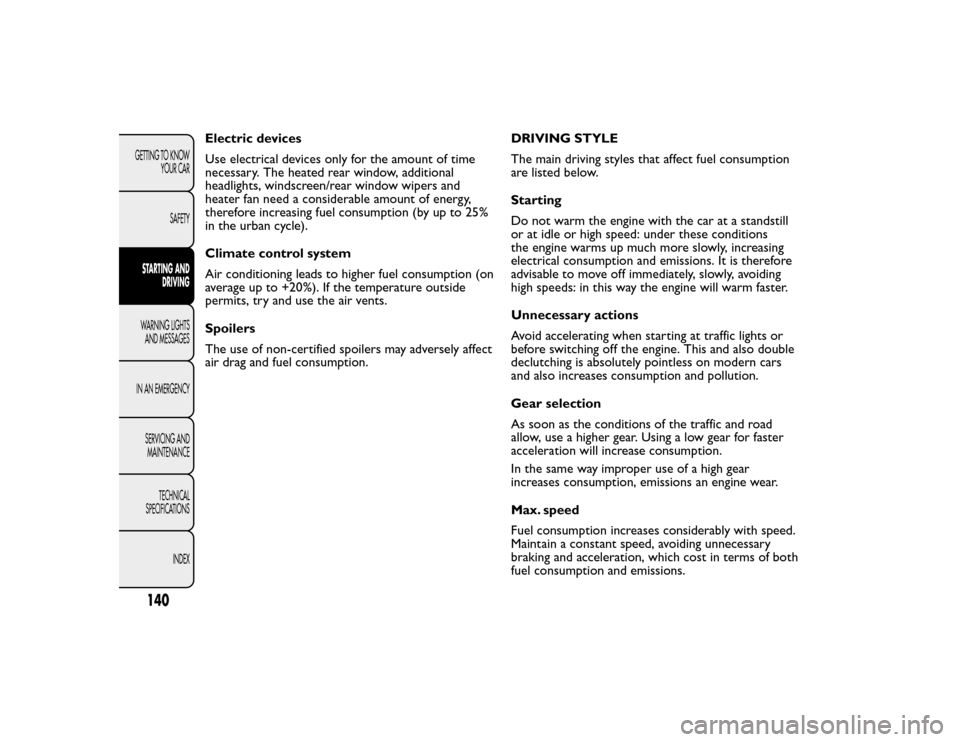
Electric devices
Use electrical devices only for the amount of time
necessary. The heated rear window, additional
headlights, windscreen/rear window wipers and
heater fan need a considerable amount of energy,
therefore increasing fuel consumption (by up to 25%
in the urban cycle).
Climate control system
Air conditioning leads to higher fuel consumption (on
average up to +20%). If the temperature outside
permits, try and use the air vents.
Spoilers
The use of non-certified spoilers may adversely affect
air drag and fuel consumption.DRIVING STYLE
The main driving styles that affect fuel consumption
are listed below.
Starting
Do not warm the engine with the car at a standstill
or at idle or high speed: under these conditions
the engine warms up much more slowly, increasing
electrical consumption and emissions. It is therefore
advisable to move off immediately, slowly, avoiding
high speeds: in this way the engine will warm faster.
Unnecessary actions
Avoid accelerating when starting at traffic lights or
before switching off the engine. This and also double
declutching is absolutely pointless on modern cars
and also increases consumption and pollution.
Gear selection
As soon as the conditions of the traffic and road
allow, use a higher gear. Using a low gear for faster
acceleration will increase consumption.
In the same way improper use of a high gear
increases consumption, emissions an engine wear.
Max. speed
Fuel consumption increases considerably with speed.
Maintain a constant speed, avoiding unnecessary
braking and acceleration, which cost in terms of both
fuel consumption and emissions.
140GETTING TO KNOW
YOUR CAR
SAFETY
STARTING AND DRIVING
WARNING LIGHTS AND MESSAGES
IN AN EMERGENCY SERVICING ANDMAINTENANCE
TECHNICAL
SPECIFICATIONS
INDEX
Page 161 of 275
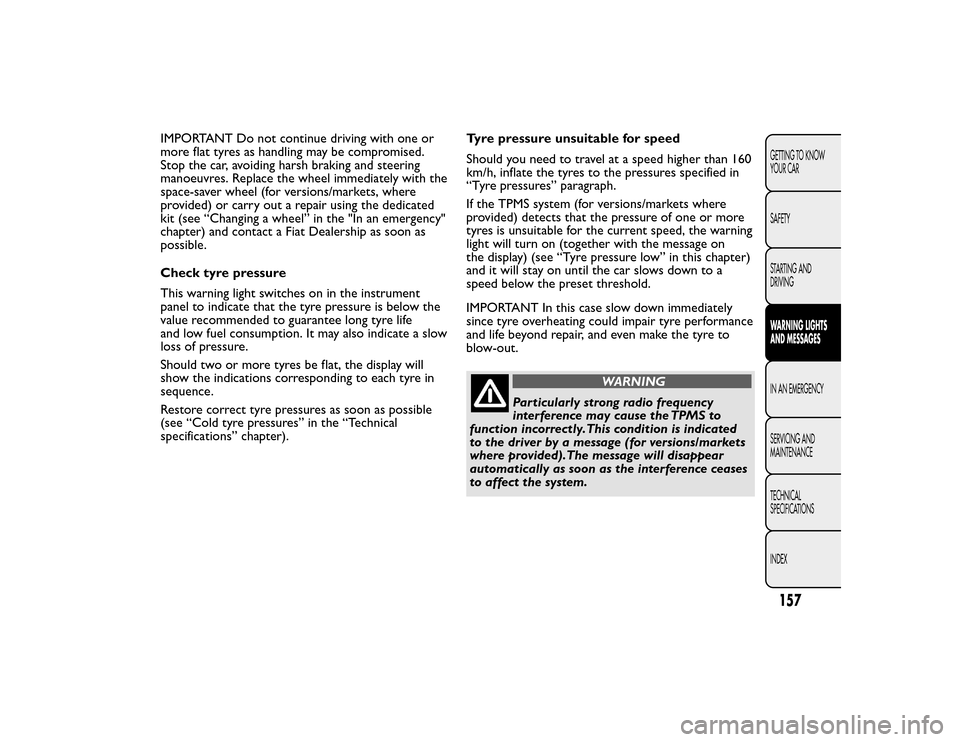
IMPORTANT Do not continue driving with one or
more flat tyres as handling may be compromised.
Stop the car, avoiding harsh braking and steering
manoeuvres. Replace the wheel immediately with the
space-saver wheel (for versions/markets, where
provided) or carry out a repair using the dedicated
kit (see “Changing a wheel” in the "In an emergency"
chapter) and contact a Fiat Dealership as soon as
possible.
Check tyre pressure
This warning light switches on in the instrument
panel to indicate that the tyre pressure is below the
value recommended to guarantee long tyre life
and low fuel consumption. It may also indicate a slow
loss of pressure.
Should two or more tyres be flat, the display will
show the indications corresponding to each tyre in
sequence.
Restore correct tyre pressures as soon as possible
(see “Cold tyre pressures” in the “Technical
specifications” chapter).Tyre pressure unsuitable for speed
Should you need to travel at a speed higher than 160
km/h, inflate the tyres to the pressures specified in
“Tyre pressures” paragraph.
If the TPMS system (for versions/markets where
provided) detects that the pressure of one or more
tyres is unsuitable for the current speed, the warning
light will turn on (together with the message on
the display) (see “Tyre pressure low” in this chapter)
and it will stay on until the car slows down to a
speed below the preset threshold.
IMPORTANT In this case slow down immediately
since tyre overheating could impair tyre performance
and life beyond repair, and even make the tyre to
blow-out.
WARNING
Particularly strong radio frequency
interference may cause the TPMS to
function incorrectly.This condition is indicated
to the driver by a message (for versions/markets
where provided).The message will disappear
automatically as soon as the interference ceases
to affect the system.
157GETTING TO KNOW
YOUR CAR
SAFETY
STARTING AND
DRIVING
WARNING LIGHTS
AND MESSAGES
IN AN EMERGENCY
SERVICING AND
MAINTENANCE
TECHNICAL
SPECIFICATIONS
INDEX
Page 200 of 275
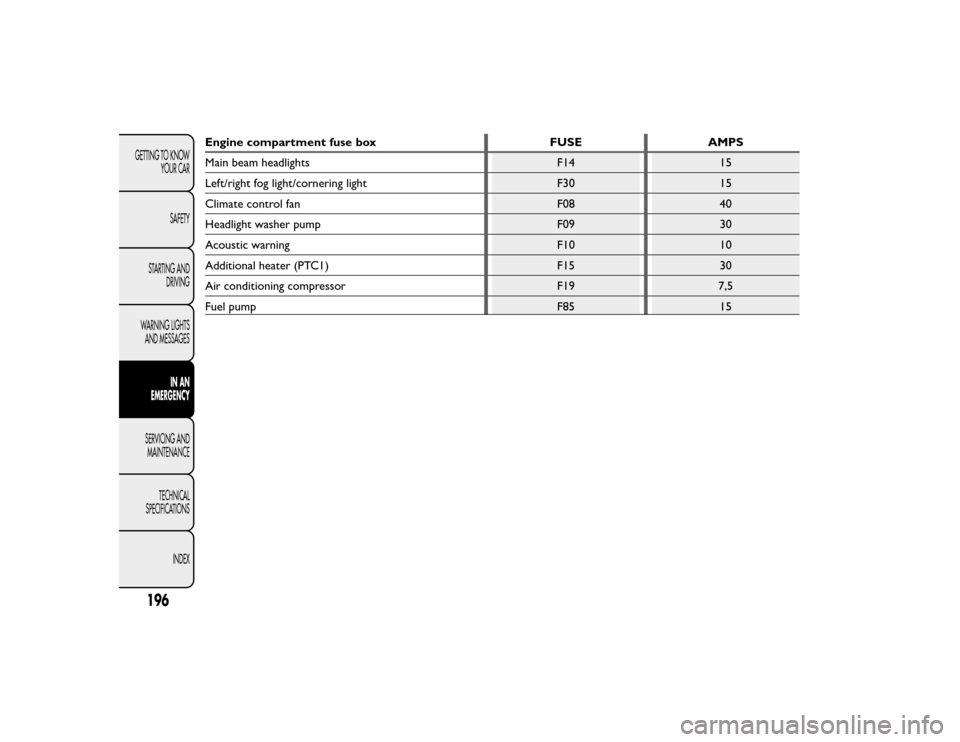
Engine compartment fuse boxFUSEAMPS
Main beam headlights F1415
Left/right fog light/cornering light F3015
Climate control fan F0840
Headlight washer pump F0930
Acoustic warning F1010
Additional heater (PTC1) F1530
Air conditioning compressor F197,5
Fuel pump F8515
196GETTING TO KNOW
YOUR CAR
SAFETY
STARTING AND DRIVING
WARNING LIGHTS AND MESSAGES
IN AN
EMERGENCY
SERVICING AND MAINTENANCE
TECHNICAL
SPECIFICATIONS
INDEX
Page 206 of 275
SERVICING AND MAINTENANCE
SCHEDULED SERVICING
202GETTING TO KNOW
YOUR CARSAFETY
STARTING AND
DRIVING
WARNING LIGHTSAND MESSAGESIN AN EMERGENCYSERVICING ANDMAINTENANCE
TECHNICAL
SPECIFICATIONS
INDEX
Correct servicing is essential in guaranteeing a long life for the car under the best conditions. For this reason, Fiat has planned a series of checks and services at fixed distance intervals and, forversions/markets, where provided, at fixed timeintervals, as described in the Scheduled ServicingPlan. Regardless of the above, it is always necessary to carefully follow the instructions in the ScheduledServicing Plan (e.g. periodically check level of liquids,tyre pressure, etc.). Scheduled Servicing is offered by all Fiat Dealerships at fixed time or kilometres/miles intervals. If, duringeach operation, in addition to the ones scheduled,the need arises for further replacements or repairs,these may be carried out only with your explicit
agreement. If your car is used frequently for towing, the interval between one service operation andthe next should be reduced. IMPORTANT INFORMATION The Scheduled Servicing services are set out by the Manufacturer. Failure to have them carried outmay invalidate the warranty. It is advisable to inform a Fiat Dealership of any small operating irregularities without waiting for thefollowing servicing. For versions equipped with specific supply (e.g. LPG) and/or trim level, in addition to what is describedin the following Scheduled Servicing Plan, refer to therelevant additional items in the dedicatedsupplements.
Page 209 of 275
205GETTING TO KNOWYOUR CAR SAFETYSTARTING AND DRIVING WARNING LIGHTS AND MESSAGES IN AN EMERGENCYSERVICING AND MAINTENANCE TECHNICAL SPECIFICATIONS INDEX
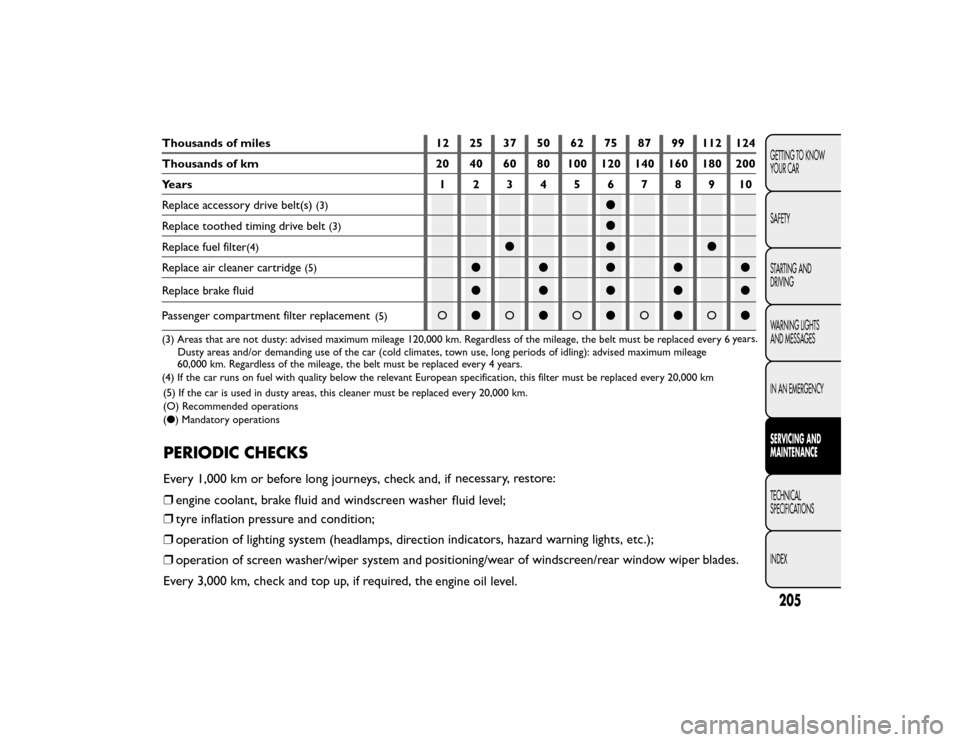
PERIODIC CHECKSEvery 1,000 km or before long journeys, check and, if necessary, restore: ❒
engine coolant, brake fluid and windscreen washer fluid level;
❒
tyre inflation pressure and condition;
❒
operation of lighting system (headlamps, directionindicators, hazard warning lights, etc.);
❒
operation of screen washer/wiper system andpositioning/wear of windscreen/rear window wiperblades.
Every 3,000 km, check and top up, if required, theengine oil level.
Thousands of miles 12 25 37 50 62 75 87 99 112 124 Thousands of km 20 40 60 80 100 120 140 160 180 200Years
12345678910
Replace accessory drive belt(s)
(3)
●
Replace toothed timing drive belt
(3)
●
Replace fuel filter
(4)
●●●
Replace air cleaner cartridge
(5)
●●●●●
Replace brake fluid
●●●●●
Passenger compartment filter replacement
(5)
O
●
O
●
O
●
O
●
O
●
(3) Areas that are not dusty: advised maximum mileage 120,000 km. Regardless of the mileage, the belt must be replaced every 6
years. Dusty areas and/or demanding use of the car (cold climates, town use, long periods of idling): advised maximum mileage 60,000 km. Regardless of the mileage, the belt must be replaced every 4 years.
(4) If the car runs on fuel with quality below the relevant European specification, this filter must be replaced every 20,000 km(5) If the car is used in dusty areas, this cleaner must be replaced every 20,000 km.(O) Recommended operations( ●) Mandatory operations
Page 223 of 275
BODYWORKPROTECTION FROM ATMOSPHERIC
AGENTS
The main causes of corrosion are the following:
❒atmospheric pollution
❒ salty air and humidity (coastal areas, or hot humid
climates);
❒ seasonal environmental conditions.
The abrasive action of wind-borne atmospheric dust
and sand, as well as mud and gravel raised by other
vehicles is also not to be underestimated.
On your car, Fiat has adopted the best manufacturing
technologies to effectively protect the bodywork
against corrosion. These are the most important:
❒
Painting products and systems which give the car
particular resistance to corrosion and abrasion;
❒ Use of galvanised (or pretreated) steel sheets, with
high resistance to corrosion;
❒ spraying the underbody, engine compartment,
wheel arch interiors and other parts with highly
protective wax products;
❒ spraying of plastic parts, with a protective function
in the more exposed points: underdoor, inner
wing, edges, etc;
❒ Use of “open” boxed sections to prevent
condensation and pockets of moisture from
triggering rust inside.
BODY AND UNDERBODY WARRANTY
Your car is covered by warranty against perforation
due to rust of any original element of the structure
or body.
For the general terms of this warranty, refer to the
Warranty Booklet.
219GETTING TO KNOW
YOUR CAR
SAFETY
STARTING AND
DRIVING
WARNING LIGHTS
AND MESSAGES
IN AN EMERGENCY
SERVICING AND
MAINTENANCE
TECHNICAL
SPECIFICATIONS
INDEX
Page 224 of 275
ADVICE FOR PRESERVING THE
BODYWORK
Paint
Paintwork does not only serve an aesthetic purpose,
but also protects the underlying sheet metal.
Touch up abrasions and scratches immediately to
prevent rust formation. Use only original paint
products for touch-ups (see “Bodywork paint
identification plate” in the “Technical specifications”
section).
Normal maintenance of paintwork consists in
washing the car: the frequency depends on the
conditions and environment where the car is used.
For example, in highly polluted areas, or if the roads
are spread with salt, it is advisable to wash the car
more frequently.To correctly wash the vehicle, proceed as follows:
❒
remove the aerial from the roof to prevent damage
to it if the car is washed in an automatic system;
❒ if high pressure jets or cleaners are used to wash
the vehicle, keep a distance of at least 40 cm
from the bodywork to avoid damage or alteration.
It should be remembered that the build up of
water can damage the car over a period of time;
❒ wash the body using a low pressure jet of water;
❒ wipe a sponge with a slightly soapy solution over
the bodywork, frequently rinsing with the sponge;
❒ rinse well with water and dry with a jet of air or a
chamois leather.
Dry the less visible parts particularly carefully, such
as the door frames, bonnet and the headlight frames,
where water may stagnate more easily. The car
should not be taken to a closed area immediately,
but left outside so that residual water can evaporate.
Do not wash the car after it has been left in the
sun or with the bonnet hot: this may alter the shine
of the paintwork.
220GETTING TO KNOW YOUR CAR
SAFETY
STARTING AND DRIVING
WARNING LIGHTS AND MESSAGES
IN AN EMERGENCY SERVICING AND MAINTENANCE
TECHNICAL
SPECIFICATIONS
INDEX