ABS FIAT CROMA 2006 2.G User Guide
[x] Cancel search | Manufacturer: FIAT, Model Year: 2006, Model line: CROMA, Model: FIAT CROMA 2006 2.GPages: 240, PDF Size: 7.41 MB
Page 95 of 240
95
SAFETY
DEVICES
CORRECT USE
OF THE CAR
WARNING
LIGHTS AND
MESSAGES
IN AN
EMERGENCY
CAR
MAINTENANCE
TECHNICAL
SPECIFICATIONS
INDEX
DASHBOARD
AND CONTROLS
GENERAL WARNINGS
❒When parking, take the utmost care
to obstacles that may be set above or
under the sensors.
❒Objects set close to the car, under
certain circumstances are not detect-
ed and could therefore cause damages
to the car or be damaged.
❒Indications sent by the sensors can be
altered by dirt, snow or ice deposit-
ed on the sensors or by ultrasound
systems (e.g.: truck pneumatic brakes
or pneumatic hammers) set nearby the
car.
AT THE FILLING
STATION
PETROL ENGINES
Use only unleaded petrol.
To prevent errors, the diameter of the fu-
el tank filler is too small to introduce a lead
petrol pump filler. Use petrol with a rat-
ed octane number (R.O.N.) not lower
than 95.
IMPORTANT An inefficient catalyst leads
to harmful exhaust emissions, thus con-
tributing to air pollution.
IMPORTANT Never use leaded petrol,
even in small amount or in an emergency,
as this would damage the catalyst beyond
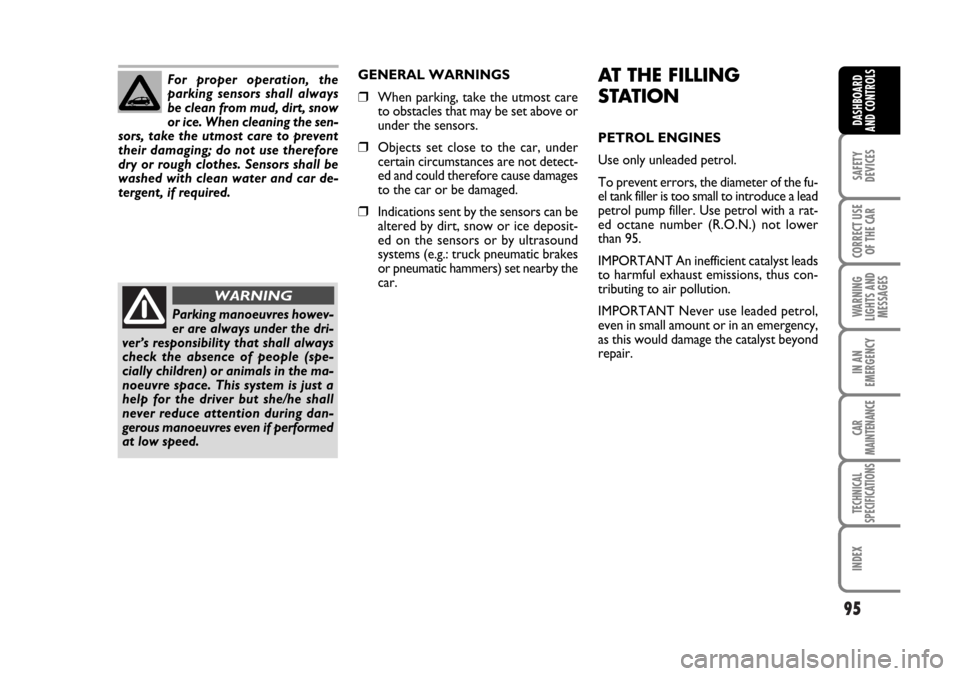
repair. For proper operation, the
parking sensors shall always
be clean from mud, dirt, snow
or ice. When cleaning the sen-
sors, take the utmost care to prevent
their damaging; do not use therefore
dry or rough clothes. Sensors shall be
washed with clean water and car de-
tergent, if required.
Parking manoeuvres howev-
er are always under the dri-
ver’s responsibility that shall always
check the absence of people (spe-
cially children) or animals in the ma-
noeuvre space. This system is just a
help for the driver but she/he shall
never reduce attention during dan-
gerous manoeuvres even if performed
at low speed.
WARNING
062-098 Croma TRW GB 20-11-2006 15:01 Pagina 95
Page 96 of 240
96
SAFETY
DEVICES
CORRECT USE
OF THE CAR
WARNING
LIGHTS AND
MESSAGES
IN AN
EMERGENCY
CAR
MAINTENANCE
TECHNICAL
SPECIFICATIONS
INDEX
DASHBOARD
AND CONTROLS
MULTIJET ENGINES
If the outside temperature is very low, the
diesel thickens due to the formation of
paraffins and could clog the diesel fuel fil-
ter.
In order to avoid these problems, different
types of diesel are distributed according to
the season: summer type, winter type and
arctic type (cold, mountain areas).
If refuelling with diesel fuel not suitable for
the current temperature, mix diesel fuel
with DIESEL MIX additive in the propor-
tions stated on the can, putting first the
antifreeze in the tank and then the diesel
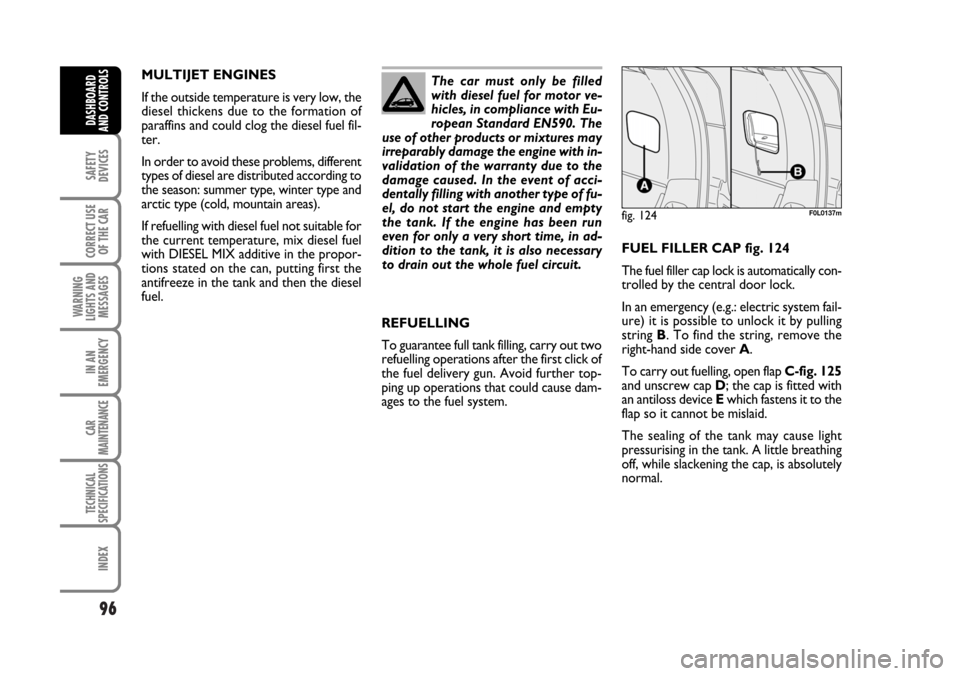
fuel.FUEL FILLER CAP fig. 124
The fuel filler cap lock is automatically con-
trolled by the central door lock.
In an emergency (e.g.: electric system fail-
ure) it is possible to unlock it by pulling
string B. To find the string, remove the
right-hand side cover A.
To carry out fuelling, open flap C-fig. 125
and unscrew cap D; the cap is fitted with
an antiloss device Ewhich fastens it to the
flap so it cannot be mislaid.
The sealing of the tank may cause light
pressurising in the tank. A little breathing
off, while slackening the cap, is absolutely
normal. The car must only be filled
with diesel fuel for motor ve-
hicles, in compliance with Eu-
ropean Standard EN590. The
use of other products or mixtures may
irreparably damage the engine with in-
validation of the warranty due to the
damage caused. In the event of acci-
dentally filling with another type of fu-
el, do not start the engine and empty
the tank. If the engine has been run
even for only a very short time, in ad-
dition to the tank, it is also necessary
to drain out the whole fuel circuit.
fig. 124F0L0137m
REFUELLING
To guarantee full tank filling, carry out two
refuelling operations after the first click of
the fuel delivery gun. Avoid further top-
ping up operations that could cause dam-
ages to the fuel system.
062-098 Croma TRW GB 20-11-2006 15:01 Pagina 96
Page 105 of 240
105
CORRECT USE
OF THE CAR
WARNING
LIGHTS AND
MESSAGES
IN AN
EMERGENCY
CAR
MAINTENANCE
TECHNICAL
SPECIFICATIONS
IINDEX
DASHBOARD
AND CONTROLS
SAFETY
DEVICES
As it may be noted, the groups overlap
partly and in fact, in commerce it is pos-
sible to find devices that cover more than
one weight group.
All restraint devices must bear the certi-
fication data, together with the control
brand, on a solidly fixed label which must
absolutely never be removed.
Over 1.50 m in height, from the point of
view of restraint systems, children are
considered as adults and wear the seat
belts normally.
Lineaccessori Fiat offers seats for each
weight group, which are the recommend-
ed choice, as they have been designed and
experimented specifically for Fiat cars.
SERIOUS DANGER: Never
place cradle child’s seats
facing backwards on the
front passenger seat of cars
fitted with passenger’s air
bag since the air bag activa-
tion could cause serious injuries, even
mortal. You are advised to carry chil-
dren always on the rear seat, as this
is the most protected position in the
case of a crash. In any case, children’s
seats must absolutely not be fitted on
the front seat of cars with passenger’s
air bag, which during inflation could
cause serious injury, even mortal, re-
gardless of the seriousness of the
crash that triggered it.
WARNING
Children may be placed on
the front seat of cars fitted
with passenger’s air bag deactivation.
In this case it is absolutely necessary
to check the amber warning light on
the cluster to make sure that deacti-
vation has actually taken place (see
paragraph front and side air bags at
point front passenger’s air bag). The
front passenger’s seat shall be ad-
justed in the most backward position
to prevent any contact between
child’s seat and dashboard.
WARNING
Page 113 of 240
113
CORRECT USE
OF THE CAR
WARNING
LIGHTS AND
MESSAGES
IN AN
EMERGENCY
CAR
MAINTENANCE
TECHNICAL
SPECIFICATIONS
IINDEX
DASHBOARD
AND CONTROLS
SAFETY
DEVICES
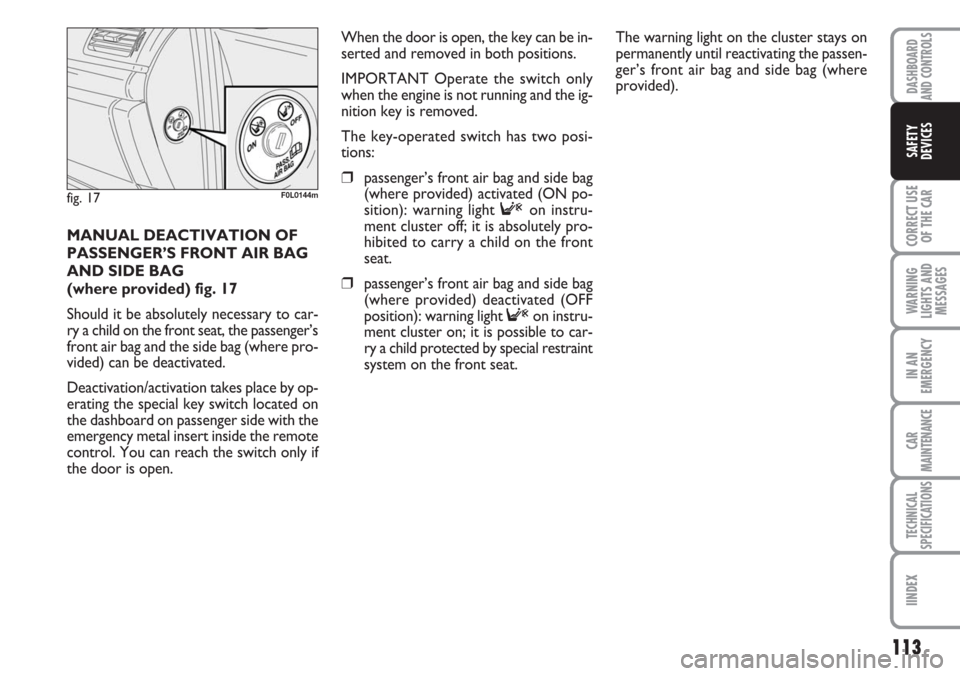
MANUAL DEACTIVATION OF
PASSENGER’S FRONT AIR BAG
AND SIDE BAG
(where provided) fig. 17
Should it be absolutely necessary to car-
ry a child on the front seat, the passenger’s
front air bag and the side bag (where pro-
vided) can be deactivated.
Deactivation/activation takes place by op-
erating the special key switch located on
the dashboard on passenger side with the
emergency metal insert inside the remote
control. You can reach the switch only if
the door is open.When the door is open, the key can be in-
serted and removed in both positions.
IMPORTANT Operate the switch only
when the engine is not running and the ig-
nition key is removed.
The key-operated switch has two posi-
tions:
❒passenger’s front air bag and side bag
(where provided) activated (ON po-
sition): warning light
Fon instru-
ment cluster off; it is absolutely pro-
hibited to carry a child on the front
seat.
❒passenger’s front air bag and side bag
(where provided) deactivated (OFF
position): warning light
Fon instru-
ment cluster on; it is possible to car-
ry a child protected by special restraint
system on the front seat.
fig. 17F0L0144m
The warning light on the cluster stays on
permanently until reactivating the passen-
ger’s front air bag and side bag (where
provided).
Page 116 of 240
116
CORRECT USE
OF THE CAR
WARNING
LIGHTS AND
MESSAGES
IN AN
EMERGENCY
CAR
MAINTENANCE
TECHNICAL
SPECIFICATIONS
INDEX
DASHBOARD
AND CONTROLS
SAFETY
DEVICES
MANUAL DEACTIVATION OF
REAR SIDE BAGS
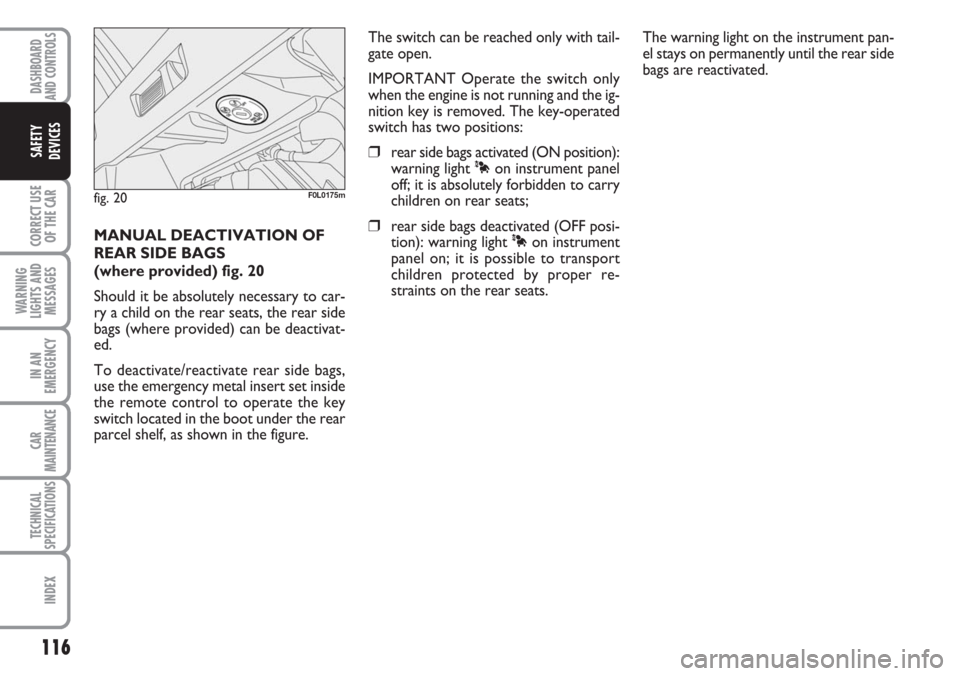
(where provided) fig. 20
Should it be absolutely necessary to car-
ry a child on the rear seats, the rear side
bags (where provided) can be deactivat-
ed.
To deactivate/reactivate rear side bags,
use the emergency metal insert set inside
the remote control to operate the key
switch located in the boot under the rear
parcel shelf, as shown in the figure.
fig. 20F0L0175m
The switch can be reached only with tail-
gate open.
IMPORTANT Operate the switch only
when the engine is not running and the ig-
nition key is removed. The key-operated
switch has two positions:
❒rear side bags activated (ON position):
warning light Àon instrument panel
off; it is absolutely forbidden to carry
children on rear seats;
❒rear side bags deactivated (OFF posi-
tion): warning light Àon instrument
panel on; it is possible to transport
children protected by proper re-
straints on the rear seats.The warning light on the instrument pan-
el stays on permanently until the rear side
bags are reactivated.
Page 120 of 240
STARTING PROCEDURE FOR
PETROL VERSIONS
Proceed as follows:
❒Ensure that the handbrake is up;
❒put the gear lever into neutral (posi-
tions P or N for automatic transmis-
sion);
❒press the clutch pedal (or brake ped-
al with automatic transmission) down
to the floor without pressing the ac-
celerator;
❒turn the ignition key to STARTand
let it go the moment the engine starts.
If the engine does not start at the first at-
tempt, return the ignition key to OFFbe-
fore repeating starting.
IMPORTANT In the event of fast engine
start-up (i.e.: fitting the ignition key and
turning it to ON), any slight jamming is to
be attributed to correct recognition of the
electronic key by the ignition switch.
ENGINE STARTING
The car is fitted with an electronic engine
lock device: if the engine fails to start, see
the paragraph “The Fiat CODE system” in
section “Dashboard and controls”.
The engine may be noisier than usual dur-
ing the first seconds of operation, espe-
cially after it has not been used for a while.
This characteristic feature of the hydraulic
tappet system does not compromise func-
tionality or reliability. This timing system
for petrol engines was adopted to limit
servicing.
120
WARNING
LIGHTS AND
MESSAGES
IN AN
EMERGENCY
CAR
MAINTENANCE
TECHNICAL
SPECIFICATIONS
INDEX
DASHBOARD
AND CONTROLS
SAFETY
DEVICES
CORRECT USE
OF THE CAR
We recommend that during
the initial period you do not
drive to full car performance
(e.g.: excessive acceleration,
long journeys at top speed, sharp brak-
ing, etc.).
When the engine is switched
off never leave the key into
the ignition switch to prevent
pointless current absorption
from draining the battery.
Running the engine in con-
fined areas is extremely dan-
gerous. The engine consumes oxygen
and produces carbon monoxide
which is a highly toxic and lethal gas.
WARNING
Page 122 of 240
IMPORTANT If it is not possible to turn
the ignition key to ON, remove the emer-
gency key, fit it into slot A-fig. 1to un-
lock the ignition switch; then, turn the key
to ONand follow the starting procedure.
Contact Fiat Dealership.
IMPORTANT Never leave the ignition key
into the ignition switch when the engine
is off. In this event, when opening the dri-
ver’s door, a buzzer will sound for about
1 second.
HOW TO WARM UP THE
ENGINE AFTER IT HAS JUST
STARTED (petrol and diesel
engines)
Proceed as follows:
❒Drive off slowly, letting the engine turn
at medium revs. Do not accelerate
abruptly;
❒Do not drive at full performance for
the initial kilometres. Wait until the
coolant temperature gauge starts
moving.
122
WARNING
LIGHTS AND
MESSAGES
IN AN
EMERGENCY
CAR
MAINTENANCE
TECHNICAL
SPECIFICATIONS
INDEX
DASHBOARD
AND CONTROLS
SAFETY
DEVICES
CORRECT USE
OF THE CAR
Never bump start the engine
by pushing, towing or coasting
downhill as this could cause
fuel to flow into the catalytic
exhaust system and damage it beyond
repair.
A quick burst on the acceler-
ator before turning off the en-
gine serves absolutely no prac-
tical purpose, it wastes fuel
and is damaging especially to tur-
bocharged engines.
Remember that the servo-
brake and power steering
are not operational until the engine
has been started, therefore much ef-
fort than usual is required on the
brake pedal and steering wheel.
WARNING
STOPPING THE ENGINE
Turn the ignition key to OFFwhile the
engine is idling.
IMPORTANT After a taxing drive, you
should allow the engine to “catch its
breath” before turning it off by letting it
idle to allow the temperature in the en-
gine compartment to fall.
IMPORTANT If the engine is turned off
while the car is still moving, for safety rea-
sons it will be impossible to remove the
key from the ignition switch. To remove
the key, turn it to ONand then to OFF
with the car stopped without forcing at re-
moval.
Page 132 of 240

INSTALLING THE TOW HOOK
The towing device should be fastened to
the body by specialised personnel accord-
ing to any additional and/or integrative in-
formation supplied by the Manufacturer of
the device.
The towing device must meet current reg-
ulations with reference to 94/20/EC Di-
rective and subsequent amendments.
For any version the towing device used
must match the towable weight of the car
on which it is to be installed.
For the electric connection a unified con-
nector should be used which is generally
placed on a special bracket normally fas-
tened to the towing device, and a special
ECU for external trailer light control shall
be installed on the car.
For the electrical connection, 7 or 13 pin
12VDC connection is to be used (CU-
NA/UNI and ISO/DIN Standards). Follow
the instructions provided by the car man-
ufacturer and/or the tow hitch manufac-
turer.An electric brake should be supplied di-
rectly by the battery through a cable with
a cross section of no less than
2.5 mm
2.
IMPORTANT Electric brake or other de-
vice shall be used with running engine.
In addition to the electrical branches, the
car’s electric system can only be con-
nected to the supply cable for an electric
brake and to the cable for an internal light,
though not above 15W.
For connections use the preset control
unit with battery cable no less than 2.5
mm
2. Do not exceed the speed limits of the
country you are driving in. In any case do
not exceed 100 km/h.
It is recommended to use a proper tow-
ing stabiliser on the trailer drawbar.
132
WARNING
LIGHTS AND
MESSAGES
IN AN
EMERGENCY
CAR
MAINTENANCE
TECHNICAL
SPECIFICATIONS
INDEX
DASHBOARD
AND CONTROLS
SAFETY
DEVICES
CORRECT USE
OF THE CAR
The ABS system with which
the car may be fitted does
not control the trailer braking system.
Drive with extreme care on slippery
roadbeds.
WARNING
Under no circumstances
should the car brake system
be altered to control the trailer brake.
The trailer braking system must be
fully independent of the car hydraulic
system.
WARNING
Page 137 of 240
137
IN AN
EMERGENCY
CAR
MAINTENANCE
TECHNICAL
SPECIFICATIONS
INDEX
DASHBOARD
AND CONTROLS
SAFETY
DEVICES
CORRECT USE
OF THE CAR
WARNING
LIGHTS AND
MESSAGES
GENERAL WARNINGS ...................................................... 138
LOW BRAKE FLUID ............................................................ 138
HANDBRAKE ON ............................................................... 138
AIR BAG FAILURE................................................................ 138
FRONT PASSENGER AIR BAG DEACTIVATED ......... 139
SEAT BELTS NOT FASTENED ......................................... 139
ENGINE COOLANT FLUID HIGH TEMPERATURE .. 139
LOW BATTERY CHARGE................................................. 140
LOW ENGINE OIL PRESSURE ......................................... 140
EXHAUST OIL ...................................................................... 140
INEFFICIENT ABS SYSTEM ................................................ 140
INEFFICIENT EBD ELECTRONIC BRAKING
DISTRIBUTOR ..................................................................... 140
INJECTION SYSTEM FAILURE ......................................... 141
ENGINE CONTROL SYSTEM FAILURE
(EOBD) .................................................................................... 141
POWER STEERING FAILURE .......................................... 141
INCOMPLETE DOOR LOCKING ................................... 141
FUEL RESERVE....................................................................... 142
GLOW PLUGS ...................................................................... 142
GLOW PLUG WARMING FAILURE ............................... 142
FIAT CODE ............................................................................ 143
WATER IN DIESEL FUEL FILTER ..................................... 143
ALARM FAILURE ................................................................. 143
BREAK-IN ATTEMPT ......................................................... 143
ELECTRONIC KEY NOT RECOGNISED ..................... 143
CHECK CAR PROTECTION SYSTEM .......................... 143
DIESEL PARTICULATE FILTER CLOGGED ................. 144
REAR FOGLIGHTS............................................................... 144
FUEL CUTOFF SWITCHED ON...................................... 144
RAIN SENSOR FAILURE ................................................... 144
EXTERNAL LIGHT FAILURE............................................. 144
GENERIC FAILURE INDICATION .................................. 144
TWILIGHT SENSOR FAILURE.......................................... 145PARKING SENSOR FAILURE ............................................ 145
ANTIPINCH SYSTEM FAILURE ........................................ 145
LOW TYRE PRESSURE ....................................................... 145
FLAT TYRES ........................................................................... 145
TYRE PRESSURE MONITORING SYSTEM FAILURE 145
FRONT FOG LIGHTS ......................................................... 146
LEFT-HAND DIRECTION INDICATOR ....................... 146
RIGHT-HAND DIRECTION INDICATOR ................... 146
SIDELIGHTS AND LOW BEAMS ..................................... 146
FOLLOW ME HOME ........................................................... 146
ESP SYSTEM .......................................................................... 146
HILL HOLDER FAILURE .................................................... 146
ASR SYSTEM ......................................................................... 147
MAIN BEAM HEADLIGHTS............................................... 147
POSSIBLE PRESENCE OF ICE ON THE ROAD ........... 147
AUTOMATIC TRANSMISSION FAILURE .................... 147
MAX. OIL TEMPERATURE (a.t.) ..................................... 147
SET SPEED LIMIT
EXCEEDED ........................................................................... 148
CRUISE CONTROL ............................................................. 148
BRAKE PAD WEAR ............................................................ 148
LOW ENGINE OIL LEVEL ................................................ 148
REAR SIDE BAGS DEACTIVATED ................................. 148
ENGINE OFF WHEN RUNNING .................................. 148
STARTING PROCEDURE MESSAGES (a.t.) ................. 148
STARTING PROCEDURE MESSAGES (m.t.) .............. 148
W W
A A
R R
N N
I I
N N
G G
L L
I I
G G
H H
T T
S S
A A
N N
D D
M M
E E
S S
S S
A A
G G
E E
S S
Page 140 of 240
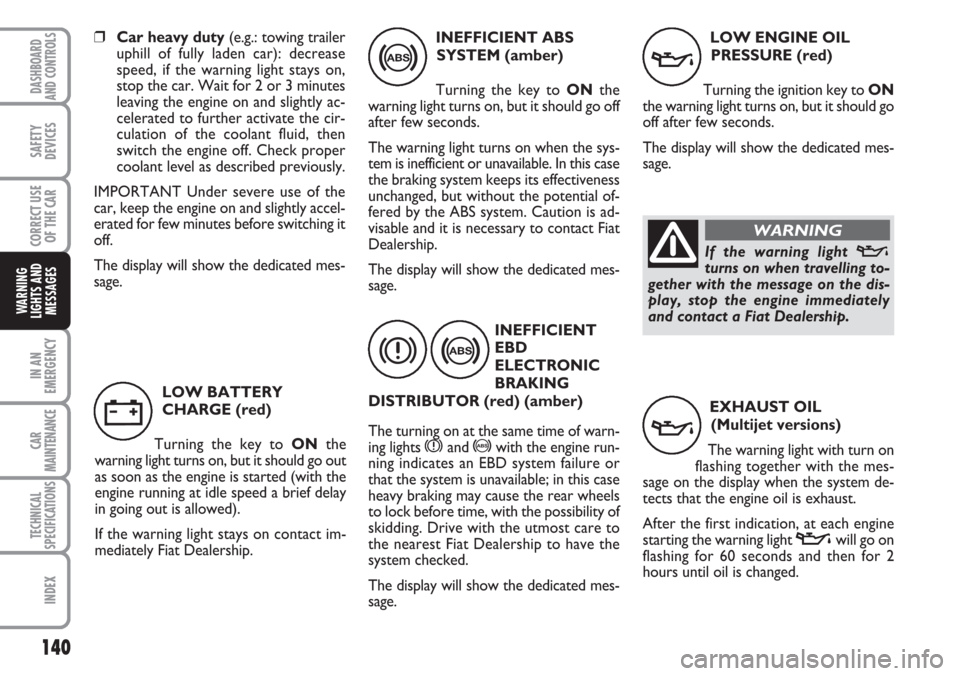
EXHAUST OIL
(Multijet versions)
The warning light with turn on
flashing together with the mes-
sage on the display when the system de-
tects that the engine oil is exhaust.
After the first indication, at each engine
starting the warning light
vwill go on
flashing for 60 seconds and then for 2
hours until oil is changed.
140
IN AN
EMERGENCY
CAR
MAINTENANCE
TECHNICAL
SPECIFICATIONS
INDEX
DASHBOARD
AND CONTROLS
SAFETY
DEVICES
CORRECT USE
OF THE CAR
WARNING
LIGHTS AND
MESSAGES
❒Car heavy duty(e.g.: towing trailer
uphill of fully laden car): decrease
speed, if the warning light stays on,
stop the car. Wait for 2 or 3 minutes
leaving the engine on and slightly ac-
celerated to further activate the cir-
culation of the coolant fluid, then
switch the engine off. Check proper
coolant level as described previously.
IMPORTANT Under severe use of the
car, keep the engine on and slightly accel-
erated for few minutes before switching it
off.
The display will show the dedicated mes-
sage.
LOW BATTERY
CHARGE (red)
Turning the key to ONthe
warning light turns on, but it should go out
as soon as the engine is started (with the
engine running at idle speed a brief delay
in going out is allowed).
If the warning light stays on contact im-
mediately Fiat Dealership.
w
INEFFICIENT ABS
SYSTEM (amber)
Turning the key to ONthe
warning light turns on, but it should go off
after few seconds.
The warning light turns on when the sys-
tem is inefficient or unavailable. In this case
the braking system keeps its effectiveness
unchanged, but without the potential of-
fered by the ABS system. Caution is ad-
visable and it is necessary to contact Fiat
Dealership.
The display will show the dedicated mes-
sage.
>
INEFFICIENT
EBD
ELECTRONIC
BRAKING
DISTRIBUTOR (red) (amber)
The turning on at the same time of warn-
ing lights
xand >with the engine run-
ning indicates an EBD system failure or
that the system is unavailable; in this case
heavy braking may cause the rear wheels
to lock before time, with the possibility of
skidding. Drive with the utmost care to
the nearest Fiat Dealership to have the
system checked.
The display will show the dedicated mes-
sage.
x>
LOW ENGINE OIL
PRESSURE (red)
Turning the ignition key to ON
the warning light turns on, but it should go
off after few seconds.
The display will show the dedicated mes-
sage.
v
v
If the warning light vturns on when travelling to-
gether with the message on the dis-
play, stop the engine immediately
and contact a Fiat Dealership.
WARNING