Air condition FIAT CROMA 2006 2.G User Guide
[x] Cancel search | Manufacturer: FIAT, Model Year: 2006, Model line: CROMA, Model: FIAT CROMA 2006 2.GPages: 240, PDF Size: 7.41 MB
Page 130 of 240
Roof rack/ski rack
Remove the roof rack or the ski rack from
the roof as soon as they are no longer
used. These accessories lower air pene-
tration and adversely affect consumption
levels. When needing to carry particular-
ly voluminous objects, preferably use a
trailer.
Electric devices
Use electric devices only for the amount
of time needed. Rear heated window, ad-
ditional headlights, windscreen wipers and
heater fan need a considerable amount of
energy, therefore increasing the require-
ment of current increases fuel consump-
tion (up to +25% in the urban cycle).
Climate control
The air conditioner is an additional load
which greatly affects the engine leading to
higher consumption (on average up to
+20%). When the temperature outside
the car permits it, use the air vents where
possible.
Spoilers
The use of non-certified aerodynamic
items may adversely affect air drag and
consumption levels.DRIVING STYLE
Starting
Do not warm the engine with the car at
a standstill or at idle or high speed: under
these conditions the engine warms up
much more slowly, increasing electrical
consumption and emissions. It is therefore
advisable to move off immediately, slow-
ly, avoiding high speeds. This way the en-
gine will warm faster.
Unnecessary actions
Avoid accelerating when waiting at traffic
lights or before switching off the engine.
This and also double declutching is ab-
solutely pointless on modern cars and al-
so increase consumption and pollution.
Gear selection
As soon as the conditions of the traffic and
road allow, use a higher gear. Using a low
gear to obtain brilliant performance in-
creases consumption.
In the same way improper use of a high
gear increases consumption, emissions an
engine wear.CONTAINING
RUNNING COSTS
Here are some suggestions which may
help you to keep the running costs of your
car down and lower the amount of toxic
emissions released into the atmosphere.
GENERAL CONSIDERATIONS
Car maintenance
Have checks and adjustments carried out
in accordance with the “Service schedule”.
Tyres
Check the pressure of the tyres routine-
ly at an interval of no more than 4 weeks:
if the pressure is too low, consumption
levels increase as resistance to rolling is
higher.
Unnecessary loads
Do not travel with too much luggage
stowed in the boot. The weight of the car
(especially when driving in town) and its
trim greatly affects consumption and sta-
bility.
130
WARNING
LIGHTS AND
MESSAGES
IN AN
EMERGENCY
CAR
MAINTENANCE
TECHNICAL
SPECIFICATIONS
INDEX
DASHBOARD
AND CONTROLS
SAFETY
DEVICES
CORRECT USE
OF THE CAR
Page 139 of 240
139
IN AN
EMERGENCY
CAR
MAINTENANCE
TECHNICAL
SPECIFICATIONS
INDEX
DASHBOARD
AND CONTROLS
SAFETY
DEVICES
CORRECT USE
OF THE CAR
WARNING
LIGHTS AND
MESSAGES
If when turning the ignition
key to ON, the warning light
¬does not turn on or if it stays on
when travelling there could be a fail-
ure in safety systems; in this event air
bags or pretensioners could not trig-
ger in case of impact or, in a minor
number of cases, they could trigger
accidentally. Contact Fiat Dealership
immediately to have the system
checked.
WARNING
The failure of the ¬warning
light (warning light off) is al-
so indicated by the flashing for more
than the normal 4 seconds of the pas-
senger’s front air bag deactivated
warning light
F.
WARNING
FRONT PASSENGER’S
AIR BAG
DEACTIVATED
(amber)
Warning light
Fwill come on when de-
activating the passenger front air bag. With
passenger front air active, turning the ig-
nition key to ON, warning light
Fwill
turn on with fixed light for about 4 sec-
onds and then it will flash for other 4 sec-
onds. It shall then go off.
F
Warning light Findicates
also warning light ¬failures.
This is indicated by intermittent flash-
ing, over 4 seconds, of warning light
F. In this event warning light ¬in-
dicates that there could be a failure
in safety systems. Contact Fiat Deal-
ership immediately to have the sys-
tem checked.
WARNINGHIGH TEMPERATURE
ENGINE COOLANT
FLUID (red)
Turning the ignition key to ONthe warn-
ing light turns on, but it should go off af-
ter few seconds.
The warning light turns on when the en-
gine is overheated.
If the warning light comes on when dri-
ving, proceed as follows:
❒normal driving conditions: stop
the car, switch off the engine and
check whether the water level in the
reservoir is not below the MIN mark.
Otherwise wait for few seconds to al-
low the engine cooling, then open
slowly and carefully the cap, top up
coolant and check whether its level is
falling between MIN and MAX marks
in the reservoir. Check visually any
leak. If, when restarting, the warning
light comes on again, contact a Fiat
Dealership.
ç
SEAT BELTS
NOT FASTENED
The warning light on the dial
turns on glowing steadily with car
stationary and driver’s seat belt not fas-
tened correctly. The warning light will turn
on flashing together with the buzzer when,
with car moving, front seat belts are not
fastened correctly. The S.B.R. (Seat Belt Re-
minder) buzzer can only be excluded by Fi-
at Dealership. The system can be reacti-
vated through the set-up menu (see dia-
gram aside). The display will show the ded-
icated message.
<
Page 186 of 240
186
WARNING
LIGHTS AND
MESSAGES
TECHNICAL
SPECIFICATIONS
INDEX
DASHBOARD
AND CONTROLS
SAFETY
DEVICES
CORRECT USE
OF THE CAR
IN AN
EMERGENCY
CAR
MAINTENANCE
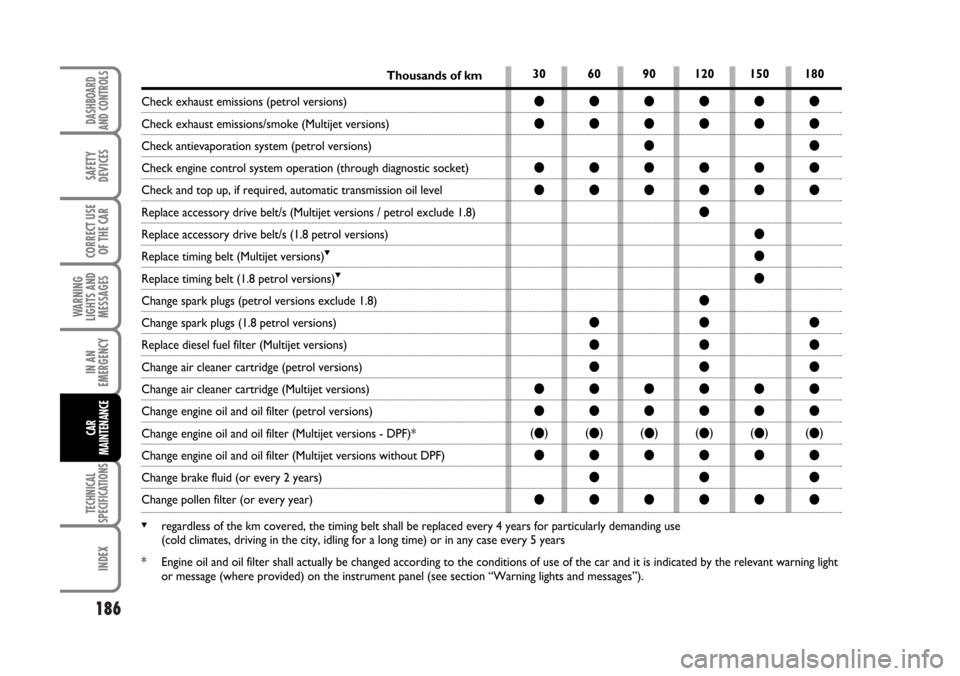
30 60 90 120 150 180
●●●●●●
●●●●●●
●●
●●●●●●
●●●●●●
●
●
●
●
●
●●●
●●●
●●●
●●●●●●
●●●●●●
(●)(●)(●)(●)(●)(●)
●●●●●●
●●●
●●●●●●
Thousands of km
Check exhaust emissions (petrol versions)
Check exhaust emissions/smoke (Multijet versions)
Check antievaporation system (petrol versions)
Check engine control system operation (through diagnostic socket)
Check and top up, if required, automatic transmission oil level
Replace accessory drive belt/s (Multijet versions / petrol exclude 1.8)
Replace accessory drive belt/s (1.8 petrol versions)
Replace timing belt (Multijet versions)O
Replace timing belt (1.8 petrol versions)O
Change spark plugs (petrol versions exclude 1.8)
Change spark plugs (1.8 petrol versions)
Replace diesel fuel filter (Multijet versions)
Change air cleaner cartridge (petrol versions)
Change air cleaner cartridge (Multijet versions)
Change engine oil and oil filter (petrol versions)
Change engine oil and oil filter (Multijet versions - DPF)*
Change engine oil and oil filter (Multijet versions without DPF)
Change brake fluid (or every 2 years)
Change pollen filter (or every year)
Oregardless of the km covered, the timing belt shall be replaced every 4 years for particularly demanding use
(cold climates, driving in the city, idling for a long time) or in any case every 5 years
* Engine oil and oil filter shall actually be changed according to the conditions of use of the car and it is indicated by the relevant warning light
or message (where provided) on the instrument panel (see section “Warning lights and messages”).
183-206 Croma TRW GB 20-11-2006 15:03 Pagina 186
Page 187 of 240

187
WARNING
LIGHTS AND
MESSAGES
TECHNICAL
SPECIFICATIONS
INDEX
DASHBOARD
AND CONTROLS
SAFETY
DEVICES
CORRECT USE
OF THE CAR
IN AN
EMERGENCY
CAR
MAINTENANCE
❒check cleanness of locks, bonnet and
boot and lever cleanness and lubrica-
tion;
❒sight inspect the conditions of: engine,
gearbox, transmission, pipes and hoses
(exhaust - fuel - brakes), rubber parts
(boots, sleeves, bushes, etc.);
❒check battery charge and fluid level
(electrolyte);
❒visual check on various drive belt con-
ditions;
❒check and replace pollen filter, if re-
quired;
❒check and replace air cleaner, if re-
quired.
ROUTINE
MAINTENANCE
Every 1,000 km or before long journeys,
check and top up if required:
❒engine coolant fluid level;
❒brake fluid level;
❒windscreen washer fluid level;
❒tyre pressure and conditions;
❒light system operation (headlights, di-
rection indicators, hazard lights, etc.);
❒windscreen wiper/washer operation
and windscreen/rear window blade
position/wear;
Every 3,000 km check and top up if re-
quired: engine oil level.
You are recommended to use FL
Selenia, products, designed and pro-
duced specifically for Fiat cars (see table
“Capacities” in section “Technical speci-
fications”).
HEAVY-DUTY
Should prevailing use of the car be under
one of the following specially heavy con-
ditions:
❒trailer or caravan towing;
❒dusty roads;
❒short distances (less than 7-8 km) re-
peated and with external tempera-
tures below zero;
❒frequently idling engines or long dis-
tance low speed driving (e.g. door-to-
door deliveries) or in case of a long
term inactivity;
❒driving in the city;
carry out the following checks more fre-
quently than required in the Service
Schedule:
❒check front disk brake pad conditions
and wear;
183-206 Croma TRW GB 20-11-2006 15:03 Pagina 187
Page 198 of 240
CHANGING THE BATTERY
If required, replace the battery with a gen-
uine spare part having the same specifi-
cations.
If a battery with different specifications is
fitted, the service intervals given in the
“Service schedule” in this section will no
longer be valid.
Refer to the instructions provided by the
battery manufacturer.
198
WARNING
LIGHTS AND
MESSAGES
TECHNICAL
SPECIFICATIONS
INDEX
DASHBOARD
AND CONTROLS
SAFETY
DEVICES
CORRECT USE
OF THE CAR
IN AN
EMERGENCY
CAR
MAINTENANCE
fig. 16F0L0191m
BATTERY
The battery is of the “Limited mainte-
nance” type: under normal conditions of
use the electrolyte does not need topping
up with distilled water.
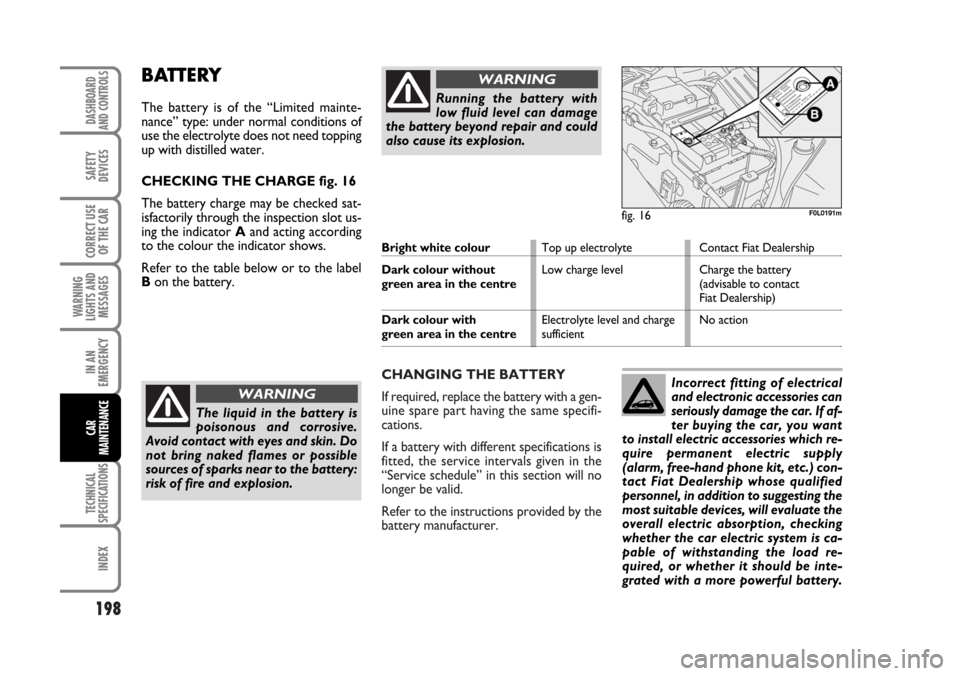
CHECKING THE CHARGE fig. 16
The battery charge may be checked sat-
isfactorily through the inspection slot us-
ing the indicator Aand acting according
to the colour the indicator shows.
Refer to the table below or to the label
Bon the battery.
The liquid in the battery is
poisonous and corrosive.
Avoid contact with eyes and skin. Do
not bring naked flames or possible
sources of sparks near to the battery:
risk of fire and explosion.
WARNING
Running the battery with
low fluid level can damage
the battery beyond repair and could
also cause its explosion.
WARNING
Bright white colourTop up electrolyte Contact Fiat Dealership
Dark colour withoutLow charge level Charge the battery
green area in the centre(advisable to contact
Fiat Dealership)
Dark colour with Electrolyte level and charge No action
green area in the centresufficient
Incorrect fitting of electrical
and electronic accessories can
seriously damage the car. If af-
ter buying the car, you want
to install electric accessories which re-
quire permanent electric supply
(alarm, free-hand phone kit, etc.) con-
tact Fiat Dealership whose qualified
personnel, in addition to suggesting the
most suitable devices, will evaluate the
overall electric absorption, checking
whether the car electric system is ca-
pable of withstanding the load re-
quired, or whether it should be inte-
grated with a more powerful battery.
183-206 Croma TRW GB 20-11-2006 15:03 Pagina 198
Page 203 of 240
203
WARNING
LIGHTS AND
MESSAGES
TECHNICAL
SPECIFICATIONS
INDEX
DASHBOARD
AND CONTROLS
SAFETY
DEVICES
CORRECT USE
OF THE CAR
IN AN
EMERGENCY
CAR
MAINTENANCE
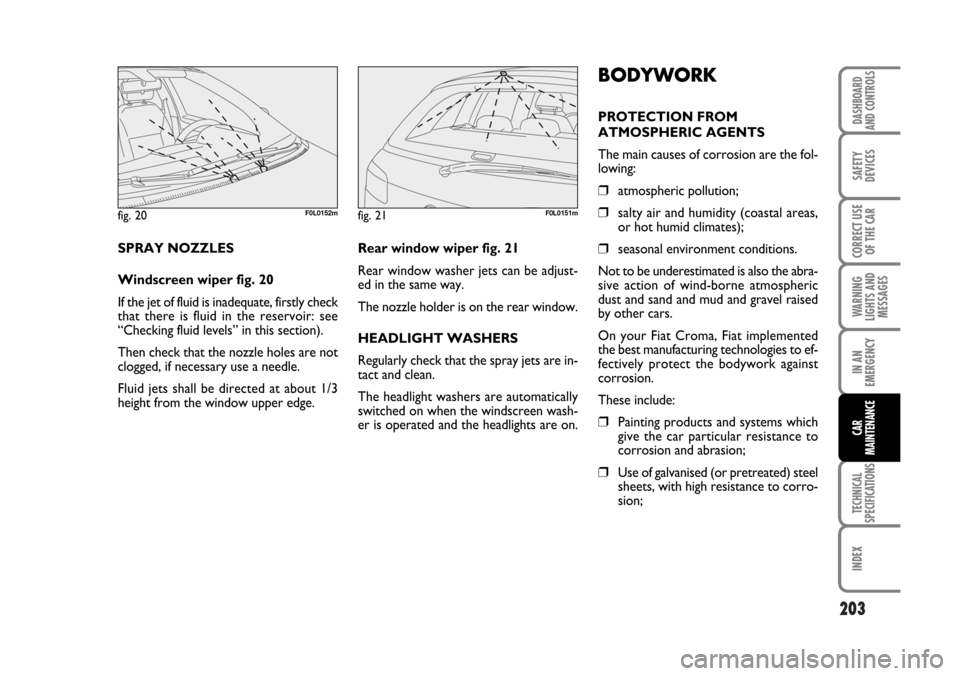
Rear window wiper fig. 21
Rear window washer jets can be adjust-
ed in the same way.
The nozzle holder is on the rear window.
HEADLIGHT WASHERS
Regularly check that the spray jets are in-
tact and clean.
The headlight washers are automatically
switched on when the windscreen wash-
er is operated and the headlights are on.
BODYWORK
PROTECTION FROM
ATMOSPHERIC AGENTS
The main causes of corrosion are the fol-
lowing:
❒atmospheric pollution;
❒salty air and humidity (coastal areas,
or hot humid climates);
❒seasonal environment conditions.
Not to be underestimated is also the abra-
sive action of wind-borne atmospheric
dust and sand and mud and gravel raised
by other cars.
On your Fiat Croma, Fiat implemented
the best manufacturing technologies to ef-
fectively protect the bodywork against
corrosion.
These include:
❒Painting products and systems which
give the car particular resistance to
corrosion and abrasion;
❒Use of galvanised (or pretreated) steel
sheets, with high resistance to corro-
sion; SPRAY NOZZLES
Windscreen wiper fig. 20
If the jet of fluid is inadequate, firstly check
that there is fluid in the reservoir: see
“Checking fluid levels” in this section).
Then check that the nozzle holes are not
clogged, if necessary use a needle.
Fluid jets shall be directed at about 1/3
height from the window upper edge.
fig. 20F0L0152mfig. 21F0L0151m
183-206 Croma TRW GB 20-11-2006 15:03 Pagina 203
Page 228 of 240
❒extra-urban cycle: frequent accel-
erating in all gears, simulating extrau-
rban use of the car; the speed varies
between 0 and 120 km/h;
❒combined consumption: is calcu-
lated weighing about 37% of urban cy-
cle consumption and about 63% of
extraurban consumption.
FUEL CONSUMPTION
The fuel consumption figures given in the
table below are determined on the basis
of the homologation tests set down by
specific European Directives.
The procedures below are followed for
measuring consumption:
❒urban cycle: cold starting followed
by driving that simulates urban use of
the car;
228
WARNING
LIGHTS AND
MESSAGES
INDEX
DASHBOARD
AND CONTROLS
SAFETY
DEVICES
CORRECT USE
OF THE CAR
IN AN
EMERGENCY
CAR
MAINTENANCE
TECHNICAL
SPECIFICATIONS
IMPORTANT The type of route, traffic
situations, weather conditions, driving
style, general conditions of the car, trim
level/equipment/accessories, load, climate
control system, roof rack, other situations
that affect air drag may lead to different
fuel consumption levels than those mea-
sured.
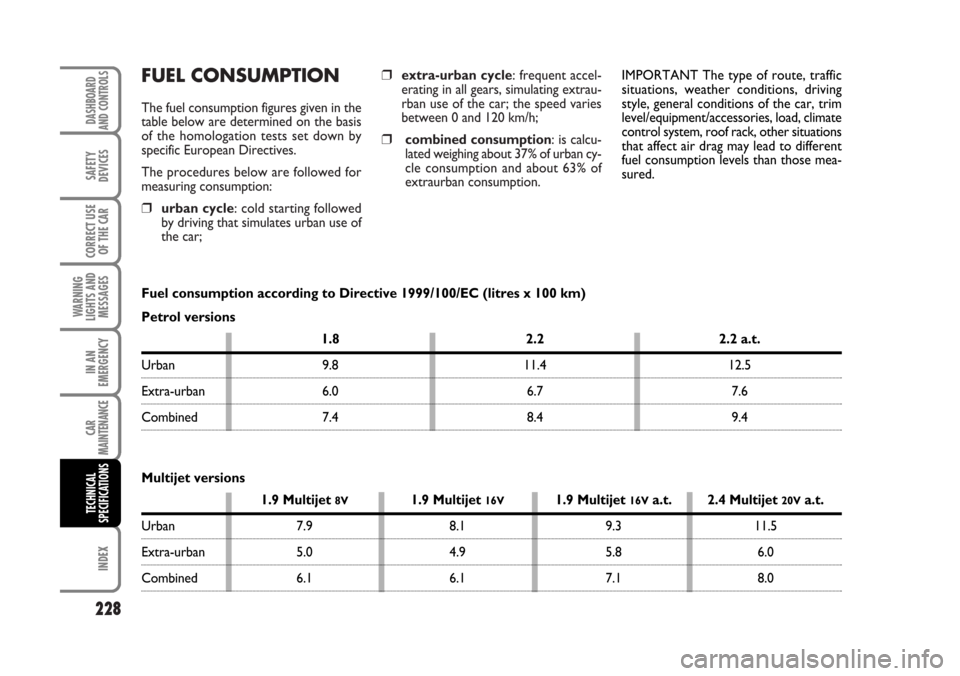
Fuel consumption according to Directive 1999/100/EC (litres x 100 km)
Petrol versions
1.8 2.2 2.2 a.t.
Urban 9.8 11.4 12.5
Extra-urban 6.0 6.7 7.6
Combined 7.4 8.4 9.4
Multijet versions
1.9 Multijet 8V1.9 Multijet 16V1.9 Multijet 16Va.t. 2.4 Multijet 20Va.t.
Urban 7.9 8.1 9.3 11.5
Extra-urban 5.0 4.9 5.8 6.0
Combined 6.1 6.1 7.1 8.0
207-231 Croma TRW GB 20-11-2006 15:04 Pagina 228