brake light FIAT CROMA 2006 2.G User Guide
[x] Cancel search | Manufacturer: FIAT, Model Year: 2006, Model line: CROMA, Model: FIAT CROMA 2006 2.GPages: 240, PDF Size: 7.41 MB
Page 88 of 240
88
SAFETY
DEVICES
CORRECT USE
OF THE CAR
WARNING
LIGHTS AND
MESSAGES
IN AN
EMERGENCY
CAR
MAINTENANCE
TECHNICAL
SPECIFICATIONS
INDEX
DASHBOARD
AND CONTROLS
ESP SYSTEM
(Electronic Stability
Program)
(where provided)
The ESP system is an electronic system
controlling the car stability in the event of
tyre grip loss.
The ESP system is therefore particularly
useful when grip conditions of the road sur-
faces changes.
ESP SYSTEM INTERVENTION
It is signalled by the blinking of the warn-
ing light
áon the instrument panel, to in-
form the driver that the car is in critical
stability and grip conditions.
ESP SYSTEM OPERATION
The ESP system is automatically activat-
ed when the car is started and cannot be
de-activated.
FAILURE WARNINGS
In the event of failure, the ESP system is
automatically disconnected and the warn-
ing light
á, comes on with fixed light on
the instrument panel, together with the
message on the display (see section
“Warning lights and messages”). In this
case contact a Fiat Dealership as soon as
possible.At pickup the ESP system control unit will
keep brake force on wheels until reaching
the torque suitable for starting, or in any
case for max. 1.5 seconds in order to pass
easily from the brake pedal to the accel-
erator pedal.
After two seconds without starting, the
system will deactivate automatically by re-
leasing gradually the brake force.
At releasing, the typical brake disengage-
ment noise indicating that the car is go-
ing to move will be heard.
Failure indications
System failure is indicated by the turning
on of warning light
áon the instrument
panel (together with the message on the
multifunction display) (see section “Warn-
ing lights and messages”).
IMPORTANT The Hill Holder system is
not a parking brake. Never get out of the
car without engaging the handbrake,
switching the engine off and engaging the
first gear (position P con with automatic
transmission).
Performance of the ESP sys-
tem, in terms of active safe-
ty should not induce the driver to take
pointless and unnecessary risks. The
style of driving must in any case al-
ways be adapted to the conditions of
the road surface, visibility an traffic.
Road safety is always the driver’s re-
sponsibility.
WARNING
HILL HOLDER SYSTEM
(where provided)
This system is an integral part of the ESP
system and it is provided to facilitate start-
ing on slopes.
It will activate automatically with the fol-
lowing conditions:
Uphill: car at a standstill on a road with a
gradient higher than 5%, engine running,
clutch and brake pedal pressed, gearbox
to neutral or engaged gear other than re-
verse.
Downhill: car at a standstill on a road with
a gradient higher than 5%, engine running,
clutch and brake pedal pressed and re-
verse gear engaged.
062-098 Croma TRW GB 20-11-2006 15:01 Pagina 88
Page 92 of 240

92
SAFETY
DEVICES
CORRECT USE
OF THE CAR
WARNING
LIGHTS AND
MESSAGES
IN AN
EMERGENCY
CAR
MAINTENANCE
TECHNICAL
SPECIFICATIONS
INDEX
DASHBOARD
AND CONTROLS
IMPORTANT NOTES ABOUT
THE T.P.M.S. SYSTEM
Failure indications will not be stored and
therefore will not be displayed when turn-
ing the engine off and on again. If failure
persists, the control unit will send warn-
ing indications to the instrument panel on-
ly after a few seconds when the car is
moving.
IMPORTANT T.P.M.S. system cannot in-
dicate sudden tyre pressure drops (e.g.:
tyre burst). In this event, brake the car
cautiously and avoid sudden steering.
IMPORTANT Replacing standard tyres
with winter tyres and vice versa involves
T.P.M.S. system set-up that shall be per-
formed at Fiat Dealerships only.
IMPORTANT The T.P.M.S. system re-
quires special equipment. Consult Fiat
Dealership to know what type of acces-
sories are compatible with the system
(wheels, wheel caps, etc.). Using other ac-
cessories could cause system malfunc-
tioning.IMPORTANT Tyre pressure could change
according to outside temperature. For this
reason the T.P.M.S. system could tem-
porarily indicate low tyre pressure. In this
event check pressure with cold tyres and
restore proper inflation values if required.
IMPORTANT If the car is fitted with
T.P.M.S. system, tyre and/or rim removal
and refitting operations involve special
precautions; to prevent damages or wrong
sensor refitting, contact Fiat Dealership to
have tyre and/or rim changed.
IMPORTANT If the car is fitted with
T.P.M.S. system, when changing a tyre,
change also the rubber seal of the valve.
Contact a Fiat Dealership.
IMPORTANT Strong radiofrequency
noise may inhibit regular TPMS system op-
eration; in this event, a dedicated message
will be displayed to warn the driver. This
message will disappear automatically as
soon as noise disappears.SOUND SYSTEM
(where provided)
For the operation of the radio with
CD/MP3 CD (where provided), read the
instructions for use given in the Supple-
ment attached to the Owner Handbook.
Sound system (where provided)
The system includes:
❒2 tweeters (power 40W max. each),
located on front doors;
❒2 mid-woofers, (diameter 165 mm,
power 40W max. each), located on
front doors;
❒2 rear full-range speakers, (diameter
165 mm, power 40W max. each), lo-
cated on rear doors.
062-098 Croma TRW GB 20-11-2006 15:01 Pagina 92
Page 95 of 240
95
SAFETY
DEVICES
CORRECT USE
OF THE CAR
WARNING
LIGHTS AND
MESSAGES
IN AN
EMERGENCY
CAR
MAINTENANCE
TECHNICAL
SPECIFICATIONS
INDEX
DASHBOARD
AND CONTROLS
GENERAL WARNINGS
❒When parking, take the utmost care
to obstacles that may be set above or
under the sensors.
❒Objects set close to the car, under
certain circumstances are not detect-
ed and could therefore cause damages
to the car or be damaged.
❒Indications sent by the sensors can be
altered by dirt, snow or ice deposit-
ed on the sensors or by ultrasound
systems (e.g.: truck pneumatic brakes
or pneumatic hammers) set nearby the
car.
AT THE FILLING
STATION
PETROL ENGINES
Use only unleaded petrol.
To prevent errors, the diameter of the fu-
el tank filler is too small to introduce a lead
petrol pump filler. Use petrol with a rat-
ed octane number (R.O.N.) not lower
than 95.
IMPORTANT An inefficient catalyst leads
to harmful exhaust emissions, thus con-
tributing to air pollution.
IMPORTANT Never use leaded petrol,
even in small amount or in an emergency,
as this would damage the catalyst beyond
repair. For proper operation, the
parking sensors shall always
be clean from mud, dirt, snow
or ice. When cleaning the sen-
sors, take the utmost care to prevent
their damaging; do not use therefore
dry or rough clothes. Sensors shall be
washed with clean water and car de-
tergent, if required.
Parking manoeuvres howev-
er are always under the dri-
ver’s responsibility that shall always
check the absence of people (spe-
cially children) or animals in the ma-
noeuvre space. This system is just a
help for the driver but she/he shall
never reduce attention during dan-
gerous manoeuvres even if performed
at low speed.
WARNING
062-098 Croma TRW GB 20-11-2006 15:01 Pagina 95
Page 100 of 240
100
CORRECT USE
OF THE CAR
WARNING
LIGHTS AND
MESSAGES
IN AN
EMERGENCY
CAR
MAINTENANCE
TECHNICAL
SPECIFICATIONS
INDEX
DASHBOARD
AND CONTROLS
SAFETY
DEVICES
SEAT BELTS
USING THE SEAT BELTS
The belt should be worn keeping the chest
straight and rested against the seat back.
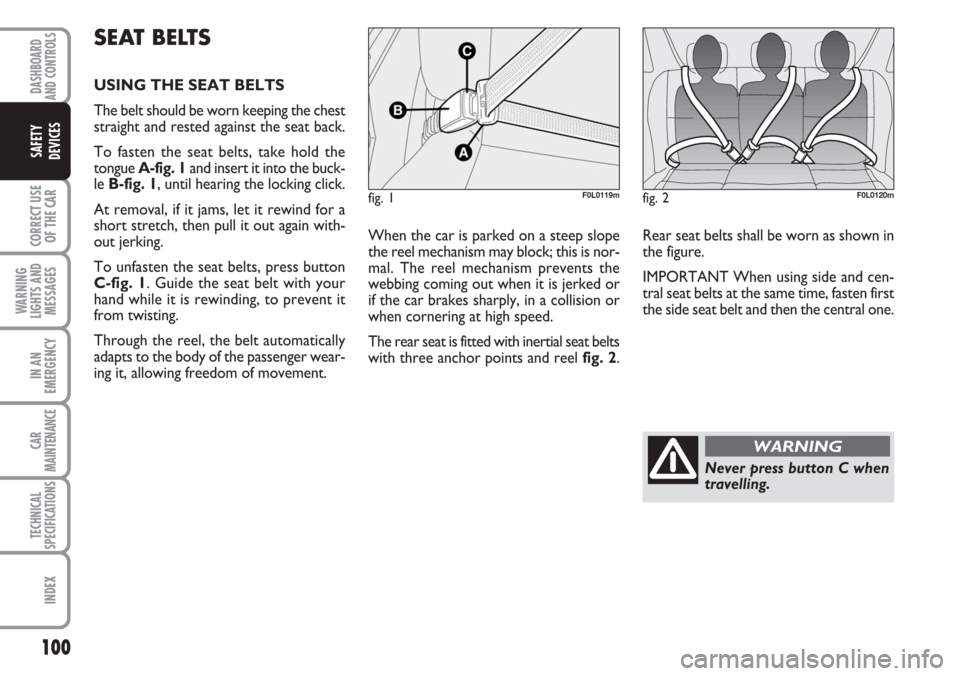
To fasten the seat belts, take hold the
tongue A-fig. 1and insert it into the buck-
le B-fig. 1, until hearing the locking click.
At removal, if it jams, let it rewind for a
short stretch, then pull it out again with-
out jerking.
To unfasten the seat belts, press button
C-fig. 1. Guide the seat belt with your
hand while it is rewinding, to prevent it
from twisting.
Through the reel, the belt automatically
adapts to the body of the passenger wear-
ing it, allowing freedom of movement.When the car is parked on a steep slope
the reel mechanism may block; this is nor-
mal. The reel mechanism prevents the
webbing coming out when it is jerked or
if the car brakes sharply, in a collision or
when cornering at high speed.
The rear seat is fitted with inertial seat belts
with three anchor points and reel fig. 2.Rear seat belts shall be worn as shown in
the figure.
IMPORTANT When using side and cen-
tral seat belts at the same time, fasten first
the side seat belt and then the central one.
fig. 1F0L0119mfig. 2F0L0120m
Never press button C when
travelling.
WARNING
Page 120 of 240
STARTING PROCEDURE FOR
PETROL VERSIONS
Proceed as follows:
❒Ensure that the handbrake is up;
❒put the gear lever into neutral (posi-
tions P or N for automatic transmis-
sion);
❒press the clutch pedal (or brake ped-
al with automatic transmission) down
to the floor without pressing the ac-
celerator;
❒turn the ignition key to STARTand
let it go the moment the engine starts.
If the engine does not start at the first at-
tempt, return the ignition key to OFFbe-
fore repeating starting.
IMPORTANT In the event of fast engine
start-up (i.e.: fitting the ignition key and
turning it to ON), any slight jamming is to
be attributed to correct recognition of the
electronic key by the ignition switch.
ENGINE STARTING
The car is fitted with an electronic engine
lock device: if the engine fails to start, see
the paragraph “The Fiat CODE system” in
section “Dashboard and controls”.
The engine may be noisier than usual dur-
ing the first seconds of operation, espe-
cially after it has not been used for a while.
This characteristic feature of the hydraulic
tappet system does not compromise func-
tionality or reliability. This timing system
for petrol engines was adopted to limit
servicing.
120
WARNING
LIGHTS AND
MESSAGES
IN AN
EMERGENCY
CAR
MAINTENANCE
TECHNICAL
SPECIFICATIONS
INDEX
DASHBOARD
AND CONTROLS
SAFETY
DEVICES
CORRECT USE
OF THE CAR
We recommend that during
the initial period you do not
drive to full car performance
(e.g.: excessive acceleration,
long journeys at top speed, sharp brak-
ing, etc.).
When the engine is switched
off never leave the key into
the ignition switch to prevent
pointless current absorption
from draining the battery.
Running the engine in con-
fined areas is extremely dan-
gerous. The engine consumes oxygen
and produces carbon monoxide
which is a highly toxic and lethal gas.
WARNING
Page 121 of 240
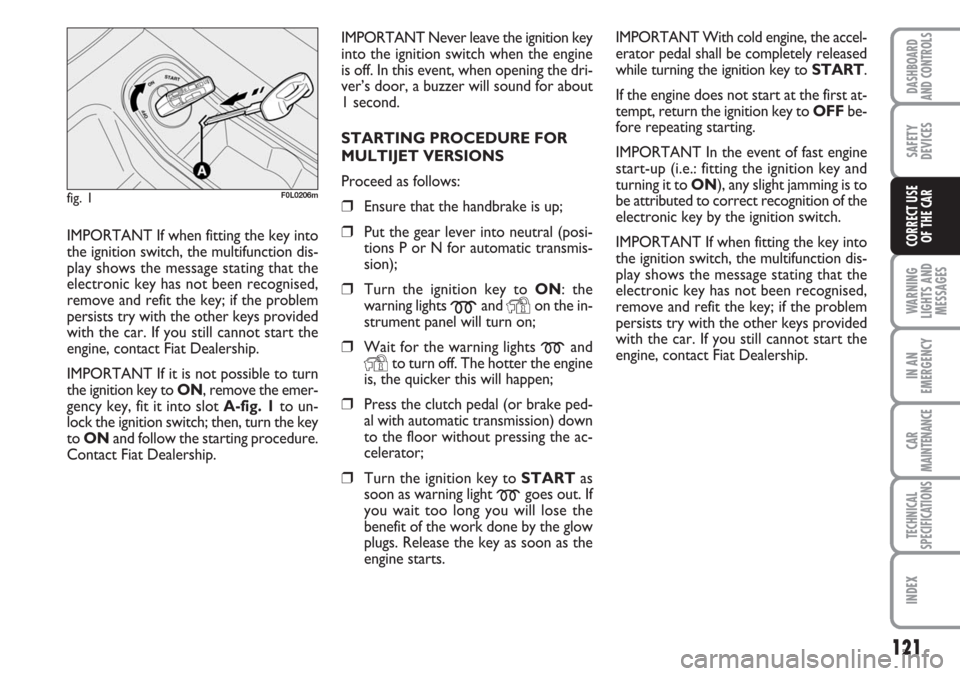
IMPORTANT Never leave the ignition key
into the ignition switch when the engine
is off. In this event, when opening the dri-
ver’s door, a buzzer will sound for about
1 second.
STARTING PROCEDURE FOR
MULTIJET VERSIONS
Proceed as follows:
❒Ensure that the handbrake is up;
❒Put the gear lever into neutral (posi-
tions P or N for automatic transmis-
sion);
❒Turn the ignition key to ON: the
warning lights
mand Yon the in-
strument panel will turn on;
❒Wait for the warning lights mand
Yto turn off. The hotter the engine
is, the quicker this will happen;
❒Press the clutch pedal (or brake ped-
al with automatic transmission) down
to the floor without pressing the ac-
celerator;
❒Turn the ignition key to STARTas
soon as warning light
mgoes out. If
you wait too long you will lose the
benefit of the work done by the glow
plugs. Release the key as soon as the
engine starts.IMPORTANT With cold engine, the accel-
erator pedal shall be completely released
while turning the ignition key to START.
If the engine does not start at the first at-
tempt, return the ignition key to OFFbe-
fore repeating starting.
IMPORTANT In the event of fast engine
start-up (i.e.: fitting the ignition key and
turning it to ON), any slight jamming is to
be attributed to correct recognition of the
electronic key by the ignition switch.
IMPORTANT If when fitting the key into
the ignition switch, the multifunction dis-
play shows the message stating that the
electronic key has not been recognised,
remove and refit the key; if the problem
persists try with the other keys provided
with the car. If you still cannot start the
engine, contact Fiat Dealership. IMPORTANT If when fitting the key into
the ignition switch, the multifunction dis-
play shows the message stating that the
electronic key has not been recognised,
remove and refit the key; if the problem
persists try with the other keys provided
with the car. If you still cannot start the
engine, contact Fiat Dealership.
IMPORTANT If it is not possible to turn
the ignition key to ON, remove the emer-
gency key, fit it into slot A-fig. 1to un-
lock the ignition switch; then, turn the key
to ONand follow the starting procedure.
Contact Fiat Dealership.
121
WARNING
LIGHTS AND
MESSAGES
IN AN
EMERGENCY
CAR
MAINTENANCE
TECHNICAL
SPECIFICATIONS
INDEX
DASHBOARD
AND CONTROLS
SAFETY
DEVICES
CORRECT USE
OF THE CAR
fig. 1F0L0206m
Page 122 of 240
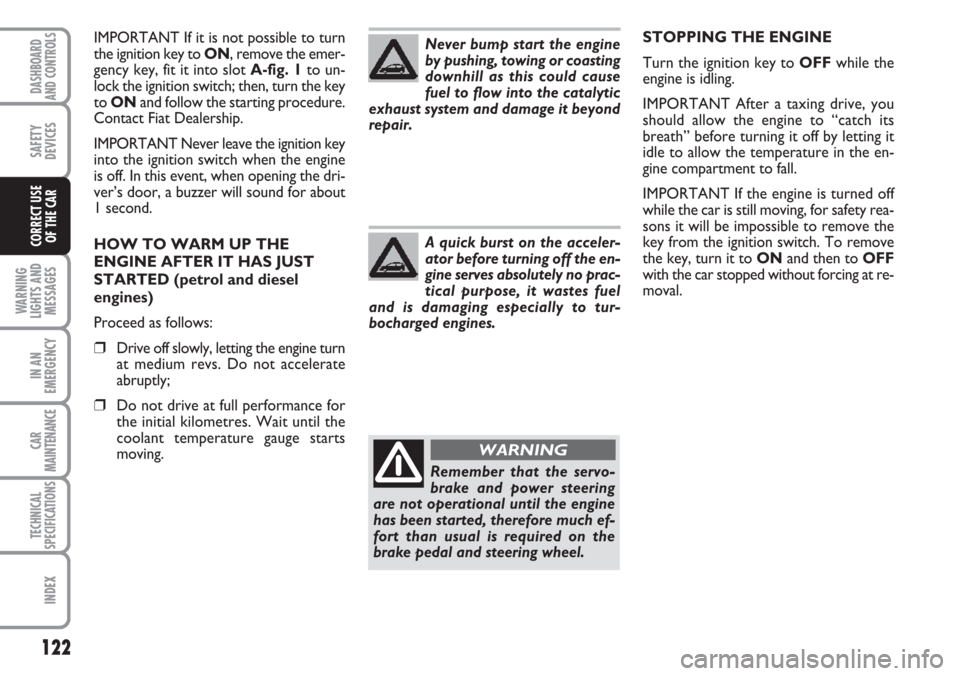
IMPORTANT If it is not possible to turn
the ignition key to ON, remove the emer-
gency key, fit it into slot A-fig. 1to un-
lock the ignition switch; then, turn the key
to ONand follow the starting procedure.
Contact Fiat Dealership.
IMPORTANT Never leave the ignition key
into the ignition switch when the engine
is off. In this event, when opening the dri-
ver’s door, a buzzer will sound for about
1 second.
HOW TO WARM UP THE
ENGINE AFTER IT HAS JUST
STARTED (petrol and diesel
engines)
Proceed as follows:
❒Drive off slowly, letting the engine turn
at medium revs. Do not accelerate
abruptly;
❒Do not drive at full performance for
the initial kilometres. Wait until the
coolant temperature gauge starts
moving.
122
WARNING
LIGHTS AND
MESSAGES
IN AN
EMERGENCY
CAR
MAINTENANCE
TECHNICAL
SPECIFICATIONS
INDEX
DASHBOARD
AND CONTROLS
SAFETY
DEVICES
CORRECT USE
OF THE CAR
Never bump start the engine
by pushing, towing or coasting
downhill as this could cause
fuel to flow into the catalytic
exhaust system and damage it beyond
repair.
A quick burst on the acceler-
ator before turning off the en-
gine serves absolutely no prac-
tical purpose, it wastes fuel
and is damaging especially to tur-
bocharged engines.
Remember that the servo-
brake and power steering
are not operational until the engine
has been started, therefore much ef-
fort than usual is required on the
brake pedal and steering wheel.
WARNING
STOPPING THE ENGINE
Turn the ignition key to OFFwhile the
engine is idling.
IMPORTANT After a taxing drive, you
should allow the engine to “catch its
breath” before turning it off by letting it
idle to allow the temperature in the en-
gine compartment to fall.
IMPORTANT If the engine is turned off
while the car is still moving, for safety rea-
sons it will be impossible to remove the
key from the ignition switch. To remove
the key, turn it to ONand then to OFF
with the car stopped without forcing at re-
moval.
Page 123 of 240
PARKING THE CAR
Proceed as follows:
❒Stop the engine and engage the hand-
brake;
❒Engage a gear (on a slope, engage first
gear if the car is faced uphill or reverse
if it is faced downhill; position P with
automatic transmission) and leave the
wheels steered.
Block the wheels with a wedge or a stone
if the car is parked on a steep slope. Do
not leave the key in the ignition switch to
prevent draining the battery. Always re-
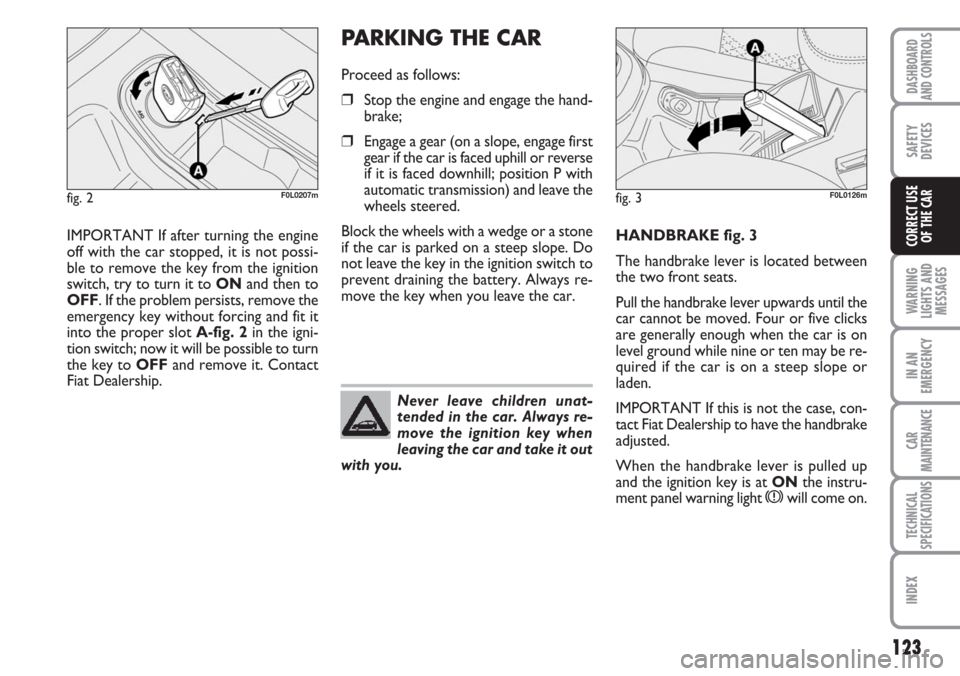
move the key when you leave the car.HANDBRAKE fig. 3
The handbrake lever is located between
the two front seats.
Pull the handbrake lever upwards until the
car cannot be moved. Four or five clicks
are generally enough when the car is on
level ground while nine or ten may be re-
quired if the car is on a steep slope or
laden.
IMPORTANT If this is not the case, con-
tact Fiat Dealership to have the handbrake
adjusted.
When the handbrake lever is pulled up
and the ignition key is at ONthe instru-
ment panel warning light
xwill come on. IMPORTANT If after turning the engine
off with the car stopped, it is not possi-
ble to remove the key from the ignition
switch, try to turn it to ONand then to
OFF. If the problem persists, remove the
emergency key without forcing and fit it
into the proper slot A-fig. 2in the igni-
tion switch; now it will be possible to turn
the key to OFFand remove it. Contact
Fiat Dealership.
123
WARNING
LIGHTS AND
MESSAGES
IN AN
EMERGENCY
CAR
MAINTENANCE
TECHNICAL
SPECIFICATIONS
INDEX
DASHBOARD
AND CONTROLS
SAFETY
DEVICES
CORRECT USE
OF THE CAR
fig. 2F0L0207m
Never leave children unat-
tended in the car. Always re-
move the ignition key when
leaving the car and take it out
with you.
fig. 3F0L0126m
Page 124 of 240
USING THE MANUAL
GEARBOX
To engage the gears, press the clutch ped-
al fully and shift the gear lever into one of
the required positions (the diagram is
shown on the knob).
IMPORTANT The car can only be put in-
to reverse gear when it has stopped mov-
ing completely. With the engine running,
before engaging the reverse, wait at least
2 seconds with the clutch pedal fully down
to prevent damage and grating of the
gears.
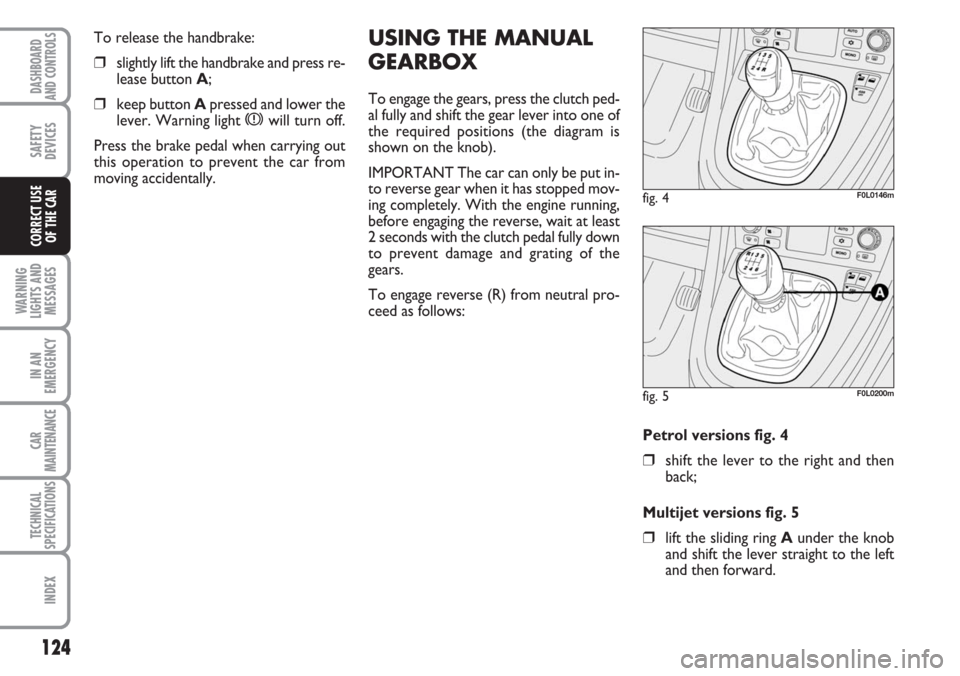
To engage reverse (R) from neutral pro-
ceed as follows:
Petrol versions fig. 4
❒shift the lever to the right and then
back;
Multijet versions fig. 5
❒lift the sliding ring Aunder the knob
and shift the lever straight to the left
and then forward. To release the handbrake:
❒slightly lift the handbrake and press re-
lease button A;
❒keep button Apressed and lower the
lever. Warning light xwill turn off.
Press the brake pedal when carrying out
this operation to prevent the car from
moving accidentally.
124
WARNING
LIGHTS AND
MESSAGES
IN AN
EMERGENCY
CAR
MAINTENANCE
TECHNICAL
SPECIFICATIONS
INDEX
DASHBOARD
AND CONTROLS
SAFETY
DEVICES
CORRECT USE
OF THE CAR
fig. 4F0L0146m
fig. 5F0L0200m
Page 126 of 240
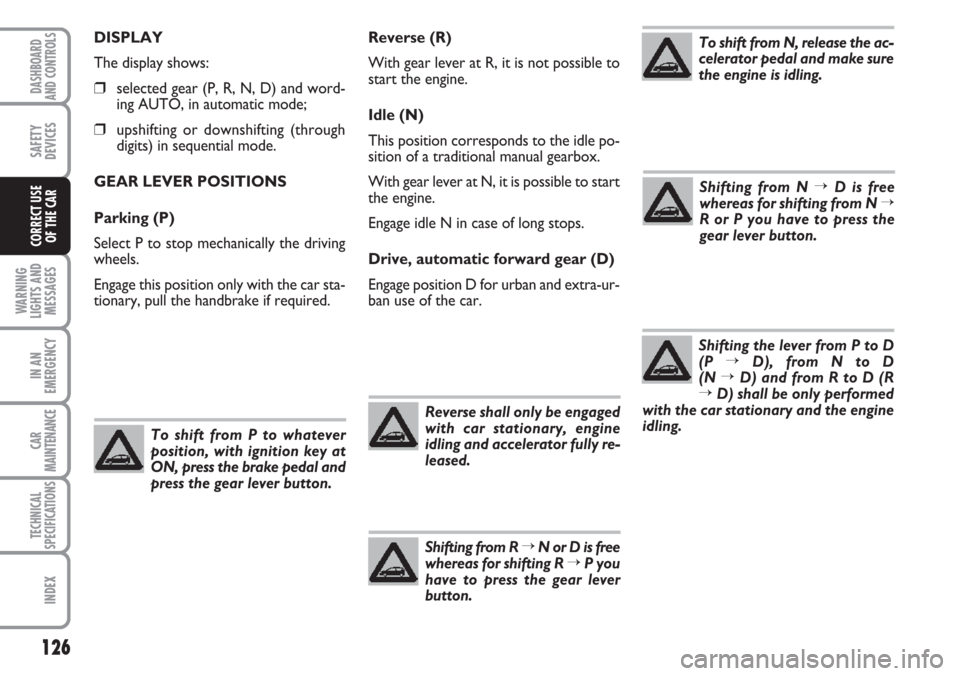
Reverse (R)
With gear lever at R, it is not possible to
start the engine.
Idle (N)
This position corresponds to the idle po-
sition of a traditional manual gearbox.
With gear lever at N, it is possible to start
the engine.
Engage idle N in case of long stops.
Drive, automatic forward gear (D)
Engage position D for urban and extra-ur-
ban use of the car. DISPLAY
The display shows:
❒selected gear (P, R, N, D) and word-
ing AUTO, in automatic mode;
❒upshifting or downshifting (through
digits) in sequential mode.
GEAR LEVER POSITIONS
Parking (P)
Select P to stop mechanically the driving
wheels.
Engage this position only with the car sta-
tionary, pull the handbrake if required.
126
WARNING
LIGHTS AND
MESSAGES
IN AN
EMERGENCY
CAR
MAINTENANCE
TECHNICAL
SPECIFICATIONS
INDEX
DASHBOARD
AND CONTROLS
SAFETY
DEVICES
CORRECT USE
OF THE CAR
To shift from P to whatever
position, with ignition key at
ON, press the brake pedal and
press the gear lever button.
Reverse shall only be engaged
with car stationary, engine
idling and accelerator fully re-
leased.
Shifting from R →N or D is free
whereas for shifting R →P you
have to press the gear lever
button.
To shift from N, release the ac-
celerator pedal and make sure
the engine is idling.
Shifting from N →D is free
whereas for shifting from N →R or P you have to press the
gear lever button.
Shifting the lever from P to D
(P →D), from N to D
(N →D) and from R to D (R→D) shall be only performed
with the car stationary and the engine
idling.