steering FIAT CROMA 2006 2.G User Guide
[x] Cancel search | Manufacturer: FIAT, Model Year: 2006, Model line: CROMA, Model: FIAT CROMA 2006 2.GPages: 240, PDF Size: 7.41 MB
Page 111 of 240
111
CORRECT USE
OF THE CAR
WARNING
LIGHTS AND
MESSAGES
IN AN
EMERGENCY
CAR
MAINTENANCE
TECHNICAL
SPECIFICATIONS
IINDEX
DASHBOARD
AND CONTROLS
SAFETY
DEVICES
At their maximum inflation, their volume
fills most of the space between the dash-
board and the passenger.
In case of crash, a person not wearing the
seat belt moves forward and may come in-
to contact with the cushion while it is still
inflating. Under this circumstance the pro-
tection offered by the air bag is reduced.
Front air bag may not be activated in the
following situations:
❒in collisions against highly deformable
objects not affecting the car front sur-
face (e.g. bumper collision against
guard rail, etc.);
❒in case of wedging under other vehi-
cles or protective barriers (for exam-
ple under a truck or guard rail), the air
bag is not triggered as it offers no ad-
ditional protection compared with the
seat belts, consequently it would be
pointless. Therefore, failure to come
into action in the above circumstance
does not mean that the system is not
working properly.
In minor crashes (for which the restrain-
ing action of the seat belts is sufficient), the
air bags are not deployed. Also in this case
it is of vital importance to wear the seat
belts since in case of side crash they guar-
antee proper positioning of the occupant
and prevent the occupants to be pitched
out of the car in case of violent crashes.
Do not apply stickers or oth-
er objects to the steering
wheel or to the air bag cover on the
passenger’s side or on the side roof
lining. Never put objects on the dash-
board on passenger side since they
could interfere with proper air bag in-
flation .
WARNING
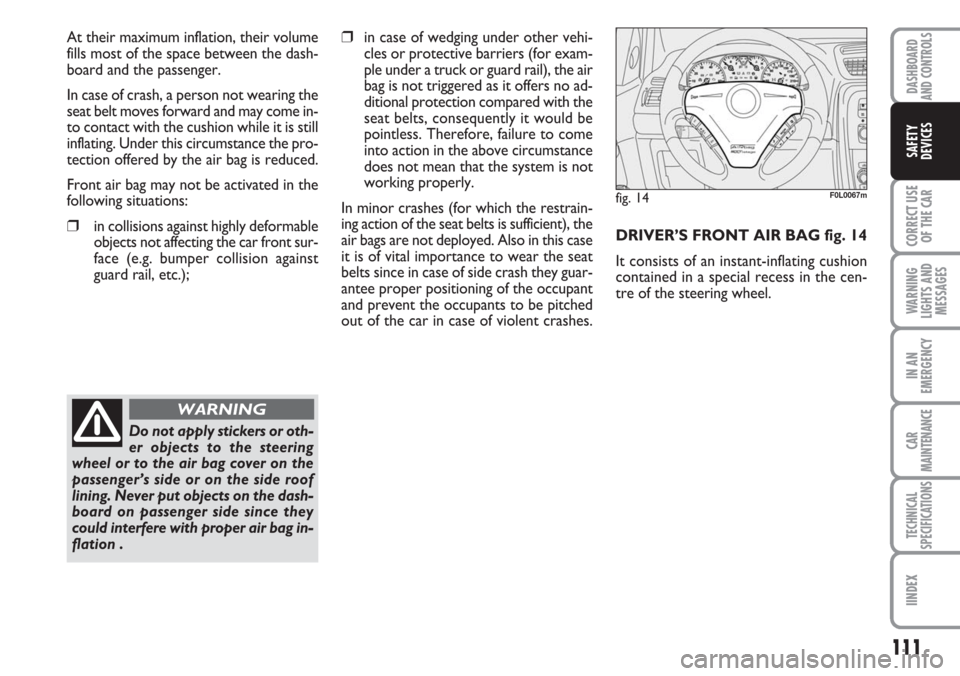
DRIVER’S FRONT AIR BAG fig. 14
It consists of an instant-inflating cushion
contained in a special recess in the cen-
tre of the steering wheel.
fig. 14F0L0067m
Page 112 of 240
112
CORRECT USE
OF THE CAR
WARNING
LIGHTS AND
MESSAGES
IN AN
EMERGENCY
CAR
MAINTENANCE
TECHNICAL
SPECIFICATIONS
INDEX
DASHBOARD
AND CONTROLS
SAFETY
DEVICES
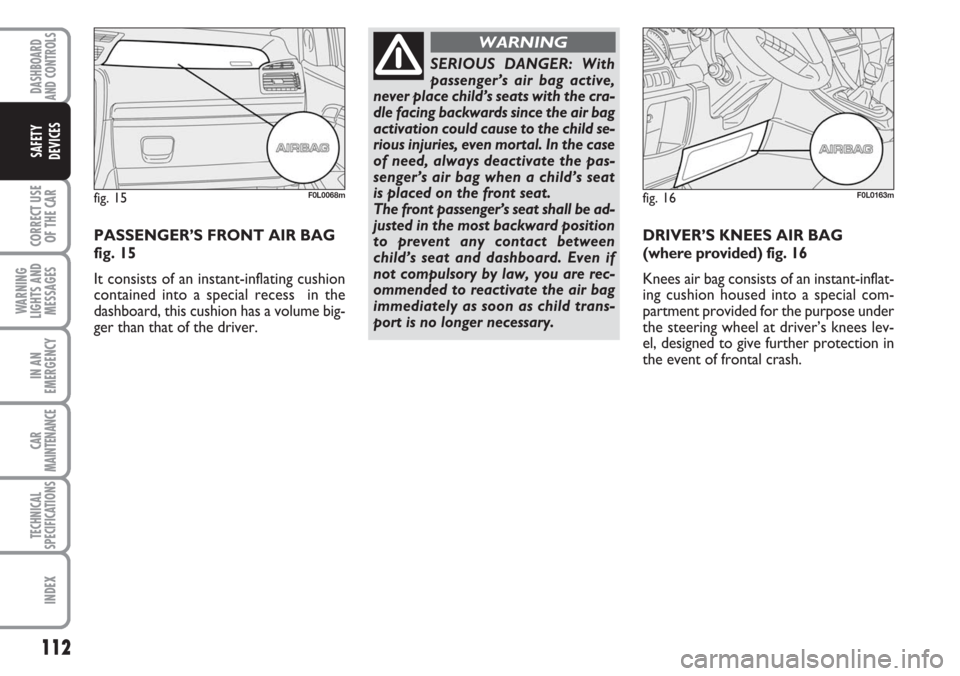
PASSENGER’S FRONT AIR BAG
fig. 15
It consists of an instant-inflating cushion
contained into a special recess in the
dashboard, this cushion has a volume big-
ger than that of the driver. DRIVER’S KNEES AIR BAG
(where provided) fig. 16
Knees air bag consists of an instant-inflat-
ing cushion housed into a special com-
partment provided for the purpose under
the steering wheel at driver’s knees lev-
el, designed to give further protection in
the event of frontal crash.
SERIOUS DANGER: With
passenger’s air bag active,
never place child’s seats with the cra-
dle facing backwards since the air bag
activation could cause to the child se-
rious injuries, even mortal. In the case
of need, always deactivate the pas-
senger’s air bag when a child’s seat
is placed on the front seat.
The front passenger’s seat shall be ad-
justed in the most backward position
to prevent any contact between
child’s seat and dashboard. Even if
not compulsory by law, you are rec-
ommended to reactivate the air bag
immediately as soon as child trans-
port is no longer necessary.
WARNING
fig. 15F0L0068mfig. 16F0L0163m
Page 117 of 240
117
CORRECT USE
OF THE CAR
WARNING
LIGHTS AND
MESSAGES
IN AN
EMERGENCY
CAR
MAINTENANCE
TECHNICAL
SPECIFICATIONS
IINDEX
DASHBOARD
AND CONTROLS
SAFETY
DEVICES
GENERAL WARNINGS
If when turning the ignition
key to ON, the warning light
ûdoes not turn on or if it stays on
when travelling (together with the
message on the display) there could
be a failure in safety systems; in this
event air bags or pretensioners could
not trigger in case of impact or, in a
minor number of cases, they could
trigger accidentally. Contact Fiat
Dealership immediately to have the
system checked.
WARNING
Do not cover the backrest of
front and rear seats with
trims or covers that are not suitable
to be used with side bags.
WARNING
Never travel with objects on
your lap, in front of your
chest or with a pipe, pencil, etc. be-
tween your lips; injury may result in
the event of the air bag being trig-
gered.
WARNING
Always keep your hands on
the steering wheel rim when
driving, so that if the air bag is trig-
gered, it can inflate without meeting
any obstacles which could cause seri-
ous harm to you. Do not drive with the
body bent forwards, keep the seat
back rest in the erect position and lean
your back well against it.
WARNING
If the car has been stolen or
an attempt to steal it has
been made, if it has been subjected to
vandals or floods, have the air bag
system checked by Fiat Dealership.
WARNING
Remember that with the key
fitted into the ignition device
even if the engine is not running, the
air bags may be triggered on a sta-
tionary car if it is bumped by anoth-
er moving car. Therefore, never seat
children on the front seat even when
the car is stationary. On the other
hand remember that if the key is not
fitted into the ignition device, no safe-
ty system (air bags or pretensioners)
is triggered in the event of an impact;
in this case, failure to come into ac-
tion cannot be considered as a sign
that the system is not working prop-
erly.
WARNING
Page 122 of 240
IMPORTANT If it is not possible to turn
the ignition key to ON, remove the emer-
gency key, fit it into slot A-fig. 1to un-
lock the ignition switch; then, turn the key
to ONand follow the starting procedure.
Contact Fiat Dealership.
IMPORTANT Never leave the ignition key
into the ignition switch when the engine
is off. In this event, when opening the dri-
ver’s door, a buzzer will sound for about
1 second.
HOW TO WARM UP THE
ENGINE AFTER IT HAS JUST
STARTED (petrol and diesel
engines)
Proceed as follows:
❒Drive off slowly, letting the engine turn
at medium revs. Do not accelerate
abruptly;
❒Do not drive at full performance for
the initial kilometres. Wait until the
coolant temperature gauge starts
moving.
122
WARNING
LIGHTS AND
MESSAGES
IN AN
EMERGENCY
CAR
MAINTENANCE
TECHNICAL
SPECIFICATIONS
INDEX
DASHBOARD
AND CONTROLS
SAFETY
DEVICES
CORRECT USE
OF THE CAR
Never bump start the engine
by pushing, towing or coasting
downhill as this could cause
fuel to flow into the catalytic
exhaust system and damage it beyond
repair.
A quick burst on the acceler-
ator before turning off the en-
gine serves absolutely no prac-
tical purpose, it wastes fuel
and is damaging especially to tur-
bocharged engines.
Remember that the servo-
brake and power steering
are not operational until the engine
has been started, therefore much ef-
fort than usual is required on the
brake pedal and steering wheel.
WARNING
STOPPING THE ENGINE
Turn the ignition key to OFFwhile the
engine is idling.
IMPORTANT After a taxing drive, you
should allow the engine to “catch its
breath” before turning it off by letting it
idle to allow the temperature in the en-
gine compartment to fall.
IMPORTANT If the engine is turned off
while the car is still moving, for safety rea-
sons it will be impossible to remove the
key from the ignition switch. To remove
the key, turn it to ONand then to OFF
with the car stopped without forcing at re-
moval.
Page 137 of 240
137
IN AN
EMERGENCY
CAR
MAINTENANCE
TECHNICAL
SPECIFICATIONS
INDEX
DASHBOARD
AND CONTROLS
SAFETY
DEVICES
CORRECT USE
OF THE CAR
WARNING
LIGHTS AND
MESSAGES
GENERAL WARNINGS ...................................................... 138
LOW BRAKE FLUID ............................................................ 138
HANDBRAKE ON ............................................................... 138
AIR BAG FAILURE................................................................ 138
FRONT PASSENGER AIR BAG DEACTIVATED ......... 139
SEAT BELTS NOT FASTENED ......................................... 139
ENGINE COOLANT FLUID HIGH TEMPERATURE .. 139
LOW BATTERY CHARGE................................................. 140
LOW ENGINE OIL PRESSURE ......................................... 140
EXHAUST OIL ...................................................................... 140
INEFFICIENT ABS SYSTEM ................................................ 140
INEFFICIENT EBD ELECTRONIC BRAKING
DISTRIBUTOR ..................................................................... 140
INJECTION SYSTEM FAILURE ......................................... 141
ENGINE CONTROL SYSTEM FAILURE
(EOBD) .................................................................................... 141
POWER STEERING FAILURE .......................................... 141
INCOMPLETE DOOR LOCKING ................................... 141
FUEL RESERVE....................................................................... 142
GLOW PLUGS ...................................................................... 142
GLOW PLUG WARMING FAILURE ............................... 142
FIAT CODE ............................................................................ 143
WATER IN DIESEL FUEL FILTER ..................................... 143
ALARM FAILURE ................................................................. 143
BREAK-IN ATTEMPT ......................................................... 143
ELECTRONIC KEY NOT RECOGNISED ..................... 143
CHECK CAR PROTECTION SYSTEM .......................... 143
DIESEL PARTICULATE FILTER CLOGGED ................. 144
REAR FOGLIGHTS............................................................... 144
FUEL CUTOFF SWITCHED ON...................................... 144
RAIN SENSOR FAILURE ................................................... 144
EXTERNAL LIGHT FAILURE............................................. 144
GENERIC FAILURE INDICATION .................................. 144
TWILIGHT SENSOR FAILURE.......................................... 145PARKING SENSOR FAILURE ............................................ 145
ANTIPINCH SYSTEM FAILURE ........................................ 145
LOW TYRE PRESSURE ....................................................... 145
FLAT TYRES ........................................................................... 145
TYRE PRESSURE MONITORING SYSTEM FAILURE 145
FRONT FOG LIGHTS ......................................................... 146
LEFT-HAND DIRECTION INDICATOR ....................... 146
RIGHT-HAND DIRECTION INDICATOR ................... 146
SIDELIGHTS AND LOW BEAMS ..................................... 146
FOLLOW ME HOME ........................................................... 146
ESP SYSTEM .......................................................................... 146
HILL HOLDER FAILURE .................................................... 146
ASR SYSTEM ......................................................................... 147
MAIN BEAM HEADLIGHTS............................................... 147
POSSIBLE PRESENCE OF ICE ON THE ROAD ........... 147
AUTOMATIC TRANSMISSION FAILURE .................... 147
MAX. OIL TEMPERATURE (a.t.) ..................................... 147
SET SPEED LIMIT
EXCEEDED ........................................................................... 148
CRUISE CONTROL ............................................................. 148
BRAKE PAD WEAR ............................................................ 148
LOW ENGINE OIL LEVEL ................................................ 148
REAR SIDE BAGS DEACTIVATED ................................. 148
ENGINE OFF WHEN RUNNING .................................. 148
STARTING PROCEDURE MESSAGES (a.t.) ................. 148
STARTING PROCEDURE MESSAGES (m.t.) .............. 148
W W
A A
R R
N N
I I
N N
G G
L L
I I
G G
H H
T T
S S
A A
N N
D D
M M
E E
S S
S S
A A
G G
E E
S S
Page 141 of 240
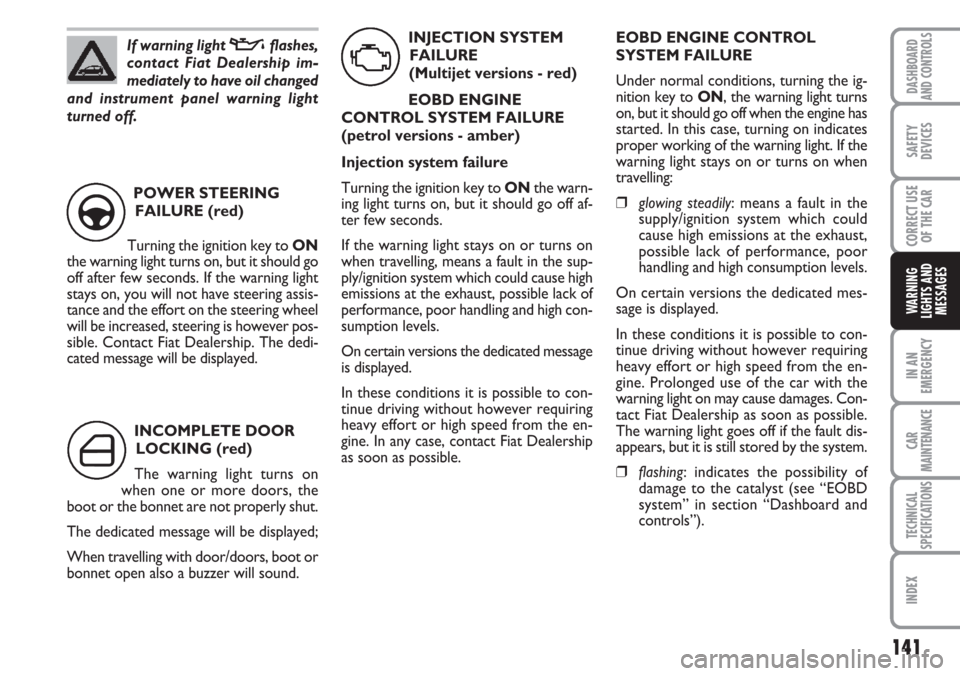
If warning light vflashes,
contact Fiat Dealership im-
mediately to have oil changed
and instrument panel warning light
turned off.
141
IN AN
EMERGENCY
CAR
MAINTENANCE
TECHNICAL
SPECIFICATIONS
INDEX
DASHBOARD
AND CONTROLS
SAFETY
DEVICES
CORRECT USE
OF THE CAR
WARNING
LIGHTS AND
MESSAGES
EOBD ENGINE CONTROL
SYSTEM FAILURE
Under normal conditions, turning the ig-
nition key to ON, the warning light turns
on, but it should go off when the engine has
started. In this case, turning on indicates
proper working of the warning light. If the
warning light stays on or turns on when
travelling:
❒glowing steadily: means a fault in the
supply/ignition system which could
cause high emissions at the exhaust,
possible lack of performance, poor
handling and high consumption levels.
On certain versions the dedicated mes-
sage is displayed.
In these conditions it is possible to con-
tinue driving without however requiring
heavy effort or high speed from the en-
gine. Prolonged use of the car with the
warning light on may cause damages. Con-
tact Fiat Dealership as soon as possible.
The warning light goes off if the fault dis-
appears, but it is still stored by the system.
❒flashing: indicates the possibility of
damage to the catalyst (see “EOBD
system” in section “Dashboard and
controls”). INJECTION SYSTEM
FAILURE
(Multijet versions - red)
EOBD ENGINE
CONTROL SYSTEM FAILURE
(petrol versions - amber)
Injection system failure
Turning the ignition key to ONthe warn-
ing light turns on, but it should go off af-
ter few seconds.
If the warning light stays on or turns on
when travelling, means a fault in the sup-
ply/ignition system which could cause high
emissions at the exhaust, possible lack of
performance, poor handling and high con-
sumption levels.
On certain versions the dedicated message
is displayed.
In these conditions it is possible to con-
tinue driving without however requiring
heavy effort or high speed from the en-
gine. In any case, contact Fiat Dealership
as soon as possible.
U
INCOMPLETE DOOR
LOCKING (red)
The warning light turns on
when one or more doors, the
boot or the bonnet are not properly shut.
The dedicated message will be displayed;
When travelling with door/doors, boot or
bonnet open also a buzzer will sound.
´
POWER STEERING
FAILURE (red)
Turning the ignition key to ON
the warning light turns on, but it should go
off after few seconds. If the warning light
stays on, you will not have steering assis-
tance and the effort on the steering wheel
will be increased, steering is however pos-
sible. Contact Fiat Dealership. The dedi-
cated message will be displayed.
g
Page 145 of 240

145
IN AN
EMERGENCY
CAR
MAINTENANCE
TECHNICAL
SPECIFICATIONS
INDEX
DASHBOARD
AND CONTROLS
SAFETY
DEVICES
CORRECT USE
OF THE CAR
WARNING
LIGHTS AND
MESSAGES
Parking sensor failure
(where provided)
The warning light on the dial turns on to-
gether with the message on the display
when failure is detected in parking sensors.
Contact Fiat Dealership.
Antipinch system failure
(where provided)
The warning light on the dial turns on to-
gether with the message on the display
when failure is detected in the antipinch
system.
Contact Fiat Dealership.
Twilight sensor failure
(where provided)
The warning light on the dial turns on (to-
gether with the message on the display)
when failure is detected in twilight sen-
sor (adjusting headlight sensitivity).Check tyre pressure
(where provided)
The warning light on the dial turns on (to-
gether with the message on the display),
when tyre pressure is low or excessive.
In this case, inflate tyres to the specified
pressure values (see paragraph “Inflating
pressures” in section “Technical Specifi-
cations”).
Flat tyres (where provided)
The warning light on the dial turns on (to-
gether with message on the display and
the buzzer), when there is a pressure drop
in one or more tyres. In this way the
T.P.M.S. system warns the driver that one
or more tyre/s is/are flat (i.e. punctured).
IMPORTANT Stop travelling with one or
more flat tyre/s since road holding could
be jeopardised. Stop the car without brak-
ing or steering sharply. Change immedi-
ately punctured wheel with space-saver
spare wheel (where provided - see sec-
tion “In an emergency”) and contact Fiat
Dealership as soon as possible.Tyre pressure monitoring system
failure (where provided)
The warning light on the dial turns on (to-
gether with the message on the display)
when a failure is detected in the T.P.M.S.
system (where provided).
Contact Fiat Dealership as soon as possi-
ble.
Should one or more wheels without sen-
sor be fitted, the instrument panel warn-
ing light will come on (together with the
message on the display) and stay on until
fitting again the four wheels with sensors.
Page 148 of 240
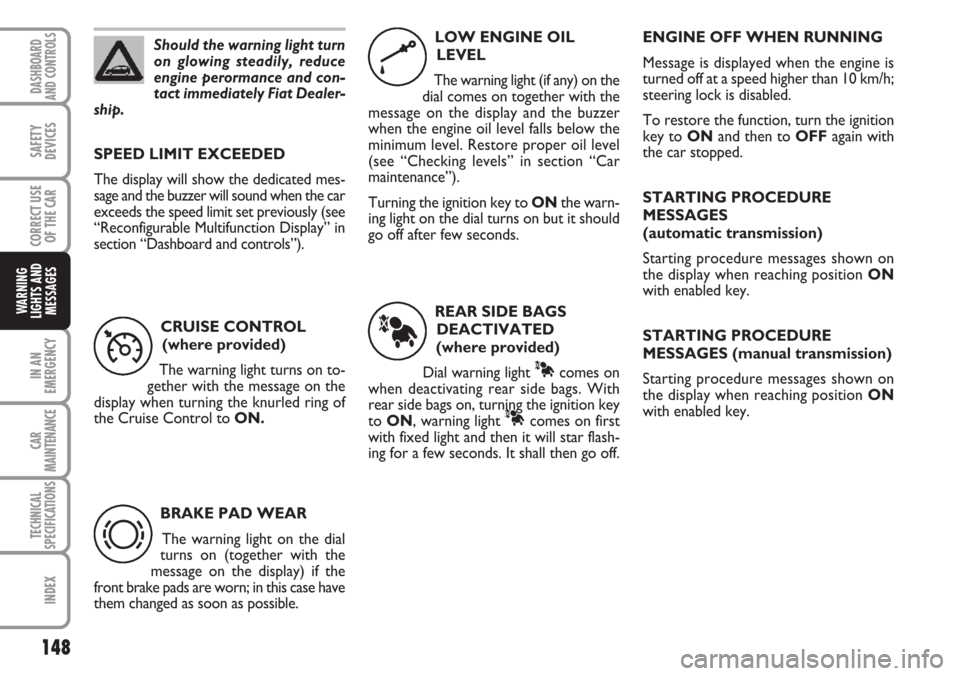
Should the warning light turn
on glowing steadily, reduce
engine perormance and con-
tact immediately Fiat Dealer-
ship.
148
IN AN
EMERGENCY
CAR
MAINTENANCE
TECHNICAL
SPECIFICATIONS
INDEX
DASHBOARD
AND CONTROLS
SAFETY
DEVICES
CORRECT USE
OF THE CAR
WARNING
LIGHTS AND
MESSAGES
SPEED LIMIT EXCEEDED
The display will show the dedicated mes-
sage and the buzzer will sound when the car
exceeds the speed limit set previously (see
“Reconfigurable Multifunction Display” in
section “Dashboard and controls”).
CRUISE CONTROL
(where provided)
The warning light turns on to-
gether with the message on the
display when turning the knurled ring of
the Cruise Control to ON.
BRAKE PAD WEAR
The warning light on the dial
turns on (together with the
message on the display) if the
front brake pads are worn; in this case have
them changed as soon as possible.LOW ENGINE OIL
LEVEL
The warning light (if any) on the
dial comes on together with the
message on the display and the buzzer
when the engine oil level falls below the
minimum level. Restore proper oil level
(see “Checking levels” in section “Car
maintenance”).
Turning the ignition key to ONthe warn-
ing light on the dial turns on but it should
go off after few seconds.
k
REAR SIDE BAGS
DEACTIVATED
(where provided)
Dial warning light
Àcomes on
when deactivating rear side bags. With
rear side bags on, turning the ignition key
to ON, warning light
Àcomes on first
with fixed light and then it will star flash-
ing for a few seconds. It shall then go off.
À
ENGINE OFF WHEN RUNNING
Message is displayed when the engine is
turned off at a speed higher than 10 km/h;
steering lock is disabled.
To restore the function, turn the ignition
key to ONand then to OFFagain with
the car stopped.
STARTING PROCEDURE
MESSAGES
(automatic transmission)
Starting procedure messages shown on
the display when reaching position ON
with enabled key.
STARTING PROCEDURE
MESSAGES (manual transmission)
Starting procedure messages shown on
the display when reaching position ON
with enabled key.
d
Ü
Page 151 of 240
151
WARNING
LIGHTS AND
MESSAGES
CAR
MAINTENANCE
TECHNICAL
SPECIFICATIONS
INDEX
DASHBOARD
AND CONTROLS
SAFETY
DEVICES
CORRECT USE
OF THE CAR
IN AN
EMERGENCY
IF A TYRE IS
PUNCTURED
GENERAL INSTRUCTIONS
Wheel changing and correct use of the
jack and space-saver spare wheel call for
some precautions as listed below.
BUMP STARTING
Never bump start the engine (by pushing,
towing, or coasting downhill) as this could
cause fuel to flow into the catalytic exhau-
st system and damage it beyond repair.
Remember that the brake booster and the
power steering system are not operating
until the engine is started, a greater effort
will therefore be required to press the
brake pedal or to turn the steering wheel.
Alert other drivers that the
car is stationary in com-
pliance with local regulations: hazard
warning lights, warning triangle etc.
Any passengers on board should lea-
ve the car, especially if it is heavily la-
den. Passengers should stay away
from oncoming traffic while the
wheel is being changed on. If the
wheel is being changed on a steep or
badly surfaced road, place the wed-
ges or other suitable material under
the wheel to stop the car.
WARNING
The space-saver spare wheel
is specific to your car, do not
use it on other models, or use the spa-
re wheel of other models on your car.
The space-saver spare wheel shall
only be used in an emergency.
It shall only be used for the distance
necessary to reach a service point and
the car speed shall not exceed 80
Km/h. The spare wheel has an oran-
ge sticker that summarises the main
cautions for use and limitations. The
sticker should never be removed or
covered.
Never fit a wheel cap on a space-sa-
ver spare wheel. The sticker gives the
following information in four langua-
ges: caution! For temporary use only!
80 km/h max! Replace by normal
wheel as soon as possible. Do not co-
ver this label.
WARNING
Page 174 of 240
174
WARNING
LIGHTS AND
MESSAGES
CAR
MAINTENANCE
TECHNICAL
SPECIFICATIONS
INDEX
DASHBOARD
AND CONTROLS
SAFETY
DEVICES
CORRECT USE
OF THE CAR
IN AN
EMERGENCY
F 12
F 13
F 31
F 32
F 33
F 34
F 35
F 36
F 37
F 38
F 39
F 40
F 41
F 42
F 43
F 44
F 45
F 4615
15
7.5
15
20
20
7.5
20
10
15
10
30
15
7.5
30
20
20
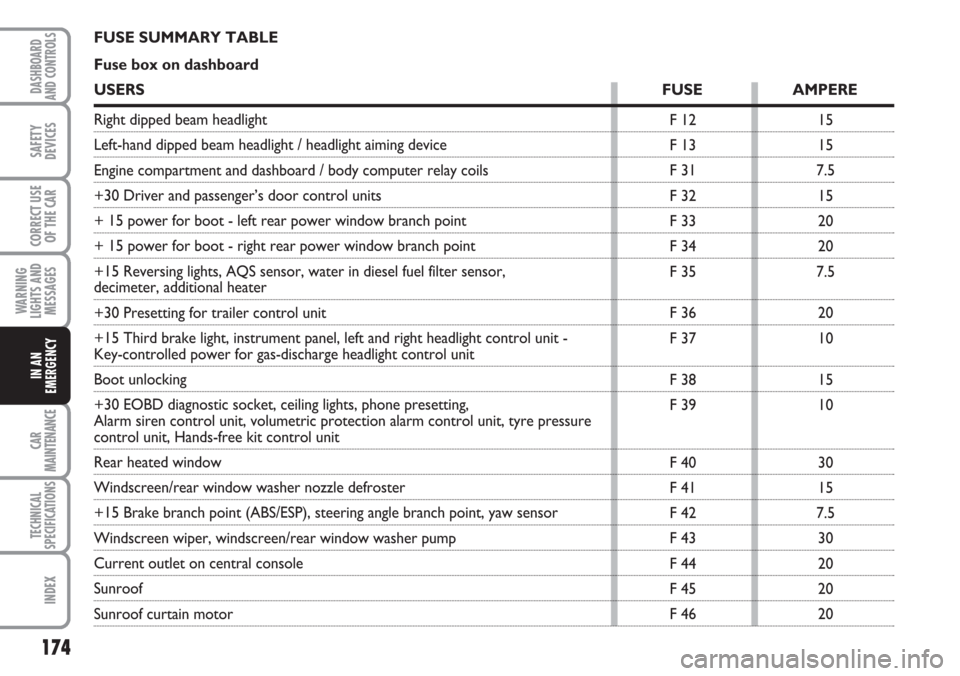
20 FUSE SUMMARY TABLE
Fuse box on dashboard
USERSFUSE AMPERE
Right dipped beam headlight
Left-hand dipped beam headlight / headlight aiming device
Engine compartment and dashboard / body computer relay coils
+30 Driver and passenger’s door control units
+ 15 power for boot - left rear power window branch point
+ 15 power for boot - right rear power window branch point
+15 Reversing lights, AQS sensor, water in diesel fuel filter sensor,
decimeter, additional heater
+30 Presetting for trailer control unit
+15 Third brake light, instrument panel, left and right headlight control unit -
Key-controlled power for gas-discharge headlight control unit
Boot unlocking
+30 EOBD diagnostic socket, ceiling lights, phone presetting,
Alarm siren control unit, volumetric protection alarm control unit, tyre pressure
control unit, Hands-free kit control unit
Rear heated window
Windscreen/rear window washer nozzle defroster
+15 Brake branch point (ABS/ESP), steering angle branch point, yaw sensor
Windscreen wiper, windscreen/rear window washer pump
Current outlet on central console
Sunroof
Sunroof curtain motor