bonnet FIAT CROMA 2006 2.G Owners Manual
[x] Cancel search | Manufacturer: FIAT, Model Year: 2006, Model line: CROMA, Model: FIAT CROMA 2006 2.GPages: 240, PDF Size: 7.41 MB
Page 4 of 240
4
SAFETY
DEVICES
CORRECT USE
OF THE CAR
WARNING
LIGHTS AND
MESSAGES
IN AN
EMERGENCY
CAR
MAINTENANCE
TECHNICAL
SPECIFICATIONS
INDEX
DASHBOARD
AND CONTROLSDASHBOARD ........................................................................ 5
INSTRUMENT PANEL ......................................................... 6
SYMBOLS ................................................................................. 7
THE FIAT CODE SYSTEM ................................................... 7
THE KEYS ................................................................................ 8
ALARM ..................................................................................... 12
IGNITION SWITCH.............................................................. 17
INSTRUMENTS ....................................................................... 18
SEATS ........................................................................................ 31
HEAD RESTRAINTS .............................................................. 34
STEERING WHEEL ............................................................... 35
REARVIEW MIRRORS ........................................................... 36
HEATING/CLIMATE
CONTROL SYSTEM ............................................................. 39
MANUAL CLIMATE CONTROL SYSTEM .................... 41
AUTOMATIC CLIMATE CONTROL SYSTEM ............ 44
EXTERNAL LIGHTS .............................................................. 54
WINDOW WASHING......................................................... 57
CRUISE CONTROL ............................................................. 60
CEILING LIGHTS .................................................................. 62
CONTROLS ........................................................................... 63
INTERIOR FITTINGS ............................................................ 66SUNROOF................................................................................ 70
DOORS .................................................................................... 73
POWER WINDOWS ........................................................... 74
BOOT ........................................................................................ 76
BONNET .................................................................................. 82
HEADLIGHTS .......................................................................... 85
ABS SYSTEM ........................................................................... 86
ESP SYSTEM ............................................................................ 88
ASR SYSTEM ........................................................................... 89
EOBD SYSTEM ....................................................................... 90
T.P.M.S. SYSTEM .................................................................... 91
SOUND SYSTEM .................................................................... 92
ACCESSORIES PURCHASED BY THE OWNER .......... 93
PARKING SENSORS ............................................................ 94
AT THE FILLING STATION .............................................. 95
PROTECTING THE ENVIRONMENT ............................ 97
DIESEL PARTICULATE FILTER (DPF) ............................. 98
D D
A A
S S
H H
B B
O O
A A
R R
D D
A A
N N
D D
C C
O O
N N
T T
R R
O O
L L
S S
001-030 Croma TRW GB 20-11-2006 14:58 Pagina 4
Page 7 of 240
THE FIAT CODE SYSTEM
To further protect your car from theft, it
has been fitted with an engine immobilising
system. This system is automatically acti-
vated when the ignition key is removed.
An electronic device, in fact, is fitted in each
ignition key grip. The device transmits a ra-
dio-frequency signal when the engine is
started through a special aerial built into the
ignition switch. The modulate signal, which
changes each time the engine is started, is
the “password”, by means of which the
control unit recognises the key and enables
to start the engine.
OPERATION
Each time the key is fitted into the ignition
switch, the Fiat CODE system control unit
sends a recognition code to the engine con-
trol unit to deactivate the inhibitor.
The code is sent only if the Fiat CODE sys-
tem control unit has recognised the code
transmitted from the key.
Each time the ignition key is removed, the
Fiat CODE system deactivates the func-
tions of the engine electronic control unit.
If the code has not been recognised cor-
rectly, the warning light
Yturns on ac-
companied by the related message on the
display (see chapter “Warning lights and
messages”).
SYMBOLS
Special coloured labels have been attached
near or actually on some of the compo-
nents of your car. These labels bear sym-
bols that remind you of the precautions
to be taken as regards that particular com-
ponent.
7
SAFETY
DEVICES
CORRECT USE
OF THE CAR
WARNING
LIGHTS AND
MESSAGES
IN AN
EMERGENCY
CAR
MAINTENANCE
TECHNICAL
SPECIFICATIONS
INDEX
DASHBOARD
AND CONTROLS
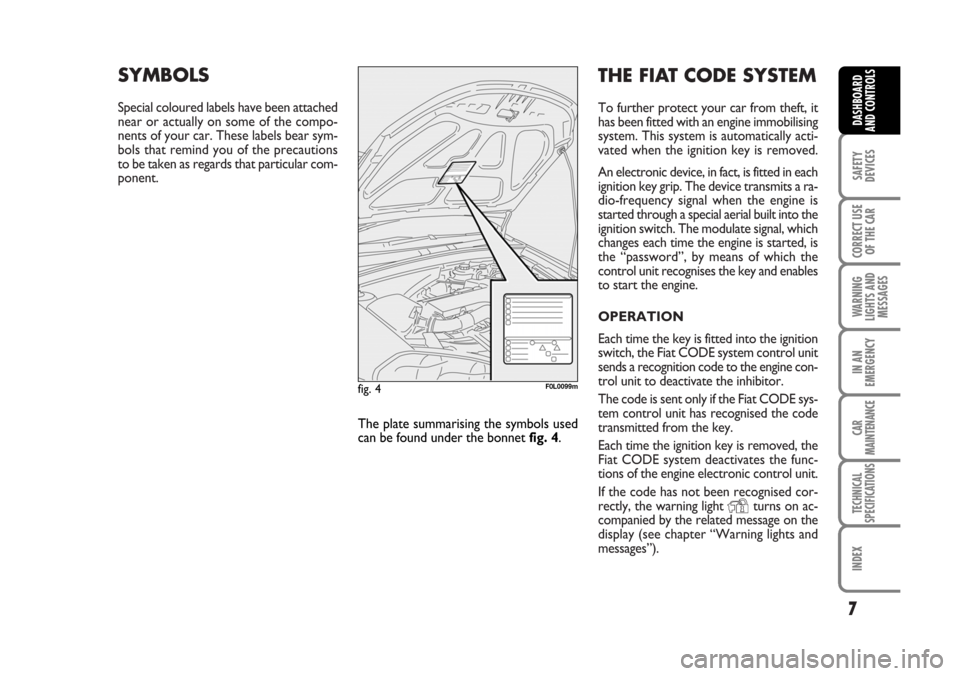
The plate summarising the symbols used
can be found under the bonnet fig. 4.
fig. 4F0L0099m
001-030 Croma TRW GB 20-11-2006 14:58 Pagina 7
Page 12 of 240
ALARM
(where provided)
WHEN THE ALARM
IS TRIGGERED
The alarm comes into action in the fol-
lowing cases:
❒unlawful opening of one of the doors,
bonnet or boot (perimetral protec-
tion);
❒attempt to start the engine with unau-
thorised key;
❒battery cable cutting;
❒presence of moving bodies in the pas-
senger’s compartment (volumetric
protection);
❒abnormal raising/sloping of the car.
Depending on the markets, the cutting in
of the alarm causes operation of the siren
and direction indicators (for about 26 sec-
onds). The ways of operating and the num-
ber of cycles may vary depending on the
markets.
A maximum number of sound/sight cycles
is however envisaged.
12
SAFETY
DEVICES
CORRECT USE
OF THE CAR
WARNING
LIGHTS AND
MESSAGES
IN AN
EMERGENCY
CAR
MAINTENANCE
TECHNICAL
SPECIFICATIONS
INDEX
DASHBOARD
AND CONTROLS
Volumetric and anti-raising protections
can be cut off by operating the front ceil-
ing light controls (see paragraphs “Volu-
metric protection sensors” and “Anti-rais-
ing sensor” on the following pages).
IMPORTANT The engine immobiliser
function is guaranteed by the Fiat CODE
system, which is automatically activated
when the ignition key is removed.
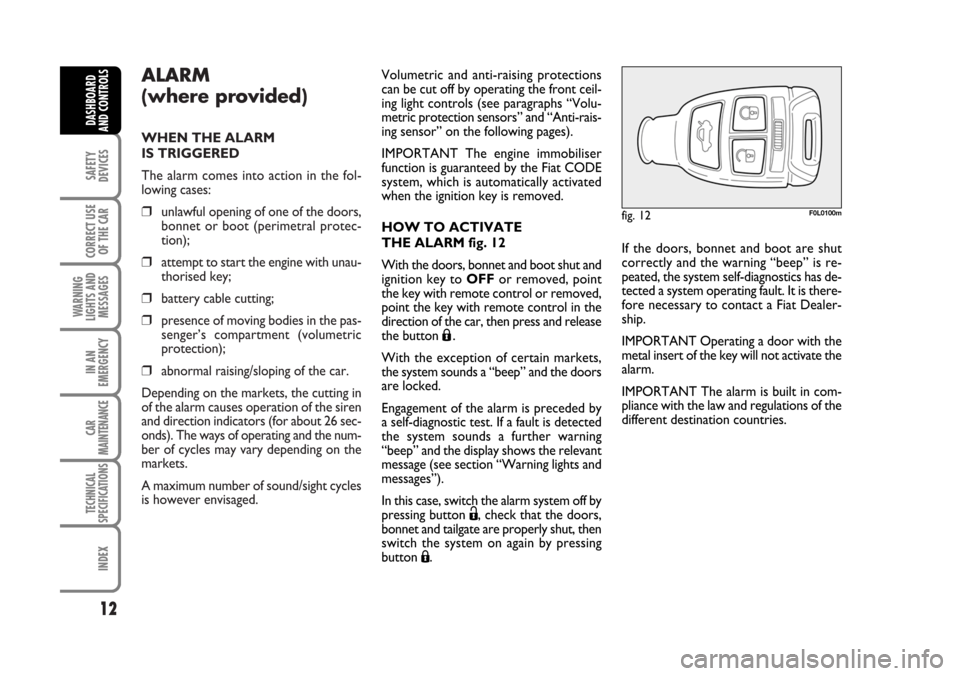
HOW TO ACTIVATE
THE ALARM fig. 12
With the doors, bonnet and boot shut and
ignition key to OFFor removed, point
the key with remote control or removed,
point the key with remote control in the
direction of the car, then press and release
the button
Á.
With the exception of certain markets,
the system sounds a “beep” and the doors
are locked.
Engagement of the alarm is preceded by
a self-diagnostic test. If a fault is detected
the system sounds a further warning
“beep” and the display shows the relevant
message (see section “Warning lights and
messages”).
In this case, switch the alarm system off by
pressing button Ë, check that the doors,
bonnet and tailgate are properly shut, then
switch the system on again by pressing
button Á.
fig. 12F0L0100m
If the doors, bonnet and boot are shut
correctly and the warning “beep” is re-
peated, the system self-diagnostics has de-
tected a system operating fault. It is there-
fore necessary to contact a Fiat Dealer-
ship.
IMPORTANT Operating a door with the
metal insert of the key will not activate the
alarm.
IMPORTANT The alarm is built in com-
pliance with the law and regulations of the
different destination countries.
001-030 Croma TRW GB 20-11-2006 14:58 Pagina 12
Page 13 of 240
13
SAFETY
DEVICES
CORRECT USE
OF THE CAR
WARNING
LIGHTS AND
MESSAGES
IN AN
EMERGENCY
CAR
MAINTENANCE
TECHNICAL
SPECIFICATIONS
INDEX
DASHBOARD
AND CONTROLS
HOW TO DEACTIVATE
THE ALARM fig. 12
Press button
Ëof the key with remote
control.
The system will react as follows (with the
exception of certain markets):
❒two brief flashes of the direction in-
dicators;
❒two brief “beeps”;
❒door unlocking.
IMPORTANT Operating a door with the
metal insert of the key will not activate the
alarm.
To deactivate the alarm, turn the ignition
key to ON.
fig. 13F0L0171m
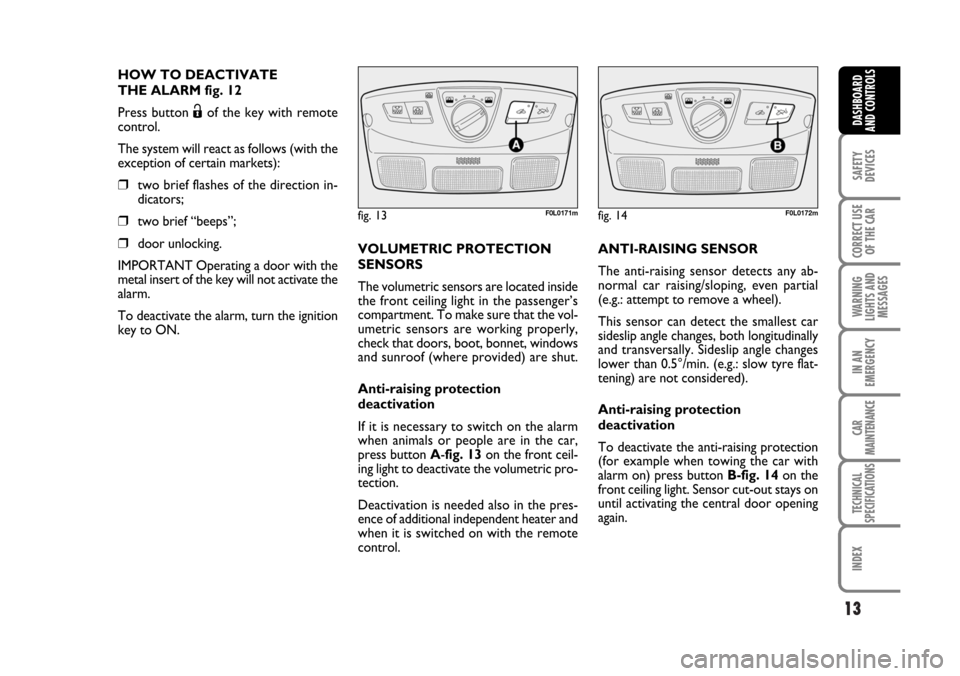
VOLUMETRIC PROTECTION
SENSORS
The volumetric sensors are located inside
the front ceiling light in the passenger’s
compartment. To make sure that the vol-
umetric sensors are working properly,
check that doors, boot, bonnet, windows
and sunroof (where provided) are shut.
Anti-raising protection
deactivation
If it is necessary to switch on the alarm
when animals or people are in the car,
press button A-fig. 13 on the front ceil-
ing light to deactivate the volumetric pro-
tection.
Deactivation is needed also in the pres-
ence of additional independent heater and
when it is switched on with the remote
control.
fig. 14F0L0172m
ANTI-RAISING SENSOR
The anti-raising sensor detects any ab-
normal car raising/sloping, even partial
(e.g.: attempt to remove a wheel).
This sensor can detect the smallest car
sideslip angle changes, both longitudinally
and transversally. Sideslip angle changes
lower than 0.5°/min. (e.g.: slow tyre flat-
tening) are not considered).
Anti-raising protection
deactivation
To deactivate the anti-raising protection
(for example when towing the car with
alarm on) press button B-fig. 14on the
front ceiling light. Sensor cut-out stays on
until activating the central door opening
again.
001-030 Croma TRW GB 20-11-2006 14:58 Pagina 13
Page 65 of 240
65
SAFETY
DEVICES
CORRECT USE
OF THE CAR
WARNING
LIGHTS AND
MESSAGES
IN AN
EMERGENCY
CAR
MAINTENANCE
TECHNICAL
SPECIFICATIONS
INDEX
DASHBOARD
AND CONTROLS
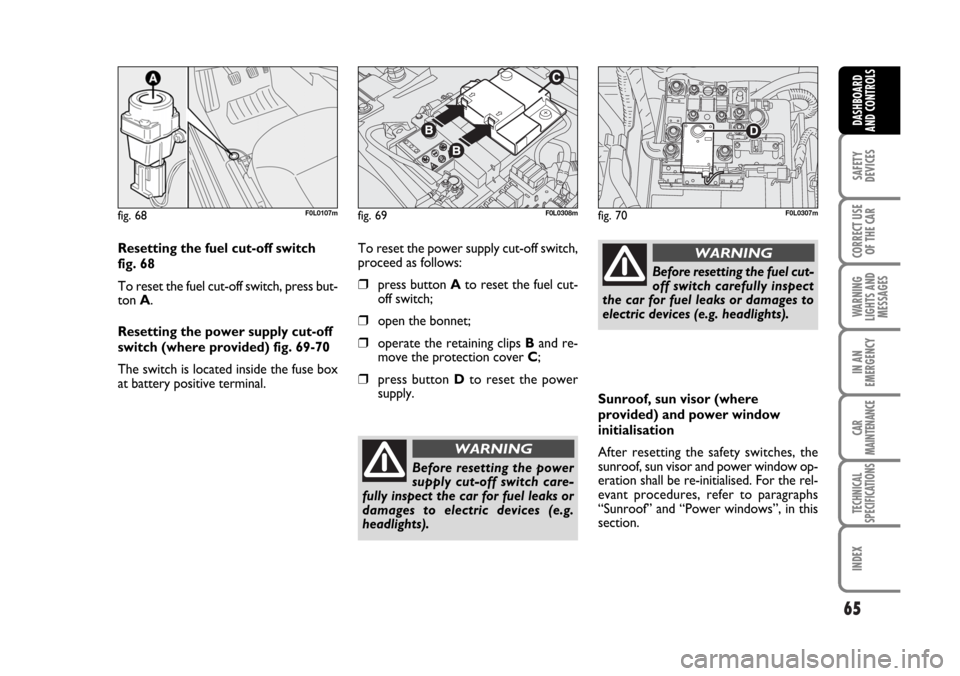
Resetting the fuel cut-off switch
fig. 68
To reset the fuel cut-off switch, press but-
ton A.
Resetting the power supply cut-off
switch (where provided) fig. 69-70
The switch is located inside the fuse box
at battery positive terminal.To reset the power supply cut-off switch,
proceed as follows:
❒press button Ato reset the fuel cut-
off switch;
❒open the bonnet;
❒operate the retaining clips Band re-
move the protection cover C;
❒press button Dto reset the power
supply.
fig. 68F0L0107mfig. 69F0L0308mfig. 70F0L0307m
Before resetting the power
supply cut-off switch care-
fully inspect the car for fuel leaks or
damages to electric devices (e.g.
headlights).
WARNING
Before resetting the fuel cut-
off switch carefully inspect
the car for fuel leaks or damages to
electric devices (e.g. headlights).
WARNING
Sunroof, sun visor (where
provided) and power window
initialisation
After resetting the safety switches, the
sunroof, sun visor and power window op-
eration shall be re-initialised. For the rel-
evant procedures, refer to paragraphs
“Sunroof” and “Power windows”, in this
section.
062-098 Croma TRW GB 20-11-2006 15:01 Pagina 65
Page 82 of 240
82
SAFETY
DEVICES
CORRECT USE
OF THE CAR
WARNING
LIGHTS AND
MESSAGES
IN AN
EMERGENCY
CAR
MAINTENANCE
TECHNICAL
SPECIFICATIONS
INDEX
DASHBOARD
AND CONTROLS
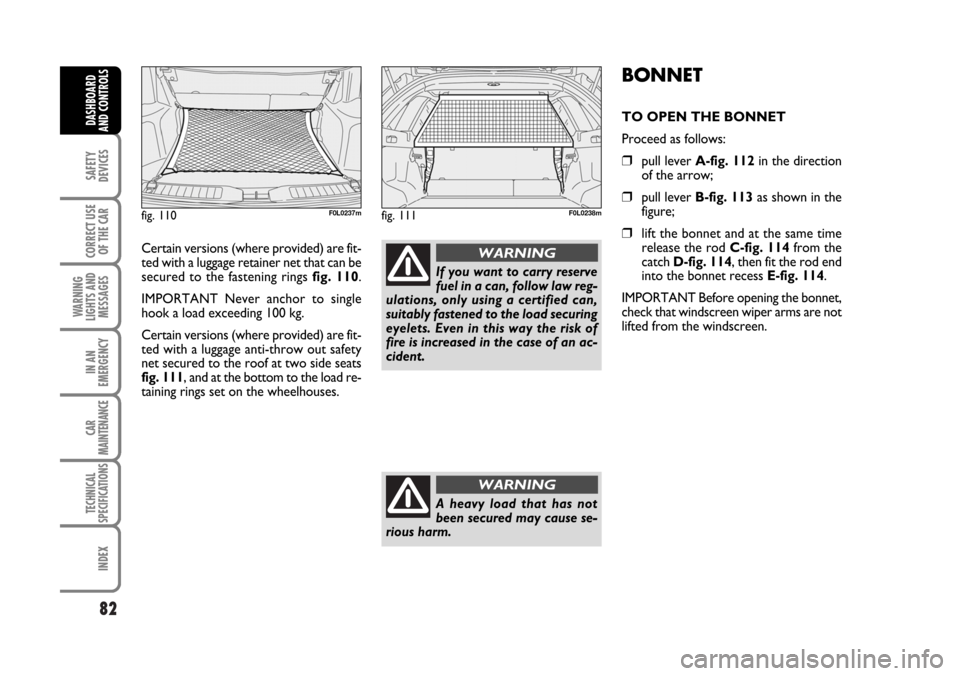
Certain versions (where provided) are fit-
ted with a luggage retainer net that can be
secured to the fastening rings fig. 110.
IMPORTANT Never anchor to single
hook a load exceeding 100 kg.
Certain versions (where provided) are fit-
ted with a luggage anti-throw out safety
net secured to the roof at two side seats
fig. 111, and at the bottom to the load re-
taining rings set on the wheelhouses.
BONNET
TO OPEN THE BONNET
Proceed as follows:
❒pull lever A-fig. 112in the direction
of the arrow;
❒pull lever B-fig. 113as shown in the
figure;
❒lift the bonnet and at the same time
release the rod C-fig. 114from the
catch D-fig. 114, then fit the rod end
into the bonnet recess E-fig. 114.
IMPORTANT Before opening the bonnet,
check that windscreen wiper arms are not
lifted from the windscreen.
fig. 110F0L0237mfig. 111F0L0238m
If you want to carry reserve
fuel in a can, follow law reg-
ulations, only using a certified can,
suitably fastened to the load securing
eyelets. Even in this way the risk of
fire is increased in the case of an ac-
cident.
WARNING
A heavy load that has not
been secured may cause se-
rious harm.
WARNING
062-098 Croma TRW GB 20-11-2006 15:01 Pagina 82
Page 83 of 240
83
SAFETY
DEVICES
CORRECT USE
OF THE CAR
WARNING
LIGHTS AND
MESSAGES
IN AN
EMERGENCY
CAR
MAINTENANCE
TECHNICAL
SPECIFICATIONS
INDEX
DASHBOARD
AND CONTROLS
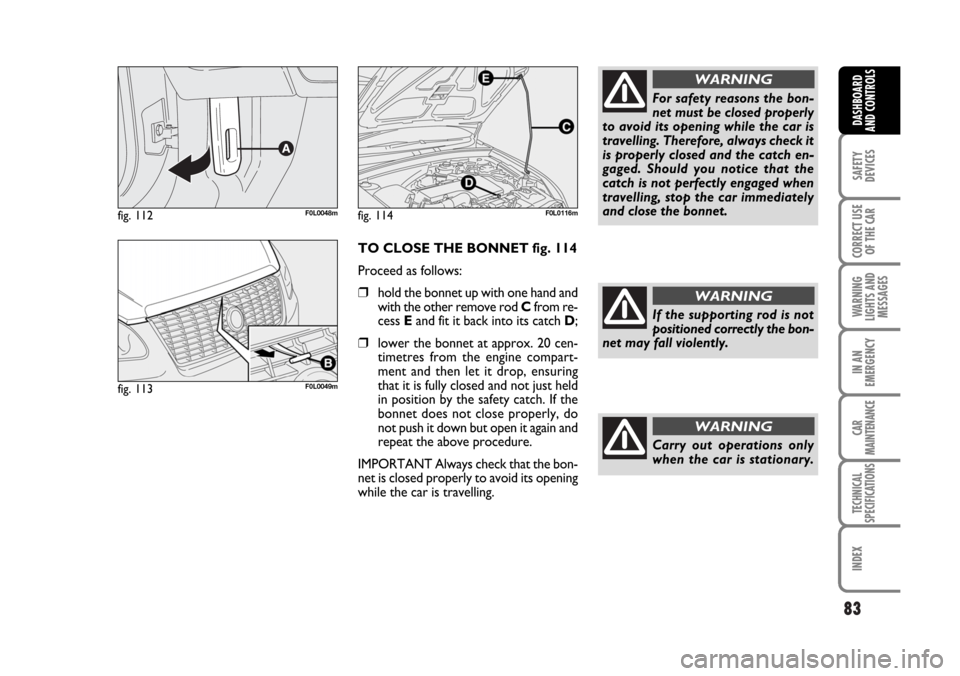
TO CLOSE THE BONNET fig. 114
Proceed as follows:
❒hold the bonnet up with one hand and
with the other remove rod Cfrom re-
cess Eand fit it back into its catch D;
❒lower the bonnet at approx. 20 cen-
timetres from the engine compart-
ment and then let it drop, ensuring
that it is fully closed and not just held
in position by the safety catch. If the
bonnet does not close properly, do
not push it down but open it again and
repeat the above procedure.
IMPORTANT Always check that the bon-
net is closed properly to avoid its opening
while the car is travelling.
fig. 112F0L0048m
fig. 113F0L0049m
fig. 114F0L0116m
For safety reasons the bon-
net must be closed properly
to avoid its opening while the car is
travelling. Therefore, always check it
is properly closed and the catch en-
gaged. Should you notice that the
catch is not perfectly engaged when
travelling, stop the car immediately
and close the bonnet.
WARNING
If the supporting rod is not
positioned correctly the bon-
net may fall violently.
WARNING
Carry out operations only
when the car is stationary.
WARNING
062-098 Croma TRW GB 20-11-2006 15:01 Pagina 83
Page 141 of 240
If warning light vflashes,
contact Fiat Dealership im-
mediately to have oil changed
and instrument panel warning light
turned off.
141
IN AN
EMERGENCY
CAR
MAINTENANCE
TECHNICAL
SPECIFICATIONS
INDEX
DASHBOARD
AND CONTROLS
SAFETY
DEVICES
CORRECT USE
OF THE CAR
WARNING
LIGHTS AND
MESSAGES
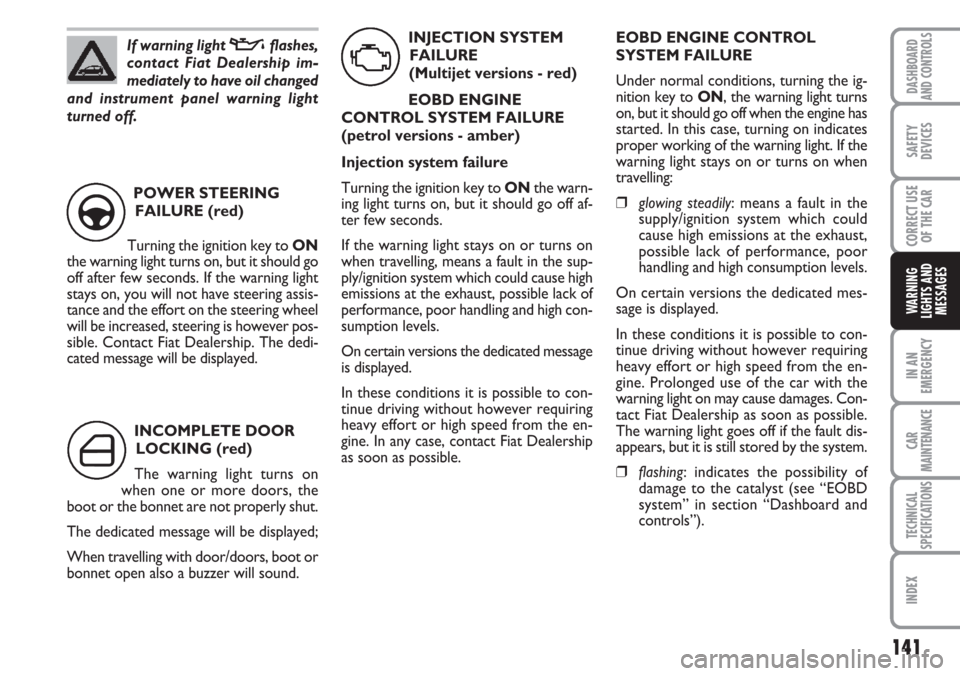
EOBD ENGINE CONTROL
SYSTEM FAILURE
Under normal conditions, turning the ig-
nition key to ON, the warning light turns
on, but it should go off when the engine has
started. In this case, turning on indicates
proper working of the warning light. If the
warning light stays on or turns on when
travelling:
❒glowing steadily: means a fault in the
supply/ignition system which could
cause high emissions at the exhaust,
possible lack of performance, poor
handling and high consumption levels.
On certain versions the dedicated mes-
sage is displayed.
In these conditions it is possible to con-
tinue driving without however requiring
heavy effort or high speed from the en-
gine. Prolonged use of the car with the
warning light on may cause damages. Con-
tact Fiat Dealership as soon as possible.
The warning light goes off if the fault dis-
appears, but it is still stored by the system.
❒flashing: indicates the possibility of
damage to the catalyst (see “EOBD
system” in section “Dashboard and
controls”). INJECTION SYSTEM
FAILURE
(Multijet versions - red)
EOBD ENGINE
CONTROL SYSTEM FAILURE
(petrol versions - amber)
Injection system failure
Turning the ignition key to ONthe warn-
ing light turns on, but it should go off af-
ter few seconds.
If the warning light stays on or turns on
when travelling, means a fault in the sup-
ply/ignition system which could cause high
emissions at the exhaust, possible lack of
performance, poor handling and high con-
sumption levels.
On certain versions the dedicated message
is displayed.
In these conditions it is possible to con-
tinue driving without however requiring
heavy effort or high speed from the en-
gine. In any case, contact Fiat Dealership
as soon as possible.
U
INCOMPLETE DOOR
LOCKING (red)
The warning light turns on
when one or more doors, the
boot or the bonnet are not properly shut.
The dedicated message will be displayed;
When travelling with door/doors, boot or
bonnet open also a buzzer will sound.
´
POWER STEERING
FAILURE (red)
Turning the ignition key to ON
the warning light turns on, but it should go
off after few seconds. If the warning light
stays on, you will not have steering assis-
tance and the effort on the steering wheel
will be increased, steering is however pos-
sible. Contact Fiat Dealership. The dedi-
cated message will be displayed.
g
Page 185 of 240
185
WARNING
LIGHTS AND
MESSAGES
TECHNICAL
SPECIFICATIONS
INDEX
DASHBOARD
AND CONTROLS
SAFETY
DEVICES
CORRECT USE
OF THE CAR
IN AN
EMERGENCY
CAR
MAINTENANCE
30 60 90 120 150 180
●●●●●●
●●●●●●
●●●●●●
●●●●●●
●●●●●●
●●●
●●●●●●
●●●●●●
●●●●●●
●●●●●●
●●●
●●
●●
●●
●●●
●
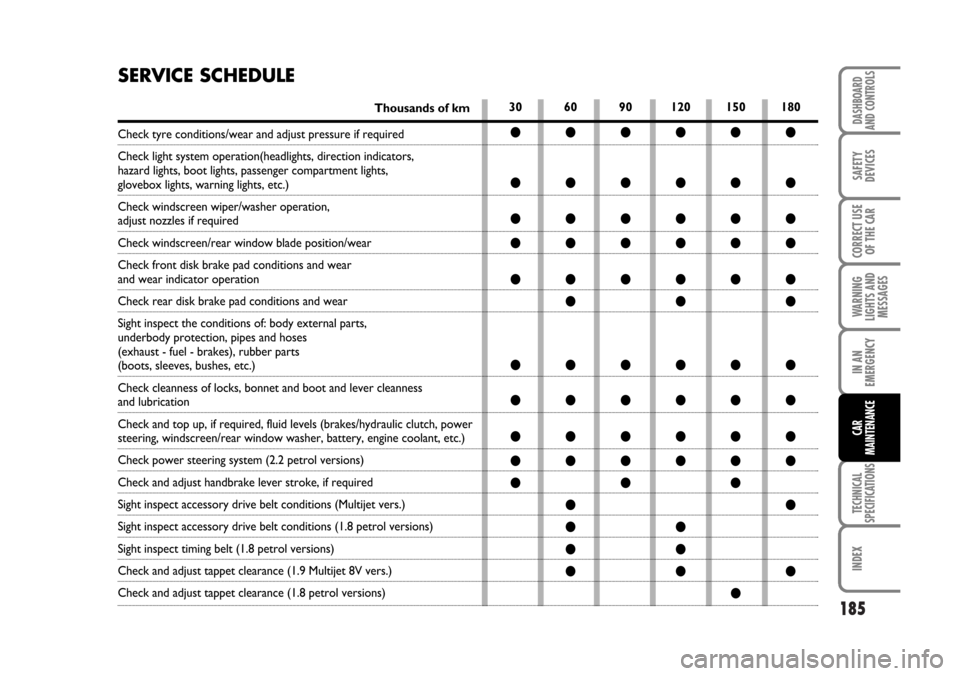
SERVICE SCHEDULE
Thousands of km
Check tyre conditions/wear and adjust pressure if required
Check light system operation(headlights, direction indicators,
hazard lights, boot lights, passenger compartment lights,
glovebox lights, warning lights, etc.)
Check windscreen wiper/washer operation,
adjust nozzles if required
Check windscreen/rear window blade position/wear
Check front disk brake pad conditions and wear
and wear indicator operation
Check rear disk brake pad conditions and wear
Sight inspect the conditions of: body external parts,
underbody protection, pipes and hoses
(exhaust - fuel - brakes), rubber parts
(boots, sleeves, bushes, etc.)
Check cleanness of locks, bonnet and boot and lever cleanness
and lubrication
Check and top up, if required, fluid levels (brakes/hydraulic clutch, power
steering, windscreen/rear window washer, battery, engine coolant, etc.)
Check power steering system (2.2 petrol versions)
Check and adjust handbrake lever stroke, if required
Sight inspect accessory drive belt conditions (Multijet vers.)
Sight inspect accessory drive belt conditions (1.8 petrol versions)
Sight inspect timing belt (1.8 petrol versions)
Check and adjust tappet clearance (1.9 Multijet 8V vers.)
Check and adjust tappet clearance (1.8 petrol versions)
183-206 Croma TRW GB 20-11-2006 15:03 Pagina 185
Page 187 of 240

187
WARNING
LIGHTS AND
MESSAGES
TECHNICAL
SPECIFICATIONS
INDEX
DASHBOARD
AND CONTROLS
SAFETY
DEVICES
CORRECT USE
OF THE CAR
IN AN
EMERGENCY
CAR
MAINTENANCE
❒check cleanness of locks, bonnet and
boot and lever cleanness and lubrica-
tion;
❒sight inspect the conditions of: engine,
gearbox, transmission, pipes and hoses
(exhaust - fuel - brakes), rubber parts
(boots, sleeves, bushes, etc.);
❒check battery charge and fluid level
(electrolyte);
❒visual check on various drive belt con-
ditions;
❒check and replace pollen filter, if re-
quired;
❒check and replace air cleaner, if re-
quired.
ROUTINE
MAINTENANCE
Every 1,000 km or before long journeys,
check and top up if required:
❒engine coolant fluid level;
❒brake fluid level;
❒windscreen washer fluid level;
❒tyre pressure and conditions;
❒light system operation (headlights, di-
rection indicators, hazard lights, etc.);
❒windscreen wiper/washer operation
and windscreen/rear window blade
position/wear;
Every 3,000 km check and top up if re-
quired: engine oil level.
You are recommended to use FL
Selenia, products, designed and pro-
duced specifically for Fiat cars (see table
“Capacities” in section “Technical speci-
fications”).
HEAVY-DUTY
Should prevailing use of the car be under
one of the following specially heavy con-
ditions:
❒trailer or caravan towing;
❒dusty roads;
❒short distances (less than 7-8 km) re-
peated and with external tempera-
tures below zero;
❒frequently idling engines or long dis-
tance low speed driving (e.g. door-to-
door deliveries) or in case of a long
term inactivity;
❒driving in the city;
carry out the following checks more fre-
quently than required in the Service
Schedule:
❒check front disk brake pad conditions
and wear;
183-206 Croma TRW GB 20-11-2006 15:03 Pagina 187