oil level FIAT CROMA 2006 2.G Owners Manual
[x] Cancel search | Manufacturer: FIAT, Model Year: 2006, Model line: CROMA, Model: FIAT CROMA 2006 2.GPages: 240, PDF Size: 7.41 MB
Page 130 of 240
Roof rack/ski rack
Remove the roof rack or the ski rack from
the roof as soon as they are no longer
used. These accessories lower air pene-
tration and adversely affect consumption
levels. When needing to carry particular-
ly voluminous objects, preferably use a
trailer.
Electric devices
Use electric devices only for the amount
of time needed. Rear heated window, ad-
ditional headlights, windscreen wipers and
heater fan need a considerable amount of
energy, therefore increasing the require-
ment of current increases fuel consump-
tion (up to +25% in the urban cycle).
Climate control
The air conditioner is an additional load
which greatly affects the engine leading to
higher consumption (on average up to
+20%). When the temperature outside
the car permits it, use the air vents where
possible.
Spoilers
The use of non-certified aerodynamic
items may adversely affect air drag and
consumption levels.DRIVING STYLE
Starting
Do not warm the engine with the car at
a standstill or at idle or high speed: under
these conditions the engine warms up
much more slowly, increasing electrical
consumption and emissions. It is therefore
advisable to move off immediately, slow-
ly, avoiding high speeds. This way the en-
gine will warm faster.
Unnecessary actions
Avoid accelerating when waiting at traffic
lights or before switching off the engine.
This and also double declutching is ab-
solutely pointless on modern cars and al-
so increase consumption and pollution.
Gear selection
As soon as the conditions of the traffic and
road allow, use a higher gear. Using a low
gear to obtain brilliant performance in-
creases consumption.
In the same way improper use of a high
gear increases consumption, emissions an
engine wear.CONTAINING
RUNNING COSTS
Here are some suggestions which may
help you to keep the running costs of your
car down and lower the amount of toxic
emissions released into the atmosphere.
GENERAL CONSIDERATIONS
Car maintenance
Have checks and adjustments carried out
in accordance with the “Service schedule”.
Tyres
Check the pressure of the tyres routine-
ly at an interval of no more than 4 weeks:
if the pressure is too low, consumption
levels increase as resistance to rolling is
higher.
Unnecessary loads
Do not travel with too much luggage
stowed in the boot. The weight of the car
(especially when driving in town) and its
trim greatly affects consumption and sta-
bility.
130
WARNING
LIGHTS AND
MESSAGES
IN AN
EMERGENCY
CAR
MAINTENANCE
TECHNICAL
SPECIFICATIONS
INDEX
DASHBOARD
AND CONTROLS
SAFETY
DEVICES
CORRECT USE
OF THE CAR
Page 137 of 240
137
IN AN
EMERGENCY
CAR
MAINTENANCE
TECHNICAL
SPECIFICATIONS
INDEX
DASHBOARD
AND CONTROLS
SAFETY
DEVICES
CORRECT USE
OF THE CAR
WARNING
LIGHTS AND
MESSAGES
GENERAL WARNINGS ...................................................... 138
LOW BRAKE FLUID ............................................................ 138
HANDBRAKE ON ............................................................... 138
AIR BAG FAILURE................................................................ 138
FRONT PASSENGER AIR BAG DEACTIVATED ......... 139
SEAT BELTS NOT FASTENED ......................................... 139
ENGINE COOLANT FLUID HIGH TEMPERATURE .. 139
LOW BATTERY CHARGE................................................. 140
LOW ENGINE OIL PRESSURE ......................................... 140
EXHAUST OIL ...................................................................... 140
INEFFICIENT ABS SYSTEM ................................................ 140
INEFFICIENT EBD ELECTRONIC BRAKING
DISTRIBUTOR ..................................................................... 140
INJECTION SYSTEM FAILURE ......................................... 141
ENGINE CONTROL SYSTEM FAILURE
(EOBD) .................................................................................... 141
POWER STEERING FAILURE .......................................... 141
INCOMPLETE DOOR LOCKING ................................... 141
FUEL RESERVE....................................................................... 142
GLOW PLUGS ...................................................................... 142
GLOW PLUG WARMING FAILURE ............................... 142
FIAT CODE ............................................................................ 143
WATER IN DIESEL FUEL FILTER ..................................... 143
ALARM FAILURE ................................................................. 143
BREAK-IN ATTEMPT ......................................................... 143
ELECTRONIC KEY NOT RECOGNISED ..................... 143
CHECK CAR PROTECTION SYSTEM .......................... 143
DIESEL PARTICULATE FILTER CLOGGED ................. 144
REAR FOGLIGHTS............................................................... 144
FUEL CUTOFF SWITCHED ON...................................... 144
RAIN SENSOR FAILURE ................................................... 144
EXTERNAL LIGHT FAILURE............................................. 144
GENERIC FAILURE INDICATION .................................. 144
TWILIGHT SENSOR FAILURE.......................................... 145PARKING SENSOR FAILURE ............................................ 145
ANTIPINCH SYSTEM FAILURE ........................................ 145
LOW TYRE PRESSURE ....................................................... 145
FLAT TYRES ........................................................................... 145
TYRE PRESSURE MONITORING SYSTEM FAILURE 145
FRONT FOG LIGHTS ......................................................... 146
LEFT-HAND DIRECTION INDICATOR ....................... 146
RIGHT-HAND DIRECTION INDICATOR ................... 146
SIDELIGHTS AND LOW BEAMS ..................................... 146
FOLLOW ME HOME ........................................................... 146
ESP SYSTEM .......................................................................... 146
HILL HOLDER FAILURE .................................................... 146
ASR SYSTEM ......................................................................... 147
MAIN BEAM HEADLIGHTS............................................... 147
POSSIBLE PRESENCE OF ICE ON THE ROAD ........... 147
AUTOMATIC TRANSMISSION FAILURE .................... 147
MAX. OIL TEMPERATURE (a.t.) ..................................... 147
SET SPEED LIMIT
EXCEEDED ........................................................................... 148
CRUISE CONTROL ............................................................. 148
BRAKE PAD WEAR ............................................................ 148
LOW ENGINE OIL LEVEL ................................................ 148
REAR SIDE BAGS DEACTIVATED ................................. 148
ENGINE OFF WHEN RUNNING .................................. 148
STARTING PROCEDURE MESSAGES (a.t.) ................. 148
STARTING PROCEDURE MESSAGES (m.t.) .............. 148
W W
A A
R R
N N
I I
N N
G G
L L
I I
G G
H H
T T
S S
A A
N N
D D
M M
E E
S S
S S
A A
G G
E E
S S
Page 140 of 240
EXHAUST OIL
(Multijet versions)
The warning light with turn on
flashing together with the mes-
sage on the display when the system de-
tects that the engine oil is exhaust.
After the first indication, at each engine
starting the warning light
vwill go on
flashing for 60 seconds and then for 2
hours until oil is changed.
140
IN AN
EMERGENCY
CAR
MAINTENANCE
TECHNICAL
SPECIFICATIONS
INDEX
DASHBOARD
AND CONTROLS
SAFETY
DEVICES
CORRECT USE
OF THE CAR
WARNING
LIGHTS AND
MESSAGES
❒Car heavy duty(e.g.: towing trailer
uphill of fully laden car): decrease
speed, if the warning light stays on,
stop the car. Wait for 2 or 3 minutes
leaving the engine on and slightly ac-
celerated to further activate the cir-
culation of the coolant fluid, then
switch the engine off. Check proper
coolant level as described previously.
IMPORTANT Under severe use of the
car, keep the engine on and slightly accel-
erated for few minutes before switching it
off.
The display will show the dedicated mes-
sage.
LOW BATTERY
CHARGE (red)
Turning the key to ONthe
warning light turns on, but it should go out
as soon as the engine is started (with the
engine running at idle speed a brief delay
in going out is allowed).
If the warning light stays on contact im-
mediately Fiat Dealership.
w
INEFFICIENT ABS
SYSTEM (amber)
Turning the key to ONthe
warning light turns on, but it should go off
after few seconds.
The warning light turns on when the sys-
tem is inefficient or unavailable. In this case
the braking system keeps its effectiveness
unchanged, but without the potential of-
fered by the ABS system. Caution is ad-
visable and it is necessary to contact Fiat
Dealership.
The display will show the dedicated mes-
sage.
>
INEFFICIENT
EBD
ELECTRONIC
BRAKING
DISTRIBUTOR (red) (amber)
The turning on at the same time of warn-
ing lights
xand >with the engine run-
ning indicates an EBD system failure or
that the system is unavailable; in this case
heavy braking may cause the rear wheels
to lock before time, with the possibility of
skidding. Drive with the utmost care to
the nearest Fiat Dealership to have the
system checked.
The display will show the dedicated mes-
sage.
x>
LOW ENGINE OIL
PRESSURE (red)
Turning the ignition key to ON
the warning light turns on, but it should go
off after few seconds.
The display will show the dedicated mes-
sage.
v
v
If the warning light vturns on when travelling to-
gether with the message on the dis-
play, stop the engine immediately
and contact a Fiat Dealership.
WARNING
Page 141 of 240
If warning light vflashes,
contact Fiat Dealership im-
mediately to have oil changed
and instrument panel warning light
turned off.
141
IN AN
EMERGENCY
CAR
MAINTENANCE
TECHNICAL
SPECIFICATIONS
INDEX
DASHBOARD
AND CONTROLS
SAFETY
DEVICES
CORRECT USE
OF THE CAR
WARNING
LIGHTS AND
MESSAGES
EOBD ENGINE CONTROL
SYSTEM FAILURE
Under normal conditions, turning the ig-
nition key to ON, the warning light turns
on, but it should go off when the engine has
started. In this case, turning on indicates
proper working of the warning light. If the
warning light stays on or turns on when
travelling:
❒glowing steadily: means a fault in the
supply/ignition system which could
cause high emissions at the exhaust,
possible lack of performance, poor
handling and high consumption levels.
On certain versions the dedicated mes-
sage is displayed.
In these conditions it is possible to con-
tinue driving without however requiring
heavy effort or high speed from the en-
gine. Prolonged use of the car with the
warning light on may cause damages. Con-
tact Fiat Dealership as soon as possible.
The warning light goes off if the fault dis-
appears, but it is still stored by the system.
❒flashing: indicates the possibility of
damage to the catalyst (see “EOBD
system” in section “Dashboard and
controls”). INJECTION SYSTEM
FAILURE
(Multijet versions - red)
EOBD ENGINE
CONTROL SYSTEM FAILURE
(petrol versions - amber)
Injection system failure
Turning the ignition key to ONthe warn-
ing light turns on, but it should go off af-
ter few seconds.
If the warning light stays on or turns on
when travelling, means a fault in the sup-
ply/ignition system which could cause high
emissions at the exhaust, possible lack of
performance, poor handling and high con-
sumption levels.
On certain versions the dedicated message
is displayed.
In these conditions it is possible to con-
tinue driving without however requiring
heavy effort or high speed from the en-
gine. In any case, contact Fiat Dealership
as soon as possible.
U
INCOMPLETE DOOR
LOCKING (red)
The warning light turns on
when one or more doors, the
boot or the bonnet are not properly shut.
The dedicated message will be displayed;
When travelling with door/doors, boot or
bonnet open also a buzzer will sound.
´
POWER STEERING
FAILURE (red)
Turning the ignition key to ON
the warning light turns on, but it should go
off after few seconds. If the warning light
stays on, you will not have steering assis-
tance and the effort on the steering wheel
will be increased, steering is however pos-
sible. Contact Fiat Dealership. The dedi-
cated message will be displayed.
g
Page 148 of 240
Should the warning light turn
on glowing steadily, reduce
engine perormance and con-
tact immediately Fiat Dealer-
ship.
148
IN AN
EMERGENCY
CAR
MAINTENANCE
TECHNICAL
SPECIFICATIONS
INDEX
DASHBOARD
AND CONTROLS
SAFETY
DEVICES
CORRECT USE
OF THE CAR
WARNING
LIGHTS AND
MESSAGES
SPEED LIMIT EXCEEDED
The display will show the dedicated mes-
sage and the buzzer will sound when the car
exceeds the speed limit set previously (see
“Reconfigurable Multifunction Display” in
section “Dashboard and controls”).
CRUISE CONTROL
(where provided)
The warning light turns on to-
gether with the message on the
display when turning the knurled ring of
the Cruise Control to ON.
BRAKE PAD WEAR
The warning light on the dial
turns on (together with the
message on the display) if the
front brake pads are worn; in this case have
them changed as soon as possible.LOW ENGINE OIL
LEVEL
The warning light (if any) on the
dial comes on together with the
message on the display and the buzzer
when the engine oil level falls below the
minimum level. Restore proper oil level
(see “Checking levels” in section “Car
maintenance”).
Turning the ignition key to ONthe warn-
ing light on the dial turns on but it should
go off after few seconds.
k
REAR SIDE BAGS
DEACTIVATED
(where provided)
Dial warning light
Àcomes on
when deactivating rear side bags. With
rear side bags on, turning the ignition key
to ON, warning light
Àcomes on first
with fixed light and then it will star flash-
ing for a few seconds. It shall then go off.
À
ENGINE OFF WHEN RUNNING
Message is displayed when the engine is
turned off at a speed higher than 10 km/h;
steering lock is disabled.
To restore the function, turn the ignition
key to ONand then to OFFagain with
the car stopped.
STARTING PROCEDURE
MESSAGES
(automatic transmission)
Starting procedure messages shown on
the display when reaching position ON
with enabled key.
STARTING PROCEDURE
MESSAGES (manual transmission)
Starting procedure messages shown on
the display when reaching position ON
with enabled key.
d
Ü
Page 186 of 240
186
WARNING
LIGHTS AND
MESSAGES
TECHNICAL
SPECIFICATIONS
INDEX
DASHBOARD
AND CONTROLS
SAFETY
DEVICES
CORRECT USE
OF THE CAR
IN AN
EMERGENCY
CAR
MAINTENANCE
30 60 90 120 150 180
●●●●●●
●●●●●●
●●
●●●●●●
●●●●●●
●
●
●
●
●
●●●
●●●
●●●
●●●●●●
●●●●●●
(●)(●)(●)(●)(●)(●)
●●●●●●
●●●
●●●●●●
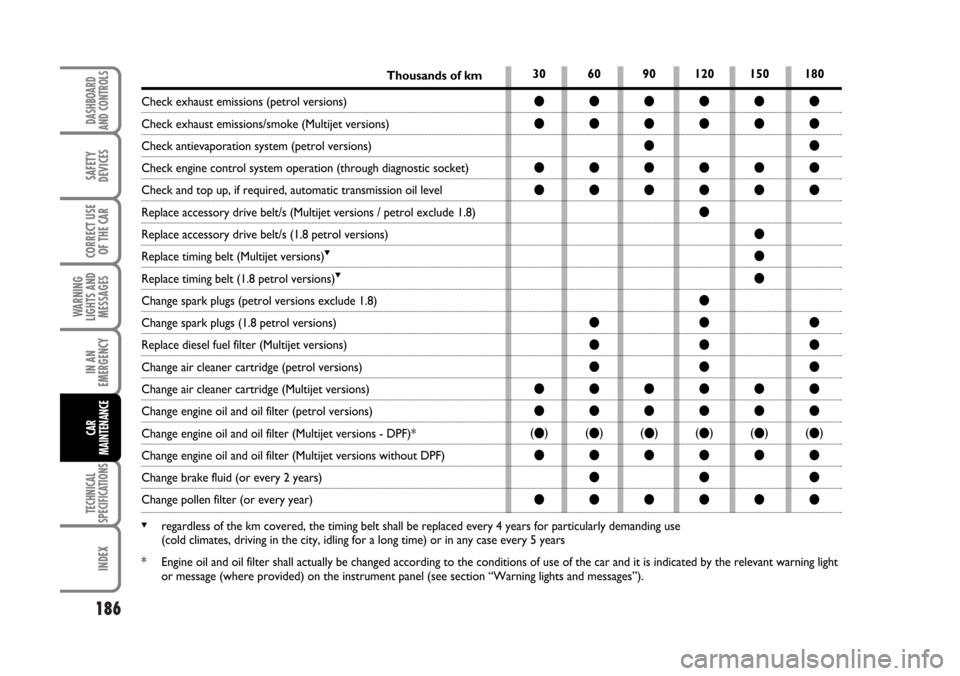
Thousands of km
Check exhaust emissions (petrol versions)
Check exhaust emissions/smoke (Multijet versions)
Check antievaporation system (petrol versions)
Check engine control system operation (through diagnostic socket)
Check and top up, if required, automatic transmission oil level
Replace accessory drive belt/s (Multijet versions / petrol exclude 1.8)
Replace accessory drive belt/s (1.8 petrol versions)
Replace timing belt (Multijet versions)O
Replace timing belt (1.8 petrol versions)O
Change spark plugs (petrol versions exclude 1.8)
Change spark plugs (1.8 petrol versions)
Replace diesel fuel filter (Multijet versions)
Change air cleaner cartridge (petrol versions)
Change air cleaner cartridge (Multijet versions)
Change engine oil and oil filter (petrol versions)
Change engine oil and oil filter (Multijet versions - DPF)*
Change engine oil and oil filter (Multijet versions without DPF)
Change brake fluid (or every 2 years)
Change pollen filter (or every year)
Oregardless of the km covered, the timing belt shall be replaced every 4 years for particularly demanding use
(cold climates, driving in the city, idling for a long time) or in any case every 5 years
* Engine oil and oil filter shall actually be changed according to the conditions of use of the car and it is indicated by the relevant warning light
or message (where provided) on the instrument panel (see section “Warning lights and messages”).
183-206 Croma TRW GB 20-11-2006 15:03 Pagina 186
Page 187 of 240

187
WARNING
LIGHTS AND
MESSAGES
TECHNICAL
SPECIFICATIONS
INDEX
DASHBOARD
AND CONTROLS
SAFETY
DEVICES
CORRECT USE
OF THE CAR
IN AN
EMERGENCY
CAR
MAINTENANCE
❒check cleanness of locks, bonnet and
boot and lever cleanness and lubrica-
tion;
❒sight inspect the conditions of: engine,
gearbox, transmission, pipes and hoses
(exhaust - fuel - brakes), rubber parts
(boots, sleeves, bushes, etc.);
❒check battery charge and fluid level
(electrolyte);
❒visual check on various drive belt con-
ditions;
❒check and replace pollen filter, if re-
quired;
❒check and replace air cleaner, if re-
quired.
ROUTINE
MAINTENANCE
Every 1,000 km or before long journeys,
check and top up if required:
❒engine coolant fluid level;
❒brake fluid level;
❒windscreen washer fluid level;
❒tyre pressure and conditions;
❒light system operation (headlights, di-
rection indicators, hazard lights, etc.);
❒windscreen wiper/washer operation
and windscreen/rear window blade
position/wear;
Every 3,000 km check and top up if re-
quired: engine oil level.
You are recommended to use FL
Selenia, products, designed and pro-
duced specifically for Fiat cars (see table
“Capacities” in section “Technical speci-
fications”).
HEAVY-DUTY
Should prevailing use of the car be under
one of the following specially heavy con-
ditions:
❒trailer or caravan towing;
❒dusty roads;
❒short distances (less than 7-8 km) re-
peated and with external tempera-
tures below zero;
❒frequently idling engines or long dis-
tance low speed driving (e.g. door-to-
door deliveries) or in case of a long
term inactivity;
❒driving in the city;
carry out the following checks more fre-
quently than required in the Service
Schedule:
❒check front disk brake pad conditions
and wear;
183-206 Croma TRW GB 20-11-2006 15:03 Pagina 187
Page 188 of 240
188
WARNING
LIGHTS AND
MESSAGES
TECHNICAL
SPECIFICATIONS
INDEX
DASHBOARD
AND CONTROLS
SAFETY
DEVICES
CORRECT USE
OF THE CAR
IN AN
EMERGENCY
CAR
MAINTENANCE
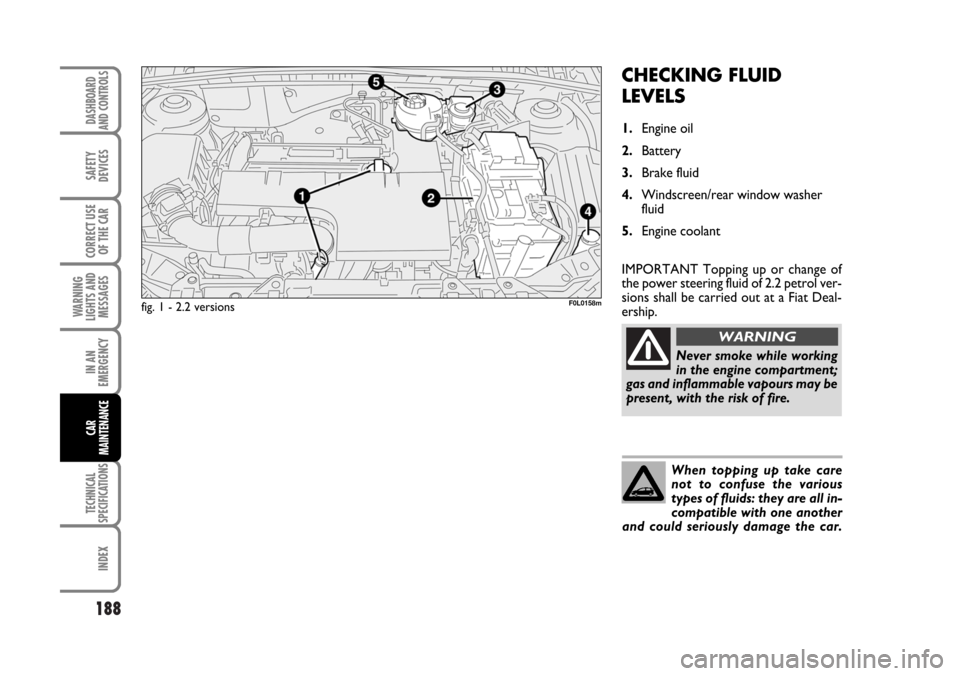
CHECKING FLUID
LEVELS
1.Engine oil
2.Battery
3.Brake fluid
4.Windscreen/rear window washer
fluid
5.Engine coolant
IMPORTANT Topping up or change of
the power steering fluid of 2.2 petrol ver-
sions shall be carried out at a Fiat Deal-
ership.
fig. 1 - 2.2 versionsF0L0158m
Never smoke while working
in the engine compartment;
gas and inflammable vapours may be
present, with the risk of fire.
WARNING
When topping up take care
not to confuse the various
types of fluids: they are all in-
compatible with one another
and could seriously damage the car.
183-206 Croma TRW GB 20-11-2006 15:03 Pagina 188
Page 193 of 240
193
WARNING
LIGHTS AND
MESSAGES
TECHNICAL
SPECIFICATIONS
INDEX
DASHBOARD
AND CONTROLS
SAFETY
DEVICES
CORRECT USE
OF THE CAR
IN AN
EMERGENCY
CAR
MAINTENANCE
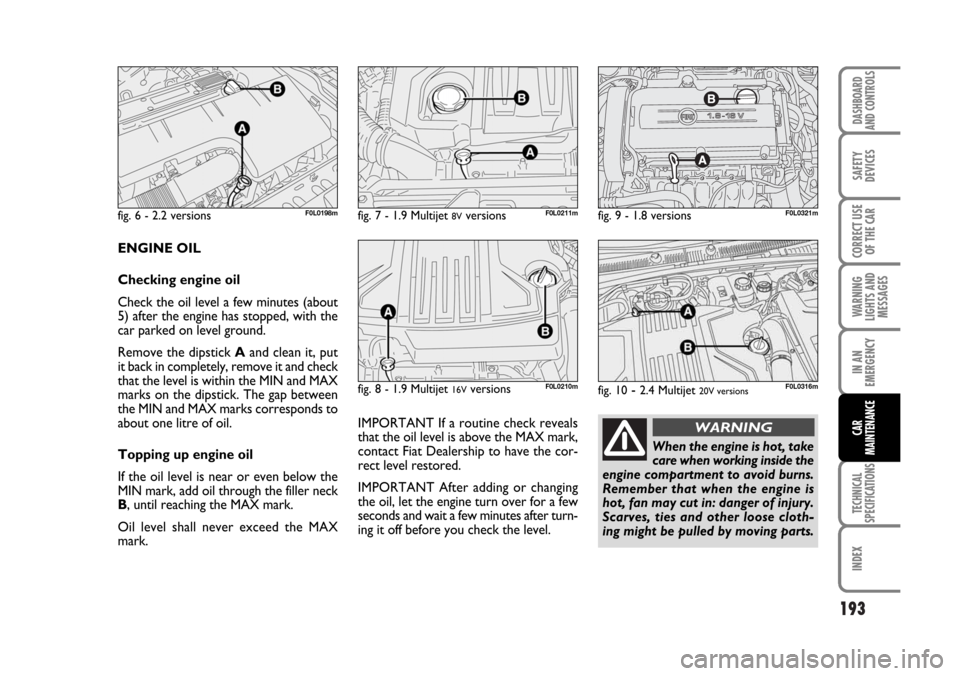
fig. 6 - 2.2 versionsF0L0198mfig. 7 - 1.9 Multijet 8VversionsF0L0211mfig. 9 - 1.8 versionsF0L0321m
fig. 8 - 1.9 Multijet 16VversionsF0L0210mfig. 10- 2.4 Multijet 20V versionsF0L0316m
ENGINE OIL
Checking engine oil
Check the oil level a few minutes (about
5) after the engine has stopped, with the
car parked on level ground.
Remove the dipstick Aand clean it, put
it back in completely, remove it and check
that the level is within the MIN and MAX
marks on the dipstick. The gap between
the MIN and MAX marks corresponds to
about one litre of oil.
Topping up engine oil
If the oil level is near or even below the
MIN mark, add oil through the filler neck
B, until reaching the MAX mark.
Oil level shall never exceed the MAX
mark.IMPORTANT If a routine check reveals
that the oil level is above the MAX mark,
contact Fiat Dealership to have the cor-
rect level restored.
IMPORTANT After adding or changing
the oil, let the engine turn over for a few
seconds and wait a few minutes after turn-
ing it off before you check the level.
When the engine is hot, take
care when working inside the
engine compartment to avoid burns.
Remember that when the engine is
hot, fan may cut in: danger of injury.
Scarves, ties and other loose cloth-
ing might be pulled by moving parts.
WARNING
183-206 Croma TRW GB 20-11-2006 15:03 Pagina 193
Page 194 of 240
194
WARNING
LIGHTS AND
MESSAGES
TECHNICAL
SPECIFICATIONS
INDEX
DASHBOARD
AND CONTROLS
SAFETY
DEVICES
CORRECT USE
OF THE CAR
IN AN
EMERGENCY
CAR
MAINTENANCE
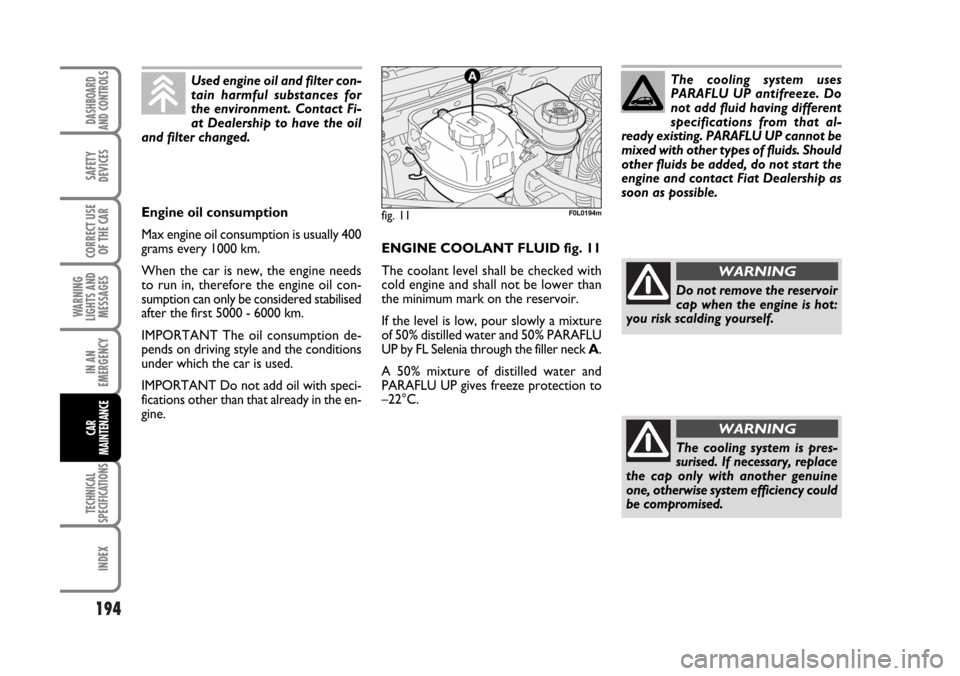
ENGINE COOLANT FLUID fig. 11
The coolant level shall be checked with
cold engine and shall not be lower than
the minimum mark on the reservoir.
If the level is low, pour slowly a mixture
of 50% distilled water and 50% PARAFLU
UP by FL Selenia through the filler neck A.
A 50% mixture of distilled water and
PARAFLU UP gives freeze protection to
–22°C. Used engine oil and filter con-
tain harmful substances for
the environment. Contact Fi-
at Dealership to have the oil
and filter changed.
Engine oil consumption
Max engine oil consumption is usually 400
grams every 1000 km.
When the car is new, the engine needs
to run in, therefore the engine oil con-
sumption can only be considered stabilised
after the first 5000 - 6000 km.
IMPORTANT The oil consumption de-
pends on driving style and the conditions
under which the car is used.
IMPORTANT Do not add oil with speci-
fications other than that already in the en-
gine.fig. 11F0L0194m
The cooling system uses
PARAFLU UP antifreeze. Do
not add fluid having different
specifications from that al-
ready existing. PARAFLU UP cannot be
mixed with other types of fluids. Should
other fluids be added, do not start the
engine and contact Fiat Dealership as
soon as possible.
Do not remove the reservoir
cap when the engine is hot:
you risk scalding yourself.
WARNING
The cooling system is pres-
surised. If necessary, replace
the cap only with another genuine
one, otherwise system efficiency could
be compromised.
WARNING
183-206 Croma TRW GB 20-11-2006 15:03 Pagina 194