spare wheel FIAT CROMA 2006 2.G Owners Manual
[x] Cancel search | Manufacturer: FIAT, Model Year: 2006, Model line: CROMA, Model: FIAT CROMA 2006 2.GPages: 240, PDF Size: 7.41 MB
Page 89 of 240
89
SAFETY
DEVICES
CORRECT USE
OF THE CAR
WARNING
LIGHTS AND
MESSAGES
IN AN
EMERGENCY
CAR
MAINTENANCE
TECHNICAL
SPECIFICATIONS
INDEX
DASHBOARD
AND CONTROLS
ASR SYSTEM
(AntiSlip Regulator)
(where provided)
The ASR function controls car drive and
cuts in automatically every time one or
both driving wheels slip.
According to slipping conditions, two dif-
ferent control systems are activated:
❒if slipping involves both driving wheels,
the ASR function intervenes reducing
the power transmitted by the engine;
❒if slipping involves only one driving
wheel, the TC (Traction Control)
function cuts in automatically braking
the wheel that is slipping.
The action of the ASR is particularly help-
ful in the following circumstances:
❒slipping of the inner wheel due to the
effect of dynamic load changes or ex-
cessive acceleration;
❒too much power transmitted to the
wheels also in relation to the condi-
tions of the road surface;
❒acceleration on slippery, snowy or
frozen surfaces;
❒in the case of loss of grip on a wet sur-
face (aquaplaning).
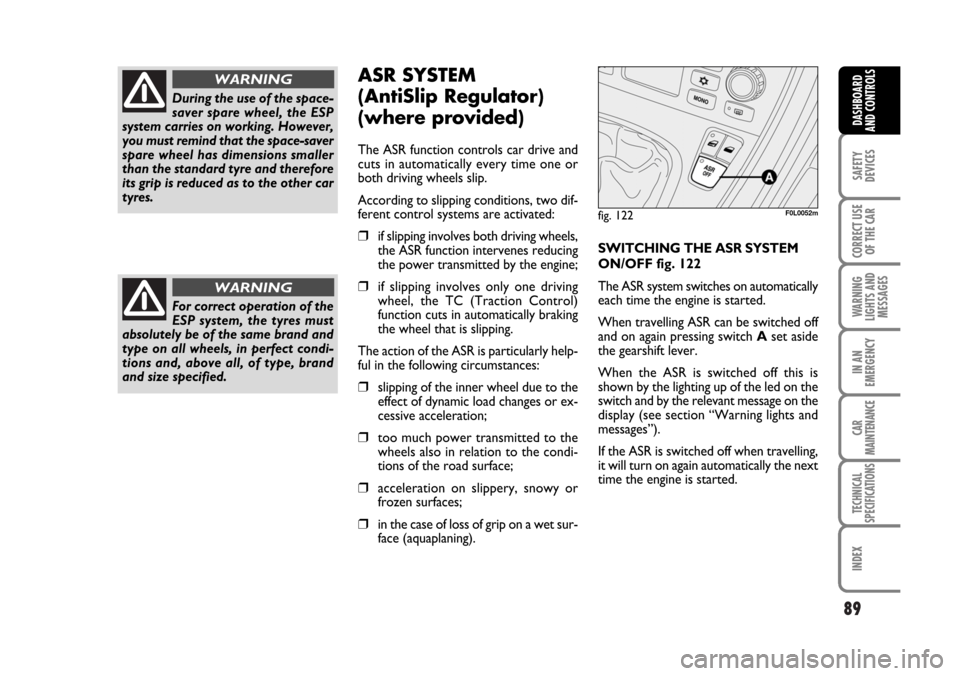
SWITCHING THE ASR SYSTEM
ON/OFF fig. 122
The ASR system switches on automatically
each time the engine is started.
When travelling ASR can be switched off
and on again pressing switchAset aside
the gearshift lever.
When the ASR is switched off this is
shown by the lighting up of the led on the
switch and by the relevant message on the
display (see section “Warning lights and
messages”).
If the ASR is switched off when travelling,
it will turn on again automatically the next
time the engine is started.
During the use of the space-
saver spare wheel, the ESP
system carries on working. However,
you must remind that the space-saver
spare wheel has dimensions smaller
than the standard tyre and therefore
its grip is reduced as to the other car
tyres.
WARNING
For correct operation of the
ESP system, the tyres must
absolutely be of the same brand and
type on all wheels, in perfect condi-
tions and, above all, of type, brand
and size specified.
WARNING
fig. 122F0L0052m
062-098 Croma TRW GB 20-11-2006 15:01 Pagina 89
Page 91 of 240
91
SAFETY
DEVICES
CORRECT USE
OF THE CAR
WARNING
LIGHTS AND
MESSAGES
IN AN
EMERGENCY
CAR
MAINTENANCE
TECHNICAL
SPECIFICATIONS
INDEX
DASHBOARD
AND CONTROLS
IMPORTANT After eliminating the in-
convenience, to check the system com-
pletely, Fiat Dealerships are obliged to run
a bench test and, if necessary, road tests
which may also call for a long journey.TYRE PRESSURE
MONITORING SYSTEM
- T.P.M.S. (where
provided)
The car can be equipped with the T.P.M.S.
(Tyre Pressure Monitoring System). This
system consists of a radio-frequency sen-
sor, installed on each wheel (on the rim
inside the tyre) that sends pressure infor-
mation to the control unit.
IMPORTANT System control unit moni-
tors the pressure of the four car tyres but
not the space-saver spare wheel. It is
therefore recommended to always check
also the space-saver spare wheel pressure.
IMPORTANT Pay the utmost attention
when checking or inflating tyres. Excessive
pressure impairs road holding, increases
suspension and wheel stress and causes
abnormal tyre wear.IMPORTANT Tyre pressure should be
checked with tyres rested and cold.
Should it become necessary for whatev-
er reason to check pressure with hot
tyres, do not reduce pressure although it
is higher than the prescribed value but re-
peat the check when tyres are cold.
If turning the ignition key to
ON, the warning light Udoes not turn on or if, while travelling
it turns on glowing steadily or flash-
ing (together with the message on the
display), contact Fiat Dealership as
soon as possible. Warning light
Uoperation can be checked by means
of special equipment by traffic
agents. Always comply with the traf-
fic regulations in force in the coun-
try where you are travelling.
WARNING
The T.P.M.S. system does not
exempt the driver to check
tyre and space-saver spare wheel pres-
sure at regular intervals.
WARNING
062-098 Croma TRW GB 20-11-2006 15:01 Pagina 91
Page 135 of 240

SNOW CHAINS
Use of snow chains should be in compli-
ance with local regulations.
Snow chains should only be applied to the
driving wheels (front wheels). We rec-
ommend using Lineaccessori Fiat snow
chains.
Check the tension of the chains after the
first few metres have been driven.
IMPORTANT Snow chains cannot be fit-
ted to the space-saver spare wheel. So, if
a front (drive) wheel is punctured and
chains are needed, a rear wheel should be
fitted to the front of the car and the spare
wheel should be fitted to the rear. This
way with two normal drive wheels, snow
chains can be fitted to them to solve an
emergency.
IMPORTANT Snow chains shall only be
a temporary solution. Use snow tyres if
you have to travel for long on roadbeds
covered with snow or ice.
IMPORTANT With snow chains fitted,
use the accelerator with extreme care to
prevent or to reduce to a minimum dri-
ving wheel skidding in order to avoid snow
chain breaking that could cause damages
to the body or the mechanical parts of the
car.
135
WARNING
LIGHTS AND
MESSAGES
IN AN
EMERGENCY
CAR
MAINTENANCE
TECHNICAL
SPECIFICATIONS
INDEX
DASHBOARD
AND CONTROLS
SAFETY
DEVICES
CORRECT USE
OF THE CAR
Versions Tyres on which chains Type of snow chains
can be fitted to be used
1.8 - 2.2205/55 R16 91V
1.9 Multijet215/55 R16 93W2.4 Multijet
215/50 R17 91WSnow chains with reduced size with
max protrusion beyond the tyre
profile of 9 mm
Refer to the above mentioned table for information on the wheels where
snow chains can be fitted. Follow the prescriptions.
Keep your speed down when snow chains are fitted. Do not ex-
ceed 40 km/h. Avoid potholes, steps and pavements and avoid
also to drive for long distances on roads not covered with snow
to prevent damaging the car and the roadbed.
Page 145 of 240

145
IN AN
EMERGENCY
CAR
MAINTENANCE
TECHNICAL
SPECIFICATIONS
INDEX
DASHBOARD
AND CONTROLS
SAFETY
DEVICES
CORRECT USE
OF THE CAR
WARNING
LIGHTS AND
MESSAGES
Parking sensor failure
(where provided)
The warning light on the dial turns on to-
gether with the message on the display
when failure is detected in parking sensors.
Contact Fiat Dealership.
Antipinch system failure
(where provided)
The warning light on the dial turns on to-
gether with the message on the display
when failure is detected in the antipinch
system.
Contact Fiat Dealership.
Twilight sensor failure
(where provided)
The warning light on the dial turns on (to-
gether with the message on the display)
when failure is detected in twilight sen-
sor (adjusting headlight sensitivity).Check tyre pressure
(where provided)
The warning light on the dial turns on (to-
gether with the message on the display),
when tyre pressure is low or excessive.
In this case, inflate tyres to the specified
pressure values (see paragraph “Inflating
pressures” in section “Technical Specifi-
cations”).
Flat tyres (where provided)
The warning light on the dial turns on (to-
gether with message on the display and
the buzzer), when there is a pressure drop
in one or more tyres. In this way the
T.P.M.S. system warns the driver that one
or more tyre/s is/are flat (i.e. punctured).
IMPORTANT Stop travelling with one or
more flat tyre/s since road holding could
be jeopardised. Stop the car without brak-
ing or steering sharply. Change immedi-
ately punctured wheel with space-saver
spare wheel (where provided - see sec-
tion “In an emergency”) and contact Fiat
Dealership as soon as possible.Tyre pressure monitoring system
failure (where provided)
The warning light on the dial turns on (to-
gether with the message on the display)
when a failure is detected in the T.P.M.S.
system (where provided).
Contact Fiat Dealership as soon as possi-
ble.
Should one or more wheels without sen-
sor be fitted, the instrument panel warn-
ing light will come on (together with the
message on the display) and stay on until
fitting again the four wheels with sensors.
Page 151 of 240
151
WARNING
LIGHTS AND
MESSAGES
CAR
MAINTENANCE
TECHNICAL
SPECIFICATIONS
INDEX
DASHBOARD
AND CONTROLS
SAFETY
DEVICES
CORRECT USE
OF THE CAR
IN AN
EMERGENCY
IF A TYRE IS
PUNCTURED
GENERAL INSTRUCTIONS
Wheel changing and correct use of the
jack and space-saver spare wheel call for
some precautions as listed below.
BUMP STARTING
Never bump start the engine (by pushing,
towing, or coasting downhill) as this could
cause fuel to flow into the catalytic exhau-
st system and damage it beyond repair.
Remember that the brake booster and the
power steering system are not operating
until the engine is started, a greater effort
will therefore be required to press the
brake pedal or to turn the steering wheel.
Alert other drivers that the
car is stationary in com-
pliance with local regulations: hazard
warning lights, warning triangle etc.
Any passengers on board should lea-
ve the car, especially if it is heavily la-
den. Passengers should stay away
from oncoming traffic while the
wheel is being changed on. If the
wheel is being changed on a steep or
badly surfaced road, place the wed-
ges or other suitable material under
the wheel to stop the car.
WARNING
The space-saver spare wheel
is specific to your car, do not
use it on other models, or use the spa-
re wheel of other models on your car.
The space-saver spare wheel shall
only be used in an emergency.
It shall only be used for the distance
necessary to reach a service point and
the car speed shall not exceed 80
Km/h. The spare wheel has an oran-
ge sticker that summarises the main
cautions for use and limitations. The
sticker should never be removed or
covered.
Never fit a wheel cap on a space-sa-
ver spare wheel. The sticker gives the
following information in four langua-
ges: caution! For temporary use only!
80 km/h max! Replace by normal
wheel as soon as possible. Do not co-
ver this label.
WARNING
Page 152 of 240

152
WARNING
LIGHTS AND
MESSAGES
CAR
MAINTENANCE
TECHNICAL
SPECIFICATIONS
INDEX
DASHBOARD
AND CONTROLS
SAFETY
DEVICES
CORRECT USE
OF THE CAR
IN AN
EMERGENCY
When driving with a space-
saver spare wheel fitted, the
driving performance of the car chan-
ges. Avoid accelerating or braking
sharply, abrupt turns or fast corne-
rings. The life of the spare wheel is
approx. 3000 Km, after this distance
it should be replaced with another of
the same type. Never attempt to fit
a conventional tyre on a rim designed
for use as a space-saver spare wheel.
Have the punctured wheel repaired
and refitted as soon as possible. Two
or more space-saver spare wheels
should never be used together. Do not
grease the threads of bolts before in-
stalling them: they might slip out.
WARNING
The jack shall only be used
for changing wheels on the
car with which it is provided or on
cars of the same model.
It must not be used for other purpo-
ses such as for instance raising cars of
other models. In no case should it be
used for repairs under the car. Incor-
rect positioning of the jack may cau-
se the jacked car to fall. Do not use
the jack for higher capacities than
stated on its label. Snow chains can-
not be fitted to the space-saver spa-
re wheel. So, if a front (drive) wheel
is punctured and chains are needed,
a rear wheel should be fitted to the
front of the car and the spare wheel
should be fitted to the rear. This way
with two normal drive wheels, snow
chains can be fitted to them to solve
an emergency.
WARNING
Fasten the wheel cap cor-
rectly to prevent the wheel
from coming free in motion. Never
tamper with the inflation valve. Ne-
ver place tools between the rim and
tyre. Check and restore, if required,
the pressure of tyres and spare wheel
to the values given in section “Tech-
nical Specifications”.
WARNING
Page 154 of 240
154
WARNING
LIGHTS AND
MESSAGES
CAR
MAINTENANCE
TECHNICAL
SPECIFICATIONS
INDEX
DASHBOARD
AND CONTROLS
SAFETY
DEVICES
CORRECT USE
OF THE CAR
IN AN
EMERGENCY
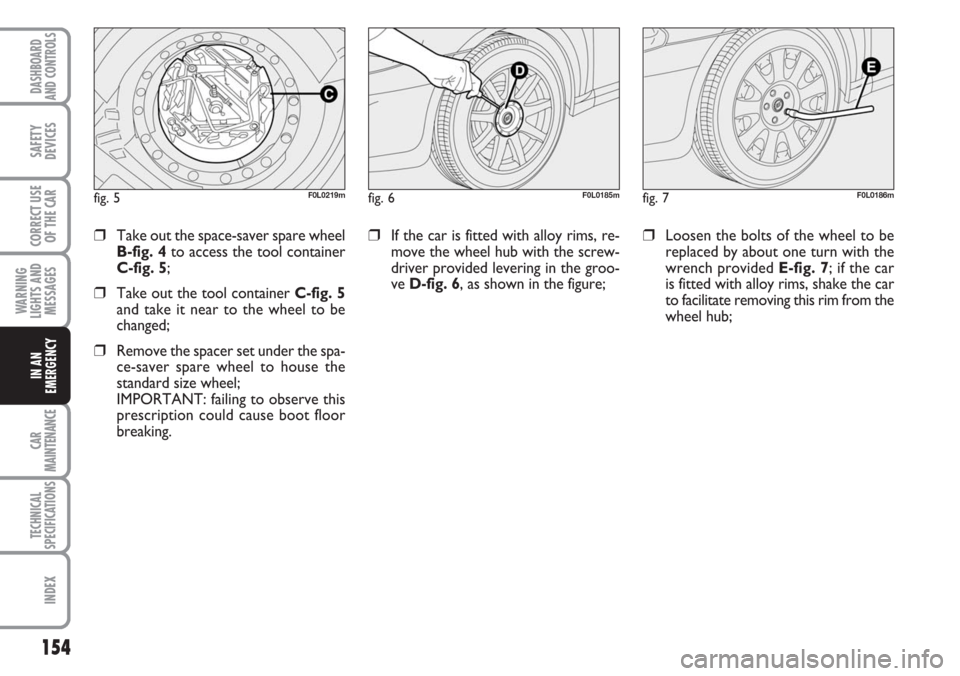
❒If the car is fitted with alloy rims, re-
move the wheel hub with the screw-
driver provided levering in the groo-
ve D-fig. 6, as shown in the figure;❒Loosen the bolts of the wheel to be
replaced by about one turn with the
wrench provided E-fig. 7; if the car
is fitted with alloy rims, shake the car
to facilitate removing this rim from the
wheel hub;❒Take out the space-saver spare wheel
B-fig. 4to access the tool container
C-fig. 5;
❒Take out the tool container C-fig. 5
and take it near to the wheel to be
changed;
❒Remove the spacer set under the spa-
ce-saver spare wheel to house the
standard size wheel;
IMPORTANT: failing to observe this
prescription could cause boot floor
breaking.
fig. 5F0L0219mfig. 6F0L0185mfig. 7F0L0186m
Page 155 of 240
155
WARNING
LIGHTS AND
MESSAGES
CAR
MAINTENANCE
TECHNICAL
SPECIFICATIONS
INDEX
DASHBOARD
AND CONTROLS
SAFETY
DEVICES
CORRECT USE
OF THE CAR
IN AN
EMERGENCY
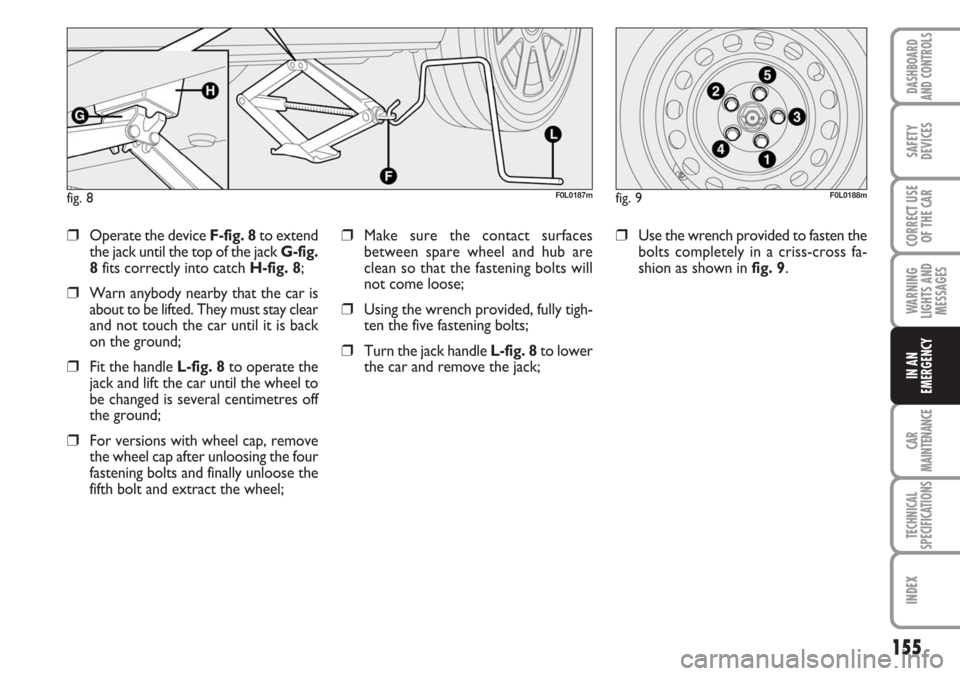
❒Make sure the contact surfaces
between spare wheel and hub are
clean so that the fastening bolts will
not come loose;
❒Using the wrench provided, fully tigh-
ten the five fastening bolts;
❒Turn the jack handle L-fig. 8to lower
the car and remove the jack;
❒Use the wrench provided to fasten the
bolts completely in a criss-cross fa-
shion as shown in fig. 9.❒Operate the device F-fig. 8to extend
the jack until the top of the jack G-fig.
8fits correctly into catch H-fig. 8;
❒Warn anybody nearby that the car is
about to be lifted. They must stay clear
and not touch the car until it is back
on the ground;
❒Fit the handle L-fig. 8to operate the
jack and lift the car until the wheel to
be changed is several centimetres off
the ground;
❒For versions with wheel cap, remove
the wheel cap after unloosing the four
fastening bolts and finally unloose the
fifth bolt and extract the wheel;
fig. 8F0L0187mfig. 9F0L0188m
Page 157 of 240
157
WARNING
LIGHTS AND
MESSAGES
CAR
MAINTENANCE
TECHNICAL
SPECIFICATIONS
INDEX
DASHBOARD
AND CONTROLS
SAFETY
DEVICES
CORRECT USE
OF THE CAR
IN AN
EMERGENCY
WHEN NEEDING TO
CHANGE A BULB
GENERAL INSTRUCTIONS
❒When a light is not working, check
that the corresponding fuse is intact
before changing a bulb. For the loca-
tion of fuses, refer to the paragraph “If
a fuse blows” in this section;
❒Before changing a bulb check the con-
tacts for oxidation;
❒Burnt bulbs must be replaced by
others of the same type and power;
❒Always check the height of the head-
light beam after changing a bulb.
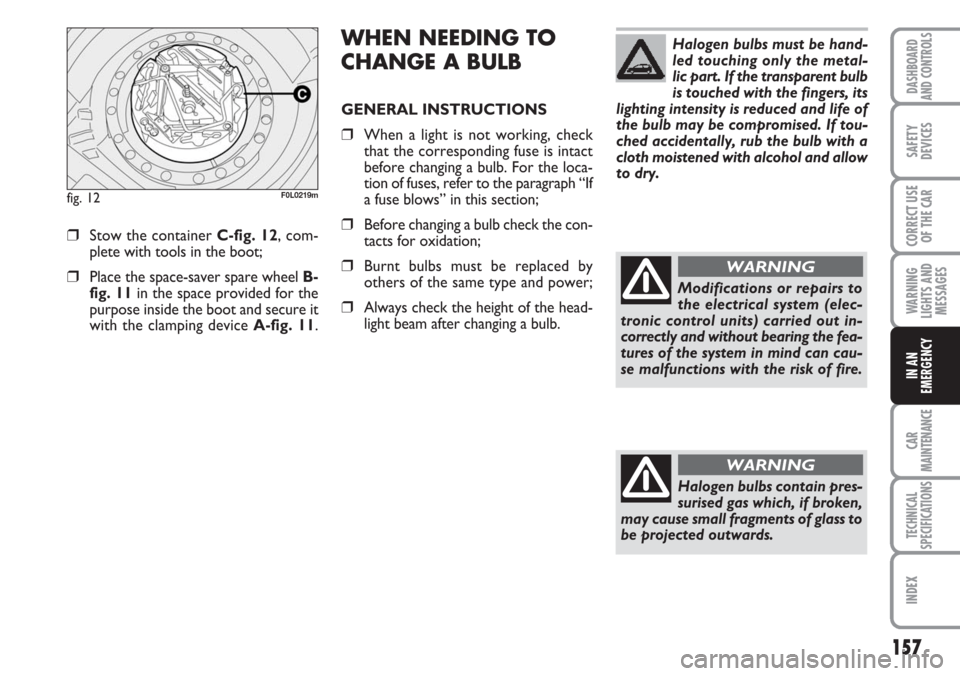
❒Stow the container C-fig. 12, com-
plete with tools in the boot;
❒Place the space-saver spare wheel B-
fig. 11in the space provided for the
purpose inside the boot and secure it
with the clamping device A-fig. 11.
fig. 12F0L0219m
Halogen bulbs must be hand-
led touching only the metal-
lic part. If the transparent bulb
is touched with the fingers, its
lighting intensity is reduced and life of
the bulb may be compromised. If tou-
ched accidentally, rub the bulb with a
cloth moistened with alcohol and allow
to dry.
Modifications or repairs to
the electrical system (elec-
tronic control units) carried out in-
correctly and without bearing the fea-
tures of the system in mind can cau-
se malfunctions with the risk of fire.
WARNING
Halogen bulbs contain pres-
surised gas which, if broken,
may cause small fragments of glass to
be projected outwards.
WARNING
Page 200 of 240
200
WARNING
LIGHTS AND
MESSAGES
TECHNICAL
SPECIFICATIONS
INDEX
DASHBOARD
AND CONTROLS
SAFETY
DEVICES
CORRECT USE
OF THE CAR
IN AN
EMERGENCY
CAR
MAINTENANCE
In fact, since these devices continue ab-
sorbing energy even when the ignition key
is off, they gradually run down the battery.
The total intake of these systems (facto-
ry and after-market) must be less than 0,6
mA x Ah (of the battery) as shown in the
following table:
IMPORTANT NOTES
❒As far as possible, avoid sharp brak-
ing and screech starts, etc. Be careful
not to hit the kerb, potholes or oth-
er obstacles hard. Driving for long
stretches over bumpy roads can dam-
age the tyres;
❒Periodically check that the tyres have
no cuts in the side wall, abnormal
swelling or irregular tyre wear. If any
of these occur, have the car seen to at
a Fiat Dealership;
❒Avoid overloading the car when trav-
elling: this may cause serious damage
to the wheels and tyres;
Battery Maximum
admitted
stand-by intake
70 Ah 42 mA
90 Ah (*) 54 mA
(*) Versions fitted with alarm.
WHEELS AND TYRES
Check the pressure of each tyre, includ-
ing the spare, every two weeks and before
long journeys. The pressure should be
checked with the tyre rested and cold.
For the correct tyre inflation pressure, see
“Wheels” in “Technical specifications”
section.
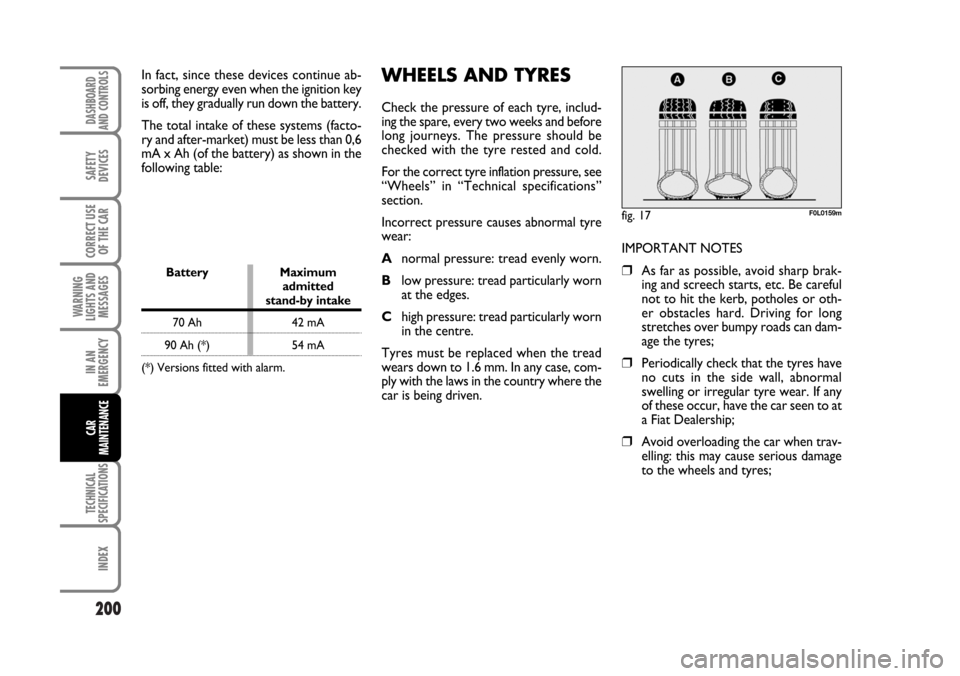
Incorrect pressure causes abnormal tyre
wear:
Anormal pressure: tread evenly worn.
Blow pressure: tread particularly worn
at the edges.
Chigh pressure: tread particularly worn
in the centre.
Tyres must be replaced when the tread
wears down to 1.6 mm. In any case, com-
ply with the laws in the country where the
car is being driven.
fig. 17F0L0159m
183-206 Croma TRW GB 20-11-2006 15:03 Pagina 200