battery FIAT DOBLO 2007 1.G User Guide
[x] Cancel search | Manufacturer: FIAT, Model Year: 2007, Model line: DOBLO, Model: FIAT DOBLO 2007 1.GPages: 218, PDF Size: 3.19 MB
Page 109 of 218
108DRIVING YOUR VEHICLE
IMPORTANTAfter a taxing drive
you should allow the engine to “catch
its breath” before turning it off by let-
ting it idle to allow the temperature in
the engine compartment to fall.
PARKING
Switch off the engine, pull up the
handbrake and engage a gear (1st gear
or reverse, according to whether the
vehicle is facing up or downhill) and
leave the wheels turned. If the vehi-
cle is left on a steep slope, wedges or
a rock should be used to lock the
wheels.
Do not leave the ignition key at
MARto prevent draining the battery.
Always remove the key when you
leave the vehicle.HANDBRAKE
The handbrake lever is located be-
tween the two front seats.
Pull the handbrake lever upwards un-
til the vehicle cannot be moved. Four
or five clicks are generally enough
when the vehicle is on level ground
while nine or ten may be required if
the vehicle is on a steep slope or laden.
IMPORTANTIf this is not the
case, take the vehicle to a Fiat Deal-
ership to have the handbrake adjust-
ed.
Instrument panel warning light x
will come on when the handbrake
lever is pulled up and the ignition key
is at MAR.
To release the handbrake:
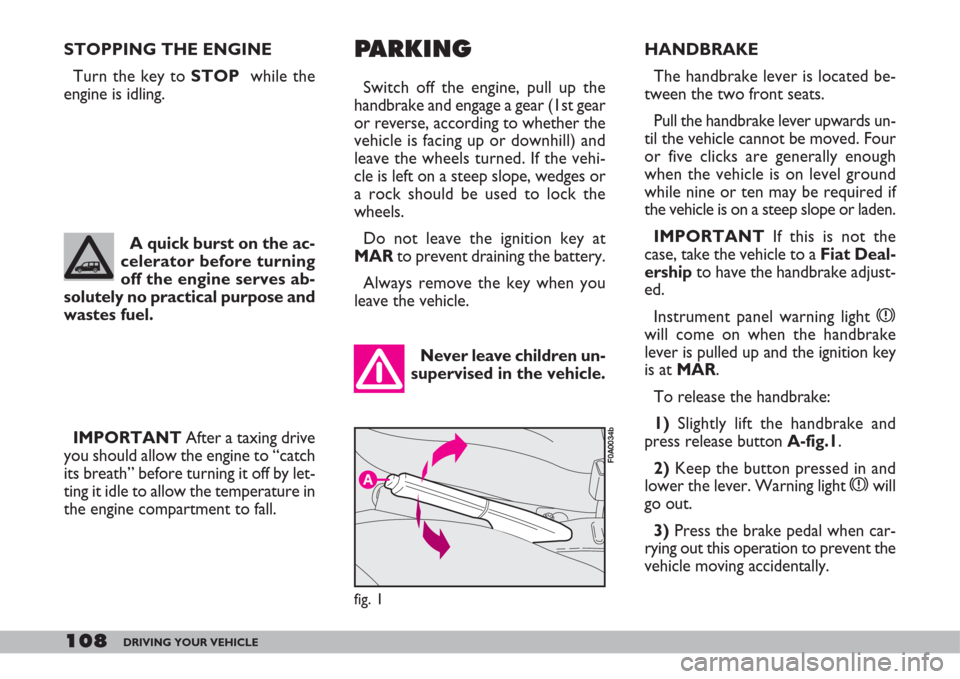
1)Slightly lift the handbrake and
press release button A-fig.1.
2)Keep the button pressed in and
lower the lever. Warning light xwill
go out.
3)Press the brake pedal when car-
rying out this operation to prevent the
vehicle moving accidentally. STOPPING THE ENGINE
Turn the key to STOPwhile the
engine is idling.
A quick burst on the ac-
celerator before turning
off the engine serves ab-
solutely no practical purpose and
wastes fuel.
Never leave children un-
supervised in the vehicle.
A
fig. 1
F0A0034b
Page 115 of 218
114DRIVING YOUR VEHICLE
The tow hitch must comply with the
current regulation, with reference to
Directive 94/20/EC and amendments.
Install a tow hitch which is suitable
for the towing capacity of the vehicle.
Use a unified coupling for the elec-
trical connections. The coupling is gen-
erally fitted on a specific mount fas-
tened to the tow hitch.
For electrical connection, a 7 or 13
pole 12VDC coupling must be used
(CUNA/UNI and ISO/DIN standards).
Follow the instructions provided by
the manufacturer of the vehicle and/or
the tow hitch.
Use the specific trailer light fusebox
for electrical connections.
An electric brake should be supplied
directly by the battery through a cable
with a cross section of no less than 2.5
mm
2.In addition to the electrical connec-
tion, only the lead for powering an
electric brake and the lead to power
a light inside the trailer not exceed-
ing 15W may be connected to the ve-
hicle’s electrical system.
For connections use the preset con-
trol unit with battery cable no less
than 2,5 mm
2.
FITTING DIAGRAM
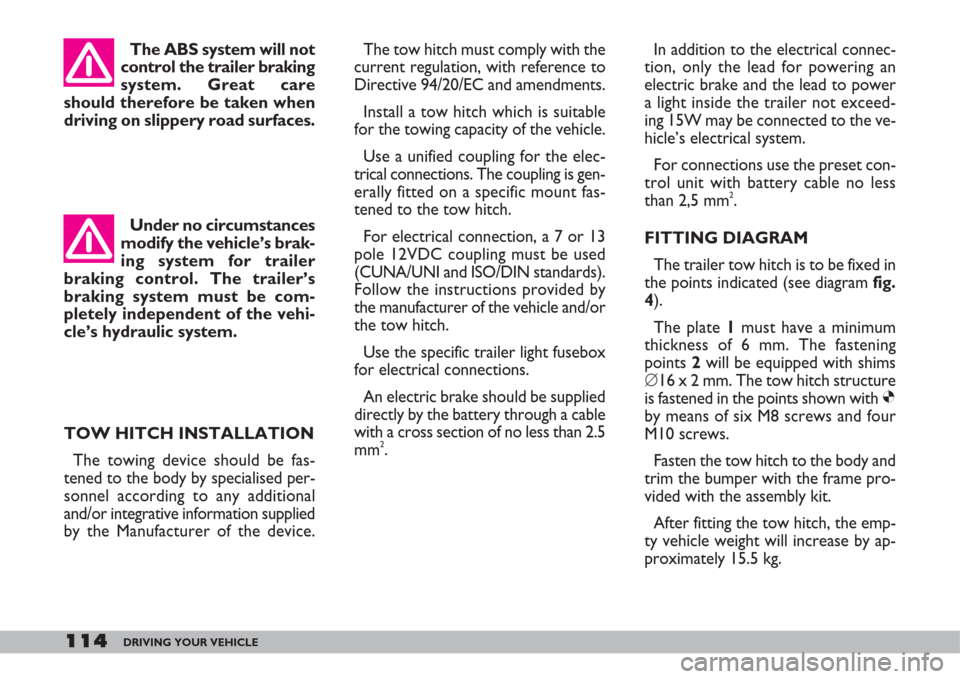
The trailer tow hitch is to be fixed in
the points indicated (see diagram fig.
4).
The plate 1must have a minimum
thickness of 6 mm. The fastening
points 2will be equipped with shims
’16 x 2 mm. The tow hitch structure
is fastened in the points shown with Ø
by means of six M8 screws and four
M10 screws.
Fasten the tow hitch to the body and
trim the bumper with the frame pro-
vided with the assembly kit.
After fitting the tow hitch, the emp-
ty vehicle weight will increase by ap-
proximately 15.5 kg. The ABS system will not
control the trailer braking
system. Great care
should therefore be taken when
driving on slippery road surfaces.
Under no circumstances
modify the vehicle’s brak-
ing system for trailer
braking control. The trailer’s
braking system must be com-
pletely independent of the vehi-
cle’s hydraulic system.
TOW HITCH INSTALLATION
The towing device should be fas-
tened to the body by specialised per-
sonnel according to any additional
and/or integrative information supplied
by the Manufacturer of the device.
Page 119 of 218
118DRIVING YOUR VEHICLE
The following precautions should be
taken if the vehicle will not be used for
several months:
– Park the vehicle in covered, dry and
if possible well-ventilated premises.
– Engage a gear.
– Make sure the handbrake is not en-
gaged.
– Remove the cables from the bat-
tery terminals (first remove the cable
to the negative terminal), and check
the battery charge. If the vehicle is to
be stored for long periods the charge
of the battery should be checked
every month and recharged if it falls
below 12.5V.IMPORTANT Where relevant,
switch off the electronic alarm with the
remote control.
– Clean and protect the painted parts
using protective wax.
– Clean and protect the shiny metal
parts using special compounds readi-
ly available.
– Sprinkle talcum powder on the
rubber windscreen and rear window
wiper blades and lift them off the glass.
– Slightly open the windows.– Cover the vehicle with a cloth or
perforated plastic sheet. Do not use
sheets of non-perforated plastic as
they do not allow moisture on the ve-
hicle body to evaporate.
– Inflate the tyres to 0.5 bar above
the normal specified pressure and
check it at intervals.
– Do not drain the engine cooling
system.
VEHICLE STORAGE
Page 121 of 218
120IN AN EMERGENCY
If the battery is flat, you can use an-
other battery to start the engine. Its
capacity must be the same or slightly
greater than the flat battery.
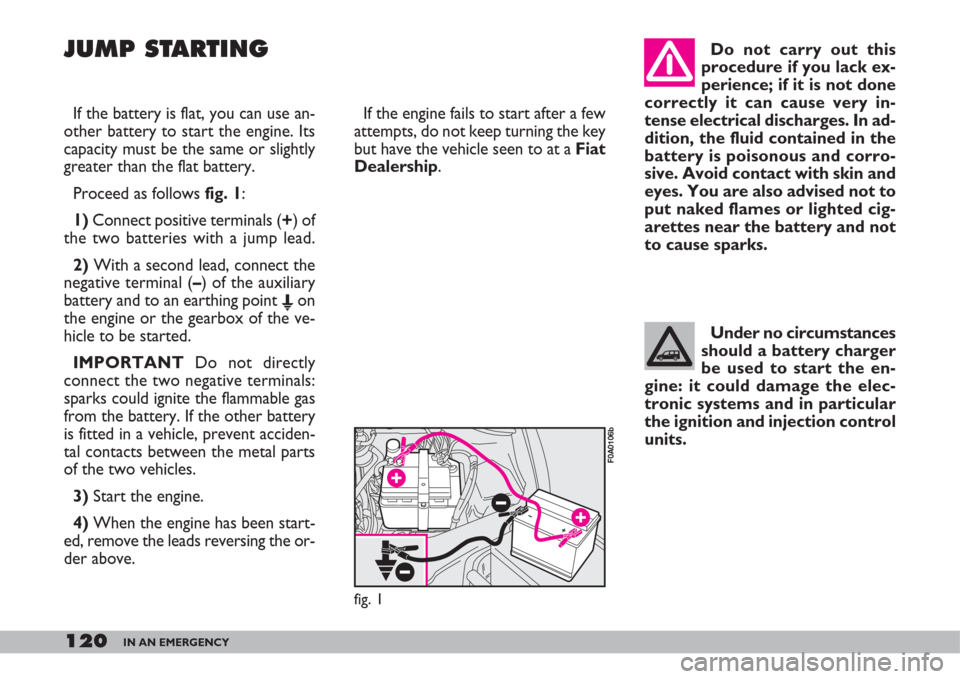
Proceed as follows fig. 1:
1) Connect positive terminals (+) of
the two batteries with a jump lead.
2)With a second lead, connect the
negative terminal (–) of the auxiliary
battery and to an earthing point E
on
the engine or the gearbox of the ve-
hicle to be started.
IMPORTANTDo not directly
connect the two negative terminals:
sparks could ignite the flammable gas
from the battery. If the other battery
is fitted in a vehicle, prevent acciden-
tal contacts between the metal parts
of the two vehicles.
3) Start the engine.
4)When the engine has been start-
ed, remove the leads reversing the or-
der above.If the engine fails to start after a few
attempts, do not keep turning the key
but have the vehicle seen to at a Fiat
Dealership.
JUMP STARTING
fig. 1
F0A0106b
Do not carry out this
procedure if you lack ex-
perience; if it is not done
correctly it can cause very in-
tense electrical discharges. In ad-
dition, the fluid contained in the
battery is poisonous and corro-
sive. Avoid contact with skin and
eyes. You are also advised not to
put naked flames or lighted cig-
arettes near the battery and not
to cause sparks.
Under no circumstances
should a battery charger
be used to start the en-
gine: it could damage the elec-
tronic systems and in particular
the ignition and injection control
units.
Page 142 of 218
141IN AN EMERGENCY
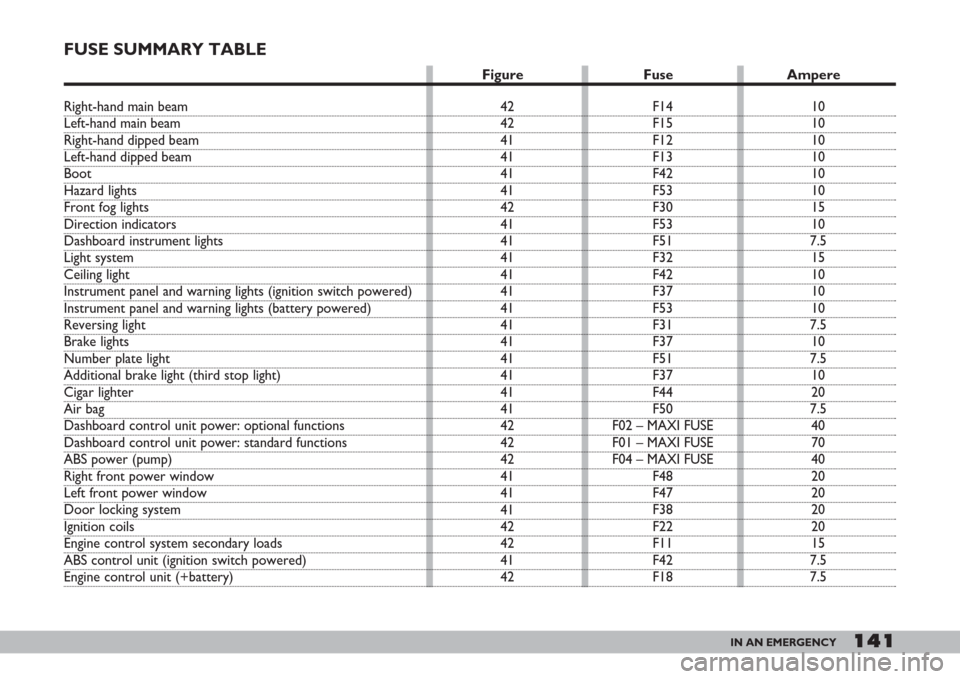
FUSE SUMMARY TABLE
10
10
10
10
10
10
15
10
7.5
15
10
10
10
7.5
10
7.5
10
20
7.5
40
70
40
20
20
20
20
15
7.5
7.5 F14
F15
F12
F13
F42
F53
F30
F53
F51
F32
F42
F37
F53
F31
F37
F51
F37
F44
F50
F02 – MAXI FUSE
F01 – MAXI FUSE
F04 – MAXI FUSE
F48
F47
F38
F22
F11
F42
F18 42
42
41
41
41
41
42
41
41
41
41
41
41
41
41
41
41
41
41
42
42
42
41
41
41
42
42
41
42
Figure Fuse Ampere
Right-hand main beam
Left-hand main beam
Right-hand dipped beam
Left-hand dipped beam
Boot
Hazard lights
Front fog lights
Direction indicators
Dashboard instrument lights
Light system
Ceiling light
Instrument panel and warning lights (ignition switch powered)
Instrument panel and warning lights (battery powered)
Reversing light
Brake lights
Number plate light
Additional brake light (third stop light)
Cigar lighter
Air bag
Dashboard control unit power: optional functions
Dashboard control unit power: standard functions
ABS power (pump)
Right front power window
Left front power window
Door locking system
Ignition coils
Engine control system secondary loads
ABS control unit (ignition switch powered)
Engine control unit (+battery)
Page 145 of 218
144IN AN EMERGENCY
IF THE BATTERY
IS FLAT
First of all, read the “Vehicle main-
tenance” section for the steps to be
taken to avoid the battery running
down and to ensure it has a long life.
IF THE BATTERY IS FLAT
Charging should be slow at a low
amp rating for 24 hours. Charging for
a longer time may damage the battery.
Proceed as follows:
1) Disconnect the electrical system
from the battery terminals.
IMPORTANTWhere relevant,
switch the electronic alarm off with
the remote control.2)Connect the charger cables to the
battery terminals.
3)Turn on the charger.
4)When you have finished, turn the
charger off before disconnecting the
battery.
5)Reconnect the cables to the bat-
tery terminals. Make sure the polari-
ty is correct.JUMP STARTING
See “Jump starting”, in this chapter.
The liquid in the battery
is poisonous and corro-
sive. Do not let it touch
the skin or eyes. Recharging the
battery should be done in a well-
ventilated area away from naked
flames or possible sources of
sparks: explosion and fire risk.
Do not attempt to
recharge a frozen bat-
tery. Thaw it first other-
wise it could explode. If the bat-
tery froze, make sure that the in-
ternal elements are not broken
(short-circuit risk) and that the
casing is not cracked (risk of
spilling the poisonous and corro-
sive fluid).
Under no circumstances
should a battery charger
be used to start the en-
gine: it could damage the elec-
tronic systems and in particular
the ignition and injection control
units.
Page 152 of 218
151VEHICLE MAINTENANCE
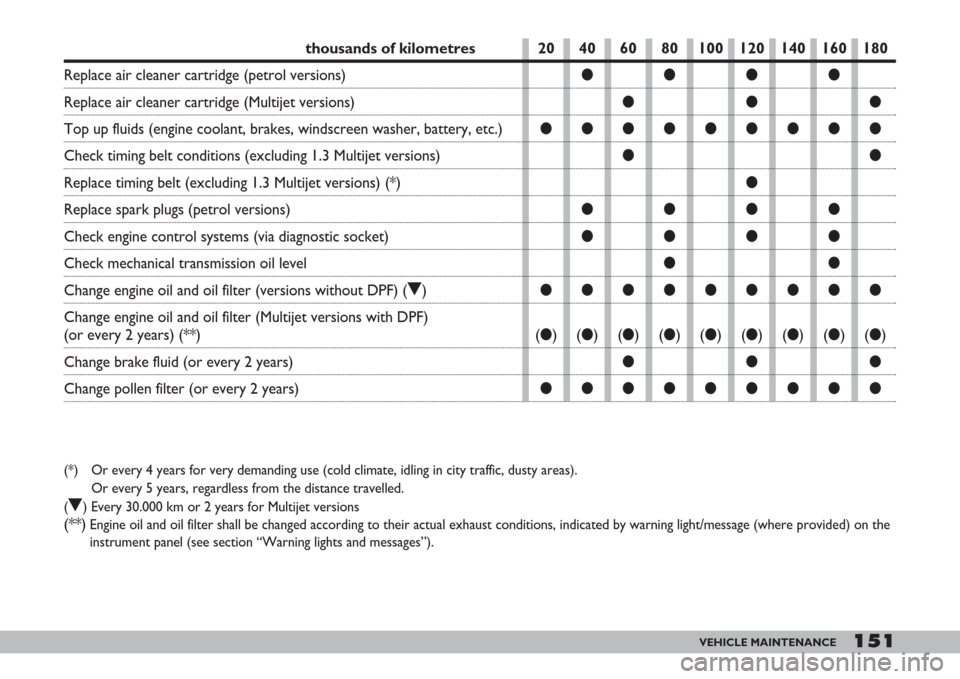
20 40 60 80 100 120 140 160 180
●●●●
●●●
●●●●●●●●●
●●
●
●●●●
●●●●
●●
●●●●●●●●●
(●)(●)(●)(●)(●)(●)(●)(●)(●)
●●●
●●●●●●●●●thousands of kilometres
Replace air cleaner cartridge (petrol versions)
Replace air cleaner cartridge (Multijet versions)
Top up fluids (engine coolant, brakes, windscreen washer, battery, etc.)
Check timing belt conditions (excluding 1.3 Multijet versions)
Replace timing belt (excluding 1.3 Multijet versions) (*)
Replace spark plugs (petrol versions)
Check engine control systems (via diagnostic socket)
Check mechanical transmission oil level
Change engine oil and oil filter (versions without DPF) (O)
Change engine oil and oil filter (Multijet versions with DPF)
(or every 2 years) (**)
Change brake fluid (or every 2 years)
Change pollen filter (or every 2 years)
(*) Or every 4 years for very demanding use (cold climate, idling in city traffic, dusty areas).
Or every 5 years, regardless from the distance travelled.
(
O) Every 30.000 km or 2 years for Multijet versions
(**)Engine oil and oil filter shall be changed according to their actual exhaust conditions, indicated by warning light/message (where provided) on the
instrument panel (see section “Warning lights and messages”).
Page 153 of 218
152VEHICLE MAINTENANCE
ANNUAL
INSPECTION
SCHEDULE
For vehicles with an annual
mileage of below 20.000 km (for
example about 10.000 km) the
following yearly inspection pro-
gramme is advised:
– check tyre conditions/wear and ad-
just pressure if required (including the
spare wheel).
– check light system operation (head-
lights, direction indicators, hazard
lights, boot lights, passenger compart-
ment lights, glovebox light, warning
lights, etc.).
– check windscreen wiper/washer
operation, adjust nozzles.
– check windscreen/rear window
blade position/wear
– check front disk brake pad condi-
tions and wear.– check cleanness of bonnet and
boot locks and lever cleanness and lu-
brication
– sight inspect the conditions of: en-
gine, gearbox, transmission, pipes and
hoses (exhaust - fuel - brakes), rubber
parts (boots, sleeves, bushes, etc)
brake and fuel hoses.
– check battery charge.
– visual check on various drive belt
conditions.
– check and top up, if required, fluid
levels (engine coolant, brake fluid,
windscreen washer fluid, battery fluid,
etc.).
– change engine oil.
– change engine oil filter.
– replace pollen filter (where pro-
vided).
ADDITIONAL
CHECKS
Every 1,000 kmor before long
trips, check and top up as necessary:
engine coolant level, brake fluid level,
windscreen washer liquid level, tyre
pressure and conditions.
Every 3,000 km check and top up
as necessary: engine oil level.
You are recommended to use FL
Selenia,products designed and pro-
duced specifically for Fiat vehicles (see
“Capacities” in section “Technical
specifications”).
Page 154 of 218
153VEHICLE MAINTENANCE
IMPORTANT - Engine oil
Should prevailing use of the vehicle
be under one of the following special-
ly heavy conditions:
– towing a trailer
– on dirty roads
– for short, repeated trips (less than
7-8 km) with outside temperature be-
low zero
– frequently idling engines or long
distance low speed driving (e.g. taxis
or door-to-door deliveries) or in case
of a long term inactivity; replace en-
gine oil more frequently than required
on Service schedule
IMPORTANT - Air cleaner
If the vehicle is used on dusty roads
change the air cleaner more frequently
than the indications in the Service
schedule. If in doubt as to how often
the engine oil and air cleaner should
be changed according to how you use
the vehicle, contact a Fiat Dealer-
ship.IMPORTANT - Pollen filter
If the vehicle is used frequently in
dusty or heavily polluted environ-
ments it is advisable to replace the fil-
tering element more frequently; in
particular it should be replaced if a re-
duction of the amount of air admitted
to the passenger compartment is not-
ed.
IMPORTANT - Battery
The charge in your battery should be
checked, where possible at the start
of the winter, to limit the risk of the
battery electrolyte freezing. This check
should be carried out more frequent-
ly if the vehicle is mainly used for short
trips or if it is fitted with accessories
that permanently take in electricity
even when the ignition key is re-
moved, especially in the case of after
market accessories.You should check the battery fluid
(electrolyte) level more frequently
than shown in the service schedule in
this chapter if the vehicle is used in hot
climates or particularly demanding
conditions.
Maintenance of your ve-
hicle should be entrusted
to a Fiat Dealership. For
ordinary routine maintenance
operations which you are able to
carry out yourself, ensure that
you have the necessary tools and
original Fiat spare parts and flu-
ids available. Do not carry out
servicing operations if you have
no experience.
Page 155 of 218
154VEHICLE MAINTENANCE
CHECKING
THE LEVELS
Do not smoke while
working in the engine
compartment: the pres-
ence of flammable gas and
vapour could cause a fire.
Be careful not to mix up
the various types of fluids
when you are topping up:
they are all mutually incompati-
ble and could damage the vehicle.
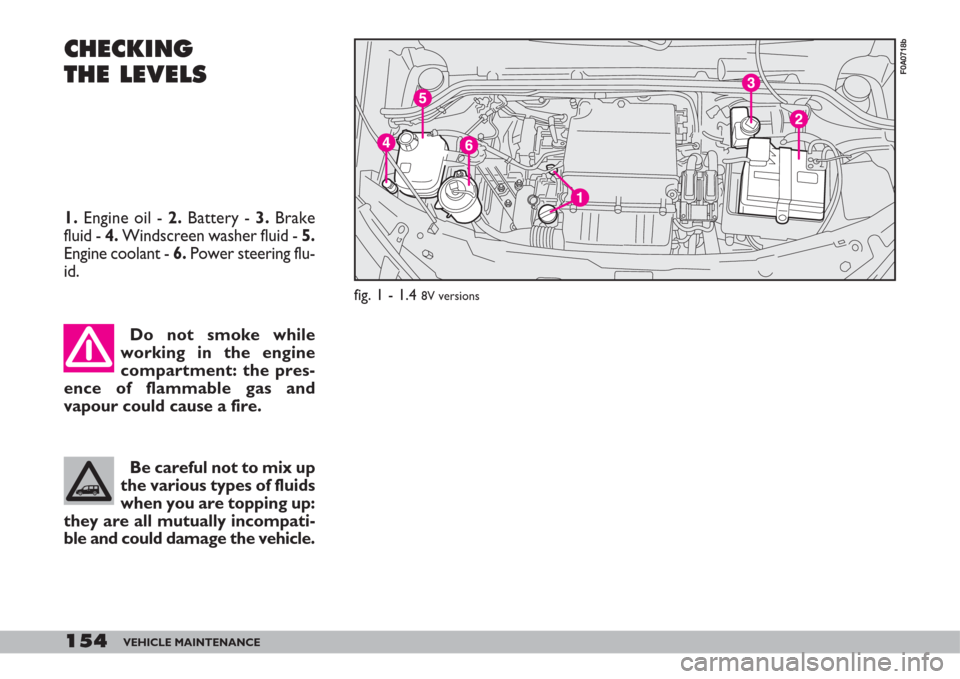
1.Engine oil - 2.Battery - 3.Brake
fluid - 4.Windscreen washer fluid - 5.
Engine coolant - 6.Power steering flu-
id.
F0A0718b
fig. 1 - 1.4 8V versions