instrument panel FIAT DOBLO 2007 1.G User Guide
[x] Cancel search | Manufacturer: FIAT, Model Year: 2007, Model line: DOBLO, Model: FIAT DOBLO 2007 1.GPages: 218, PDF Size: 3.19 MB
Page 69 of 218
68GETTING TO KNOW YOUR VEHICLE
CONTROLS
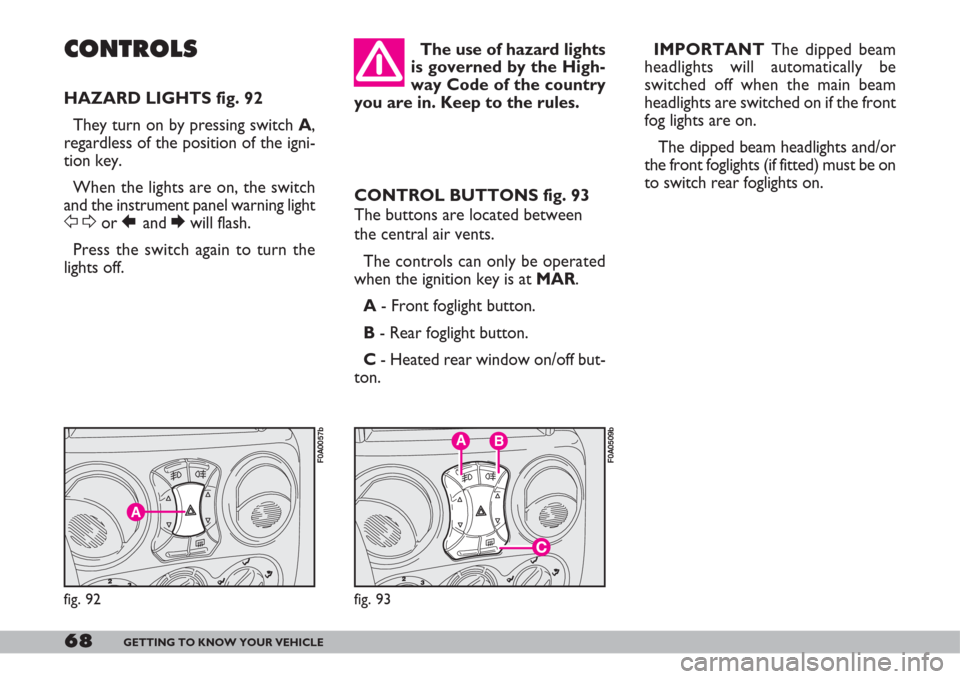
HAZARD LIGHTS fig. 92
They turn on by pressing switch A,
regardless of the position of the igni-
tion key.
When the lights are on, the switch
and the instrument panel warning light
FDor Rand Ewill flash.
Press the switch again to turn the
lights off.CONTROL BUTTONS fig. 93
The buttons are located between
the central air vents.
The controls can only be operated
when the ignition key is at MAR.
A- Front foglight button.
B- Rear foglight button.
C- Heated rear window on/off but-
ton. IMPORTANTThe dipped beam
headlights will automatically be
switched off when the main beam
headlights are switched on if the front
fog lights are on.
The dipped beam headlights and/or
the front foglights (if fitted) must be on
to switch rear foglights on.
A
fig. 92
F0A0057b
The use of hazard lights
is governed by the High-
way Code of the country
you are in. Keep to the rules.
BA
fig. 93
F0A0509b
Page 94 of 218
93GETTING TO KNOW YOUR VEHICLE
Manual deactivation
The passenger side airbag can be de-
activated if it is absolutely necessary to
carry a child in the front passenger
seat.
Deactivation / reactivation shall be
carried out with ignition device at
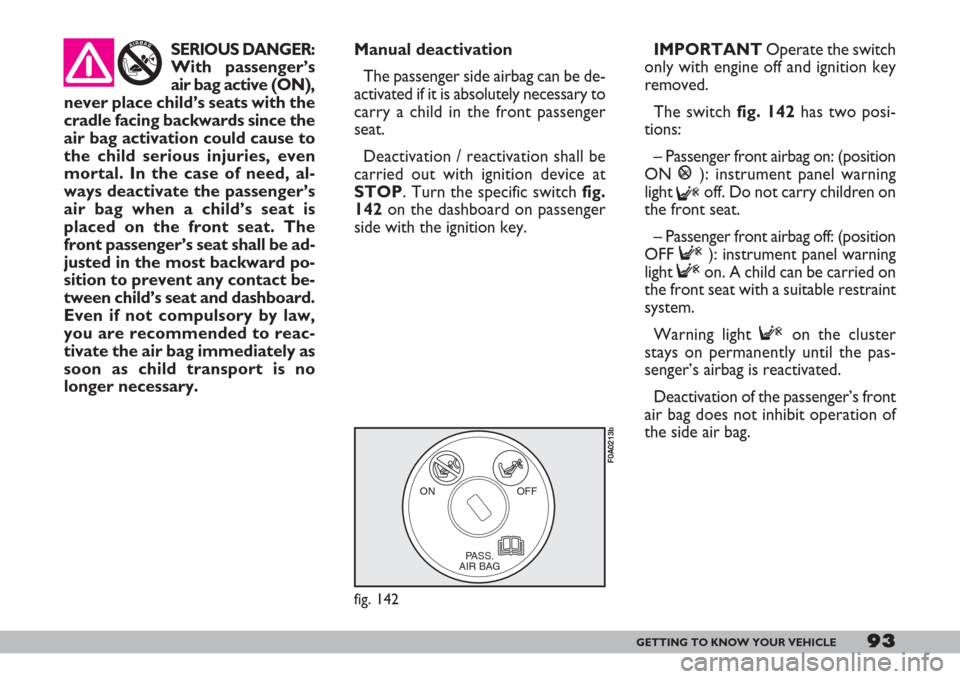
STOP. Turn the specific switch fig.
142on the dashboard on passenger
side with the ignition key.IMPORTANTOperate the switch
only with engine off and ignition key
removed.
The switch fig. 142has two posi-
tions:
– Passenger front airbag on: (position
ON P): instrument panel warning
light
Foff. Do not carry children on
the front seat.
– Passenger front airbag off: (position
OFF F): instrument panel warning
light Fon. A child can be carried on
the front seat with a suitable restraint
system.
Warning light Fon the cluster
stays on permanently until the pas-
senger’s airbag is reactivated.
Deactivation of the passenger’s front
air bag does not inhibit operation of
the side air bag.SERIOUS DANGER:
With passenger’s
air bag active (ON),
never place child’s seats with the
cradle facing backwards since the
air bag activation could cause to
the child serious injuries, even
mortal. In the case of need, al-
ways deactivate the passenger’s
air bag when a child’s seat is
placed on the front seat. The
front passenger’s seat shall be ad-
justed in the most backward po-
sition to prevent any contact be-
tween child’s seat and dashboard.
Even if not compulsory by law,
you are recommended to reac-
tivate the air bag immediately as
soon as child transport is no
longer necessary.
ON OFF
PASS.
AIR BAG
fig. 142
F0A0213b
Page 98 of 218
97GETTING TO KNOW YOUR VEHICLE
EOBD SYSTEM
The EOBD system (European On
Board Diagnosis) allows continuos di-
agnosis of the components of the ve-
hicle correlated with emissions.
Furthermore, the system warns the
driver of deterioration concerning the
emission system components by
means of the Uwarning light on the
instrument panel.
The objective is to:
– monitor system efficiency;
– warn when failures can increase
emissions over the threshold estab-
lished by the European regulations;
– warn of the need to replace dete-
riorated components.
Furthermore, the system is equipped
with a connector for interfacing with
specific tools used to read the error
codes stored in the control unit mem-
ory along with a set of diagnostic and
engine specific parameters.IMPORTANTAfter eliminating the
problem, your Fiat Dealershipwill
run a bench test to fully check the sys-
tem. In some cases, a long road test
may be required. Contact a Fiat Dealer-
ship as soon as possible if
the Uwarning light ei-
ther does not come on when the
key is turned to MAR or comes
on, with fixed or flashing light,
when travelling. Warning light U
operation can be checked by
means of special equipment by
traffic agents. Always comply
with the traffic regulations in
force in the country where you
are travelling.
SOUND SYSTEM
If the “Sound System” has not been
requested, the vehicle features an odd-
ment compartment on the dashboard.
Contact a Fiat Dealer-
ship if you want to install
a sound system after pur-
chasing your vehicle. Their staff
will advise you on how to safe-
guard the life of the battery. Ex-
cessive idle intake can damage
the battery and invalid the bat-
tery warranty as well.
LIGHT PRESETTING
The system consists of the following:
– sound system power wires;
– wires for front speakers on the
dashboard, doors (where provided)
and rear speakers for passengers
transport versions;
– sound system compartment;
– aerial wire and aerial.
Page 107 of 218
106DRIVING YOUR VEHICLE
ENGINE
STARTING3)Press the clutch pedal fully down,
without pressing the accelerator.
4) Turn the ignition key to AVV
and let it go the moment the engine
starts.
If the engine does not start at the
first attempt, return the ignition key
to STOPbefore trying to start the
engine again.
If the warning lights ¢(Y) and U
stay on when the ignition key is at
MAR, turn the key to STOPand
then to MARagain; if the warning light
stays on, try with the other keys pro-
vided.
If you are still unable to start the en-
gine, perform the emergency start-up
procedure (see section “In an emer-
gency”) and go to a Fiat Dealership.
IMPORTANTNever leave the ig-
nition key at MARwhen the engine is
off.HOW TO START DIESEL
VERSIONS
1) Ensure that the handbrake is up.
2)Put the gear lever into neutral.
3)Turn the ignition key to MAR. In-
strument panel warning lights U, m
and ¢(Y) will come on.
4)Wait for warning lights Uand ¢
(Y) to turn off.
5) Wait for the instrument panel
warning light mto go out. The hot-
ter the engine is, the quicker this will
happen.
6)Press the clutch pedal down to
the floor without touching the accel-
erator.
7) Turn the key to AVVimmedi-
ately after the mwarning light goes
out. If you wait to long, you will lose
the benefit of the work done by the
glow plugs.
D D
R R
I I
V V
I I
N N
G G
Y Y
O O
U U
R R
V V
E E
H H
I I
C C
L L
E E
It is dangerous to let the
engine run in a garage or
other closed area. The
engine consumes oxygen and
gives off carbon dioxide, carbon
monoxide and other poisonous
fumes.
Do not touch the high
voltage cables (spark plug
leads) when the engine is
running.
STARTING PROCEDURE FOR
PETROL VERSIONS
1) Ensure that the handbrake is up.
2)Put the gear lever into neutral.
Page 108 of 218
107DRIVING YOUR VEHICLE
HOW TO WARM UP THE
ENGINE AFTER IS HAS JUST
STARTED (petrol and diesel
versions)
– Begin to move forward slowly let-
ting the engine turn at medium revs.
Do not accelerate abruptly.
– Do not push the engine to its lim-
it for the first few kilometres. You are
recommended to wait until the
coolant temperature gauge starts
moving.
EMERGENCY START-UP
If the Fiat CODE system fails to
recognise that code transmitted by the
ignition key (instrument panel warning
light ¢(Y) on) the emergency start-
up can be performed by using the
CODE card code.
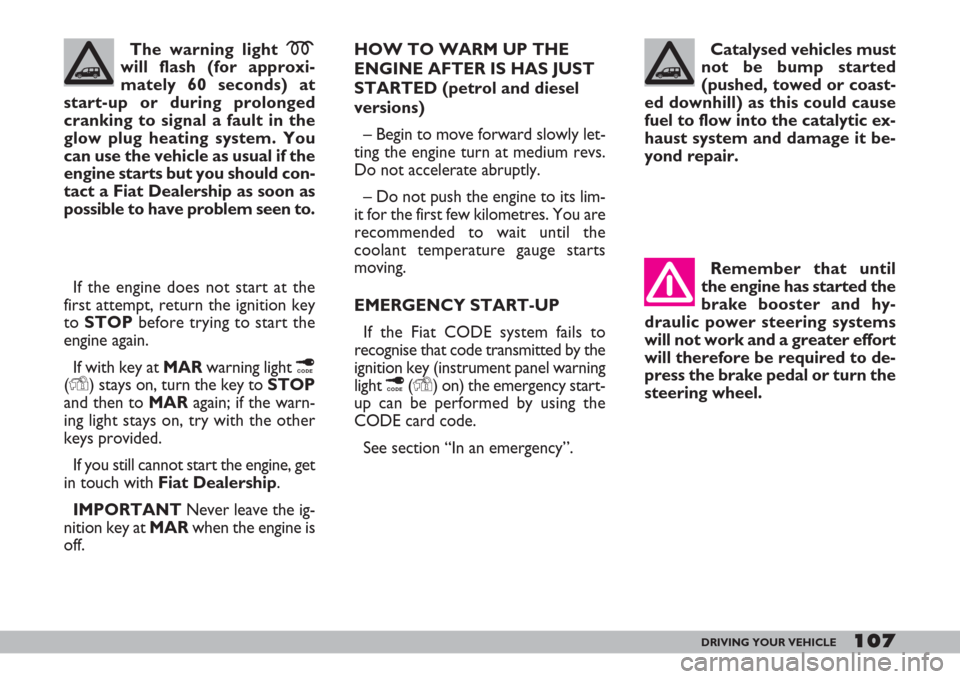
See section “In an emergency”. The warning light m
will flash (for approxi-
mately 60 seconds) at
start-up or during prolonged
cranking to signal a fault in the
glow plug heating system. You
can use the vehicle as usual if the
engine starts but you should con-
tact a Fiat Dealership as soon as
possible to have problem seen to.
If the engine does not start at the
first attempt, return the ignition key
to STOPbefore trying to start the
engine again.
If with key at MARwarning light ¢
(Y) stays on, turn the key to STOP
and then to MARagain; if the warn-
ing light stays on, try with the other
keys provided.
If you still cannot start the engine, get
in touch with Fiat Dealership.
IMPORTANTNever leave the ig-
nition key at MARwhen the engine is
off.Catalysed vehicles must
not be bump started
(pushed, towed or coast-
ed downhill) as this could cause
fuel to flow into the catalytic ex-
haust system and damage it be-
yond repair.
Remember that until
the engine has started the
brake booster and hy-
draulic power steering systems
will not work and a greater effort
will therefore be required to de-
press the brake pedal or turn the
steering wheel.
Page 109 of 218
108DRIVING YOUR VEHICLE
IMPORTANTAfter a taxing drive
you should allow the engine to “catch
its breath” before turning it off by let-
ting it idle to allow the temperature in
the engine compartment to fall.
PARKING
Switch off the engine, pull up the
handbrake and engage a gear (1st gear
or reverse, according to whether the
vehicle is facing up or downhill) and
leave the wheels turned. If the vehi-
cle is left on a steep slope, wedges or
a rock should be used to lock the
wheels.
Do not leave the ignition key at
MARto prevent draining the battery.
Always remove the key when you
leave the vehicle.HANDBRAKE
The handbrake lever is located be-
tween the two front seats.
Pull the handbrake lever upwards un-
til the vehicle cannot be moved. Four
or five clicks are generally enough
when the vehicle is on level ground
while nine or ten may be required if
the vehicle is on a steep slope or laden.
IMPORTANTIf this is not the
case, take the vehicle to a Fiat Deal-
ership to have the handbrake adjust-
ed.
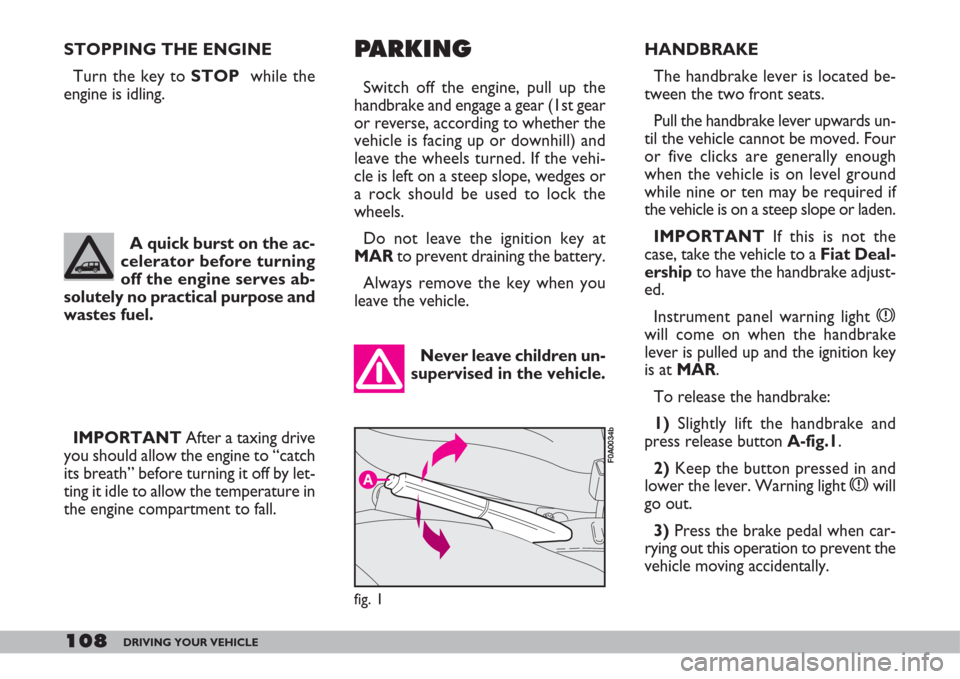
Instrument panel warning light x
will come on when the handbrake
lever is pulled up and the ignition key
is at MAR.
To release the handbrake:
1)Slightly lift the handbrake and
press release button A-fig.1.
2)Keep the button pressed in and
lower the lever. Warning light xwill
go out.
3)Press the brake pedal when car-
rying out this operation to prevent the
vehicle moving accidentally. STOPPING THE ENGINE
Turn the key to STOPwhile the
engine is idling.
A quick burst on the ac-
celerator before turning
off the engine serves ab-
solutely no practical purpose and
wastes fuel.
Never leave children un-
supervised in the vehicle.
A
fig. 1
F0A0034b
Page 113 of 218
112DRIVING YOUR VEHICLE
CHEAP RUNNING
THAT RESPECTS THE ENVIRONMENT
LOOKING
AFTER EMISSION
CONTROL DEVICES
The correct use of pollution control
devices not only ensures respect for
the environment but also has an effect
on the vehicle’s performance. Keeping
these devices in good condition is
therefore a fundamental rule for dri-
ving that is easy on your pocket and
on the environment too.
The first step to take is to follow the
SERVICE SCHEDULE to the letter.
If your vehicle has a petrol engine use
only unleaded petrol.
If you have trouble starting, do not
keep turning the ignition key for long
periods. Be especially careful to avoid
bump starting the vehicle by pushing,
towing or rolling downhill: these are
all manoeuvres that can damage the
catalytic exhaust. Use an auxiliary bat-
tery for start-ups only.If the engine begins to “loose its
smoothness”, when travelling, contin-
ue your journey but reduce the de-
mands you are making on the engine
and have the vehicle seen to at a Fi-
at Dealershipas soon as possible.
When the instrument panel fuel re-
serve warning light comes on, fill up as
soon as possible. A low level of fuel
can cause an uneven supply of fuel to
the engine with the inevitable increase
in the temperature of the exhaust gas
and serious damage to the catalytic
converter.
Never run the engine with one or
more spark plugs disconnected, even
for testing purposes.
Do not warm up the engine by let-
ting it idle for a while before moving
off unless the outside temperature is
very low and, even in this case, only
do so for less than 30 seconds.
Do not install other heat shields and
do not remove those already fitted to
the catalytic converter and exhaust
pipe. Environmental protection has been
one of the guiding principles in the
production of the Fiat Doblò. It is no
accident that its pollution control
equipment is much more effective than
that required by current legislation.
Nonetheless, the environment can-
not get by without a concerted effort
from everyone.
By following a few simple rules you
can avoid harming the environment
and often cut down fuel consumption
at the same time.
On this subject, a few useful tips have
been given below to supplement those
marked by symbol #, at various points
of the handbook.
You are asked to read both the for-
mer and the latter carefully.
Page 142 of 218
141IN AN EMERGENCY
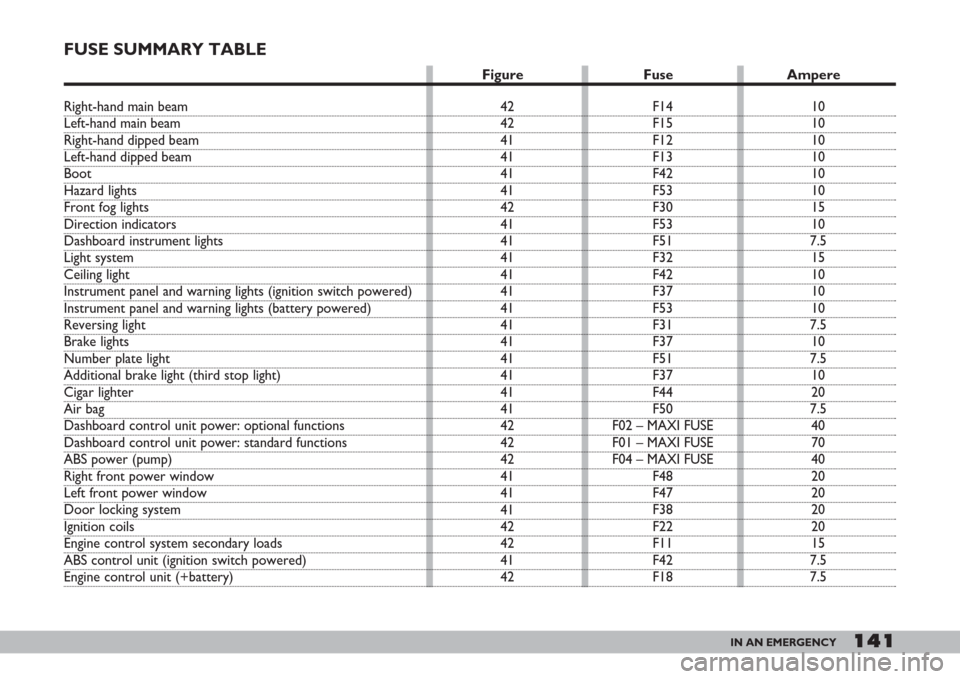
FUSE SUMMARY TABLE
10
10
10
10
10
10
15
10
7.5
15
10
10
10
7.5
10
7.5
10
20
7.5
40
70
40
20
20
20
20
15
7.5
7.5 F14
F15
F12
F13
F42
F53
F30
F53
F51
F32
F42
F37
F53
F31
F37
F51
F37
F44
F50
F02 – MAXI FUSE
F01 – MAXI FUSE
F04 – MAXI FUSE
F48
F47
F38
F22
F11
F42
F18 42
42
41
41
41
41
42
41
41
41
41
41
41
41
41
41
41
41
41
42
42
42
41
41
41
42
42
41
42
Figure Fuse Ampere
Right-hand main beam
Left-hand main beam
Right-hand dipped beam
Left-hand dipped beam
Boot
Hazard lights
Front fog lights
Direction indicators
Dashboard instrument lights
Light system
Ceiling light
Instrument panel and warning lights (ignition switch powered)
Instrument panel and warning lights (battery powered)
Reversing light
Brake lights
Number plate light
Additional brake light (third stop light)
Cigar lighter
Air bag
Dashboard control unit power: optional functions
Dashboard control unit power: standard functions
ABS power (pump)
Right front power window
Left front power window
Door locking system
Ignition coils
Engine control system secondary loads
ABS control unit (ignition switch powered)
Engine control unit (+battery)
Page 151 of 218
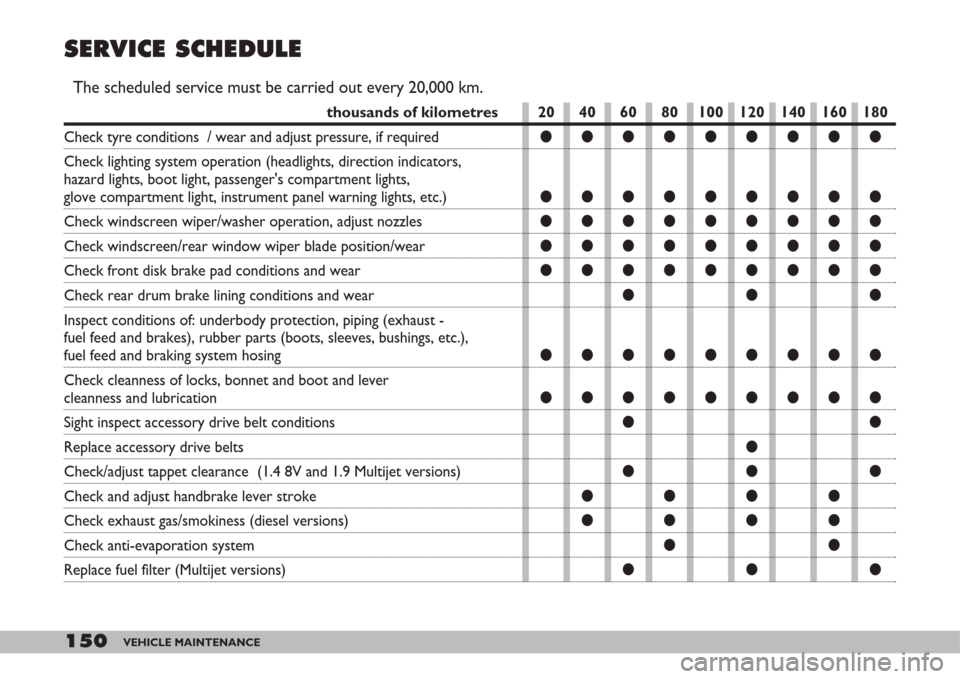
150VEHICLE MAINTENANCE
thousands of kilometres
Check tyre conditions / wear and adjust pressure, if required
Check lighting system operation (headlights, direction indicators,
hazard lights, boot light, passenger's compartment lights,
glove compartment light, instrument panel warning lights, etc.)
Check windscreen wiper/washer operation, adjust nozzles
Check windscreen/rear window wiper blade position/wear
Check front disk brake pad conditions and wear
Check rear drum brake lining conditions and wear
Inspect conditions of: underbody protection, piping (exhaust -
fuel feed and brakes), rubber parts (boots, sleeves, bushings, etc.),
fuel feed and braking system hosing
Check cleanness of locks, bonnet and boot and lever
cleanness and lubrication
Sight inspect accessory drive belt conditions
Replace accessory drive belts
Check/adjust tappet clearance (1.4 8V and 1.9 Multijet versions)
Check and adjust handbrake lever stroke
Check exhaust gas/smokiness (diesel versions)
Check anti-evaporation system
Replace fuel filter (Multijet versions)
SERVICE SCHEDULE
The scheduled service must be carried out every 20,000 km.
20 40 60 80 100 120 140 160 180
●●●●●●●●●
●●●●●●●●●
●●●●●●●●●
●●●●●●●●●
●●●●●●●●●
●●●
●●●●●●●●●
●●●●●●●●●
●●
●
●●●
●●●●
●●●●
●●
●●●
Page 152 of 218
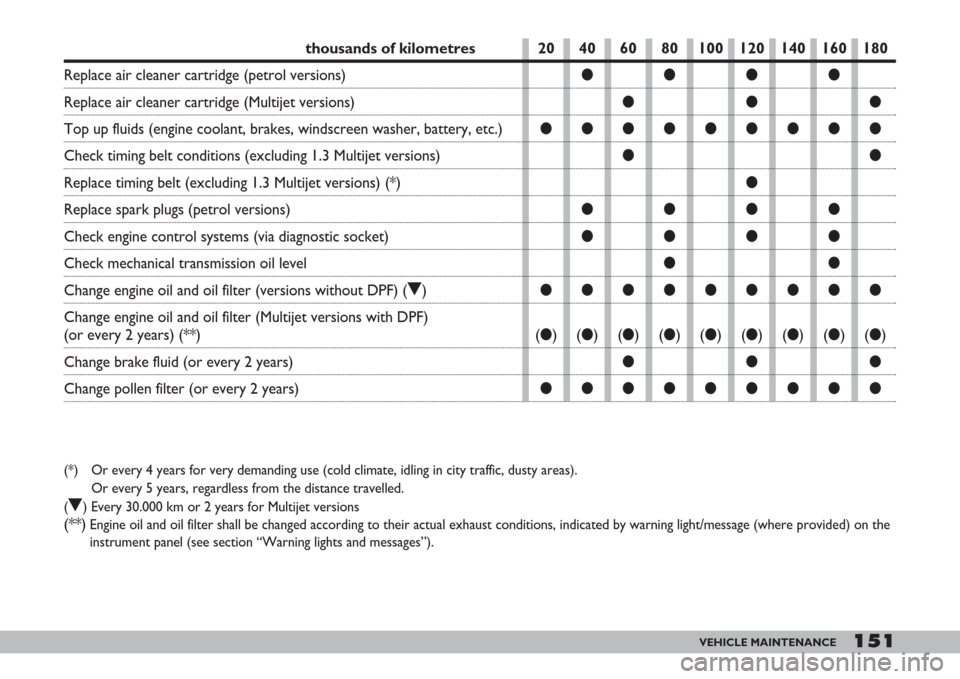
151VEHICLE MAINTENANCE
20 40 60 80 100 120 140 160 180
●●●●
●●●
●●●●●●●●●
●●
●
●●●●
●●●●
●●
●●●●●●●●●
(●)(●)(●)(●)(●)(●)(●)(●)(●)
●●●
●●●●●●●●●thousands of kilometres
Replace air cleaner cartridge (petrol versions)
Replace air cleaner cartridge (Multijet versions)
Top up fluids (engine coolant, brakes, windscreen washer, battery, etc.)
Check timing belt conditions (excluding 1.3 Multijet versions)
Replace timing belt (excluding 1.3 Multijet versions) (*)
Replace spark plugs (petrol versions)
Check engine control systems (via diagnostic socket)
Check mechanical transmission oil level
Change engine oil and oil filter (versions without DPF) (O)
Change engine oil and oil filter (Multijet versions with DPF)
(or every 2 years) (**)
Change brake fluid (or every 2 years)
Change pollen filter (or every 2 years)
(*) Or every 4 years for very demanding use (cold climate, idling in city traffic, dusty areas).
Or every 5 years, regardless from the distance travelled.
(
O) Every 30.000 km or 2 years for Multijet versions
(**)Engine oil and oil filter shall be changed according to their actual exhaust conditions, indicated by warning light/message (where provided) on the
instrument panel (see section “Warning lights and messages”).