fuel filter FIAT DOBLO 2007 1.G Owners Manual
[x] Cancel search | Manufacturer: FIAT, Model Year: 2007, Model line: DOBLO, Model: FIAT DOBLO 2007 1.GPages: 218, PDF Size: 3.19 MB
Page 24 of 218
23GETTING TO KNOW YOUR VEHICLE
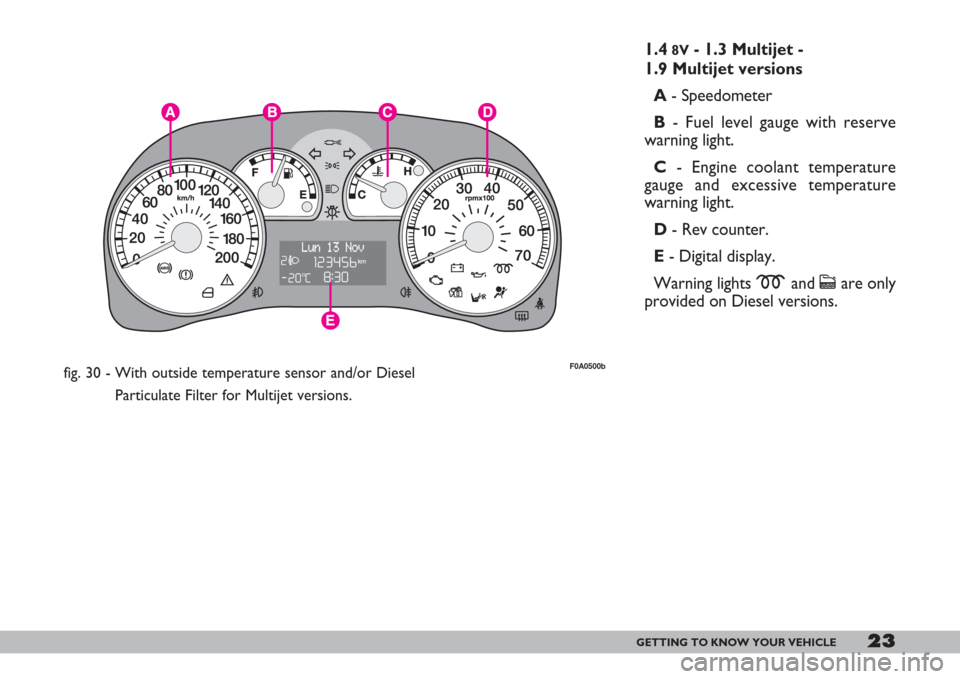
fig. 30 - With outside temperature sensor and/or Diesel
Particulate Filter for Multijet versions.F0A0500b
1.48V- 1.3 Multijet -
1.9 Multijet versions
A- Speedometer
B- Fuel level gauge with reserve
warning light.
C- Engine coolant temperature
gauge and excessive temperature
warning light.
D- Rev counter.
E- Digital display.
Warning lights
mand care only
provided on Diesel versions.
Page 45 of 218
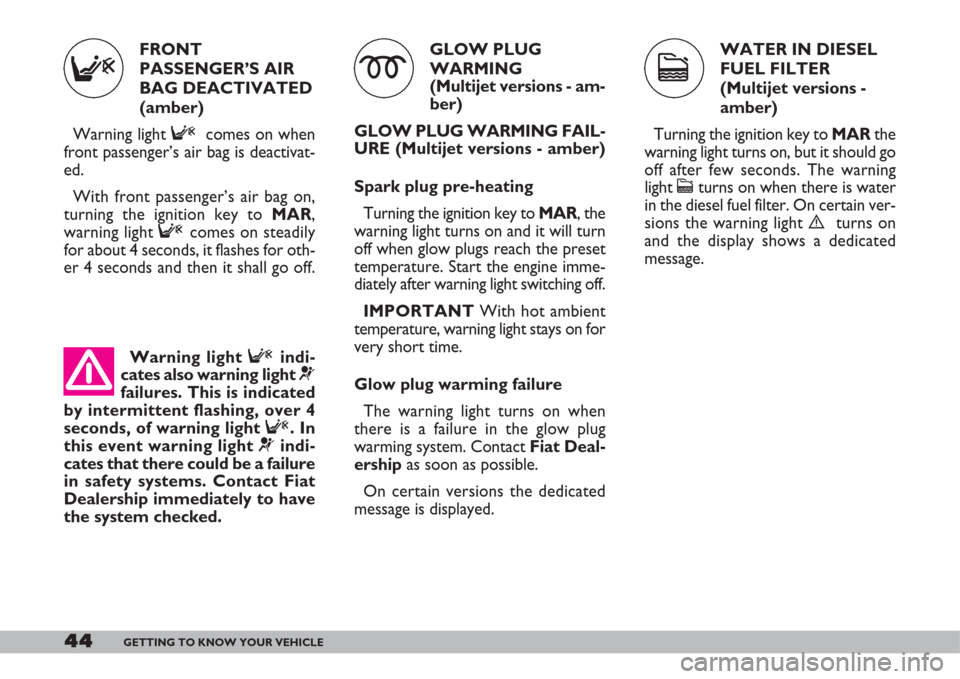
WATER IN DIESEL
FUEL FILTER
(Multijet versions -
amber)
Turning the ignition key toMARthe
warning light turns on, but it should go
off after few seconds. The warning
light
cturns on when there is water
in the diesel fuel filter. On certain ver-
sions the warning light
èturns on
and the display shows a dedicated
message.
44GETTING TO KNOW YOUR VEHICLE
GLOW PLUG
WARMING
(Multijet versions - am-
ber)
GLOW PLUG WARMING FAIL-
URE (Multijet versions - amber)
Spark plug pre-heating
Turning the ignition key to MAR, the
warning light turns on and it will turn
off when glow plugs reach the preset
temperature. Start the engine imme-
diately after warning light switching off.
IMPORTANTWith hot ambient
temperature, warning light stays on for
very short time.
Glow plug warming failure
The warning light turns on when
there is a failure in the glow plug
warming system. Contact Fiat Deal-
ershipas soon as possible.
On certain versions the dedicated
message is displayed. FRONT
PASSENGER’S AIR
BAG DEACTIVATED
(amber)
Warning light
Fcomes on when
front passenger’s air bag is deactivat-
ed.
With front passenger’s air bag on,
turning the ignition key to MAR,
warning light
Fcomes on steadily
for about 4 seconds, it flashes for oth-
er 4 seconds and then it shall go off.
Warning light
Findi-
cates also warning light ¬
failures. This is indicated
by intermittent flashing, over 4
seconds, of warning light F. In
this event warning light ¬indi-
cates that there could be a failure
in safety systems. Contact Fiat
Dealership immediately to have
the system checked.
mcF
Page 48 of 218
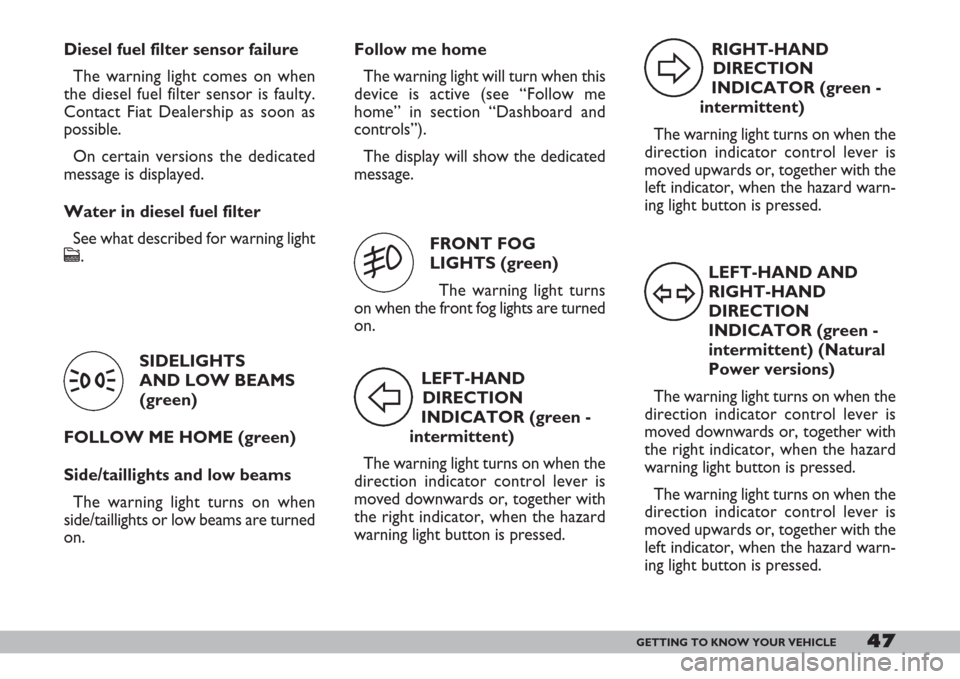
LEFT-HAND AND
RIGHT-HAND
DIRECTION
INDICATOR (green -
intermittent) (Natural
Power versions)
The warning light turns on when the
direction indicator control lever is
moved downwards or, together with
the right indicator, when the hazard
warning light button is pressed.
The warning light turns on when the
direction indicator control lever is
moved upwards or, together with the
left indicator, when the hazard warn-
ing light button is pressed.RIGHT-HAND
DIRECTION
INDICATOR (green -
intermittent)
The warning light turns on when the
direction indicator control lever is
moved upwards or, together with the
left indicator, when the hazard warn-
ing light button is pressed.
LEFT-HAND
DIRECTION
INDICATOR (green -
intermittent)
The warning light turns on when the
direction indicator control lever is
moved downwards or, together with
the right indicator, when the hazard
warning light button is pressed. SIDELIGHTS
AND LOW BEAMS
(green)
FOLLOW ME HOME (green)
Side/taillights and low beams
The warning light turns on when
side/taillights or low beams are turned
on.
47GETTING TO KNOW YOUR VEHICLE
FRONT FOG
LIGHTS (green)
The warning light turns
on when the front fog lights are turned
on.
3
5
Follow me home
The warning light will turn when this
device is active (see “Follow me
home” in section “Dashboard and
controls”).
The display will show the dedicated
message.
F
y
D
Diesel fuel filter sensor failure
The warning light comes on when
the diesel fuel filter sensor is faulty.
Contact Fiat Dealership as soon as
possible.
On certain versions the dedicated
message is displayed.
Water in diesel fuel filter
See what described for warning light
c.
Page 80 of 218
79GETTING TO KNOW YOUR VEHICLE
When using the boot,
make sure the load you
are carrying does not ex-
ceed the permitted weight (see
“Technical specifications”). Also
ensure the items in the boot are
arranged properly to prevent
them being thrown forwards and
injuring passengers should you
brake sharply. Do not travel with
the tailgate open: exhaust gas
could filter into the passenger
compartment.
If you are travelling in
areas where refuelling
can be difficult and you
want to carry a can of petrol, fol-
low the law in force. Use a ho-
mologated can and secure it ad-
equately. Even given these pre-
cautions, the risk of fire in the
event of an accident is increased.
Do not use the key as a
handle to open the tail-
gate. You could damage
it.
The opening of the boot is made eas-
ier by the gas-filed struts on each side.
IMPORTANTFit the key well into
the lock before turning it.
You will be able to open the tailgate
with the key only if you remove the
key from the lock after turning it by 45
degrees.
To close, lower the tailgate until the
lock clicks.
CENTRAL DOOR LOCKING
SYSTEM
From the outside
With the doors closed, fit and turn
the key in one of the front door locks.IMPORTANTAdjust the height of
the dipped headlight beam when trav-
elling at night with a rather heavy load
in the boot (see “Headlights” in this
chapter).
Make sure the load does not exceed
the values shown in “Weights” para-
graph, “Technical specifications” chap-
ter for correct operation of the head-
light adjustment device.
Do not knock the tail-
gate into objects on the
roof rack when you open
it.
Page 104 of 218
103GETTING TO KNOW YOUR VEHICLE
If the outside temperature is very
low, the diesel thickens due to the for-
mation of paraffin and could clog the
fuel filter.
In order to avoid these problems, dif-
ferent types of diesel are distributed
according to the season: summer type,
winter type and arctic type (cold
mountain areas).
If refuelling with diesel fuel not ade-
quate, you are recommended to add
TUTELA DIESEL ARTto the fuel,
in the proportions written on the con-
tainer. Pour the antifreeze into the fu-
el tank before the fuel.
REFUELLING
To guarantee full tank filling, carry
out two refuelling operations after the
first click of the fuel delivery gun.
Avoid further topping up operations
that could cause damages to the fuel
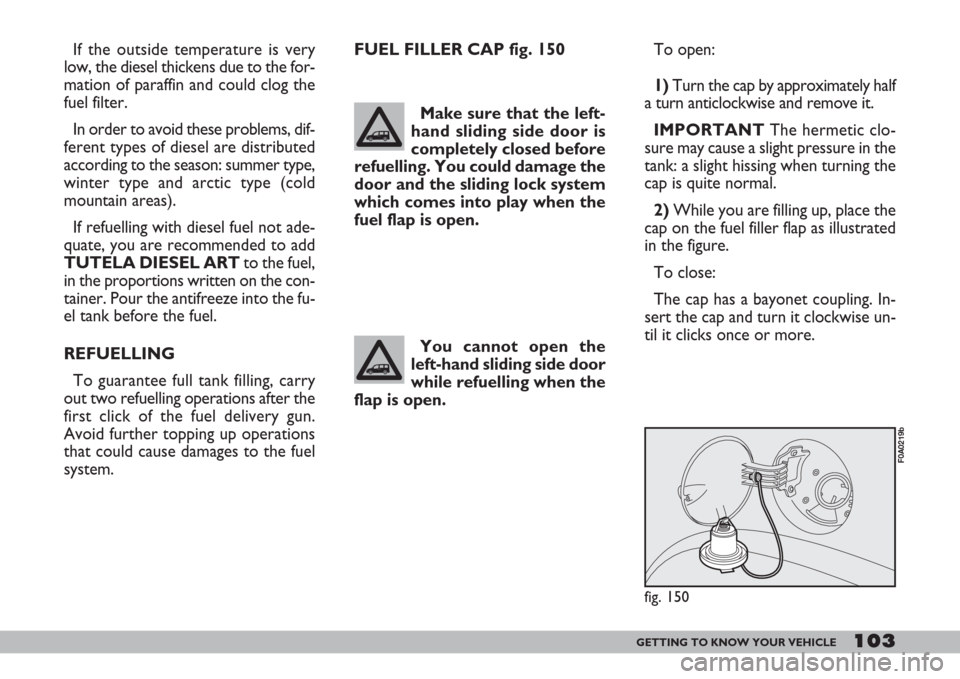
system.FUEL FILLER CAP fig. 150
Make sure that the left-
hand sliding side door is
completely closed before
refuelling. You could damage the
door and the sliding lock system
which comes into play when the
fuel flap is open.
You cannot open the
left-hand sliding side door
while refuelling when the
flap is open.
fig. 150
F0A0219b
To open:
1)Turn the cap by approximately half
a turn anticlockwise and remove it.
IMPORTANTThe hermetic clo-
sure may cause a slight pressure in the
tank: a slight hissing when turning the
cap is quite normal.
2)While you are filling up, place the
cap on the fuel filler flap as illustrated
in the figure.
To close:
The cap has a bayonet coupling. In-
sert the cap and turn it clockwise un-
til it clicks once or more.
Page 105 of 218
104GETTING TO KNOW YOUR VEHICLE
On certain versions the cap has a
mechanical lock to be opened using
the door key. PROTECTING THE
ENVIRONMENT
Protecting the environment has been
the guiding principle in the design of
the Fiat Doblò right from the start.
The result is the use of materials and
creation of devices that can reduce or
considerably curtail harmful influences
on the environment.
The devices for curtailing petrol en-
gine emissions are the following:
– a three-way catalytic converter;
– Lambda sensors (oxygen sensors);
– a fuel evaporation system. Do not put naked flames
or lighted cigarettes near
the fuel filler hole as there
is a danger of fire. Do not bend
too close to the hole either so as
not to breathe in harmful
vapours.
IMPORTANTIf required, replace
the fuel cap with another genuine cap
to avoid affecting the efficiency of the
fuel vapour recovery system.
The devices for curtailing diesel en-
gine emissions are:
– an oxidising catalytic converter;
– an exhaust gas recirculation system
(E.G.R.).
– diesel particulate filter (DPF)
– Lambda probes (where provided).
Consequently, the Fiat Doblò is ready
to travel well ahead of the most strin-
gent international pollution control
standards.
Page 111 of 218
110DRIVING YOUR VEHICLE
Some suggestions which may help
you to keep the running costs of the
vehicle down and lower the amount
of toxic emissions released into the at-
mosphere are given below.
GENERAL
CONSIDERATIONS
Vehicle maintenance
The overall state of the vehicle is an
important factor which has a marked
influence over fuel consumption and
driving comfort and on the life span of
your vehicle. For this reason care
should be taken to maintain your ve-
hicle by carrying out the necessary
checks and regulations in accordance
with the specifications given in the
SERVICE SCHEDULE (see sections:
spark plugs, idling, air cleaners, diesel
fuel filter, timing).Tyres
Tyre pressure should be checked at
least once every four weeks: if the
pressure is too low fuel consumption
increases as the resistance to the
rolling movement of the tyre is
greater. In this state, tyre wear is in-
creased and handling suffers which will
effect safety.
Unnecessary loads
Do not travel with too much load in
the boot. The weight of the vehicle
and its trim greatly effects consump-
tion and stability.
Roof rack/ski rack
Remove the roof rack or the ski rack
from the roof as soon as they are no
longer used.
These accessories reduce the aero-
dynamic penetration of the vehicle and
will increase consumption. Whentransporting particularly large objects,
use a trailer, where possible.
Electric devices
Use electric devices for the neces-
sary time only. The heated rear win-
dow, fog lights, windscreen wipers,
heater fan require large amounts of
electricity and increasing the request
for power will also increase fuel con-
sumption (up to +25% when driving in
towns).
Climate control system
The climate control system is an ad-
ditional load which greatly effects the
engine leading to higher consumption
(up to +20% in average). When the
temperature outside allows, use the
air vents where possible.
Aerodynamic accessories
The use of non-certified aerodynamic
items may adversely affect air drag and
consumption levels.
CONTAINING RUNNING COSTS AND POLLUTION
Page 151 of 218
150VEHICLE MAINTENANCE
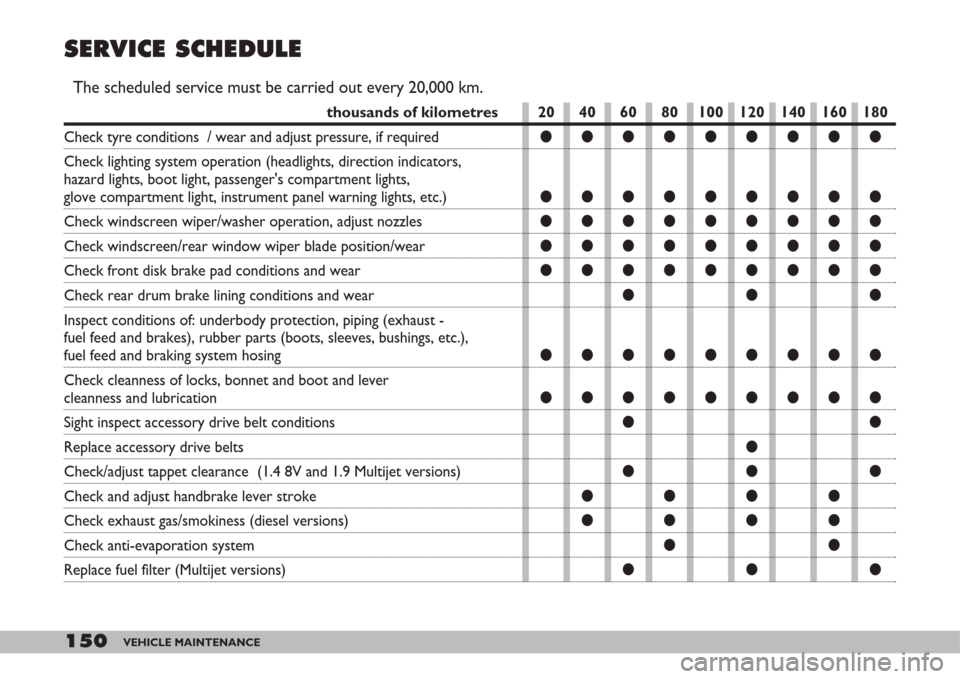
thousands of kilometres
Check tyre conditions / wear and adjust pressure, if required
Check lighting system operation (headlights, direction indicators,
hazard lights, boot light, passenger's compartment lights,
glove compartment light, instrument panel warning lights, etc.)
Check windscreen wiper/washer operation, adjust nozzles
Check windscreen/rear window wiper blade position/wear
Check front disk brake pad conditions and wear
Check rear drum brake lining conditions and wear
Inspect conditions of: underbody protection, piping (exhaust -
fuel feed and brakes), rubber parts (boots, sleeves, bushings, etc.),
fuel feed and braking system hosing
Check cleanness of locks, bonnet and boot and lever
cleanness and lubrication
Sight inspect accessory drive belt conditions
Replace accessory drive belts
Check/adjust tappet clearance (1.4 8V and 1.9 Multijet versions)
Check and adjust handbrake lever stroke
Check exhaust gas/smokiness (diesel versions)
Check anti-evaporation system
Replace fuel filter (Multijet versions)
SERVICE SCHEDULE
The scheduled service must be carried out every 20,000 km.
20 40 60 80 100 120 140 160 180
●●●●●●●●●
●●●●●●●●●
●●●●●●●●●
●●●●●●●●●
●●●●●●●●●
●●●
●●●●●●●●●
●●●●●●●●●
●●
●
●●●
●●●●
●●●●
●●
●●●
Page 153 of 218
152VEHICLE MAINTENANCE
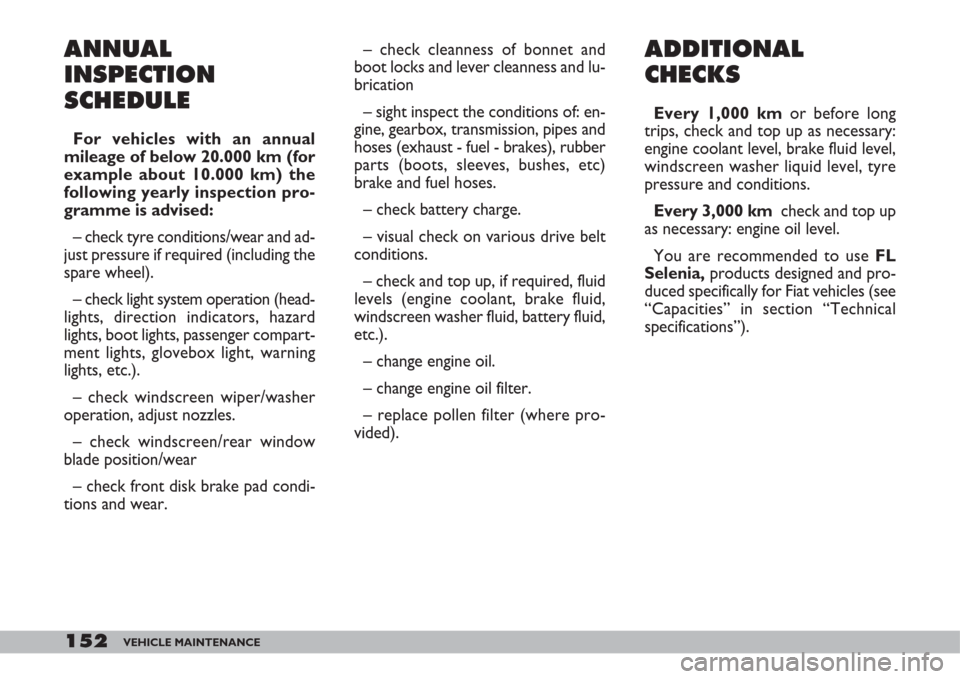
ANNUAL
INSPECTION
SCHEDULE
For vehicles with an annual
mileage of below 20.000 km (for
example about 10.000 km) the
following yearly inspection pro-
gramme is advised:
– check tyre conditions/wear and ad-
just pressure if required (including the
spare wheel).
– check light system operation (head-
lights, direction indicators, hazard
lights, boot lights, passenger compart-
ment lights, glovebox light, warning
lights, etc.).
– check windscreen wiper/washer
operation, adjust nozzles.
– check windscreen/rear window
blade position/wear
– check front disk brake pad condi-
tions and wear.– check cleanness of bonnet and
boot locks and lever cleanness and lu-
brication
– sight inspect the conditions of: en-
gine, gearbox, transmission, pipes and
hoses (exhaust - fuel - brakes), rubber
parts (boots, sleeves, bushes, etc)
brake and fuel hoses.
– check battery charge.
– visual check on various drive belt
conditions.
– check and top up, if required, fluid
levels (engine coolant, brake fluid,
windscreen washer fluid, battery fluid,
etc.).
– change engine oil.
– change engine oil filter.
– replace pollen filter (where pro-
vided).
ADDITIONAL
CHECKS
Every 1,000 kmor before long
trips, check and top up as necessary:
engine coolant level, brake fluid level,
windscreen washer liquid level, tyre
pressure and conditions.
Every 3,000 km check and top up
as necessary: engine oil level.
You are recommended to use FL
Selenia,products designed and pro-
duced specifically for Fiat vehicles (see
“Capacities” in section “Technical
specifications”).
Page 201 of 218
200TECHNICAL SPECIFICATIONS
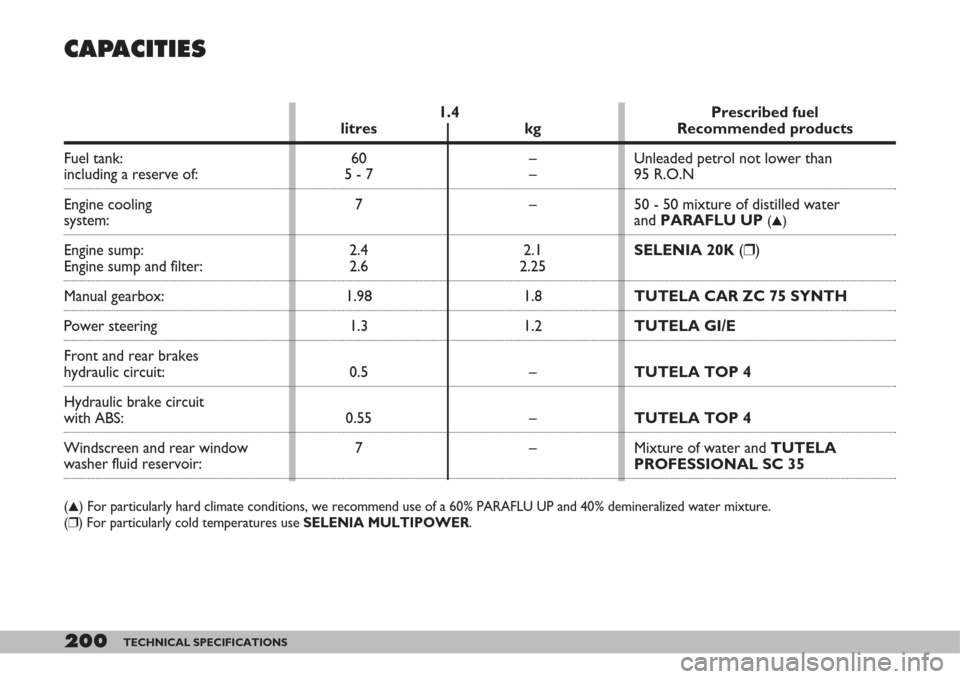
CAPACITIES
1.4
litres kg
60 –
5 - 7 –
7–
2.4 2.1
2.6 2.25
1.98 1.8
1.3 1.2
0.5 –
0.55 –
7–
Fuel tank:including a reserve of:
Engine cooling
system:
Engine sump:
Engine sump and filter:
Manual gearbox:
Power steering
Front and rear brakes
hydraulic circuit:
Hydraulic brake circuit
with ABS:
Windscreen and rear window
washer fluid reservoir:
(▲) For particularly hard climate conditions, we recommend use of a 60% PARAFLU UP and 40% demineralized water mixture.
(❒) For particularly cold temperatures use SELENIA MULTIPOWER.
Prescribed fuel
Recommended products
Unleaded petrol not lower than
95 R.O.N
50 - 50 mixture of distilled water
and PARAFLU UP
(▲)
SELENIA 20K(❒)
TUTELA CAR ZC 75 SYNTH
TUTELA GI/E
TUTELA TOP 4
TUTELA TOP 4
Mixture of water and TUTELA
PROFESSIONAL SC 35