lights FIAT DOBLO 2008 1.G Owner's Manual
[x] Cancel search | Manufacturer: FIAT, Model Year: 2008, Model line: DOBLO, Model: FIAT DOBLO 2008 1.GPages: 222, PDF Size: 3.39 MB
Page 83 of 222
82GETTING TO KNOW YOUR VEHICLE
fig. 127
F0A0433b
7-seat versions
To extend the boot, proceed as fol-
lows:
– remove head restraints;
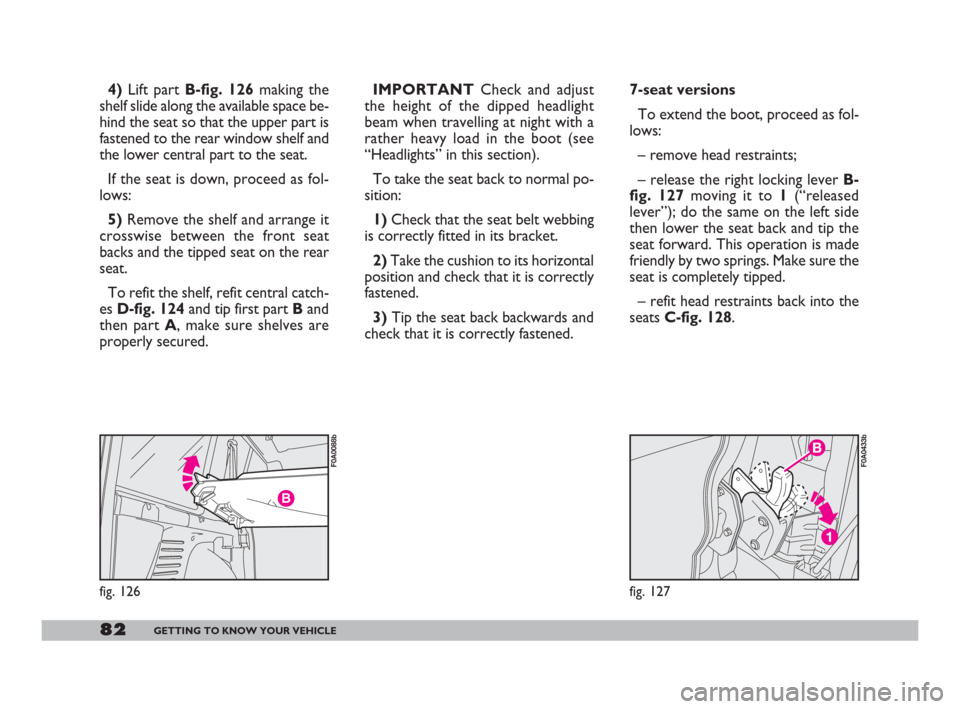
– release the right locking lever B-
fig. 127moving it to 1(“released
lever”); do the same on the left side
then lower the seat back and tip the
seat forward. This operation is made
friendly by two springs. Make sure the
seat is completely tipped.
– refit head restraints back into the
seats C-fig. 128.
B
fig. 126
F0A0088b
4)Lift part B-fig. 126making the
shelf slide along the available space be-
hind the seat so that the upper part is
fastened to the rear window shelf and
the lower central part to the seat.
If the seat is down, proceed as fol-
lows:
5)Remove the shelf and arrange it
crosswise between the front seat
backs and the tipped seat on the rear
seat.
To refit the shelf, refit central catch-
es D-fig. 124and tip first part Band
then part A, make sure shelves are
properly secured.IMPORTANTCheck and adjust
the height of the dipped headlight
beam when travelling at night with a
rather heavy load in the boot (see
“Headlights” in this section).
To take the seat back to normal po-
sition:
1)Check that the seat belt webbing
is correctly fitted in its bracket.
2)Take the cushion to its horizontal
position and check that it is correctly
fastened.
3)Tip the seat back backwards and
check that it is correctly fastened.
001-105 Doblo GB 16-12-2008 14:22 Pagina 82
Page 89 of 222
88GETTING TO KNOW YOUR VEHICLE
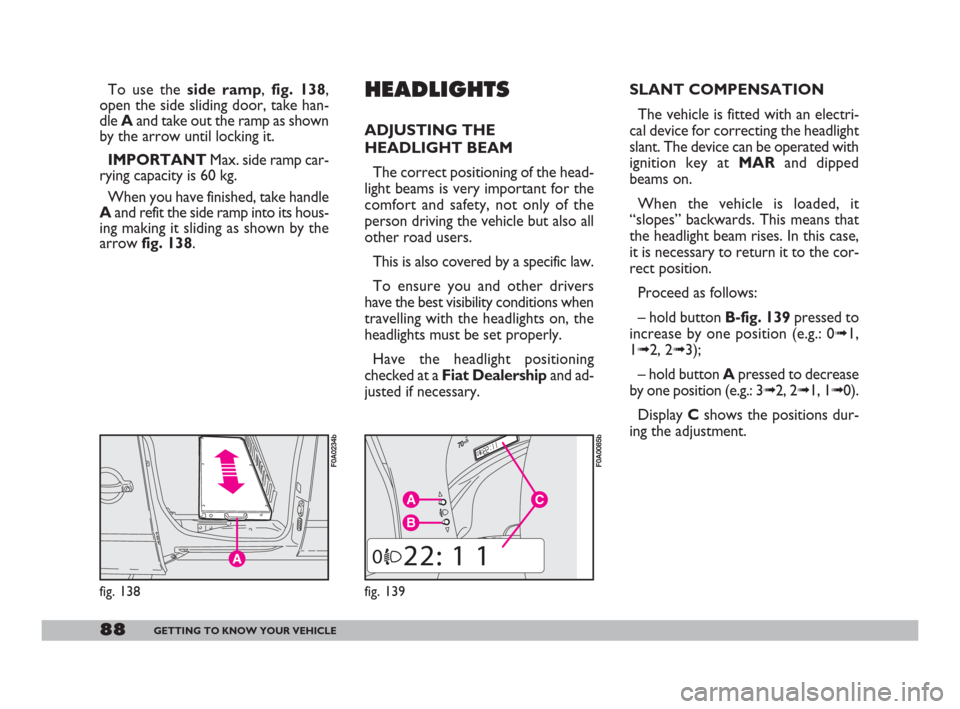
To use the side ramp, fig. 138,
open the side sliding door, take han-
dle Aand take out the ramp as shown
by the arrow until locking it.
IMPORTANTMax. side ramp car-
rying capacity is 60 kg.
When you have finished, take handle
Aand refit the side ramp into its hous-
ing making it sliding as shown by the
arrow fig. 138.
fig. 138
F0A0234b
HEADLIGHTS
ADJUSTING THE
HEADLIGHT BEAM
The correct positioning of the head-
light beams is very important for the
comfort and safety, not only of the
person driving the vehicle but also all
other road users.
This is also covered by a specific law.
To ensure you and other drivers
have the best visibility conditions when
travelling with the headlights on, the
headlights must be set properly.
Have the headlight positioning
checked at a Fiat Dealershipand ad-
justed if necessary.SLANT COMPENSATION
The vehicle is fitted with an electri-
cal device for correcting the headlight
slant. The device can be operated with
ignition key at MARand dipped
beams on.
When the vehicle is loaded, it
“slopes” backwards. This means that
the headlight beam rises. In this case,
it is necessary to return it to the cor-
rect position.
Proceed as follows:
– hold button B-fig. 139pressed to
increase by one position (e.g.: 0➟1,
1➟2, 2➟3);
– hold button Apressed to decrease
by one position (e.g.: 3➟2, 2➟1, 1➟0).
Display Cshows the positions dur-
ing the adjustment.
0y
1∆
70
22: 1 10
7
7B
AC
fig. 139
F0A0085b
001-105 Doblo GB 16-12-2008 14:22 Pagina 88
Page 90 of 222
89GETTING TO KNOW YOUR VEHICLE
ABS
The vehicle can be fitted with an ABS
braking system, which prevents the
wheels from locking when braking,
makes the most of road grip and gives
the best control when emergency
braking under difficult road conditions.
The driver can tell the ABS system
has come into play because the brake
pedal pulsates slightly and the system
gets noisier.
This should not be interpreted as a
fault in the brakes; on the contrary it
is a sign that the ABS system is work-
ing: it tells the driver that the vehicle
is travelling at the limit of its road grip
and that he should alter his speed to
fit the type of road surface.
The ABS system is an addition to the
basic braking system. If there is a mal-
function, the system turns off auto-
matically and only the ordinary brakes
continue to work.If a failure occurs, and consequently
the anti-lock function is not effective,
the braking system will continue to
work as usual.
If you have never driven a vehicle
with ABS before, you should practice
using the system on slippery terrain,
obviously with the necessary safety
precautions and keeping to the High-
way Code of the country you are in.
It is also a good idea to read the fol-
lowing information carefully.
The advantage in using the ABS sys-
tem is that it continues to give you
maximum manoeuvrability even when
braking hard in conditions of poor grip
by preventing the wheels locking.
You should, however, not expect the
braking distance to always decrease:
for example surfaces with gravel or
fresh snow on a slippery road will in
fact increase the braking distance. Correct positions as a function
of the load
0- one or two occupants in the
front seats.
1- five occupants.
2- five occupants + load in boot.
3- driver + maximum permissible
load stowed in boot.
Check the headlight
beam position every time
you change the load to be
carried.
HEADLIGHT ADJUSTMENT
ABROAD
Headlights are orientated as to drive
inside the country of origin before sell-
ing the vehicle. When travelling in
countries with opposite driving direc-
tion, you need to cover the headlight
areas according to the Road Code of
the country you are travelling in.
001-105 Doblo GB 16-12-2008 14:22 Pagina 89
Page 106 of 222
105GETTING TO KNOW YOUR VEHICLE
DIESEL PARTICULATE
FILTER (DPF) (for Multijet
versions 1.3 85 HP and 1.9 120
HP)
The Diesel Particulate Filter is a me-
chanical filter, integral with the exhaust
system, that physically traps particulates
present in the exhaust gases of Diesel
engines.
The diesel particular filter has been
adopted to eliminate almost totally par-
ticulates in compliance with current /
future law regulations.
During normal use of the vehicle, the
engine control unit records a set of da-
ta (e.g.: travel time, type of route, tem-
peratures, etc.) and it will then calcu-
late how much particulates has been
trapped by the filter.Since this filter physically traps partic-
ulates, it shall be cleaned (reclaimed) at
regular intervals by burning carbon par-
ticles.
Reclaiming procedure is controlled
automatically by the engine control unit
according to the filter conditions and
the conditions of use of the vehicle.
During reclaiming the following phe-
nomena could take place: idling slight
increase, fan activation, slight smoke in-
crease, high exhaust temperatures.
These situations shall not be considered
as faults and they do not affect vehicle
performance and environment.
If the dedicated message is displayed,
refer to paragraph “Warning lights and
messages”.
001-105 Doblo GB 16-12-2008 14:22 Pagina 105
Page 107 of 222
106DRIVING YOUR VEHICLE
ENGINE
STARTING3)Press the clutch pedal fully down,
without pressing the accelerator.
4) Turn the ignition key to AVV
and let it go the moment the engine
starts.
If the engine does not start at the
first attempt, return the ignition key
to STOPbefore trying to start the
engine again.
If the warning lights ¢(Y) and U
stay on when the ignition key is at
MAR, turn the key to STOPand
then to MARagain; if the warning light
stays on, try with the other keys pro-
vided.
If you are still unable to start the en-
gine, perform the emergency start-up
procedure (see section “In an emer-
gency”) and go to a Fiat Dealership.
IMPORTANTNever leave the ig-
nition key at MARwhen the engine is
off.HOW TO START DIESEL
VERSIONS
1) Ensure that the handbrake is up.
2)Put the gear lever into neutral.
3)Turn the ignition key to MAR. In-
strument panel warning lights U, m
and ¢(Y) will come on.
4)Wait for warning lights Uand ¢
(Y) to turn off.
5) Wait for the instrument panel
warning light mto go out. The hot-
ter the engine is, the quicker this will
happen.
6)Press the clutch pedal down to
the floor without touching the accel-
erator.
7) Turn the key to AVVimmedi-
ately after the mwarning light goes
out. If you wait to long, you will lose
the benefit of the work done by the
glow plugs.
D D
R R
I I
V V
I I
N N
G G
Y Y
O O
U U
R R
V V
E E
H H
I I
C C
L L
E E
It is dangerous to let the
engine run in a garage or
other closed area. The
engine consumes oxygen and
gives off carbon dioxide, carbon
monoxide and other poisonous
fumes.
Do not touch the high
voltage cables (spark plug
leads) when the engine is
running.
STARTING PROCEDURE FOR
PETROL VERSIONS
1) Ensure that the handbrake is up.
2)Put the gear lever into neutral.
106-118 Doblo GB 9-05-2008 12:09 Pagina 106
Page 111 of 222
110DRIVING YOUR VEHICLE
Some suggestions which may help
you to keep the running costs of the
vehicle down and lower the amount
of toxic emissions released into the at-
mosphere are given below.
GENERAL
CONSIDERATIONS
Vehicle maintenance
The overall state of the vehicle is an
important factor which has a marked
influence over fuel consumption and
driving comfort and on the life span of
your vehicle. For this reason care
should be taken to maintain your ve-
hicle by carrying out the necessary
checks and regulations in accordance
with the specifications given in the
SERVICE SCHEDULE (see sections:
spark plugs, idling, air cleaners, diesel
fuel filter, timing).Tyres
Tyre pressure should be checked at
least once every four weeks: if the
pressure is too low fuel consumption
increases as the resistance to the
rolling movement of the tyre is
greater. In this state, tyre wear is in-
creased and handling suffers which will
effect safety.
Unnecessary loads
Do not travel with too much load in
the boot. The weight of the vehicle
and its trim greatly effects consump-
tion and stability.
Roof rack/ski rack
Remove the roof rack or the ski rack
from the roof as soon as they are no
longer used.
These accessories reduce the aero-
dynamic penetration of the vehicle and
will increase consumption. Whentransporting particularly large objects,
use a trailer, where possible.
Electric devices
Use electric devices for the neces-
sary time only. The heated rear win-
dow, fog lights, windscreen wipers,
heater fan require large amounts of
electricity and increasing the request
for power will also increase fuel con-
sumption (up to +25% when driving in
towns).
Climate control system
The climate control system is an ad-
ditional load which greatly effects the
engine leading to higher consumption
(up to +20% in average). When the
temperature outside allows, use the
air vents where possible.
Aerodynamic accessories
The use of non-certified aerodynamic
items may adversely affect air drag and
consumption levels.
CONTAINING RUNNING COSTS AND POLLUTION
106-118 Doblo GB 9-05-2008 12:09 Pagina 110
Page 112 of 222
DRIVING STYLE
Starting
Do not warm the engine when the
vehicle is stationary or at high or low
revs: in this way the engine will warm
up gradually increasing consumption
and emissions. You should drive off
slowly straight away avoiding high revs
so that the engine will warm up more
quickly.
Unnecessary actions
Avoid revving the engine when
stopped at traffic lights or before
switching off the engine and avoid dou-
bling the clutch as these actions have
no purpose of modern vehicles and
serve only to increase consumption
and pollution.
Gear selection
As soon as the traffic and road con-
ditions allow it, shift to a higher gear.
Using a lower gear to liven up accel-
eration greatly increases consumption.
In the same way, improper use of the
higher gears will increase consump-tion, emissions and wear and tear on
the engine.
Top speed
Fuel consumption increases consid-
erably as speed increases. For exam-
ple, when accelerating from 90 to 120
km/h, fuel consumption increases up
to approximately +30%. Your speed
should be kept as even as possible and
superfluous braking and acceleration
avoided as this increases both con-
sumption and emissions. A “smooth”
driving style should be adopted by at-
tempting to anticipate manoeuvres to
avoid imminent danger and to keep a
safe distance from the vehicle in front
to avoid braking sharply.
Acceleration
Accelerating violently increasing the
revs will greatly effect consumption
and emission: acceleration should be
gradual and not exceed the maximum
torque.CONDITIONS OF USE
Cold starting
Frequent cold starting will not enable
the engine to reach optimal running
temperature. It follows, therefore, that
consumption will be higher (from +15
to +30% in towns) as will the pro-
duction of toxic emissions.
Traffic situations and road
conditions
Heavy traffic and higher consumption
are synonymous: for example, when
driving slowly with frequent use of
lower gears or in towns where there
are numerous traffic lights.
Also twisting roads, mountain roads
and rough road surfaces pay a heavy toll
on consumption.
Traffic hold-ups
During prolonged stops (traffic lights,
level crossings, etc.) the engine should
be switched off.
111DRIVING YOUR VEHICLE
106-118 Doblo GB 9-05-2008 12:09 Pagina 111
Page 120 of 222
119IN AN EMERGENCY
I I
N N
A A
N N
E E
M M
E E
R R
G G
E E
N N
C C
Y Y
EMERGENCY
START-UP
If the Fiat code cannot deactivate the
engine immobilising system, the warn-
ing lights ¢(Y) and Ustay on and
the engine will not start. Follow the
emergency start-up procedure to start
the engine.
Read the whole procedure carefully
before trying to carry it out. If you
make a mistake, you must turn the ig-
nition key back to STOPand repeat
the whole operation from the begin-
ning (step 1).
1)Read the 5-figure electronic code
given on the CODE card.
2)Turn the ignition key to MAR.3)Press and hold down the accel-
erator pedal. The injection system
warning light Uwill come on for
about 8 seconds, and then go out. At
this point release the accelerator ped-
al and get ready to count the flashes
of the Uinjection warning light.
4) Count the number of flashes that
corresponds to the first figure of the
code on the CODE card, then press
the accelerator pedal and keep it there
until the Uwarning light comes on
for four seconds and then goes out;
release the accelerator pedal.
5) The Uwarning light will start
flashing again: after it has flashed the
number of times that corresponds to
the second figure on the CODE card,
press the accelerator pedal to the
floor and keep it there.
6)Do the same for the remaining fig-
ures on the CODE card.7)Once the final figure has been en-
tered, keep the accelerator pedal
pressed. The Uwarning light will light
up for four seconds and then go out;
release the accelerator pedal.
8)The Uwarning light will flash
rapidly for about 4 seconds to indicate
that the operation has been complet-
ed correctly.
9) Start the engine by turning the ig-
nition key from MARto AVV.
If, however, the Uwarning light
stays on, turn the ignition key to
STOPand repeat the procedure
from step 1).
IMPORTANT After an emergency
start-up, you should contact a Fiat
Dealership otherwise you will have
to repeat the procedure described
each time you want to start the en-
gine.
119-148 Doblo GB 9-05-2008 12:09 Pagina 119
Page 122 of 222
121IN AN EMERGENCY
BUMP STARTING IF A TYRE IS
PUNCTURED
GENERAL INSTRUCTIONS
Wheel changing and correct use of
the jack and spare wheel call for some
precautions as listed below. Catalysed vehicles must
not be bump started
(pushed, towed or coast-
ed down hill) as this could cause
fuel to flow into the catalytic ex-
haust system and damage it be-
yond repair.
Remember that until
the engine has started the
brake booster and hy-
draulic power steering systems
will not work and a greater effort
will therefore be required to de-
press the brake pedal or turn the
steering wheel.
Alert other drivers that
the vehicle is stationary in
compliance with local
regulations: hazard warning
lights, warning triangle etc.
Passengers on board should
leave the vehicle, especially if it is
heavily laden. Passengers should
stay away from oncoming traffic
while the wheel is being changed.
If the wheel is being changed on
a steep or badly surfaced road,
place wedges or other suitable
material under the wheels to
stop the vehicle.
The spare wheel is vehicle-spe-
cific. Never use the wheel on oth-
er models. Never fit other mod-
el spare wheels on your vehicle.
Do not use the jack for
loads over the value indi-
cated on the plate.
The jack should only be used to
change a wheel on the vehicle for
which it was designed. It should
not be put to other uses or em-
ployed to raise other models of
vehicle. Under no circumstances
should it be used when carrying
out repairs under the vehicle.
An incorrectly positioned jack
may cause the vehicle to fall.
119-148 Doblo GB 9-05-2008 12:09 Pagina 121
Page 131 of 222
130IN AN EMERGENCY
IF A BULB BURNS OUT
Modifications or repairs
to the electrical system
carried out incorrectly
and without bearing the features
of the system in mind can cause
malfunctions with the risk of fire.Only touch the metal
part when handling halo-
gen bulbs. If the transpar-
ent bulb is touched it reduces the
intensity of the light emitted and
can also reduce the life of the
bulb. If you touch the bulb acci-
dentally, rub it with a cloth moist-
ened with alcohol and leave it to
dry.
You should have the
bulbs replaced at a Fiat
Dealership. Always check
the height of the headlight beam
after changing a bulb.
Halogen bulbs contain
pressurised gas which, if
broken, may cause small
fragments of glass to be project-
ed outwards.
GENERAL INSTRUCTIONS
– When a light is not working, check
that it has not fused before changing
the bulb.
– For the location of the fuses, re-
fer to “If a fuse blows” in this chap-
ter.
– Before replacing a bulb that does
not work, check that the contacts are
not oxidised.
– Burnt-out bulbs must be replaced
with ones of the same type.
– Always check the height of the
headlight beam after changing a bulb.
IMPORTANTThe headlight inner
surface may be lightly misted over: this
is not a fault but a natural fact due to
low temperature and the level of air
humidity. It will disappear as soon the
headlights are turned on. The pres-
ence of drops inside the headlights
means water infiltration, therefore
contact Fiat Dealership.
119-148 Doblo GB 9-05-2008 12:09 Pagina 130