tyre pressure FIAT DOBLO COMBI 2013 Owner handbook (in English)
[x] Cancel search | Manufacturer: FIAT, Model Year: 2013, Model line: DOBLO COMBI, Model: FIAT DOBLO COMBI 2013Pages: 283, PDF Size: 6.31 MB
Page 189 of 283
185
KNOW
YOUR
VEHICLE
SAFETY
STARTING
AND
DRIVING
WARNING
LIGHTS AND
MESSAGES
IN AN
EMERGENCY
SERVICING
AND
MAINTENANCE
TECHNICAL
SPECIFICATIONS
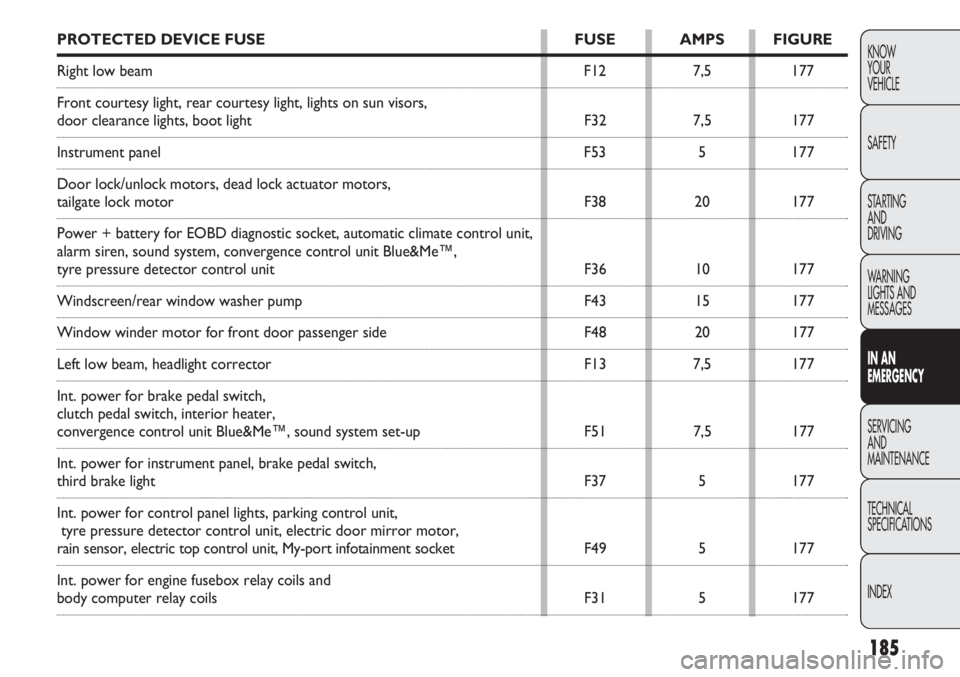
INDEXPROTECTED DEVICE FUSE FUSE AMPS FIGURE
Right low beam F127,5177
Front courtesy light, rear courtesy light, lights on sun visors,
door clearance lights, boot light F327,5177
Instrument panel F535177
Door lock/unlock motors, dead lock actuator motors,
tailgate lock motor F3820177
Power + battery for EOBD diagnostic socket, automatic climate control un\
it,
alarm siren, sound system, convergence control unit Blue&Me™,
tyre pressure detector control unit F3610177
Windscreen/rear window washer pump F4315177
Window winder motor for front door passenger side F4820177
Left low beam, headlight corrector F137,5177
Int. power for brake pedal switch,
clutch pedal switch, interior heater,
convergence control unit Blue&Me™, sound system set-up F517,5177
Int. power for instrument panel, brake pedal switch,
third brake light F375177
Int. power for control panel lights, parking control unit, tyre pressure detector control unit, electric door mirror motor,
rain sensor, electric top control unit, My-port infotainment socket F495177
Int. power for engine fusebox relay coils and
body computer relay coils F315177
Page 196 of 283
192
KNOWYOUR
VEHICLE
SAFETY
STARTING AND
DRIVING
WARNING
LIGHTS AND MESSAGES
IN AN
EMERGENCY
SERV IC
ING
AND
MAINTENANCE
TECHNICAL
SPECIFICA TIONS
INDEX
●●●●●●
●●●●●●
●●●●●●
●●●●●●
●●●●●●
●●●●●● ●●●
●●●●●●
●●●●●● ●●
●●
●●●●●●
●●●●●●
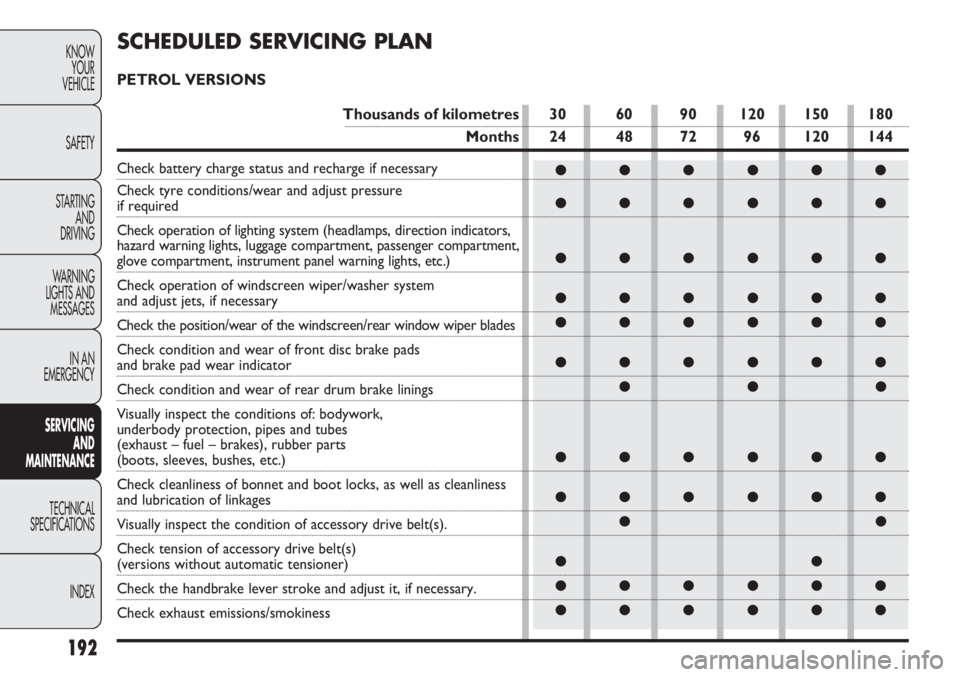
SCHEDULED SERVI CING PLAN
PETROL VERSIONS
Thousands of kilometres 30 60 90 120 150 180
Months 24 48 72 96 120 144
Check battery charge status and recharge if necessary
Check tyre conditions/wear and adjust pressure
if required
Check operation of lighting system (headlamps, direction indicators,
hazard warning lights, luggage compartment, passenger compartment,
glove compartment, instrument panel warning lights, etc.)
Check operation of windscreen wiper/washer system
and adjust jets, if necessary
Check the position/wear of the windscreen/rear window wiper blades
Check condition and wear of front disc brake pads
and brake pad wear indicator
Check condition and wear of rear drum brake linings
Visually inspect the conditions of: bodywork,
underbody protection, pipes and tubes
(exhaust – fuel – brakes), rubber parts
(boots, sleeves, bushes, etc.)
Check cleanliness of bonnet and boot locks, as well as cleanliness
and lubrication of linkages
Visually inspect the condition of accessory drive belt(s).
Check tension of accessory drive belt(s)
(versions without automatic tensioner)
Check the handbrake lever stroke and adjust it, if necessary.
Check exhaust emissions/smokiness
Page 198 of 283
194
KNOWYOUR
VEHICLE
SAFETY
STARTING AND
DRIVING
WARNING
LIGHTS AND MESSAGES
IN AN
EMERGENCY
SERV IC
ING
AND
MAINTENANCE
TECHNICAL
SPECIFICA TIONS
INDEX
●●●●●●
●●●●●●
●●●●●●
●●●●●●
●●●●●● ●●●
●●●●●●
●●●●●●
●●●●●●
●●
●●●●●● ●●
●●●●●●
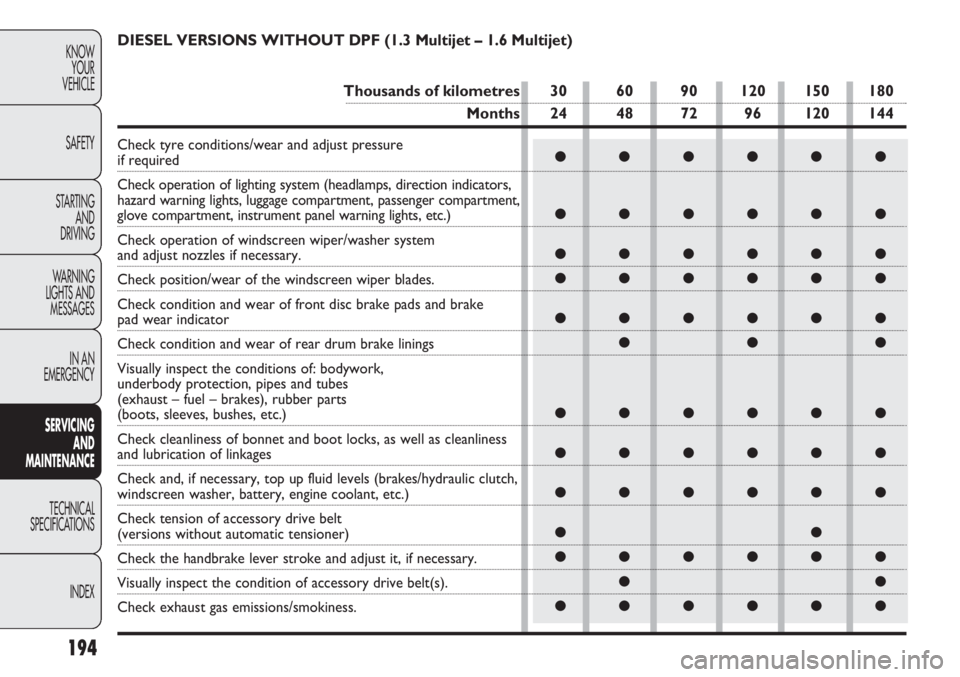
DIESEL VERSIONS WITHOUT DPF (1.3 Multijet – 1.6 Multijet)
Thousands of kilometres 30 60 90 120 150 180
Months 24 48 72 96 120 144
Check tyre conditions/wear and adjust pressure if required
Check operation of lighting system (headlamps, direction indicators,
hazard warning lights, luggage compartment, passenger compartment,
glove compartment, instrument panel warning lights, etc.)
Check operation of windscreen wiper/washer system
and adjust nozzles if necessary.
Check position/wear of the windscreen wiper blades.
Check condition and wear of front disc brake pads and brake
pad wear indicator
Check condition and wear of rear drum brake linings
Visually inspect the conditions of: bodywork,
underbody protection, pipes and tubes
(exhaust – fuel – brakes), rubber parts
(boots, sleeves, bushes, etc.)
Check cleanliness of bonnet and boot locks, as well as cleanliness
and lubrication of linkages
Check and, if necessary, top up fluid levels (brakes/hydraulic clutch, \
windscreen washer, battery, engine coolant, etc.)
Check tension of accessory drive belt
(versions without automatic tensioner)
Check the handbrake lever stroke and adjust it, if necessary.
Visually inspect the condition of accessory drive belt(s).
Check exhaust gas emissions/smokiness.
Page 200 of 283
196
KNOWYOUR
VEHICLE
SAFETY
STARTING AND
DRIVING
WARNING
LIGHTS AND MESSAGES
IN AN
EMERGENCY
SERV IC
ING
AND
MAINTENANCE
TECHNICAL
SPECIFICA TIONS
INDEX
● ●●●●
● ●●●●
● ●●●●
● ●●●●
● ●●●● ●●
● ●●●●
● ●●●●
● ●●●●
●●
● ●●●● ●●
● ●●●●
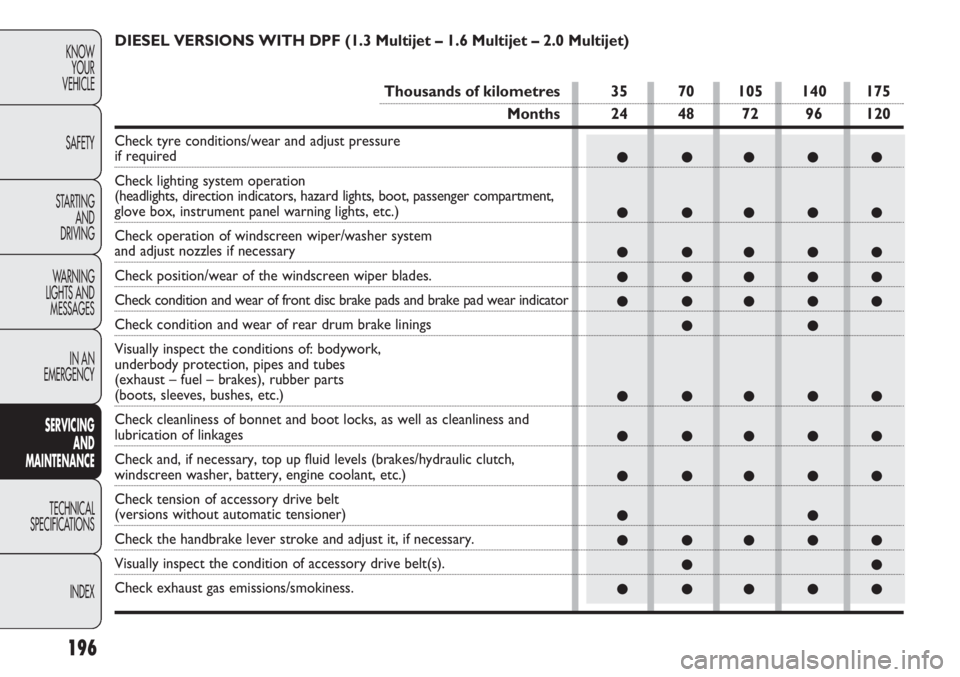
DIESEL VERSIONS WITH DPF (1.3 Multijet – 1.6 Multijet – 2.0 Multijet)
Thousands of kilometres 35 70 105 140 175
Months 24 48 72 96 120
Check tyre conditions/wear and adjust pressure if required
Check lighting system operation
(headlights, direction indicators, hazard lights, boot, passenger compa\
rtment,
glove box, instrument panel warning lights, etc.)
Check operation of windscreen wiper/washer system
and adjust nozzles if necessary
Check position/wear of the windscreen wiper blades.
Check condition and wear of front disc brake pads and brake pad wear ind\
icator
Check condition and wear of rear drum brake linings
Visually inspect the conditions of: bodywork,
underbody protection, pipes and tubes
(exhaust – fuel – brakes), rubber parts
(boots, sleeves, bushes, etc.)
Check cleanliness of bonnet and boot locks, as well as cleanliness and
lubrication of linkages
Check and, if necessary, top up fluid levels (brakes/hydraulic clutch, \
windscreen washer, battery, engine coolant, etc.)
Check tension of accessory drive belt
(versions without automatic tensioner)
Check the handbrake lever stroke and adjust it, if necessary.
Visually inspect the condition of accessory drive belt(s).
Check exhaust gas emissions/smokiness.
Page 202 of 283

198
KNOWYOUR
VEHICLE
SAFETY
STARTING AND
DRIVING
WARNING
LIGHTS AND MESSAGES
IN AN
EMERGENCY
SERV IC
ING
AND
MAINTENANCE
TECHNICAL
SPECIFICA TIONS
INDEX
HEAV Y USAGE OF THE VEHICLE
If the vehicle is mostly used in one of the following con-
ditions:
❒trailer or caravan towing;
❒dusty roads;
❒short distances (less than 7-8 km) and with external
temperatures below zero;
❒frequently idling engine or long distance low speed
driving or in the case of long term inactivity;
❒the following checks must be carried out more often
than indicated in the Scheduled Servicing Plan:
❒check front disc brake pad conditions and wear;
❒check cleanliness of bonnet and boot locks and lever
cleanliness and lubrication;
❒visually inspect the conditions of: engine, gearbox,
transmission, pipes and tubes (exhaust – fuel
– brakes), rubber parts (boots, sleeves, bushes, etc.);
❒check battery charge and liquid level (electrolyte);
❒visual check on various drive belt conditions;
❒check and if necessary change engine oil and oil filter.
❒ check and, if necessary, replace pollen filter.
REGULAR CHECKS
Every 1,000 km or before long journeys, check and, if nec-
essary, top up:
❒ engine coolant fluid level;
❒ brake fluid level;
❒ windscreen washer level;
❒ tyre pressure and conditions.
❒ operation of lighting system (headlights, direction in-
dicators, hazard lights, etc.);
❒ operation of windscreen washer/wipers system and po-
sitioning/wear of windscreen/rear window wiper blades
(for versions/markets where provided);
Check and top up, if required, the engine oil level every
3,000 km.
Page 213 of 283

209
KNOW
YOUR
VEHICLE
SAFETY
STARTING
AND
DRIVING
WARNING
LIGHTS AND
MESSAGES
IN AN
EMERGENCY
SERVIC
ING
AND
MAINTENANCE
TECHNICAL
SPECIFICA TIONS
INDEX
IMPORTANT NOTES
❒ Where possible, avoid braking suddenly, wheel-spinning
and crashing into kerbs, potholes or other obstacles.
Long distances on uneven roads can damage the tyres;
❒ check the tyres regularly for cuts on the sides, swelling
or irregular tread wear. Go to a Fiat Dealership if re-
quired.
❒ avoid overloading the car when travelling: this may cause
serious damage to the wheels and tyres;
❒ if a tyre is punctured, stop the vehicle immediately and
change it to avoid damage to the tyre, the rim, and the
suspension and steering systems;
❒ a tyre will age even if it is not used much. Cracks in
the tread and on the sidewalls are a sign of ageing. In
any event, have the tyres checked by specialised per-
sonnel if they have been fitted for longer than six years.
Remember to check the spare wheel very carefully;
❒ In case of replacement, always fit new tyres, avoidingWHEELS AND TYRES
Check the pressure of each tyre, including the spare, every
two weeks and before long journeys. The pressure should
be checked with the tyre rested and cold.
It is normal for the pressure to increase when the vehi-
cle is used; for the correct tyre inflation pressure, see
“Wheels” in the “Technical specifications” section.
Incorrect pressure causes abnormal tyre wear fig. 186:
A normal pressure: tread evenly worn.
B low pressure: tread particularly worn at the edges.
C high pressure: tread particularly worn in the centre.
The tyres must be replaced when the tread is less than 1.6
mm thick. In all cases, follow the laws in force in the coun-
try where you are driving.
F0V0161mfig. 186
Page 214 of 283

210
KNOWYOUR
VEHICLE
SAFETY
STARTING AND
DRIVING
WARNING
LIGHTS AND MESSAGES
IN AN
EMERGENCY
SERV IC
ING
AND
MAINTENANCE
TECHNICAL
SPECIFICA TIONS
INDEX
those with an unknown origin.
❒ If a tyre is replaced, you should also change the inflation
valve.
❒ to allow even wear between the front and rear tyres,
it is advisable to switch them every 10-15 thousand kilo-
metres, keeping them on the same side of the car so
as not to reverse the direction of rotation.
Remember that road hold depends on cor-
rect tyre pressures.
WARNING
If the pressure is too low, the tyre
overheats and this can cause it serious
damage.
WARNING
Do not switch the tyres from the right of
the vehicle to the left and vice versa.
WARNING
Do not re-spray alloy wheel rims at tem-
peratures higher than 150 °C. The me-
chanical characteristics of the wheels may be
compromised.
WARNING
Page 231 of 283
227
KNOW
YOUR
VEHICLE
SAFETY
STARTING
AND
DRIVING
WARNING
LIGHTS AND
MESSAGES
IN AN
EMERGENCY
SERVICING
AND
MAINTENANCE
TECHNICAL
SPECIFICATIO
NS
INDEX
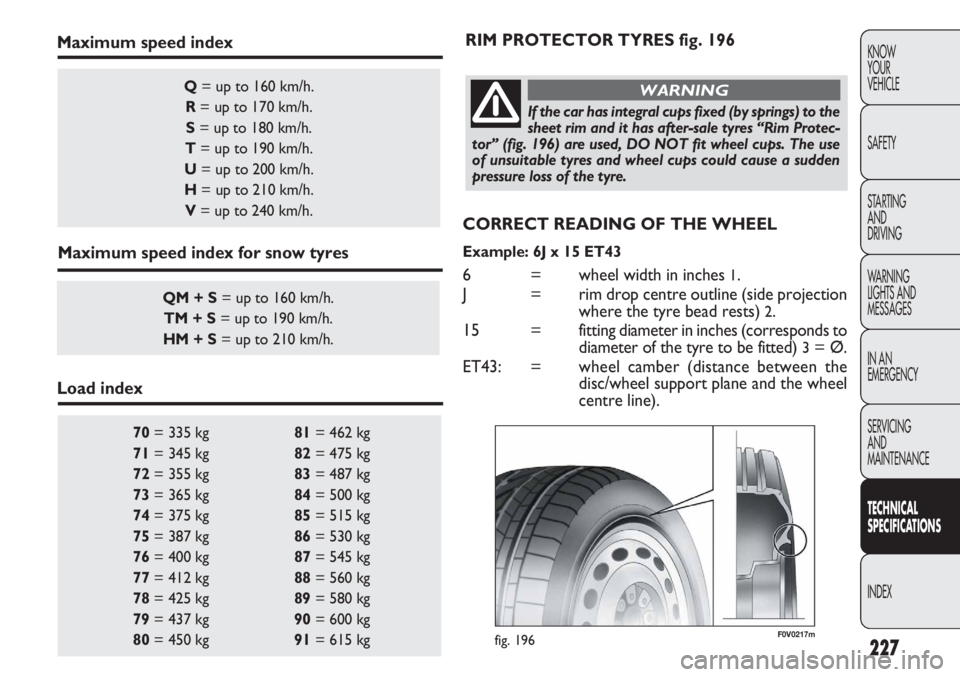
70 = 335 kg 81= 462 kg
71 = 345 kg 82= 475 kg
72 = 355 kg 83= 487 kg
73 = 365 kg 84= 500 kg
74 = 375 kg 85= 515 kg
75 = 387 kg 86= 530 kg
76 = 400 kg 87= 545 kg
77 = 412 kg 88= 560 kg
78 = 425 kg 89= 580 kg
79 = 437 kg 90= 600 kg
80 = 450 kg 91= 615 kg
Q= up to 160 km/h.
R = up to 170 km/h.
S = up to 180 km/h.
T = up to 190 km/h.
U = up to 200 km/h.
H = up to 210 km/h.
V = up to 240 km/h.
QM + S = up to 160 km/h.
TM + S = up to 190 km/h.
HM + S = up to 210 km/h.
Maximum speed index
Maximum speed index for snow tyres
Load index RIM PROTECTOR TYRES fig. 196
If the car has integral cups fixed (by springs) to the
sheet rim and it has after-sale tyres “Rim Protec-
tor” (fig. 196) are used, DO NOT fit wheel cups. The use
of unsuitable tyres and wheel cups could cause a sudden
pressure loss of the tyre.
WARNING
F0V0217mfig. 196
CORRECT READING OF THE WHEEL
Example: 6J x 15 ET43
6 = wheel width in inches 1.
J = rim drop centre outline (side projection where the tyre bead rests)
2.
15 = fitting diameter in inches (corresponds to diameter of the tyre to be fitted)
3= Ø.
ET43: = wheel camber (di stance between the
disc/wheel support plane and the wheel
centre line).
Page 233 of 283

229
KNOW
YOUR
VEHICLE
SAFETY
STARTING
AND
DRIVING
WARNING
LIGHTS AND
MESSAGES
IN AN
EMERGENCY
SERVICING
AND
MAINTENANCE
TECHNICAL
SPECIFICATIO
NS
INDEX
COLD TYRE PRESSURES (bar)
Add +0.3 bar to the prescribed pressure when the tyres are warm. However\
, recheck that the value is correct with the tyre cold.
With snow tyres, add +0.2 bar to the pressure recommended for standard t\
yres.
When running at speeds higher than 160 km/h, inflate tyres at full-load \
pressures.
Size STANDARD TYRES
Medium load Full load
FrontRearFront Rear
185/65 R15 88T 2.52.52.9 2.9
185/65 R15 92T 2.52.62.9 3
195/65 R15 95T 2.42.4 Doblò (M1) 2.62.6 Doblò (M1)
2.4 Doblò Cargo 2.7 Doblò Cargo
3.0 Doblò Combi (N1)3.2 Doblò Combi (N1)
195/60 R16C 99/97T2.72.72.7 2.8 Doblò 5P (M1)
3.3 Doblò Cargo
3.6 Doblò 7P (M1)/
Doblò Combi (N1)/
Doblò Cargo Maxi
PERFORMANCE
Maximum speeds after initial period of use (km/h).
1.4 1.4 T-JET 1.3 Multijet 1.6 Multijet 2.0 Multijet
161 172 (low roof)
158 (Euro 5) 164
179
167 (high roof) 156 (Euro 4) 158 (90 HP low roof)
153 (90 HP high roof)
Page 254 of 283
250
KNOWYOUR
VEHICLE
SAFETY
STARTING AND
DRIVING
WARNING
LIGHTS AND MESSAGES
IN AN
EMERGENCY
SERVICING AND
MAINTENANCE
TECHNICAL
SPECIFICAT IO
NS
INDEX
9. Air conditioning leads to higher fuel consumption (on average up to +30%). If the temperature outside is not
too extreme, try and use the air vents.
Driving style
1. After starting the engine you should drive away im-
mediately and slowly, avoiding high revs. Do not warm
up the engine at low or high revs when the vehicle is
stationary; this causes the engine to warm up more
slowly, thereby increasing fuel consumption, emissions
and mechanical component wear.
2. Avoid pointless actions such as revving up when at
traffic lights or before stopping the engine. The latter
action, like double-declutching, is unnecessary and caus-
es increased fuel consumption and pollution.
3. Gear selection: select a high gear as soon as possible
(taking into account normal engine operation and traf-
fic conditions) without pushing the engine to high revs
during the intermediate gears. Using low gears at high
revs to get excellent acceleration increases fuel con-
sumption, harmful emissions and engine wear.
PRACTICAL ADVICE FOR REDUCING FUEL
CONSUMPTION AND HARMFUL EMISSIONS
Vehicle condition
1. Have checks and
servicingcarried out in accordance
with the “Scheduled servicing plan”.
2. Check tyre pressure regularly, at least once every four
weeks. Excessively low pressures will increase con-
sumption because rolling resistance will be higher. In
these conditions, the tyre will wear and performance
will decay faster.
3. Use snow tyres only when the weather conditions
make them absolutely necessary. They increase con-
sumption and noise.
4. Do not travel with a heavy load: the weight of the
vehicle (especially when driving in town) and its trim
greatly affect fuel consumption and stability.
5. Remove roof racks or ski racks after use. These ac-
cessories reduce the vehicle’s aerodynamic penetra-
tion and have a negative effect on fuel consumption.
6. It is better to use a trailer to transport particularly bulky objects.
7. Use the vehicle’s air vents if possible: travelling with the windows open impairs aerodynamics.
8. Use electrical devices only for the amount of time needed. The heated rear window, auxiliary headlights,
windscreen wipers and fan heater use up a consider-
able amount of current, causing increased fuel con-
sumption (up to +25% in the urban cycle).