tyres FIAT DOBLO COMBI 2013 Owner handbook (in English)
[x] Cancel search | Manufacturer: FIAT, Model Year: 2013, Model line: DOBLO COMBI, Model: FIAT DOBLO COMBI 2013Pages: 283, PDF Size: 6.31 MB
Page 101 of 283
97
KNOW
YOUR
VEHICLE
SAFETY
STAR
TING
AND
DRIVING
WARNING
LIGHTS AND
MESSAGES
IN AN
EMERGENCY
SERVICING
AND
MAINTENANCE
TECHNICAL
SPECIFICATIONS
INDEX
EBD failure
EBD failure is indicated by warning lights
>andxin the
instrument panel coming on (together with the appropri-
ate message on the multifunction display on some versions)
(see “Warning lights and messages”).
In this case, the rear wheels may suddenly lock and the ve-
hicle may swerve when braking sharply. Drive carefully
to the nearest Fiat Service Network to have the system
checked.
FAILURE INDICATIONS
ABS failure
ABS failure is indicated by warning light
>in the instru-
ment panel coming on (together with the appropriate mes-
sage on the multifunction display on some versions) (see
“Warning lights and messages”).
In the case, the braking system will work as normal with-
out the extra capacity offered by the ABS system. Drive
carefully to the nearest Fiat Service Network to have the
system checked.
If the ABS intervenes, it means you have
almost reached the grip limit between the
tyres and the road surface: slow down to make
sure you can use the available grip.
WARNING
The ABS gets the most out of the available
grip, but it cannot increase it; you must
therefore always take care when driving on slip-
pery roads. Do not take any unnecessary risks.
WARNING
If only warning light xlights up in the in-
strument panel (with a message in the
multifunction display on some versions), stop the
vehicle immediately and contact the nearest Fiat
Service Network. Fluid leaking from the hydraulic
system will compromise the operation of the brak-
ing system, whether it is of the conventional type
or with ABS.
WARNING
Page 103 of 283
99
KNOW
YOUR
VEHICLE
SAFETY
STAR
TING
AND
DRIVING
WARNING
LIGHTS AND
MESSAGES
IN AN
EMERGENCY
SERVICING
AND
MAINTENANCE
TECHNICAL
SPECIFICATIONS
INDEX
At pick-up, the ESP system control unit will maintain the
braking pressure at the wheels until the necessary engine
torque for moving away is reached or, in any case, for a
maximum of 1.75 seconds in order to move easily from
the brake pedal to the accelerator pedal.
If the vehicle has not departed after this time, the system
will deactivate automatically by gradually releasing the brak-
ing pressure.
During this release stage, the typical brake disengagement
noise indicating that the vehicle is going to move immi-
nently will be heard.
Failure indications
System failure is indicated by the turning on of warning
light
*in the instrument panel with digital display and
warning light
áin the instrument panel with multifunction
display (for versions/markets where provided) (see sec-
tion “Warning lights and messages”).
IMPORTANT The Hill Holder system is not a parking
brake; therefore, never leave the vehicle without having
engaged the handbrake, turned the engine off and engaged
the first gear.
FAILURE INDICATIONS
In the event of a failure, the ESP will be automatically
switched off and the
áwarning light will come on per-
manently in the instrument panel along with a message in
the multifunction display (for versions/markets where pro-
vided) (see “Warning lights and messages” section). The
LED on the ASR OFF button will also light up. Contact the
Fiat Service Network as soon as possible if this happens.
Do not take unnecessary risks, even if your
vehicle is fitted with an ESP system. Your
driving style must always be suited to the road
conditions, visibility and traffic. The driver is al-
ways ultimately responsible for road safety.
WARNING
HILL HOLDER SYSTEM
This is an integral part of the ESP system and facilitates
hill starts. It is automatically activated in the following con-
ditions:
❒uphill: vehicle stationary on a road with a gradient high-
er than 5%, engine running, brake pedal pressed and
gearbox in neutral or gear other than reverse;
❒downhill: vehicle stationary on a road with a gradient
higher than 5 per cent, engine running, brake pedal de-
pressed and reverse gear engaged. For the correct operation of the ESP and
ASR systems, the tyres must absolutely be
the same make and type on all wheels, in perfect
condition and, above all, of the type, make and
size specified.
WARNING
Page 104 of 283
100
KNOWYOUR
VEHICLE
SAFETY
ST AR
TING AND
DRIVING
WARNING
LIGHTS AND MESSAGES
IN AN
EMERGENCY
SERVICING AND
MAINTENANCE
TECHNICAL
SPECIFICATIONS
INDEX
MSR system
(engine drive regulator)
This is an integral part of the ASR system that, in the event
of a sudden gear down shift, cuts in and provides torque
to the engine thus preventing excessive drive wheel dri-
ve which, especially in poor grip conditions, can lead to
a loss of stability.
Engagement/disengagement of the ASR system
The ASR system switches on automatically each time the
engine is started.
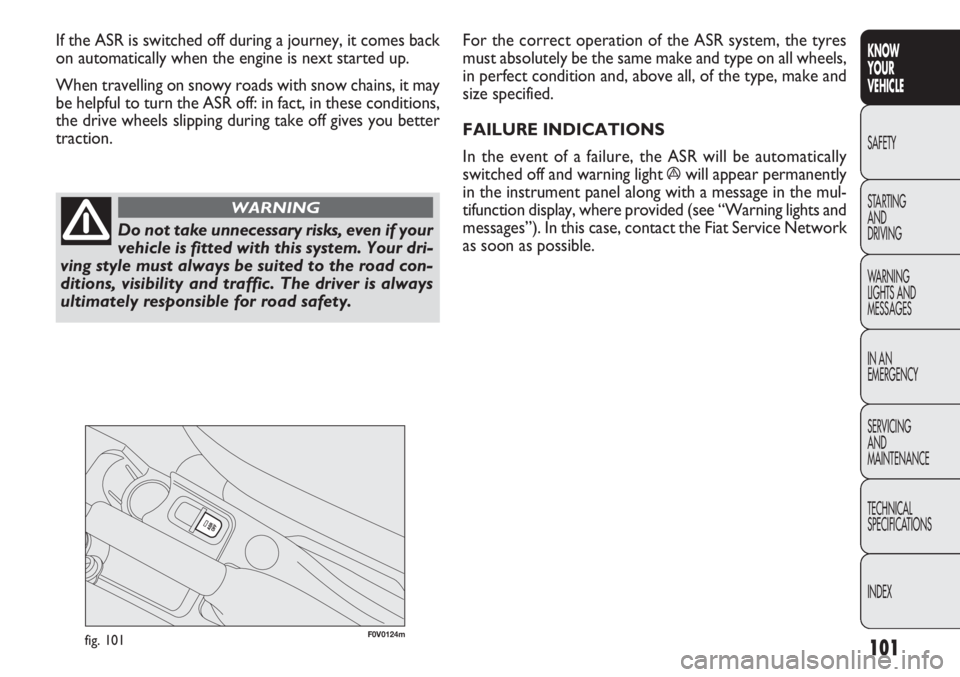
When travelling, the ASR can be switched off and on again
by pressing switch fig. 101, which can be found between
the front seats to the side of the handbrake lever.
When the ASR is switched off, this is shown by the LED
on the switch coming on and by the relevant message ap-
pearing on the multifunction display, where provided.
ASR SYSTEM (Anti-slip Regulator)
This is a traction control system that cuts in automatical-
ly every time one or both drive wheels slip.
Depending on the slipping conditions, two different con-
trol systems are activated:
❒if both drive wheels are slipping, the ASR function in-
tervenes by reducing the power transmitted by the en-
gine;
❒if the slipping only involves only one drive wheel, the
ASR system cuts in by automatically braking the wheel
that is slipping.
The action of the ASR system is especially useful in the fol-
lowing conditions:
❒slipping of the inner wheel when cornering due to the
effect of dynamic load changes or excessive accelera-
tion;
❒too much power transmitted to the wheels also in re-
lation to the conditions of the road surface;
❒acceleration on slippery, snowy or icy surfaces;
❒in the case of loss of grip on a wet surface (aquaplan-
ing).
For the correct operation of the ESP and
ASR systems, the tyres must absolutely be
the same make and type on all wheels, in perfect
condition and, above all, of the type, make and
size specified.
WARNING
Page 105 of 283
101
KNOW
YOUR
VEHICLE
SAFETY
STAR
TING
AND
DRIVING
WARNING
LIGHTS AND
MESSAGES
IN AN
EMERGENCY
SERVICING
AND
MAINTENANCE
TECHNICAL
SPECIFICATIONS
INDEX
F0V0124mfig. 101
For the correct operation of the ASR system, the tyres
must absolutely be the same make and type on all wheels,
in perfect condition and, above all, of the type, make and
size specified.
FAILURE INDICATIONS
In the event of a failure, the ASR will be automatically
switched off and warning light
áwill appear permanently
in the instrument panel along with a message in the mul-
tifunction display, where provided (see “Warning lights and
messages”). In this case, contact the Fiat Service Network
as soon as possible.
If the ASR is switched off during a journey, it comes back
on automatically when the engine is next started up.
When travelling on snowy roads with snow chains, it may
be helpful to turn the ASR off: in fact, in these conditions,
the drive wheels slipping during take off gives you better
traction.
Do not take unnecessary risks, even if your
vehicle is fitted with this system. Your dri-
ving style must always be suited to the road con-
ditions, visibility and traffic. The driver is always
ultimately responsible for road safety.
WARNING
Page 141 of 283
137
KNOW
YOUR
VEHICLE
SAFETY
STARTING
AN
D
DRIVING
WARNING
LIGHTS AND
MESSAGES
IN AN
EMERGENCY
SERVICING
AND
MAINTENANCE
TECHNICAL
SPECIFICA TIONS
INDEX
Depress the clutch pedal fully to change
gear correctly. Therefore, the floor area
under the pedals should be clear: ensure that any
rubber mats are flat and do not interfere with the
pedals.
WARNING
Do not drive with your hand resting on the
gear lever, because this pressure, even if
light, can wear out the inner components
of the gearbox over time. The clutch pedal should
be used only for gear changes. Do not drive with
your foot resting on the clutch pedal, however
slightly. For versions/markets where provided, the
electronic clutch control could cut in by interpret-
ing the incorrect driving style as a fault.
SAVING FUEL
Here are some useful tips to save fuel and minimise harm-
ful emissions of CO
2and other pollutants (nitric oxides,
unburnt hydrocarbons, fine dusts etc…).
PRACTICAL ADVICE FOR REDUCING FUEL
CONSUMPTION AND HARMFUL EMISSIONS
Vehicle conditions
1. Have checks and adjustments carried out in
accordance with the “Scheduled Servicing Plan”.
2. Check tyre pressures regularly, at least once every
four weeks. Excessively low pressures will increase
consumption because rolling resistance will be high-
er. In addition, this wears the tyre more quickly and
impairs performance.
3. Only use snow tyres when the weather conditions
make them absolutely necessary. They increase con-
sumption and noise.
4. Do not travel with a heavy load: the weight of the vehicle (especially when driving in town) and its trim
greatly affect fuel consumption and stability.
Page 144 of 283
140
KNOWYOUR
VEHICLE
SAFETY
ST ARTING
AN
D
DRIVING
WARNING
LIGHTS AND MESSAGES
IN AN
EMERGENCY
SERVICING AND
MAINTENANCE
TECHNICAL
SPECIFICA TIONS
INDEX
SNOW TYRES
A Fiat Dealership will be happy to provide advice con-
cerning the most suitable type of tyre for the customer’s
requirements.
For the type, pressures and specifications of the snow tyre
to be used, follow carefully the instructions given in the
“Wheels” paragraph of the “Technical specifications” sec-
tion.
The winter performance of these tyres is considerably re-
duced when the tread thickness is less than 4 mm. If this
is the case, replace them.
Due to their specific features, the performance of snow
tyres is much lower than that of standard tyres in normal
conditions or on long motorway stretches. You should
therefore use them only in the conditions for which they
were designed.
IMPORTANT When using snow tyres with a maximum
speed index below the one that can be reached by the
vehicle (increased by 5%), place a notice in the passenger
compartment, plainly in view, which states the maximum
speed allowed by the snow tyres (as per EC Directive).
All four tyres should be the same (brand and profile) to
ensure greater safety when driving and braking as well as
making the car more responsive.
Remember that you should not change the rotation di-
rection of the tyres.The ABS with which the vehicle may be
equipped will not control the braking sys-
tem of the trailer. Particular caution is therefore
required on slippery roads.
WARNING
Never modify the braking system of the ve-
hicle to control the trailer brake. The trail-
er braking system must be fully independent from
the hydraulic system of the vehicle.
WARNING
Page 145 of 283
141
KNOW
YOUR
VEHICLE
SAFETY
STARTING
AN
D
DRIVING
WARNING
LIGHTS AND
MESSAGES
IN AN
EMERGENCY
SERVICING
AND
MAINTENANCE
TECHNICAL
SPECIFICA TIONS
INDEX
SNOW CHAINS
The use of snow chains should be in compliance with lo-
cal regulations.
Snow chains may be fitted only to the front wheel tyres
(drive wheels).
Check the tension of the chains after the first few metres
have been driven.You must not exceed 160 km/h on snow
tyres with a “Q” mark; in any case, make
sure you stick to the rules of the highway code.
WARNING
Keep your speed down when snow chains
are fitted – do not exceed 50 km/h. Avoid
potholes, steps and pavements and also
avoid driving for long distances on roads not cov-
ered with snow to avoid damaging the car and the
road surface.
Page 146 of 283
142
KNOWYOUR
VEHICLE
SAFETY
ST ARTING
AN
D
DRIVING
WARNING
LIGHTS AND MESSAGES
IN AN
EMERGENCY
SERVICING AND
MAINTENANCE
TECHNICAL
SPECIFICA TIONS
INDEX
❒sprinkle talcum powder on the rubber windscreen and
rear window wiper blades and lift them off the glass;
❒open the windows slightly;
❒cover the vehicle with a piece of fabric or perforated
plastic sheet; Do not use compact plastic tarpaulins,
which prevent humidity from evaporating from the sur-
face of the vehicle;
❒inflate tyres to a pressure of +0.5 bar above the nor-
mal specified pressure and check regularly;
❒do not drain the engine cooling system.
VEHICLE INACTIVITY
If the vehicle needs to be off the road for longer than one
month, the following precautions must be taken:
❒park the vehicle indoors in a dry and, if possible, well-
ventilated place;
❒engage a gear and check that the handbrake is not on;
❒disconnect the negative terminal from the battery pole
(see paragraph “Vehicle inactivity” in the "Dashboard
and controls" chapter) and check the charge conditions
(see paragraph “Battery” in the “Care and mainte-
nance” chapter);
❒clean and protect the painted parts using protective
wax;
❒clean and protect the shiny metal parts using special
compounds readily available;
Page 161 of 283
157
KNOW
YOUR
VEHICLE
SAFETY
STARTING
AND
DRIVING
WARNING
LIGHTS AND
MESSAGES
IN AN
EMERGENCY
SERVICING
AND
MAINTENANCE
TECHNICAL
SPECIFICATIONS
INDEXUse your hazard lights, warning triangle,
etc to show that your car is stationary.
Passengers should get out of the car, particularly
if it is heavily loaded, and wait for the wheel to be
changed away from the traffic. If you are on a
steep slope or uneven surface, place wedges or
other suitable objects under the wheels to secure
the vehicle. Repair and refit the standard wheel
as soon as possible. Do not grease the bolt threads
before you fit them, because they could sudden-
ly come loose.
WARNING
Use the jack only to replace wheels on the
vehicle with which it is supplied or on oth-
er vehicles of the same model. Never use the jack
for other purposes, such as lifting other models.
Never use the jack to carry out repairs under the
vehicle. Incorrect positioning of the jack may
cause the lifted vehicle to fall. Do not use the jack
for loads higher than the one shown on its label.
WARNING
Incorrect hub cap assembly may cause it
to come off when the car is moving. Nev-
er tamper with the inflation valve. Never intro-
duce tools of any kind between the rim and the
tyre. Check tyre and spare wheel pressures regu-
larly, referring to the values shown in the “Tech-
nical specifications” section.
WARNING
Note for one-way tyres
One-way tyres have a few arrows on the side indicating
the rotation direction. If a wheel is changed (when punc-
tured, for example) the direction of the arrows on the spa-
re wheel tyre may not coincide with the rotation direc-
tion of the wheel to be replaced. In these conditions, too,
the tyre still maintains its safety features.
Anyway, it is recommended to have the wheel repaired
and refitted as soon as possible, as the best performance
is achieved when the rotation direction of all tyres coin-
cides with the one indicated by the arrows.
Page 168 of 283
164
KNOWYOUR
VEHICLE
SAFETY
STARTING AND
DRIVING
WARNING
LIGHTS AND MESSAGES
IN AN
EMERGENCY
SERVICING AND
MAINTENANCE
TECHNICAL
SPECIFICA TIONS
INDEX
In the event of a puncture caused by for-
eign bodies, it is possible to repair tyres
showing holes on the track or shoulder of
up to 4 mm in diameter.
It is not possible to repair damage to the
tyre sidewall. Do not use the quick repair
kit if the damage has been caused by travelling on
a flat tyre.
WARNING
IMPORTANT INFORMATION:
The sealing fluid of the quick tyre repair kit is effective at
external temperatures of between -20 °C and +50 °C.
Do not operate the compressor for longer
than 20 minutes at a time. Risk of over-
heating. The quick repair kit is not suitable for per-
manent repairs. The tyres repaired must therefore
be used only temporarily.
WARNING
Do not dispose of the cylinder and sealant
in the open environment. Dispose of them
according to the national and local laws in
force.
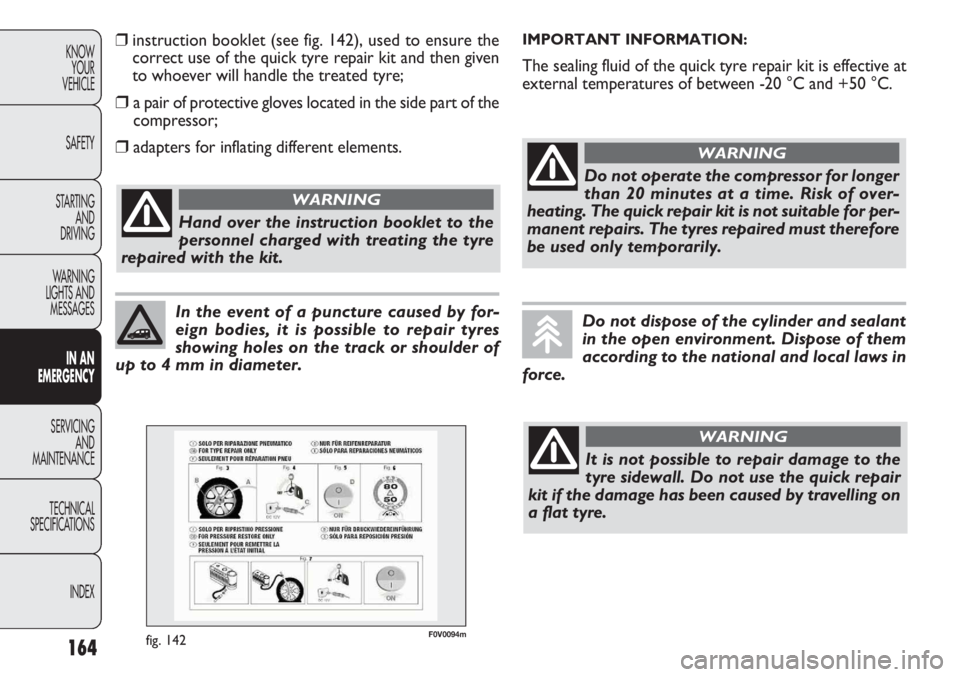
❒ instruction booklet (see fig. 142), used to ensure the
correct use of the quick tyre repair kit and then given
to whoever will handle the treated tyre;
❒a pair of protective gloves located in the side part of the
compressor;
❒adapters for inflating different elements.
Hand over the instruction booklet to the
personnel charged with treating the tyre
repaired with the kit.
WARNING
F0V0094mfig. 142