ABS FIAT DOBLO COMBI 2015 2.G User Guide
[x] Cancel search | Manufacturer: FIAT, Model Year: 2015, Model line: DOBLO COMBI, Model: FIAT DOBLO COMBI 2015 2.GPages: 323, PDF Size: 46.77 MB
Page 118 of 323
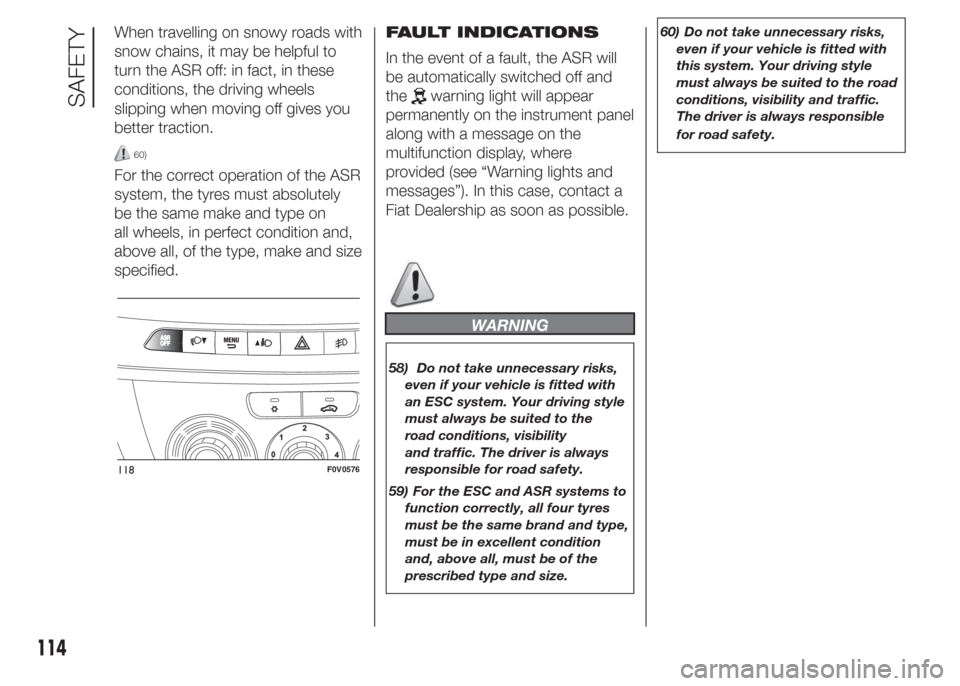
When travelling on snowy roads with
snow chains, it may be helpful to
turn the ASR off: in fact, in these
conditions, the driving wheels
slipping when moving off gives you
better traction.
60)
For the correct operation of the ASR
system, the tyres must absolutely
be the same make and type on
all wheels, in perfect condition and,
above all, of the type, make and size
specified.FAULT INDICATIONS
In the event of a fault, the ASR will
be automatically switched off and
the
warning light will appear
permanently on the instrument panel
along with a message on the
multifunction display, where
provided (see “Warning lights and
messages”). In this case, contact a
Fiat Dealership as soon as possible.
WARNING
58) Do not take unnecessary risks,
even if your vehicle is fitted with
an ESC system. Your driving style
must always be suited to the
road conditions, visibility
and traffic. The driver is always
responsible for road safety.
59) For the ESC and ASR systems to
function correctly, all four tyres
must be the same brand and type,
must be in excellent condition
and, above all, must be of the
prescribed type and size.60) Do not take unnecessary risks,
even if your vehicle is fitted with
this system. Your driving style
must always be suited to the road
conditions, visibility and traffic.
The driver is always responsible
for road safety.
118F0V0576
114
SAFETY
Page 122 of 323
The pretensioner does not require
any maintenance or lubrication.
Anything that modifies its original
conditions invalidates its efficiency.
If, due to unusual natural events
(floods, sea storms, etc.), the device
has been affected by water and
mud, it must absolutely be replaced.
66)
16)
LOAD LIMITERS
(for versions/markets, where
provided)
To increase passenger safety, the
front and rear seat belt retractors
(for versions/markets where
provided) contain a load limiter
which controls the force acting on
the chest and shoulders during
the belt restraining action in the
event of a frontal collision.GENERAL WARNINGS
FOR USING THE SEAT
BELTS
The driver is responsible for
respecting (and ensuring that all the
other passengers also respect)
the local laws in force regarding the
use of seat belts. Always fasten
the seat belts before setting off.
Seat belts must also be worn by
pregnant mothers: the risk of injury
in the event of an accident is greatly
reduced for them and the unborn
child if they are wearing a seat belt.
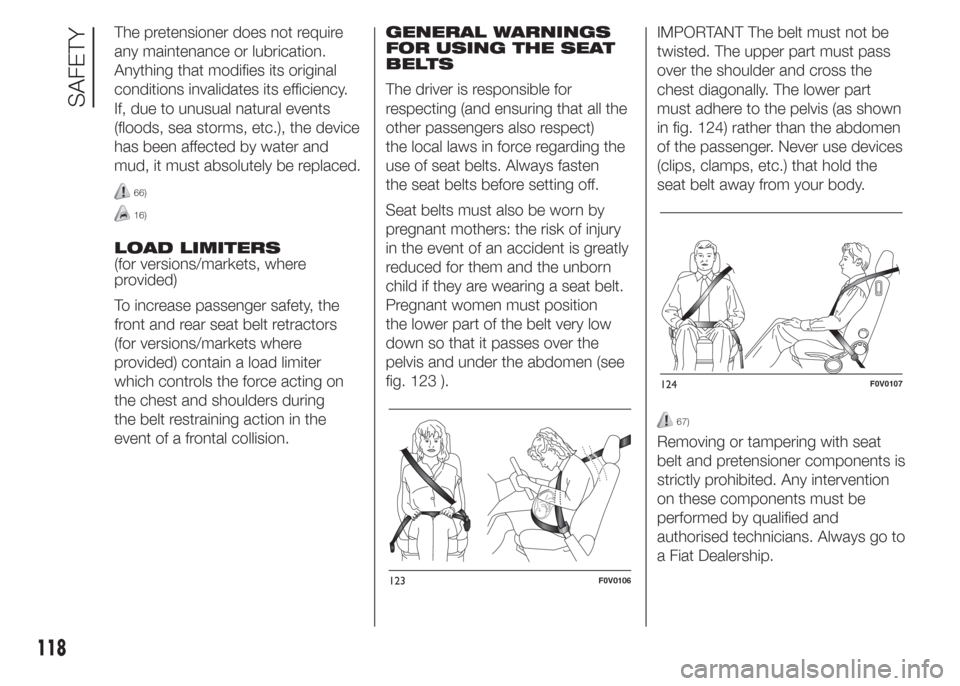
Pregnant women must position
the lower part of the belt very low
down so that it passes over the
pelvis and under the abdomen (see
fig. 123 ).IMPORTANT The belt must not be
twisted. The upper part must pass
over the shoulder and cross the
chest diagonally. The lower part
must adhere to the pelvis (as shown
in fig. 124) rather than the abdomen
of the passenger. Never use devices
(clips, clamps, etc.) that hold the
seat belt away from your body.
67)
Removing or tampering with seat
belt and pretensioner components is
strictly prohibited. Any intervention
on these components must be
performed by qualified and
authorised technicians. Always go to
a Fiat Dealership.
123F0V0106
124F0V0107
118
SAFETY
Page 153 of 323
Reducing the stored
speed
This can be done in two ways:
❒by deactivating the device and then
storing the new speed
or
❒by moving the stalk downwards (-)
until the new speed, which will
automatically remain memorised, is
reached.
Each movement of the stalk will
correspond to a slight reduction in
speed of about 1 km/h, while
keeping the stalk held downwards
will decrease the speed
continuously.
Deactivating the
device
The device can be switched off by
the driver in the following ways:
❒by turning ring nut A to the
OFF position;
❒if the engine is stopped (leaving the
stalk ring nut at ON), when the
ignition key is next turned to ON,
Cruise Control will be activated
automatically.
Deactivating the
function
The device can be switched off by
the driver in the following ways:
❒by pressing the brake pedal when the
device is adjusting the speed:
❒by pressing the clutch pedal when
the device is adjusting the speed;
❒by pressing button B fig. 146 when
the device is adjusting the speed
(for versions/markets, where
provided);
❒by pressing the accelerator pedal (in
this case the system is not actually
turned off but the acceleration
request takes priority; the cruise
control remains activated, without the
need to the press button B fig. 146
to restore the previous conditions
once the acceleration is over).
The device is automatically switched
off in the following cases:
❒if the ABS or ESC systems intervene
❒with the vehicle speed below the
set limit
❒in the event of system failure.
WARNING
95) When travelling with the device
active, never move the gear lever
to neutral.
96) In the event of device faults or
failures, turn the ring nut A to
OFF and contact a Fiat
Dealership.
149
Page 156 of 323
❒The performance of the parking
assistance system may also be
affected by the position of the
sensors. For example by a change in
the ride setting (caused by the wear
of the shock absorbers, suspension),
changing the tyres, overloading the
vehicle and carrying out specific
tuning operations that require the
vehicle to be lowered.
❒Detection of obstacles in the upper
part of the vehicle (particularly in the
case of vans or chassis cabs) may
not be guaranteed because the
system detects obstacles that could
strike the lower part of the vehicle.
❒The parking sensors work properly
with the swing doors closed.
❒If they are open, they can cause the
system to send false signals: always
close the rear doors.
❒Do not apply stickers to the sensors.
WARNING
97) The sensors must be clean of
mud, dirt, snow and ice in order
for the system to work. Be careful
not to scratch or damage the
sensors while cleaning them.
Avoid using dry, rough or hard
cloths. The sensors must be
washed using clean water, with
the addition of car shampoo if
necessary. When using special
washing equipment such as high
pressure jets or steam cleaning,
clean the sensors very quickly
keeping the jet more than 10 cm
away.
98) Parking manoeuvres, however,
are always the driver’s
responsibility. While carrying out
these manoeuvres, always make
sure that no people (especially
children) or animals are in the
area concerned. The parking
sensor is designed to assist
drivers, who must still never allow
their attention to lapse during
potentially dangerous
manoeuvres even if performed at
low speed.
REFUELLING THE
VEHICLE
PETROL ENGINES
Only use unleaded petrol, with an
octane number (R.O.N.) not lower
than 95.
IMPORTANT An inefficient catalytic
converter leads to harmful exhaust
emissions, thus contributing to
air pollution.
IMPORTANT Never use leaded
petrol, even in small amounts or in
an emergency, as this would
damage the catalytic converter
beyond repair.
DIESEL ENGINES
Operation at low
temperatures
If the outside temperature is very
low, the diesel thickens due to the
formation of paraffin clots with
consequent defective operation of
the fuel supply system.
152
STARTING AND DRIVING
Page 157 of 323
In order to avoid these problems,
different types of diesel are
distributed according to the season:
summer type, winter type and
arctic type (cold/mountain areas). If
refuelling with diesel fuel whose
specifications are not suitable for the
current temperature, it is advisable
to mix TUTELA DIESEL ART additive
in the proportions shown on the
container. Pour the additive into the
tank before the diesel fuel.
When using or parking the vehicle
for a long time in the mountains
or cold areas, it is advisable to refuel
using locally available diesel fuel.
In this case, it is also advisable
to keep the tank over 50% full.
22)
FILLING THE TANK
To fill the tank completely, top up
twice after the first click of the fuel
supply gun. Further top ups could
cause faults in the fuel supply
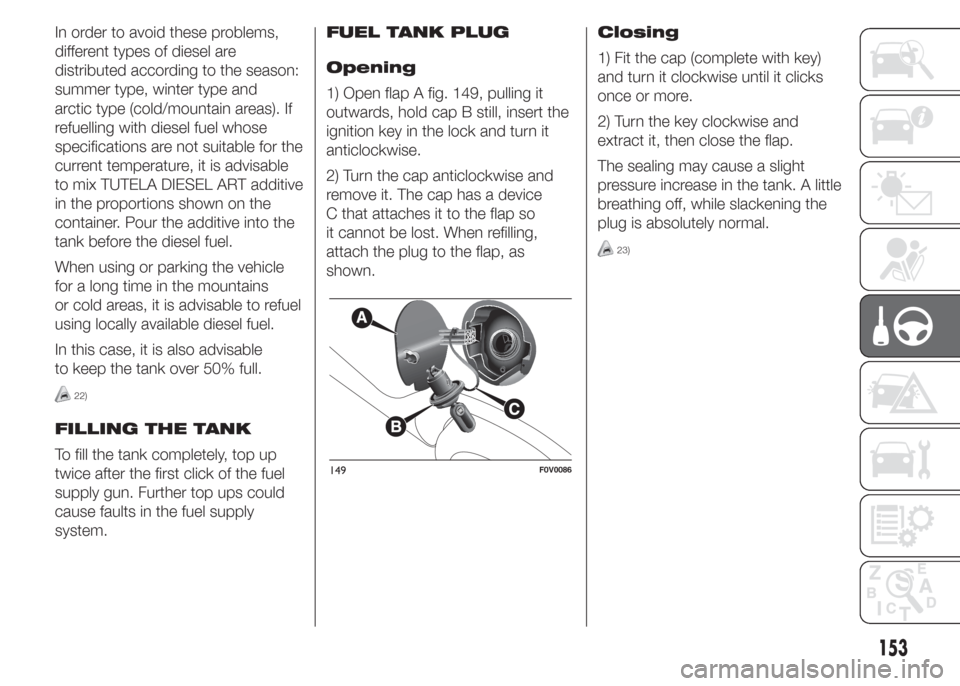
system.FUEL TANK PLUG
Opening
1) Open flap A fig. 149, pulling it
outwards, hold cap B still, insert the
ignition key in the lock and turn it
anticlockwise.
2) Turn the cap anticlockwise and
remove it. The cap has a device
C that attaches it to the flap so
it cannot be lost. When refilling,
attach the plug to the flap, as
shown.Closing
1) Fit the cap (complete with key)
and turn it clockwise until it clicks
once or more.
2) Turn the key clockwise and
extract it, then close the flap.
The sealing may cause a slight
pressure increase in the tank. A little
breathing off, while slackening the
plug is absolutely normal.
23)
149F0V0086
153
Page 158 of 323
IMPORTANT
22) For diesel engines, use only
diesel fuel for motor vehicles
in accordance with EN590
European specifications. The use
of other products or mixtures
may damage the engine beyond
repair and consequently invalidate
the warranty, due to the damage
caused. If you accidentally refuel
with another type of fuel, do not
start the engine, and drain the
tank. If the engine has run, even
for a very short time, you will need
to have the entire fuel supply
system emptied in addition to the
tank.
23) Do not bring naked flames or lit
cigarettes near the fuel tank filler:
fire risk. Keep your face away
from the fuel filler to prevent
breathing in harmful vapours.
SAVING FUEL
Some useful tips are given below for
fuel saving and reducing harmful
emissions of CO2 and other
pollutants (nitrogen oxides, unburnt
hydrocarbons, Particulate Matter
(PM), etc.).
PRACTICAL ADVICE
FOR REDUCING FUEL
CONSUMPTION AND
HARMFUL EMISSIONS
Vehicle conditions
❒Have checks and adjustments for
vehicle maintenancecarried out
in accordance with the “Scheduled
servicing plan”.
❒Checktyrepressure regularly, at
least once every four weeks.
Excessively low pressures will
increase consumption because
rolling resistance will be higher. In
addition, this wears the tyre more
quickly and impairs performance.
❒Only usesnow tyreswhen
the weather conditions make them
absolutely necessary. They increase
consumption and noise.❒Do not travel witha heavy load: the
weight of the vehicle (especially when
driving in town) and its geometry
greatly affect fuel consumption and
stability.
❒Removeroof racks or ski racks
after use. These accessories reduce
the vehicle's aerodynamic
penetration and have a negative
effect on fuel consumption.
❒When transporting particularly large
objects, use atrailerif possible.
❒Use the vehicle's air vents if possible:
travelling with the windows open
impairs aerodynamics.
❒Use electrical devices only for the
amount of time needed. The vehicle’s
heated rear window, additional
headlights, screen wipers and heater
fan require a considerable amount
of energy; this increases fuel
consumption (by up to +25% in an
urban cycle).
❒Air conditioning leads to higher fuel
consumption (on average up to
+30%). If the temperature outside is
not too extreme, try and use the
air vents.
154
STARTING AND DRIVING
Page 160 of 323
TOWING TRAILERS
IMPORTANT
The vehicle must be equipped with
a type-approved tow hook and
adequate electrical system to tow
trailers. Installation should be carried
out by specialised personnel who
will issue the required papers for
travelling on roads.
Install any specific and/or additional
door mirrors as specified by the
Highway Code.
Remember that when towing a
trailer, steep hills are harder to climb,
braking spaces increase and
overtaking takes longer depending
on the overall weight.
Engage a low gear when driving
downhill, rather than constantly
using the brake.
The weight of the trailer on the
vehicle tow hook will reduce the
loading capacity of the vehicle by
the same amount.To make sure that the maximum
towable weight is not exceeded
(given in the vehicle registration
document) account should be taken
of the fully laden trailer, including
accessories and luggage.
Do not exceed the speed limits
specific to each country you are
driving in, in the case of vehicles
towing trailers. In any case, the top
speed must not exceed 80 km/h.
99) 100)
WARNING
99) The ABS device with which the
vehicle is equipped will not
control the braking system of the
trailer. Particular caution is
required on slippery roads.
100) Never modify the braking
system of the vehicle to control
the trailer brake. The trailer
braking system must be fully
independent from the hydraulic
system of the vehicle.
SNOW TYRES
Fiat Dealerships will be happy to
provide advice concerning the most
suitable type of tyres for the
customer's requirements.
For the type of tyre to be used,
inflation pressures and the
specifications of snow tyres, follow
the instructions given in the
"Wheels" paragraph of the
"Technical specifications" section.
The winter features of these tyres
are reduced considerably when the
tread depth is below 4 mm. Replace
them in this case.
Due to snow tyre characteristics,
under normal conditions of use
or on long motorway journeys, the
performance of these tyres is lower
than that of standard tyres. Limit
performance according to the use
for which they were approved.
156
STARTING AND DRIVING
Page 169 of 323
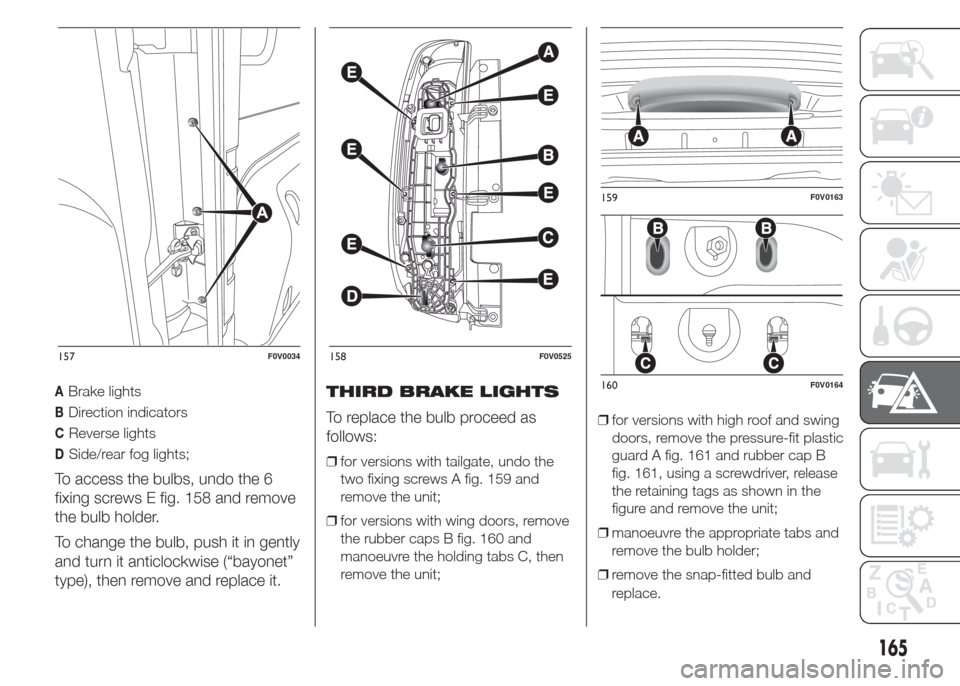
ABrake lights
BDirection indicators
CReverse lights
DSide/rear fog lights;
To access the bulbs, undo the 6
fixing screws E fig. 158 and remove
the bulb holder.
To change the bulb, push it in gently
and turn it anticlockwise (“bayonet”
type), then remove and replace it.THIRD BRAKE LIGHTS
To replace the bulb proceed as
follows:
❒for versions with tailgate, undo the
two fixing screws A fig. 159 and
remove the unit;
❒for versions with wing doors, remove
the rubber caps B fig. 160 and
manoeuvre the holding tabs C, then
remove the unit;❒for versions with high roof and swing
doors, remove the pressure-fit plastic
guard A fig. 161 and rubber cap B
fig. 161, using a screwdriver, release
the retaining tags as shown in the
figure and remove the unit;
❒manoeuvre the appropriate tabs and
remove the bulb holder;
❒remove the snap-fitted bulb and
replace.
157F0V0034158F0V0525
159F0V0163
160F0V0164
165
Page 170 of 323
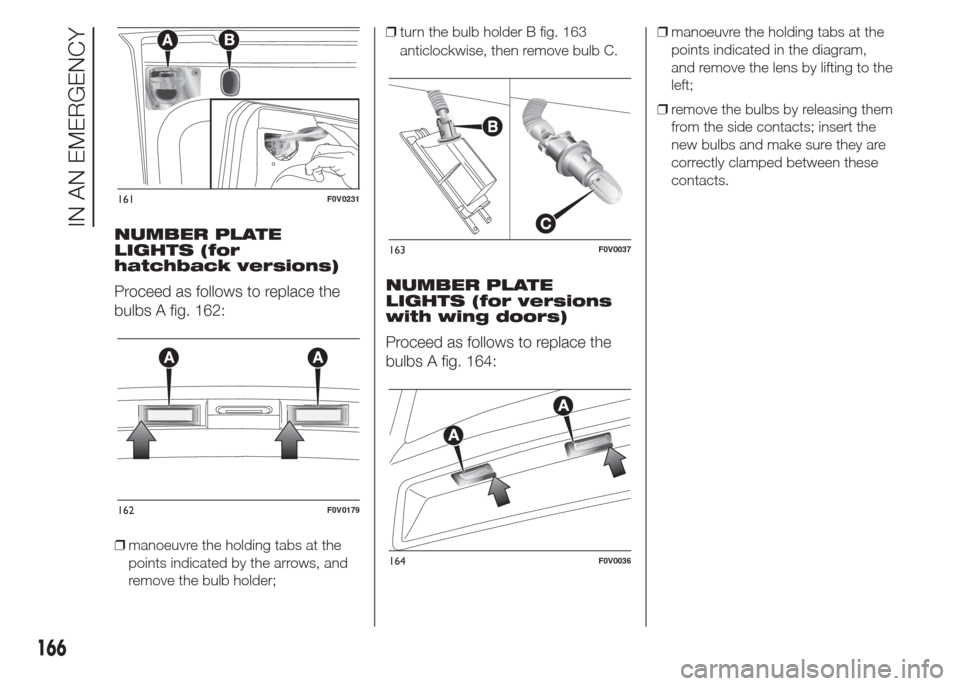
NUMBER PLATE
LIGHTS (for
hatchback versions)
Proceed as follows to replace the
bulbs A fig. 162:
❒manoeuvre the holding tabs at the
points indicated by the arrows, and
remove the bulb holder;❒turn the bulb holder B fig. 163
anticlockwise, then remove bulb C.
NUMBER PLATE
LIGHTS (for versions
with wing doors)
Proceed as follows to replace the
bulbs A fig. 164:
❒manoeuvre the holding tabs at the
points indicated in the diagram,
and remove the lens by lifting to the
left;
❒remove the bulbs by releasing them
from the side contacts; insert the
new bulbs and make sure they are
correctly clamped between these
contacts.
161F0V0231
162F0V0179
163F0V0037
164F0V0036
166
IN AN EMERGENCY
Page 210 of 323
Check fluid level through the
reservoir.
Close cap D by pressing on the
central section.
129)
BRAKE FLUID
Undo the cap E fig. 207 - fig. 208 -
fig. 209 - fig. 210 - fig. 211 - fig.
212: check that the fluid contained
in the reservoir is at the maximum
level.
The fluid level in the reservoir must
not exceed the MAX mark.
Use the brake fluid shown in the
"Fluids and lubricants" table (see
"Technical Specifications").
NB Carefully clean the reservoir cap
E and surrounding surfaces.
Take great care to ensure that
impurities do not enter the reservoir
when the cap is opened.
For topping-up, always use a funnel
with integrated filter with mesh
equal to or lower than 0.12 mm.IMPORTANT Brake fluid absorbs
moisture. For this reason, if the
vehicle is mainly used in areas with a
high degree of atmospheric
humidity, the fluid should be
replaced at more frequent intervals
than specified in the “Scheduled
Servicing Plan”.
34)
130) 131)
POWER STEERING
FLUID
Check that the oil level with the
vehicle on flat ground and the
engine cold is between the MIN and
MAX marks on the reservoir body
G fig. 207 - fig. 208 - fig. 209 -
fig. 210 - fig. 211 - fig. 212.
The level may exceed the MAX mark
when the oil is hot.
If topping up is required, make sure
the oil you use has the same
specifications as that already in the
system.
132)
4)
35)
WARNING
126) Never smoke while working in
the engine compartment: gas
and flammable vapours may be
present, with the risk of fire.
127) When the engine is hot, take
care when working inside the
engine compartment to avoid
burns. Remember that when the
engine is hot, the fan may
operate: danger of injury. Scarves,
ties and other loose clothing may
be pulled by moving parts.
128) The cooling system is
pressurised. If necessary, only
replace the cap with another
original one or the operation of
the system may be adversely
affected. Do not remove the cap
from the reservoir when the
engine is hot: danger of scalding.
206
SERVICING AND MAINTENANCE