belt FIAT DOBLO COMBI 2015 2.G User Guide
[x] Cancel search | Manufacturer: FIAT, Model Year: 2015, Model line: DOBLO COMBI, Model: FIAT DOBLO COMBI 2015 2.GPages: 323, PDF Size: 46.77 MB
Page 122 of 323
The pretensioner does not require
any maintenance or lubrication.
Anything that modifies its original
conditions invalidates its efficiency.
If, due to unusual natural events
(floods, sea storms, etc.), the device
has been affected by water and
mud, it must absolutely be replaced.
66)
16)
LOAD LIMITERS
(for versions/markets, where
provided)
To increase passenger safety, the
front and rear seat belt retractors
(for versions/markets where
provided) contain a load limiter
which controls the force acting on
the chest and shoulders during
the belt restraining action in the
event of a frontal collision.GENERAL WARNINGS
FOR USING THE SEAT
BELTS
The driver is responsible for
respecting (and ensuring that all the
other passengers also respect)
the local laws in force regarding the
use of seat belts. Always fasten
the seat belts before setting off.
Seat belts must also be worn by
pregnant mothers: the risk of injury
in the event of an accident is greatly
reduced for them and the unborn
child if they are wearing a seat belt.
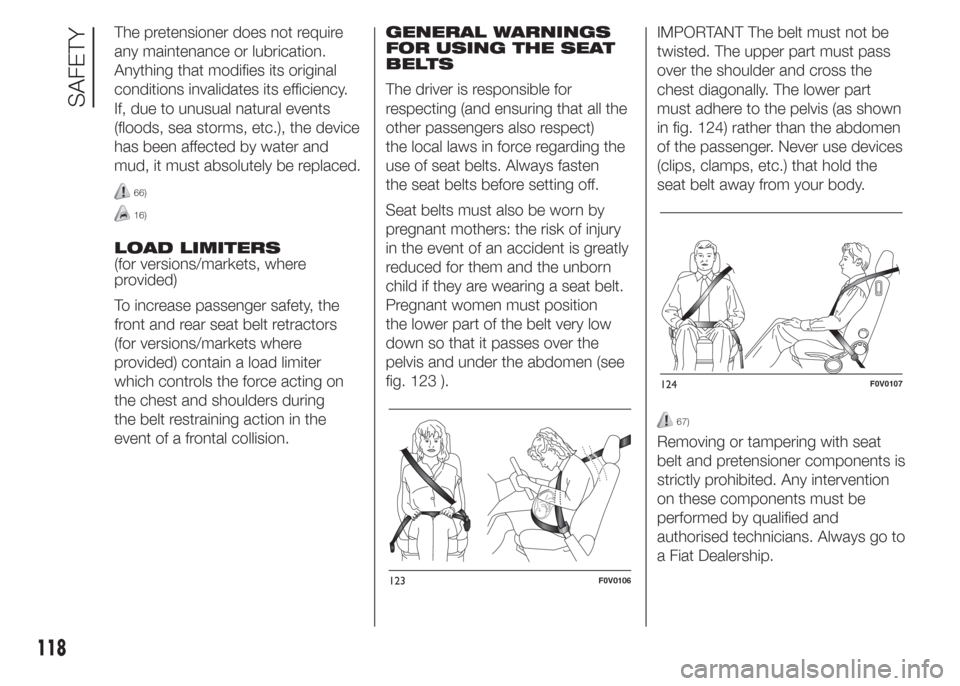
Pregnant women must position
the lower part of the belt very low
down so that it passes over the
pelvis and under the abdomen (see
fig. 123 ).IMPORTANT The belt must not be
twisted. The upper part must pass
over the shoulder and cross the
chest diagonally. The lower part
must adhere to the pelvis (as shown
in fig. 124) rather than the abdomen
of the passenger. Never use devices
(clips, clamps, etc.) that hold the
seat belt away from your body.
67)
Removing or tampering with seat
belt and pretensioner components is
strictly prohibited. Any intervention
on these components must be
performed by qualified and
authorised technicians. Always go to
a Fiat Dealership.
123F0V0106
124F0V0107
118
SAFETY
Page 123 of 323
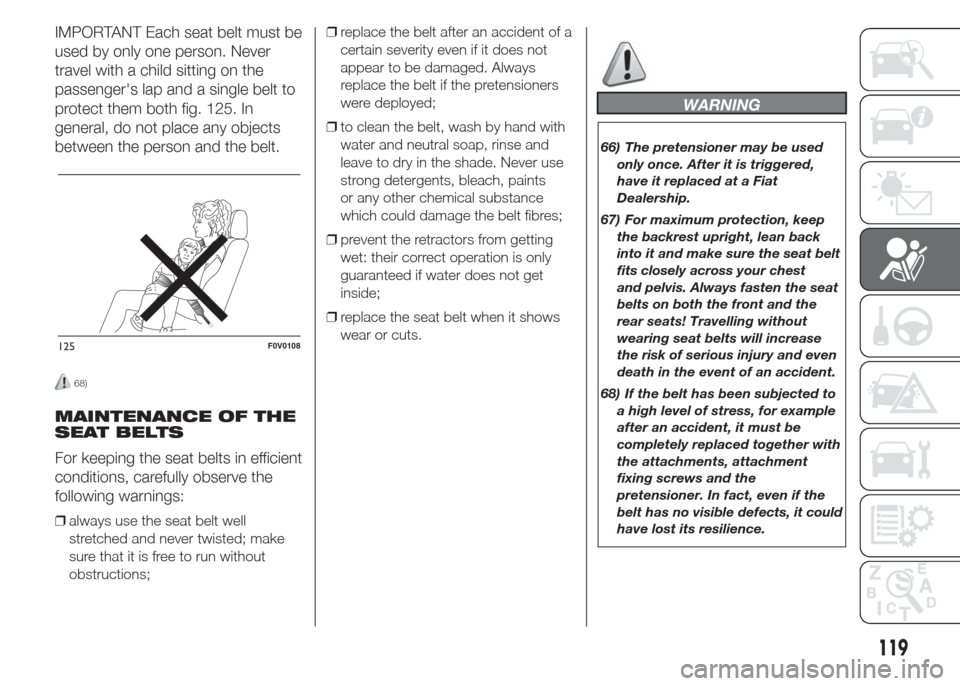
IMPORTANT Each seat belt must be
used by only one person. Never
travel with a child sitting on the
passenger's lap and a single belt to
protect them both fig. 125. In
general, do not place any objects
between the person and the belt.
68)
MAINTENANCE OF THE
SEAT BELTS
For keeping the seat belts in efficient
conditions, carefully observe the
following warnings:
❒always use the seat belt well
stretched and never twisted; make
sure that it is free to run without
obstructions;❒replace the belt after an accident of a
certain severity even if it does not
appear to be damaged. Always
replace the belt if the pretensioners
were deployed;
❒to clean the belt, wash by hand with
water and neutral soap, rinse and
leave to dry in the shade. Never use
strong detergents, bleach, paints
or any other chemical substance
which could damage the belt fibres;
❒prevent the retractors from getting
wet: their correct operation is only
guaranteed if water does not get
inside;
❒replace the seat belt when it shows
wear or cuts.
WARNING
66) The pretensioner may be used
only once. After it is triggered,
have it replaced at a Fiat
Dealership.
67) For maximum protection, keep
the backrest upright, lean back
into it and make sure the seat belt
fits closely across your chest
and pelvis. Always fasten the seat
belts on both the front and the
rear seats! Travelling without
wearing seat belts will increase
the risk of serious injury and even
death in the event of an accident.
68) If the belt has been subjected to
a high level of stress, for example
after an accident, it must be
completely replaced together with
the attachments, attachment
fixing screws and the
pretensioner. In fact, even if the
belt has no visible defects, it could
have lost its resilience.
125F0V0108
119
Page 124 of 323
IMPORTANT
16) Operations which lead to knocks,
vibrations or localised heating
(over 100°C for a maximum of 6
hours) in the area around the
pretensioner may cause damage
or trigger it. This device is not
affected by vibrations caused by
irregularities of the road surface
or low obstacles such as kerbs,
etc. Contact a Fiat Dealership for
any assistance.
CARRYING
CHILDREN SAFELY
For optimal protection in the event
of an impact, all passengers must
be seated and wearing adequate
restraint systems.
This is even more important for
children.
This prescription is compulsory in all
EU countries according to EC
Directive 2003/20/EC.
Compared with an adult, a child's
head is larger and heavier in
proportion to their body and the
child's muscular and bone
structures are not fully developed.
Therefore, correct restraint systems
other than adult seat belts are
necessary to reduce as much as
possible the risk of injuries in the
event of an accident, braking or a
sudden manoeuvre.
Children must be seated safely and
comfortably.As far as the characteristics of the
child restraint systems used allow,
you are advised to keep children
in rearward facing child restraint
systems for as long as possible,
since this is the most protected
position in the event of an impact.
Several child restraint system types
are available; always choose the one
most suitable for the child.
When over 1.50 m in height, from
the point of view of restraint
systems, children are considered as
adults and wear seat belts normally.
In Europe child restraint systems
are classified, among other criteria,
into five weight groups:
Group Weight range
Group0 upto10kg
Group 0+ up to 13 kg
Group 1 9 - 18 kg
Group 2 15 - 25 kg
Group 3 22 - 36 kg
120
SAFETY
Page 125 of 323
All restraint devices must bear the
certification data, together with
the control mark, on a label solidly
fixed to the child restraint system
which must never be removed.
Lineaccessori Fiat offers child
restraint systems for each weight
group. These devices are
recommended having been
specifically designed for Fiat
vehicles.
69)
GROUP 0 and 0+
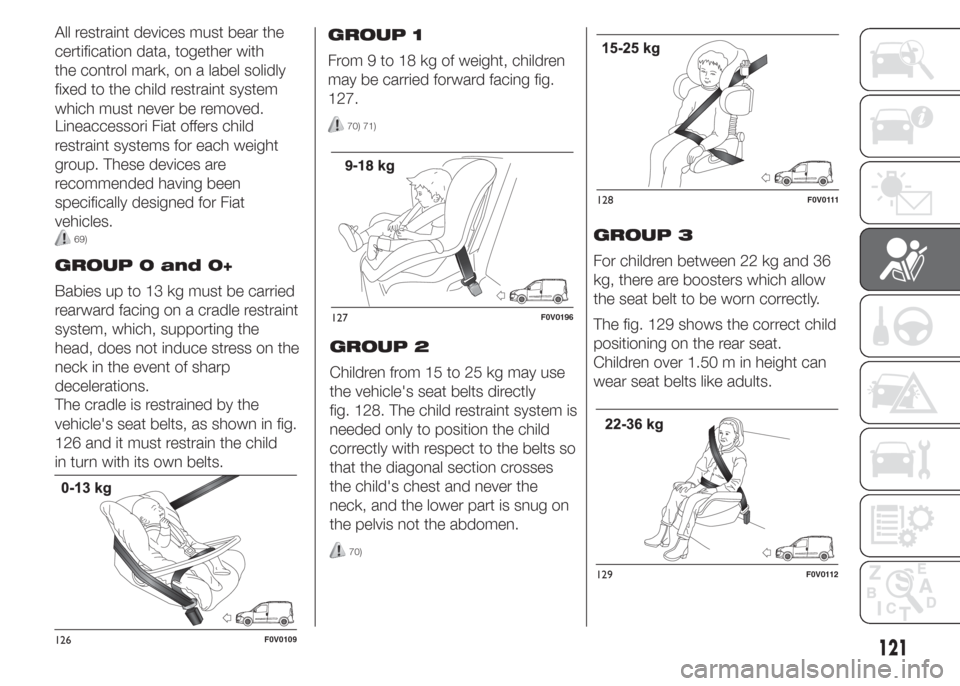
Babies up to 13 kg must be carried
rearward facing on a cradle restraint
system, which, supporting the
head, does not induce stress on the
neck in the event of sharp
decelerations.
The cradle is restrained by the
vehicle's seat belts, as shown in fig.
126 and it must restrain the child
in turn with its own belts.GROUP 1
From 9 to 18 kg of weight, children
may be carried forward facing fig.
127.
70) 71)
GROUP 2
Children from 15 to 25 kg may use
the vehicle's seat belts directly
fig. 128. The child restraint system is
needed only to position the child
correctly with respect to the belts so
that the diagonal section crosses
the child's chest and never the
neck, and the lower part is snug on
the pelvis not the abdomen.
70)
GROUP 3
For children between 22 kg and 36
kg, there are boosters which allow
the seat belt to be worn correctly.
The fig. 129 shows the correct child
positioning on the rear seat.
Children over 1.50 m in height can
wear seat belts like adults.
126F0V0109
127F0V0196
128F0V0111
121
129F0V0112
Page 127 of 323
WARNING
69) SEVERE DANGER: When an active passenger airbag is fitted, DO NOT install child restraint systems to be fitted
rearward facing on the front seat. Deployment of the airbag in an accident could cause fatal injuries to the child
regardless of the severity of the impact. It is advisable to always carry children in a child restraint system on the rear
seat, which is the most protected position in the event of a collision. Should it be necessary to carry a child on the
passenger side front seat in a rearward facing child restraint system, the passenger side front airbag and side bag
(side bag – for versions/markets, where provided) must be deactivated through the Setup menu. Deactivation should
be verified by checking whether the warning light above the front courtesy light is switched on. The passenger seat
must also be positioned back as far as possible in order to avoid the child restraint system from coming into contact
with the dashboard.
70) The figures are indicative and for assembly purposes only. Fit the child restraint system according to the
instructions, which must be included.
71) Child restraint systems with Isofix attachment are available for a safe anchoring to the seat without using the
vehicle seat belts. Follow the assembly instructions carefully.
123
Page 128 of 323
ISOFIX CHILD
RESTRAINT SYSTEM
SETUP
(for versions/markets, where
provided)
Only for vehicles designed to carry
people, (homologation M1),
provision has been made on some
versions to fit a Universal Isofix child
restraint system, a new European
standardised system for carrying
children safely.
Isofix systems can be fitted
alongside a traditional child restraint
system. An example of a child
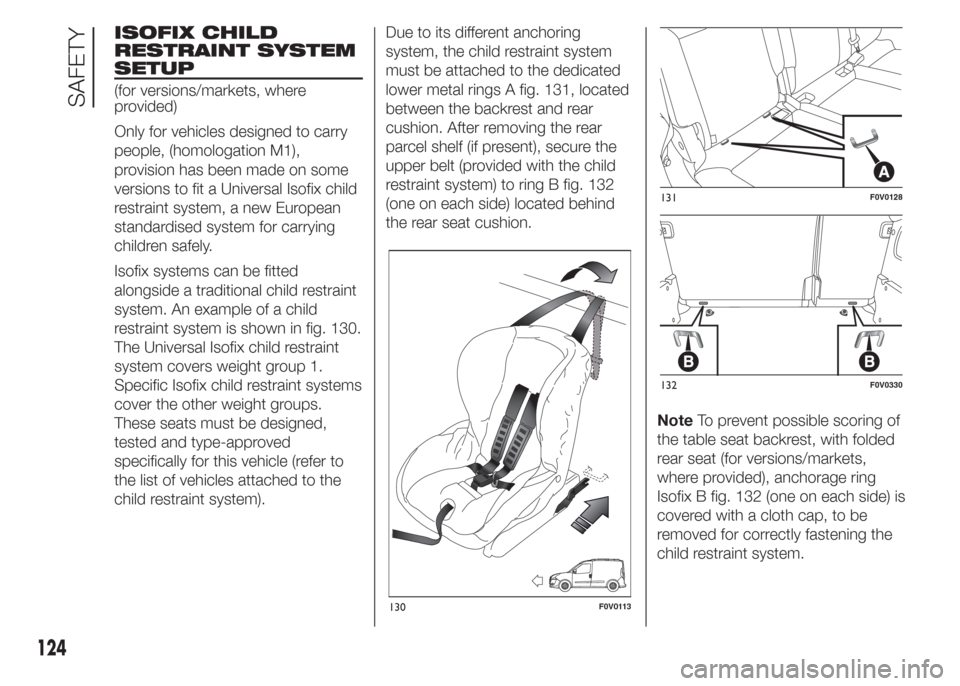
restraint system is shown in fig. 130.
The Universal Isofix child restraint
system covers weight group 1.
Specific Isofix child restraint systems
cover the other weight groups.
These seats must be designed,
tested and type-approved
specifically for this vehicle (refer to
the list of vehicles attached to the
child restraint system).Due to its different anchoring
system, the child restraint system
must be attached to the dedicated
lower metal rings A fig. 131, located
between the backrest and rear
cushion. After removing the rear
parcel shelf (if present), secure the
upper belt (provided with the child
restraint system) to ring B fig. 132
(one on each side) located behind
the rear seat cushion.
NoteTo prevent possible scoring of
the table seat backrest, with folded
rear seat (for versions/markets,
where provided), anchorage ring
Isofix B fig. 132 (one on each side) is
covered with a cloth cap, to be
removed for correctly fastening the
child restraint system.
130F0V0113
131F0V0128
132F0V0330
124
SAFETY
Page 131 of 323
Below is a summary of
the main safety rules
to be followed when
carrying children:
❒install the child restraint systems on
the rear seat, which is the most
protected position in the event of an
accident;
❒if you need to deactivate the
passenger airbag, always check that
the
warning light above the front
courtesy light is on constantly to
make sure that it has actually been
deactivated;
❒carefully follow the instructions that
came with the child restraint system,
which the manufacturer must supply
by law. Keep the instructions in the
vehicle along with the other papers
and this handbook. Do not install
second-hand child restraint systems
without instructions.
❒always check that the seat belt is well
fastened by pulling on it;
❒only one child is to be strapped into
each restraint system; never carry
two children using one child restraint
system;
❒always check that seat belts do not
rest on the child’s neck;
❒while travelling, do not let the child sit
incorrectly or release the belts;❒never carry children on your lap, even
newborns. No-one can hold a child in
the event of an accident.
❒in the event of an accident, replace
the child restraint system with a
new one.
73)
WARNING
72) Fit the child restraint system only
when the vehicle is stationary.
The child restraint system is
correctly fixed to the brackets
when you hear the click. Follow
the instructions for assembly,
disassembly and positioning that
the Manufacturer must supply
with the child restraint system.
73) When an active passenger
airbag is fitted, DO NOT install
rearward facing child restraint
systems on the front seat. Always
deactivate the passenger airbag
when a rearward facing child
restraint system is installed on the
front passenger seat.
FRONT AIRBAGS
The vehicle is fitted with front airbag
for the driver and, for versions/
markets where provided, front
airbag for the passenger.
FRONT AIRBAGS
The front driver/passenger airbags
(for versions/markets where
provided) have been designed to
protect the front-seat occupants in
the event of head-on crashes of
medium-high severity, by placing the
bag between the occupant and the
steering wheel or dashboard.
Non-activation in other types of
crash (side-on collisions, rear
shunts, roll-overs, etc.) is therefore
not a sign of system malfunction.
An electronic control unit will make
the bag inflate in the event of a
frontal impact.
The bag will inflate instantaneously
placing itself between the front
occupants' body and the structures
which could cause injury. It will
deflate immediately afterwards.
127
Page 132 of 323
Front driver/passenger airbags (for
versions/markets where provided)
are not a replacement for, but rather
a complement to, the seat belts,
which should be worn at all times as
specified by law in Europe and
most non-European countries.
In the event of an impact, those not
wearing a seat belt are projected
forwards, and may come into
contact with the bag which is still
inflating. The protection offered
by the cushion is compromised in
such a case.
Front airbags may not activate in the
following situations:
❒frontal impacts against highly
deformable objects not involving the
front surface of the vehicle (e.g.
wing collision against guard rail, etc.);
❒vehicle wedging under other vehicles
or protective barriers (e.g. trucks or
guard rails);
they may not provide any additional
protection compared with seat belts,
so their activation would not be
appropriate. In these cases,
non-deployment does not indicate a
system malfunction.
74)
The driver's and passenger's front
airbags have been designed and
calibrated to protect front seat
occupants wearing seat belts.
At their maximum inflation, their
volume fills most of the space
between the steering wheel and the
driver and between the dashboard
and the passenger.
The airbags are not deployed in the
event of minor front collisions (for
which the restraining action of
the seat belts is sufficient). It
is therefore always necessary to
wear seat belts.
DRIVER'S SIDE FRONT
AIRBAG
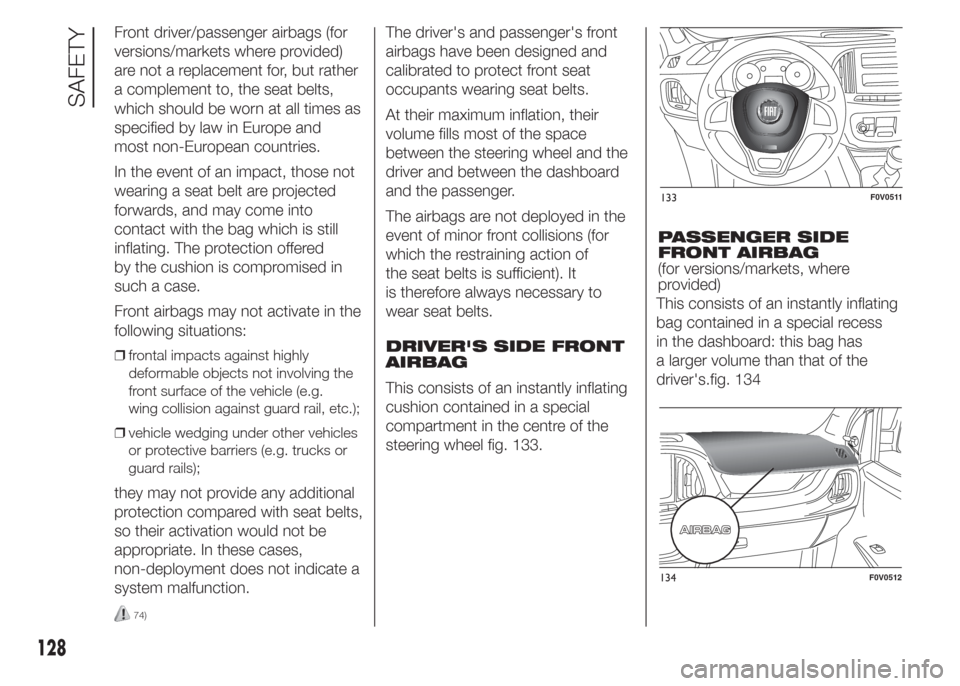
This consists of an instantly inflating
cushion contained in a special
compartment in the centre of the
steering wheel fig. 133.PASSENGER SIDE
FRONT AIRBAG
(for versions/markets, where
provided)
This consists of an instantly inflating
bag contained in a special recess
in the dashboard: this bag has
a larger volume than that of the
driver's.fig. 134
133F0V0511
134F0V0512
128
SAFETY
Page 136 of 323
SIDE BAGS
(for versions/markets, where
provided)
On some versions, the vehicle may
be fitted with driver and passenger
front side airbags for head and torso
protection.
Side bags protect occupants from
side-on crashes of medium/high
severity by placing the bag between
the occupant and the internal parts
of the side structure of the vehicle.
Non-activation of side bags in other
types of collisions (front collisions,
rear shunts, roll-overs, etc.) does
not indicate a system malfunction.
An electronic control unit causes the
bags to inflate in the event of a
side impact. The bags inflate
instantaneously placing themselves
between the occupants' bodies
and the structures which could
cause injury. They deflate
immediately afterwards.
Side bags are not a replacement of,
but rather a complement to, seat
belts, which you are recommended
to wear at all times, as specified
by law in Europe and most
non-European countries.For this reason, the seat belt must
be worn at all times. In the case
of side-on collisions, the seat belts
hold occupants in the correct
position in relation to the airbag and
prevent them from being thrown
out of the vehicle by a very violent
collision.
SIDE BAGS
(for versions/markets, where
provided)
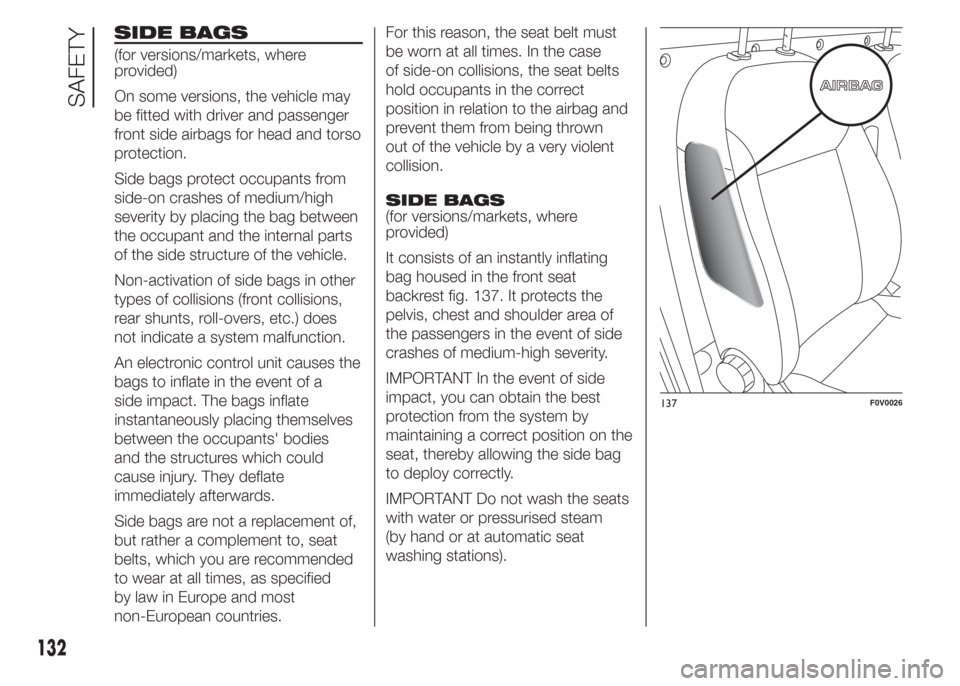
It consists of an instantly inflating
bag housed in the front seat
backrest fig. 137. It protects the
pelvis, chest and shoulder area of
the passengers in the event of side
crashes of medium-high severity.
IMPORTANT In the event of side
impact, you can obtain the best
protection from the system by
maintaining a correct position on the
seat, thereby allowing the side bag
to deploy correctly.
IMPORTANT Do not wash the seats
with water or pressurised steam
(by hand or at automatic seat
washing stations).
137F0V0026
132
SAFETY
Page 145 of 323
ENGINE STOPPING
FAILURE CONDITIONS
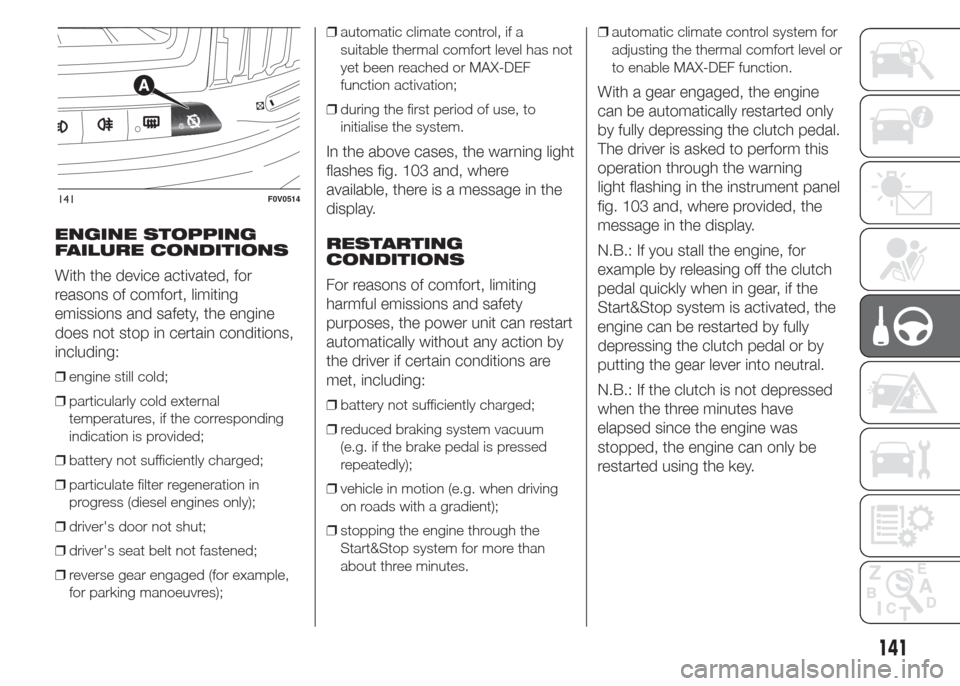
With the device activated, for
reasons of comfort, limiting
emissions and safety, the engine
does not stop in certain conditions,
including:
❒engine still cold;
❒particularly cold external
temperatures, if the corresponding
indication is provided;
❒battery not sufficiently charged;
❒particulate filter regeneration in
progress (diesel engines only);
❒driver's door not shut;
❒driver's seat belt not fastened;
❒reverse gear engaged (for example,
for parking manoeuvres);❒automatic climate control, if a
suitable thermal comfort level has not
yet been reached or MAX-DEF
function activation;
❒during the first period of use, to
initialise the system.
In the above cases, the warning light
flashes fig. 103 and, where
available, there is a message in the
display.
RESTARTING
CONDITIONS
For reasons of comfort, limiting
harmful emissions and safety
purposes, the power unit can restart
automatically without any action by
the driver if certain conditions are
met, including:
❒battery not sufficiently charged;
❒reduced braking system vacuum
(e.g. if the brake pedal is pressed
repeatedly);
❒vehicle in motion (e.g. when driving
on roads with a gradient);
❒stopping the engine through the
Start&Stop system for more than
about three minutes.❒automatic climate control system for
adjusting the thermal comfort level or
to enable MAX-DEF function.
With a gear engaged, the engine
can be automatically restarted only
by fully depressing the clutch pedal.
The driver is asked to perform this
operation through the warning
light flashing in the instrument panel
fig. 103 and, where provided, the
message in the display.
N.B.: If you stall the engine, for
example by releasing off the clutch
pedal quickly when in gear, if the
Start&Stop system is activated, the
engine can be restarted by fully
depressing the clutch pedal or by
putting the gear lever into neutral.
N.B.: If the clutch is not depressed
when the three minutes have
elapsed since the engine was
stopped, the engine can only be
restarted using the key.
141F0V0514
141