bonnet FIAT DOBLO COMBI 2015 2.G User Guide
[x] Cancel search | Manufacturer: FIAT, Model Year: 2015, Model line: DOBLO COMBI, Model: FIAT DOBLO COMBI 2015 2.GPages: 323, PDF Size: 46.77 MB
Page 202 of 323
PERIODIC CHECKS
Every 1,000 km or before long
journeys, check and, if necessary,
top up the following:
❒engine coolant level;
❒brake fluid level;
❒windscreen washer fluid level;
❒tyre inflation pressure and condition;
❒operation of lighting system
(headlights, direction indicators,
hazard warning lights, etc.);
❒operation of screen washer/wiper
system and positioning/wear of
windscreen/rear screen wiper blades
(for versions/markets where
provided);
Every 3,000 km check and top up if
required: engine oil level.
DEMANDING
VEHICLE USE
If the vehicle is mostly used in one of
the following conditions:
❒towing a trailer or motorhome;
❒dusty roads;
❒short, repeated journeys (less than
7-8 km) at sub-zero outside
temperatures;
❒engine often idling or driving long
distances at low speeds or long
periods of inactivity;
the following checks must be
carried out more often than
indicated in the Scheduled Servicing
Plan:
❒check front disc brake pad condition
and wear;
❒check cleanliness of bonnet and
luggage compartment locks,
cleanliness and lubrication of linkage;
❒visually inspect condition of: engine,
gearbox, transmission, pipes and
hoses (exhaust - fuel system -
brakes) and rubber elements (boots -
sleeves - bushes - etc.);
❒check battery charge and battery
fluid level (electrolyte);❒visually inspect conditions of the
auxiliary drive belts;
❒check and, if necessary, change
engine oil and replace oil filter;
❒check and, if necessary, replace
pollen filter;
❒replacement of air cleaner cartridge
every 15,000 km.
198
SERVICING AND MAINTENANCE
Page 213 of 323
USEFUL TIPS FOR
EXTENDING BATTERY
LIFE
To avoid draining your battery and
make it last longer, observe the
following instructions:
❒when you park the vehicle, ensure
that the doors, tailgate and bonnet
are closed properly, to prevent any
roof lights from remaining on inside
the passenger's compartment;
❒switch off all roof lights inside the
vehicle: the vehicle is however
equipped with a system which
switches all internal lights off
automatically;
❒do not keep accessories (e.g. radio,
hazard warning lights, etc.) switched
on for a long time when the engine
is not running;
❒before performing any operation on
the electrical system, disconnect
the negative battery pole;
❒completely tighten the battery
terminals.
IMPORTANT If the charge level
remains under 50% for a long time,
the battery is damaged by
sulphation, reducing its capacity and
efficiency at starting.The battery is also more prone to
the risk of freezing (already at
temperatures of -10°C). Refer to the
paragraph "Vehicle inactivity" in
"Starting and driving" if the vehicle is
left parked for a long time.
If, after buying the vehicle, you want
to install electric accessories which
require permanent electric supply
(alarm, etc.) contact a Fiat
Dealership whose qualified
personnel, in addition to suggesting
the most suitable devices from the
Lineaccessori Fiat, will evaluate
the overall electric absorption,
checking whether the vehicle's
electrical system is capable of
withstanding the load required, or
whether it should be integrated with
a more powerful battery.
Since some of these devices
continue to consume electricity even
when the engine is off, they
gradually run down the battery.
WARNING
133) Battery fluid is poisonous and
corrosive. Avoid contact with
skin and eyes. Keep naked flames
or possible sources of sparks
away from the battery: risk
of explosion or fire.
134) Using the battery when the fluid
is too low can damage it
irreparably and generate a risk of
explosion.
135) When performing any operation
on the battery or near it, always
protect your eyes with special
goggles.
209
Page 217 of 323
SPRAY NOZZLES
If the jet is not coming out, firstly
check that there is fluid in the
windscreen/rear window reservoir
(for versions/markets where
provided) (see “Checking levels” in
this section).
Then check that the nozzle holes are
not clogged; use a needle to
unblock them if necessary.
Windscreen (washer)
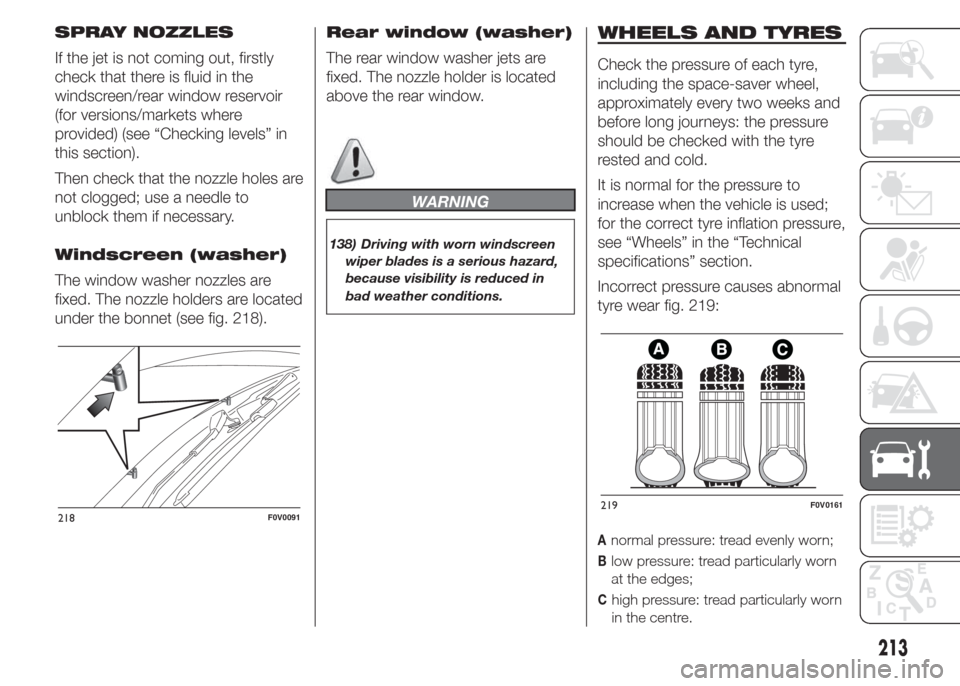
The window washer nozzles are
fixed. The nozzle holders are located
under the bonnet (see fig. 218).Rear window (washer)
The rear window washer jets are
fixed. The nozzle holder is located
above the rear window.
WARNING
138) Driving with worn windscreen
wiper blades is a serious hazard,
because visibility is reduced in
bad weather conditions.
WHEELS AND TYRES
Check the pressure of each tyre,
including the space-saver wheel,
approximately every two weeks and
before long journeys: the pressure
should be checked with the tyre
rested and cold.
It is normal for the pressure to
increase when the vehicle is used;
for the correct tyre inflation pressure,
see “Wheels” in the “Technical
specifications” section.
Incorrect pressure causes abnormal
tyre wear fig. 219:
Anormal pressure: tread evenly worn;
Blow pressure: tread particularly worn
at the edges;
Chigh pressure: tread particularly worn
in the centre.
218F0V0091219F0V0161
213
Page 221 of 323
If you put the vehicle through a car
wash, follow these
recommendations:
– remove the aerial from the roof so
it does not get damaged;
– water added to a soapy solution
should be used for washing;
– rinse thoroughly to avoid soap
marks staying on the bodywork or
less visible parts.
39)
Dry the less visible parts with special
care, such as the door frames,
bonnet and the headlight frames,
where water may stagnate more
easily. It is a good idea to leave the
vehicle outdoors for a while after
washing it to give water time to
evaporate.
Do not wash the vehicle after it has
been left in the sun or with the
bonnet hot: this may alter the shine
of the paintwork.Exterior plastic parts should be
cleaned in the same way as the rest
of the vehicle. Where possible, do
not park the vehicle under trees; the
resinous substances released by
many species give the paint a dull
appearance and increase the
possibility of corrosion.
IMPORTANT Bird droppings should
be washed off immediately and
thoroughly as the acid they contain
is particularly aggressive.6)
Windows
To clean glasses, use specific
cleaning products. Use clean cloths
to avoid scratching the glass or
damaging the transparency.
IMPORTANT Wipe the inside
surface of the rear window gently
with a cloth in the direction of the
filaments to avoid damaging the
heater coils.Engine compartment
At the end of each winter,
thoroughly wash the engine
compartment, taking care to avoid
spraying the water jet directly onto
the electronic control units and
the relay/fuse box on the left side of
the engine compartment (driving
direction). Have this operation
performed at a specialised
workshop.
IMPORTANT The washing should
take place with the engine cold and
the ignition key in the STOP
position. After the washing
operation, make sure that the
various protections (e.g. rubber
caps and guards) have not been
removed or damaged.
Headlights
IMPORTANT Never use aromatic
substances (e.g. petrol) or ketones
(e.g. acetone) for cleaning the
plastic lenses of the front headlights.
217
Page 226 of 323
IDENTIFICATION
DATA
It is advisable to take note of the
identification codes. The following
identification codes are printed and
shown on the plates:
❒VIN plate.
❒Chassis marking.
❒Bodywork paint identification plate.
❒Engine marking.
VIN PLATE
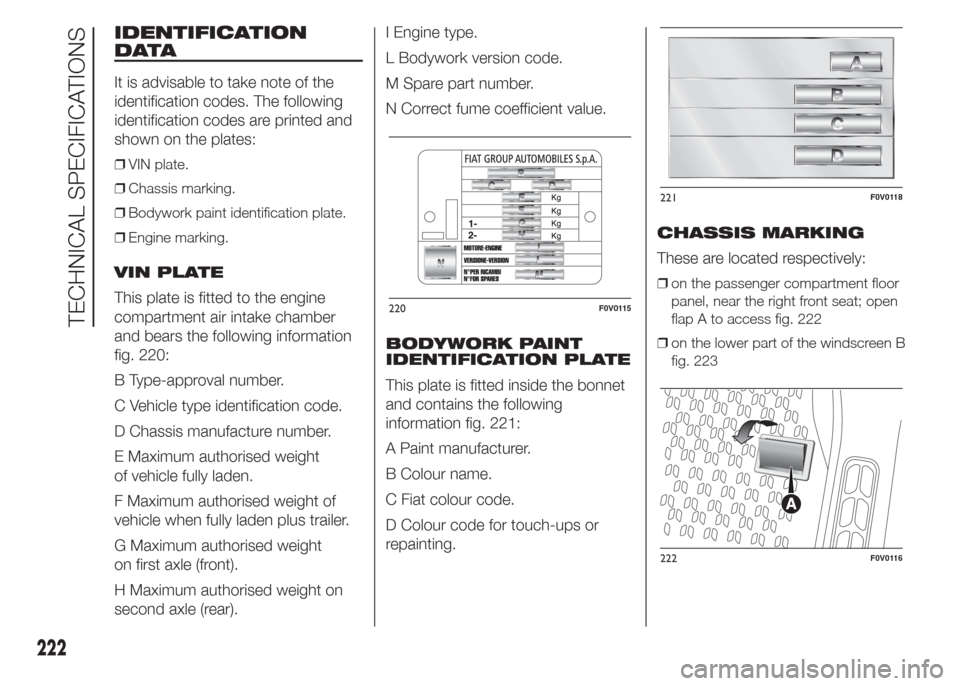
This plate is fitted to the engine
compartment air intake chamber
and bears the following information
fig. 220:
B Type-approval number.
C Vehicle type identification code.
D Chassis manufacture number.
E Maximum authorised weight
of vehicle fully laden.
F Maximum authorised weight of
vehicle when fully laden plus trailer.
G Maximum authorised weight
on first axle (front).
H Maximum authorised weight on
second axle (rear).I Engine type.
L Bodywork version code.
M Spare part number.
N Correct fume coefficient value.
BODYWORK PAINT
IDENTIFICATION PLATE
This plate is fitted inside the bonnet
and contains the following
information fig. 221:
A Paint manufacturer.
B Colour name.
C Fiat colour code.
D Colour code for touch-ups or
repainting.CHASSIS MARKING
These are located respectively:❒on the passenger compartment floor
panel, near the right front seat; open
flap A to access fig. 222
❒on the lower part of the windscreen B
fig. 223
220F0V0115
221F0V0118
222F0V0116
222
TECHNICAL SPECIFICATIONS
Page 319 of 323
INDEX
A
BS .............................................. 110
Accessories purchased by the
owner .......................................... 5
Active safety systems ..................... 110
Advice for preserving the
bodywork..................................... 216
Air cleaner/pollen filter .................... 208
Ashtray .......................................... 67
ASR system ................................... 113
Automatic climate control
system ......................................... 50
Battery .......................................... 208
Battery recharging.......................... 210
Blades ........................................... 212
Bodywork ...................................... 216
Bodywork paint identification
plate............................................. 222
Bodywork version .......................... 224
Bonnet ........................................... 59
Boot............................................... 60
Brake fluid ...................................... 206
Brakes
– specifications ............................ 230
Bump starting ................................ 184
Carrying children safely ................. 120
– child restraint systems ............... 126
Changing a wheel .......................... 175
Chassis marking ............................ 222Child restraint systems
(compliance for use) ..................... 122
Child safety device ......................... 20
Cigar lighter.................................... 67
CO2 emissions............................... 296
Control panel and on-board
instruments .................................. 74
Controls ......................................... 58
Cruise Control ................................ 148
Daytime running lights .................. 34
Dead lock ...................................... 15
Demanding vehicle use .................. 198
Diesel filter ..................................... 208
Diffusers ......................................... 43
Digital display ................................. 77
– Control buttons ......................... 77
– Set-up menu ............................. 77
Dimensions .................................... 240
Dipped headlights .................... 34-163
Direction indicators ................... 35-164
Door mirrors ................................... 33
Doors ............................................. 19
Draining condensation (MultiJet
versions) ...................................... 208
Driver side armrest ......................... 64
Driver's side front airbag ................ 128
Electric windows .......................... 56
– Initialisation................................ 57
Emergency starting ................ 137-183
Engine codes ................................. 224Engine compartment control unit
fuses ............................................ 169
Engine compartment...................... 199
Engine coolant ............................... 205
Engine
– technical specifications.............. 226
Engine marking .............................. 223
Engine oil ....................................... 205
EOBD system ................................ 91
ESC system ................................... 112
Exterior lights ................................. 34
Fastening the tow hook................. 186
Fiat CODE system.......................... 18
Fix&Go automatic quick tyre
repair kit ....................................... 180
Fluids and lubricants ...................... 277
Fog lights ................................. 58-164
Follow Me Home device ................. 35
Follow Me Home ............................ 35
Front airbags .................................. 127
Front bench .................................. 28
Front light clusters .......................... 163
Front roof light ................................ 167
Fuel consumption .......................... 281
Fuel cut-off system......................... 185
Fuses on compartment wired
casing .......................................... 170
Glove compartment ...................... 64
Handbrake.................................... 138