steering wheel FIAT DOBLO COMBI 2015 2.G User Guide
[x] Cancel search | Manufacturer: FIAT, Model Year: 2015, Model line: DOBLO COMBI, Model: FIAT DOBLO COMBI 2015 2.GPages: 323, PDF Size: 46.77 MB
Page 131 of 323
Below is a summary of
the main safety rules
to be followed when
carrying children:
❒install the child restraint systems on
the rear seat, which is the most
protected position in the event of an
accident;
❒if you need to deactivate the
passenger airbag, always check that
the
warning light above the front
courtesy light is on constantly to
make sure that it has actually been
deactivated;
❒carefully follow the instructions that
came with the child restraint system,
which the manufacturer must supply
by law. Keep the instructions in the
vehicle along with the other papers
and this handbook. Do not install
second-hand child restraint systems
without instructions.
❒always check that the seat belt is well
fastened by pulling on it;
❒only one child is to be strapped into
each restraint system; never carry
two children using one child restraint
system;
❒always check that seat belts do not
rest on the child’s neck;
❒while travelling, do not let the child sit
incorrectly or release the belts;❒never carry children on your lap, even
newborns. No-one can hold a child in
the event of an accident.
❒in the event of an accident, replace
the child restraint system with a
new one.
73)
WARNING
72) Fit the child restraint system only
when the vehicle is stationary.
The child restraint system is
correctly fixed to the brackets
when you hear the click. Follow
the instructions for assembly,
disassembly and positioning that
the Manufacturer must supply
with the child restraint system.
73) When an active passenger
airbag is fitted, DO NOT install
rearward facing child restraint
systems on the front seat. Always
deactivate the passenger airbag
when a rearward facing child
restraint system is installed on the
front passenger seat.
FRONT AIRBAGS
The vehicle is fitted with front airbag
for the driver and, for versions/
markets where provided, front
airbag for the passenger.
FRONT AIRBAGS
The front driver/passenger airbags
(for versions/markets where
provided) have been designed to
protect the front-seat occupants in
the event of head-on crashes of
medium-high severity, by placing the
bag between the occupant and the
steering wheel or dashboard.
Non-activation in other types of
crash (side-on collisions, rear
shunts, roll-overs, etc.) is therefore
not a sign of system malfunction.
An electronic control unit will make
the bag inflate in the event of a
frontal impact.
The bag will inflate instantaneously
placing itself between the front
occupants' body and the structures
which could cause injury. It will
deflate immediately afterwards.
127
Page 132 of 323
Front driver/passenger airbags (for
versions/markets where provided)
are not a replacement for, but rather
a complement to, the seat belts,
which should be worn at all times as
specified by law in Europe and
most non-European countries.
In the event of an impact, those not
wearing a seat belt are projected
forwards, and may come into
contact with the bag which is still
inflating. The protection offered
by the cushion is compromised in
such a case.
Front airbags may not activate in the
following situations:
❒frontal impacts against highly
deformable objects not involving the
front surface of the vehicle (e.g.
wing collision against guard rail, etc.);
❒vehicle wedging under other vehicles
or protective barriers (e.g. trucks or
guard rails);
they may not provide any additional
protection compared with seat belts,
so their activation would not be
appropriate. In these cases,
non-deployment does not indicate a
system malfunction.
74)
The driver's and passenger's front
airbags have been designed and
calibrated to protect front seat
occupants wearing seat belts.
At their maximum inflation, their
volume fills most of the space
between the steering wheel and the
driver and between the dashboard
and the passenger.
The airbags are not deployed in the
event of minor front collisions (for
which the restraining action of
the seat belts is sufficient). It
is therefore always necessary to
wear seat belts.
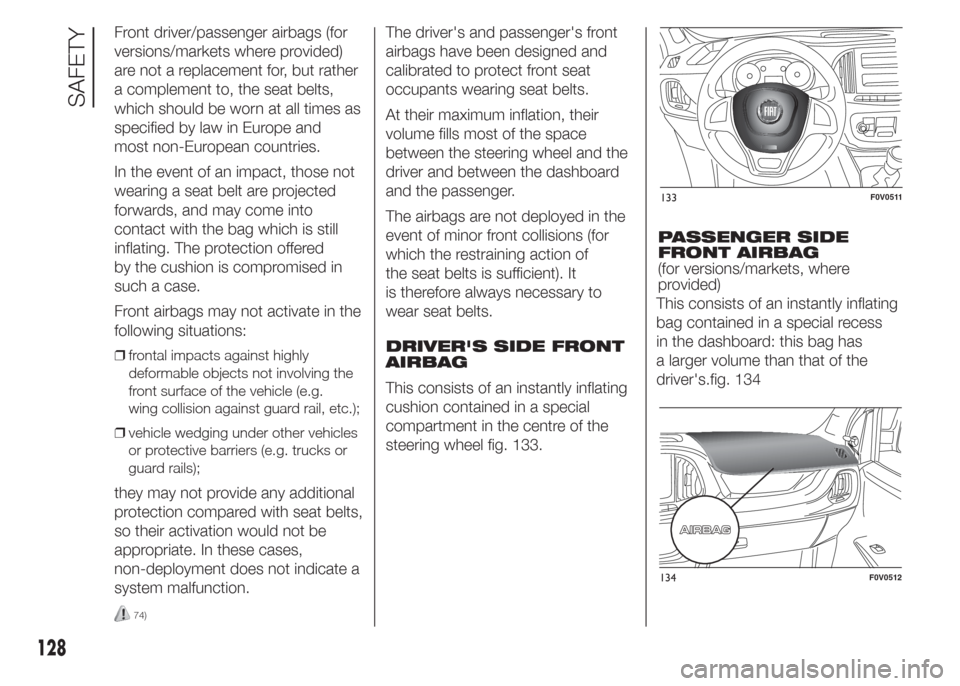
DRIVER'S SIDE FRONT
AIRBAG
This consists of an instantly inflating
cushion contained in a special
compartment in the centre of the
steering wheel fig. 133.PASSENGER SIDE
FRONT AIRBAG
(for versions/markets, where
provided)
This consists of an instantly inflating
bag contained in a special recess
in the dashboard: this bag has
a larger volume than that of the
driver's.fig. 134
133F0V0511
134F0V0512
128
SAFETY
Page 135 of 323
WARNING
74) Do not apply stickers or other objects to the steering wheel, the dashboard in the passenger side airbag area and
the seats. Never put objects (e.g. mobile phones) on the passenger side of the dashboard since they could interfere
with correct inflation of the passenger airbag and also cause serious injury to the passengers.
75) When an active passenger airbag is fitted, DO NOT install rearward facing child restraint systems on the front seat.
Deployment of the airbag in an accident could cause fatal injuries to the child regardless of the severity of the
impact. Therefore, always deactivate the passenger side airbag when a rearward facing child restraint system is
installed on the front passenger seat. The front passenger seat must also be positioned back as far as possible in
order to prevent the child restraint system from coming into contact with the dashboard. Immediately reactivate the
passenger airbag as soon as the child restraint system has been removed.
131
Page 188 of 323
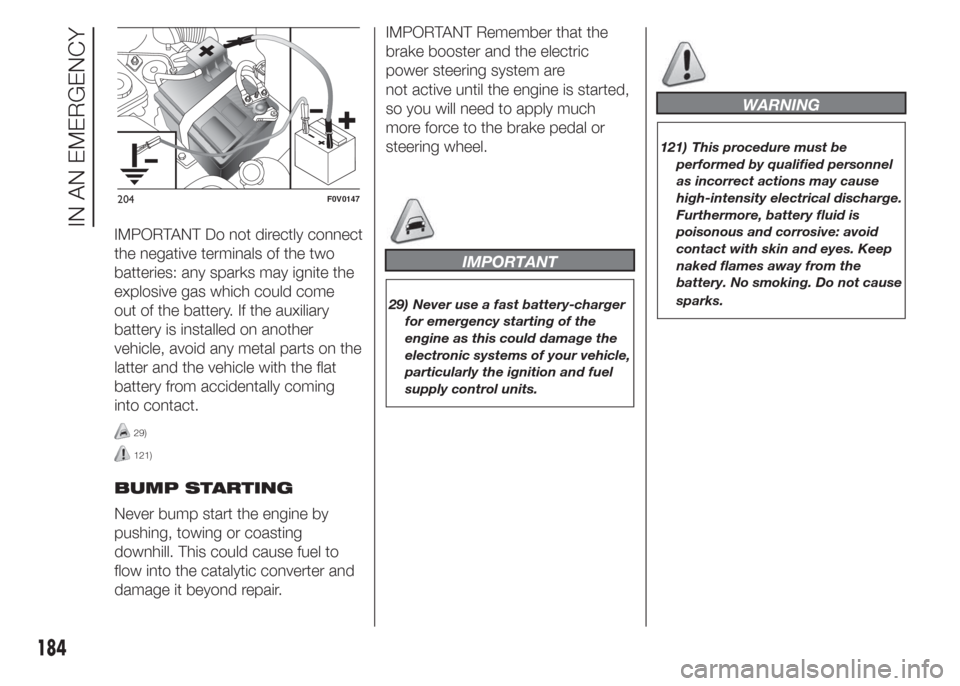
IMPORTANT Do not directly connect
the negative terminals of the two
batteries: any sparks may ignite the
explosive gas which could come
out of the battery. If the auxiliary
battery is installed on another
vehicle, avoid any metal parts on the
latter and the vehicle with the flat
battery from accidentally coming
into contact.
29)
121)
BUMP STARTING
Never bump start the engine by
pushing, towing or coasting
downhill. This could cause fuel to
flow into the catalytic converter and
damage it beyond repair.IMPORTANT Remember that the
brake booster and the electric
power steering system are
not active until the engine is started,
so you will need to apply much
more force to the brake pedal or
steering wheel.
IMPORTANT
29) Never use a fast battery-charger
for emergency starting of the
engine as this could damage the
electronic systems of your vehicle,
particularly the ignition and fuel
supply control units.
WARNING
121) This procedure must be
performed by qualified personnel
as incorrect actions may cause
high-intensity electrical discharge.
Furthermore, battery fluid is
poisonous and corrosive: avoid
contact with skin and eyes. Keep
naked flames away from the
battery. No smoking. Do not cause
sparks.
204F0V0147
184
IN AN EMERGENCY
Page 190 of 323
TOWING THE
VEHICLE
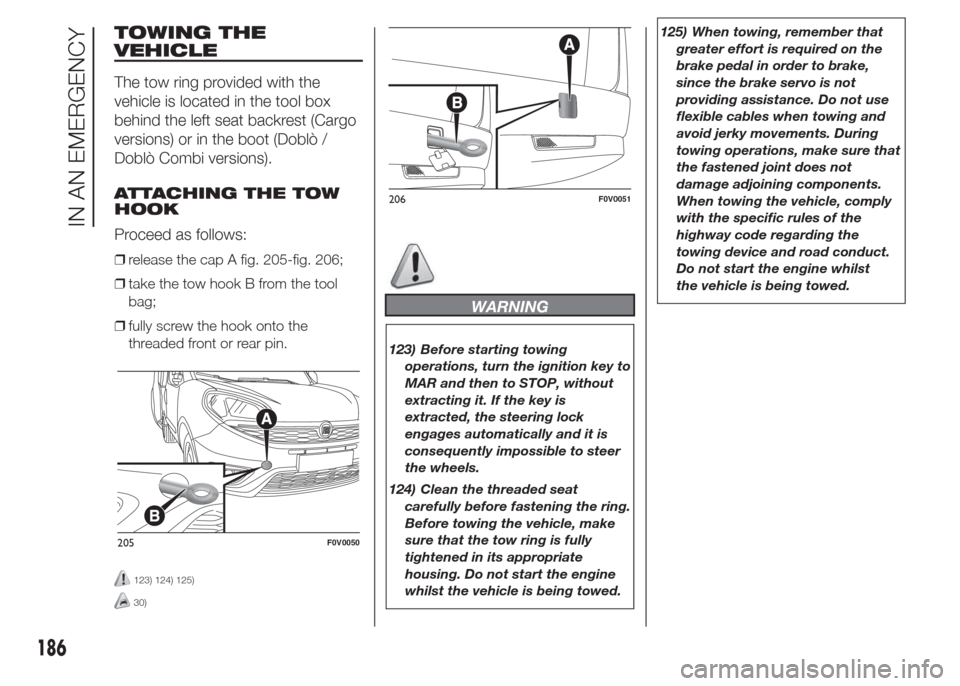
The tow ring provided with the
vehicle is located in the tool box
behind the left seat backrest (Cargo
versions) or in the boot (Doblò /
Doblò Combi versions).
ATTACHING THE TOW
HOOK
Proceed as follows:
❒release the cap A fig. 205-fig. 206;
❒take the tow hook B from the tool
bag;
❒fully screw the hook onto the
threaded front or rear pin.
123) 124) 125)
30)
WARNING
123) Before starting towing
operations, turn the ignition key to
MAR and then to STOP, without
extracting it. If the key is
extracted, the steering lock
engages automatically and it is
consequently impossible to steer
the wheels.
124) Clean the threaded seat
carefully before fastening the ring.
Before towing the vehicle, make
sure that the tow ring is fully
tightened in its appropriate
housing. Do not start the engine
whilst the vehicle is being towed.125) When towing, remember that
greater effort is required on the
brake pedal in order to brake,
since the brake servo is not
providing assistance. Do not use
flexible cables when towing and
avoid jerky movements. During
towing operations, make sure that
the fastened joint does not
damage adjoining components.
When towing the vehicle, comply
with the specific rules of the
highway code regarding the
towing device and road conduct.
Do not start the engine whilst
the vehicle is being towed.
205F0V0050
206F0V0051
186
IN AN EMERGENCY
Page 218 of 323
The tyres must be replaced when
the tread is less than 1.6 mm thick.
In any case, follow the laws in force
in the country you are in.
IMPORTANT
❒As far as possible, avoid sharp
braking, screech starts and violent
shocks against pavements, potholes
or other hard obstacles. Driving for
long stretches over bumpy roads can
damage the tyres;
❒periodically check that the tyres have
no cuts in the side wall, abnormal
swelling or irregular tyre wear.
Contact a Fiat Dealership if required;
❒avoid overloading the vehicle when
travelling: this may cause serious
damage to the wheels and tyres;
❒if a tyre is punctured, stop
immediately and change it to avoid
damage to the tyre, the rim,
suspensions and steering system;
❒tyres age even if they are not used
much. Cracks in the tread and on
the side walls are a sign of ageing.
Have the tyres checked by
specialised personnel if they have
been fitted for longer than 6 years.
Remember to check the spare wheel
very carefully;❒in the case of replacement, always fit
new tyres, avoiding those of
unknown origin;
❒If a tyre is changed, also change the
inflation valve;
❒to allow even wear between the front
and rear tyres, it is advisable to
change them over every 10-15
thousand kilometres, keeping them
on the same side of the vehicle so as
not to reverse the direction of
rotation.
139) 140) 141) 142)
WARNING
139) Remember that the road
holding qualities of your vehicle
also depend on the correct
inflation pressure of the tyres.
140) If tyre pressure is too low, the
tire may overheat and be severely
damaged as a result.
141) Do not switch tyres from the
righthand side of the vehicle to
the lefthand side, and vice versa.142) Never submit alloy rims to
repainting treatments requiring
the use of temperatures
exceeding 150°C. The mechanical
properties of the wheels could
be impaired.
214
SERVICING AND MAINTENANCE
Page 222 of 323
IMPORTANT
39) Some car washes with old-style
blades and/or in a poor state of
repair can damage the paintwork,
facilitating the formation of lines
that give the paint a dull/misty
appearance, especially on dark
colours. If this happens, lightly
polish the paintwork with
appropriate products.
IMPORTANT
6) Detergents cause water pollution.
The vehicle should be washed in
areas equipped for collecting
and purifying the liquid used in
the washing process.
INTERIORS
Regularly check that water is not
trapped under the mats (due to
water dripping off shoes, umbrellas,
etc.), as this could cause oxidation
of the sheet metal.
143) 144)
SEATS AND FABRIC
PARTS
Remove dust with a soft brush or a
vacuum cleaner. It is advisable to
use a moist brush on velvet
upholstery.
Rub the seats with a sponge
moistened with a solution of water
and mild soap.
PLASTIC PARTS
It is advisable to clean interior parts
with a moist cloth and a solution
of water and non-abrasive mild
soap. Use specific products for
cleaning plastic, without solvents
and specifically designed to prevent
damage to the appearance and
colour of the treated parts, to
remove grease and tough stains.IMPORTANT Do not use alcohol,
petrols or their derivatives to clean
the instrument panel glass.
LEATHER STEERING
WHEEL/GEAR
KNOB/HANDBRAKE
(for versions/markets, where
provided)
These components must be cleaned
with mild soap and water only.
Never use alcohol or alcohol-based
products.
Read the product label carefully
before using specific products for
cleaning the interiors: make sure the
product does not contain spirits or
alcohol-based substances.
If, when cleaning the windscreen
with special products, window
cleaner accidentally drips onto the
leather of the steering wheel/gear
lever knob/hand brake, wipe away
immediately and then wash the
affected area with mild soap and
water.
IMPORTANT Be careful when using
a steering wheel locking device,
to avoid damaging the leather
upholstery through abrasion.
218
SERVICING AND MAINTENANCE
Page 225 of 323
TECHNICAL SPECIFICATIONS
Everything you may find useful for
understanding how your vehicle
is made and works is contained in
this chapter and illustrated with
data, tables and graphics. For the
enthusiasts and the technician, but
also just for those who want to
know every detail of their vehicle.IDENTIFICATION DATA....................222
ENGINE CODES - BODYWORK
VERSIONS ......................................224
ENGINE ..........................................226
SUPPLY ..........................................228
TRANSMISSION .............................229
BRAKES .........................................230
SUSPENSION .................................231
STEERING ......................................232
WHEELS .........................................233
DIMENSIONS ..................................240
WEIGHTS........................................248
SUPPLIES .......................................275
FLUIDS AND LUBRICANTS ............277
PERFORMANCE .............................280
FUEL CONSUMPTION ....................281
CO2 EMISSIONS ............................296
OFFICIAL TYPE APPROVALS .........306
PRESCRIPTIONS FOR HANDLING
THE VEHICLE AT THE END OF ITS
LIFE ................................................309
221
Page 236 of 323
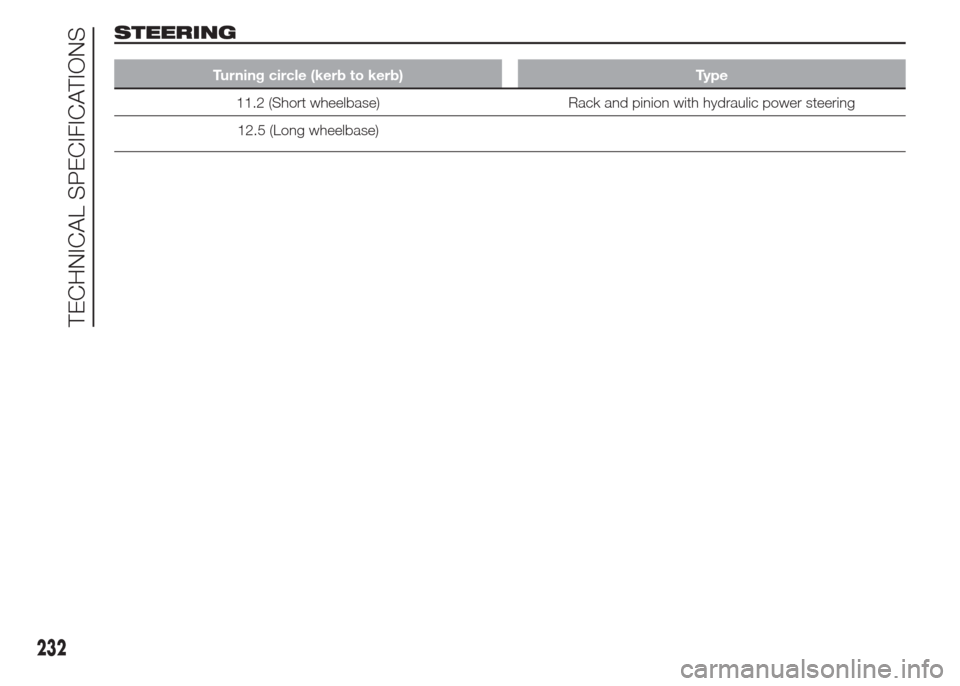
STEERING
Turning circle (kerb to kerb) Type
11.2 (Short wheelbase) Rack and pinion with hydraulic power steering
12.5 (Long wheelbase)
232
TECHNICAL SPECIFICATIONS
Page 282 of 323
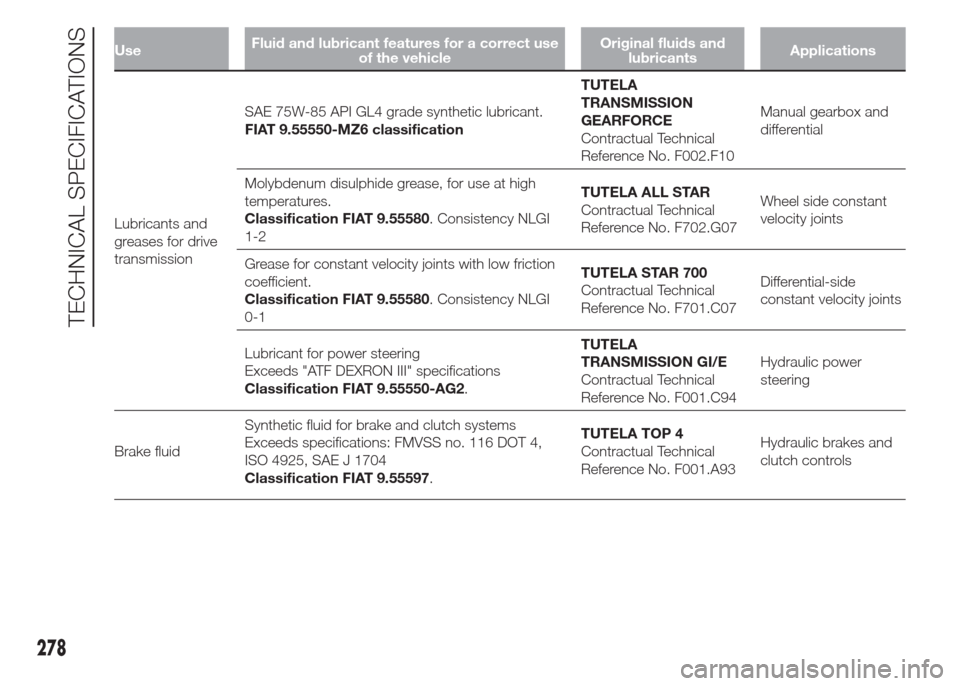
UseFluid and lubricant features for a correct use
of the vehicleOriginal fluids and
lubricantsApplications
Lubricants and
greases for drive
transmissionSAE 75W-85 API GL4 grade synthetic lubricant.
FIAT 9.55550-MZ6 classificationTUTELA
TRANSMISSION
GEARFORCE
Contractual Technical
Reference No. F002.F10Manual gearbox and
differential
Molybdenum disulphide grease, for use at high
temperatures.
Classification FIAT 9.55580. Consistency NLGI
1-2TUTELA ALL STAR
Contractual Technical
Reference No. F702.G07Wheel side constant
velocity joints
Grease for constant velocity joints with low friction
coefficient.
Classification FIAT 9.55580. Consistency NLGI
0-1TUTELA STAR 700
Contractual Technical
Reference No. F701.C07Differential-side
constant velocity joints
Lubricant for power steering
Exceeds "ATF DEXRON III" specifications
Classification FIAT 9.55550-AG2.TUTELA
TRANSMISSION GI/E
Contractual Technical
Reference No. F001.C94Hydraulic power
steering
Brake fluidSynthetic fluid for brake and clutch systems
Exceeds specifications: FMVSS no. 116 DOT 4,
ISO 4925, SAE J 1704
Classification FIAT 9.55597.TUTELA TOP 4
Contractual Technical
Reference No. F001.A93Hydraulic brakes and
clutch controls
278
TECHNICAL SPECIFICATIONS