maintenance FIAT DOBLO COMBI 2015 2.G Owner's Manual
[x] Cancel search | Manufacturer: FIAT, Model Year: 2015, Model line: DOBLO COMBI, Model: FIAT DOBLO COMBI 2015 2.GPages: 323, PDF Size: 46.77 MB
Page 212 of 323
AIR CLEANER/
POLLEN FILTER
Have the air cleaner or the pollen
filter replaced by a Fiat Dealership.
DIESEL FILTER
DRAINING
CONDENSATION
(MultiJet versions)
36)
IMPORTANT
36) The presence of water in the
supply circuit may cause severe
damage to the injection system
and irregular engine operation. If
the
warning light comes on,
go to a Fiat Dealership as soon as
possible to have the system bled.
If this problem is indicated
immediately after refuelling, water
may have entered the fuel tank.
In this case, immediately turn off
the engine and contact a Fiat
Dealership.
BATTERY
The battery is of the “limited
maintenance” type: under normal
conditions of use, the electrolyte
does not need topping up with
distilled water.
It does, however, need to be
checked periodically at a Fiat
Dealership or by specialist personnel
to make sure it is working correctly.
133) 134)
REPLACING THE
BATTERY
If required, replace the battery with
an original spare part with the same
specifications.
If a battery with different
specifications is fitted, the service
intervals given in the “Scheduled
Servicing Plan” will no longer be
valid.
Follow the battery manufacturer's
instructions for maintenance.
37) 38)
5)
135)
208
SERVICING AND MAINTENANCE
Page 214 of 323
IMPORTANT
37) Incorrect assembly of electrical
and electronic devices may cause
severe damage to your vehicle.
Contact a Fiat Dealership if you
want to install accessories
(alarms, radiophone, etc.): they
will suggest the most suitable
devices and advise you if a higher
capacity battery needs to be
installed.
38) If the vehicle needs to be off the
road for a long period under
conditions of intense cold, remove
the battery and take it to a
heated location, otherwise it may
freeze.
IMPORTANT
5) Batteries contain substances
which are very dangerous for the
environment. To replace your
battery, we recommend
contacting your Fiat Dealership to
dispose of your old battery in full
respect of the environment and in
compliance with all applicable
laws and regulations.
BATTERY
RECHARGING
IMPORTANT The battery recharging
procedure is given as information
only. This operation should be
performed at a Fiat Dealership.
Charging should be slow at a low
ampere rating for approximately 24
hours. Charging for a long time
may damage the battery.
To recharge, proceed as follows:
IN THE ABSENCE OF
THE START&STOP
SYSTEM
❒disconnect the terminal from the
negative battery pole;
❒connect the charger cables to the
battery terminals, observing the
poles;
❒turn on the charger;
❒when you have finished, turn the
charger off before disconnecting
it from the battery;
❒reconnect the negative battery
terminal.
210
SERVICING AND MAINTENANCE
Page 216 of 323
WINDSCREEN/REAR
WINDOW WIPER
(for versions/markets, where
provided)
BLADES
Periodically clean the rubber part
using special products; TUTELA
PROFESSIONAL SC 35 is
recommended.
Replace the blades if the rubber
edge is deformed or worn. In any
case, it is advisable to replace them
approximately once a year.
A few simple precautions can
reduce the possibility of damage to
the blades:
❒if the temperature falls below zero,
make sure that ice has not frozen
the rubber against the glass. Use a
de-icing product to release it if
required;
❒remove any snow from the glass: in
addition to protecting the blades,
this prevents effort on the motor and
overheating;
❒do not operate the windscreen and
rear window wipers on dry glass.
138)
Replacing the
windscreen wiper
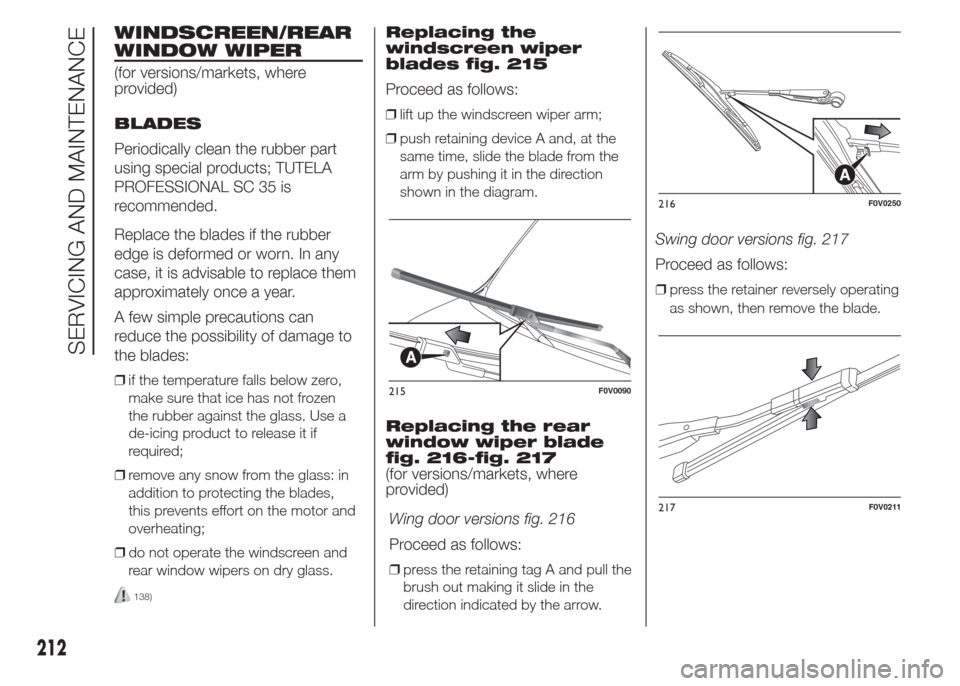
blades fig. 215
Proceed as follows:
❒lift up the windscreen wiper arm;
❒push retaining device A and, at the
same time, slide the blade from the
arm by pushing it in the direction
shown in the diagram.
Replacing the rear
window wiper blade
fig. 216-fig. 217
(for versions/markets, where
provided)
Wing door versions fig. 216
Proceed as follows:
❒press the retaining tag A and pull the
brush out making it slide in the
direction indicated by the arrow.
Swing door versions fig. 217
Proceed as follows:
❒press the retainer reversely operating
as shown, then remove the blade.
215F0V0090
216F0V0250
217F0V0211
212
SERVICING AND MAINTENANCE
Page 218 of 323
The tyres must be replaced when
the tread is less than 1.6 mm thick.
In any case, follow the laws in force
in the country you are in.
IMPORTANT
❒As far as possible, avoid sharp
braking, screech starts and violent
shocks against pavements, potholes
or other hard obstacles. Driving for
long stretches over bumpy roads can
damage the tyres;
❒periodically check that the tyres have
no cuts in the side wall, abnormal
swelling or irregular tyre wear.
Contact a Fiat Dealership if required;
❒avoid overloading the vehicle when
travelling: this may cause serious
damage to the wheels and tyres;
❒if a tyre is punctured, stop
immediately and change it to avoid
damage to the tyre, the rim,
suspensions and steering system;
❒tyres age even if they are not used
much. Cracks in the tread and on
the side walls are a sign of ageing.
Have the tyres checked by
specialised personnel if they have
been fitted for longer than 6 years.
Remember to check the spare wheel
very carefully;❒in the case of replacement, always fit
new tyres, avoiding those of
unknown origin;
❒If a tyre is changed, also change the
inflation valve;
❒to allow even wear between the front
and rear tyres, it is advisable to
change them over every 10-15
thousand kilometres, keeping them
on the same side of the vehicle so as
not to reverse the direction of
rotation.
139) 140) 141) 142)
WARNING
139) Remember that the road
holding qualities of your vehicle
also depend on the correct
inflation pressure of the tyres.
140) If tyre pressure is too low, the
tire may overheat and be severely
damaged as a result.
141) Do not switch tyres from the
righthand side of the vehicle to
the lefthand side, and vice versa.142) Never submit alloy rims to
repainting treatments requiring
the use of temperatures
exceeding 150°C. The mechanical
properties of the wheels could
be impaired.
214
SERVICING AND MAINTENANCE
Page 219 of 323
RUBBER HOSES
As far as the maintenance of the
brake system and fuel supply
system rubber hoses is concerned,
follow the "Scheduled Servicing
Plan" in this chapter carefully.
Ozone, high temperatures and
prolonged lack of fluid in the system
may cause hardening and cracking
of the hoses, with possible leaks.
Careful checking is therefore
necessary.
PROLONGED
VEHICLE INACTIVITY
If the vehicle needs to be off the
road for longer than one month, the
following precautions must be
taken:
❒park the vehicle indoors in a dry and,
if possible, well-ventilated place;
❒engage a gear and check that the
handbrake is not engaged;
❒disconnect the negative terminal from
the battery pole (see paragraph
“Vehicle inactivity” in the "Dashboard
and controls" chapter) and check
the charge conditions (see paragraph
“Battery” in the “Care and
maintenance” chapter);
❒clean and protect the painted parts
using protective wax;
❒clean and protect the shiny metal
parts using special compounds
available commercially;
❒sprinkle talcum powder on the
windscreen and rear window wiper
rubber blades and lift them off the
glass;
❒slightly open the windows;❒cover the vehicle with a piece of
fabric or perforated plastic sheet. Do
not use compact plastic tarpaulins,
which prevent humidity from
evaporating from the surface of the
vehicle;
❒inflate tyres to +0.5 bar above the
standard specified pressure and
check it at intervals;
❒do not drain the engine cooling
system.
215
Page 220 of 323
BODYWORK
PROTECTION AGAINST
ATMOSPHERIC
AGENTS
The main causes of corrosion are
the following:
❒atmospheric pollution;
❒salty air and humidity (coastal areas,
or hot humid climates);
❒seasonal environmental conditions.
The abrasive action of wind-borne
atmospheric dust and sand, as well
as mud and gravel raised by other
cars is also not to be
underestimated.
On your vehicle, Fiat has
implemented the best
manufacturing technologies to
effectively protect the bodywork
against corrosion.
These include:
❒painting products and systems which
give the vehicle particular resistance
to corrosion and abrasion;
❒use of galvanised (or pretreated)
sheet metal, with high resistance
to corrosion;❒spraying the underbody, engine
compartment, wheelhouse internal
parts and other parts with highly
protective wax products;
❒spraying of plastic parts, with a
protective function in the more
exposed points: underdoor, inner
wing, edges, etc.;
❒use of "open" boxed sections to
prevent condensation and pockets of
moisture from triggering rust inside.
VEHICLE EXTERIOR
AND UNDERBODY
WARRANTY
Your vehicle is covered by warranty
against perforation due to corrosion
of any original element of the
structure or body.
For the general terms of this
warranty, refer to the Warranty
Booklet.
ADVICE FOR
PRESERVING THE
BODYWORKPaintwork
Paintwork does not only serve an
aesthetic purpose, but also protects
the underlying sheet metal.
Touch up abrasions and scratches
immediately to prevent rust
formation. Use only original paint
products for touch-ups (see
“Bodywork paint identification plate”
in the “Technical specifications”
section).
Normal maintenance of paintwork
consists in washing the vehicle: the
frequency depends on the
conditions and environment where
the vehicle is used.
For example, it is advisable to wash
the vehicle more often in areas
with high levels of environmental
pollution or on roads spread with
salt.To correctly wash the vehicle,
proceed as follows:
❒wash the bodywork using a low
pressure jet of water;
❒wipe a sponge with a slightly soapy
solution over the bodywork,
frequently rinsing the sponge;
❒rinse well with water and dry with a
jet of air or a chamois.
216
SERVICING AND MAINTENANCE
Page 222 of 323
IMPORTANT
39) Some car washes with old-style
blades and/or in a poor state of
repair can damage the paintwork,
facilitating the formation of lines
that give the paint a dull/misty
appearance, especially on dark
colours. If this happens, lightly
polish the paintwork with
appropriate products.
IMPORTANT
6) Detergents cause water pollution.
The vehicle should be washed in
areas equipped for collecting
and purifying the liquid used in
the washing process.
INTERIORS
Regularly check that water is not
trapped under the mats (due to
water dripping off shoes, umbrellas,
etc.), as this could cause oxidation
of the sheet metal.
143) 144)
SEATS AND FABRIC
PARTS
Remove dust with a soft brush or a
vacuum cleaner. It is advisable to
use a moist brush on velvet
upholstery.
Rub the seats with a sponge
moistened with a solution of water
and mild soap.
PLASTIC PARTS
It is advisable to clean interior parts
with a moist cloth and a solution
of water and non-abrasive mild
soap. Use specific products for
cleaning plastic, without solvents
and specifically designed to prevent
damage to the appearance and
colour of the treated parts, to
remove grease and tough stains.IMPORTANT Do not use alcohol,
petrols or their derivatives to clean
the instrument panel glass.
LEATHER STEERING
WHEEL/GEAR
KNOB/HANDBRAKE
(for versions/markets, where
provided)
These components must be cleaned
with mild soap and water only.
Never use alcohol or alcohol-based
products.
Read the product label carefully
before using specific products for
cleaning the interiors: make sure the
product does not contain spirits or
alcohol-based substances.
If, when cleaning the windscreen
with special products, window
cleaner accidentally drips onto the
leather of the steering wheel/gear
lever knob/hand brake, wipe away
immediately and then wash the
affected area with mild soap and
water.
IMPORTANT Be careful when using
a steering wheel locking device,
to avoid damaging the leather
upholstery through abrasion.
218
SERVICING AND MAINTENANCE
Page 320 of 323
Hazard warning lights..................... 160
Headlights...................................... 69
Headlight washers ......................... 41
Head restraints............................... 31
Heating and ventilation ............... 42-44
Hill Holder system .......................... 112
Identification data .......................... 222
Ignition device ................................ 17
Important information ..................... 133
Inflation pressure ............................ 239
Installing electrical/electronic
devices ........................................ 5
Interior fittings ................................ 64
Interior lights .................................. 36
Interior mirror ................................. 32
Interiors .......................................... 218
Isofix child restraint system
setup ........................................... 124
Jump starting ................................ 183
Lifting the vehicle .......................... 185
Load limiters .................................. 118
Luggage compartment light ........... 38
Main beam headlights............. 35-164
Maintenance of the seat belts ........ 119
Manual climate control system ....... 47
Manual deactivation of
passenger side front airbag and
side bag for chest/head
protection .................................... 129
MSR system .................................. 113Multifunction display....................... 81
– Control buttons ......................... 81
– Set-up menu ............................. 82
Number plate lights (for
hatchback versions) ..................... 166
Number plate lights (for versions
with wing doors)........................... 166
Occupant protection systems ....... 115
Parking ......................................... 138
Parking sensors ............................. 150
Partitions........................................ 29
Passenger side front airbag ............ 128
Performance .................................. 280
Periodic checks ............................. 198
Plastic parts ................................... 218
Plugs (type) .................................... 226
Power socket ................................. 65
Power steering fluid........................ 206
Practical advice for reducing fuel
consumption and harmful
emissions ..................................... 154
Prescriptions for vehicle at end
of life ........................................... 309
Pretensioners ................................. 117
Procedure for diesel versions ......... 136
Procedure for petrol versions.......... 136
Prolonged vehicle inactivity............. 215
Protecting the environment ............ 71
Protection against atmospheric
agents.......................................... 216
Radio (setup) ................................ 70
Radio transmitters and mobile
phones......................................... 5
Rear doors ..................................... 21
Rear fog lights ................................ 59
Rear light clusters .......................... 164
Rear roof light ................................ 168
Rear view mirrors ........................... 32
Rear window washer...................... 40
Rear window wiper ........................ 40
Refuelling the vehicle ...................... 152
Replacing a bulb ............................ 160
Replacing an exterior bulb .............. 163
Replacing an interior bulb ............... 167
Replacing fuses.............................. 168
Replacing the battery ..................... 208
Rim Protector................................. 234
Rims and tyres ............................... 233
Roof rack ....................................... 68
Rubber hoses ................................ 215
Saving fuel .................................... 154
SBR system ................................... 117
Scheduled servicing ....................... 190
Scheduled Servicing Plan ............... 191
Seat belts....................................... 115
Seats and fabric parts .................... 218
Seats ............................................. 24
– Driver’s seat .............................. 24
– Passenger seat ......................... 25
INDEX