wheel FIAT DOBLO COMBI 2015 2.G Owner's Manual
[x] Cancel search | Manufacturer: FIAT, Model Year: 2015, Model line: DOBLO COMBI, Model: FIAT DOBLO COMBI 2015 2.GPages: 323, PDF Size: 46.77 MB
Page 118 of 323
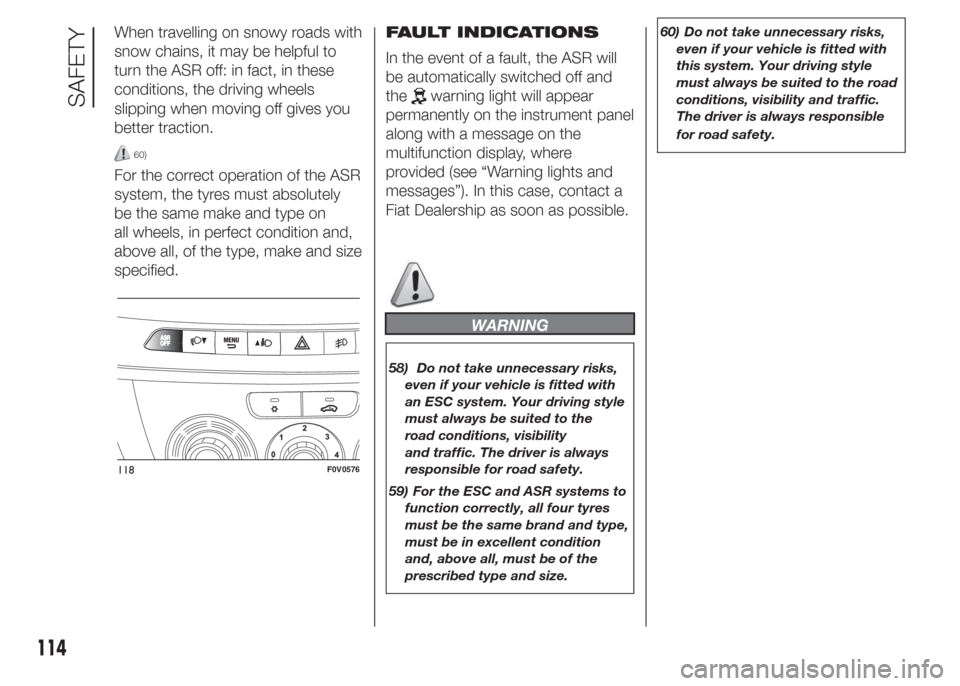
When travelling on snowy roads with
snow chains, it may be helpful to
turn the ASR off: in fact, in these
conditions, the driving wheels
slipping when moving off gives you
better traction.
60)
For the correct operation of the ASR
system, the tyres must absolutely
be the same make and type on
all wheels, in perfect condition and,
above all, of the type, make and size
specified.FAULT INDICATIONS
In the event of a fault, the ASR will
be automatically switched off and
the
warning light will appear
permanently on the instrument panel
along with a message on the
multifunction display, where
provided (see “Warning lights and
messages”). In this case, contact a
Fiat Dealership as soon as possible.
WARNING
58) Do not take unnecessary risks,
even if your vehicle is fitted with
an ESC system. Your driving style
must always be suited to the
road conditions, visibility
and traffic. The driver is always
responsible for road safety.
59) For the ESC and ASR systems to
function correctly, all four tyres
must be the same brand and type,
must be in excellent condition
and, above all, must be of the
prescribed type and size.60) Do not take unnecessary risks,
even if your vehicle is fitted with
this system. Your driving style
must always be suited to the road
conditions, visibility and traffic.
The driver is always responsible
for road safety.
118F0V0576
114
SAFETY
Page 131 of 323
Below is a summary of
the main safety rules
to be followed when
carrying children:
❒install the child restraint systems on
the rear seat, which is the most
protected position in the event of an
accident;
❒if you need to deactivate the
passenger airbag, always check that
the
warning light above the front
courtesy light is on constantly to
make sure that it has actually been
deactivated;
❒carefully follow the instructions that
came with the child restraint system,
which the manufacturer must supply
by law. Keep the instructions in the
vehicle along with the other papers
and this handbook. Do not install
second-hand child restraint systems
without instructions.
❒always check that the seat belt is well
fastened by pulling on it;
❒only one child is to be strapped into
each restraint system; never carry
two children using one child restraint
system;
❒always check that seat belts do not
rest on the child’s neck;
❒while travelling, do not let the child sit
incorrectly or release the belts;❒never carry children on your lap, even
newborns. No-one can hold a child in
the event of an accident.
❒in the event of an accident, replace
the child restraint system with a
new one.
73)
WARNING
72) Fit the child restraint system only
when the vehicle is stationary.
The child restraint system is
correctly fixed to the brackets
when you hear the click. Follow
the instructions for assembly,
disassembly and positioning that
the Manufacturer must supply
with the child restraint system.
73) When an active passenger
airbag is fitted, DO NOT install
rearward facing child restraint
systems on the front seat. Always
deactivate the passenger airbag
when a rearward facing child
restraint system is installed on the
front passenger seat.
FRONT AIRBAGS
The vehicle is fitted with front airbag
for the driver and, for versions/
markets where provided, front
airbag for the passenger.
FRONT AIRBAGS
The front driver/passenger airbags
(for versions/markets where
provided) have been designed to
protect the front-seat occupants in
the event of head-on crashes of
medium-high severity, by placing the
bag between the occupant and the
steering wheel or dashboard.
Non-activation in other types of
crash (side-on collisions, rear
shunts, roll-overs, etc.) is therefore
not a sign of system malfunction.
An electronic control unit will make
the bag inflate in the event of a
frontal impact.
The bag will inflate instantaneously
placing itself between the front
occupants' body and the structures
which could cause injury. It will
deflate immediately afterwards.
127
Page 132 of 323
Front driver/passenger airbags (for
versions/markets where provided)
are not a replacement for, but rather
a complement to, the seat belts,
which should be worn at all times as
specified by law in Europe and
most non-European countries.
In the event of an impact, those not
wearing a seat belt are projected
forwards, and may come into
contact with the bag which is still
inflating. The protection offered
by the cushion is compromised in
such a case.
Front airbags may not activate in the
following situations:
❒frontal impacts against highly
deformable objects not involving the
front surface of the vehicle (e.g.
wing collision against guard rail, etc.);
❒vehicle wedging under other vehicles
or protective barriers (e.g. trucks or
guard rails);
they may not provide any additional
protection compared with seat belts,
so their activation would not be
appropriate. In these cases,
non-deployment does not indicate a
system malfunction.
74)
The driver's and passenger's front
airbags have been designed and
calibrated to protect front seat
occupants wearing seat belts.
At their maximum inflation, their
volume fills most of the space
between the steering wheel and the
driver and between the dashboard
and the passenger.
The airbags are not deployed in the
event of minor front collisions (for
which the restraining action of
the seat belts is sufficient). It
is therefore always necessary to
wear seat belts.
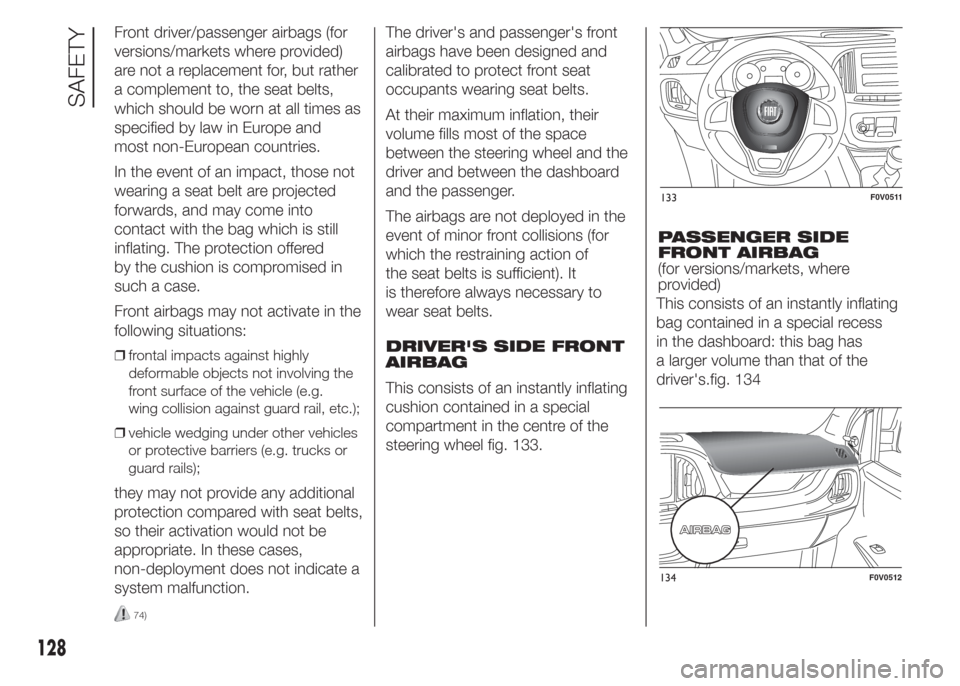
DRIVER'S SIDE FRONT
AIRBAG
This consists of an instantly inflating
cushion contained in a special
compartment in the centre of the
steering wheel fig. 133.PASSENGER SIDE
FRONT AIRBAG
(for versions/markets, where
provided)
This consists of an instantly inflating
bag contained in a special recess
in the dashboard: this bag has
a larger volume than that of the
driver's.fig. 134
133F0V0511
134F0V0512
128
SAFETY
Page 135 of 323
WARNING
74) Do not apply stickers or other objects to the steering wheel, the dashboard in the passenger side airbag area and
the seats. Never put objects (e.g. mobile phones) on the passenger side of the dashboard since they could interfere
with correct inflation of the passenger airbag and also cause serious injury to the passengers.
75) When an active passenger airbag is fitted, DO NOT install rearward facing child restraint systems on the front seat.
Deployment of the airbag in an accident could cause fatal injuries to the child regardless of the severity of the
impact. Therefore, always deactivate the passenger side airbag when a rearward facing child restraint system is
installed on the front passenger seat. The front passenger seat must also be positioned back as far as possible in
order to prevent the child restraint system from coming into contact with the dashboard. Immediately reactivate the
passenger airbag as soon as the child restraint system has been removed.
131
Page 142 of 323
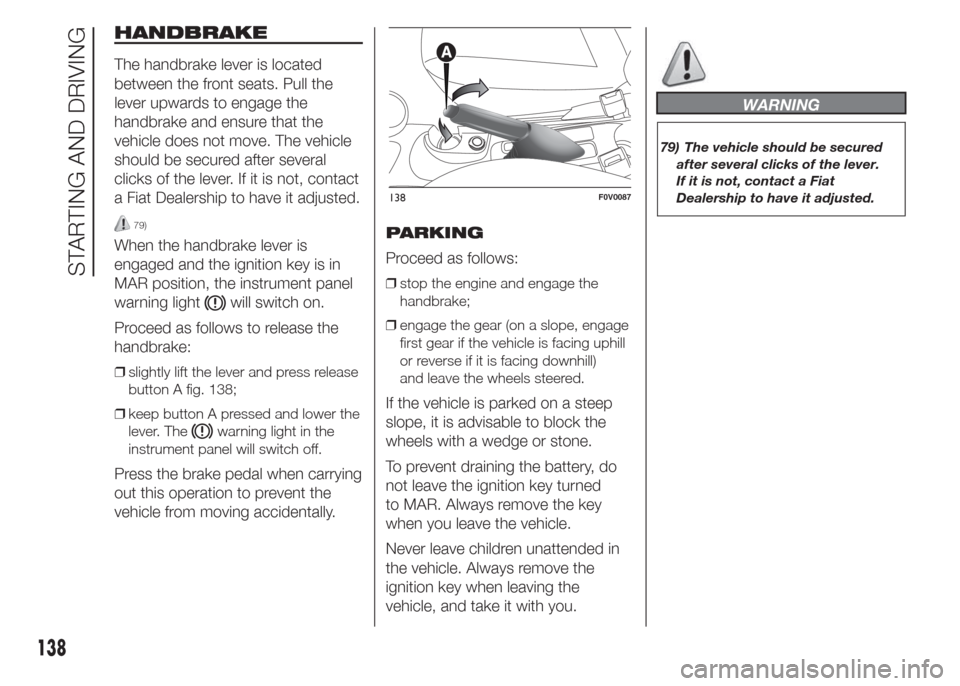
HANDBRAKE
The handbrake lever is located
between the front seats. Pull the
lever upwards to engage the
handbrake and ensure that the
vehicle does not move. The vehicle
should be secured after several
clicks of the lever. If it is not, contact
a Fiat Dealership to have it adjusted.
79)
When the handbrake lever is
engaged and the ignition key is in
MAR position, the instrument panel
warning light
will switch on.
Proceed as follows to release the
handbrake:
❒slightly lift the lever and press release
button A fig. 138;
❒keep button A pressed and lower the
lever. The
warning light in the
instrument panel will switch off.
Press the brake pedal when carrying
out this operation to prevent the
vehicle from moving accidentally.PARKING
Proceed as follows:
❒stop the engine and engage the
handbrake;
❒engage the gear (on a slope, engage
first gear if the vehicle is facing uphill
or reverse if it is facing downhill)
and leave the wheels steered.
If the vehicle is parked on a steep
slope, it is advisable to block the
wheels with a wedge or stone.
To prevent draining the battery, do
not leave the ignition key turned
to MAR. Always remove the key
when you leave the vehicle.
Never leave children unattended in
the vehicle. Always remove the
ignition key when leaving the
vehicle, and take it with you.
WARNING
79) The vehicle should be secured
after several clicks of the lever.
If it is not, contact a Fiat
Dealership to have it adjusted.
138F0V0087
138
STARTING AND DRIVING
Page 149 of 323
❒The TPMS warns the driver of any
condition of insufficient tyre pressure
If this drops below the insufficient
pressure limit for any reason including
low temperature and normal
pressure loss of the tyre.
❒The seasonal temperature changes
affect tyre pressure.
The TPMS uses wireless devices
with electronic sensors mounted on
the wheel rims to constantly monitor
the value of tyre pressure. The
sensors mounted on each wheel as
part of the valve stem transmit
various information of the tyres to
the receiver module, in order to
calculate the pressure.
IMPORTANT Monitoring and
maintaining the correct pressure in
all four tyres are particularly
important.
Tyre pressure
monitoring system low
pressure warning
The system warns the driver if one
or more tyres are flat by switching
on the warning light
on the
instrument panel (together with a
warning message and an acoustic
signal).The TPMS continues to advise the
driver of the low tyre pressure
condition until this is corrected; the
warning continues until the pressure
corresponds or exceeds the
pressure prescribed for the cold
tyres. When the tyre low pressure
control warning light
switches on
constantly, the inflation pressure
must be adjusted until it reaches the
pressure prescribed for cold tyres.
After the automatic update of the
system, the tyre pressure control
warning light switches off. You may
need to drive the vehicle for about
20 minutes at a speed higher than
20 km/h to allow the TPMS to
receive this information.
IMPORTANT In the case of deflation
of more than one tyre sequentially,
without switching off and on the
engine, from the second tyre
involved the acoustic signal is not
activated, only the dedicated signal
is shown on the display.To prevent the signal from being
stored in the event of pressure loss
of a subsequent tyre (with
deactivation of the acoustic signal),
the ignition key must be turned to
MAR and then to STOP, each time
pressure is restored.
TPMS operation faults
The system fault is indicated by
warning light
which first flashes
for 75 seconds and then stays
on steadily. This can occur in any of
the following situations:
❒interference caused by electronic
devices or radio frequency emissions
similar to those of the TPM sensors.
❒Application of tinted films which
interfere with the signals of the radio
waves.
❒Presence of snow or ice on the
wheels or the wheel arches.
❒Use of snow chains.
❒Use of wheels/tyres not equipped
with TPM sensors.
❒The space-saver wheel is not
equipped with the tyre pressure
control sensor. Therefore, the tyre
pressure is not controlled by the
system.
145
Page 150 of 323
NOTE The vehicle may be equipped
with FiX&Go Automatic tyre repair
kit, space-saver wheel or full size
spare wheel (with or without original
TPMS sensor to measure tyre
pressure).
After the punctured tyre has been
repaired with the original tyre sealant
contained in the FiX&Go Automatic
tyre repair kit, the previous condition
must be restored, so that the
warning light is off during normal
driving.
Space-saver wheel (for versions/
markets, where provided): the
space-saver wheel is not equipped
with a TPMS sensor. Once fitted,
while driving normally, the warning
light comes on (flashing for about 75
seconds, and then constantly).
This condition lasts until a wheel
equipped with an original TPMS
sensor is fitted on the vehicle.Normal spare wheel (without TPMS
sensor): once fitted, while driving
normally, the
warning light comes
on (flashing for about 75 seconds,
and then constantly). This condition
lasts until a wheel equipped with
an original TPMS sensor is fitted on
the vehicle. The system is then
restored and the
warning light
switches off.
Normal spare wheel (with TPMS
sensor): once fitted, while driving
normally, the
warning light
switches off.
IMPORTANT In all the above-
mentioned cases, it is advisable to
check the spare wheel tyre pressure
before starting driving.
NOTE If the tyres are replaced,
driving the vehicle for short
stretches, some time might be
needed before the system is
restored.IMPORTANT
WARNING
86) The TPMS is optimised for the
original tyres and wheels
provided. TPMS pressures and
alerts have been defined
according to the size of the tyres
mounted on the vehicle. Using
equipment with different size,
type or kind may cause irregular
system operation or sensor
damage. Non-original spare
wheels can damage the sensor.
Do not use tyre sealant or
balancing weights if the vehicle is
equipped with TPMS as these
may damage the sensors.
87) If the system signals a pressure
decrease on a specific tyre, it is
recommended to check the
pressure on all four tyres.
88) TPMS does not relieve the driver
from the obligation to check the
tyre pressure every month; it is
not to be considered a replacing
system for maintenance or a
safety system.
146
STARTING AND DRIVING
Page 154 of 323
TRACTION PLUS
SYSTEM
(for versions/markets, where
provided)
Traction Plus is a driving aid, useful
for setting off in poor grip conditions
(snow, ice, mud, etc.) which allows
the drive force to be distributed in
the best way over the front axle
when one wheel is slipping.
Traction Plus acts by braking the
wheels with poor grip (or those
slipping more than the others),
thereby transferring the drive force
to those which have greater grip on
the ground.
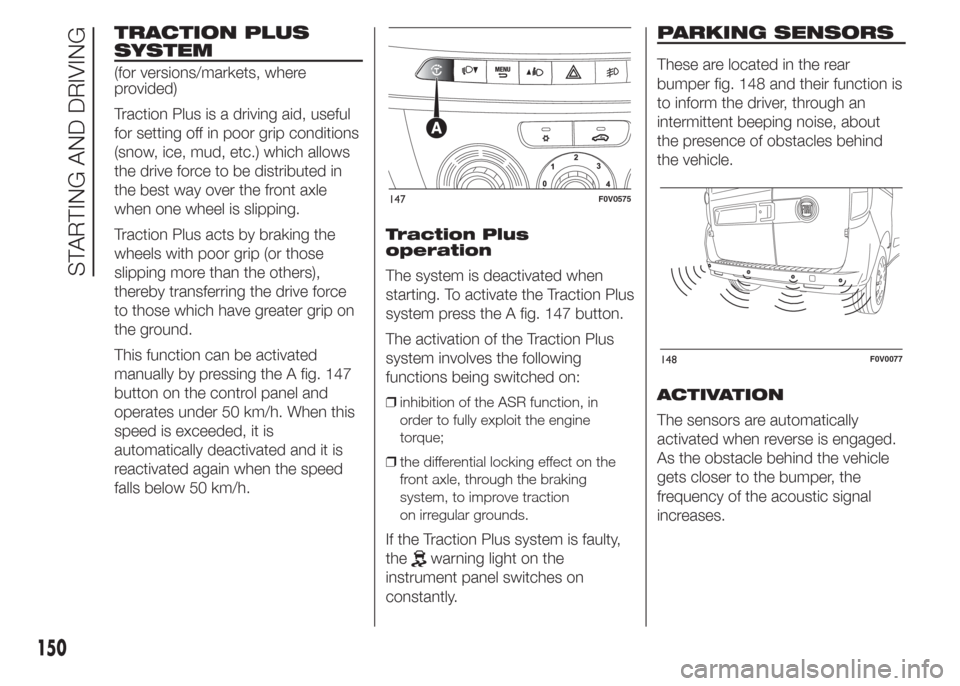
This function can be activated
manually by pressing the A fig. 147
button on the control panel and
operates under 50 km/h. When this
speed is exceeded, it is
automatically deactivated and it is
reactivated again when the speed
falls below 50 km/h.Traction Plus
operation
The system is deactivated when
starting. To activate the Traction Plus
system press the A fig. 147 button.
The activation of the Traction Plus
system involves the following
functions being switched on:
❒inhibition of the ASR function, in
order to fully exploit the engine
torque;
❒the differential locking effect on the
front axle, through the braking
system, to improve traction
on irregular grounds.
If the Traction Plus system is faulty,
the
warning light on the
instrument panel switches on
constantly.
PARKING SENSORS
These are located in the rear
bumper fig. 148 and their function is
to inform the driver, through an
intermittent beeping noise, about
the presence of obstacles behind
the vehicle.
ACTIVATION
The sensors are automatically
activated when reverse is engaged.
As the obstacle behind the vehicle
gets closer to the bumper, the
frequency of the acoustic signal
increases.
147F0V0575
148F0V0077
150
STARTING AND DRIVING
Page 160 of 323
TOWING TRAILERS
IMPORTANT
The vehicle must be equipped with
a type-approved tow hook and
adequate electrical system to tow
trailers. Installation should be carried
out by specialised personnel who
will issue the required papers for
travelling on roads.
Install any specific and/or additional
door mirrors as specified by the
Highway Code.
Remember that when towing a
trailer, steep hills are harder to climb,
braking spaces increase and
overtaking takes longer depending
on the overall weight.
Engage a low gear when driving
downhill, rather than constantly
using the brake.
The weight of the trailer on the
vehicle tow hook will reduce the
loading capacity of the vehicle by
the same amount.To make sure that the maximum
towable weight is not exceeded
(given in the vehicle registration
document) account should be taken
of the fully laden trailer, including
accessories and luggage.
Do not exceed the speed limits
specific to each country you are
driving in, in the case of vehicles
towing trailers. In any case, the top
speed must not exceed 80 km/h.
99) 100)
WARNING
99) The ABS device with which the
vehicle is equipped will not
control the braking system of the
trailer. Particular caution is
required on slippery roads.
100) Never modify the braking
system of the vehicle to control
the trailer brake. The trailer
braking system must be fully
independent from the hydraulic
system of the vehicle.
SNOW TYRES
Fiat Dealerships will be happy to
provide advice concerning the most
suitable type of tyres for the
customer's requirements.
For the type of tyre to be used,
inflation pressures and the
specifications of snow tyres, follow
the instructions given in the
"Wheels" paragraph of the
"Technical specifications" section.
The winter features of these tyres
are reduced considerably when the
tread depth is below 4 mm. Replace
them in this case.
Due to snow tyre characteristics,
under normal conditions of use
or on long motorway journeys, the
performance of these tyres is lower
than that of standard tyres. Limit
performance according to the use
for which they were approved.
156
STARTING AND DRIVING
Page 161 of 323
IMPORTANT When using snow
tyres with a maximum speed index
below the one that can be reached
by the vehicle (increased by 5%),
place a notice in the passenger
compartment, plainly in view, which
states the maximum speed allowed
by the snow tyres (as per EC
Directive).
All four tyres should be the same
(brand and track) to ensure greater
safety when driving and braking
as well as a good manoeuvrability.
Remember that you should not
change the rotation direction of the
tyres.
101)
WARNING
101) The max. speed for snow tyres
with “Q” marking is 160 km/h. The
Road Traffic Code speed limits
must however be always strictly
observed.
SNOW CHAINS
The use of snow chains should be in
compliance with local regulations.
The snow chains may be applied
only onto the front wheel (drive
wheels).
Check the tension of the snow
chains after the first few metres have
been driven.
102)
WARNING
102) Keep your speed down when
snow chains are fitted; do not
exceed 50 km/h. Avoid potholes,
steps and pavements and avoid
driving for long distances on
roads not covered with snow to
prevent damaging the vehicle and
the roadbed.
157