wheel FIAT DOBLO COMBI 2015 2.G User Guide
[x] Cancel search | Manufacturer: FIAT, Model Year: 2015, Model line: DOBLO COMBI, Model: FIAT DOBLO COMBI 2015 2.GPages: 323, PDF Size: 46.77 MB
Page 39 of 323
MAIN BEAM
HEADLIGHTS
With ring nut in position
, push
the stalk forward toward the
dashboard (stable position). The
warning light switches on in the
instrument panel. Pulling the stalk
towards the steering wheel, the
main beams are turned off and the
dipped headlights on.
FLASHING
You can flash the beams pulling the
stalk toward the steering wheel
(unstable position). The
warning
light switches on in the instrument
panel.
DIRECTION
INDICATORS
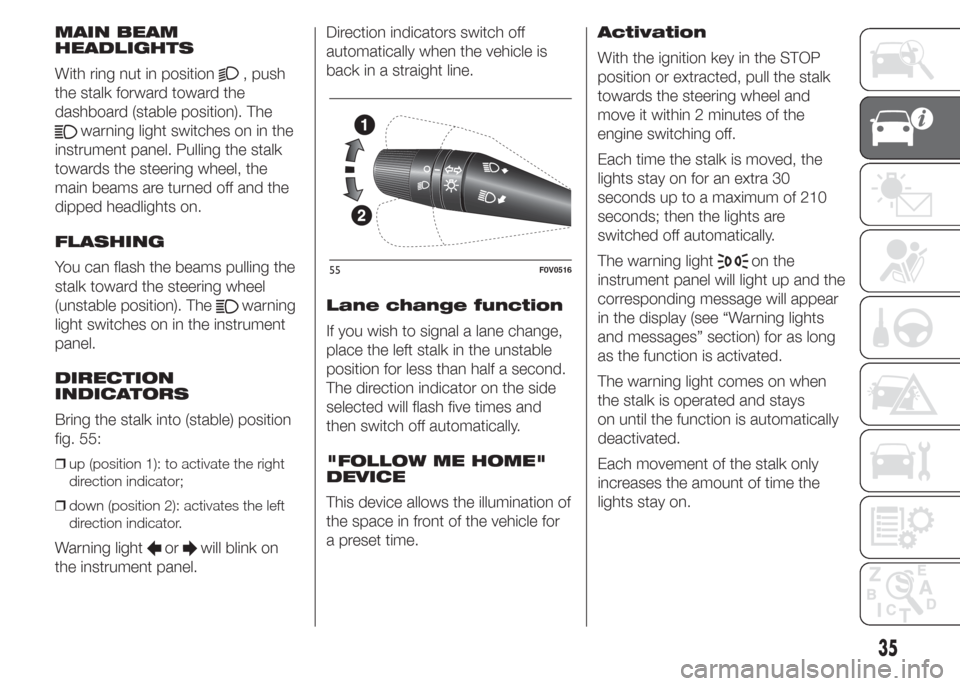
Bring the stalk into (stable) position
fig. 55:
❒up (position 1): to activate the right
direction indicator;
❒down (position 2): activates the left
direction indicator.
Warning lightorwill blink on
the instrument panel.Direction indicators switch off
automatically when the vehicle is
back in a straight line.
Lane change function
If you wish to signal a lane change,
place the left stalk in the unstable
position for less than half a second.
The direction indicator on the side
selected will flash five times and
then switch off automatically.
"FOLLOW ME HOME"
DEVICE
This device allows the illumination of
the space in front of the vehicle for
a preset time.Activation
With the ignition key in the STOP
position or extracted, pull the stalk
towards the steering wheel and
move it within 2 minutes of the
engine switching off.
Each time the stalk is moved, the
lights stay on for an extra 30
seconds up to a maximum of 210
seconds; then the lights are
switched off automatically.
The warning light
on the
instrument panel will light up and the
corresponding message will appear
in the display (see “Warning lights
and messages” section) for as long
as the function is activated.
The warning light comes on when
the stalk is operated and stays
on until the function is automatically
deactivated.
Each movement of the stalk only
increases the amount of time the
lights stay on.55F0V0516
35
Page 40 of 323
Deactivation
Keep the stalk pulled towards the
steering wheel for more than 2
seconds.
WARNING
27) The daytime running lights are
an alternative to dipped
headlights for driving during the
daytime. They are compliant in
countries where is it obligatory to
have lights on during the day
and permitted in those where it is
not obligatory. Daytime running
lights cannot replace dipped
headlights when driving at night
or through tunnels. The use of
daytime running lights is
governed by the highway code of
the country in which you are
driving. Comply with the
prescriptions.
INTERIOR LIGHTS
FRONT ROOF LIGHT
WITH MOVABLE LENS
The light fades up or reaches full
brightness immediately if pushed at
the sides.
On the Doblò Cargo versions, it is
only connected to the front doors.
On the Doblò/Doblò Combi people
carrier versions, it is connected to
the front doors and the sliding
side doors.FRONT ROOF LIGHT
WITH SPOT LIGHTS
(for versions/markets, where
provided)
On the Doblò Cargo versions, it is
only connected to the front doors.
On the Doblò/Doblò Combi people
carrier versions, it is connected to
the front doors and the sliding
side doors.
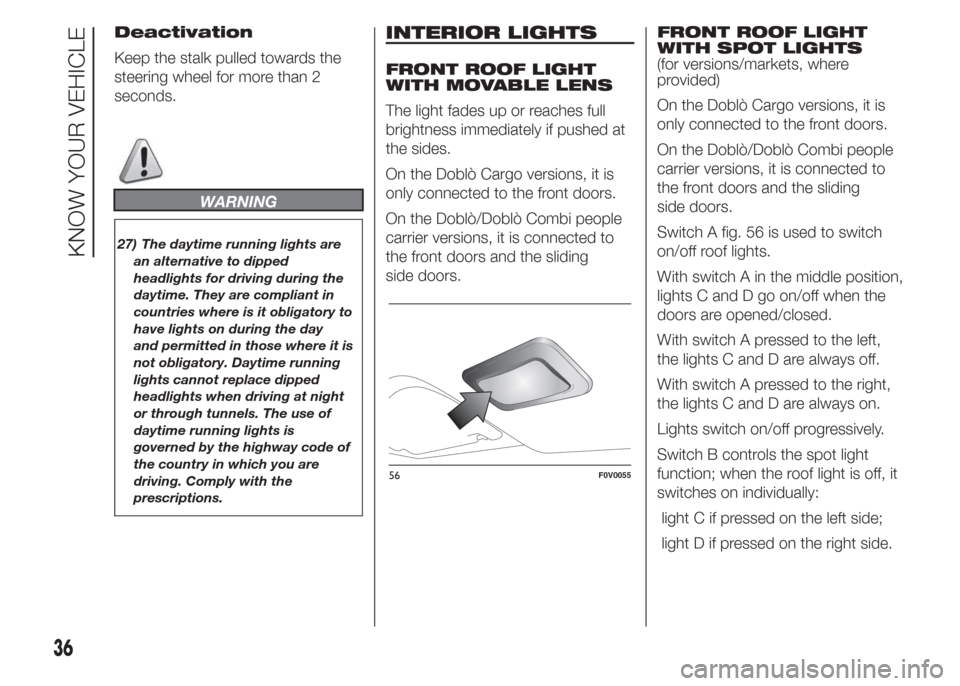
Switch A fig. 56 is used to switch
on/off roof lights.
With switch A in the middle position,
lights C and D go on/off when the
doors are opened/closed.
With switch A pressed to the left,
the lights C and D are always off.
With switch A pressed to the right,
the lights C and D are always on.
Lights switch on/off progressively.
Switch B controls the spot light
function; when the roof light is off, it
switches on individually:
light C if pressed on the left side;
light D if pressed on the right side.
56F0V0055
36
KNOW YOUR VEHICLE
Page 41 of 323
IMPORTANT Before getting out of
the vehicle, make sure both
switches are in the middle position;
when the doors are closed, the
lights switch off to prevent the
battery from being run down. In any
case, if the switch is left in on
position, the roof light switches off
automatically 15 minutes after
the engine switching off.
REAR ROOF LIGHT
WITH MOVABLE LENS
(Doblò/Doblò Combi versions)
The light comes on automatically
when a front door or sliding side
door is opened and goes out when
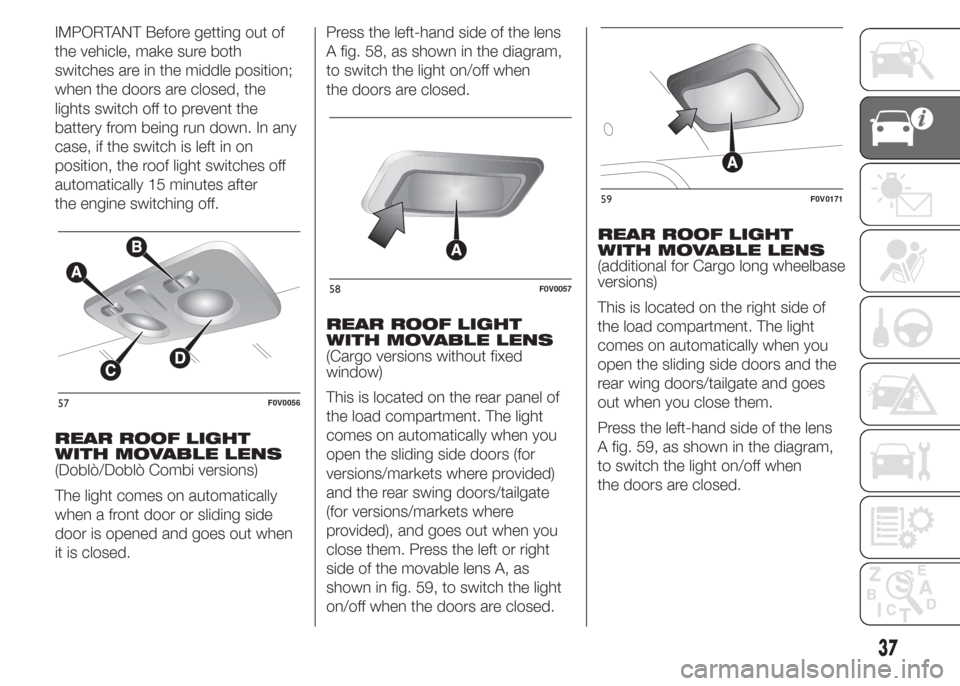
it is closed.Press the left-hand side of the lens
A fig. 58, as shown in the diagram,
to switch the light on/off when
the doors are closed.
REAR ROOF LIGHT
WITH MOVABLE LENS
(Cargo versions without fixed
window)
This is located on the rear panel of
the load compartment. The light
comes on automatically when you
open the sliding side doors (for
versions/markets where provided)
and the rear swing doors/tailgate
(for versions/markets where
provided), and goes out when you
close them. Press the left or right
side of the movable lens A, as
shown in fig. 59, to switch the light
on/off when the doors are closed.REAR ROOF LIGHT
WITH MOVABLE LENS
(additional for Cargo long wheelbase
versions)
This is located on the right side of
the load compartment. The light
comes on automatically when you
open the sliding side doors and the
rear wing doors/tailgate and goes
out when you close them.
Press the left-hand side of the lens
A fig. 59, as shown in the diagram,
to switch the light on/off when
the doors are closed.
57F0V0056
58F0V0057
59F0V0171
37
Page 44 of 323
WINDSCREEN/REAR
WINDOW WIPER
IN BRIEF
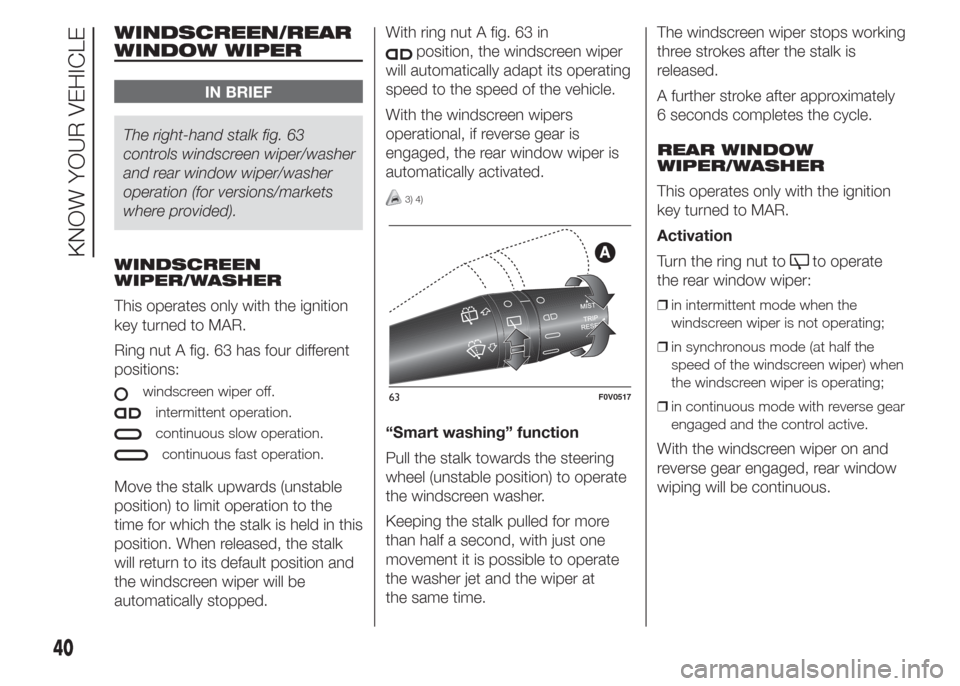
The right-hand stalk fig. 63
controls windscreen wiper/washer
and rear window wiper/washer
operation (for versions/markets
where provided).
WINDSCREEN
WIPER/WASHER
This operates only with the ignition
key turned to MAR.
Ring nut A fig. 63 has four different
positions:
windscreen wiper off.
intermittent operation.
continuous slow operation.
continuous fast operation.
Move the stalk upwards (unstable
position) to limit operation to the
time for which the stalk is held in this
position. When released, the stalk
will return to its default position and
the windscreen wiper will be
automatically stopped.With ring nut A fig. 63 in
position, the windscreen wiper
will automatically adapt its operating
speed to the speed of the vehicle.
With the windscreen wipers
operational, if reverse gear is
engaged, the rear window wiper is
automatically activated.
3) 4)
“Smart washing” function
Pull the stalk towards the steering
wheel (unstable position) to operate
the windscreen washer.
Keeping the stalk pulled for more
than half a second, with just one
movement it is possible to operate
the washer jet and the wiper at
the same time.The windscreen wiper stops working
three strokes after the stalk is
released.
A further stroke after approximately
6 seconds completes the cycle.
REAR WINDOW
WIPER/WASHER
This operates only with the ignition
key turned to MAR.
Activation
Turn the ring nut to
to operate
the rear window wiper:
❒in intermittent mode when the
windscreen wiper is not operating;
❒in synchronous mode (at half the
speed of the windscreen wiper) when
the windscreen wiper is operating;
❒in continuous mode with reverse gear
engaged and the control active.
With the windscreen wiper on and
reverse gear engaged, rear window
wiping will be continuous.
63F0V0517
40
KNOW YOUR VEHICLE
Page 69 of 323
POWER SOCKET (12 V)
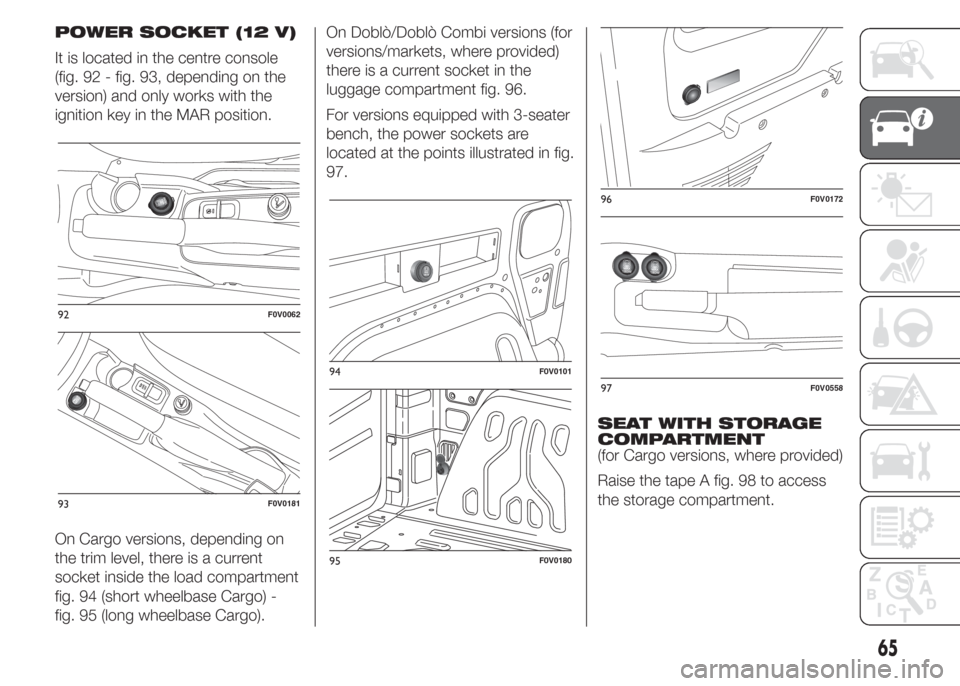
It is located in the centre console
(fig. 92 - fig. 93, depending on the
version) and only works with the
ignition key in the MAR position.
On Cargo versions, depending on
the trim level, there is a current
socket inside the load compartment
fig. 94 (short wheelbase Cargo) -
fig. 95 (long wheelbase Cargo).On Doblò/Doblò Combi versions (for
versions/markets, where provided)
there is a current socket in the
luggage compartment fig. 96.
For versions equipped with 3-seater
bench, the power sockets are
located at the points illustrated in fig.
97.
SEAT WITH STORAGE
COMPARTMENT
(for Cargo versions, where provided)
Raise the tape A fig. 98 to access
the storage compartment.
92F0V0062
93F0V0181
94F0V0101
95F0V0180
96F0V0172
97F0V0558
65
Page 97 of 323
Warning lights on
panelWhat it means What to do
red
amber
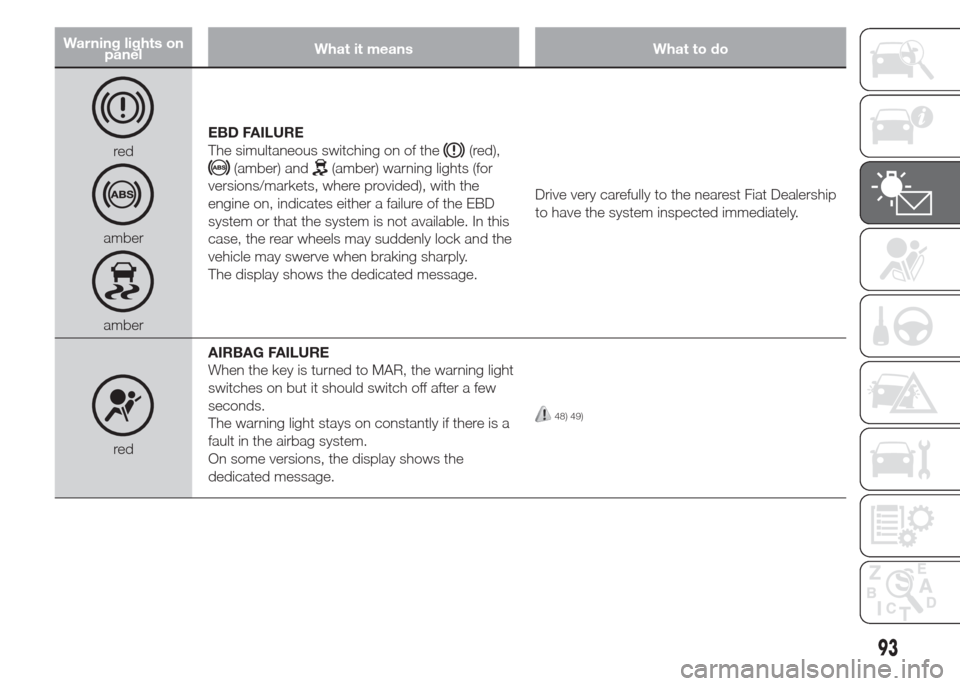
amberEBD FAILURE
The simultaneous switching on of the
(red),
(amber) and(amber) warning lights (for
versions/markets, where provided), with the
engine on, indicates either a failure of the EBD
system or that the system is not available. In this
case, the rear wheels may suddenly lock and the
vehicle may swerve when braking sharply.
The display shows the dedicated message.Drive very carefully to the nearest Fiat Dealership
to have the system inspected immediately.
redAIRBAG FAILURE
When the key is turned to MAR, the warning light
switches on but it should switch off after a few
seconds.
The warning light stays on constantly if there is a
fault in the airbag system.
On some versions, the display shows the
dedicated message.
48) 49)
93
Page 114 of 323
ACTIVE SAFETY
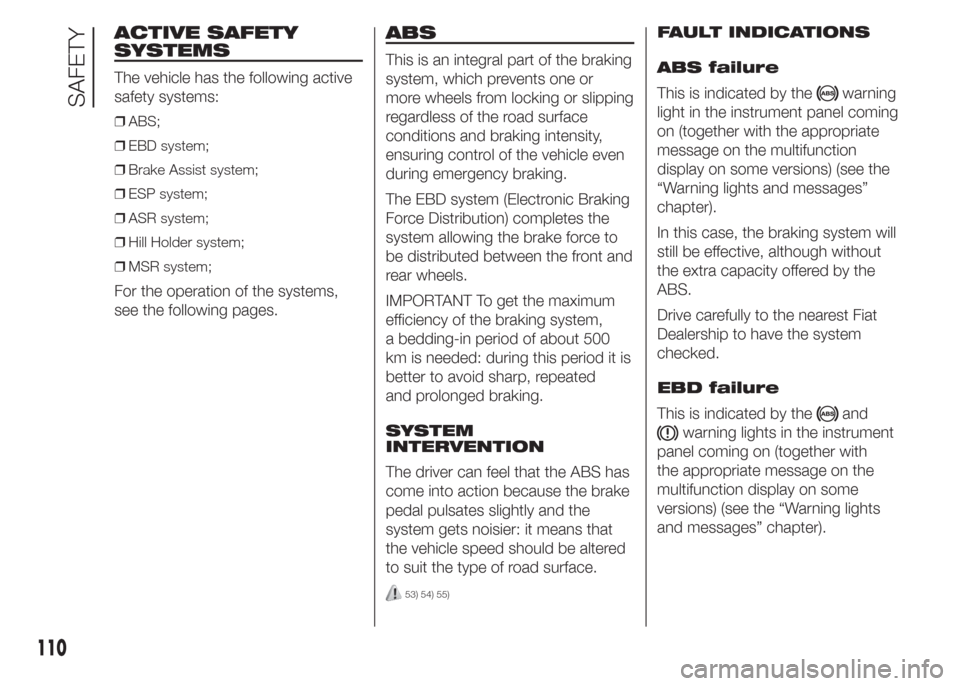
SYSTEMS
The vehicle has the following active
safety systems:
❒ABS;
❒EBD system;
❒Brake Assist system;
❒ESP system;
❒ASR system;
❒Hill Holder system;
❒MSR system;
For the operation of the systems,
see the following pages.
ABS
This is an integral part of the braking
system, which prevents one or
more wheels from locking or slipping
regardless of the road surface
conditions and braking intensity,
ensuring control of the vehicle even
during emergency braking.
The EBD system (Electronic Braking
Force Distribution) completes the
system allowing the brake force to
be distributed between the front and
rear wheels.
IMPORTANT To get the maximum
efficiency of the braking system,
a bedding-in period of about 500
km is needed: during this period it is
better to avoid sharp, repeated
and prolonged braking.
SYSTEM
INTERVENTION
The driver can feel that the ABS has
come into action because the brake
pedal pulsates slightly and the
system gets noisier: it means that
the vehicle speed should be altered
to suit the type of road surface.
53) 54) 55)
FAULT INDICATIONS
ABS failure
This is indicated by the
warning
light in the instrument panel coming
on (together with the appropriate
message on the multifunction
display on some versions) (see the
“Warning lights and messages”
chapter).
In this case, the braking system will
still be effective, although without
the extra capacity offered by the
ABS.
Drive carefully to the nearest Fiat
Dealership to have the system
checked.
EBD failure
This is indicated by the
and
warning lights in the instrument
panel coming on (together with
the appropriate message on the
multifunction display on some
versions) (see the “Warning lights
and messages” chapter).
110
SAFETY
Page 115 of 323
In this case, the rear wheels may
suddenly lock and the vehicle may
swerve when braking sharply. Drive
carefully to the nearest Fiat
Dealership to have the system
checked.
56)
BRAKE ASSIST
(integrated ESP
emergency braking
assistance)
(for versions/markets, where
provided)
This system (which cannot be
deactivated) recognises emergency
braking conditions according to
the speed of operation of the brake
pedal and provides an additional
hydraulic braking pressure to
support that provided by the driver.
This allows faster and more powerful
operation of the braking system.
Brake Assist is deactivated on the
versions equipped with ESP, in
the event of ESP system failure
(indicated by the
warning light
coming on together with the
message in the multifunction display,
where provided).
57)
WARNING
53) When the ABS cuts in and you
feel the brake pedal pulsating,
do not raise your foot, but keep it
pressed; in doing so you will stop
in the shortest amount of space
possible depending on the current
road conditions.
54) If the ABS intervenes, it is a sign
that the grip between tyre and the
road surface has reached the
limit: you must slow down to
adapt the speed to the road grip
available.
55) The ABS exploits the grip
available to the full, but it cannot
improve it. Therefore, you should
take great care when driving on
slippery surfaces, without taking
unnecessary risks.56) If only the
warning light
lights up in the instrument panel
(with a message in the display
on some versions), stop the
vehicle immediately and contact
the nearest Fiat Dealership. Fluid
leaking from the hydraulic system
will compromise the operation
of the braking system, whether it
is of the conventional type or
with ABS.
57) When the ABS cuts in and you
feel the brake pedal pulsating,
do not raise your foot, but keep it
pressed; in doing so you will stop
in the shortest amount of space
possible depending on the current
road conditions.
111
Page 116 of 323
ESC (Electronic
Stability Control)
SYSTEM
(for versions/markets, where
provided)
IN BRIEF
This is an electronic system that
controls vehicle stability in the
event of tyre grip loss, helping to
maintain directional control.
The ESC system is therefore
particularly useful when grip
conditions of road surfaces
change.
The MSR system (adjustment of
the engine braking torque during
gear changes) and the HBA
system (automatic increase in the
braking pressure during
emergency braking) are present
with ESC, ASR and Hill Holder
systems (for versions/markets
where provided).SYSTEM
INTERVENTION
This is signalled by the flashing of
the
warning light in the instrument
panel, to inform the driver that the
vehicle is in critical stability and grip
conditions.
SYSTEM ACTIVATION
The ESC system is automatically
activated when the vehicle is
started.
FAULT INDICATIONS
In the event of a fault, the ESC will
be automatically switched off and
the
warning light will come on
permanently on the instrument panel
along with a message on the
multifunction display (for versions/
markets where provided) (see
"Warning lights and messages"
section). The LED on the ASR OFF
button will also light up. Contact
a Fiat Dealership as soon as
possible.
58)
HILL HOLDER SYSTEM
This system is an integral part of the
ESC system and facilitates starting
on slopes. It is automatically
activated in the following conditions:
❒uphill: vehicle stationary on a road
with a gradient higher than 5%,
engine running, brake pressed and
gearbox in neutral or gear (other than
reverse) engaged;
❒downhill: vehicle stationary on a road
with a gradient higher than 5%,
engine running, brake pressed and
reverse gear engaged.
When setting off, the ESC system
control unit maintains the braking
pressure at the wheels until the
torque necessary for starting is
reached, or in any case for a
maximum of 1.75 seconds, allowing
your right foot to be moved easily
from the brake pedal to the
accelerator.
If the vehicle has not departed after
1.75 seconds, the system will
deactivate automatically by gradually
releasing the brake force.
112
SAFETY
Page 117 of 323
During this release stage, the typical
brake disengagement noise
indicating that the vehicle is going to
move imminently will be heard.
Fault indications
Any system fault is indicated by the
turning on of the
warning light on
the instrument panel with digital
display and the
warning light on
the instrument panel with
multifunction display (for versions/
markets where provided) (see
section “Warning lights and
messages”).
IMPORTANT The Hill Holder system
is not a parking brake, therefore
do not leave the vehicle without
activating the handbrake, switching
off the engine and engaging first
gear.
59)
ASR SYSTEM (Antislip
Regulator)
This is a traction control system that
cuts in automatically every time
one or both drive wheels slip.Depending on the slipping
conditions, two different control
systems are activated:
❒if the slipping involves both drive
wheels, the ASR intervenes reducing
the power transmitted by the engine;
❒if the slipping only involves one of the
drive wheels, it intervenes
automatically braking the wheel that
is slipping.
The action of the ASR system is
particularly helpful in the following
circumstances:
❒slipping of the inner wheel on bends
due to dynamic variations in the load
or excessive acceleration;
❒excessive power transmitted to the
wheels, also in relation to road
surface conditions;
❒acceleration on slippery, snowy or icy
road surfaces;
❒loss of grip on wet road surfaces
(aquaplaning).
MSR system (engine
drive regulation)
This is a system that, in the event of
a sudden gear down shift, cuts in
and provides torque to the engine
thus preventing excessive drive
wheel drive which, especially in poor
grip conditions, can lead to a loss
of stability.
Engagement/
disengagement of the
ASR system
The ASR system switches on
automatically each time the engine
is started.
Whilst driving, the ASR can be
switched off and subsequently
switched on again by pressing the
fig. 118 button on the dashboard.
Switching off is shown by the
warning light on the instrument
panel switching on and a dedicated
message shown in the multifunction
display, where provided.
If the ASR is switched off when
driving, it is automatically switched
on again when the vehicle is started
up.
113