ignition FIAT DOBLO COMBI 2015 2.G Owner's Guide
[x] Cancel search | Manufacturer: FIAT, Model Year: 2015, Model line: DOBLO COMBI, Model: FIAT DOBLO COMBI 2015 2.GPages: 323, PDF Size: 46.77 MB
Page 149 of 323
❒The TPMS warns the driver of any
condition of insufficient tyre pressure
If this drops below the insufficient
pressure limit for any reason including
low temperature and normal
pressure loss of the tyre.
❒The seasonal temperature changes
affect tyre pressure.
The TPMS uses wireless devices
with electronic sensors mounted on
the wheel rims to constantly monitor
the value of tyre pressure. The
sensors mounted on each wheel as
part of the valve stem transmit
various information of the tyres to
the receiver module, in order to
calculate the pressure.
IMPORTANT Monitoring and
maintaining the correct pressure in
all four tyres are particularly
important.
Tyre pressure
monitoring system low
pressure warning
The system warns the driver if one
or more tyres are flat by switching
on the warning light
on the
instrument panel (together with a
warning message and an acoustic
signal).The TPMS continues to advise the
driver of the low tyre pressure
condition until this is corrected; the
warning continues until the pressure
corresponds or exceeds the
pressure prescribed for the cold
tyres. When the tyre low pressure
control warning light
switches on
constantly, the inflation pressure
must be adjusted until it reaches the
pressure prescribed for cold tyres.
After the automatic update of the
system, the tyre pressure control
warning light switches off. You may
need to drive the vehicle for about
20 minutes at a speed higher than
20 km/h to allow the TPMS to
receive this information.
IMPORTANT In the case of deflation
of more than one tyre sequentially,
without switching off and on the
engine, from the second tyre
involved the acoustic signal is not
activated, only the dedicated signal
is shown on the display.To prevent the signal from being
stored in the event of pressure loss
of a subsequent tyre (with
deactivation of the acoustic signal),
the ignition key must be turned to
MAR and then to STOP, each time
pressure is restored.
TPMS operation faults
The system fault is indicated by
warning light
which first flashes
for 75 seconds and then stays
on steadily. This can occur in any of
the following situations:
❒interference caused by electronic
devices or radio frequency emissions
similar to those of the TPM sensors.
❒Application of tinted films which
interfere with the signals of the radio
waves.
❒Presence of snow or ice on the
wheels or the wheel arches.
❒Use of snow chains.
❒Use of wheels/tyres not equipped
with TPM sensors.
❒The space-saver wheel is not
equipped with the tyre pressure
control sensor. Therefore, the tyre
pressure is not controlled by the
system.
145
Page 153 of 323
Reducing the stored
speed
This can be done in two ways:
❒by deactivating the device and then
storing the new speed
or
❒by moving the stalk downwards (-)
until the new speed, which will
automatically remain memorised, is
reached.
Each movement of the stalk will
correspond to a slight reduction in
speed of about 1 km/h, while
keeping the stalk held downwards
will decrease the speed
continuously.
Deactivating the
device
The device can be switched off by
the driver in the following ways:
❒by turning ring nut A to the
OFF position;
❒if the engine is stopped (leaving the
stalk ring nut at ON), when the
ignition key is next turned to ON,
Cruise Control will be activated
automatically.
Deactivating the
function
The device can be switched off by
the driver in the following ways:
❒by pressing the brake pedal when the
device is adjusting the speed:
❒by pressing the clutch pedal when
the device is adjusting the speed;
❒by pressing button B fig. 146 when
the device is adjusting the speed
(for versions/markets, where
provided);
❒by pressing the accelerator pedal (in
this case the system is not actually
turned off but the acceleration
request takes priority; the cruise
control remains activated, without the
need to the press button B fig. 146
to restore the previous conditions
once the acceleration is over).
The device is automatically switched
off in the following cases:
❒if the ABS or ESC systems intervene
❒with the vehicle speed below the
set limit
❒in the event of system failure.
WARNING
95) When travelling with the device
active, never move the gear lever
to neutral.
96) In the event of device faults or
failures, turn the ring nut A to
OFF and contact a Fiat
Dealership.
149
Page 157 of 323
In order to avoid these problems,
different types of diesel are
distributed according to the season:
summer type, winter type and
arctic type (cold/mountain areas). If
refuelling with diesel fuel whose
specifications are not suitable for the
current temperature, it is advisable
to mix TUTELA DIESEL ART additive
in the proportions shown on the
container. Pour the additive into the
tank before the diesel fuel.
When using or parking the vehicle
for a long time in the mountains
or cold areas, it is advisable to refuel
using locally available diesel fuel.
In this case, it is also advisable
to keep the tank over 50% full.
22)
FILLING THE TANK
To fill the tank completely, top up
twice after the first click of the fuel
supply gun. Further top ups could
cause faults in the fuel supply
system.FUEL TANK PLUG
Opening
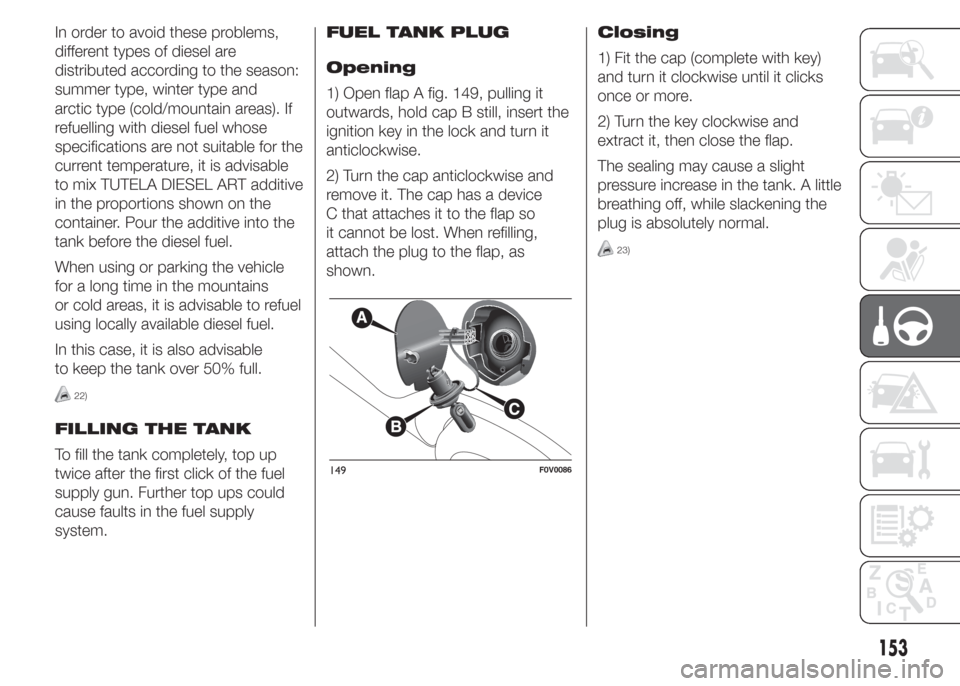
1) Open flap A fig. 149, pulling it
outwards, hold cap B still, insert the
ignition key in the lock and turn it
anticlockwise.
2) Turn the cap anticlockwise and
remove it. The cap has a device
C that attaches it to the flap so
it cannot be lost. When refilling,
attach the plug to the flap, as
shown.Closing
1) Fit the cap (complete with key)
and turn it clockwise until it clicks
once or more.
2) Turn the key clockwise and
extract it, then close the flap.
The sealing may cause a slight
pressure increase in the tank. A little
breathing off, while slackening the
plug is absolutely normal.
23)
149F0V0086
153
Page 164 of 323
HAZARD WARNING
LIGHTS
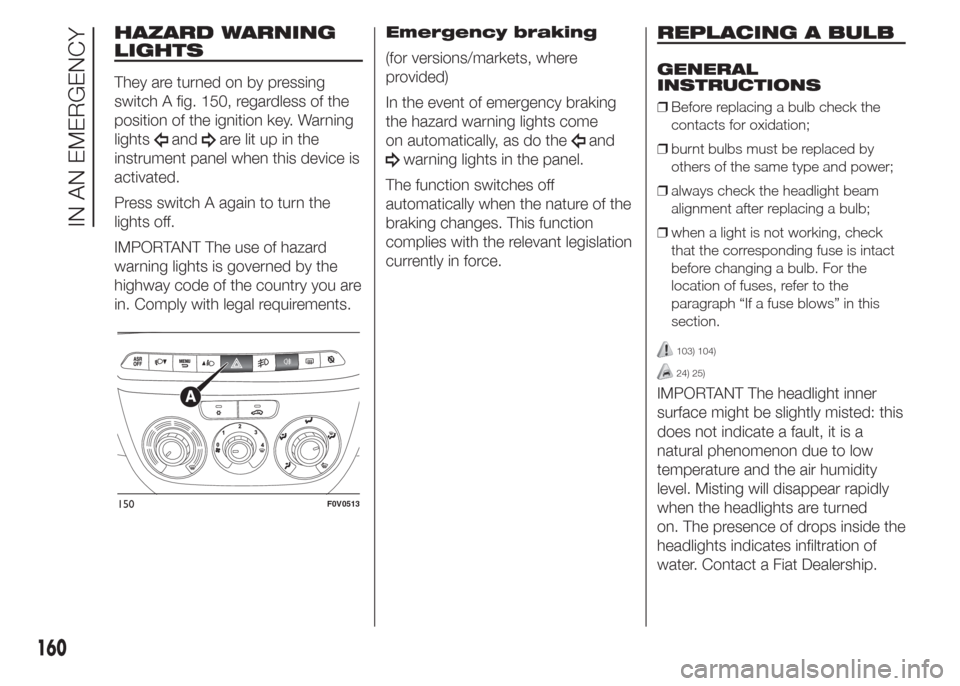
They are turned on by pressing
switch A fig. 150, regardless of the
position of the ignition key. Warning
lights
andare lit up in the
instrument panel when this device is
activated.
Press switch A again to turn the
lights off.
IMPORTANT The use of hazard
warning lights is governed by the
highway code of the country you are
in. Comply with legal requirements.Emergency braking
(for versions/markets, where
provided)
In the event of emergency braking
the hazard warning lights come
on automatically, as do theand
warning lights in the panel.
The function switches off
automatically when the nature of the
braking changes. This function
complies with the relevant legislation
currently in force.
REPLACING A BULB
GENERAL
INSTRUCTIONS
❒Before replacing a bulb check the
contacts for oxidation;
❒burnt bulbs must be replaced by
others of the same type and power;
❒always check the headlight beam
alignment after replacing a bulb;
❒when a light is not working, check
that the corresponding fuse is intact
before changing a bulb. For the
location of fuses, refer to the
paragraph “If a fuse blows” in this
section.
103) 104)
24) 25)
IMPORTANT The headlight inner
surface might be slightly misted: this
does not indicate a fault, it is a
natural phenomenon due to low
temperature and the air humidity
level. Misting will disappear rapidly
when the headlights are turned
on. The presence of drops inside the
headlights indicates infiltration of
water. Contact a Fiat Dealership.
150F0V0513
160
IN AN EMERGENCY
Page 178 of 323
WARNING
105) If the replaced fuse blows again, contact a Fiat Dealership.
106) Never replace a fuse with another with a higher amp rating; DANGER OF FIRE. If a general protection fuse
(MEGA-FUSE, MIDI-FUSE) is activated, contact a Fiat Dealership. Before replacing a fuse, make sure that the ignition
key has been removed and that all the other services are switched off and/or disengaged.
107) Contact a Fiat Dealership if a safety system (airbags, brakes), engine system (engine, gearbox) or steering system
general protection fuse blows.
174
IN AN EMERGENCY
Page 188 of 323
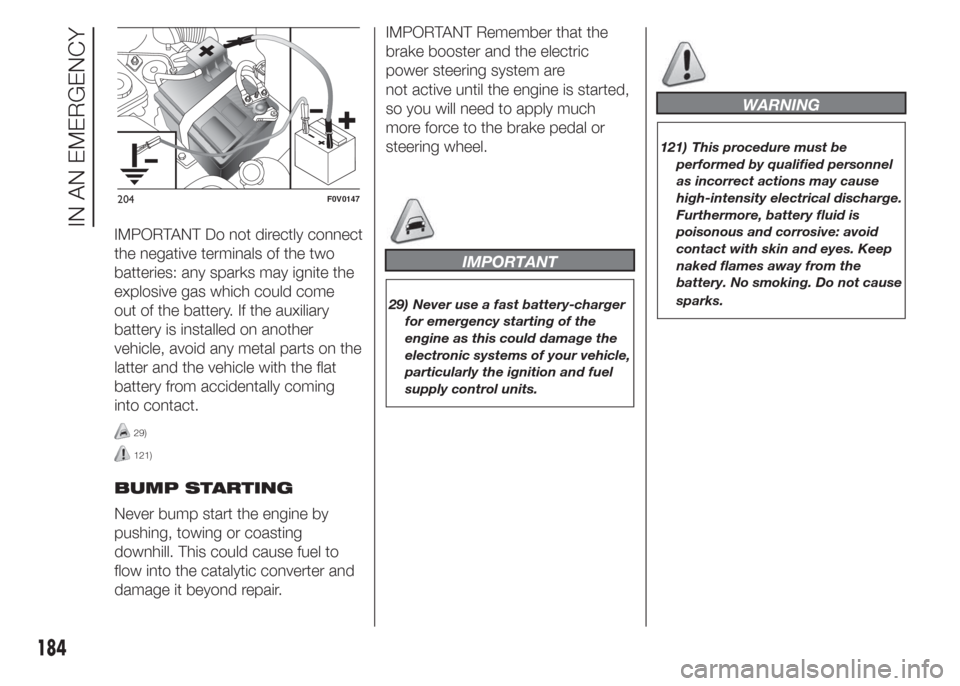
IMPORTANT Do not directly connect
the negative terminals of the two
batteries: any sparks may ignite the
explosive gas which could come
out of the battery. If the auxiliary
battery is installed on another
vehicle, avoid any metal parts on the
latter and the vehicle with the flat
battery from accidentally coming
into contact.
29)
121)
BUMP STARTING
Never bump start the engine by
pushing, towing or coasting
downhill. This could cause fuel to
flow into the catalytic converter and
damage it beyond repair.IMPORTANT Remember that the
brake booster and the electric
power steering system are
not active until the engine is started,
so you will need to apply much
more force to the brake pedal or
steering wheel.
IMPORTANT
29) Never use a fast battery-charger
for emergency starting of the
engine as this could damage the
electronic systems of your vehicle,
particularly the ignition and fuel
supply control units.
WARNING
121) This procedure must be
performed by qualified personnel
as incorrect actions may cause
high-intensity electrical discharge.
Furthermore, battery fluid is
poisonous and corrosive: avoid
contact with skin and eyes. Keep
naked flames away from the
battery. No smoking. Do not cause
sparks.
204F0V0147
184
IN AN EMERGENCY
Page 189 of 323
FUEL CUT-OFF
SYSTEM
This intervenes in the case of an
impact causing:
❒the fuel supply cut-off with the engine
consequently switching off;
❒the automatic unlocking of the doors;
❒the switching on of the interior lights;
❒switching on of the hazard warning
lights (to deactivate the lights press
the dedicated button on the
dashboard).
122)
When the system has been
triggered, the message “Fuel cut off,
see handbook” is displayed on
some versions.
Check carefully for fuel leaks, for
instance in the engine compartment,
under the vehicle or near the tank
area.
After a collision, turn the ignition key
to STOP to prevent the battery
from running down.
The following procedure should be
carried out to restore the correct
operation of the vehicle:
❒turn the ignition key to the MAR
position;❒activate the right direction indicator;
❒deactivate the right direction
indicator;
❒activate the left direction indicator;
❒deactivate the left direction indicator;
❒activate the right direction indicator;
❒deactivate the right direction
indicator;
❒activate the left direction indicator;
❒deactivate the left direction indicator;
❒turn the ignition key to the OFF
position.
WARNING
122) If, after an impact, you smell
fuel or notice leaks from the fuel
supply system, do not reactivate
the system to avoid the risk of fire.
LIFTING THE
VEHICLE
If the vehicle needs to be lifted, go
to a Fiat Dealership which is
equipped with the arm hoist or
workshop lift.
185
Page 190 of 323
TOWING THE
VEHICLE
The tow ring provided with the
vehicle is located in the tool box
behind the left seat backrest (Cargo
versions) or in the boot (Doblò /
Doblò Combi versions).
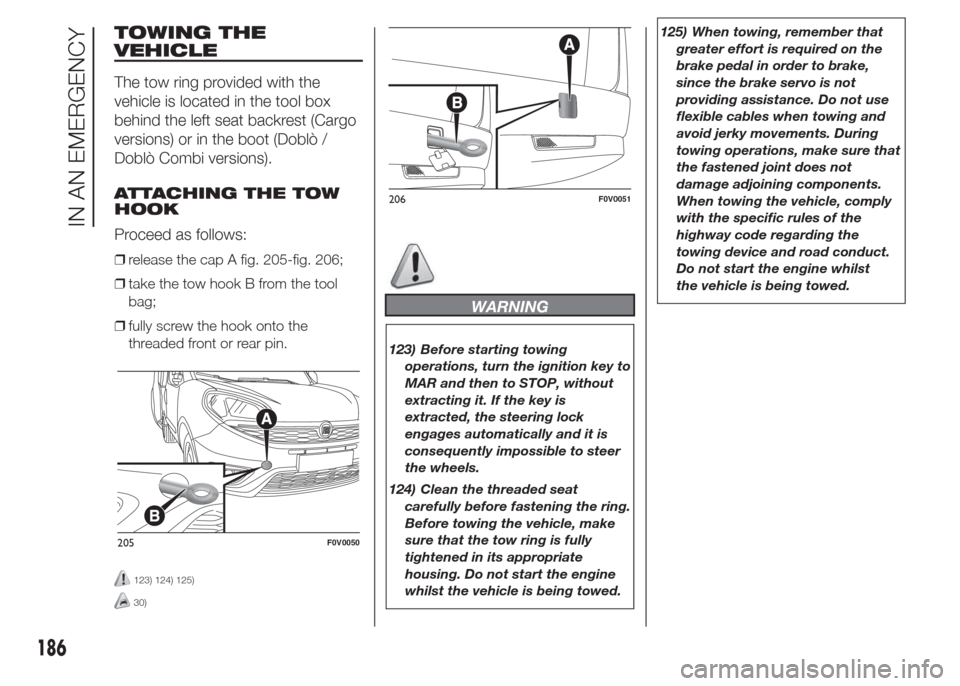
ATTACHING THE TOW
HOOK
Proceed as follows:
❒release the cap A fig. 205-fig. 206;
❒take the tow hook B from the tool
bag;
❒fully screw the hook onto the
threaded front or rear pin.
123) 124) 125)
30)
WARNING
123) Before starting towing
operations, turn the ignition key to
MAR and then to STOP, without
extracting it. If the key is
extracted, the steering lock
engages automatically and it is
consequently impossible to steer
the wheels.
124) Clean the threaded seat
carefully before fastening the ring.
Before towing the vehicle, make
sure that the tow ring is fully
tightened in its appropriate
housing. Do not start the engine
whilst the vehicle is being towed.125) When towing, remember that
greater effort is required on the
brake pedal in order to brake,
since the brake servo is not
providing assistance. Do not use
flexible cables when towing and
avoid jerky movements. During
towing operations, make sure that
the fastened joint does not
damage adjoining components.
When towing the vehicle, comply
with the specific rules of the
highway code regarding the
towing device and road conduct.
Do not start the engine whilst
the vehicle is being towed.
205F0V0050
206F0V0051
186
IN AN EMERGENCY
Page 221 of 323
If you put the vehicle through a car
wash, follow these
recommendations:
– remove the aerial from the roof so
it does not get damaged;
– water added to a soapy solution
should be used for washing;
– rinse thoroughly to avoid soap
marks staying on the bodywork or
less visible parts.
39)
Dry the less visible parts with special
care, such as the door frames,
bonnet and the headlight frames,
where water may stagnate more
easily. It is a good idea to leave the
vehicle outdoors for a while after
washing it to give water time to
evaporate.
Do not wash the vehicle after it has
been left in the sun or with the
bonnet hot: this may alter the shine
of the paintwork.Exterior plastic parts should be
cleaned in the same way as the rest
of the vehicle. Where possible, do
not park the vehicle under trees; the
resinous substances released by
many species give the paint a dull
appearance and increase the
possibility of corrosion.
IMPORTANT Bird droppings should
be washed off immediately and
thoroughly as the acid they contain
is particularly aggressive.6)
Windows
To clean glasses, use specific
cleaning products. Use clean cloths
to avoid scratching the glass or
damaging the transparency.
IMPORTANT Wipe the inside
surface of the rear window gently
with a cloth in the direction of the
filaments to avoid damaging the
heater coils.Engine compartment
At the end of each winter,
thoroughly wash the engine
compartment, taking care to avoid
spraying the water jet directly onto
the electronic control units and
the relay/fuse box on the left side of
the engine compartment (driving
direction). Have this operation
performed at a specialised
workshop.
IMPORTANT The washing should
take place with the engine cold and
the ignition key in the STOP
position. After the washing
operation, make sure that the
various protections (e.g. rubber
caps and guards) have not been
removed or damaged.
Headlights
IMPORTANT Never use aromatic
substances (e.g. petrol) or ketones
(e.g. acetone) for cleaning the
plastic lenses of the front headlights.
217
Page 320 of 323
Hazard warning lights..................... 160
Headlights...................................... 69
Headlight washers ......................... 41
Head restraints............................... 31
Heating and ventilation ............... 42-44
Hill Holder system .......................... 112
Identification data .......................... 222
Ignition device ................................ 17
Important information ..................... 133
Inflation pressure ............................ 239
Installing electrical/electronic
devices ........................................ 5
Interior fittings ................................ 64
Interior lights .................................. 36
Interior mirror ................................. 32
Interiors .......................................... 218
Isofix child restraint system
setup ........................................... 124
Jump starting ................................ 183
Lifting the vehicle .......................... 185
Load limiters .................................. 118
Luggage compartment light ........... 38
Main beam headlights............. 35-164
Maintenance of the seat belts ........ 119
Manual climate control system ....... 47
Manual deactivation of
passenger side front airbag and
side bag for chest/head
protection .................................... 129
MSR system .................................. 113Multifunction display....................... 81
– Control buttons ......................... 81
– Set-up menu ............................. 82
Number plate lights (for
hatchback versions) ..................... 166
Number plate lights (for versions
with wing doors)........................... 166
Occupant protection systems ....... 115
Parking ......................................... 138
Parking sensors ............................. 150
Partitions........................................ 29
Passenger side front airbag ............ 128
Performance .................................. 280
Periodic checks ............................. 198
Plastic parts ................................... 218
Plugs (type) .................................... 226
Power socket ................................. 65
Power steering fluid........................ 206
Practical advice for reducing fuel
consumption and harmful
emissions ..................................... 154
Prescriptions for vehicle at end
of life ........................................... 309
Pretensioners ................................. 117
Procedure for diesel versions ......... 136
Procedure for petrol versions.......... 136
Prolonged vehicle inactivity............. 215
Protecting the environment ............ 71
Protection against atmospheric
agents.......................................... 216
Radio (setup) ................................ 70
Radio transmitters and mobile
phones......................................... 5
Rear doors ..................................... 21
Rear fog lights ................................ 59
Rear light clusters .......................... 164
Rear roof light ................................ 168
Rear view mirrors ........................... 32
Rear window washer...................... 40
Rear window wiper ........................ 40
Refuelling the vehicle ...................... 152
Replacing a bulb ............................ 160
Replacing an exterior bulb .............. 163
Replacing an interior bulb ............... 167
Replacing fuses.............................. 168
Replacing the battery ..................... 208
Rim Protector................................. 234
Rims and tyres ............................... 233
Roof rack ....................................... 68
Rubber hoses ................................ 215
Saving fuel .................................... 154
SBR system ................................... 117
Scheduled servicing ....................... 190
Scheduled Servicing Plan ............... 191
Seat belts....................................... 115
Seats and fabric parts .................... 218
Seats ............................................. 24
– Driver’s seat .............................. 24
– Passenger seat ......................... 25
INDEX