brake FIAT DOBLO COMBI 2015 2.G Service Manual
[x] Cancel search | Manufacturer: FIAT, Model Year: 2015, Model line: DOBLO COMBI, Model: FIAT DOBLO COMBI 2015 2.GPages: 323, PDF Size: 46.77 MB
Page 203 of 323
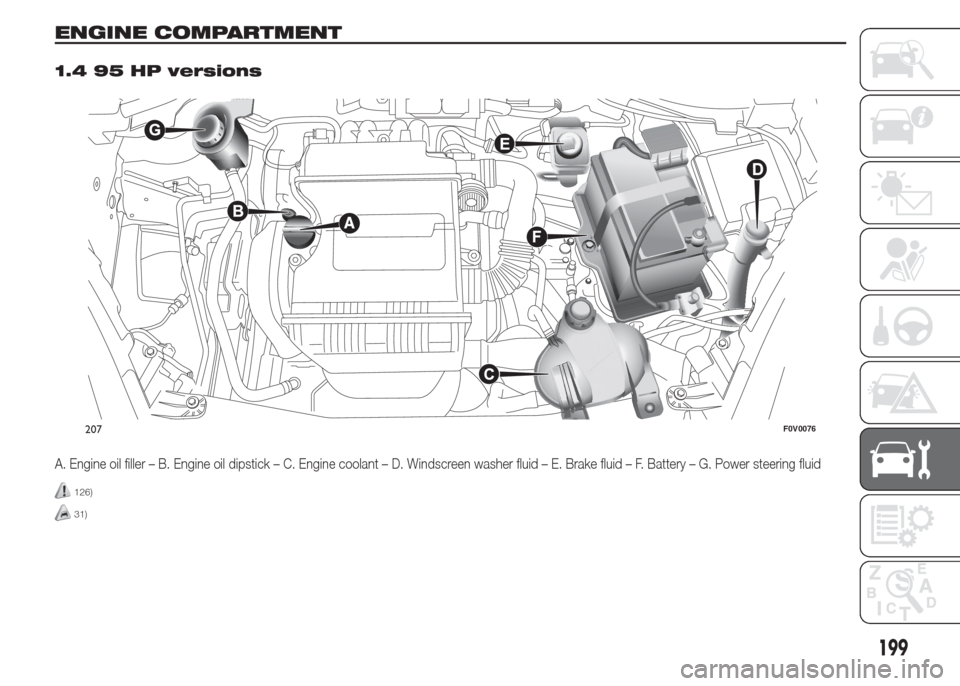
ENGINE COMPARTMENT.
1.4 95 HP versions
A. Engine oil filler – B. Engine oil dipstick – C. Engine coolant – D. Windscreen washer fluid – E. Brake fluid – F. Battery – G. Power steering fluid
126)
31)
207F0V0076
199
Page 204 of 323
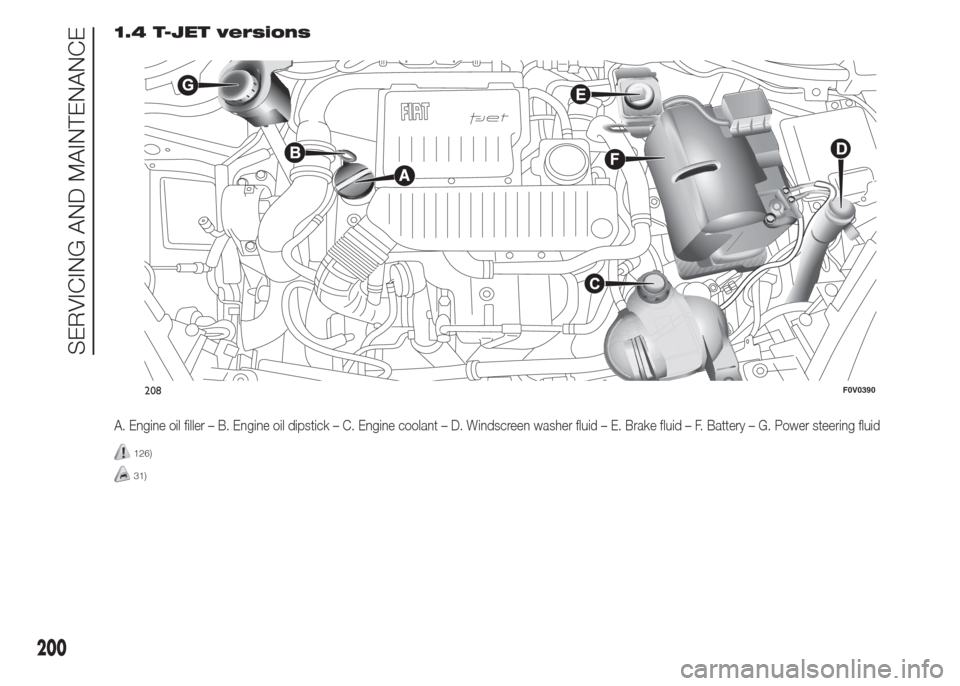
1.4 T-JET versions
A. Engine oil filler – B. Engine oil dipstick – C. Engine coolant – D. Windscreen washer fluid – E. Brake fluid – F. Battery – G. Power steering fluid
126)
31)
208F0V0390
200
SERVICING AND MAINTENANCE
Page 205 of 323
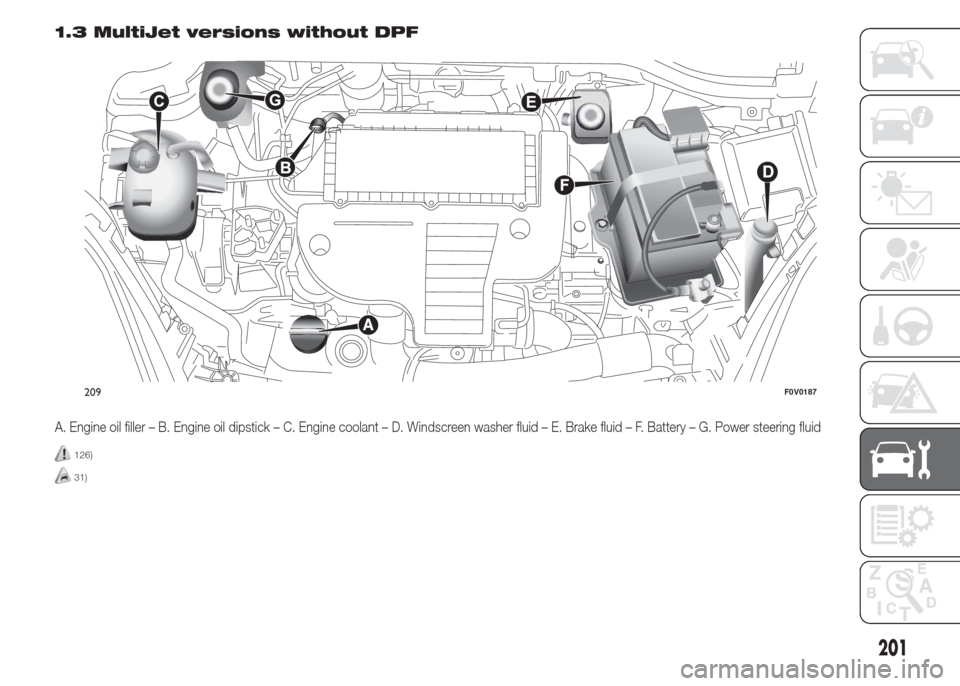
1.3 MultiJet versions without DPF
A. Engine oil filler – B. Engine oil dipstick – C. Engine coolant – D. Windscreen washer fluid – E. Brake fluid – F. Battery – G. Power steering fluid
126)
31)
209F0V0187
201
Page 206 of 323
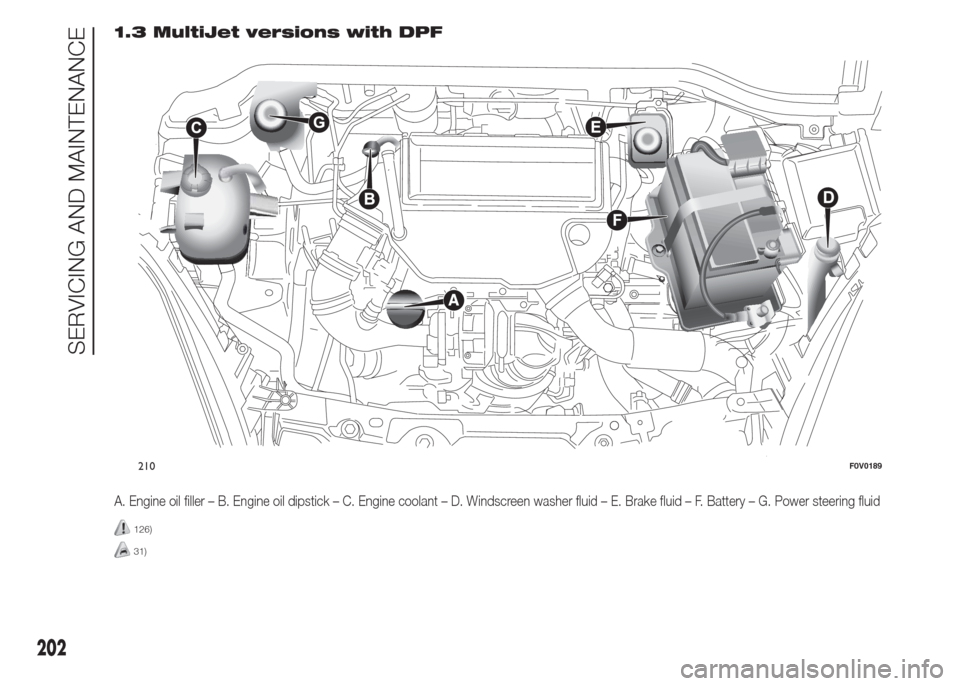
1.3 MultiJet versions with DPF
A. Engine oil filler – B. Engine oil dipstick – C. Engine coolant – D. Windscreen washer fluid – E. Brake fluid – F. Battery – G. Power steering fluid
126)
31)
210F0V0189
202
SERVICING AND MAINTENANCE
Page 207 of 323
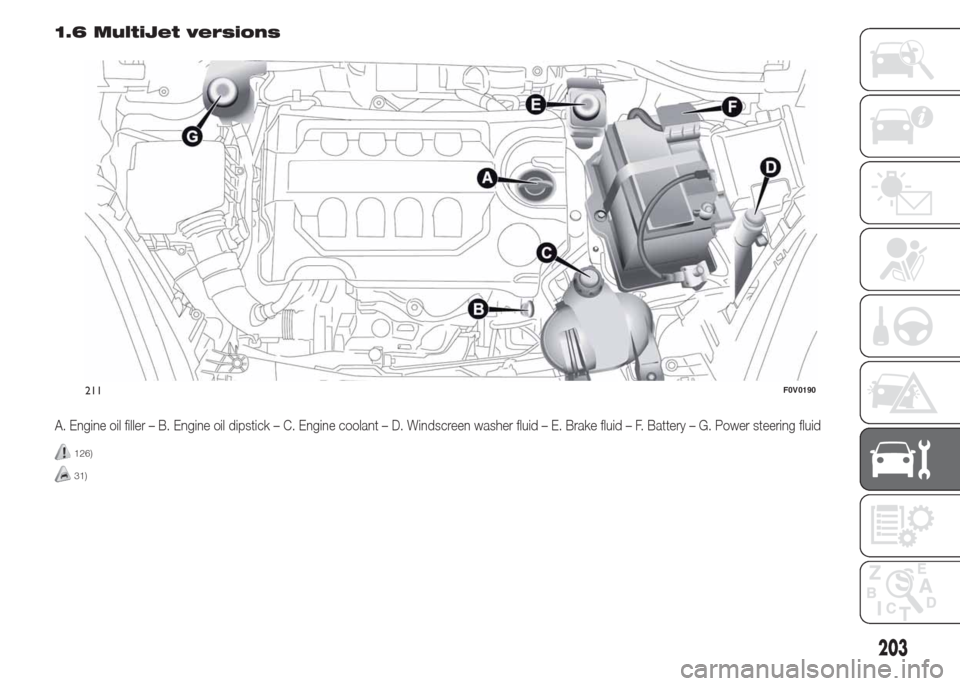
1.6 MultiJet versions
A. Engine oil filler – B. Engine oil dipstick – C. Engine coolant – D. Windscreen washer fluid – E. Brake fluid – F. Battery – G. Power steering fluid
126)
31)
211F0V0190
203
Page 208 of 323
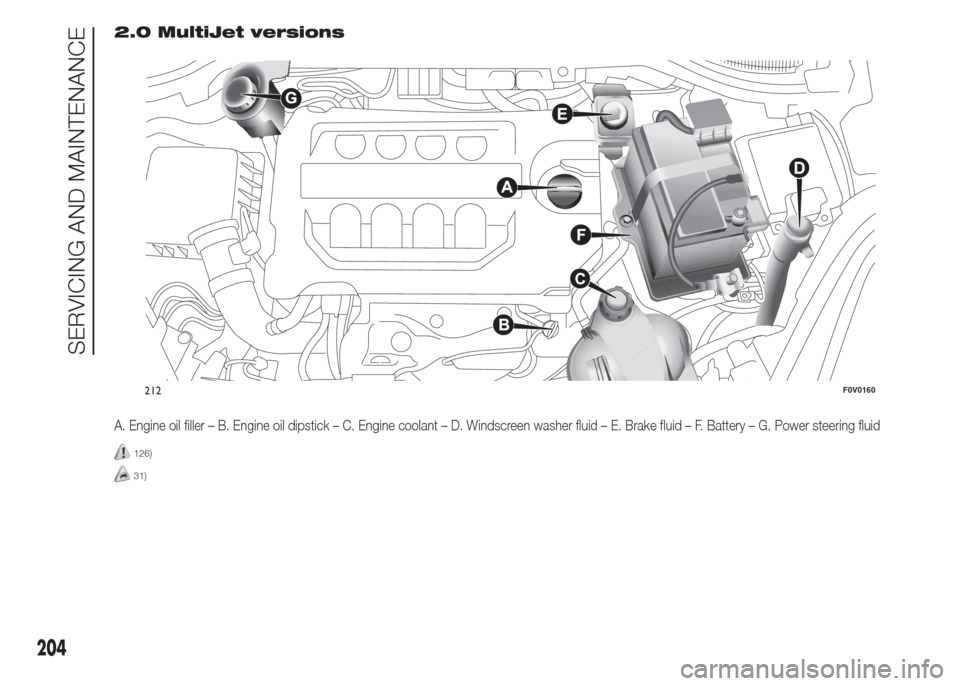
2.0 MultiJet versions
A. Engine oil filler – B. Engine oil dipstick – C. Engine coolant – D. Windscreen washer fluid – E. Brake fluid – F. Battery – G. Power steering fluid
126)
31)
212F0V0160
204
SERVICING AND MAINTENANCE
Page 210 of 323
Check fluid level through the
reservoir.
Close cap D by pressing on the
central section.
129)
BRAKE FLUID
Undo the cap E fig. 207 - fig. 208 -
fig. 209 - fig. 210 - fig. 211 - fig.
212: check that the fluid contained
in the reservoir is at the maximum
level.
The fluid level in the reservoir must
not exceed the MAX mark.
Use the brake fluid shown in the
"Fluids and lubricants" table (see
"Technical Specifications").
NB Carefully clean the reservoir cap
E and surrounding surfaces.
Take great care to ensure that
impurities do not enter the reservoir
when the cap is opened.
For topping-up, always use a funnel
with integrated filter with mesh
equal to or lower than 0.12 mm.IMPORTANT Brake fluid absorbs
moisture. For this reason, if the
vehicle is mainly used in areas with a
high degree of atmospheric
humidity, the fluid should be
replaced at more frequent intervals
than specified in the “Scheduled
Servicing Plan”.
34)
130) 131)
POWER STEERING
FLUID
Check that the oil level with the
vehicle on flat ground and the
engine cold is between the MIN and
MAX marks on the reservoir body
G fig. 207 - fig. 208 - fig. 209 -
fig. 210 - fig. 211 - fig. 212.
The level may exceed the MAX mark
when the oil is hot.
If topping up is required, make sure
the oil you use has the same
specifications as that already in the
system.
132)
4)
35)
WARNING
126) Never smoke while working in
the engine compartment: gas
and flammable vapours may be
present, with the risk of fire.
127) When the engine is hot, take
care when working inside the
engine compartment to avoid
burns. Remember that when the
engine is hot, the fan may
operate: danger of injury. Scarves,
ties and other loose clothing may
be pulled by moving parts.
128) The cooling system is
pressurised. If necessary, only
replace the cap with another
original one or the operation of
the system may be adversely
affected. Do not remove the cap
from the reservoir when the
engine is hot: danger of scalding.
206
SERVICING AND MAINTENANCE
Page 211 of 323
129) Do not travel with the
windscreen washer fluid reservoir
empty: the windscreen washer
is essential for improving visibility.
Some commercial windscreen
washer additives are flammable.
The engine compartment contains
hot parts which could cause a
fire if they come into contact with
these additives.
130) Brake fluid is poisonous and
highly corrosive. In the event of
accidental contact, immediately
wash the affected parts with
water and mild soap. Then rinse
thoroughly. Consult a doctor
immediately if you swallow the
fluid.
131) The symbol
on the container
indicates a synthetic brake fluid,
which is different from a mineral
fluid. Using a mineral-type fluid
will damage the special rubber
seals of the braking system
beyond repair.
132) Prevent power steering fluid
from coming into contact with
hot engine parts: it is flammable.
IMPORTANT
31) When topping up, take care not
to mix up the various types of
fluids: they are not compatible
with each other and could
seriously damage the vehicle.
32) Do not add oil with specifications
other than those of the oil already
in the engine.
33) PARAFLU
UPanti-freeze is used
in the engine cooling system. Use
the same fluid as in the cooling
system when topping up.
PARAFLU
UPcannot be mixed with
any other type of fluid. If this
happens, do not start the engine
and contact a Fiat Dealership.
34) Avoid allowing brake fluid, which
is extremely corrosive, to come
into contact with painted areas.
Should it happen, wash
immediately with water.
35) Do not press the power steering
end of travel lock for longer than 8
consecutive seconds with the
engine running because it will
cause noise and risk damaging
the system.
IMPORTANT
3) Used engine oil and oil filters
contain substances which are
harmful to the environment. It is
advisable to have oil and filters
changed by a Fiat Dealership,
where they will be disposed of
properly and in accordance with
the law.
4) Power steering fluid consumption
is extremely low; if another top-up
is required after only a short
period of time, have the system
checked for leaks at a Fiat
Dealership.
207
Page 219 of 323
RUBBER HOSES
As far as the maintenance of the
brake system and fuel supply
system rubber hoses is concerned,
follow the "Scheduled Servicing
Plan" in this chapter carefully.
Ozone, high temperatures and
prolonged lack of fluid in the system
may cause hardening and cracking
of the hoses, with possible leaks.
Careful checking is therefore
necessary.
PROLONGED
VEHICLE INACTIVITY
If the vehicle needs to be off the
road for longer than one month, the
following precautions must be
taken:
❒park the vehicle indoors in a dry and,
if possible, well-ventilated place;
❒engage a gear and check that the
handbrake is not engaged;
❒disconnect the negative terminal from
the battery pole (see paragraph
“Vehicle inactivity” in the "Dashboard
and controls" chapter) and check
the charge conditions (see paragraph
“Battery” in the “Care and
maintenance” chapter);
❒clean and protect the painted parts
using protective wax;
❒clean and protect the shiny metal
parts using special compounds
available commercially;
❒sprinkle talcum powder on the
windscreen and rear window wiper
rubber blades and lift them off the
glass;
❒slightly open the windows;❒cover the vehicle with a piece of
fabric or perforated plastic sheet. Do
not use compact plastic tarpaulins,
which prevent humidity from
evaporating from the surface of the
vehicle;
❒inflate tyres to +0.5 bar above the
standard specified pressure and
check it at intervals;
❒do not drain the engine cooling
system.
215
Page 222 of 323
IMPORTANT
39) Some car washes with old-style
blades and/or in a poor state of
repair can damage the paintwork,
facilitating the formation of lines
that give the paint a dull/misty
appearance, especially on dark
colours. If this happens, lightly
polish the paintwork with
appropriate products.
IMPORTANT
6) Detergents cause water pollution.
The vehicle should be washed in
areas equipped for collecting
and purifying the liquid used in
the washing process.
INTERIORS
Regularly check that water is not
trapped under the mats (due to
water dripping off shoes, umbrellas,
etc.), as this could cause oxidation
of the sheet metal.
143) 144)
SEATS AND FABRIC
PARTS
Remove dust with a soft brush or a
vacuum cleaner. It is advisable to
use a moist brush on velvet
upholstery.
Rub the seats with a sponge
moistened with a solution of water
and mild soap.
PLASTIC PARTS
It is advisable to clean interior parts
with a moist cloth and a solution
of water and non-abrasive mild
soap. Use specific products for
cleaning plastic, without solvents
and specifically designed to prevent
damage to the appearance and
colour of the treated parts, to
remove grease and tough stains.IMPORTANT Do not use alcohol,
petrols or their derivatives to clean
the instrument panel glass.
LEATHER STEERING
WHEEL/GEAR
KNOB/HANDBRAKE
(for versions/markets, where
provided)
These components must be cleaned
with mild soap and water only.
Never use alcohol or alcohol-based
products.
Read the product label carefully
before using specific products for
cleaning the interiors: make sure the
product does not contain spirits or
alcohol-based substances.
If, when cleaning the windscreen
with special products, window
cleaner accidentally drips onto the
leather of the steering wheel/gear
lever knob/hand brake, wipe away
immediately and then wash the
affected area with mild soap and
water.
IMPORTANT Be careful when using
a steering wheel locking device,
to avoid damaging the leather
upholstery through abrasion.
218
SERVICING AND MAINTENANCE