instrument panel FIAT DOBLO COMBI 2015 2.G Service Manual
[x] Cancel search | Manufacturer: FIAT, Model Year: 2015, Model line: DOBLO COMBI, Model: FIAT DOBLO COMBI 2015 2.GPages: 323, PDF Size: 46.77 MB
Page 154 of 323
TRACTION PLUS
SYSTEM
(for versions/markets, where
provided)
Traction Plus is a driving aid, useful
for setting off in poor grip conditions
(snow, ice, mud, etc.) which allows
the drive force to be distributed in
the best way over the front axle
when one wheel is slipping.
Traction Plus acts by braking the
wheels with poor grip (or those
slipping more than the others),
thereby transferring the drive force
to those which have greater grip on
the ground.
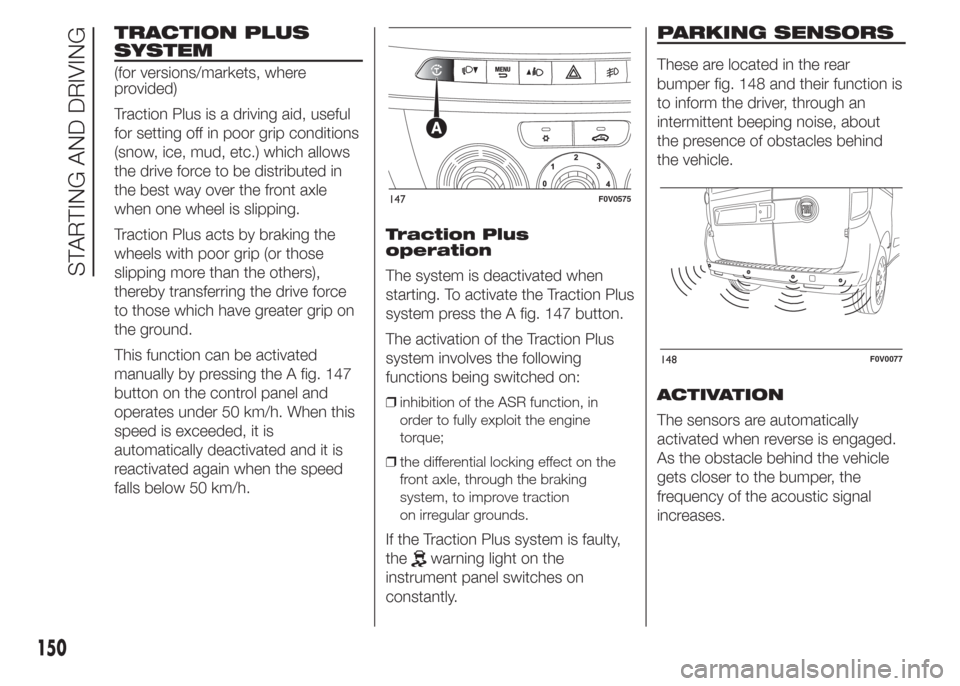
This function can be activated
manually by pressing the A fig. 147
button on the control panel and
operates under 50 km/h. When this
speed is exceeded, it is
automatically deactivated and it is
reactivated again when the speed
falls below 50 km/h.Traction Plus
operation
The system is deactivated when
starting. To activate the Traction Plus
system press the A fig. 147 button.
The activation of the Traction Plus
system involves the following
functions being switched on:
❒inhibition of the ASR function, in
order to fully exploit the engine
torque;
❒the differential locking effect on the
front axle, through the braking
system, to improve traction
on irregular grounds.
If the Traction Plus system is faulty,
the
warning light on the
instrument panel switches on
constantly.
PARKING SENSORS
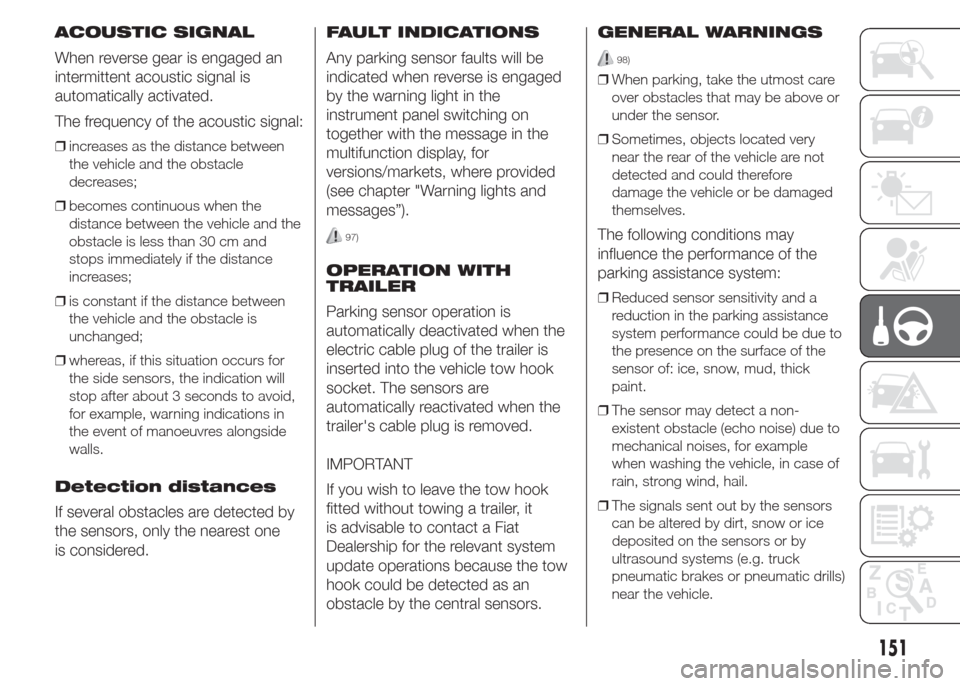
These are located in the rear
bumper fig. 148 and their function is
to inform the driver, through an
intermittent beeping noise, about
the presence of obstacles behind
the vehicle.
ACTIVATION
The sensors are automatically
activated when reverse is engaged.
As the obstacle behind the vehicle
gets closer to the bumper, the
frequency of the acoustic signal
increases.
147F0V0575
148F0V0077
150
STARTING AND DRIVING
Page 155 of 323
ACOUSTIC SIGNAL
When reverse gear is engaged an
intermittent acoustic signal is
automatically activated.
The frequency of the acoustic signal:
❒increases as the distance between
the vehicle and the obstacle
decreases;
❒becomes continuous when the
distance between the vehicle and the
obstacle is less than 30 cm and
stops immediately if the distance
increases;
❒is constant if the distance between
the vehicle and the obstacle is
unchanged;
❒whereas, if this situation occurs for
the side sensors, the indication will
stop after about 3 seconds to avoid,
for example, warning indications in
the event of manoeuvres alongside
walls.
Detection distances
If several obstacles are detected by
the sensors, only the nearest one
is considered.FAULT INDICATIONS
Any parking sensor faults will be
indicated when reverse is engaged
by the warning light in the
instrument panel switching on
together with the message in the
multifunction display, for
versions/markets, where provided
(see chapter "Warning lights and
messages”).
97)
OPERATION WITH
TRAILER
Parking sensor operation is
automatically deactivated when the
electric cable plug of the trailer is
inserted into the vehicle tow hook
socket. The sensors are
automatically reactivated when the
trailer's cable plug is removed.
IMPORTANT
If you wish to leave the tow hook
fitted without towing a trailer, it
is advisable to contact a Fiat
Dealership for the relevant system
update operations because the tow
hook could be detected as an
obstacle by the central sensors.GENERAL WARNINGS
98)
❒When parking, take the utmost care
over obstacles that may be above or
under the sensor.
❒Sometimes, objects located very
near the rear of the vehicle are not
detected and could therefore
damage the vehicle or be damaged
themselves.
The following conditions may
influence the performance of the
parking assistance system:
❒Reduced sensor sensitivity and a
reduction in the parking assistance
system performance could be due to
the presence on the surface of the
sensor of: ice, snow, mud, thick
paint.
❒The sensor may detect a non-
existent obstacle (echo noise) due to
mechanical noises, for example
when washing the vehicle, in case of
rain, strong wind, hail.
❒The signals sent out by the sensors
can be altered by dirt, snow or ice
deposited on the sensors or by
ultrasound systems (e.g. truck
pneumatic brakes or pneumatic drills)
near the vehicle.
151
Page 164 of 323
HAZARD WARNING
LIGHTS
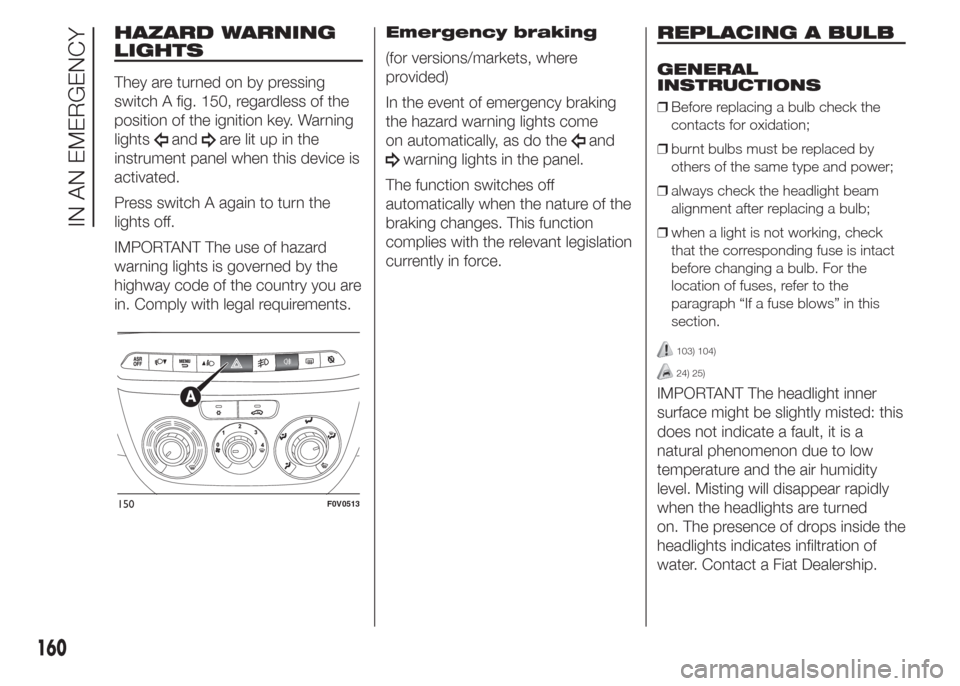
They are turned on by pressing
switch A fig. 150, regardless of the
position of the ignition key. Warning
lights
andare lit up in the
instrument panel when this device is
activated.
Press switch A again to turn the
lights off.
IMPORTANT The use of hazard
warning lights is governed by the
highway code of the country you are
in. Comply with legal requirements.Emergency braking
(for versions/markets, where
provided)
In the event of emergency braking
the hazard warning lights come
on automatically, as do theand
warning lights in the panel.
The function switches off
automatically when the nature of the
braking changes. This function
complies with the relevant legislation
currently in force.
REPLACING A BULB
GENERAL
INSTRUCTIONS
❒Before replacing a bulb check the
contacts for oxidation;
❒burnt bulbs must be replaced by
others of the same type and power;
❒always check the headlight beam
alignment after replacing a bulb;
❒when a light is not working, check
that the corresponding fuse is intact
before changing a bulb. For the
location of fuses, refer to the
paragraph “If a fuse blows” in this
section.
103) 104)
24) 25)
IMPORTANT The headlight inner
surface might be slightly misted: this
does not indicate a fault, it is a
natural phenomenon due to low
temperature and the air humidity
level. Misting will disappear rapidly
when the headlights are turned
on. The presence of drops inside the
headlights indicates infiltration of
water. Contact a Fiat Dealership.
150F0V0513
160
IN AN EMERGENCY
Page 184 of 323
FIX&GO automatic
QUICK TYRE REPAIR
KIT
The quick repair kit Fix&Go
automatic is contained in a suitable
bag inside the compartment on
the right rear side or, for Cargo
versions, under the passenger seat
(for versions with fixed or movable
seat), or in the glove compartment
(for versions with folding seat).
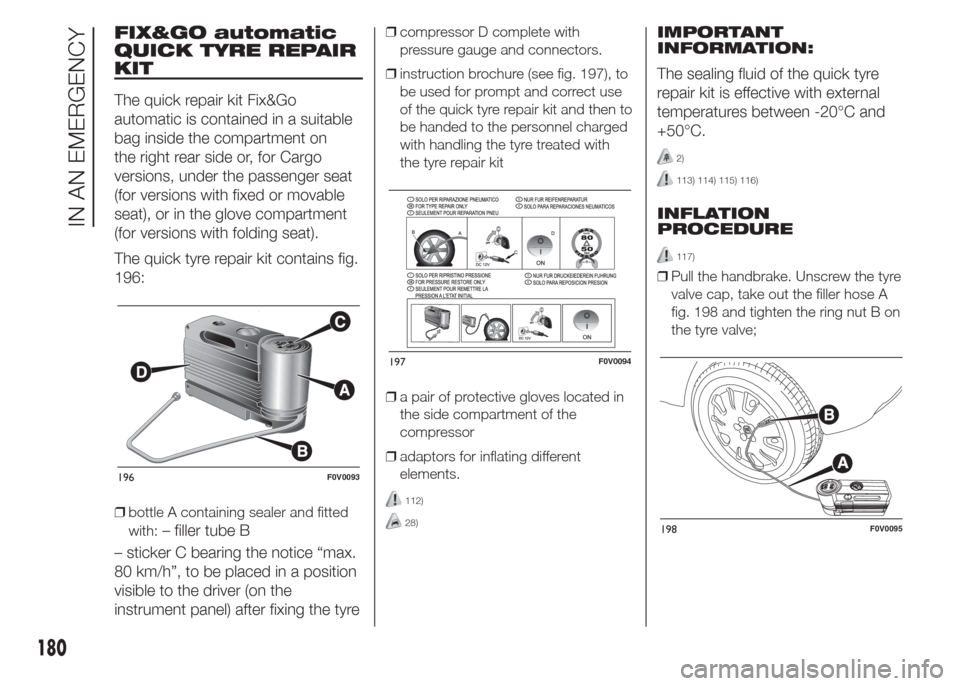
The quick tyre repair kit contains fig.
196:
❒bottle A containing sealer and fitted
with:
– filler tube B
– sticker C bearing the notice “max.
80 km/h”, to be placed in a position
visible to the driver (on the
instrument panel) after fixing the tyre
❒compressor D complete with
pressure gauge and connectors.
❒instruction brochure (see fig. 197), to
be used for prompt and correct use
of the quick tyre repair kit and then to
be handed to the personnel charged
with handling the tyre treated with
the tyre repair kit
❒a pair of protective gloves located in
the side compartment of the
compressor
❒adaptors for inflating different
elements.
112)
28)
IMPORTANT
INFORMATION:
The sealing fluid of the quick tyre
repair kit is effective with external
temperatures between -20°C and
+50°C.
2)
113) 114) 115) 116)
INFLATION
PROCEDURE
117)
❒Pull the handbrake. Unscrew the tyre
valve cap, take out the filler hose A
fig. 198 and tighten the ring nut B on
the tyre valve;
196F0V0093
197F0V0094
198F0V0095
180
IN AN EMERGENCY
Page 187 of 323
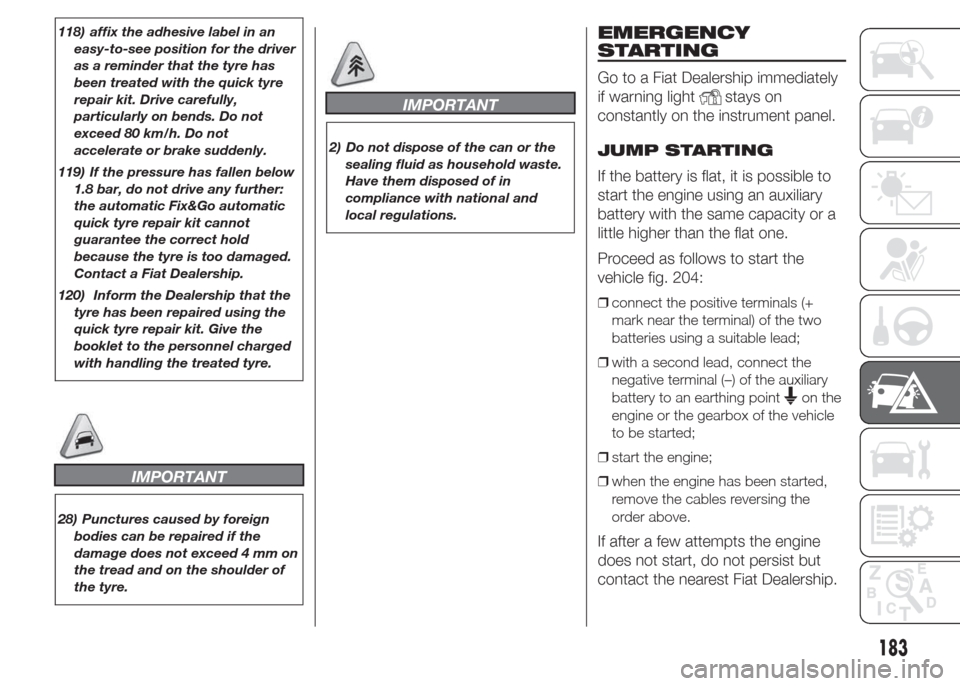
118) affix the adhesive label in an
easy-to-see position for the driver
as a reminder that the tyre has
been treated with the quick tyre
repair kit. Drive carefully,
particularly on bends. Do not
exceed 80 km/h. Do not
accelerate or brake suddenly.
119) If the pressure has fallen below
1.8 bar, do not drive any further:
the automatic Fix&Go automatic
quick tyre repair kit cannot
guarantee the correct hold
because the tyre is too damaged.
Contact a Fiat Dealership.
120) Inform the Dealership that the
tyre has been repaired using the
quick tyre repair kit. Give the
booklet to the personnel charged
with handling the treated tyre.
IMPORTANT
28) Punctures caused by foreign
bodies can be repaired if the
damage does not exceed 4 mm on
the tread and on the shoulder of
the tyre.
IMPORTANT
2) Do not dispose of the can or the
sealing fluid as household waste.
Have them disposed of in
compliance with national and
local regulations.
EMERGENCY
STARTING
Go to a Fiat Dealership immediately
if warning light
stays on
constantly on the instrument panel.
JUMP STARTING
If the battery is flat, it is possible to
start the engine using an auxiliary
battery with the same capacity or a
little higher than the flat one.
Proceed as follows to start the
vehicle fig. 204:
❒connect the positive terminals (+
mark near the terminal) of the two
batteries using a suitable lead;
❒with a second lead, connect the
negative terminal (–) of the auxiliary
battery to an earthing point
on the
engine or the gearbox of the vehicle
to be started;
❒start the engine;
❒when the engine has been started,
remove the cables reversing the
order above.
If after a few attempts the engine
does not start, do not persist but
contact the nearest Fiat Dealership.
183
Page 195 of 323
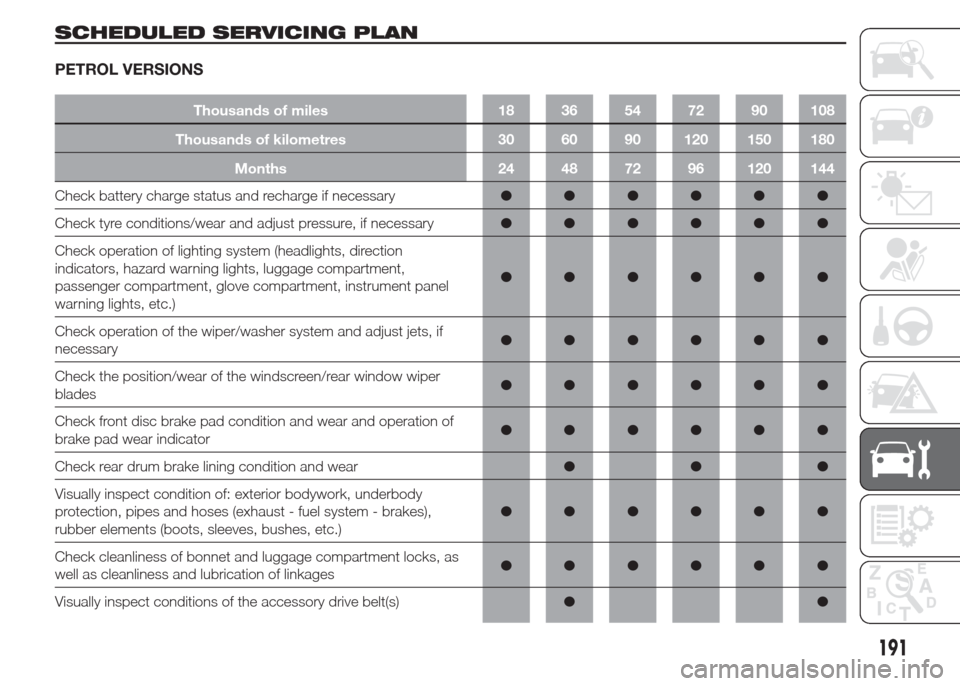
SCHEDULED SERVICING PLAN
PETROL VERSIONS
Thousands of miles 18 36 54 72 90 108
Thousands of kilometres 30 60 90 120 150 180
Months 24 48 72 96 120 144
Check battery charge status and recharge if necessary●●●●●●
Check tyre conditions/wear and adjust pressure, if necessary●●●●●●
Check operation of lighting system (headlights, direction
indicators, hazard warning lights, luggage compartment,
passenger compartment, glove compartment, instrument panel
warning lights, etc.)●●●●●●
Check operation of the wiper/washer system and adjust jets, if
necessary●●●●●●
Check the position/wear of the windscreen/rear window wiper
blades●●●●●●
Check front disc brake pad condition and wear and operation of
brake pad wear indicator●●●●●●
Check rear drum brake lining condition and wear●●●
Visually inspect condition of: exterior bodywork, underbody
protection, pipes and hoses (exhaust - fuel system - brakes),
rubber elements (boots, sleeves, bushes, etc.)●●●●●●
Check cleanliness of bonnet and luggage compartment locks, as
well as cleanliness and lubrication of linkages●●●●●●
Visually inspect conditions of the accessory drive belt(s)●●
191
Page 198 of 323
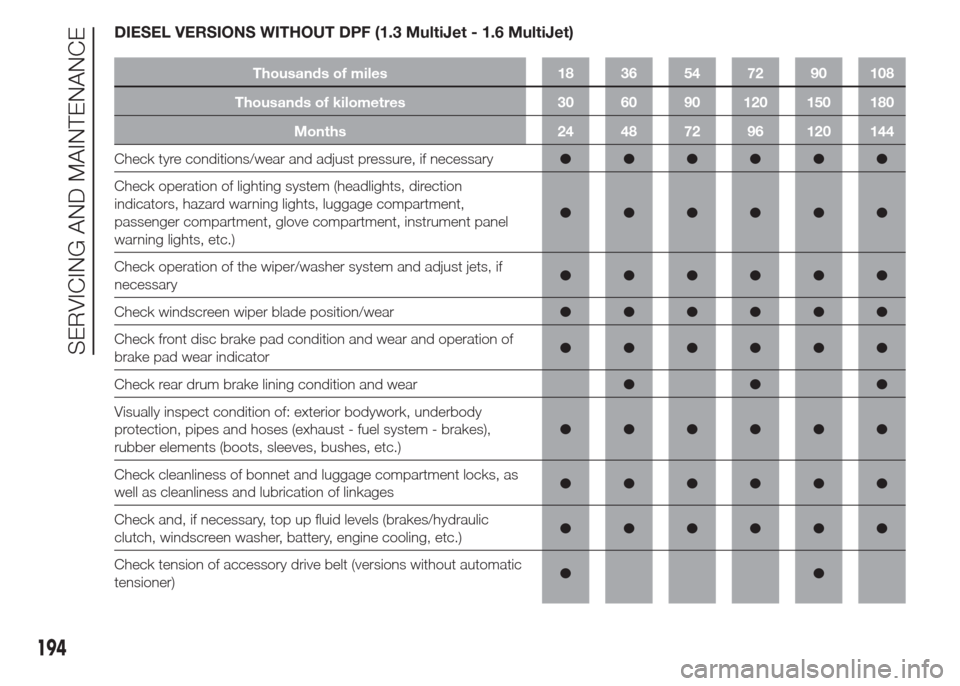
DIESEL VERSIONS WITHOUT DPF (1.3 MultiJet - 1.6 MultiJet)
Thousands of miles 18 36 54 72 90 108
Thousands of kilometres 30 60 90 120 150 180
Months 24 48 72 96 120 144
Check tyre conditions/wear and adjust pressure, if necessary●●●●●●
Check operation of lighting system (headlights, direction
indicators, hazard warning lights, luggage compartment,
passenger compartment, glove compartment, instrument panel
warning lights, etc.)●●●●●●
Check operation of the wiper/washer system and adjust jets, if
necessary●●●●●●
Check windscreen wiper blade position/wear●●●●●●
Check front disc brake pad condition and wear and operation of
brake pad wear indicator●●●●●●
Check rear drum brake lining condition and wear●●●
Visually inspect condition of: exterior bodywork, underbody
protection, pipes and hoses (exhaust - fuel system - brakes),
rubber elements (boots, sleeves, bushes, etc.)●●●●●●
Check cleanliness of bonnet and luggage compartment locks, as
well as cleanliness and lubrication of linkages●●●●●●
Check and, if necessary, top up fluid levels (brakes/hydraulic
clutch, windscreen washer, battery, engine cooling, etc.)●●●●●●
Check tension of accessory drive belt (versions without automatic
tensioner)●●
194
SERVICING AND MAINTENANCE
Page 200 of 323
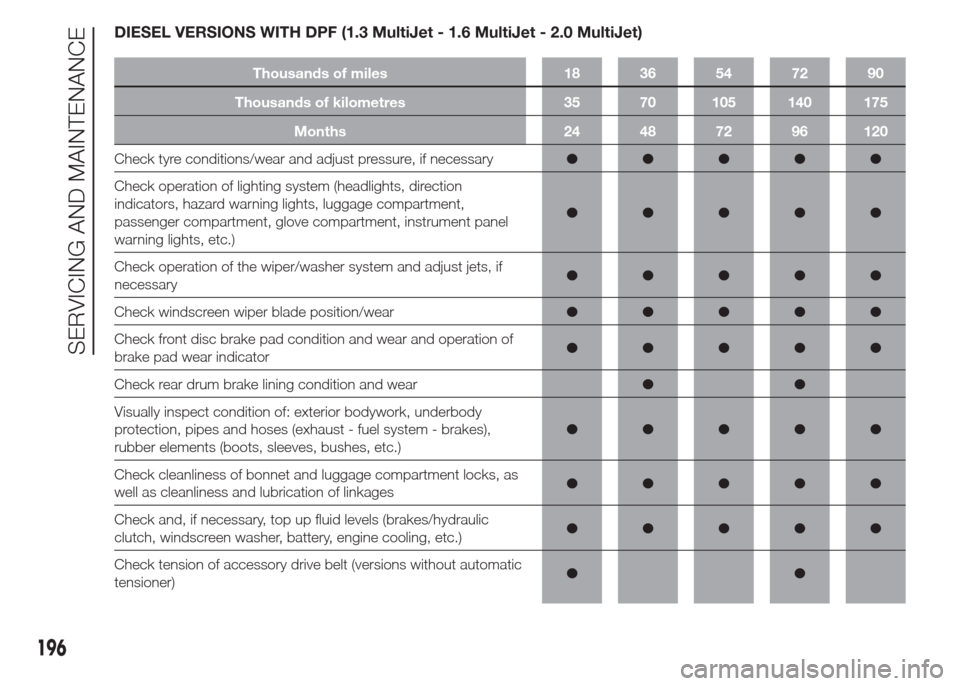
DIESEL VERSIONS WITH DPF (1.3 MultiJet - 1.6 MultiJet - 2.0 MultiJet)
Thousands of miles 18 36 54 72 90
Thousands of kilometres 35 70 105 140 175
Months 24 48 72 96 120
Check tyre conditions/wear and adjust pressure, if necessary●●●●●
Check operation of lighting system (headlights, direction
indicators, hazard warning lights, luggage compartment,
passenger compartment, glove compartment, instrument panel
warning lights, etc.)●●●●●
Check operation of the wiper/washer system and adjust jets, if
necessary●●●●●
Check windscreen wiper blade position/wear●●●●●
Check front disc brake pad condition and wear and operation of
brake pad wear indicator●●●●●
Check rear drum brake lining condition and wear●●
Visually inspect condition of: exterior bodywork, underbody
protection, pipes and hoses (exhaust - fuel system - brakes),
rubber elements (boots, sleeves, bushes, etc.)●●●●●
Check cleanliness of bonnet and luggage compartment locks, as
well as cleanliness and lubrication of linkages●●●●●
Check and, if necessary, top up fluid levels (brakes/hydraulic
clutch, windscreen washer, battery, engine cooling, etc.)●●●●●
Check tension of accessory drive belt (versions without automatic
tensioner)●●
196
SERVICING AND MAINTENANCE
Page 201 of 323
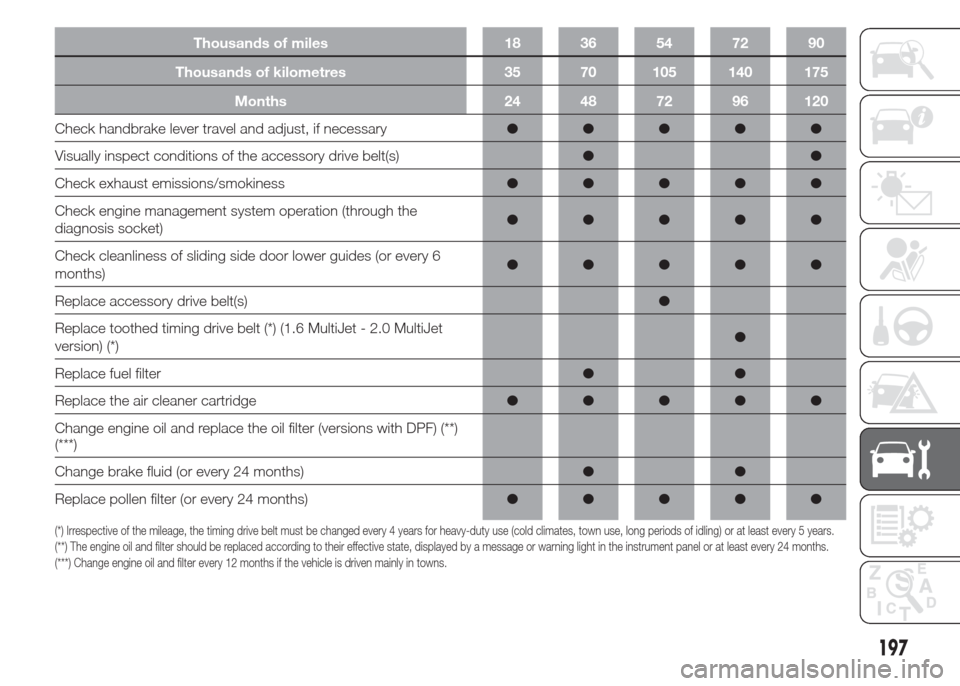
Thousands of miles 18 36 54 72 90
Thousands of kilometres 35 70 105 140 175
Months 24 48 72 96 120
Check handbrake lever travel and adjust, if necessary●●●●●
Visually inspect conditions of the accessory drive belt(s)●●
Check exhaust emissions/smokiness●●●●●
Check engine management system operation (through the
diagnosis socket)●●●●●
Check cleanliness of sliding side door lower guides (or every 6
months)●●●●●
Replace accessory drive belt(s)●
Replace toothed timing drive belt (*) (1.6 MultiJet - 2.0 MultiJet
version) (*)●
Replace fuel filter●●
Replace the air cleaner cartridge●●●●●
Change engine oil and replace the oil filter (versions with DPF) (**)
(***)
Change brake fluid (or every 24 months)●●
Replace pollen filter (or every 24 months)●●●●●
(*) Irrespective of the mileage, the timing drive belt must be changed every 4 years for heavy-duty use (cold climates, town use, long periods of idling) or at least every 5 years.
(**) The engine oil and filter should be replaced according to their effective state, displayed by a message or warning light in the instrument panel orat least every 24 months.
(***) Change engine oil and filter every 12 months if the vehicle is driven mainly in towns.
197
Page 222 of 323
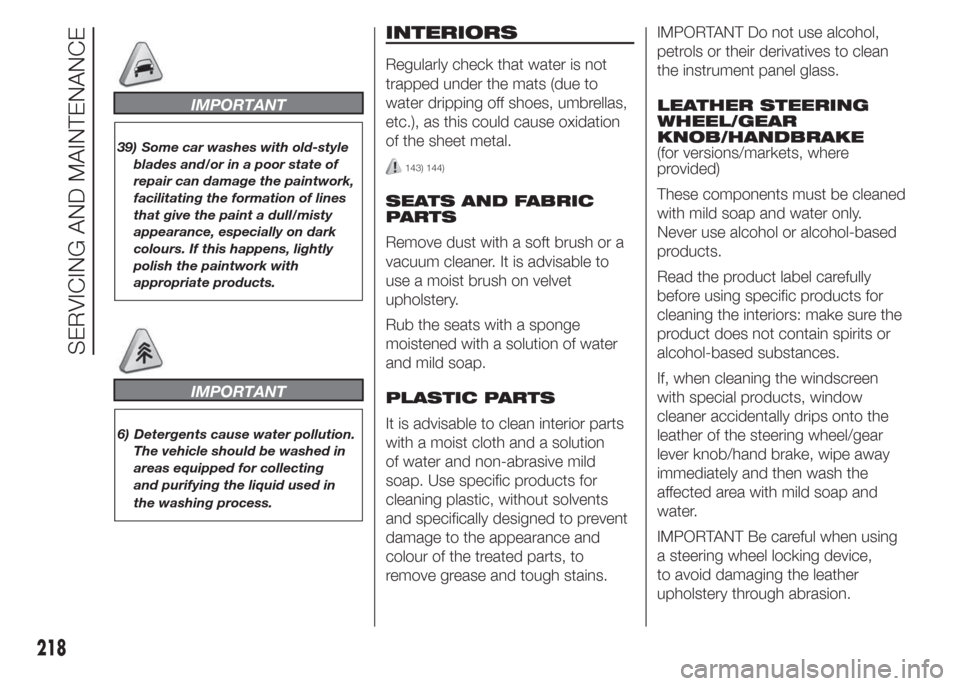
IMPORTANT
39) Some car washes with old-style
blades and/or in a poor state of
repair can damage the paintwork,
facilitating the formation of lines
that give the paint a dull/misty
appearance, especially on dark
colours. If this happens, lightly
polish the paintwork with
appropriate products.
IMPORTANT
6) Detergents cause water pollution.
The vehicle should be washed in
areas equipped for collecting
and purifying the liquid used in
the washing process.
INTERIORS
Regularly check that water is not
trapped under the mats (due to
water dripping off shoes, umbrellas,
etc.), as this could cause oxidation
of the sheet metal.
143) 144)
SEATS AND FABRIC
PARTS
Remove dust with a soft brush or a
vacuum cleaner. It is advisable to
use a moist brush on velvet
upholstery.
Rub the seats with a sponge
moistened with a solution of water
and mild soap.
PLASTIC PARTS
It is advisable to clean interior parts
with a moist cloth and a solution
of water and non-abrasive mild
soap. Use specific products for
cleaning plastic, without solvents
and specifically designed to prevent
damage to the appearance and
colour of the treated parts, to
remove grease and tough stains.IMPORTANT Do not use alcohol,
petrols or their derivatives to clean
the instrument panel glass.
LEATHER STEERING
WHEEL/GEAR
KNOB/HANDBRAKE
(for versions/markets, where
provided)
These components must be cleaned
with mild soap and water only.
Never use alcohol or alcohol-based
products.
Read the product label carefully
before using specific products for
cleaning the interiors: make sure the
product does not contain spirits or
alcohol-based substances.
If, when cleaning the windscreen
with special products, window
cleaner accidentally drips onto the
leather of the steering wheel/gear
lever knob/hand brake, wipe away
immediately and then wash the
affected area with mild soap and
water.
IMPORTANT Be careful when using
a steering wheel locking device,
to avoid damaging the leather
upholstery through abrasion.
218
SERVICING AND MAINTENANCE