brake FIAT DOBLO COMBI 2016 2.G User Guide
[x] Cancel search | Manufacturer: FIAT, Model Year: 2016, Model line: DOBLO COMBI, Model: FIAT DOBLO COMBI 2016 2.GPages: 298, PDF Size: 25.92 MB
Page 106 of 298
SYSTEM ACTIVATION
The ESC system is automatically
activated when the vehicle is started.
FAULT INDICATIONS
In the event of a fault, the ESC will be
automatically switched off and the
warning light will come on
permanently on the instrument panel,
along with a message on the
multifunction display (for versions/
markets where provided) (see "Warning
lights and messages" section). The
LED on the ASR OFF button will also
light up. Contact a Fiat Dealership
as soon as possible.
57)
HILL HOLDER SYSTEM
This system is an integral part of the
ESC system and facilitates starting on
slopes. It is automatically activated
in the following conditions:
uphill: vehicle stationary on a road
with a gradient higher than 5%, engine
running, brake pressed and gearbox
in neutral or gear (other than reverse)
engaged;
downhill: vehicle stationary on a road
with a gradient higher than 5%, engine
running, brake pressed and reverse
gear engaged.When setting off, the ESC system
control unit maintains the braking
pressure at the wheels until the torque
necessary for starting is reached, or
in any case for a maximum of 1.75
seconds, allowing your right foot to be
moved easily from the brake pedal to
the accelerator.
If the vehicle has not departed after
1.75 seconds, the system will
deactivate automatically by gradually
releasing the brake force.
During this release stage, the typical
brake disengagement noise indicating
that the vehicle is going to move
imminently will be heard.
Fault indications
Any system fault is indicated by the
turning on of the
warning light on
the instrument panel with digital display
and the
warning light on the
instrument panel with multifunction
display (for versions/markets where
provided) (see section “Warning lights
and messages”).
IMPORTANT The Hill Holder system is
not a parking brake, therefore do not
leave the vehicle without activating the
handbrake, switching off the engine
and engaging first gear.
58)
ASR SYSTEM (Antislip
Regulator)
This is a traction control system that
cuts in automatically every time one or
both drive wheels slip.
Depending on the slipping conditions,
two different control systems are
activated:
if the slipping involves both drive
wheels, the ASR intervenes reducing
the power transmitted by the engine;
if the slipping only involves one
of the drive wheels, it intervenes
automatically braking the wheel that is
slipping.
The action of the ASR system is
particularly helpful in the following
circumstances:
slipping of the inner wheel on bends
due to dynamic variations in the load
or excessive acceleration;
excessive power transmitted to the
wheels, also in relation to road surface
conditions;
acceleration on slippery, snowy or
icy road surfaces;
in the case of loss of grip on a wet
surface (aquaplaning).
102
SAFETY
Page 127 of 298
STARTING AND DRIVING
Let’s get to the "heart" of the vehicle:
seeing how you can exploit all of its
potential to the full.
We’ll look at how to drive it safely in any
situation, so that it can be a welcome
companion, with our comfort and
our wallets in mind.STARTING THE ENGINE .................124
HANDBRAKE ..................................125
USING THE GEARBOX ...................126
START&STOP SYSTEM ..................127
TPMS (TYRE PRESSURE
MONITORING SYSTEM) .................130
SPEED BLOCK ...............................133
CRUISE CONTROL .........................133
TRACTION PLUS SYSTEM .............135
PARKING SENSORS.......................136
REFUELLING THE VEHICLE ...........138
SAVING FUEL .................................139
TOWING TRAILERS ........................140
SNOW TYRES ................................141
SNOW CHAINS...............................141
123
Page 128 of 298
STARTING THE
ENGINE
The vehicle is fitted with an immobiliser:
if the engine fails to start, see the
paragraph on “The Fiat CODE system”
in the “Dashboard and controls”
section.
The engine may be noisier during the
first few seconds of operation,
especially after a long period of
inactivity. This is due to the hydraulic
tappets, the timing system chosen for
petrol engine versions to reduce the
number of servicing interventions, and
affects neither functionality nor reliability.
17) 18)
95)
PROCEDURE FOR
PETROL VERSIONS
Proceed as follows:
engage the handbrake;
put the gear lever into neutral;
fully depress the clutch pedal,
without touching the accelerator;
turn the ignition key to AVV and
release it as soon as the engine starts.
If the engine does not start at the
first attempt, return the ignition key to
STOP before repeating the starting
procedure.
If, when the ignition key is on MAR, the
instrument panel warning light
remains on together with warning
light
, turn the key to STOP and
then back to MAR; if the warning light
remains on, try the other keys provided
with the vehicle. If you are still unable
to start the engine, perform the
emergency starting procedure (see
"Emergency starting" in the "In an
emergency" chapter) and contact a Fiat
Dealership.PROCEDURE FOR DIESEL
VERSIONS
Proceed as follows:
engage the handbrake;
put the gear lever into neutral;
turn the ignition key to MAR: the
warning lights
andon the
instrument panel will turn on;
wait for the warning lightsand
to switch off. The hotter the engine
is, the quicker this will happen;
fully depress the clutch pedal,
without touching the accelerator;
turn the ignition key to AVV as soon
as warning light
switches off.
Waiting too long will waste the heating
work carried out by the glow plugs.
Release the key as soon as the engine
starts.
IMPORTANT With the engine cold, the
accelerator pedal must be fully released
when you turn the ignition key to AVV.
If the engine does not start at the
first attempt, return the ignition key to
STOP before repeating the starting
procedure.
If, when the ignition key is at MAR the
warning light remains lit, turn the
key to STOP and then back to MAR; if
the warning light remains lit, try with the
other keys provided with the vehicle. If
you still cannot start the engine, contact
a Fiat Dealership.
124
STARTING AND DRIVING
Page 129 of 298
19)
WARMING UP THE
ENGINE JUST AFTER IT
HAS STARTED
Proceed as follows:
drive off slowly, letting the engine
turn at medium revs. Do not accelerate
abruptly;
do not demand full performance at
first. Wait until the engine coolant
temperature gauge starts moving.
EMERGENCY STARTING
If the instrument panel warning light
stays on steadily, you can perform
an emergency starting by using the
code on the CODE card (see the “In an
emergency” section).
20)
STOPPING THE ENGINE
Turn the ignition key to STOP while the
engine is idling.
IMPORTANT After a taxing drive, you
should allow the engine to “catch
its breath” before turning it off by letting
it idle to allow the temperature in the
engine compartment to fall.
WARNING
17)It is advisable not to demand maximum
performance from your vehicle (e.g.
excessive acceleration, long distances at
high speeds, excessively intense braking,
etc.) during the initial period of use.
18)When the engine is off, do not leave
the key turned to MAR to prevent
unnecessary electrical consumption from
draining the battery.
19)If the indicator flashes for 60
seconds after starting or during an
extended towing period, this indicates
a problem in the glow plug preheating
system. Use the vehicle normally if the
engine starts, but contact a Fiat Dealership
as soon as possible.
20)Never start the engine by pushing,
towing or driving downhill. This could
cause fuel to flow into the catalytic
converter and damage it beyond repair.
WARNING
95)It is dangerous to run the engine in
enclosed areas. The engine takes in
oxygen and releases carbon dioxide,
carbon monoxide and other toxic gases.
HANDBRAKE
The handbrake lever is located between
the front seats. Pull the lever upwards
to engage the handbrake and ensure
that the vehicle does not move. The
vehicle should be secured after several
clicks of the lever. If it is not, contact
a Fiat Dealership to have it adjusted.
96)When the handbrake lever is engaged
and the ignition key is in MAR position,
the instrument panel warning light
will switch on.
Proceed as follows to release the
handbrake:
slightly lift the lever and press
release button A fig. 140;
keep button A pressed and lower
the lever. The
warning light in the
instrument panel will switch off.
Press the brake pedal when carrying
out this operation to prevent the vehicle
from moving accidentally.
PARKING
Proceed as follows:
stop the engine and engage the
handbrake;
engage the gear (on a slope, engage
first gear if the vehicle is facing uphill
or reverse if it is facing downhill) and
leave the wheels steered.
125
Page 131 of 298
START&STOP
SYSTEM
IN BRIEF
The Start&Stop device automatically
stops the engine each time the
vehicle is stationary and starts it
again when the driver wants to move
off.
This improves the efficiency of the
vehicle by reducing fuel consumption,
the emission of harmful gases and
noise pollution.
OPERATING MODE
Engine stopping mode
WITH MANUAL GEARBOX
With the vehicle stationary, the engine
stops with the gearbox in neutral and
the clutch pedal released.
WITH ROBOTIZED GEARBOX
The engine cuts out if the vehicle stops
with the brake pedal pressed.
This condition can be maintained even
if the brake pedal is not depressed, if
the gear lever is in position N.NOTE: The engine can only be stopped
automatically after a speed of about
10 km/h is reached, to prevent the
engine from being repeatedly stopped
when driving at walking pace.
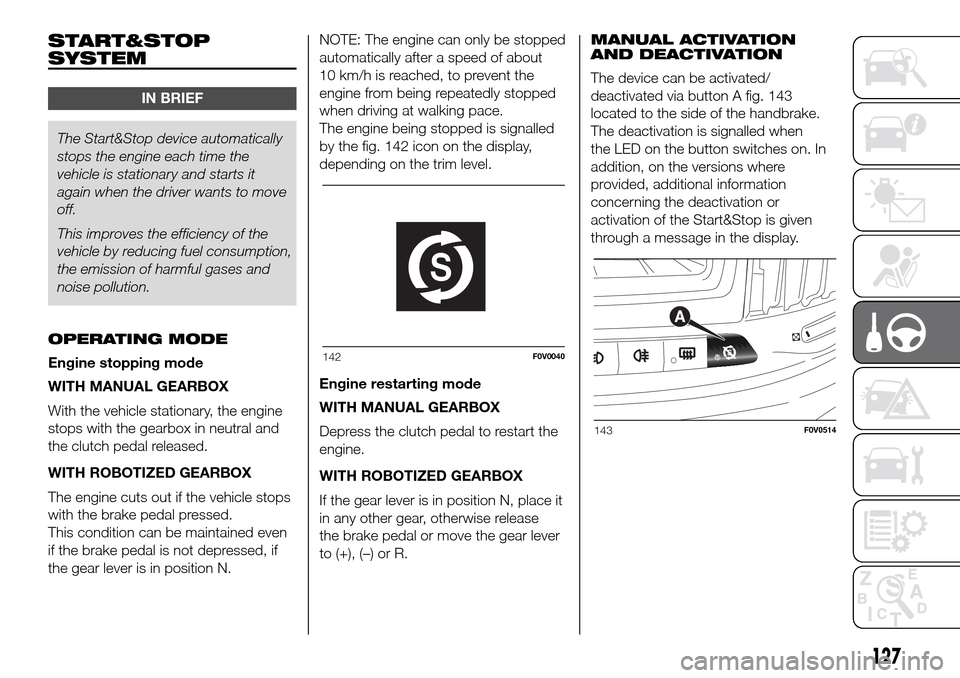
The engine being stopped is signalled
by the fig. 142 icon on the display,
depending on the trim level.
Engine restarting mode
WITH MANUAL GEARBOX
Depress the clutch pedal to restart the
engine.
WITH ROBOTIZED GEARBOX
If the gear lever is in position N, place it
in any other gear, otherwise release
the brake pedal or move the gear lever
to (+), (–) or R.MANUAL ACTIVATION
AND DEACTIVATION
The device can be activated/
deactivated via button A fig. 143
located to the side of the handbrake.
The deactivation is signalled when
the LED on the button switches on. In
addition, on the versions where
provided, additional information
concerning the deactivation or
activation of the Start&Stop is given
through a message in the display.
142F0V0040
143F0V0514
127
Page 132 of 298
ENGINE STOPPING
FAILURE CONDITIONS
With the device activated, for reasons
of comfort, limiting emissions and
safety, the engine does not stop in
certain conditions, including:
engine still cold;
particularly cold external
temperatures, if the corresponding
indication is provided;
battery not sufficiently charged;
particulate filter regeneration in
progress (diesel engines only);
driver's door not shut;
driver's seat belt not fastened;
reverse gear engaged (for example,
for parking manoeuvres);
automatic climate control, if a
suitable thermal comfort level has not
yet been reached or MAX-DEF function
activation;
during the first period of use, to
initialise the system.
In the above cases, the warning light
flashes fig. 103 and, where available,
there is a message in the display.RESTARTING
CONDITIONS
For reasons of comfort, limiting harmful
emissions and safety purposes, the
power unit can restart automatically
without any action by the driver if
certain conditions are met, including:
battery not sufficiently charged;
reduced braking system vacuum
(e.g. if the brake pedal is pressed
repeatedly);
vehicle in motion (e.g. when driving
on roads with a gradient);
stopping the engine through the
Start&Stop system for more than about
three minutes.
automatic climate control system for
adjusting the thermal comfort level or
to enable MAX-DEF function.
With a gear engaged, the engine can
be automatically restarted only by
fully depressing the clutch pedal. The
driver is asked to perform this operation
through the warning light flashing in
the instrument panel fig. 103 and,
where provided, the message in the
display.N.B.: If you stall the engine, for example
by releasing off the clutch pedal quickly
when in gear, if the Start&Stop system
is activated, the engine can be
restarted by fully depressing the clutch
pedal or by putting the gear lever into
neutral.
N.B.: If the clutch is not depressed
when the three minutes have elapsed
since the engine was stopped, the
engine can only be restarted using the
key.
SAFETY FUNCTIONS
In engine cut-out conditions through
the Start&Stop system, if the driver
unfastens his/her seat belt and opens
the driver's door or the passenger door,
the engine can be restarted only by
using the key.
The driver is notified of this condition by
a buzzer, through the fig. 142 warning
light flashing in the instrument panel
and, where provided, by a message in
the display.
128
STARTING AND DRIVING
Page 134 of 298
EMERGENCY STARTING
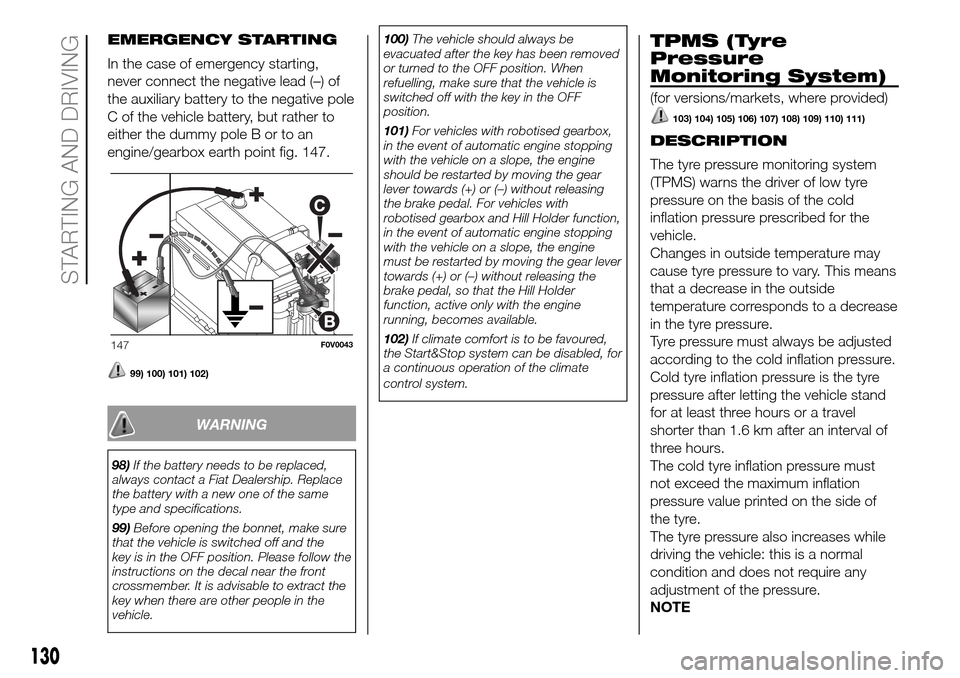
In the case of emergency starting,
never connect the negative lead (–) of
the auxiliary battery to the negative pole
C of the vehicle battery, but rather to
either the dummy pole B or to an
engine/gearbox earth point fig. 147.
99) 100) 101) 102)
WARNING
98)If the battery needs to be replaced,
always contact a Fiat Dealership. Replace
the battery with a new one of the same
type and specifications.
99)Before opening the bonnet, make sure
that the vehicle is switched off and the
key is in the OFF position. Please follow the
instructions on the decal near the front
crossmember. It is advisable to extract the
key when there are other people in the
vehicle.100)The vehicle should always be
evacuated after the key has been removed
or turned to the OFF position. When
refuelling, make sure that the vehicle is
switched off with the key in the OFF
position.
101)For vehicles with robotised gearbox,
in the event of automatic engine stopping
with the vehicle on a slope, the engine
should be restarted by moving the gear
lever towards (+) or (–) without releasing
the brake pedal. For vehicles with
robotised gearbox and Hill Holder function,
in the event of automatic engine stopping
with the vehicle on a slope, the engine
must be restarted by moving the gear lever
towards (+) or (–) without releasing the
brake pedal, so that the Hill Holder
function, active only with the engine
running, becomes available.
102)If climate comfort is to be favoured,
the Start&Stop system can be disabled, for
a continuous operation of the climate
control system.
TPMS (Tyre
Pressure
Monitoring System)
(for versions/markets, where provided)
103) 104) 105) 106) 107) 108) 109) 110) 111)
DESCRIPTION
The tyre pressure monitoring system
(TPMS) warns the driver of low tyre
pressure on the basis of the cold
inflation pressure prescribed for the
vehicle.
Changes in outside temperature may
cause tyre pressure to vary. This means
that a decrease in the outside
temperature corresponds to a decrease
in the tyre pressure.
Tyre pressure must always be adjusted
according to the cold inflation pressure.
Cold tyre inflation pressure is the tyre
pressure after letting the vehicle stand
for at least three hours or a travel
shorter than 1.6 km after an interval of
three hours.
The cold tyre inflation pressure must
not exceed the maximum inflation
pressure value printed on the side of
the tyre.
The tyre pressure also increases while
driving the vehicle: this is a normal
condition and does not require any
adjustment of the pressure.
NOTE
147F0V0043
130
STARTING AND DRIVING
Page 138 of 298
Storing vehicle speed
Proceed as follows:
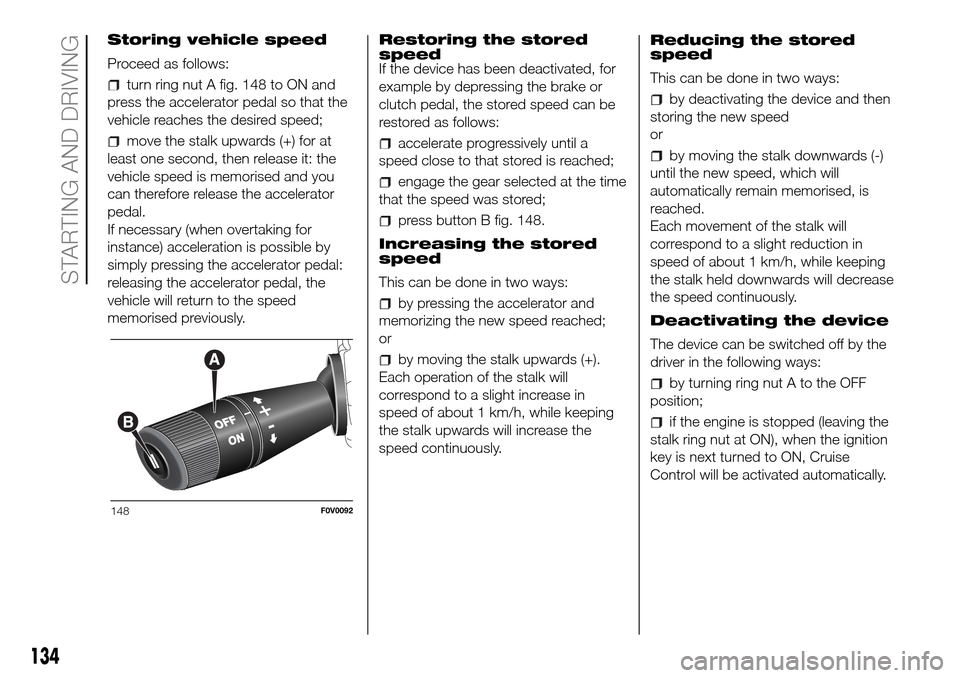
turn ring nut A fig. 148 to ON and
press the accelerator pedal so that the
vehicle reaches the desired speed;
move the stalk upwards (+) for at
least one second, then release it: the
vehicle speed is memorised and you
can therefore release the accelerator
pedal.
If necessary (when overtaking for
instance) acceleration is possible by
simply pressing the accelerator pedal:
releasing the accelerator pedal, the
vehicle will return to the speed
memorised previously.Restoring the stored
speed
If the device has been deactivated, for
example by depressing the brake or
clutch pedal, the stored speed can be
restored as follows:accelerate progressively until a
speed close to that stored is reached;
engage the gear selected at the time
that the speed was stored;
press button B fig. 148.
Increasing the stored
speed
This can be done in two ways:
by pressing the accelerator and
memorizing the new speed reached;
or
by moving the stalk upwards (+).
Each operation of the stalk will
correspond to a slight increase in
speed of about 1 km/h, while keeping
the stalk upwards will increase the
speed continuously.Reducing the stored
speed
This can be done in two ways:
by deactivating the device and then
storing the new speed
or
by moving the stalk downwards (-)
until the new speed, which will
automatically remain memorised, is
reached.
Each movement of the stalk will
correspond to a slight reduction in
speed of about 1 km/h, while keeping
the stalk held downwards will decrease
the speed continuously.
Deactivating the device
The device can be switched off by the
driver in the following ways:
by turning ring nut A to the OFF
position;
if the engine is stopped (leaving the
stalk ring nut at ON), when the ignition
key is next turned to ON, Cruise
Control will be activated automatically.
148F0V0092
134
STARTING AND DRIVING
Page 139 of 298
Deactivating the
function
The device can be switched off by the
driver in the following ways:
by pressing the brake pedal when
the device is adjusting the speed:
by pressing the clutch pedal when
the device is adjusting the speed;
by pressing button B fig. 148 when
the device is adjusting the speed (for
versions/markets, where provided);
by pressing the accelerator pedal (in
this case the system is not actually
turned off but the acceleration request
takes priority; the cruise control remains
activated, without the need to the
press button B fig. 148 to restore the
previous conditions once the
acceleration is over).
The device is automatically switched off
in the following cases:
if the ABS or ESC systems intervene
with the vehicle speed below the
set limit
in the event of system failure.
WARNING
112)When travelling with the device active,
never move the gear lever to neutral.
113)In the event of device faults or failures,
turn the ring nut A to OFF and contact a
Fiat Dealership.
TRACTION PLUS
SYSTEM
(for versions/markets, where provided)
Traction Plus is a driving aid, useful
for setting off in poor grip conditions
(snow, ice, mud, etc.) which allows the
drive force to be distributed in the
best way over the front axle when one
wheel is slipping.
Traction Plus acts by braking the
wheels with poor grip (or those slipping
more than the others), thereby
transferring the drive force to those
which have greater grip on the ground.
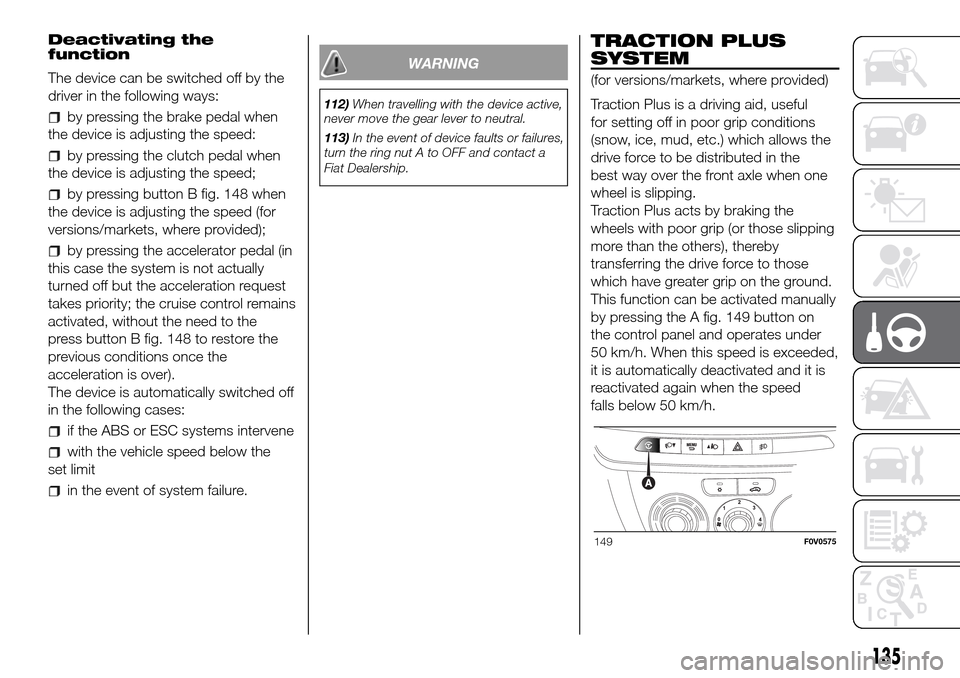
This function can be activated manually
by pressing the A fig. 149 button on
the control panel and operates under
50 km/h. When this speed is exceeded,
it is automatically deactivated and it is
reactivated again when the speed
falls below 50 km/h.
149F0V0575
135
Page 141 of 298
OPERATION WITH
TRAILER
Parking sensor operation is
automatically deactivated when the
electric cable plug of the trailer is
inserted into the vehicle tow hook
socket. The sensors are automatically
reactivated when the trailer's cable plug
is removed.
IMPORTANT
If you wish to leave the tow hook fitted
without towing a trailer, it is advisable to
contact a Fiat Dealership for the
relevant system update operations
because the tow hook could be
detected as an obstacle by the central
sensors.
GENERAL WARNINGS
115)
When parking, take the utmost care
over obstacles that may be above or
under the sensor.
Sometimes, objects located very
near the rear of the vehicle are not
detected and could therefore damage
the vehicle or be damaged themselves.
The following conditions may influence
the performance of the parking
assistance system:
Reduced sensor sensitivity and a
reduction in the parking assistance
system performance could be due to
the presence on the surface of the
sensor of: ice, snow, mud, thick paint.
The sensor may detect a non-
existent obstacle (echo noise) due to
mechanical noises, for example when
washing the vehicle, in case of rain,
strong wind, hail.
The signals sent out by the sensors
can be altered by dirt, snow or ice
deposited on the sensors or by
ultrasound systems (e.g. truck
pneumatic brakes or pneumatic drills)
near the vehicle.
The performance of the parking
assistance system may also be affected
by the position of the sensors. For
example by a change in the ride setting
(caused by the wear of the shock
absorbers, suspension), changing the
tyres, overloading the vehicle and
carrying out specific tuning operations
that require the vehicle to be lowered.
Detection of obstacles in the upper
part of the vehicle (particularly in the
case of vans or chassis cabs) may not
be guaranteed because the system
detects obstacles that could strike the
lower part of the vehicle.
The parking sensors work properly
with the swing doors closed.
If they are open, they can cause the
system to send false signals: always
close the rear doors.
Do not apply stickers to the sensors.
WARNING
114)The sensors must be clean of mud,
dirt, snow and ice in order for the system
to work. Be careful not to scratch or
damage the sensors while cleaning them.
Avoid using dry, rough or hard cloths.
The sensors must be washed using clean
water, with the addition of car shampoo
if necessary. When using special washing
equipment such as high pressure jets or
steam cleaning, clean the sensors very
quickly keeping the jet more than 10 cm
away.
115)Parking manoeuvres, however, are
always the driver’s responsibility. While
carrying out these manoeuvres, always
make sure that no people (especially
children) or animals are in the area
concerned. The parking sensor is designed
to assist drivers, who must still never
allow their attention to lapse during
potentially dangerous manoeuvres even if
performed at low speed.
137