clutch FIAT DOBLO COMBI 2016 2.G User Guide
[x] Cancel search | Manufacturer: FIAT, Model Year: 2016, Model line: DOBLO COMBI, Model: FIAT DOBLO COMBI 2016 2.GPages: 298, PDF Size: 25.92 MB
Page 178 of 298
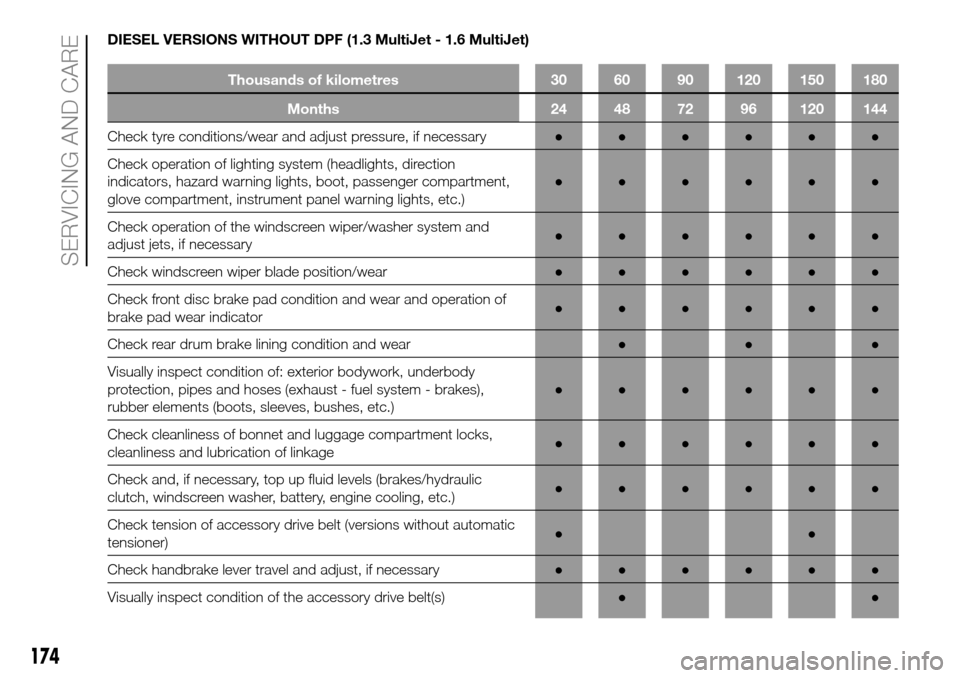
DIESEL VERSIONS WITHOUT DPF (1.3 MultiJet - 1.6 MultiJet)
Thousands of kilometres 30 60 90 120 150 180
Months 24 48 72 96 120 144
Check tyre conditions/wear and adjust pressure, if necessary●●●●●●
Check operation of lighting system (headlights, direction
indicators, hazard warning lights, boot, passenger compartment,
glove compartment, instrument panel warning lights, etc.)●●●●●●
Check operation of the windscreen wiper/washer system and
adjust jets, if necessary●●●●●●
Check windscreen wiper blade position/wear●●●●●●
Check front disc brake pad condition and wear and operation of
brake pad wear indicator●●●●●●
Check rear drum brake lining condition and wear●●●
Visually inspect condition of: exterior bodywork, underbody
protection, pipes and hoses (exhaust - fuel system - brakes),
rubber elements (boots, sleeves, bushes, etc.)●●●●●●
Check cleanliness of bonnet and luggage compartment locks,
cleanliness and lubrication of linkage●●●●●●
Check and, if necessary, top up fluid levels (brakes/hydraulic
clutch, windscreen washer, battery, engine cooling, etc.)●●●●●●
Check tension of accessory drive belt (versions without automatic
tensioner)●●
Check handbrake lever travel and adjust, if necessary●●●●●●
Visually inspect condition of the accessory drive belt(s)●●
174
SERVICING AND CARE
Page 180 of 298
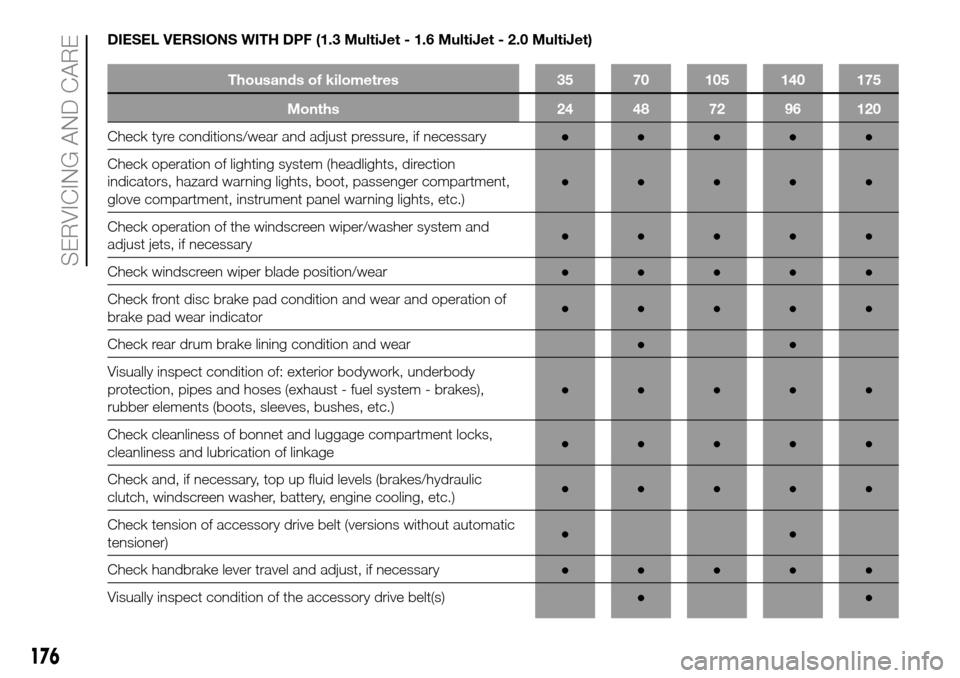
DIESEL VERSIONS WITH DPF (1.3 MultiJet - 1.6 MultiJet - 2.0 MultiJet)
Thousands of kilometres 35 70 105 140 175
Months 24 48 72 96 120
Check tyre conditions/wear and adjust pressure, if necessary●●●●●
Check operation of lighting system (headlights, direction
indicators, hazard warning lights, boot, passenger compartment,
glove compartment, instrument panel warning lights, etc.)●●●●●
Check operation of the windscreen wiper/washer system and
adjust jets, if necessary●●●●●
Check windscreen wiper blade position/wear●●●●●
Check front disc brake pad condition and wear and operation of
brake pad wear indicator●●●●●
Check rear drum brake lining condition and wear●●
Visually inspect condition of: exterior bodywork, underbody
protection, pipes and hoses (exhaust - fuel system - brakes),
rubber elements (boots, sleeves, bushes, etc.)●●●●●
Check cleanliness of bonnet and luggage compartment locks,
cleanliness and lubrication of linkage●●●●●
Check and, if necessary, top up fluid levels (brakes/hydraulic
clutch, windscreen washer, battery, engine cooling, etc.)●●●●●
Check tension of accessory drive belt (versions without automatic
tensioner)●●
Check handbrake lever travel and adjust, if necessary●●●●●
Visually inspect condition of the accessory drive belt(s)●●
176
SERVICING AND CARE
Page 211 of 298
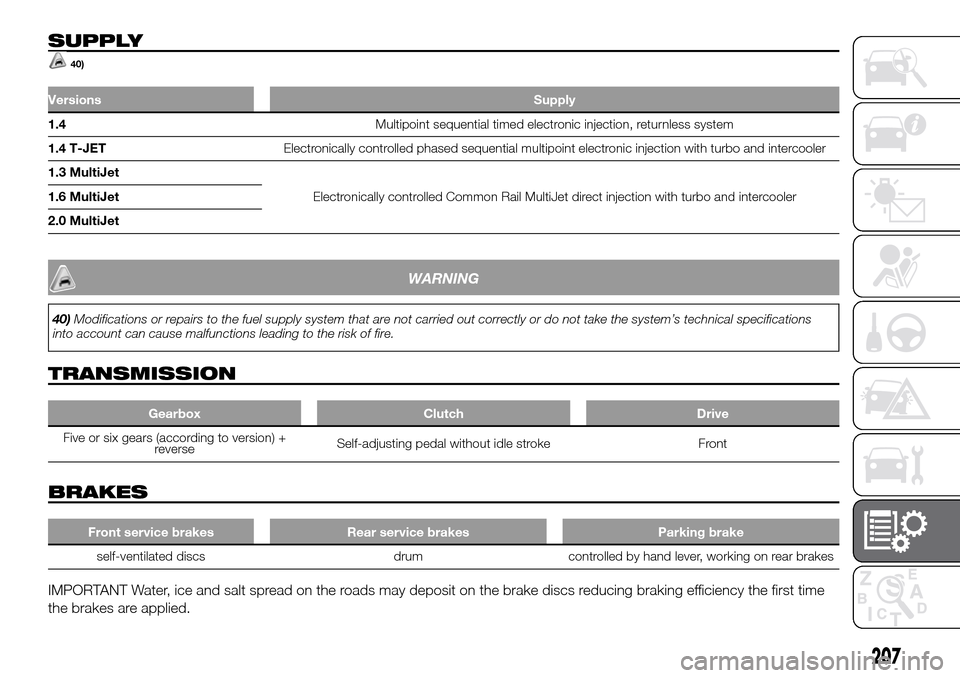
SUPPLY
40)
VersionsSupply
1.4Multipoint sequential timed electronic injection, returnless system
1.4 T-JETElectronically controlled phased sequential multipoint electronic injection with turbo and intercooler
1.3 MultiJet
Electronically controlled Common Rail MultiJet direct injection with turbo and intercooler 1.6 MultiJet
2.0 MultiJet
WARNING
40)Modifications or repairs to the fuel supply system that are not carried out correctly or do not take the system’s technical specifications
into account can cause malfunctions leading to the risk of fire.
TRANSMISSION
Gearbox Clutch Drive
Five or six gears (according to version) +
reverseSelf-adjusting pedal without idle stroke Front
BRAKES
Front service brakes Rear service brakes Parking brake
self-ventilated discs drum controlled by hand lever, working on rear brakes
IMPORTANT Water, ice and salt spread on the roads may deposit on the brake discs reducing braking efficiency the first time
the brakes are applied.
207
Page 255 of 298
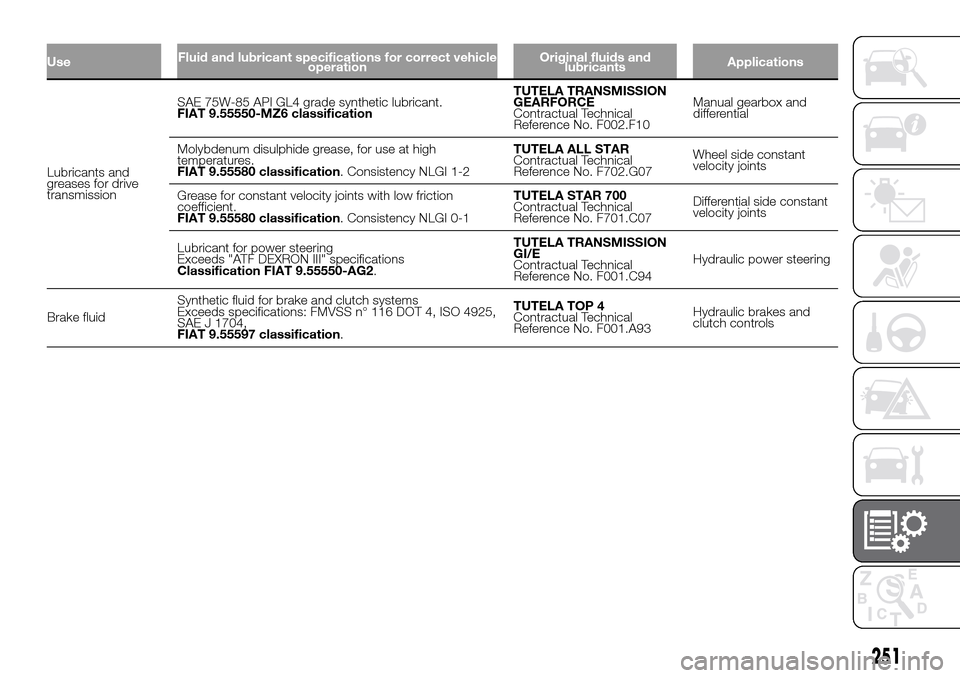
UseFluid and lubricant specifications for correct vehicle
operationOriginal fluids and
lubricantsApplications
Lubricants and
greases for drive
transmissionSAE 75W-85 API GL4 grade synthetic lubricant.
FIAT 9.55550-MZ6 classificationTUTELA TRANSMISSION
GEARFORCE
Contractual Technical
Reference No. F002.F10Manual gearbox and
differential
Molybdenum disulphide grease, for use at high
temperatures.
FIAT 9.55580 classification. Consistency NLGI 1-2TUTELA ALL STAR
Contractual Technical
Reference No. F702.G07Wheel side constant
velocity joints
Grease for constant velocity joints with low friction
coefficient.
FIAT 9.55580 classification. Consistency NLGI 0-1TUTELA STAR 700
Contractual Technical
Reference No. F701.C07Differential side constant
velocity joints
Lubricant for power steering
Exceeds "ATF DEXRON III" specifications
Classification FIAT 9.55550-AG2.TUTELA TRANSMISSION
GI/E
Contractual Technical
Reference No. F001.C94Hydraulic power steering
Brake fluidSynthetic fluid for brake and clutch systems
Exceeds specifications: FMVSS n° 116 DOT 4, ISO 4925,
SAE J 1704,
FIAT 9.55597 classification.TUTELA TOP 4
Contractual Technical
Reference No. F001.A93Hydraulic brakes and
clutch controls
251
Page 259 of 298
8. Use electrical devices only for the
amount of time needed. The vehicle’s
heated rear window, additional
headlights, screen wipers and heater
fan require a considerable amount
of energy; this increases fuel
consumption (by up to +25% in an
urban cycle).
9. Air conditioning leads to higher fuel
consumption (on average up to +30%).
If the temperature outside is not too
extreme, try and use the air vents.
Driving style
1. After starting the engine you should
drive away immediately and slowly,
avoiding high revs. Do not warm up the
engine at low or high revs when the
vehicle is stationary; this causes the
engine to warm up more slowly, thereby
increasing fuel consumption, emissions
and mechanical component wear.
2. Avoid pointless actions such
as revving up when at traffic lights or
before stopping the engine. The latter
action, like double-declutching, is
unnecessary and causes increased fuel
consumption and pollution.3. Gear selection: select a high gear as
soon as possible (taking into account
normal engine operation and traffic
conditions) without pushing the engine
to high revs during the intermediate
gears. Using low gears at high revs to
get lively acceleration increases fuel
consumption, harmful emissions and
engine wear.
4. Vehicle speed: fuel consumption
increases exponentially as the speed of
the vehicle increases. Keep your speed
moderate and as even as possible,
avoiding unnecessary braking and
acceleration, which cause excessive
fuel consumption and increased
emissions. Keeping a safe distance
from the vehicle in front helps to
maintain a steady speed.
5. Acceleration: accelerating violently
severely affects consumption and
emissions. Acceleration should be
gradual and should not exceed the
maximum engine torque rate.
255