seats FIAT DOBLO COMBI 2016 2.G User Guide
[x] Cancel search | Manufacturer: FIAT, Model Year: 2016, Model line: DOBLO COMBI, Model: FIAT DOBLO COMBI 2016 2.GPages: 298, PDF Size: 25.92 MB
Page 61 of 298
EMERGENCY OPENING
FROM THE INSIDE
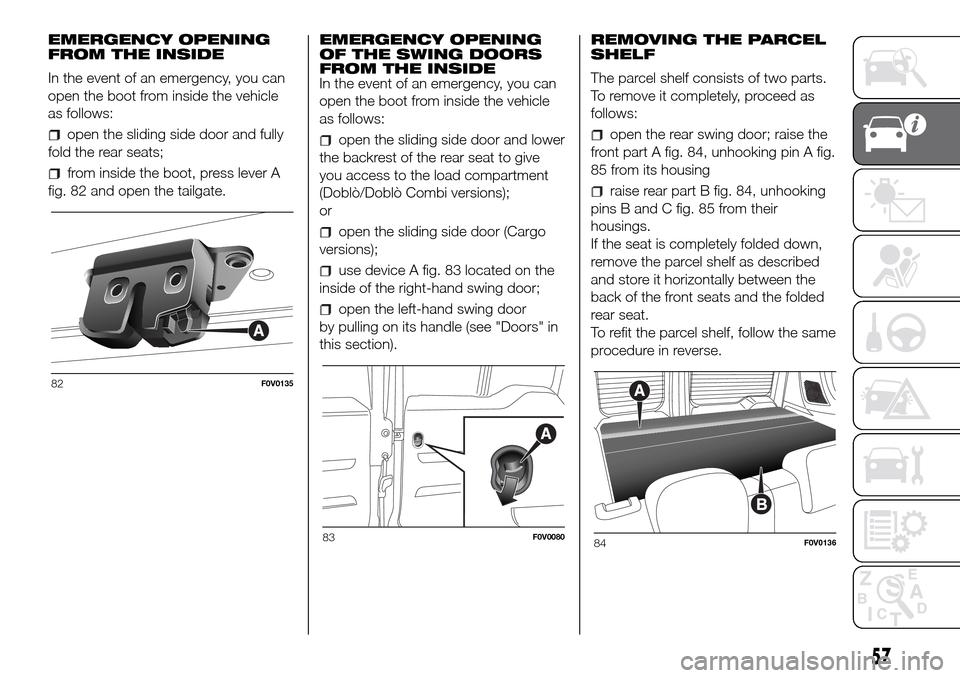
In the event of an emergency, you can
open the boot from inside the vehicle
as follows:
open the sliding side door and fully
fold the rear seats;
from inside the boot, press lever A
fig. 82 and open the tailgate.EMERGENCY OPENING
OF THE SWING DOORS
FROM THE INSIDE
In the event of an emergency, you can
open the boot from inside the vehicle
as follows:
open the sliding side door and lower
the backrest of the rear seat to give
you access to the load compartment
(Doblò/Doblò Combi versions);
or
open the sliding side door (Cargo
versions);
use device A fig. 83 located on the
inside of the right-hand swing door;
open the left-hand swing door
by pulling on its handle (see "Doors" in
this section).REMOVING THE PARCEL
SHELF
The parcel shelf consists of two parts.
To remove it completely, proceed as
follows:
open the rear swing door; raise the
front part A fig. 84, unhooking pin A fig.
85 from its housing
raise rear part B fig. 84, unhooking
pins B and C fig. 85 from their
housings.
If the seat is completely folded down,
remove the parcel shelf as described
and store it horizontally between the
back of the front seats and the folded
rear seat.
To refit the parcel shelf, follow the same
procedure in reverse.
82F0V0135
83F0V008084F0V0136
57
Page 62 of 298
EXTENDING THE BOOT
Proceed as follows:
open the rear doors and remove the
parcel shelf (as described previously);
completely lower the rear seat head
restraints;
move the seat belt to the side,
making sure that it is fully extended and
not twisted;
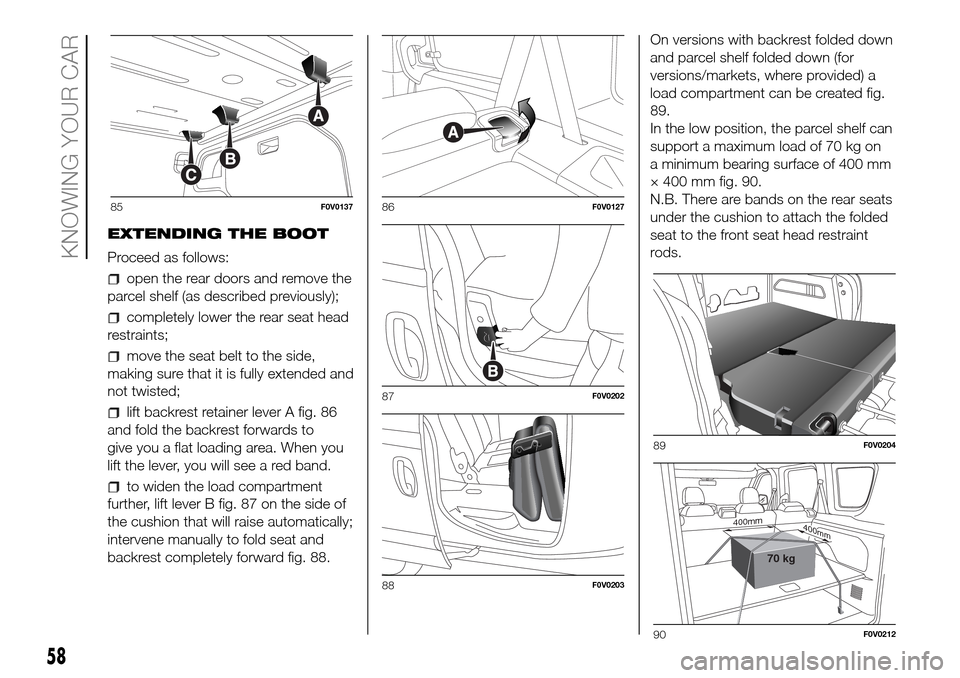
lift backrest retainer lever A fig. 86
and fold the backrest forwards to
give you a flat loading area. When you
lift the lever, you will see a red band.
to widen the load compartment
further, lift lever B fig. 87 on the side of
the cushion that will raise automatically;
intervene manually to fold seat and
backrest completely forward fig. 88.On versions with backrest folded down
and parcel shelf folded down (for
versions/markets, where provided) a
load compartment can be created fig.
89.
In the low position, the parcel shelf can
support a maximum load of 70 kg on
a minimum bearing surface of 400 mm
× 400 mm fig. 90.
N.B. There are bands on the rear seats
under the cushion to attach the folded
seat to the front seat head restraint
rods.
85F0V013786F0V0127
87F0V0202
88F0V0203
89F0V0204
400mm400mm
70 kg
90F0V0212
58
KNOWING YOUR CAR
Page 63 of 298
SECURING YOUR LOAD
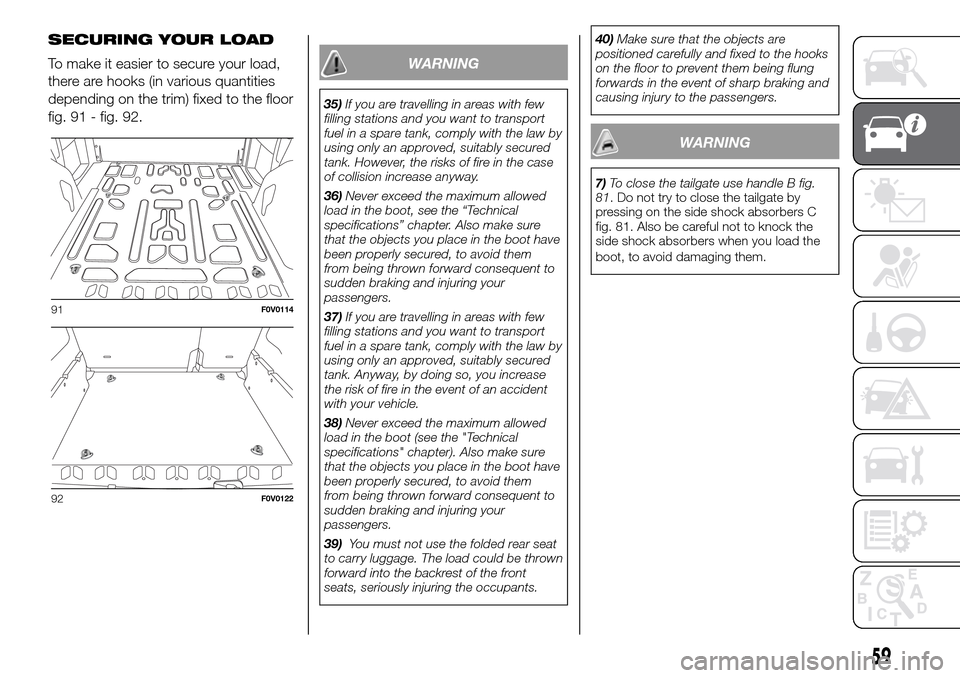
To make it easier to secure your load,
there are hooks (in various quantities
depending on the trim) fixed to the floor
fig. 91 - fig. 92.
WARNING
35)If you are travelling in areas with few
filling stations and you want to transport
fuel in a spare tank, comply with the law by
using only an approved, suitably secured
tank. However, the risks of fire in the case
of collision increase anyway.
36)Never exceed the maximum allowed
load in the boot, see the “Technical
specifications” chapter. Also make sure
that the objects you place in the boot have
been properly secured, to avoid them
from being thrown forward consequent to
sudden braking and injuring your
passengers.
37)If you are travelling in areas with few
filling stations and you want to transport
fuel in a spare tank, comply with the law by
using only an approved, suitably secured
tank. Anyway, by doing so, you increase
the risk of fire in the event of an accident
with your vehicle.
38)Never exceed the maximum allowed
load in the boot (see the "Technical
specifications" chapter). Also make sure
that the objects you place in the boot have
been properly secured, to avoid them
from being thrown forward consequent to
sudden braking and injuring your
passengers.
39)You must not use the folded rear seat
to carry luggage. The load could be thrown
forward into the backrest of the front
seats, seriously injuring the occupants.40)Make sure that the objects are
positioned carefully and fixed to the hooks
on the floor to prevent them being flung
forwards in the event of sharp braking and
causing injury to the passengers.
WARNING
7)To close the tailgate use handle B fig.
81. Do not try to close the tailgate by
pressing on the side shock absorbers C
fig. 81. Also be careful not to knock the
side shock absorbers when you load the
boot, to avoid damaging them.
91F0V0114
92F0V0122
59
Page 68 of 298
HEADLIGHTS
LIGHT BEAM ALIGNMENT
The correct alignment of the headlights
is essential for the comfort and safety
of the driver and other road users.
To ensure the best visibility when
travelling with the headlights on, the
headlight alignment must be correct.
Contact a Fiat Dealership to have
the headlights checked and adjusted.
HEADLIGHT ALIGNMENT
CORRECTOR
This device works with the ignition key
in the MAR position and the dipped
beam headlights on.
The vehicle tilts backwards when it is
laden, raising the beam. The beams
must therefore be realigned in this case.
Headlight alignment
adjustment
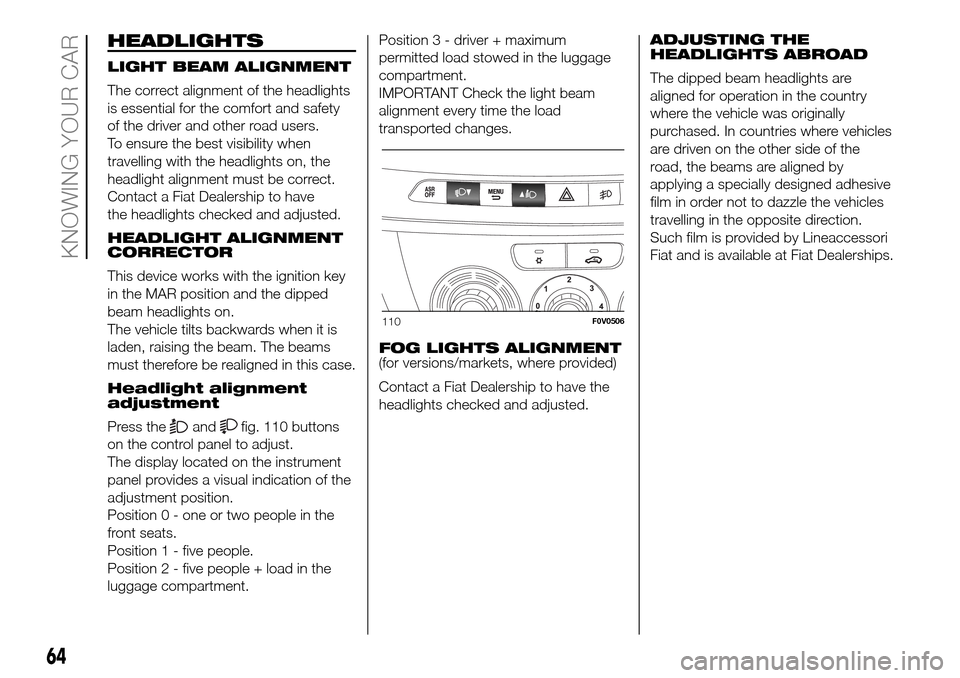
Press the
andfig. 110 buttons
on the control panel to adjust.
The display located on the instrument
panel provides a visual indication of the
adjustment position.
Position 0 - one or two people in the
front seats.
Position 1 - five people.
Position 2 - five people + load in the
luggage compartment.Position 3 - driver + maximum
permitted load stowed in the luggage
compartment.
IMPORTANT Check the light beam
alignment every time the load
transported changes.
FOG LIGHTS ALIGNMENT
(for versions/markets, where provided)
Contact a Fiat Dealership to have the
headlights checked and adjusted.ADJUSTING THE
HEADLIGHTS ABROAD
The dipped beam headlights are
aligned for operation in the country
where the vehicle was originally
purchased. In countries where vehicles
are driven on the other side of the
road, the beams are aligned by
applying a specially designed adhesive
film in order not to dazzle the vehicles
travelling in the opposite direction.
Such film is provided by Lineaccessori
Fiat and is available at Fiat Dealerships.
110F0V0506
64
KNOWING YOUR CAR
Page 108 of 298
OCCUPANT
PROTECTION
SYSTEMS
The most important safety equipment
of the vehicle comprises the following
protection systems:
seat belts;
SBR (Seat Belt Reminder) system;
head restraints;
child restraint systems;
front airbags and side bags.
Read the information given the
following pages with the utmost care. It
is of fundamental importance that the
protection systems are used in the
correct way to guarantee the maximum
possible safety level for the driver and
the passengers.
SEAT BELTS
USING THE SEAT BELTS
All vehicle seats are equipped with seat
belts with three anchor points and a
retractor. The retractor mechanism
operates locking the belt in the event of
sharp braking or strong deceleration
due to an impact.
This allows the belt strap to slide freely
and to adapt to the body of the
occupant. In the event of an accident,
the belt will lock reducing the risk of
impact inside the passenger
compartment and of being projected
outside the vehicle. The driver is
responsible for respecting, and
ensuring that all the other occupants of
the vehicle also respect, the local laws
in force in relation to the use of the seat
belts.
Always fasten the seat belts before
setting off.
The seat belt should be worn keeping
the chest straight and rested against
the backrest.
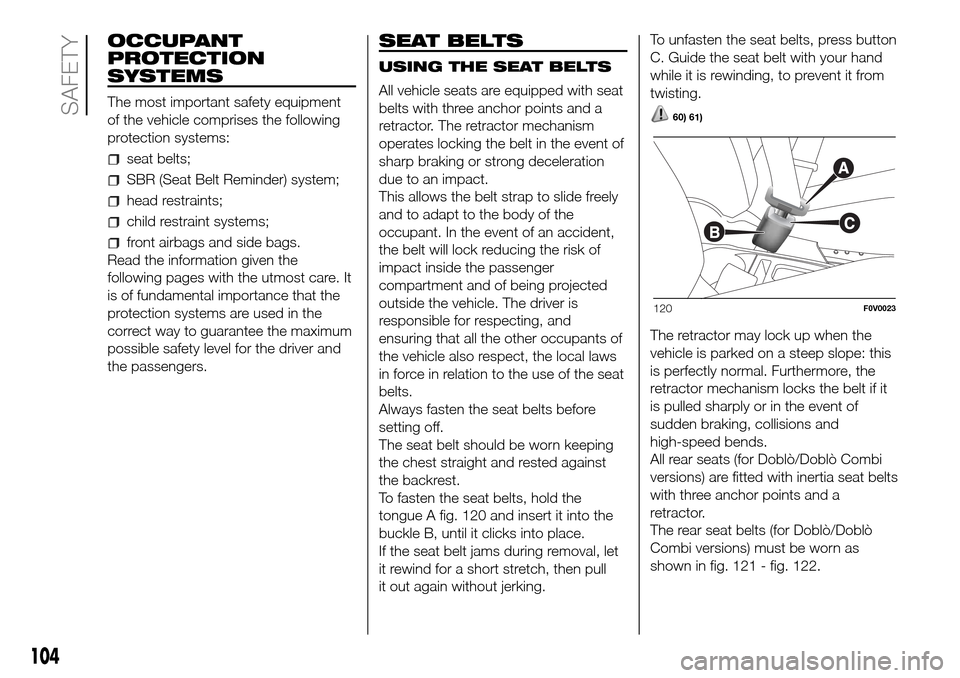
To fasten the seat belts, hold the
tongue A fig. 120 and insert it into the
buckle B, until it clicks into place.
If the seat belt jams during removal, let
it rewind for a short stretch, then pull
it out again without jerking.To unfasten the seat belts, press button
C. Guide the seat belt with your hand
while it is rewinding, to prevent it from
twisting.
60) 61)
The retractor may lock up when the
vehicle is parked on a steep slope: this
is perfectly normal. Furthermore, the
retractor mechanism locks the belt if it
is pulled sharply or in the event of
sudden braking, collisions and
high-speed bends.
All rear seats (for Doblò/Doblò Combi
versions) are fitted with inertia seat belts
with three anchor points and a
retractor.
The rear seat belts (for Doblò/Doblò
Combi versions) must be worn as
shown in fig. 121 - fig. 122.
120F0V0023
104
SAFETY
Page 109 of 298
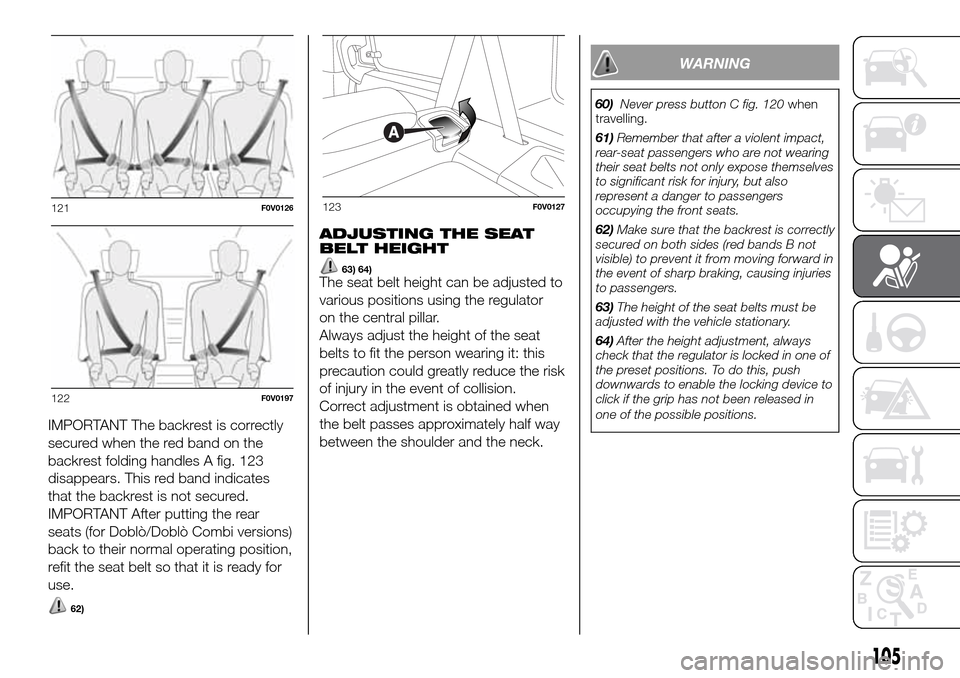
IMPORTANT The backrest is correctly
secured when the red band on the
backrest folding handles A fig. 123
disappears. This red band indicates
that the backrest is not secured.
IMPORTANT After putting the rear
seats (for Doblò/Doblò Combi versions)
back to their normal operating position,
refit the seat belt so that it is ready for
use.
62)
ADJUSTING THE SEAT
BELT HEIGHT
63) 64)The seat belt height can be adjusted to
various positions using the regulator
on the central pillar.
Always adjust the height of the seat
belts to fit the person wearing it: this
precaution could greatly reduce the risk
of injury in the event of collision.
Correct adjustment is obtained when
the belt passes approximately half way
between the shoulder and the neck.
WARNING
60)Never press button C fig. 120when
travelling.
61)Remember that after a violent impact,
rear-seat passengers who are not wearing
their seat belts not only expose themselves
to significant risk for injury, but also
represent a danger to passengers
occupying the front seats.
62)Make sure that the backrest is correctly
secured on both sides (red bands B not
visible) to prevent it from moving forward in
the event of sharp braking, causing injuries
to passengers.
63)The height of the seat belts must be
adjusted with the vehicle stationary.
64)After the height adjustment, always
check that the regulator is locked in one of
the preset positions. To do this, push
downwards to enable the locking device to
click if the grip has not been released in
one of the possible positions.
121F0V0126
122F0V0197
123F0V0127
105
Page 112 of 298
WARNING
65)The pretensioner may be used only
once. After it is triggered, have it replaced
at a Fiat Dealership.
66)For maximum safety, keep the backrest
upright, lean back into it and make sure
the seat belt fits closely across your chest
and pelvis. Always fasten the seat belts
on both the front and the rear seats!
Travelling without wearing seat belts will
increase the risk of serious injury and even
death in the event of an accident.
67)If the belt has been sharply pulled, for
example as the result of an accident, the
seat belt, together with the anchoring
devices, the anchoring device fixing screws
and the pretensioner must be completely
replaced. Even if the belt does not present
any exterior signs of wear or damage, it
may have lost its restraining properties.
WARNING
16)Operations which lead to knocks,
vibrations or localised heating (over 100°C
for a maximum of 6 hours) in the area
around the pretensioners may cause
damage or trigger them. These devices are
not affected by vibrations caused by
irregularities of the road surface or low
obstacles such as kerbs, etc. Contact a
Fiat Dealership for any assistance.
CARRYING
CHILDREN SAFELY
For optimal protection in the event of an
impact, all passengers must be seated
and wearing adequate restraint
systems.
This is even more important for
children.
This prescription is compulsory in all EU
countries according to EC Directive
2003/20/EC.
Compared with an adult, a child's head
is larger and heavier in proportion to
their body and the child's muscular and
bone structures are not fully developed.
Therefore, correct restraint systems
other than adult seat belts are
necessary to reduce as much as
possible the risk of injuries in the event
of an accident, braking or a sudden
manoeuvre.
Children must be seated safely and
comfortably.
Depending on the characteristics of the
child restraint systems used, you are
advised to keep children in rear-facing
child restraint systems for as long as
possible (at least until 3-4 years old),
since this is the most protected position
in the event of an impact.It is recommended to always choose
the restraint system most suitable
for the child; for this reason always refer
to the Owner Handbook provided with
the child restraint system, to be sure
that it is of the right type for the children
it is intended for.
When over 1.50 m in height, from the
point of view of restraint systems,
children are considered as adults and
wear seat belts normally.
In Europe child restraint systems are
classified, among other criteria, into five
weight groups:
Group Weight groups
Group 0up to 10 kg in
weight
Group 0+up to 13 kg in
weight
Group 1 9 - 18 kg
Group 2 15 - 25 kg
Group 3 22 - 36 kg
All restraint devices must bear the
certification data, together with the
control mark, on a label solidly fixed to
the child restraint system which must
never be removed.
Lineaccessori Fiat offers child restraint
systems for each weight group. These
devices are recommended having been
specifically designed for Fiat vehicles.
108
SAFETY
Page 114 of 298
PASSENGER SEAT COMPLIANCE WITH REGULATIONS ON UNIVERSAL CHILD
RESTRAINT SYSTEM USE
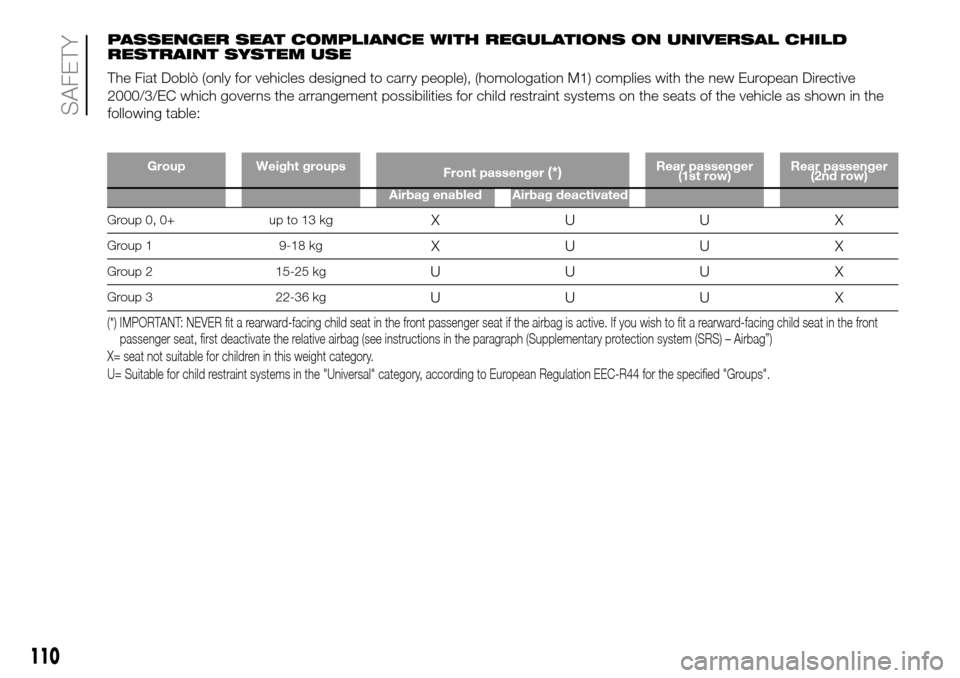
The Fiat Doblò (only for vehicles designed to carry people), (homologation M1) complies with the new European Directive
2000/3/EC which governs the arrangement possibilities for child restraint systems on the seats of the vehicle as shown in the
following table:
110
SAFETY
Group Weight groups
Front passenger(*)Rear passenger
(1st row)Rear passenger
(2nd row)
Airbag enabled Airbag deactivated
Group 0, 0+ up to 13 kgXUUX
Group 1 9-18 kgXUUX
Group 2 15-25 kgUUU X
Group 3 22-36 kgUUU X
(*) IMPORTANT: NEVER fit a rearward-facing child seat in the front passenger seat if the airbag is active. If you wish to fit a rearward-facing child seat in the front
passenger seat, first deactivate the relative airbag (see instructions in the paragraph (Supplementary protection system (SRS) – Airbag”)
X= seat not suitable for children in this weight category.
U= Suitable for child restraint systems in the "Universal" category, according to European Regulation EEC-R44 for the specified "Groups".
Page 115 of 298
WARNING
68)SERIOUS DANGER: When an active passenger airbag is fitted, DO NOT install rear facing child restraint systems on the front seat.
Deployment of the airbag in an accident could cause fatal injuries to the child regardless of the severity of the impact. It is advisable to always
carry children in a child restraint system on the rear seat, which is the most protected position in the event of a collision. Should it be
necessary to carry a child on the passenger side front seat in a rear-facing child restraint system, the passenger side front airbag and side
bag (for versions/markets, where provided) must be deactivated through the Setup menu. Deactivation should be verified by checking that
the
warning light above the front courtesy light is switched on. Move the passenger's seat as far back as possible to avoid contact
between the child seat and the dashboard.
69)The figures are only examples for fitting purposes. Fit the child restraint system according to the instructions, which must be included.
70)Child seats with Isofix attachments are available for a safe anchoring to the seat without using the car seat belts. Follow the assembly
instructions carefully.
111
Page 118 of 298
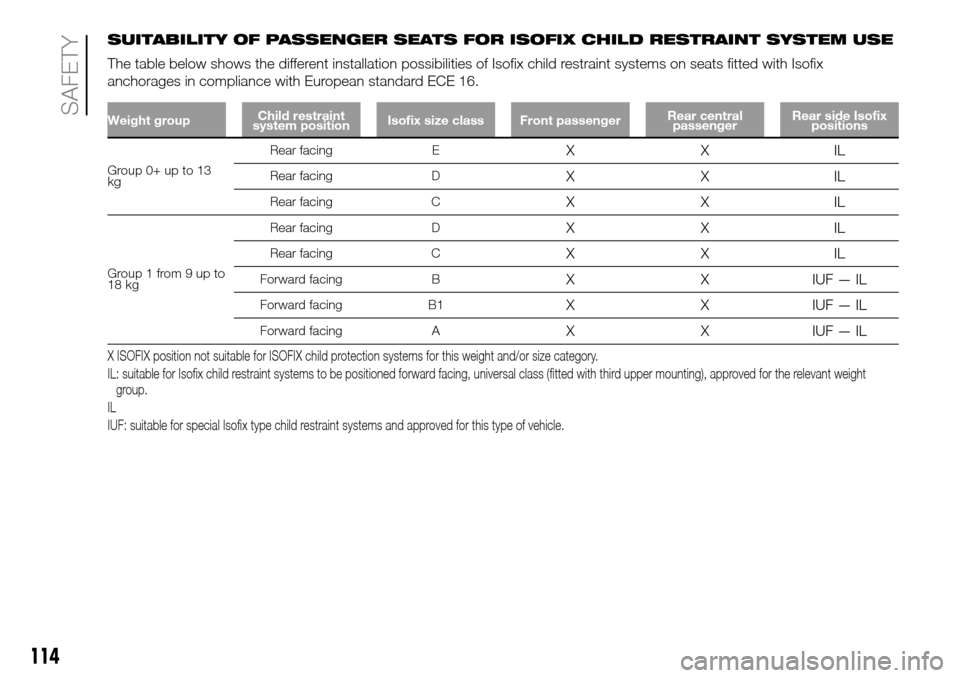
SUITABILITY OF PASSENGER SEATS FOR ISOFIX CHILD RESTRAINT SYSTEM USE
The table below shows the different installation possibilities of Isofix child restraint systems on seats fitted with Isofix
anchorages in compliance with European standard ECE 16.
Weight groupChild restraint
system positionIsofix size class Front passengerRear central
passengerRear side Isofix
positions
Group 0+ up to 13
kgRear facing E
XXIL
Rear facing DXXIL
Rear facing CXXIL
Group1from9upto
18 kgRear facing D
XXIL
Rear facing CXXIL
Forward facing BX X IUF — IL
Forward facing B1X X IUF — IL
Forward facing AX X IUF — IL
X ISOFIX position not suitable for ISOFIX child protection systems for this weight and/or size category.
IL: suitable for Isofix child restraint systems to be positioned forward facing, universal class (fitted with third upper mounting), approved for the relevant weight
group.
IL
IUF: suitable for special Isofix type child restraint systems and approved for this type of vehicle.
114
SAFETY