ABS FIAT DOBLO COMBI 2016 2.G Owner's Manual
[x] Cancel search | Manufacturer: FIAT, Model Year: 2016, Model line: DOBLO COMBI, Model: FIAT DOBLO COMBI 2016 2.GPages: 298, PDF Size: 25.92 MB
Page 194 of 298
BATTERY
The battery is of the “limited
maintenance” type: under normal
conditions of use, the electrolyte does
not need topping up with distilled water.
It does, however, need to be checked
periodically at a Fiat Dealership or
by specialist personnel to make sure it
is working correctly.
143) 144)
REPLACING THE
BATTERY
If required, replace the battery with an
original spare part with the same
specifications.
If a battery with different specifications
is fitted, the service intervals given in
the “Scheduled Servicing Plan” will no
longer be valid.
Follow the battery manufacturer's
instructions for maintenance.
37) 38)
4)
145)
USEFUL TIPS FOR
EXTENDING BATTERY
LIFE
To avoid draining your battery and
make it last longer, observe the
following instructions:
when you park the vehicle, ensure
that the doors, tailgate and bonnet are
closed properly, to prevent any roof
lights from remaining on inside the
passenger's compartment;
switch off all roof lights inside the
vehicle: the vehicle is however
equipped with a system which switches
all internal lights off automatically;
do not keep accessories (e.g. radio,
hazard warning lights, etc.) switched
on for a long time when the engine
is not running;
before performing any operation on
the electrical system, disconnect the
negative battery pole;
completely tighten the battery
terminals.
IMPORTANT If the charge level remains
under 50% for a long time, the battery
is damaged by sulphation, reducing
its capacity and efficiency at starting.The battery is also more prone to the
risk of freezing (already at temperatures
of -10°C). Refer to the paragraph
"Vehicle inactivity" in "Starting and
driving" if the vehicle is left parked for a
long time.
If, after buying the vehicle, you want to
install electric accessories which require
permanent electric supply (alarm, etc.)
contact a Fiat Dealership whose
qualified personnel, in addition to
suggesting the most suitable devices
from the Lineaccessori Fiat, will
evaluate the overall electric absorption,
checking whether the vehicle's
electrical system is capable of
withstanding the load required, or
whether it should be integrated with a
more powerful battery.
Since some of these devices continue
to consume electricity even when
the engine is off, they gradually run
down the battery.
WARNING
143)Battery fluid is poisonous and
corrosive. Avoid contact with skin and
eyes. Keep naked flames or possible
sources of sparks away from the battery:
risk of explosion or fire.
144)Using the battery when the fluid is too
low can damage it irreparably and generate
a risk of explosion.
190
SERVICING AND CARE
Page 195 of 298
145)When performing any operation on
the battery or near it, always protect your
eyes with special goggles.
WARNING
37)Incorrect assembly of electrical and
electronic devices may cause severe
damage to your vehicle. Contact a Fiat
Dealership if you want to install
accessories (alarms, radiophone, etc.):
they will suggest the most suitable devices
and advise you if a higher capacity battery
needs to be installed.
38)If the vehicle needs to be off the road
for a long period under conditions of
intense cold, remove the battery and take it
to a heated location, otherwise it may
freeze.
WARNING
4)Batteries contain substances which are
very dangerous for the environment. To
replace your battery, we recommend
contacting your Fiat Dealership to dispose
of your old battery in full respect of the
environment and in compliance with all
applicable laws and regulations.
BATTERY
RECHARGING
IMPORTANT The battery recharging
procedure is given as information only.
This operation should be performed
at a Fiat Dealership.
Charging should be slow at a low
ampere rating for approximately 24
hours. Charging for a long time may
damage the battery.
To recharge, proceed as follows:
IN THE ABSENCE OF THE
START&STOP SYSTEM
disconnect the terminal from the
negative battery pole;
connect the charger cables to the
battery terminals, observing the poles;
turn on the charger;
when you have finished, turn the
charger off before disconnecting it from
the battery;
reconnect the negative battery
terminal.WITH START&STOP
SYSTEM
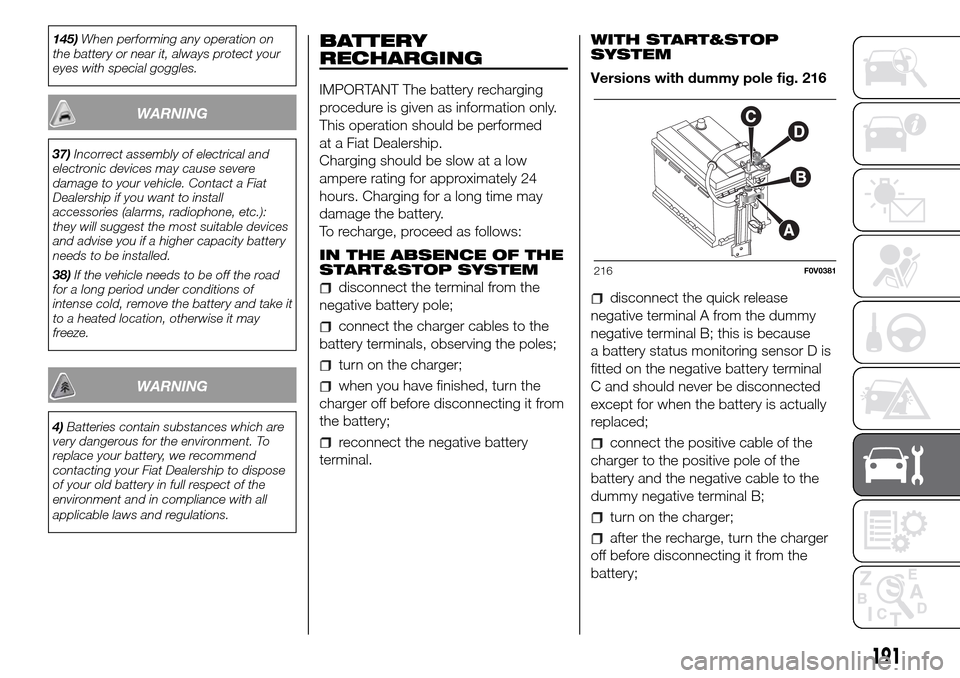
Versions with dummy pole fig. 216
disconnect the quick release
negative terminal A from the dummy
negative terminal B; this is because
a battery status monitoring sensor D is
fitted on the negative battery terminal
C and should never be disconnected
except for when the battery is actually
replaced;
connect the positive cable of the
charger to the positive pole of the
battery and the negative cable to the
dummy negative terminal B;
turn on the charger;
after the recharge, turn the charger
off before disconnecting it from the
battery;
216F0V0381
191
Page 212 of 298
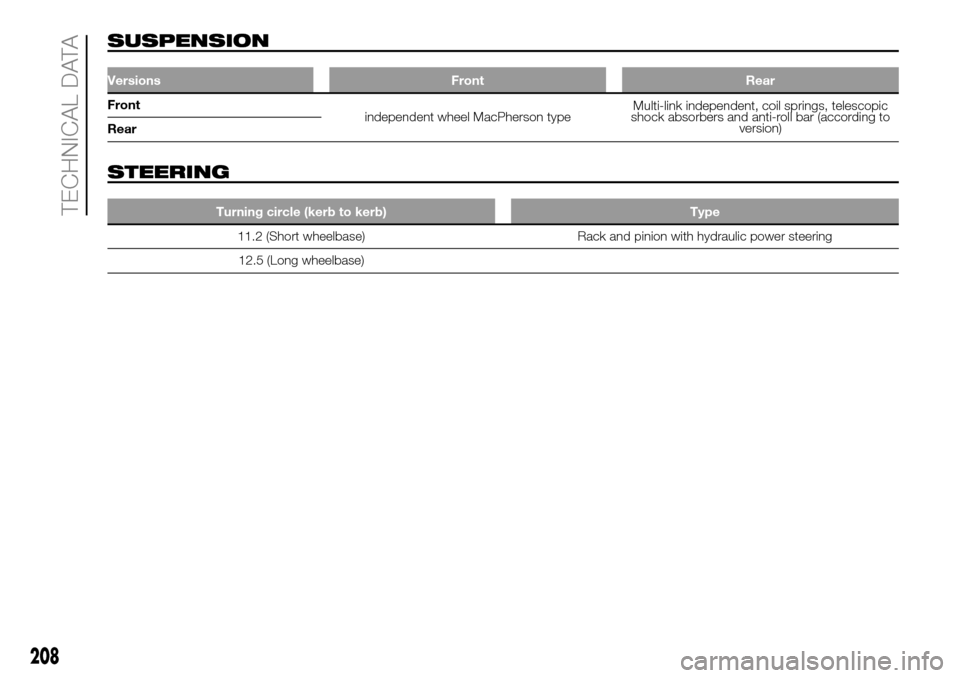
SUSPENSION
Versions Front Rear
Front
independent wheel MacPherson typeMulti-link independent, coil springs, telescopic
shock absorbers and anti-roll bar (according to
version)
Rear
STEERING
Turning circle (kerb to kerb) Type
11.2 (Short wheelbase) Rack and pinion with hydraulic power steering
12.5 (Long wheelbase)
208
TECHNICAL DATA
Page 252 of 298
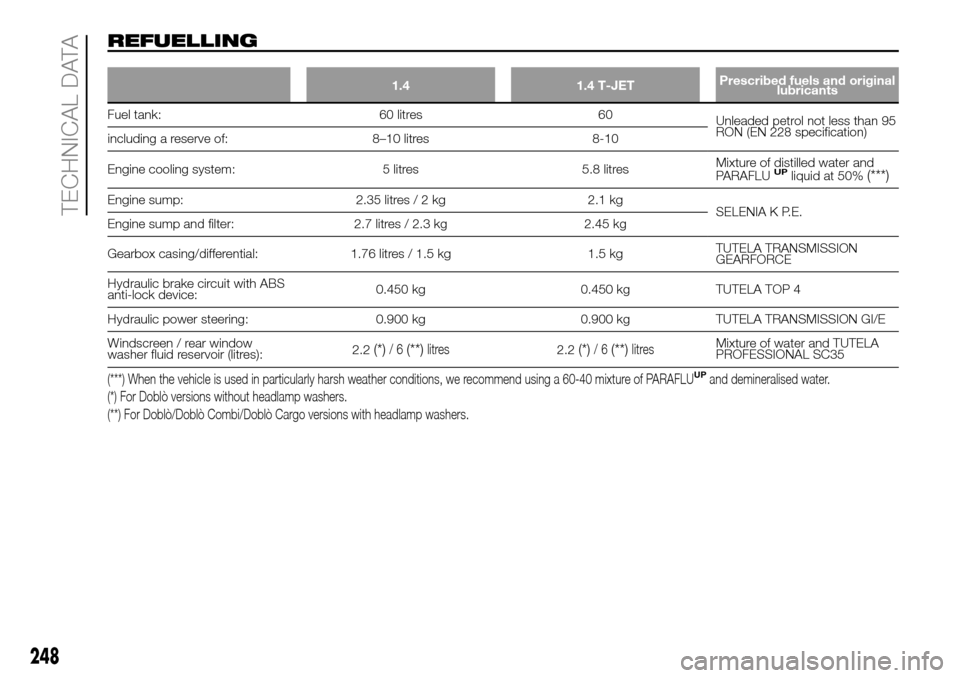
REFUELLING
1.4 1.4 T-JETPrescribed fuels and original
lubricants
Fuel tank: 60 litres 60
Unleaded petrol not less than 95
RON (EN 228 specification)
including a reserve of: 8–10 litres 8-10
Engine cooling system: 5 litres 5.8 litresMixture of distilled water and
PARAFLU
UPliquid at 50%(***)
Engine sump: 2.35 litres/2kg 2.1kg
SELENIA K P.E.
Engine sump and filter: 2.7 litres / 2.3 kg 2.45 kg
Gearbox casing/differential: 1.76 litres / 1.5 kg 1.5 kgTUTELA TRANSMISSION
GEARFORCE
Hydraulic brake circuit with ABS
anti-lock device:0.450 kg 0.450 kg TUTELA TOP 4
Hydraulic power steering: 0.900 kg 0.900 kg TUTELA TRANSMISSION GI/E
Windscreen / rear window
washer fluid reservoir (litres):2.2
(*)/6(**)litres2.2(*)/6(**)litresMixture of water and TUTELA
PROFESSIONAL SC35
(***) When the vehicle is used in particularly harsh weather conditions, we recommend using a 60-40 mixture of PARAFLUUPand demineralised water.
(*) For Doblò versions without headlamp washers.
(**) For Doblò/Doblò Combi/Doblò Cargo versions with headlamp washers.
248
TECHNICAL DATA
Page 253 of 298
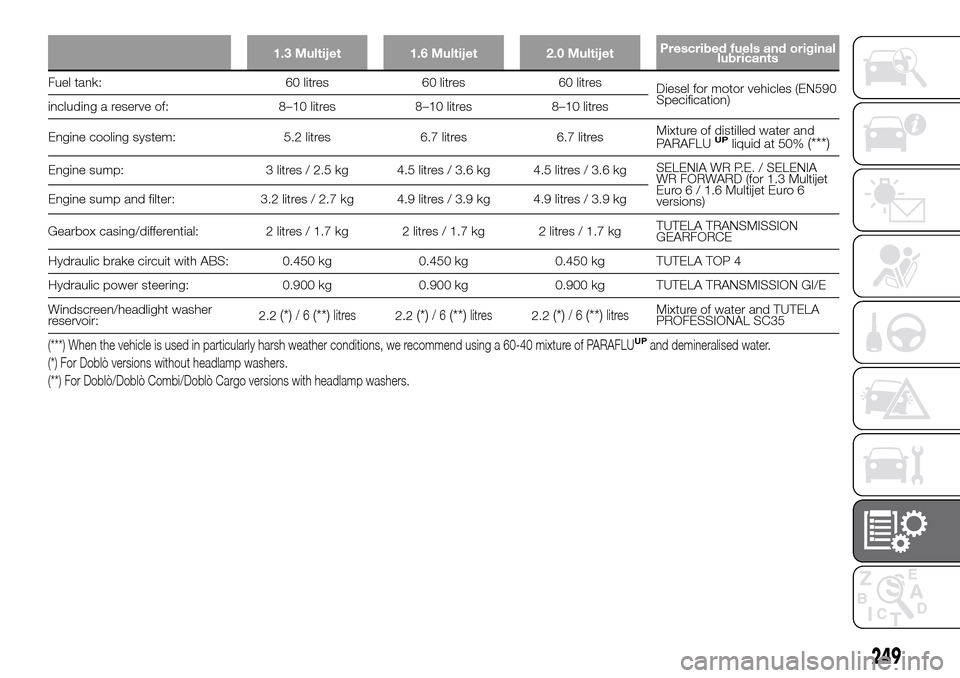
1.3 Multijet 1.6 Multijet 2.0 MultijetPrescribed fuels and original
lubricants
Fuel tank: 60 litres 60 litres 60 litres
Diesel for motor vehicles (EN590
Specification)
including a reserve of: 8–10 litres 8–10 litres 8–10 litres
Engine cooling system: 5.2 litres 6.7 litres 6.7 litresMixture of distilled water and
PARAFLU
UPliquid at 50%(***)
Engine sump: 3 litres / 2.5 kg 4.5 litres / 3.6 kg 4.5 litres / 3.6 kgSELENIA WR P.E. / SELENIA
WR FORWARD (for 1.3 Multijet
Euro 6 / 1.6 Multijet Euro 6
versions) Engine sump and filter: 3.2 litres / 2.7 kg 4.9 litres / 3.9 kg 4.9 litres / 3.9 kg
Gearbox casing/differential: 2 litres / 1.7 kg 2 litres / 1.7 kg 2 litres / 1.7 kgTUTELA TRANSMISSION
GEARFORCE
Hydraulic brake circuit with ABS: 0.450 kg 0.450 kg 0.450 kg TUTELA TOP 4
Hydraulic power steering: 0.900 kg 0.900 kg 0.900 kg TUTELA TRANSMISSION GI/E
Windscreen/headlight washer
reservoir:2.2
(*)/6(**)litres2.2(*)/6(**)litres2.2(*)/6(**)litresMixture of water and TUTELA
PROFESSIONAL SC35
(***) When the vehicle is used in particularly harsh weather conditions, we recommend using a 60-40 mixture of PARAFLUUPand demineralised water.
(*) For Doblò versions without headlamp washers.
(**) For Doblò/Doblò Combi/Doblò Cargo versions with headlamp washers.
249
Page 258 of 298
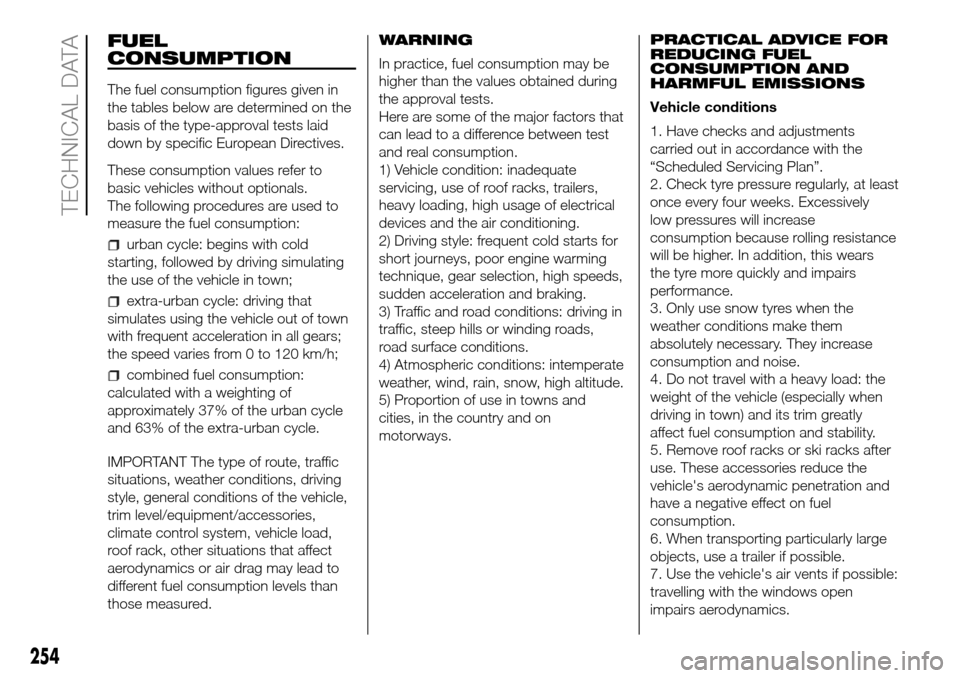
FUEL
CONSUMPTION
The fuel consumption figures given in
the tables below are determined on the
basis of the type-approval tests laid
down by specific European Directives.
These consumption values refer to
basic vehicles without optionals.
The following procedures are used to
measure the fuel consumption:
urban cycle: begins with cold
starting, followed by driving simulating
the use of the vehicle in town;
extra-urban cycle: driving that
simulates using the vehicle out of town
with frequent acceleration in all gears;
the speed varies from 0 to 120 km/h;
combined fuel consumption:
calculated with a weighting of
approximately 37% of the urban cycle
and 63% of the extra-urban cycle.
IMPORTANT The type of route, traffic
situations, weather conditions, driving
style, general conditions of the vehicle,
trim level/equipment/accessories,
climate control system, vehicle load,
roof rack, other situations that affect
aerodynamics or air drag may lead to
different fuel consumption levels than
those measured.WARNING
In practice, fuel consumption may be
higher than the values obtained during
the approval tests.
Here are some of the major factors that
can lead to a difference between test
and real consumption.
1) Vehicle condition: inadequate
servicing, use of roof racks, trailers,
heavy loading, high usage of electrical
devices and the air conditioning.
2) Driving style: frequent cold starts for
short journeys, poor engine warming
technique, gear selection, high speeds,
sudden acceleration and braking.
3) Traffic and road conditions: driving in
traffic, steep hills or winding roads,
road surface conditions.
4) Atmospheric conditions: intemperate
weather, wind, rain, snow, high altitude.
5) Proportion of use in towns and
cities, in the country and on
motorways.PRACTICAL ADVICE FOR
REDUCING FUEL
CONSUMPTION AND
HARMFUL EMISSIONS
Vehicle conditions
1. Have checks and adjustments
carried out in accordance with the
“Scheduled Servicing Plan”.
2. Check tyre pressure regularly, at least
once every four weeks. Excessively
low pressures will increase
consumption because rolling resistance
will be higher. In addition, this wears
the tyre more quickly and impairs
performance.
3. Only use snow tyres when the
weather conditions make them
absolutely necessary. They increase
consumption and noise.
4. Do not travel with a heavy load: the
weight of the vehicle (especially when
driving in town) and its trim greatly
affect fuel consumption and stability.
5. Remove roof racks or ski racks after
use. These accessories reduce the
vehicle's aerodynamic penetration and
have a negative effect on fuel
consumption.
6. When transporting particularly large
objects, use a trailer if possible.
7. Use the vehicle's air vents if possible:
travelling with the windows open
impairs aerodynamics.
254
TECHNICAL DATA
Page 294 of 298
INDEX
"
Universal" child restraint
system fitting
................................ 114
ABS system
.................................. 100
Accessories purchased by the
owner .......................................... 5
Active safety systems ..................... 100
Advice for preserving the
bodywork..................................... 196
Air cleaner/pollen filter .................... 189
Ashtray .......................................... 62
ASR system ................................... 102
Automatic climate control
system ......................................... 47
Battery
.......................................... 190
Battery recharging.......................... 191
Blades ........................................... 192
Body paintwork identification
plate............................................. 200
Bodywork ...................................... 196
Bodywork version .......................... 202
Bonnet ........................................... 55
Boot............................................... 56
Brake fluid ...................................... 187
Brakes
– features ..................................... 207
Bump starting ................................ 165
Carrying children safely
................. 108
– child restraint systems ............... 114Changing a wheel .......................... 158
Chassis marking ............................ 200
Child restraint systems (suitability
for use)......................................... 110
Child safety device ......................... 20
Cigarette lighter .............................. 62
CO2 emissions............................... 268
Control panel and on-board
instruments .................................. 68
Controls ......................................... 54
Cruise Control ................................ 133
Daytime running lights
.................. 32
Dead lock ...................................... 15
Demanding vehicle use .................. 178
Diesel filter ..................................... 189
Diffusers ......................................... 40
Digital display ................................. 70
– Control buttons ......................... 71
– Set-up menu ............................. 71
Dipped headlights .......................... 32.......................... 147
Direction indicators ........................ 33........................ 148
Door mirrors ................................... 31
Doors ............................................. 18
Draining condensation (MultiJet
versions) ...................................... 189
Driver side armrest ......................... 60
Driver's side front airbag ................ 117
Electric windows
.......................... 52
– Initialisation................................ 53
Emergency starting ........................ 125........................ 165Engine
– technical specifications.............. 204
Engine codes ................................. 202
Engine compartment...................... 179
Engine compartment control unit
fuses ............................................ 153
Engine coolant ............................... 187
Engine marking .............................. 201
Engine oil ....................................... 187
EOBD system ................................ 82
ESC system ................................... 101
External lights................................. 32
Fastening the tow hook
................. 167
Fiat CODE system.......................... 17
Fix&Go automatic quick tyre
repair kit ....................................... 162
Fluids and lubricants ...................... 250
Fog lights ....................................... 54....................................... 148
Follow Me Home ............................ 33
Follow Me Home device ................. 33
Front airbags .................................. 116
Front bench .................................. 26
Front light clusters .......................... 147
Front roof light ................................ 150
Fuel consumption .......................... 254
Fuel cut-off system......................... 166
Fuses on compartment wired
casing .......................................... 154
Glove compartment
...................... 60