wheel FIAT DOBLO COMBI 2016 2.G Owner's Guide
[x] Cancel search | Manufacturer: FIAT, Model Year: 2016, Model line: DOBLO COMBI, Model: FIAT DOBLO COMBI 2016 2.GPages: 298, PDF Size: 25.92 MB
Page 162 of 298
CHANGING A WHEEL
The vehicle is originally equipped with
the Fix&Go automatic quick tyre repair
kit (see instructions in the next section).
As an alternative, the vehicle may
have a normal-sized spare wheel.
Wheel changing and correct use of the
jack and spare wheel call for some
precautions, as listed below.
125) 126) 127) 128)
Note for one-way tyres
One-way tyres have a few arrows on
the side indicating the rotation direction.
If a wheel is changed (when punctured,
for example) the direction of the arrows
on the spare wheel tyre may not
coincide with the rotation direction of
the wheel to be replaced.
In these conditions, too, the tyre still
maintains its safety features.
Anyway, it is recommended to have the
wheel repaired and refitted as soon as
possible, as the best performance is
achieved when the rotation direction of
all tyres coincides with the one
indicated by the arrows.
Please note that:
the jack weight is 4 kg;
the jack requires no adjustment;
the jack cannot be repaired and in
the event of a fault it must be replaced
by another original one;
no tool other than its cranking
device may be fitted on the jack.
To change a wheel, proceed as follows:
stop the vehicle in a position that is
not dangerous for oncoming traffic
where you can change the wheel safely.
The ground should be flat if possible,
and sufficiently firm;
stop the engine and pull the
handbrake;
engage first gear or reverse;
wear the reflective safety jacket
(compulsory by law in certain countries)
before getting out of the vehicle;
indicate that the vehicle has broken
down using the devices required by
the law in the current country (e.g.
warning triangle, hazard lights, etc.);
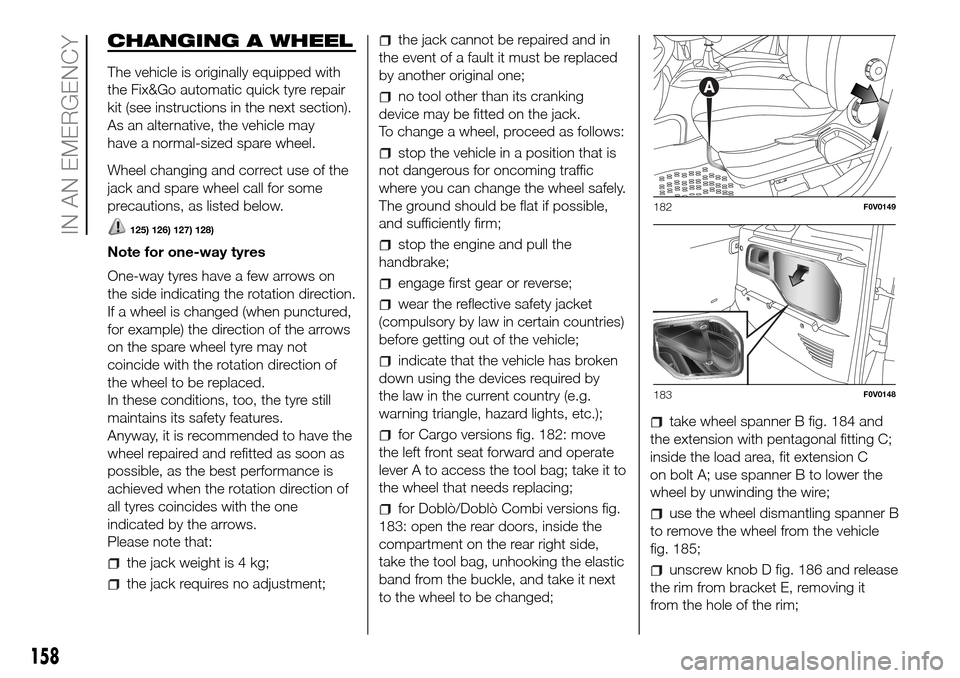
for Cargo versions fig. 182: move
the left front seat forward and operate
lever A to access the tool bag; take it to
the wheel that needs replacing;
for Doblò/Doblò Combi versions fig.
183: open the rear doors, inside the
compartment on the rear right side,
take the tool bag, unhooking the elastic
band from the buckle, and take it next
to the wheel to be changed;
take wheel spanner B fig. 184 and
the extension with pentagonal fitting C;
inside the load area, fit extension C
on bolt A; use spanner B to lower the
wheel by unwinding the wire;
use the wheel dismantling spanner B
to remove the wheel from the vehicle
fig. 185;
unscrew knob D fig. 186 and release
the rim from bracket E, removing it
from the hole of the rim;
182F0V0149
183F0V0148
158
IN AN EMERGENCY
Page 163 of 298
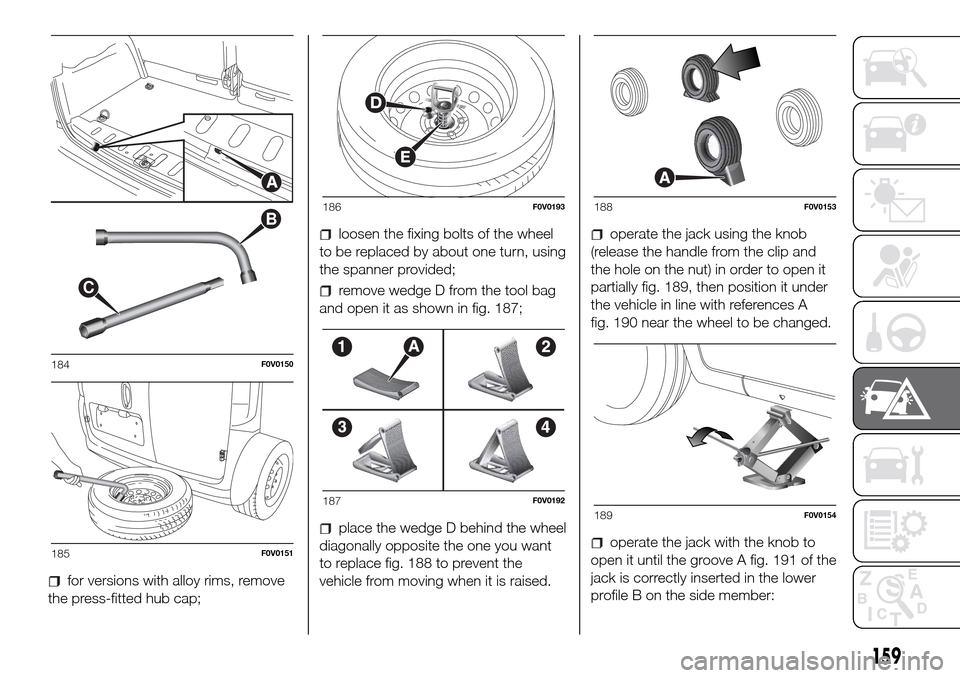
for versions with alloy rims, remove
the press-fitted hub cap;
loosen the fixing bolts of the wheel
to be replaced by about one turn, using
the spanner provided;
remove wedge D from the tool bag
and open it as shown in fig. 187;
place the wedge D behind the wheel
diagonally opposite the one you want
to replace fig. 188 to prevent the
vehicle from moving when it is raised.
operate the jack using the knob
(release the handle from the clip and
the hole on the nut) in order to open it
partially fig. 189, then position it under
the vehicle in line with references A
fig. 190 near the wheel to be changed.
operate the jack with the knob to
open it until the groove A fig. 191 of the
jack is correctly inserted in the lower
profile B on the side member:
B
C
184F0V0150
185F0V0151
186F0V0193
187F0V0192
188F0V0153
189F0V0154
159
Page 164 of 298
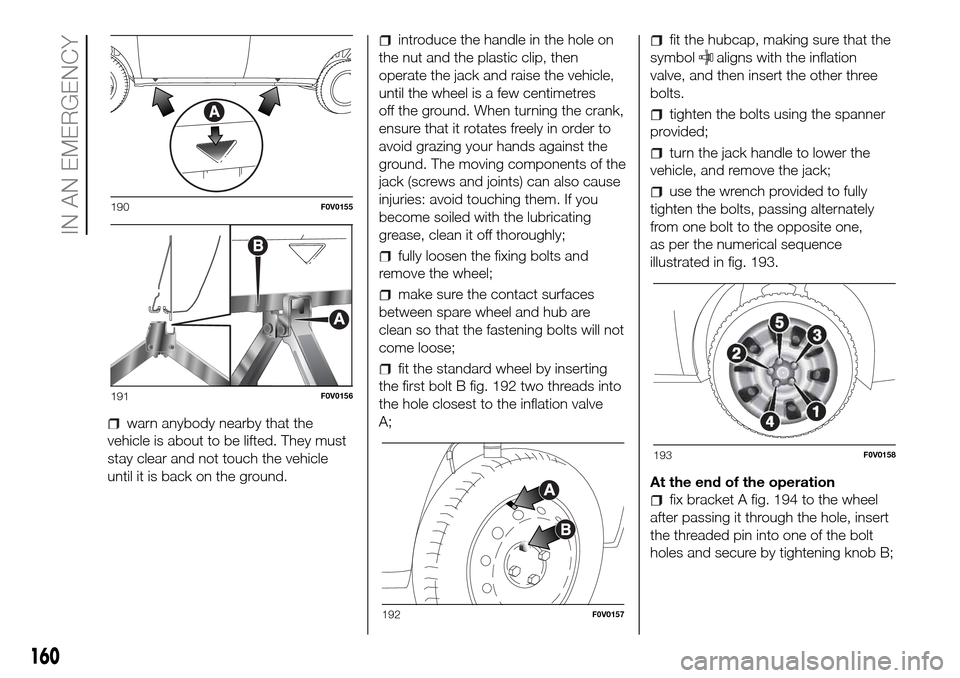
warn anybody nearby that the
vehicle is about to be lifted. They must
stay clear and not touch the vehicle
until it is back on the ground.
introduce the handle in the hole on
the nut and the plastic clip, then
operate the jack and raise the vehicle,
until the wheel is a few centimetres
off the ground. When turning the crank,
ensure that it rotates freely in order to
avoid grazing your hands against the
ground. The moving components of the
jack (screws and joints) can also cause
injuries: avoid touching them. If you
become soiled with the lubricating
grease, clean it off thoroughly;
fully loosen the fixing bolts and
remove the wheel;
make sure the contact surfaces
between spare wheel and hub are
clean so that the fastening bolts will not
come loose;
fit the standard wheel by inserting
the first bolt B fig. 192 two threads into
the hole closest to the inflation valve
A;
fit the hubcap, making sure that the
symbol
aligns with the inflation
valve, and then insert the other three
bolts.
tighten the bolts using the spanner
provided;
turn the jack handle to lower the
vehicle, and remove the jack;
use the wrench provided to fully
tighten the bolts, passing alternately
from one bolt to the opposite one,
as per the numerical sequence
illustrated in fig. 193.
At the end of the operation
fix bracket A fig. 194 to the wheel
after passing it through the hole, insert
the threaded pin into one of the bolt
holes and secure by tightening knob B;
190F0V0155
191F0V0156
192F0V0157
193F0V0158
160
IN AN EMERGENCY
Page 165 of 298
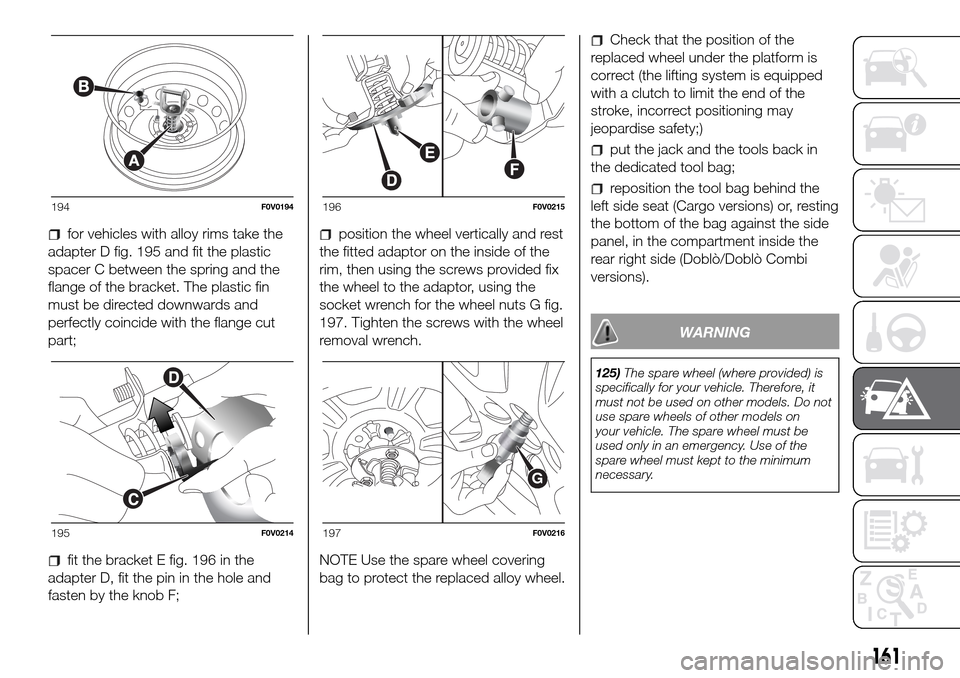
for vehicles with alloy rims take the
adapter D fig. 195 and fit the plastic
spacer C between the spring and the
flange of the bracket. The plastic fin
must be directed downwards and
perfectly coincide with the flange cut
part;
fit the bracket E fig. 196 in the
adapter D, fit the pin in the hole and
fasten by the knob F;
position the wheel vertically and rest
the fitted adaptor on the inside of the
rim, then using the screws provided fix
the wheel to the adaptor, using the
socket wrench for the wheel nuts G fig.
197. Tighten the screws with the wheel
removal wrench.
NOTE Use the spare wheel covering
bag to protect the replaced alloy wheel.
Check that the position of the
replaced wheel under the platform is
correct (the lifting system is equipped
with a clutch to limit the end of the
stroke, incorrect positioning may
jeopardise safety;)
put the jack and the tools back in
the dedicated tool bag;
reposition the tool bag behind the
left side seat (Cargo versions) or, resting
the bottom of the bag against the side
panel, in the compartment inside the
rear right side (Doblò/Doblò Combi
versions).
WARNING
125)The spare wheel (where provided) is
specifically for your vehicle. Therefore, it
must not be used on other models. Do not
use spare wheels of other models on
your vehicle. The spare wheel must be
used only in an emergency. Use of the
spare wheel must kept to the minimum
necessary.
194F0V0194
195F0V0214
196F0V0215
G
197F0V0216
161
Page 166 of 298
126)Use your hazard lights, warning
triangle, etc. to show that your vehicle is
stationary according to the regulations
in force. Passengers should get out of the
vehicle, particularly if it is heavily loaded,
and wait for the wheel to be changed away
from the traffic. If you are on a slope or
uneven surface, place wedges or other
suitable objects under the wheels to secure
the vehicle. Have the wheel repaired and
refitted as soon as possible. Do not apply
grease to the bolt threads before
assembly: they might spontaneously
unscrew.
127)Use the jack only to replace wheels
on the vehicle with which it is supplied
or on other vehicles of the same model.
Never use the jack for other purposes,
such as lifting other models. Never use the
jack to carry out repairs under the vehicle.
Incorrect positioning of the jack may cause
the lifted vehicle to fall. Do not use the
jack for loads higher than those shown on
the label.
128)Incorrect hub cap assembly may
cause it to come off when the vehicle is
moving. Never tamper with the inflation
valve. Never introduce tools of any kind
between rim and tyre. Check tyre and
spare wheel pressures regularly, referring to
the values shown in the "Technical
specifications" section.FIX&GO AUTOMATIC
KIT
(where provided)
DESCRIPTION
28)
129) 130)The quick repair kit Fix&Go automatic is
contained in a suitable bag inside the
compartment on the right rear side
or, for Cargo versions, under the
passenger seat (for versions with fixed
or movable seat), or in the glove
compartment (for versions with folding
seat).
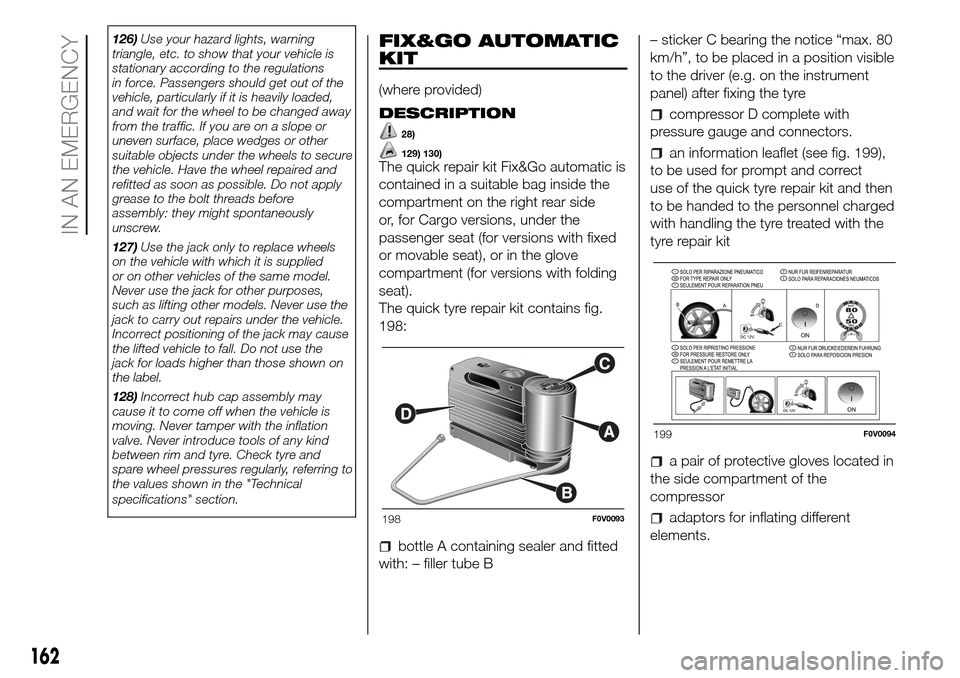
The quick tyre repair kit contains fig.
198:
bottle A containing sealer and fitted
with: – filler tube B– sticker C bearing the notice “max. 80
km/h”, to be placed in a position visible
to the driver (e.g. on the instrument
panel) after fixing the tyre
compressor D complete with
pressure gauge and connectors.
an information leaflet (see fig. 199),
to be used for prompt and correct
use of the quick tyre repair kit and then
to be handed to the personnel charged
with handling the tyre treated with the
tyre repair kit
a pair of protective gloves located in
the side compartment of the
compressor
adaptors for inflating different
elements.198F0V0093
199F0V0094
162
IN AN EMERGENCY
Page 167 of 298
TYRE REPAIRING AND
PRESSURE RESTORING
PROCEDURE
28)
129) 130)Proceed as follows:
place the vehicle in a safe and
suitable area, engaging the parking
brake. Take the kit from the specific
compartment. Remove the adhesive
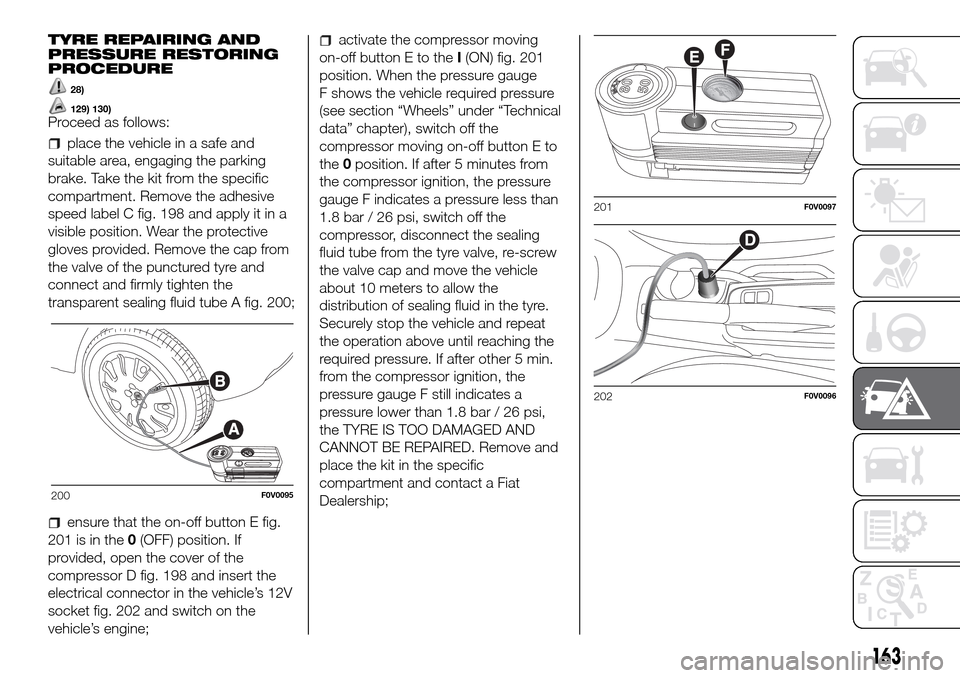
speed label C fig. 198 and apply it in a
visible position. Wear the protective
gloves provided. Remove the cap from
the valve of the punctured tyre and
connect and firmly tighten the
transparent sealing fluid tube A fig. 200;
ensure that the on-off button E fig.
201 is in the0(OFF) position. If
provided, open the cover of the
compressor D fig. 198 and insert the
electrical connector in the vehicle’s 12V
socket fig. 202 and switch on the
vehicle’s engine;
activate the compressor moving
on-off button E to theI(ON) fig. 201
position. When the pressure gauge
F shows the vehicle required pressure
(see section “Wheels” under “Technical
data” chapter), switch off the
compressor moving on-off button E to
the0position. If after 5 minutes from
the compressor ignition, the pressure
gauge F indicates a pressure less than
1.8 bar / 26 psi, switch off the
compressor, disconnect the sealing
fluid tube from the tyre valve, re-screw
the valve cap and move the vehicle
about 10 meters to allow the
distribution of sealing fluid in the tyre.
Securely stop the vehicle and repeat
the operation above until reaching the
required pressure. If after other 5 min.
from the compressor ignition, the
pressure gauge F still indicates a
pressure lower than 1.8 bar / 26 psi,
the TYRE IS TOO DAMAGED AND
CANNOT BE REPAIRED. Remove and
place the kit in the specific
compartment and contact a Fiat
Dealership;
200F0V0095
201F0V0097
202F0V0096
163
Page 170 of 298
IMPORTANT Remember that the brake
booster and the electric power steering
system are not active until the engine
is started, so you will need to apply
much more force to the brake pedal or
steering wheel.
WARNING
29)Never use a fast battery-charger for
emergency starting of the engine as this
could damage the electronic systems
of your vehicle, particularly the ignition and
fuel supply control units.
WARNING
131)This procedure must be performed by
qualified personnel as incorrect actions
may cause high-intensity electrical
discharge. Furthermore, battery fluid is
poisonous and corrosive: avoid contact
with skin and eyes. Keep naked flames
away from the battery. No smoking. Do not
cause sparks.
FUEL CUT-OFF
SYSTEM
This intervenes in the case of an impact
causing:
the fuel supply cut-off with the
engine consequently switching off;
the automatic unlocking of the
doors;
the switching on of the interior lights;
switching on of the hazard warning
lights (to deactivate the lights press
the dedicated button on the
dashboard).
132)When the system has been triggered,
the message “Fuel cut off, see
handbook” is displayed on some
versions.
Check carefully for fuel leaks, for
instance in the engine compartment,
under the vehicle or near the tank area.
After a collision, turn the ignition key
to STOP to prevent the battery from
running down.
The following procedure should be
carried out to restore the correct
operation of the vehicle:
turn the ignition key to the MAR
position;
activate the right direction indicator;
deactivate the right direction
indicator;
activate the left direction indicator;
deactivate the left direction indicator;
activate the right direction indicator;
deactivate the right direction
indicator;
activate the left direction indicator;
deactivate the left direction indicator;
turn the ignition key to the OFF
position.
WARNING
132)If, after an impact, you smell fuel or
notice leaks from the fuel supply system,
do not reactivate the system to avoid
the risk of fire.
166
IN AN EMERGENCY
Page 171 of 298
LIFTING THE
VEHICLE
If the vehicle needs to be lifted, go to a
Fiat Dealership which is equipped
with the arm hoist or workshop lift.
TOWING THE
VEHICLE
The tow ring provided with the vehicle
is located in the tool box behind the left
seat backrest (Cargo versions) or in
the boot (Doblò / Doblò Combi
versions).
ATTACHING THE TOW
HOOK
Proceed as follows:
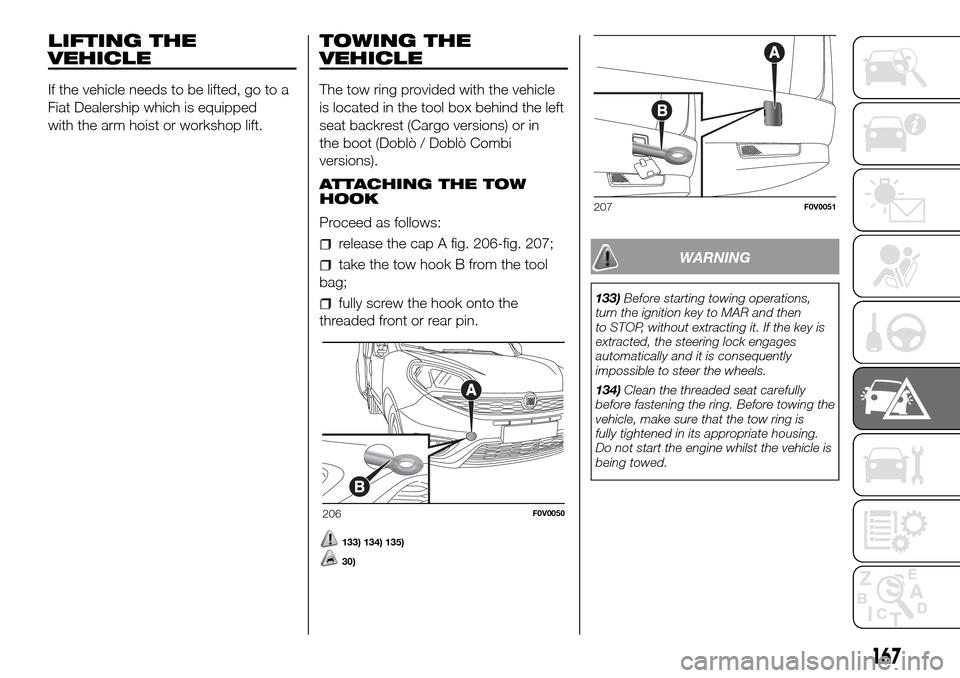
release the cap A fig. 206-fig. 207;
take the tow hook B from the tool
bag;
fully screw the hook onto the
threaded front or rear pin.
133) 134) 135)
30)
WARNING
133)Before starting towing operations,
turn the ignition key to MAR and then
to STOP, without extracting it. If the key is
extracted, the steering lock engages
automatically and it is consequently
impossible to steer the wheels.
134)Clean the threaded seat carefully
before fastening the ring. Before towing the
vehicle, make sure that the tow ring is
fully tightened in its appropriate housing.
Do not start the engine whilst the vehicle is
being towed.
206F0V0050
207F0V0051
167
Page 173 of 298
SERVICING AND CARE
Correct maintenance permits the
performance of the car to be
maintained over time, as well as limited
running costs and safeguarding the
efficiency of the safety systems.
This chapter explains how.SCHEDULED SERVICING ...............170
SCHEDULED SERVICING PLAN .....171
PERIODIC CHECKS ........................178
DEMANDING VEHICLE USE ...........178
ENGINE COMPARTMENT ...............179
AIR CLEANER/ POLLEN FILTER .....189
DIESEL FILTER................................189
BATTERY ........................................190
BATTERY RECHARGING ................191
WINDSCREEN/REAR WINDOW
WIPER ............................................192
WHEELS AND TYRES.....................194
RUBBER HOSES ............................195
PROLONGED VEHICLE
INACTIVITY .....................................195
BODYWORK ...................................196
INTERIORS .....................................198
169
Page 198 of 298
WARNING
148)Driving with worn windscreen wiper
blades is a serious hazard, because
visibility is reduced in bad weather
conditions.
WHEELS AND TYRES
Check the pressure of each tyre,
including the space-saver wheel,
approximately every two weeks and
before long journeys: the pressure
should be checked with the tyre rested
and cold.
It is normal for the pressure to increase
when the vehicle is used; for the correct
tyre inflation pressure, see “Wheels” in
the “Technical specifications” section.
Incorrect pressure causes abnormal
tyre wear fig. 222:
Anormal pressure: tread evenly worn;
Blow pressure: tread particularly worn
at the edges;
Chigh pressure: tread particularly worn
in the centre.The tyres must be replaced when the
tread is less than 1.6 mm thick. In
any case, follow the laws in force in the
country you are in.
IMPORTANT
As far as possible, avoid sharp
braking, screech starts and violent
shocks against pavements, potholes or
other hard obstacles. Driving for long
stretches over bumpy roads can
damage the tyres;
periodically check that the tyres
have no cuts in the side wall, abnormal
swelling or irregular tyre wear. Contact
a Fiat Dealership if required;
avoid overloading the vehicle when
travelling: this may cause serious
damage to the wheels and tyres;
if a tyre is punctured, stop
immediately and change it to avoid
damage to the tyre, the rim,
suspensions and steering system;
tyres age even if they are not used
much. Cracks in the tread and on
the side walls are a sign of ageing.
Have the tyres checked by specialised
personnel if they have been fitted for
longer than 6 years. Remember to
check the spare wheel very carefully;
in the case of replacement, always
fit new tyres, avoiding those of
unknown origin;
222F0V0161
194
SERVICING AND CARE