service FIAT DOBLO COMBI 2017 2.G User Guide
[x] Cancel search | Manufacturer: FIAT, Model Year: 2017, Model line: DOBLO COMBI, Model: FIAT DOBLO COMBI 2017 2.GPages: 300, PDF Size: 24.91 MB
Page 179 of 300
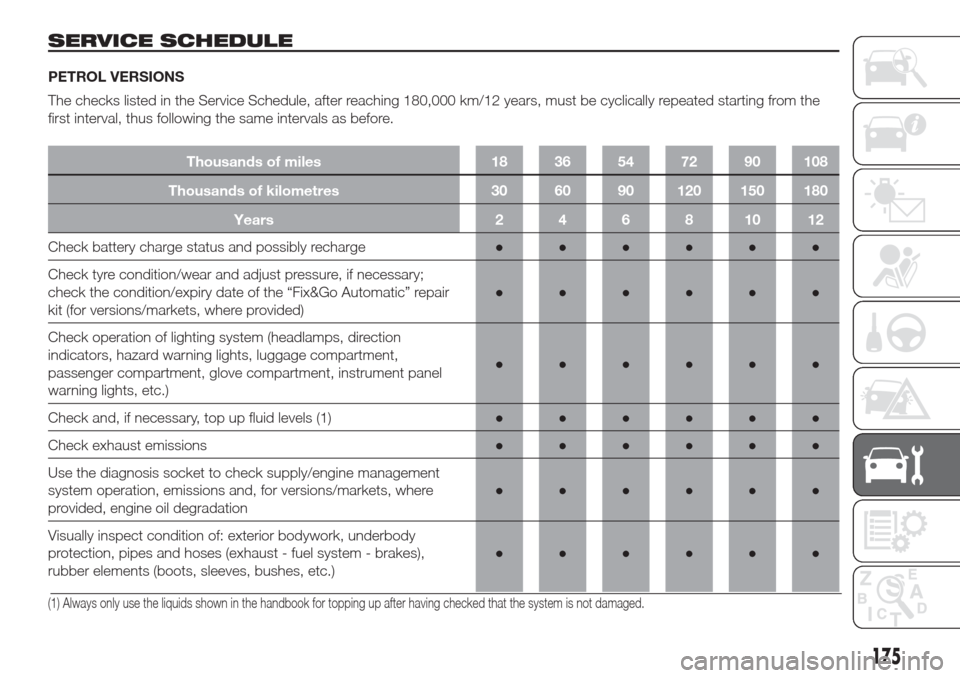
SERVICE SCHEDULE
PETROL VERSIONS
The checks listed in the Service Schedule, after reaching 180,000 km/12 years, must be cyclically repeated starting from the
first interval, thus following the same intervals as before.
Thousands of miles 18 36 54 72 90 108
Thousands of kilometres 30 60 90 120 150 180
Years 2 4 6 8 10 12
Check battery charge status and possibly recharge●●●●●●
Check tyre condition/wear and adjust pressure, if necessary;
check the condition/expiry date of the “Fix&Go Automatic” repair
kit (for versions/markets, where provided)●●●●●●
Check operation of lighting system (headlamps, direction
indicators, hazard warning lights, luggage compartment,
passenger compartment, glove compartment, instrument panel
warning lights, etc.)●●●●●●
Check and, if necessary, top up fluid levels (1)●●●●●●
Check exhaust emissions●●●●●●
Use the diagnosis socket to check supply/engine management
system operation, emissions and, for versions/markets, where
provided, engine oil degradation●●●●●●
Visually inspect condition of: exterior bodywork, underbody
protection, pipes and hoses (exhaust - fuel system - brakes),
rubber elements (boots, sleeves, bushes, etc.)●●●●●●
(1) Always only use the liquids shown in the handbook for topping up after having checked that the system is not damaged.
175
Page 182 of 300
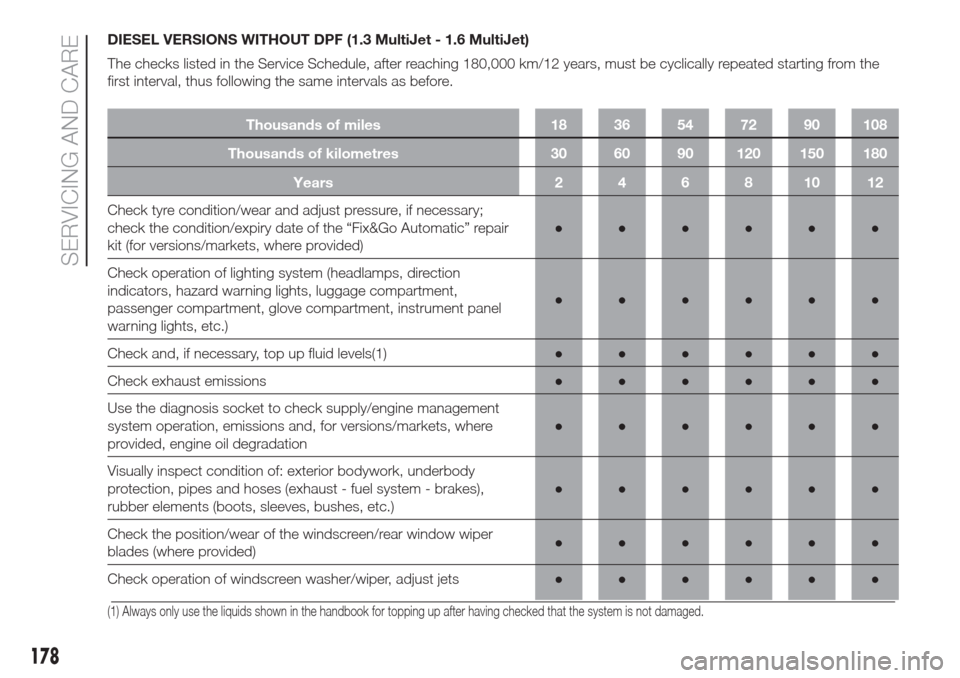
DIESEL VERSIONS WITHOUT DPF (1.3 MultiJet - 1.6 MultiJet)
The checks listed in the Service Schedule, after reaching 180,000 km/12 years, must be cyclically repeated starting from the
first interval, thus following the same intervals as before.
Thousands of miles 18 36 54 72 90 108
Thousands of kilometres 30 60 90 120 150 180
Years 2 4 6 8 10 12
Check tyre condition/wear and adjust pressure, if necessary;
check the condition/expiry date of the “Fix&Go Automatic” repair
kit (for versions/markets, where provided)●●●●●●
Check operation of lighting system (headlamps, direction
indicators, hazard warning lights, luggage compartment,
passenger compartment, glove compartment, instrument panel
warning lights, etc.)●●●●●●
Check and, if necessary, top up fluid levels(1)●●●●●●
Check exhaust emissions●●●●●●
Use the diagnosis socket to check supply/engine management
system operation, emissions and, for versions/markets, where
provided, engine oil degradation●●●●●●
Visually inspect condition of: exterior bodywork, underbody
protection, pipes and hoses (exhaust - fuel system - brakes),
rubber elements (boots, sleeves, bushes, etc.)●●●●●●
Check the position/wear of the windscreen/rear window wiper
blades (where provided)●●●●●●
Check operation of windscreen washer/wiper, adjust jets●●●●●●
(1) Always only use the liquids shown in the handbook for topping up after having checked that the system is not damaged.
178
SERVICING AND CARE
Page 184 of 300
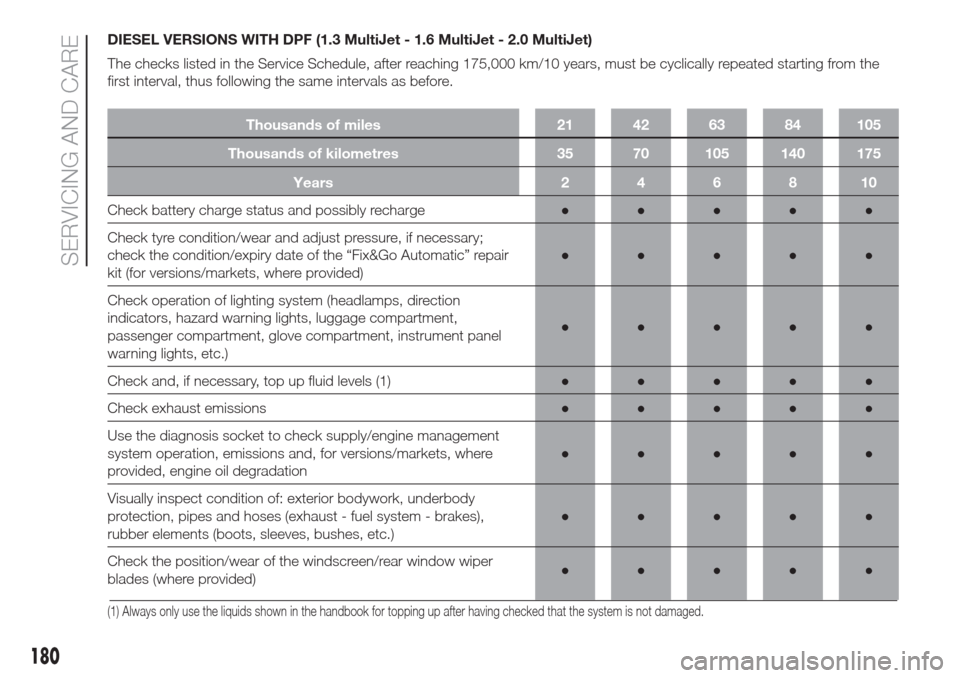
DIESEL VERSIONS WITH DPF (1.3 MultiJet - 1.6 MultiJet - 2.0 MultiJet)
The checks listed in the Service Schedule, after reaching 175,000 km/10 years, must be cyclically repeated starting from the
first interval, thus following the same intervals as before.
Thousands of miles 21 42 63 84 105
Thousands of kilometres 35 70 105 140 175
Years246810
Check battery charge status and possibly recharge●●●●●
Check tyre condition/wear and adjust pressure, if necessary;
check the condition/expiry date of the “Fix&Go Automatic” repair
kit (for versions/markets, where provided)●●●●●
Check operation of lighting system (headlamps, direction
indicators, hazard warning lights, luggage compartment,
passenger compartment, glove compartment, instrument panel
warning lights, etc.)●●●●●
Check and, if necessary, top up fluid levels (1)●●●●●
Check exhaust emissions●●●●●
Use the diagnosis socket to check supply/engine management
system operation, emissions and, for versions/markets, where
provided, engine oil degradation●●●●●
Visually inspect condition of: exterior bodywork, underbody
protection, pipes and hoses (exhaust - fuel system - brakes),
rubber elements (boots, sleeves, bushes, etc.)●●●●●
Check the position/wear of the windscreen/rear window wiper
blades (where provided)●●●●●
(1) Always only use the liquids shown in the handbook for topping up after having checked that the system is not damaged.
180
SERVICING AND CARE
Page 199 of 300
BATTERY
The battery is of the “limited
maintenance” type: under normal
conditions of use, the electrolyte does
not need topping up with distilled water.
It does, however, need to be checked
periodically at a Fiat Dealership or
by specialist personnel to make sure it
is working correctly.
143) 144)
REPLACING THE
BATTERY
If required, replace the battery with an
original spare part with the same
specifications.
If a battery with different specifications
is fitted, the service intervals given in
the “Scheduled Servicing Plan” will no
longer be valid.
Follow the battery manufacturer's
instructions for maintenance.
37) 38)
6)
145)
USEFUL TIPS FOR
EXTENDING BATTERY
LIFE
To avoid draining your battery and
make it last longer, observe the
following instructions:
when you park the vehicle, ensure
that the doors, tailgate and bonnet are
closed properly, to prevent any roof
lights from remaining on inside the
passenger's compartment;
switch off all roof lights inside the
vehicle: the vehicle is however
equipped with a system which switches
all internal lights off automatically;
do not keep accessories (e.g. radio,
hazard warning lights, etc.) switched
on for a long time when the engine
is not running;
before performing any operation on
the electrical system, disconnect the
negative battery pole;
completely tighten the battery
terminals.
IMPORTANT If the charge level remains
under 50% for a long time, the battery
is damaged by sulphation, reducing
its capacity and efficiency at starting.The battery is also more prone to the
risk of freezing (already at temperatures
of -10°C). Refer to the paragraph
"Vehicle inactivity" in "Starting and
driving" if the vehicle is left parked for a
long time.
If, after buying the vehicle, you want to
install electric accessories which require
permanent electric supply (alarm, etc.)
contact a Fiat Dealership whose
qualified personnel, in addition to
suggesting the most suitable devices
from the Lineaccessori Fiat, will
evaluate the overall electric absorption,
checking whether the vehicle's
electrical system is capable of
withstanding the load required, or
whether it should be integrated with a
more powerful battery.
Since some of these devices continue
to consume electricity even when
the engine is off, they gradually run
down the battery.
WARNING
143)Battery fluid is poisonous and
corrosive. Avoid contact with skin and
eyes. Keep naked flames or possible
sources of sparks away from the battery:
risk of explosion or fire.
144)Using the battery when the fluid is too
low can damage it irreparably and generate
a risk of explosion.
195
Page 217 of 300
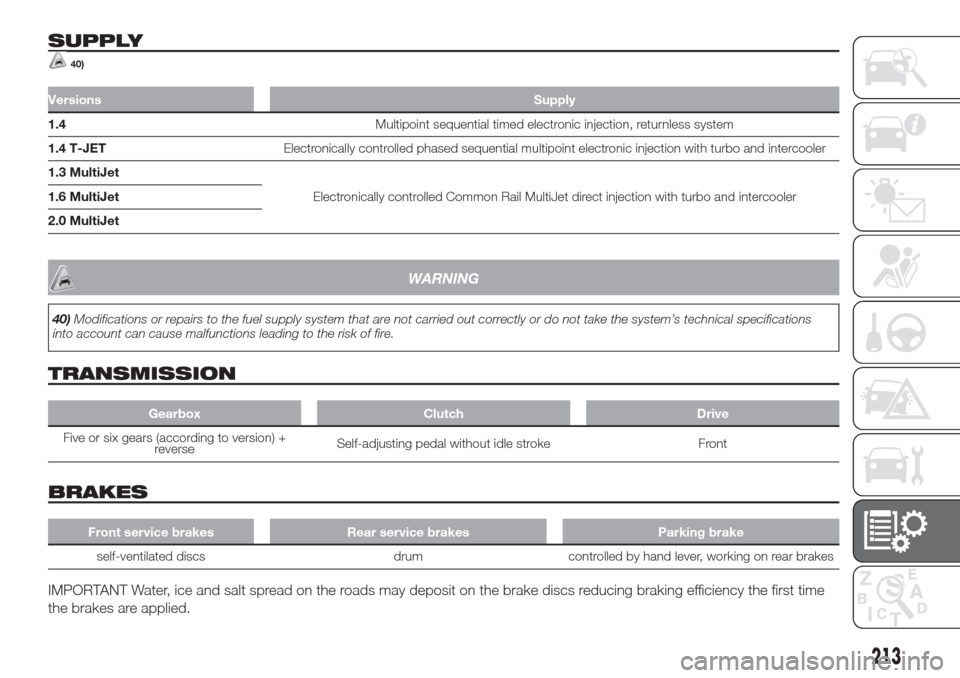
SUPPLY
40)
VersionsSupply
1.4Multipoint sequential timed electronic injection, returnless system
1.4 T-JETElectronically controlled phased sequential multipoint electronic injection with turbo and intercooler
1.3 MultiJet
Electronically controlled Common Rail MultiJet direct injection with turbo and intercooler 1.6 MultiJet
2.0 MultiJet
WARNING
40)Modifications or repairs to the fuel supply system that are not carried out correctly or do not take the system’s technical specifications
into account can cause malfunctions leading to the risk of fire.
TRANSMISSION
Gearbox Clutch Drive
Five or six gears (according to version) +
reverseSelf-adjusting pedal without idle stroke Front
BRAKES
Front service brakes Rear service brakes Parking brake
self-ventilated discs drum controlled by hand lever, working on rear brakes
IMPORTANT Water, ice and salt spread on the roads may deposit on the brake discs reducing braking efficiency the first time
the brakes are applied.
213
Page 260 of 300
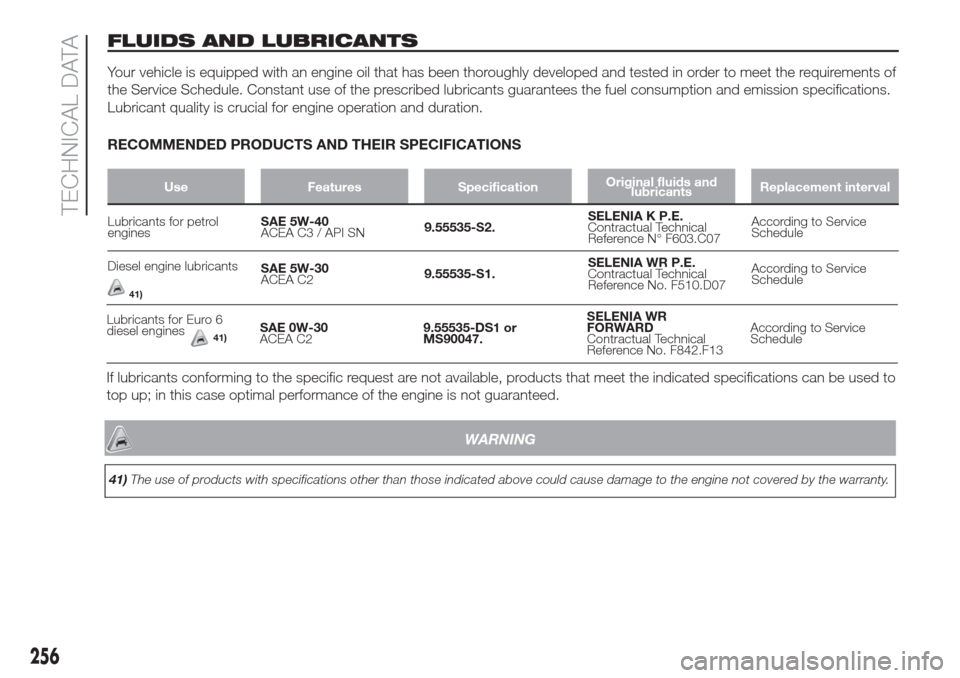
FLUIDS AND LUBRICANTS
Your vehicle is equipped with an engine oil that has been thoroughly developed and tested in order to meet the requirements of
the Service Schedule. Constant use of the prescribed lubricants guarantees the fuel consumption and emission specifications.
Lubricant quality is crucial for engine operation and duration.
RECOMMENDED PRODUCTS AND THEIR SPECIFICATIONS
Use Features SpecificationOriginal fluids and
lubricantsReplacement interval
Lubricants for petrol
enginesSAE 5W-40
ACEA C3 / API SN9.55535-S2.SELENIA K P.E.
Contractual Technical
Reference N° F603.C07According to Service
Schedule
Diesel engine lubricants
41)
SAE 5W-30
ACEA C29.55535-S1.SELENIA WR P.E.
Contractual Technical
Reference No. F510.D07According to Service
Schedule
Lubricants for Euro 6
diesel engines
41)SAE 0W-30
ACEA C29.55535-DS1 or
MS90047.SELENIA WR
FORWARD
Contractual Technical
Reference No. F842.F13According to Service
Schedule
If lubricants conforming to the specific request are not available, products that meet the indicated specifications can be used to
top up; in this case optimal performance of the engine is not guaranteed.
256
TECHNICAL DATA
WARNING
41)The use of products with specifications other than those indicated above could cause damage to the engine not covered by the warranty.
Page 264 of 300
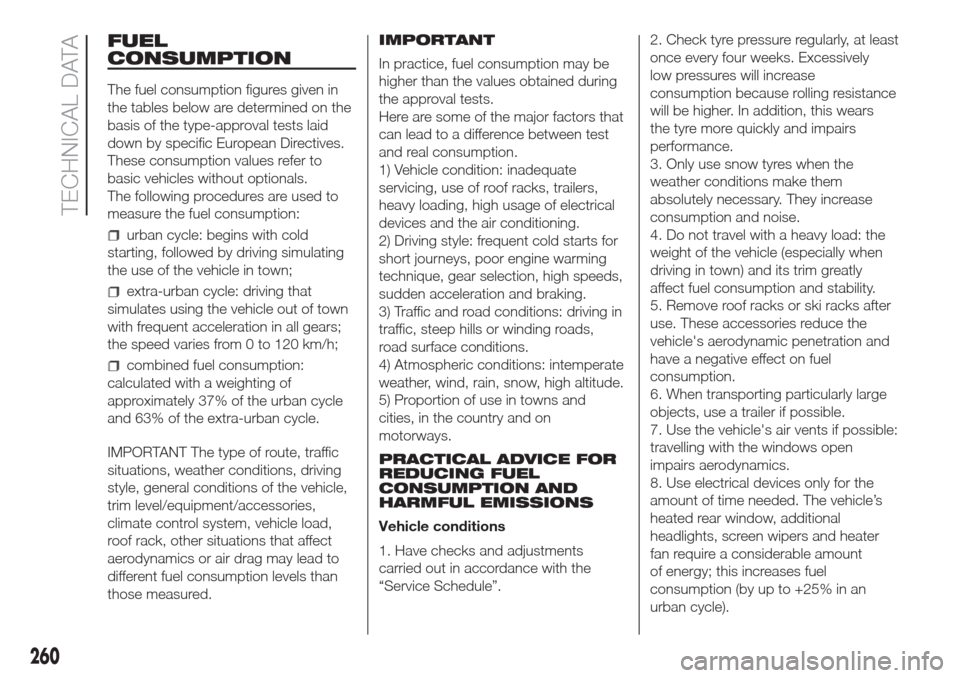
FUEL
CONSUMPTION
The fuel consumption figures given in
the tables below are determined on the
basis of the type-approval tests laid
down by specific European Directives.
These consumption values refer to
basic vehicles without optionals.
The following procedures are used to
measure the fuel consumption:
urban cycle: begins with cold
starting, followed by driving simulating
the use of the vehicle in town;
extra-urban cycle: driving that
simulates using the vehicle out of town
with frequent acceleration in all gears;
the speed varies from 0 to 120 km/h;
combined fuel consumption:
calculated with a weighting of
approximately 37% of the urban cycle
and 63% of the extra-urban cycle.
IMPORTANT The type of route, traffic
situations, weather conditions, driving
style, general conditions of the vehicle,
trim level/equipment/accessories,
climate control system, vehicle load,
roof rack, other situations that affect
aerodynamics or air drag may lead to
different fuel consumption levels than
those measured.IMPORTANT
In practice, fuel consumption may be
higher than the values obtained during
the approval tests.
Here are some of the major factors that
can lead to a difference between test
and real consumption.
1) Vehicle condition: inadequate
servicing, use of roof racks, trailers,
heavy loading, high usage of electrical
devices and the air conditioning.
2) Driving style: frequent cold starts for
short journeys, poor engine warming
technique, gear selection, high speeds,
sudden acceleration and braking.
3) Traffic and road conditions: driving in
traffic, steep hills or winding roads,
road surface conditions.
4) Atmospheric conditions: intemperate
weather, wind, rain, snow, high altitude.
5) Proportion of use in towns and
cities, in the country and on
motorways.
PRACTICAL ADVICE FOR
REDUCING FUEL
CONSUMPTION AND
HARMFUL EMISSIONS
Vehicle conditions
1. Have checks and adjustments
carried out in accordance with the
“Service Schedule”.2. Check tyre pressure regularly, at least
once every four weeks. Excessively
low pressures will increase
consumption because rolling resistance
will be higher. In addition, this wears
the tyre more quickly and impairs
performance.
3. Only use snow tyres when the
weather conditions make them
absolutely necessary. They increase
consumption and noise.
4. Do not travel with a heavy load: the
weight of the vehicle (especially when
driving in town) and its trim greatly
affect fuel consumption and stability.
5. Remove roof racks or ski racks after
use. These accessories reduce the
vehicle's aerodynamic penetration and
have a negative effect on fuel
consumption.
6. When transporting particularly large
objects, use a trailer if possible.
7. Use the vehicle's air vents if possible:
travelling with the windows open
impairs aerodynamics.
8. Use electrical devices only for the
amount of time needed. The vehicle’s
heated rear window, additional
headlights, screen wipers and heater
fan require a considerable amount
of energy; this increases fuel
consumption (by up to +25% in an
urban cycle).
260
TECHNICAL DATA
Page 288 of 300
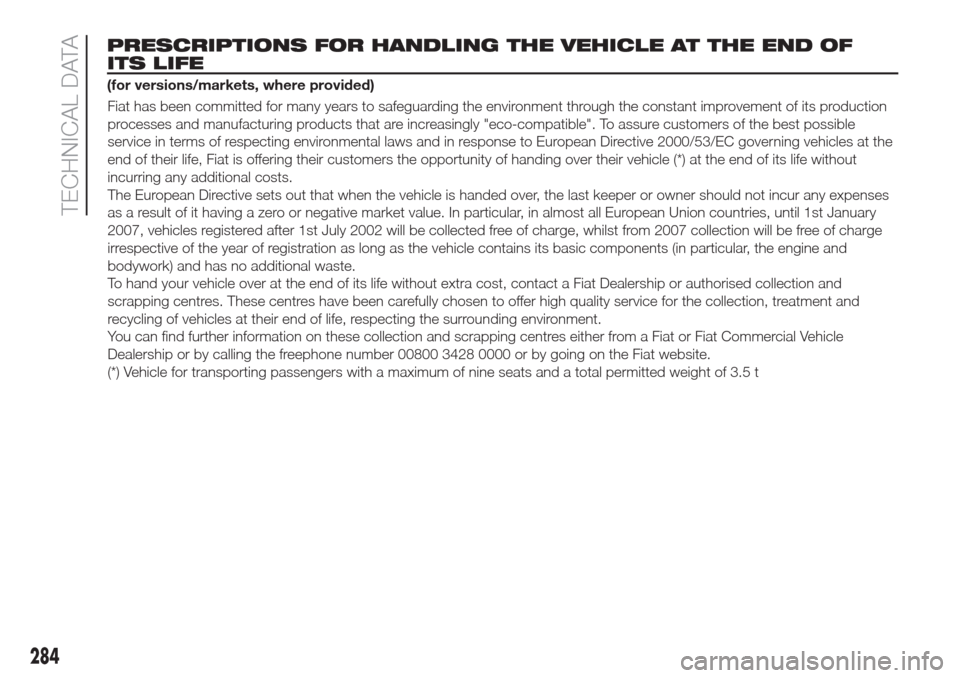
Fiat has been committed for many years to safeguarding the environment through the constant improvement of its production
processes and manufacturing products that are increasingly "eco-compatible". To assure customers of the best possible
service in terms of respecting environmental laws and in response to European Directive 2000/53/EC governing vehicles at the
end of their life, Fiat is offering their customers the opportunity of handing over their vehicle (*) at the end of its life without
incurring any additional costs.
The European Directive sets out that when the vehicle is handed over, the last keeper or owner should not incur any expenses
as a result of it having a zero or negative market value. In particular, in almost all European Union countries, until 1st January
2007, vehicles registered after 1st July 2002 will be collected free of charge, whilst from 2007 collection will be free of charge
irrespective of the year of registration as long as the vehicle contains its basic components (in particular, the engine and
bodywork) and has no additional waste.
To hand your vehicle over at the end of its life without extra cost, contact a Fiat Dealership or authorised collection and
scrapping centres. These centres have been carefully chosen to offer high quality service for the collection, treatment and
recycling of vehicles at their end of life, respecting the surrounding environment.
You can find further information on these collection and scrapping centres either from a Fiat or Fiat Commercial Vehicle
Dealership or by calling the freephone number 00800 3428 0000 or by going on the Fiat website.
(*) Vehicle for transporting passengers with a maximum of nine seats and a total permitted weight of 3.5 t
284
TECHNICAL DATA
PRESCRIPTIONS FOR HANDLING THE VEHICLE AT THE END OF
ITS LIFE
(for versions/markets, where provided)
Page 291 of 300
Mopar Vehicle Protectionoffers a series of service contracts that are designed to give all our customers the
pleasure of driving their vehicle without any hitch's and concerns.
Our product portfolio consists of a wide and flexible range of extended warranty and maintenance plans
endorsed by FCA. Each with a series of different coverage tiers, in terms of durability and mileage, built to
accommodate you’re driving needs.
Service contracts are made by experts that know every part of your vehicle, and commit themselves
to maintain it in tip top conditions. Our knowledge and passion is tailored around designing
products that promises all our drivers “worry-free driving”.
Only with Mopar Vehicle Protection you are ensured that all service operations are performed
by highly qualified and specialized technicians in authorized FCA repair facilities, using the right tools,
equipment and only original parts, all over Europe.
Check which Service Contract plans are available on your market today and choose the
Service Contract that suits your driving habits best.
Ask your local dealer for further information.
MAINTAIN YOUR VEHICLE IN
TIP TOP CONDITIONS WITH
Page 297 of 300
– Driver’s seat .............................. 22
– Passenger seat ......................... 23
– Rear seats ................................. 24
Seats and fabric parts .................... 202
Service Schedule ........................... 175
Side bag ........................................ 124
Side bags....................................... 124
Side doors ..................................... 19
Side lights ...................................... 151
Side/tail lights................................. 33
Ski rack.......................................... 64
Snow chains .................................. 146
Snow tyres ..................................... 145
Spare wheel ................................... 215
Spark plugs (type) .......................... 210
Speed block................................... 137
Spray nozzles................................. 198
Start&Stop system ......................... 131
Starting the engine ......................... 128
Steering ......................................... 214
Steering wheel ............................... 31
Stopping the engine ....................... 129
Storage compartment .................... 60
Sun visors ...................................... 63
Supply ........................................... 213
Suspension .................................... 214
Symbols......................................... 4
The keys
....................................... 14– Key with remote control............. 14
– Key without remote control........ 14
Third brake lights............................ 152
Towing the vehicle .......................... 170
Towing trailers ................................ 144
TPMS............................................. 134
Traction Plus system ...................... 139
Transmission .................................. 213
Trip computer................................. 80
Types of bulbs ................................ 149
Tyres .............................................. 215
Usage conditions
.......................... 144
Use of the Owner Handbook.......... 3
Useful tips for extending battery
life ................................................ 195
Using the gearbox .......................... 130
Vehicle exterior and underbody
warranty
....................................... 201
Vehicle modifications/alterations ..... 5
VIN plate ........................................ 206
Warming up the engine just
after it has started
........................ 128
Warning lights and messages......... 83
Weights.......................................... 225
Wheel geometry ............................. 215
Wheels ........................................... 215
Wheels and tyres ........................... 199
Windscreen / rear window wiper
(replacement) ............................... 197Windscreen washer ....................... 38
Windscreen wiper .......................... 38
Windscreen/rear window washer
fluid .............................................. 192