tyre pressure FIAT DOBLO COMBI 2017 2.G Owner's Manual
[x] Cancel search | Manufacturer: FIAT, Model Year: 2017, Model line: DOBLO COMBI, Model: FIAT DOBLO COMBI 2017 2.GPages: 300, PDF Size: 24.91 MB
Page 220 of 300
95690 kg
99775 kg
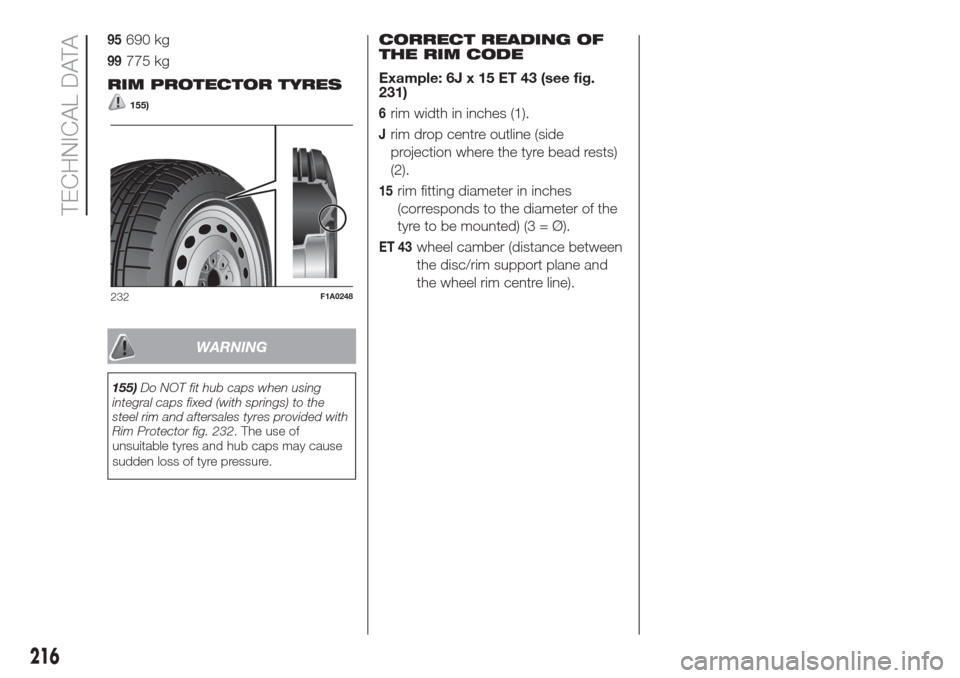
RIM PROTECTOR TYRES
155)
WARNING
155)Do NOT fit hub caps when using
integral caps fixed (with springs) to the
steel rim and aftersales tyres provided with
Rim Protector fig. 232. The use of
unsuitable tyres and hub caps may cause
sudden loss of tyre pressure.
CORRECT READING OF
THE RIM CODE
Example: 6J x 15 ET 43 (see fig.
231)
6rim width in inches (1).
Jrim drop centre outline (side
projection where the tyre bead rests)
(2).
15rim fitting diameter in inches
(corresponds to the diameter of the
tyre to be mounted) (3 = Ø).
ET 43wheel camber (distance between
the disc/rim support plane and
the wheel rim centre line).
232F1A0248
216
TECHNICAL DATA
Page 223 of 300
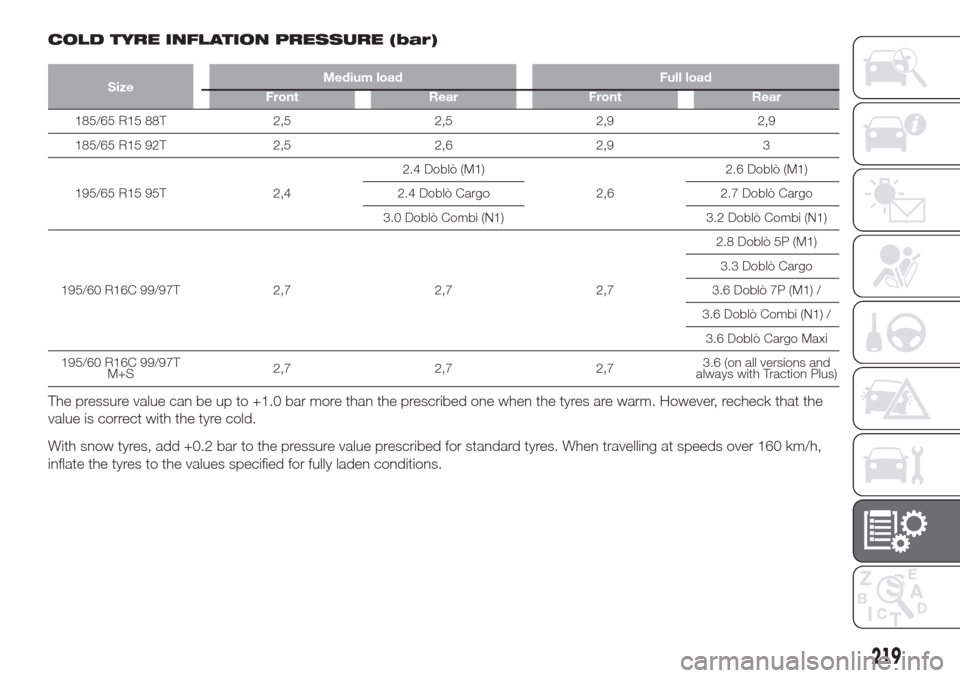
COLD TYRE INFLATION PRESSURE (bar)
SizeMedium load Full load
Front Rear Front Rear
185/65 R15 88T 2,5 2,5 2,9 2,9
185/65 R15 92T 2,5 2,6 2,9 3
195/65 R15 95T 2,42.4 Doblò (M1)
2,62.6 Doblò (M1)
2.4 Doblò Cargo 2.7 Doblò Cargo
3.0 Doblò Combi (N1) 3.2 Doblò Combi (N1)
195/60 R16C 99/97T 2,7 2,7 2,72.8 Doblò 5P (M1)
3.3 Doblò Cargo
3.6 Doblò 7P (M1) /
3.6 Doblò Combi (N1) /
3.6 Doblò Cargo Maxi
195/60 R16C 99/97T
M+S2,7 2,7 2,73.6 (on all versions and
always with Traction Plus)
The pressure value can be up to +1.0 bar more than the prescribed one when the tyres are warm. However, recheck that the
value is correct with the tyre cold.
With snow tyres, add +0.2 bar to the pressure value prescribed for standard tyres. When travelling at speeds over 160 km/h,
inflate the tyres to the values specified for fully laden conditions.
219
Page 264 of 300
FUEL
CONSUMPTION
The fuel consumption figures given in
the tables below are determined on the
basis of the type-approval tests laid
down by specific European Directives.
These consumption values refer to
basic vehicles without optionals.
The following procedures are used to
measure the fuel consumption:
urban cycle: begins with cold
starting, followed by driving simulating
the use of the vehicle in town;
extra-urban cycle: driving that
simulates using the vehicle out of town
with frequent acceleration in all gears;
the speed varies from 0 to 120 km/h;
combined fuel consumption:
calculated with a weighting of
approximately 37% of the urban cycle
and 63% of the extra-urban cycle.
IMPORTANT The type of route, traffic
situations, weather conditions, driving
style, general conditions of the vehicle,
trim level/equipment/accessories,
climate control system, vehicle load,
roof rack, other situations that affect
aerodynamics or air drag may lead to
different fuel consumption levels than
those measured.IMPORTANT
In practice, fuel consumption may be
higher than the values obtained during
the approval tests.
Here are some of the major factors that
can lead to a difference between test
and real consumption.
1) Vehicle condition: inadequate
servicing, use of roof racks, trailers,
heavy loading, high usage of electrical
devices and the air conditioning.
2) Driving style: frequent cold starts for
short journeys, poor engine warming
technique, gear selection, high speeds,
sudden acceleration and braking.
3) Traffic and road conditions: driving in
traffic, steep hills or winding roads,
road surface conditions.
4) Atmospheric conditions: intemperate
weather, wind, rain, snow, high altitude.
5) Proportion of use in towns and
cities, in the country and on
motorways.
PRACTICAL ADVICE FOR
REDUCING FUEL
CONSUMPTION AND
HARMFUL EMISSIONS
Vehicle conditions
1. Have checks and adjustments
carried out in accordance with the
“Service Schedule”.2. Check tyre pressure regularly, at least
once every four weeks. Excessively
low pressures will increase
consumption because rolling resistance
will be higher. In addition, this wears
the tyre more quickly and impairs
performance.
3. Only use snow tyres when the
weather conditions make them
absolutely necessary. They increase
consumption and noise.
4. Do not travel with a heavy load: the
weight of the vehicle (especially when
driving in town) and its trim greatly
affect fuel consumption and stability.
5. Remove roof racks or ski racks after
use. These accessories reduce the
vehicle's aerodynamic penetration and
have a negative effect on fuel
consumption.
6. When transporting particularly large
objects, use a trailer if possible.
7. Use the vehicle's air vents if possible:
travelling with the windows open
impairs aerodynamics.
8. Use electrical devices only for the
amount of time needed. The vehicle’s
heated rear window, additional
headlights, screen wipers and heater
fan require a considerable amount
of energy; this increases fuel
consumption (by up to +25% in an
urban cycle).
260
TECHNICAL DATA
Page 296 of 300
Handbrake
.................................... 129
Hazard warning lights..................... 148
Head restraints............................... 30
Headlight washers ......................... 39
Headlights...................................... 64
Heating and ventilation ................... 40
Hill Holder system .......................... 102
Identification data
.......................... 206
Ignition device ................................ 16
Important notes.............................. 125
Inflation pressure ............................ 219
Installing electrical/electronic
devices ........................................ 5
Interior fittings ................................ 60
Interior lights .................................. 35
Interior mirror ................................. 32
Interiors .......................................... 202
Isofix child restraint system
setup ........................................... 113
Jump starting
................................ 168
Lifting the vehicle
.......................... 170
Load limiters .................................. 107
Luggage compartment light ........... 36
Main beam headlights
.................. 34
Manual climate control system ....... 45
Manual deactivation of
passenger side front airbag and
side bag for chest/head
protection .................................... 120MSR system .................................. 103
Multifunction display....................... 73
– Control buttons ......................... 74
– Set-up menu ............................. 74
Number plate lights (for
hatchback versions)
..................... 154
Number plate lights (for versions
with wing doors)........................... 154
Occupant protection systems
....... 104
Parking
......................................... 129
Parking sensors ............................. 139
Partitions........................................ 28
Passenger’s side front airbag ......... 120
Performance .................................. 259
Periodic checks ............................. 183
Plastic parts ................................... 202
Power Socket ................................ 61
Power steering fluid........................ 193
Practical advice for reducing fuel
consumption and harmful
emissions ..................................... 143
Pre-tensioners................................ 107
Prescriptions for vehicle at end
of life ........................................... 284
Procedure for diesel versions ......... 128
Procedure for petrol versions.......... 128
Prolonged vehicle inactivity............. 200
Protecting the environment ............ 66
Protection against atmospheric
agents.......................................... 201
Radio (setup)
................................ 65
Radio transmitters and mobile
phones......................................... 6
Rear doors ..................................... 20
Rear fog lights ................................ 55
Rear light clusters .......................... 152
Rear roof light ................................ 155
Rear view mirrors ........................... 32
Rear window washer...................... 39
Rear window wiper ........................ 38
Recharging the battery ................... 196
Refuelling ....................................... 254
Refuelling the vehicle ...................... 141
Replacing a bulb ............................ 148
Replacing an exterior bulb .............. 151
Replacing an interior bulb ............... 155
Replacing fuses.............................. 157
Replacing the battery ..................... 195
Rim Protector................................. 216
Rims and tyres ............................... 215
Roof rack ....................................... 64
Rubber hoses ................................ 200
Saving fuel
.................................... 143
SBR system ................................... 106
Scheduled servicing ....................... 174
Seat belts....................................... 104
Seat belts maintenance .................. 108
Seat with storage compartment ..... 62
Seats ............................................. 22
INDEX