isofix FIAT DOBLO COMBI 2017 2.G Owners Manual
[x] Cancel search | Manufacturer: FIAT, Model Year: 2017, Model line: DOBLO COMBI, Model: FIAT DOBLO COMBI 2017 2.GPages: 300, PDF Size: 24.91 MB
Page 103 of 300
SAFETY
The chapter that you are about to read
is very important: it describes the
safety systems with which the car is
equipped and provides instructions on
how to use them correctly.ACTIVE SAFETY SYSTEMS ............100
ABS SYSTEM .................................100
ESC (ELECTRONIC STABILITY
CONTROL) SYSTEM .......................101
OCCUPANT PROTECTION
SYSTEMS .......................................104
SEAT BELTS ...................................104
SBR SYSTEM .................................106
PRE-TENSIONERS .........................107
CARRYING CHILDREN SAFELY ......109
ISOFIX CHILD RESTRAINT
SYSTEM SETUP .............................113
FRONT AIRBAGS............................119
SIDE BAGS ....................................124
99
Page 116 of 300
WARNING
68)SERIOUS DANGER: When an active passenger airbag is fitted, DO NOT install rear facing child restraint systems on the front seat.
Deployment of the airbag in an accident could cause fatal injuries to the child regardless of the severity of the impact. It is advisable to always
carry children in a child restraint system on the rear seat, which is the most protected position in the event of a crash. Should it be absolutely
necessary to carry a child on the front seat in a rearward-facing child restraint system, the passenger front and side airbags (for versions/
markets, where provided) must be deactivated through the setup menu. Deactivation can be verified by checking operation of the
warning
light alone or in the SBR (according to versions, where provided). Move the passenger's seat as far back as possible to avoid contact
between the child restraint system and the dashboard.
69)The diagrams are indicative and provided for assembly purposes only. Fit the child restraint system according to the instructions, which
must be included.
70)Child restraint systems with Isofix attachments are available for a safe anchoring to the seat without using the car seat belts. Follow the
assembly instructions carefully.
112
SAFETY
Page 117 of 300
ISOFIX CHILD
RESTRAINT SYSTEM
SETUP
(for versions/markets, where provided)
Only for vehicles designed to carry
people, (M1 approval), provision has
been made on some versions to fit
a Universal Isofix child restraint system,
a European standardised system for
carrying children safely.
The ISOFIX system lets you install the
ISOFIX child restraining system without
using the car seat belts but connecting
them directly to the car seat with three
anchors in the car.
Isofix systems can be fitted alongside a
traditional child restraint system. An
example of a child restraint system is
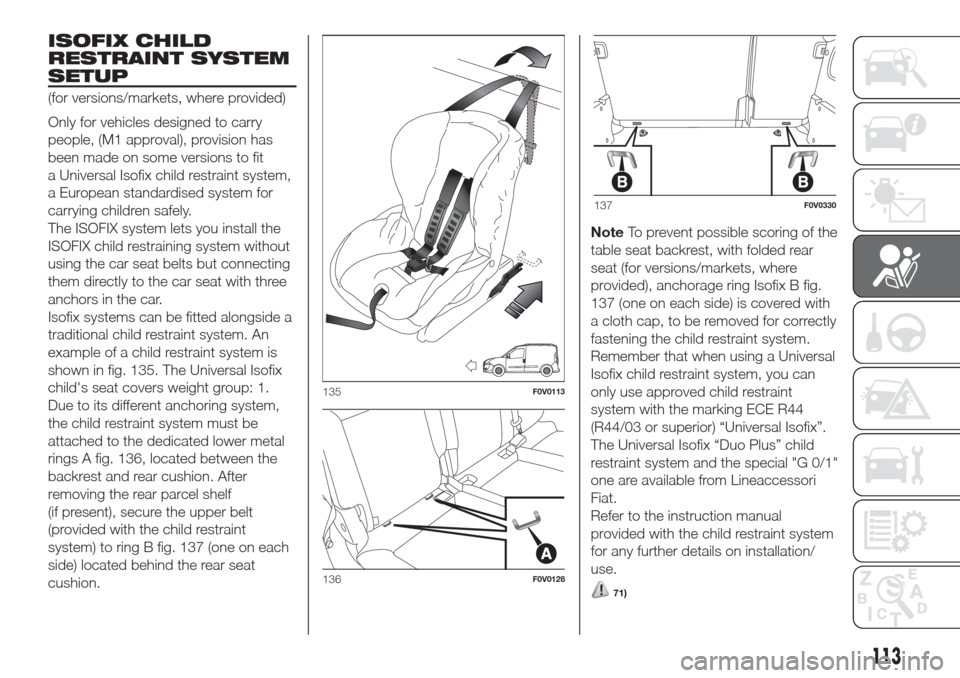
shown in fig. 135. The Universal Isofix
child's seat covers weight group: 1.
Due to its different anchoring system,
the child restraint system must be
attached to the dedicated lower metal
rings A fig. 136, located between the
backrest and rear cushion. After
removing the rear parcel shelf
(if present), secure the upper belt
(provided with the child restraint
system) to ring B fig. 137 (one on each
side) located behind the rear seat
cushion.NoteTo prevent possible scoring of the
table seat backrest, with folded rear
seat (for versions/markets, where
provided), anchorage ring Isofix B fig.
137 (one on each side) is covered with
a cloth cap, to be removed for correctly
fastening the child restraint system.
Remember that when using a Universal
Isofix child restraint system, you can
only use approved child restraint
system with the marking ECE R44
(R44/03 or superior) “Universal Isofix”.
The Universal Isofix “Duo Plus” child
restraint system and the special "G 0/1"
one are available from Lineaccessori
Fiat.
Refer to the instruction manual
provided with the child restraint system
for any further details on installation/
use.
71)
135F0V0113
136F0V0128
137F0V0330
113
Page 118 of 300
SUITABILITY OF PASSENGER SEATS FOR ISOFIX CHILD RESTRAINT SYSTEM USE
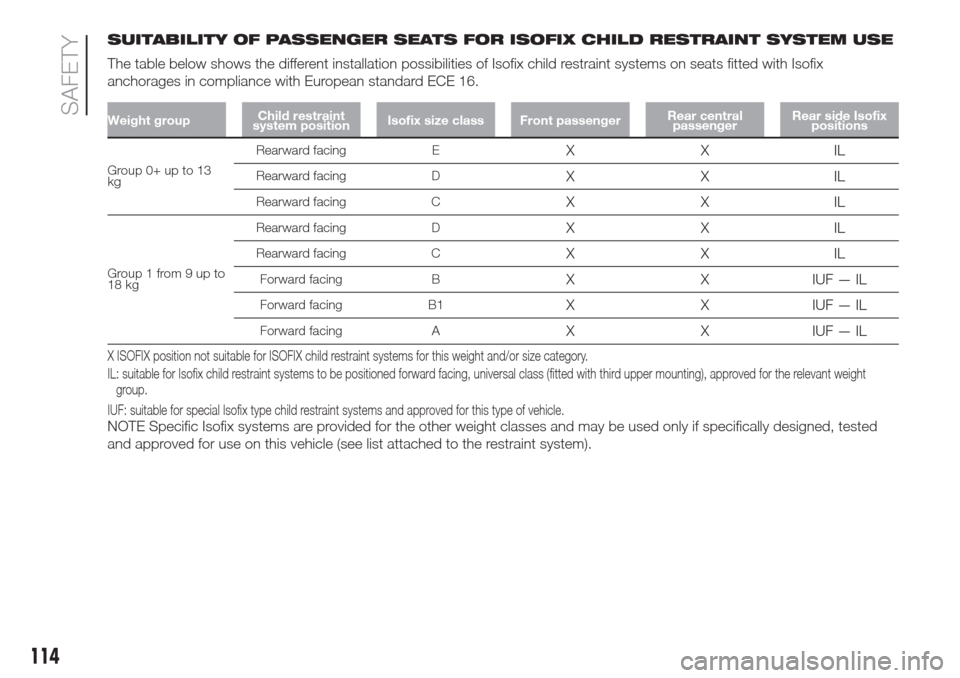
The table below shows the different installation possibilities of Isofix child restraint systems on seats fitted with Isofix
anchorages in compliance with European standard ECE 16.
Weight groupChild restraint
system positionIsofix size class Front passengerRear central
passengerRear side Isofix
positions
Group 0+ up to 13
kgRearward facing E
XXIL
Rearward facing DXXIL
Rearward facing CXXIL
Group1from9upto
18 kgRearward facing D
XXIL
Rearward facing CXXIL
Forward facing BX X IUF — IL
Forward facing B1X X IUF — IL
Forward facing AX X IUF — IL
X ISOFIX position not suitable for ISOFIX child restraint systems for this weight and/or size category.
IL: suitable for Isofix child restraint systems to be positioned forward facing, universal class (fitted with third upper mounting), approved for the relevant weight
group.
IUF: suitable for special Isofix type child restraint systems and approved for this type of vehicle.
NOTE Specific Isofix systems are provided for the other weight classes and may be used only if specifically designed, tested
and approved for use on this vehicle (see list attached to the restraint system).
114
SAFETY
Page 119 of 300
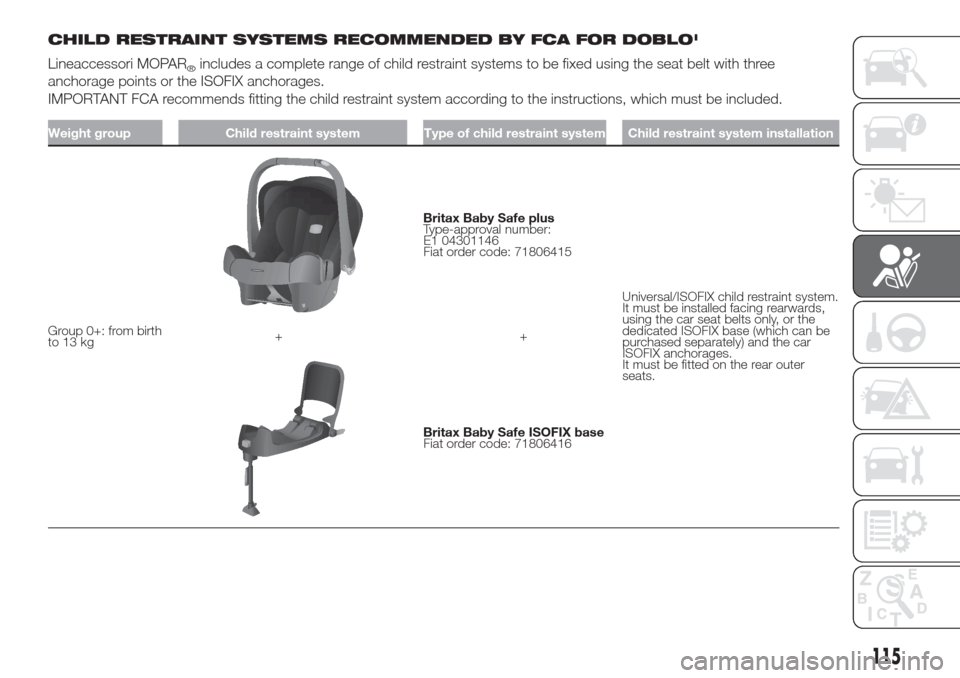
CHILD RESTRAINT SYSTEMS RECOMMENDED BY FCA FOR DOBLO'
Lineaccessori MOPAR
®includes a complete range of child restraint systems to be fixed using the seat belt with three
anchorage points or the ISOFIX anchorages.
IMPORTANT FCA recommends fitting the child restraint system according to the instructions, which must be included.
Weight group Child restraint system Type of child restraint system Child restraint system installation
Group 0+: from birth
to 13 kg
Britax Baby Safe plus
Type-approval number:
E1 04301146
Fiat order code: 71806415
Universal/ISOFIX child restraint system.
It must be installed facing rearwards,
using the car seat belts only, or the
dedicated ISOFIX base (which can be
purchased separately) and the car
ISOFIX anchorages.
It must be fitted on the rear outer
seats. ++
Britax Baby Safe ISOFIX base
Fiat order code: 71806416
115
Page 120 of 300
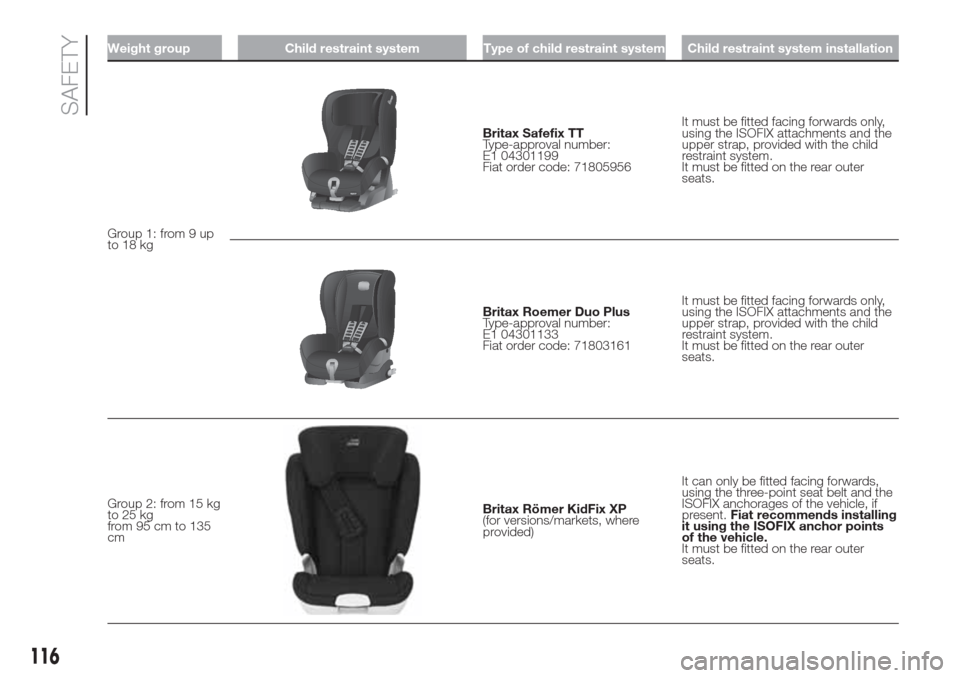
Weight group Child restraint system Type of child restraint system Child restraint system installation
Group 1: from 9 up
to 18 kg
Britax Safefix TT
Type-approval number:
E1 04301199
Fiat order code: 71805956It must be fitted facing forwards only,
using the ISOFIX attachments and the
upper strap, provided with the child
restraint system.
It must be fitted on the rear outer
seats.
Britax Roemer Duo Plus
Type-approval number:
E1 04301133
Fiat order code: 71803161It must be fitted facing forwards only,
using the ISOFIX attachments and the
upper strap, provided with the child
restraint system.
It must be fitted on the rear outer
seats.
Group 2: from 15 kg
to 25 kg
from 95 cm to 135
cm
Britax Römer KidFix XP
(for versions/markets, where
provided)It can only be fitted facing forwards,
using the three-point seat belt and the
ISOFIX anchorages of the vehicle, if
present.Fiat recommends installing
it using the ISOFIX anchor points
of the vehicle.
It must be fitted on the rear outer
seats.
116
SAFETY
Page 121 of 300
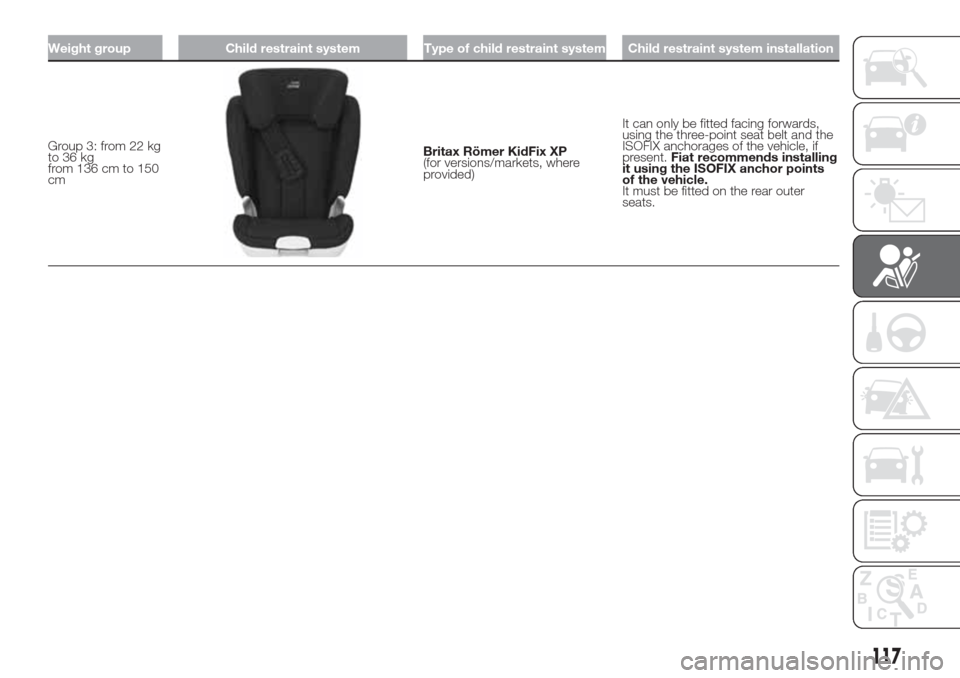
Weight group Child restraint system Type of child restraint system Child restraint system installation
Group 3: from 22 kg
to 36 kg
from 136 cm to 150
cmBritax Römer KidFix XP
(for versions/markets, where
provided)It can only be fitted facing forwards,
using the three-point seat belt and the
ISOFIX anchorages of the vehicle, if
present.Fiat recommends installing
it using the ISOFIX anchor points
of the vehicle.
It must be fitted on the rear outer
seats.
117
Page 122 of 300
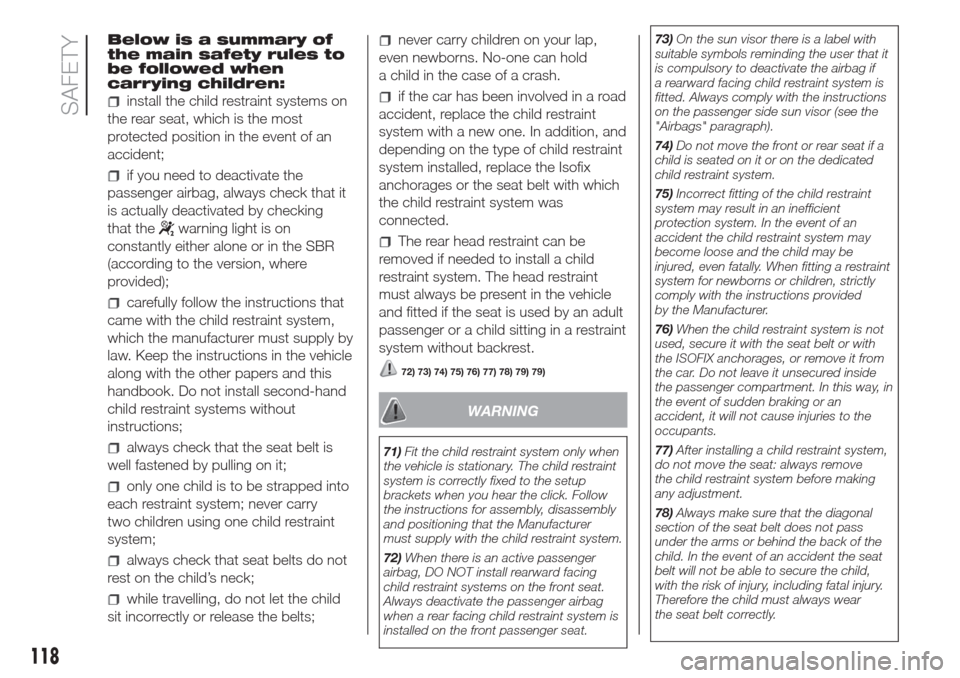
Below is a summary of
the main safety rules to
be followed when
carrying children:
install the child restraint systems on
the rear seat, which is the most
protected position in the event of an
accident;
if you need to deactivate the
passenger airbag, always check that it
is actually deactivated by checking
that the
warning light is on
constantly either alone or in the SBR
(according to the version, where
provided);
carefully follow the instructions that
came with the child restraint system,
which the manufacturer must supply by
law. Keep the instructions in the vehicle
along with the other papers and this
handbook. Do not install second-hand
child restraint systems without
instructions;
always check that the seat belt is
well fastened by pulling on it;
only one child is to be strapped into
each restraint system; never carry
two children using one child restraint
system;
always check that seat belts do not
rest on the child’s neck;
while travelling, do not let the child
sit incorrectly or release the belts;
never carry children on your lap,
even newborns. No-one can hold
a child in the case of a crash.
if the car has been involved in a road
accident, replace the child restraint
system with a new one. In addition, and
depending on the type of child restraint
system installed, replace the Isofix
anchorages or the seat belt with which
the child restraint system was
connected.
The rear head restraint can be
removed if needed to install a child
restraint system. The head restraint
must always be present in the vehicle
and fitted if the seat is used by an adult
passenger or a child sitting in a restraint
system without backrest.
72) 73) 74) 75) 76) 77) 78) 79) 79)
WARNING
71)Fit the child restraint system only when
the vehicle is stationary. The child restraint
system is correctly fixed to the setup
brackets when you hear the click. Follow
the instructions for assembly, disassembly
and positioning that the Manufacturer
must supply with the child restraint system.
72)When there is an active passenger
airbag, DO NOT install rearward facing
child restraint systems on the front seat.
Always deactivate the passenger airbag
when a rear facing child restraint system is
installed on the front passenger seat.73)On the sun visor there is a label with
suitable symbols reminding the user that it
is compulsory to deactivate the airbag if
a rearward facing child restraint system is
fitted. Always comply with the instructions
on the passenger side sun visor (see the
"Airbags" paragraph).
74)Do not move the front or rear seat if a
child is seated on it or on the dedicated
child restraint system.
75)Incorrect fitting of the child restraint
system may result in an inefficient
protection system. In the event of an
accident the child restraint system may
become loose and the child may be
injured, even fatally. When fitting a restraint
system for newborns or children, strictly
comply with the instructions provided
by the Manufacturer.
76)When the child restraint system is not
used, secure it with the seat belt or with
the ISOFIX anchorages, or remove it from
the car. Do not leave it unsecured inside
the passenger compartment. In this way, in
the event of sudden braking or an
accident, it will not cause injuries to the
occupants.
77)After installing a child restraint system,
do not move the seat: always remove
the child restraint system before making
any adjustment.
78)Always make sure that the diagonal
section of the seat belt does not pass
under the arms or behind the back of the
child. In the event of an accident the seat
belt will not be able to secure the child,
with the risk of injury, including fatal injury.
Therefore the child must always wear
the seat belt correctly.
118
SAFETY
Page 123 of 300
79)Do not use the same lower anchoring
to install more than one child restraint
system.
80)If a Universal ISOFIX child restraint
system is not fixed to all three anchorages,
it will not be able to protect the child
correctly. In an accident, the child could be
seriously or fatally injured.FRONT AIRBAGS
The vehicle is fitted with front airbag for
the driver and, for versions/markets
where provided, front airbag for the
passenger.
FRONT AIRBAGS
The front driver/passenger airbags (for
versions/markets where provided)
have been designed to protect the
front-seat occupants in the event of
head-on crashes of medium-high
severity, by placing the bag between
the occupant and the steering wheel or
dashboard.
Therefore, failure to deploy of the
airbags in other types of collisions (side
collisions, rear shunts, roll-overs, etc.)
is not a system malfunction.
An electronic control unit will make the
bag inflate in the event of a frontal
impact.
The bag will inflate instantaneously
placing itself between the front
occupants body and the structures
which could cause injury. It will deflate
immediately afterwards.Front driver/passenger airbags (for
versions/markets where provided) are
not a replacement for, but rather a
complement to, the seat belts, which
should be worn at all times as specified
by law in Europe and most non-
European countries.
In the event of an impact, those not
wearing a seat belt are projected
forwards, and may come into contact
with the bag which is still inflating.
The protection offered by the cushion is
compromised in such a case.
Front airbags may not activate in the
following situations:
frontal impacts against highly
deformable objects not involving the
front surface of the vehicle (e.g. wing
collision against guard rail, etc.);
vehicle wedging under other vehicles
or protective barriers (e.g. trucks or
guard rails);
they may not provide any additional
protection compared with seat belts, so
their activation would not be
appropriate. In these cases, non-
deployment does not indicate a system
malfunction.
81) 82) 82) 84) 85)
The driver's and passenger's front
airbags have been designed and
calibrated to protect front seat
occupants wearing seat belts.
119
Page 296 of 300
Handbrake
.................................... 129
Hazard warning lights..................... 148
Head restraints............................... 30
Headlight washers ......................... 39
Headlights...................................... 64
Heating and ventilation ................... 40
Hill Holder system .......................... 102
Identification data
.......................... 206
Ignition device ................................ 16
Important notes.............................. 125
Inflation pressure ............................ 219
Installing electrical/electronic
devices ........................................ 5
Interior fittings ................................ 60
Interior lights .................................. 35
Interior mirror ................................. 32
Interiors .......................................... 202
Isofix child restraint system
setup ........................................... 113
Jump starting
................................ 168
Lifting the vehicle
.......................... 170
Load limiters .................................. 107
Luggage compartment light ........... 36
Main beam headlights
.................. 34
Manual climate control system ....... 45
Manual deactivation of
passenger side front airbag and
side bag for chest/head
protection .................................... 120MSR system .................................. 103
Multifunction display....................... 73
– Control buttons ......................... 74
– Set-up menu ............................. 74
Number plate lights (for
hatchback versions)
..................... 154
Number plate lights (for versions
with wing doors)........................... 154
Occupant protection systems
....... 104
Parking
......................................... 129
Parking sensors ............................. 139
Partitions........................................ 28
Passenger’s side front airbag ......... 120
Performance .................................. 259
Periodic checks ............................. 183
Plastic parts ................................... 202
Power Socket ................................ 61
Power steering fluid........................ 193
Practical advice for reducing fuel
consumption and harmful
emissions ..................................... 143
Pre-tensioners................................ 107
Prescriptions for vehicle at end
of life ........................................... 284
Procedure for diesel versions ......... 128
Procedure for petrol versions.......... 128
Prolonged vehicle inactivity............. 200
Protecting the environment ............ 66
Protection against atmospheric
agents.......................................... 201
Radio (setup)
................................ 65
Radio transmitters and mobile
phones......................................... 6
Rear doors ..................................... 20
Rear fog lights ................................ 55
Rear light clusters .......................... 152
Rear roof light ................................ 155
Rear view mirrors ........................... 32
Rear window washer...................... 39
Rear window wiper ........................ 38
Recharging the battery ................... 196
Refuelling ....................................... 254
Refuelling the vehicle ...................... 141
Replacing a bulb ............................ 148
Replacing an exterior bulb .............. 151
Replacing an interior bulb ............... 155
Replacing fuses.............................. 157
Replacing the battery ..................... 195
Rim Protector................................. 216
Rims and tyres ............................... 215
Roof rack ....................................... 64
Rubber hoses ................................ 200
Saving fuel
.................................... 143
SBR system ................................... 106
Scheduled servicing ....................... 174
Seat belts....................................... 104
Seat belts maintenance .................. 108
Seat with storage compartment ..... 62
Seats ............................................. 22
INDEX