tyre pressure FIAT DOBLO COMBI 2018 Owner handbook (in English)
[x] Cancel search | Manufacturer: FIAT, Model Year: 2018, Model line: DOBLO COMBI, Model: FIAT DOBLO COMBI 2018Pages: 272, PDF Size: 23.75 MB
Page 147 of 272
SCHEDULED
SERVICING
Correct servicing is crucial for
guaranteeing a long life for the vehicle
under the best conditions.
This is why Fiat has planned a series of
checks and services every 30,000/
35,000 km (depending on the version).
It is, however, important to remember
that scheduled servicing does not
completely cover all the requirements of
the car: even in the initial period before
30,000/35,000 km, and then
subsequently between one service and
another, ordinary care is always
required such as routine checks
involving topping up fluid level,
checking tyre pressures etc.
IMPORTANT Scheduled Servicing
operations are required by the
Manufacturer. Failure to have them
carried out may invalidate the warranty.
Scheduled Servicing can be carried
out by any Fiat Dealership, at
pre-established times.
If during each operation, in addition to
the ones scheduled, the need arises for
further replacements or repairs, these
may only be carried out with the
express agreement of the Customer.IMPORTANT It is advisable to contact a
Fiat Dealership in the event of any
minor operating failure, without waiting
for the next service coupon.
If your vehicle is used frequently for
trailer towing, the interval between
scheduled maintenance services must
be reduced.
145
Page 148 of 272
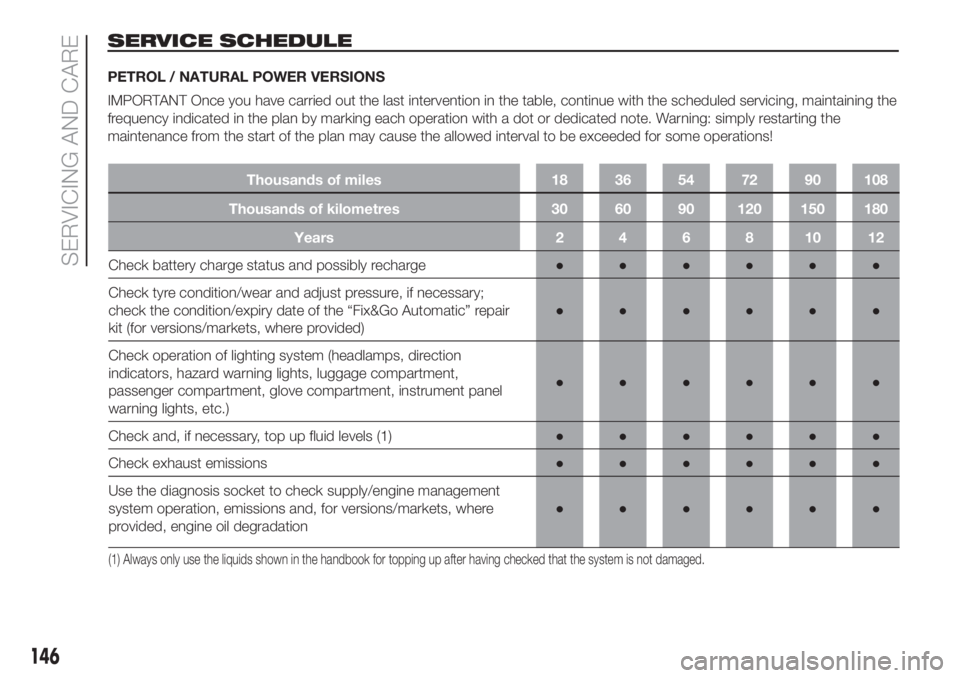
SERVICE SCHEDULE
PETROL / NATURAL POWER VERSIONS
IMPORTANT Once you have carried out the last intervention in the table, continue with the scheduled servicing, maintaining the
frequency indicated in the plan by marking each operation with a dot or dedicated note. Warning: simply restarting the
maintenance from the start of the plan may cause the allowed interval to be exceeded for some operations!
146
SERVICING AND CARE
Thousands of miles 18 36 54 72 90 108
Thousands of kilometres 30 60 90 120 150 180
Years 2 4 6 8 10 12
Check battery charge status and possibly recharge●●●●●●
Check tyre condition/wear and adjust pressure, if necessary;
check the condition/expiry date of the “Fix&Go Automatic” repair
kit (for versions/markets, where provided)●●●●●●
Check operation of lighting system (headlamps, direction
indicators, hazard warning lights, luggage compartment,
passenger compartment, glove compartment, instrument panel
warning lights, etc.)●●●●●●
Check and, if necessary, top up fluid levels (1)●●●●●●
Check exhaust emissions●●●●●●
Use the diagnosis socket to check supply/engine management
system operation, emissions and, for versions/markets, where
provided, engine oil degradation●●●●●●
(1) Always only use the liquids shown in the handbook for topping up after having checked that the system is not damaged.
Page 151 of 272
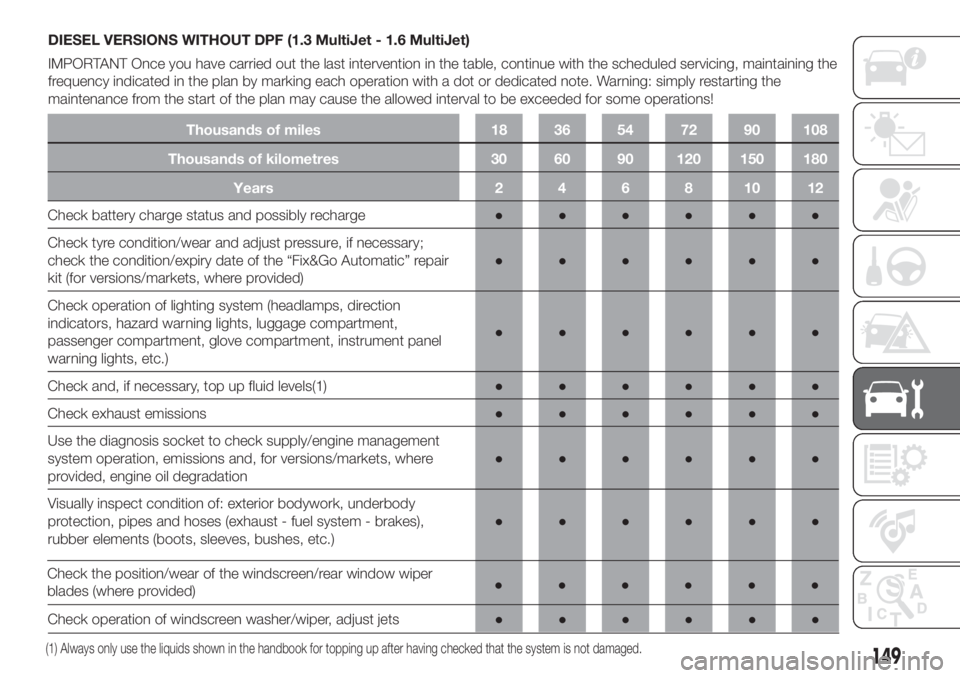
DIESEL VERSIONS WITHOUT DPF (1.3 MultiJet - 1.6 MultiJet)
IMPORTANT Once you have carried out the last intervention in the table, continue with the scheduled servicing, maintaining the
frequency indicated in the plan by marking each operation with a dot or dedicated note. Warning: simply restarting the
maintenance from the start of the plan may cause the allowed interval to be exceeded for some operations!
149
Thousands of miles 18 36 54 72 90 108
Thousands of kilometres 30 60 90 120 150 180
Years 2 4 6 8 10 12
Check battery charge status and possibly recharge●●●●●●
Check tyre condition/wear and adjust pressure, if necessary;
check the condition/expiry date of the “Fix&Go Automatic” repair
kit (for versions/markets, where provided)●●●●●●
Check operation of lighting system (headlamps, direction
indicators, hazard warning lights, luggage compartment,
passenger compartment, glove compartment, instrument panel
warning lights, etc.)●●●●●●
Check and, if necessary, top up fluid levels(1)●●●●●●
Check exhaust emissions●●●●●●
Use the diagnosis socket to check supply/engine management
system operation, emissions and, for versions/markets, where
provided, engine oil degradation●●●●●●
Visually inspect condition of: exterior bodywork, underbody
protection, pipes and hoses (exhaust - fuel system - brakes),
rubber elements (boots, sleeves, bushes, etc.)●●●●●●
(1) Always only use the liquids shown in the handbook for topping up after having checked that the system is not damaged.
Check the position/wear of the windscreen/rear window wiper
blades (where provided)●●●●●●
Check operation of windscreen washer/wiper, adjust jets●●●●●●
Page 153 of 272
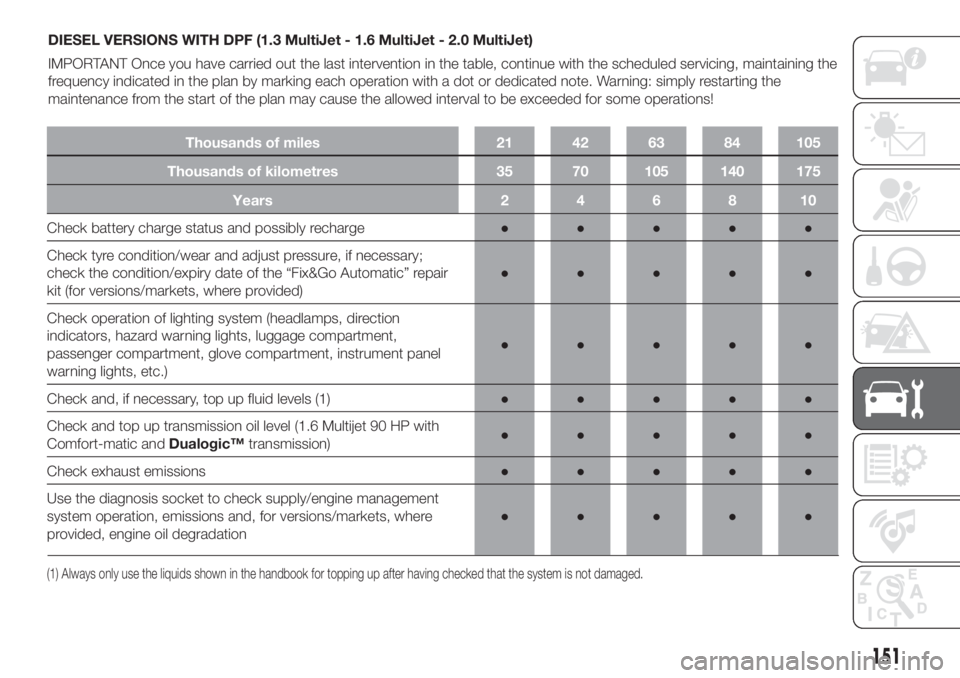
DIESEL VERSIONS WITH DPF (1.3 MultiJet - 1.6 MultiJet - 2.0 MultiJet)
IMPORTANT Once you have carried out the last intervention in the table, continue with the scheduled servicing, maintaining the
frequency indicated in the plan by marking each operation with a dot or dedicated note. Warning: simply restarting the
maintenance from the start of the plan may cause the allowed interval to be exceeded for some operations!
151
Thousands of miles 21 42 63 84 105
Thousands of kilometres 35 70 105 140 175
Years246810
Check battery charge status and possibly recharge●●●●●
Check tyre condition/wear and adjust pressure, if necessary;
check the condition/expiry date of the “Fix&Go Automatic” repair
kit (for versions/markets, where provided)●●●●●
Check operation of lighting system (headlamps, direction
indicators, hazard warning lights, luggage compartment,
passenger compartment, glove compartment, instrument panel
warning lights, etc.)●●●●●
Check and, if necessary, top up fluid levels (1)●●●●●
Check and top up transmission oil level (1.6 Multijet 90 HP with
Comfort-matic andDualogic™transmission)●●●●●
Check exhaust emissions●●●●●
Use the diagnosis socket to check supply/engine management
system operation, emissions and, for versions/markets, where
provided, engine oil degradation●●●●●
(1) Always only use the liquids shown in the handbook for topping up after having checked that the system is not damaged.
Page 156 of 272
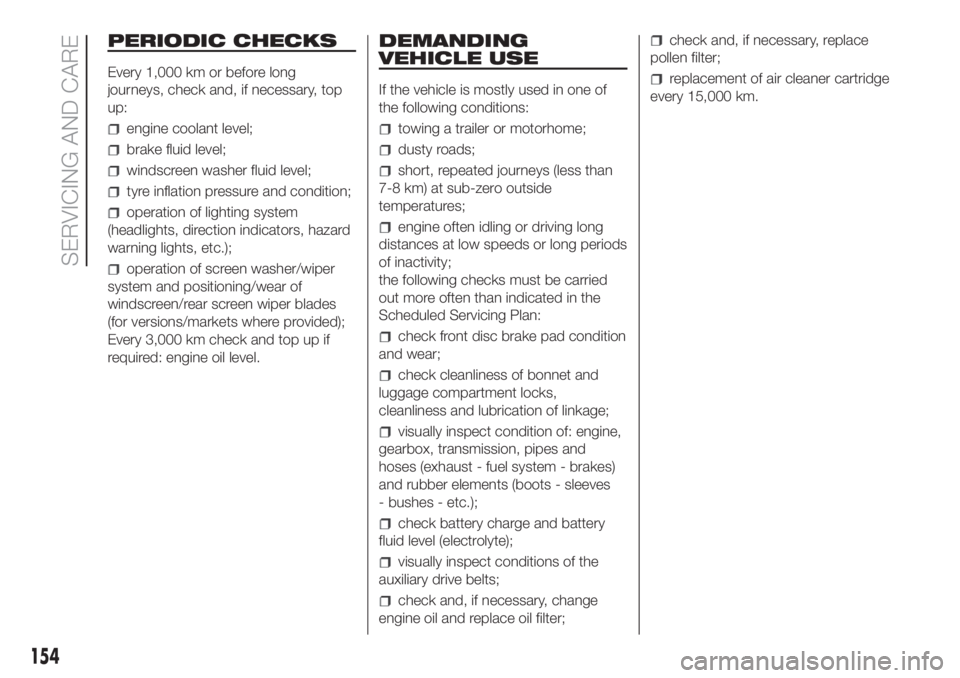
PERIODIC CHECKS
Every 1,000 km or before long
journeys, check and, if necessary, top
up:
engine coolant level;
brake fluid level;
windscreen washer fluid level;
tyre inflation pressure and condition;
operation of lighting system
(headlights, direction indicators, hazard
warning lights, etc.);
operation of screen washer/wiper
system and positioning/wear of
windscreen/rear screen wiper blades
(for versions/markets where provided);
Every 3,000 km check and top up if
required: engine oil level.
DEMANDING
VEHICLE USE
If the vehicle is mostly used in one of
the following conditions:
towing a trailer or motorhome;
dusty roads;
short, repeated journeys (less than
7-8 km) at sub-zero outside
temperatures;
engine often idling or driving long
distances at low speeds or long periods
of inactivity;
the following checks must be carried
out more often than indicated in the
Scheduled Servicing Plan:
check front disc brake pad condition
and wear;
check cleanliness of bonnet and
luggage compartment locks,
cleanliness and lubrication of linkage;
visually inspect condition of: engine,
gearbox, transmission, pipes and
hoses (exhaust - fuel system - brakes)
and rubber elements (boots - sleeves
- bushes - etc.);
check battery charge and battery
fluid level (electrolyte);
visually inspect conditions of the
auxiliary drive belts;
check and, if necessary, change
engine oil and replace oil filter;
check and, if necessary, replace
pollen filter;
replacement of air cleaner cartridge
every 15,000 km.
154
SERVICING AND CARE
Page 171 of 272
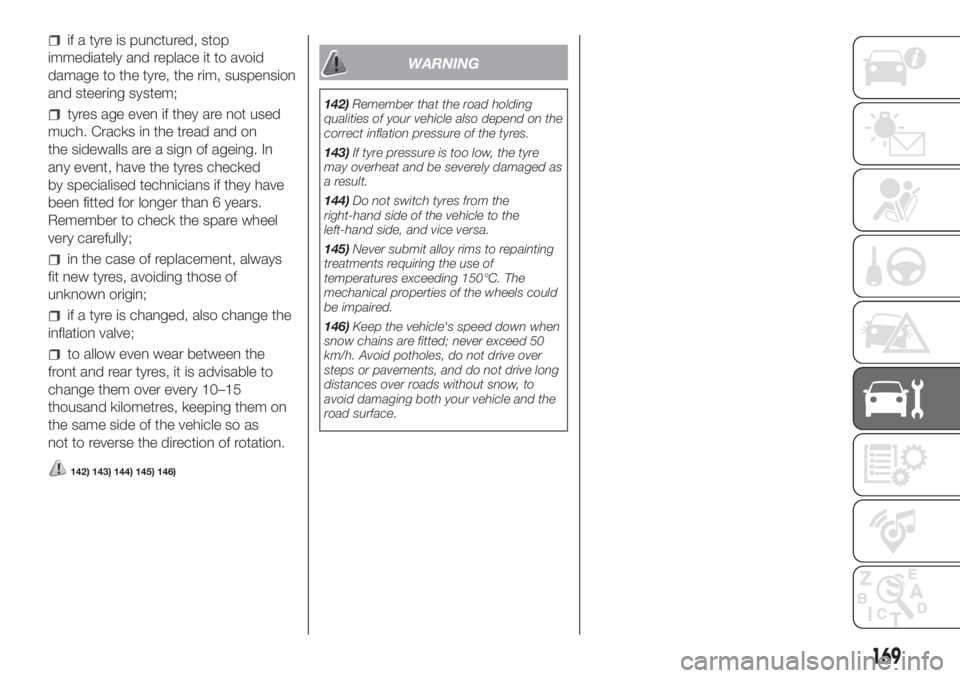
if a tyre is punctured, stop
immediately and replace it to avoid
damage to the tyre, the rim, suspension
and steering system;
tyres age even if they are not used
much. Cracks in the tread and on
the sidewalls are a sign of ageing. In
any event, have the tyres checked
by specialised technicians if they have
been fitted for longer than 6 years.
Remember to check the spare wheel
very carefully;
in the case of replacement, always
fit new tyres, avoiding those of
unknown origin;
if a tyre is changed, also change the
inflation valve;
to allow even wear between the
front and rear tyres, it is advisable to
change them over every 10–15
thousand kilometres, keeping them on
the same side of the vehicle so as
not to reverse the direction of rotation.
142) 143) 144) 145) 146)
WARNING
142)Remember that the road holding
qualities of your vehicle also depend on the
correct inflation pressure of the tyres.
143)If tyre pressure is too low, the tyre
may overheat and be severely damaged as
a result.
144)Do not switch tyres from the
righthand side of the vehicle to the
lefthand side, and vice versa.
145)Never submit alloy rims to repainting
treatments requiring the use of
temperatures exceeding 150°C. The
mechanical properties of the wheels could
be impaired.
146)Keep the vehicle's speed down when
snow chains are fitted; never exceed 50
km/h. Avoid potholes, do not drive over
steps or pavements, and do not drive long
distances over roads without snow, to
avoid damaging both your vehicle and the
road surface.
169
Page 182 of 272
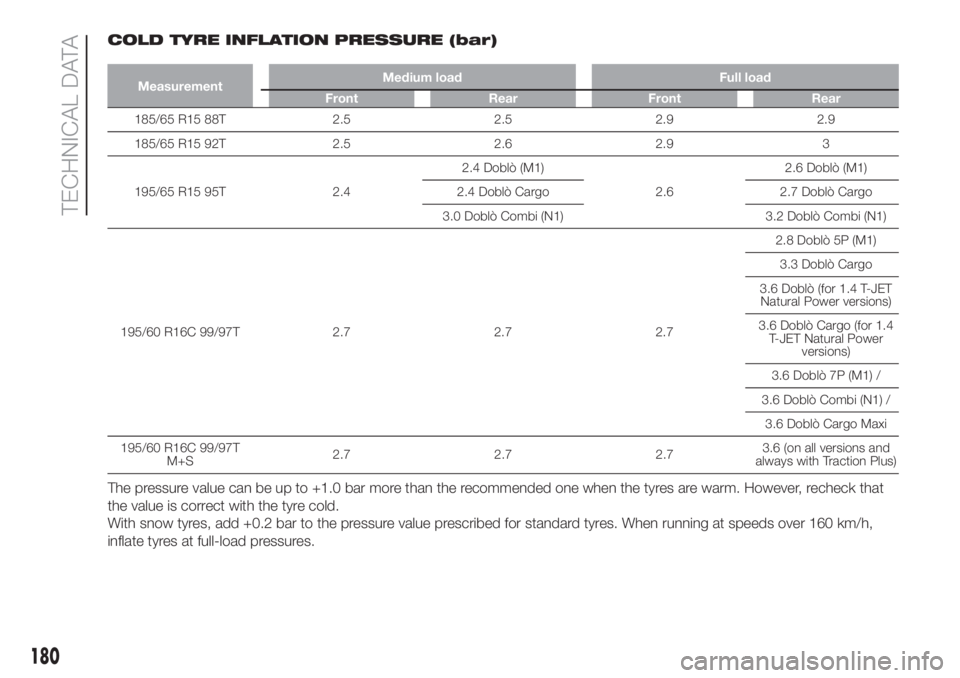
COLD TYRE INFLATION PRESSURE (bar)
MeasurementMedium load Full load
Front Rear Front Rear
185/65 R15 88T 2.5 2.5 2.9 2.9
185/65 R15 92T 2.5 2.6 2.9 3
195/65 R15 95T 2.42.4 Doblò (M1)
2.62.6 Doblò (M1)
2.4 Doblò Cargo 2.7 Doblò Cargo
3.0 Doblò Combi (N1) 3.2 Doblò Combi (N1)
195/60 R16C 99/97T 2.7 2.7 2.72.8 Doblò 5P (M1)
3.3 Doblò Cargo
3.6 Doblò (for 1.4 T-JET
Natural Power versions)
3.6 Doblò Cargo (for 1.4
T-JET Natural Power
versions)
3.6 Doblò 7P (M1) /
3.6 Doblò Combi (N1) /
3.6 Doblò Cargo Maxi
195/60 R16C 99/97T
M+S2.7 2.7 2.73.6 (on all versions and
always with Traction Plus)
The pressure value can be up to +1.0 bar more than the recommended one when the tyres are warm. However, recheck that
the value is correct with the tyre cold.
With snow tyres, add +0.2 bar to the pressure value prescribed for standard tyres. When running at speeds over 160 km/h,
inflate tyres at full-load pressures.
180
TECHNICAL DATA
Page 267 of 272
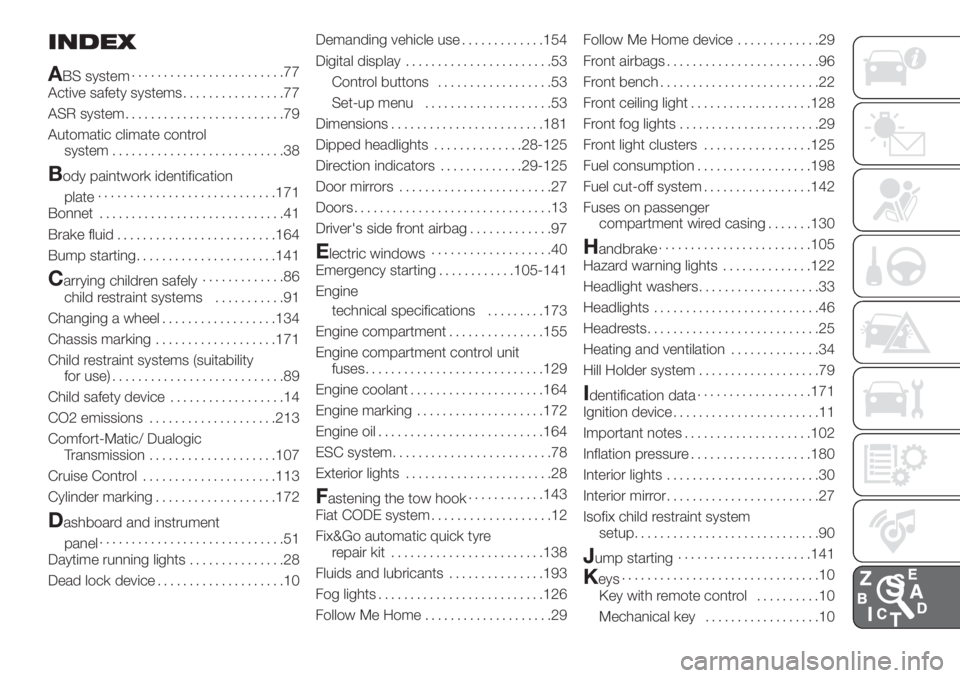
INDEX
A
BS system........................77
Active safety systems................77
ASR system.........................79
Automatic climate control
system...........................38
Body paintwork identification
plate............................171
Bonnet.............................41
Brake fluid.........................164
Bump starting......................141
Carrying children safely.............86
child restraint systems...........91
Changing a wheel..................134
Chassis marking...................171
Child restraint systems (suitability
for use)...........................89
Child safety device..................14
CO2 emissions....................213
Comfort-Matic/ Dualogic
Transmission....................107
Cruise Control.....................113
Cylinder marking...................172
Dashboard and instrument
panel.............................51
Daytime running lights...............28
Dead lock device....................10Demanding vehicle use.............154
Digital display.......................53
Control buttons..................53
Set-up menu....................53
Dimensions........................181
Dipped headlights..............28-125
Direction indicators.............29-125
Door mirrors........................27
Doors...............................13
Driver's side front airbag.............97
Electric windows...................40
Emergency starting............105-141
Engine
technical specifications.........173
Engine compartment...............155
Engine compartment control unit
fuses............................129
Engine coolant.....................164
Engine marking....................172
Engine oil..........................164
ESC system.........................78
Exterior lights.......................28
Fastening the tow hook............143
Fiat CODE system...................12
Fix&Go automatic quick tyre
repair kit........................138
Fluids and lubricants...............193
Fog lights..........................126
Follow Me Home....................29Follow Me Home device.............29
Front airbags........................96
Front bench.........................22
Front ceiling light...................128
Front fog lights......................29
Front light clusters.................125
Fuel consumption..................198
Fuel cut-off system.................142
Fuses on passenger
compartment wired casing.......130
Handbrake........................105
Hazard warning lights..............122
Headlight washers...................33
Headlights..........................46
Headrests...........................25
Heating and ventilation..............34
Hill Holder system...................79
Identification data..................171
Ignition device.......................11
Important notes....................102
Inflation pressure...................180
Interior lights........................30
Interior mirror........................27
Isofix child restraint system
setup.............................90
Jump starting.....................141
Keys...............................10
Key with remote control..........10
Mechanical key..................10