engine FIAT DOBLO PANORAMA 2016 2.G Owners Manual
[x] Cancel search | Manufacturer: FIAT, Model Year: 2016, Model line: DOBLO PANORAMA, Model: FIAT DOBLO PANORAMA 2016 2.GPages: 323, PDF Size: 25.46 MB
Page 269 of 323
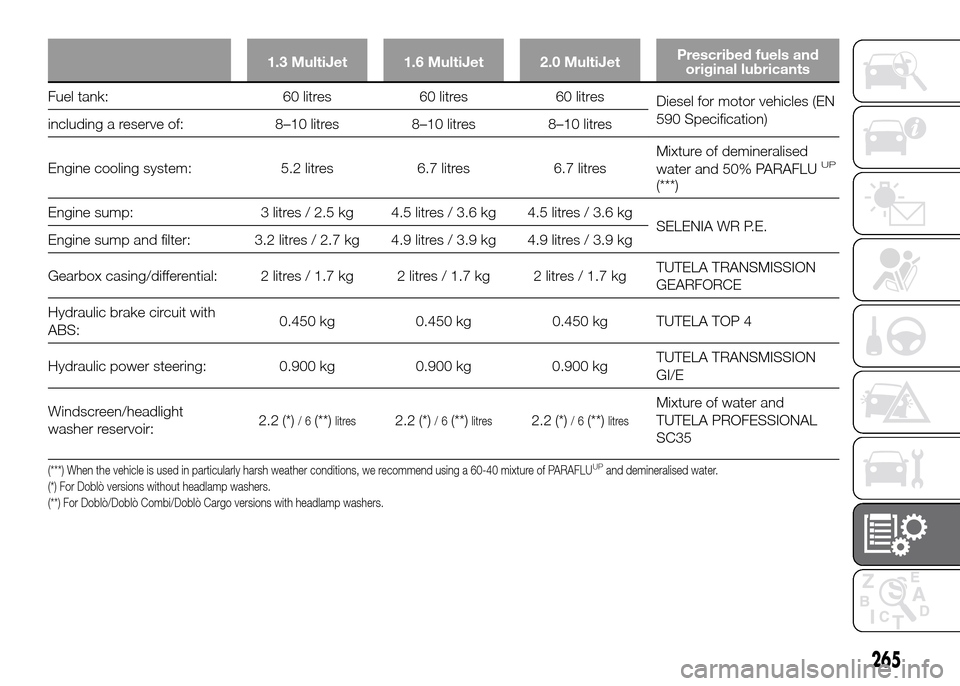
1.3 MultiJet 1.6 MultiJet 2.0 MultiJetPrescribed fuels and
original lubricants
Fuel tank: 60 litres 60 litres 60 litres
Diesel for motor vehicles (EN
590 Specification)
including a reserve of: 8–10 litres 8–10 litres 8–10 litres
Engine cooling system: 5.2 litres 6.7 litres 6.7 litresMixture of demineralised
water and 50% PARAFLU
UP
(***)
Engine sump: 3 litres / 2.5 kg 4.5 litres / 3.6 kg 4.5 litres / 3.6 kg
SELENIA WR P.E.
Engine sump and filter: 3.2 litres / 2.7 kg 4.9 litres / 3.9 kg 4.9 litres / 3.9 kg
Gearbox casing/differential: 2 litres / 1.7 kg 2 litres / 1.7 kg 2 litres / 1.7 kgTUTELA TRANSMISSION
GEARFORCE
Hydraulic brake circuit with
ABS:0.450 kg 0.450 kg 0.450 kg TUTELA TOP 4
Hydraulic power steering: 0.900 kg 0.900 kg 0.900 kgTUTELA TRANSMISSION
GI/E
Windscreen/headlight
washer reservoir:2.2 (*)
/6(**)litres2.2 (*)/6(**)litres2.2 (*)/6(**)litres
Mixture of water and
TUTELA PROFESSIONAL
SC35
(***) When the vehicle is used in particularly harsh weather conditions, we recommend using a 60-40 mixture of PARAFLUUPand demineralised water.
(*) For Doblò versions without headlamp washers.
(**) For Doblò/Doblò Combi/Doblò Cargo versions with headlamp washers.
265
Page 270 of 323
FLUIDS AND LUBRICANTS
Your vehicle is equipped with an engine oil that has been thoroughly developed and tested in order to meet the requirements of
the Scheduled Servicing Plan. Constant use of the prescribed lubricants guarantees the fuel consumption and emission
specifications. Lubricant quality is crucial for engine operation and duration.
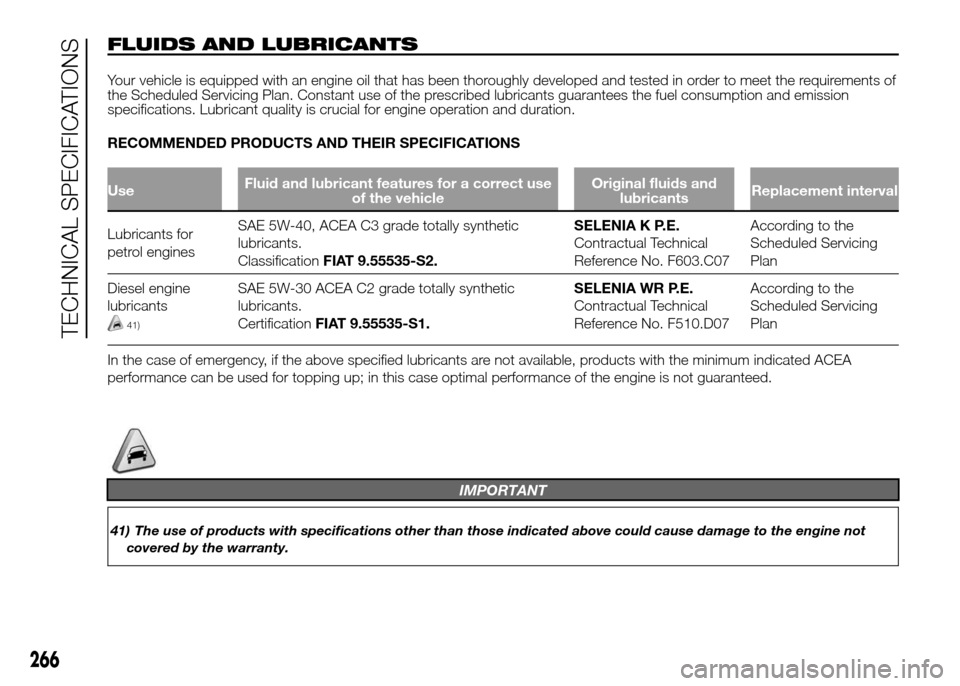
RECOMMENDED PRODUCTS AND THEIR SPECIFICATIONS
UseFluid and lubricant features for a correct use
of the vehicleOriginal fluids and
lubricantsReplacement interval
Lubricants for
petrol enginesSAE 5W-40, ACEA C3 grade totally synthetic
lubricants.
ClassificationFIAT 9.55535-S2.SELENIA K P.E.
Contractual Technical
Reference No. F603.C07According to the
Scheduled Servicing
Plan
Diesel engine
lubricants
41)
SAE 5W-30 ACEA C2 grade totally synthetic
lubricants.
CertificationFIAT 9.55535-S1.SELENIA WR P.E.
Contractual Technical
Reference No. F510.D07According to the
Scheduled Servicing
Plan
In the case of emergency, if the above specified lubricants are not available, products with the minimum indicated ACEA
performance can be used for topping up; in this case optimal performance of the engine is not guaranteed.
IMPORTANT
41) The use of products with specifications other than those indicated above could cause damage to the engine not
covered by the warranty.
266
TECHNICAL SPECIFICATIONS
Page 272 of 323
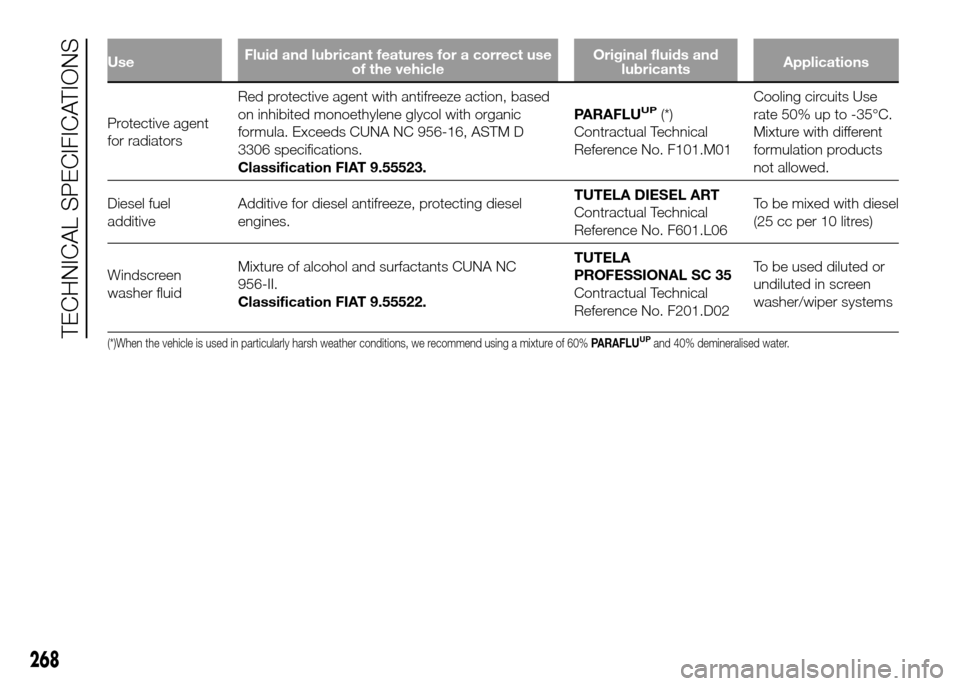
UseFluid and lubricant features for a correct use
of the vehicleOriginal fluids and
lubricantsApplications
Protective agent
for radiatorsRed protective agent with antifreeze action, based
on inhibited monoethylene glycol with organic
formula. Exceeds CUNA NC 956-16, ASTM D
3306 specifications.
Classification FIAT 9.55523.PARAFLUUP(*)
Contractual Technical
Reference No. F101.M01Cooling circuits Use
rate 50% up to -35°C.
Mixture with different
formulation products
not allowed.
Diesel fuel
additiveAdditive for diesel antifreeze, protecting diesel
engines.TUTELA DIESEL ART
Contractual Technical
Reference No. F601.L06To be mixed with diesel
(25 cc per 10 litres)
Windscreen
washer fluidMixture of alcohol and surfactants CUNA NC
956-II.
Classification FIAT 9.55522.TUTELA
PROFESSIONAL SC 35
Contractual Technical
Reference No. F201.D02To be used diluted or
undiluted in screen
washer/wiper systems
(*)When the vehicle is used in particularly harsh weather conditions, we recommend using a mixture of 60%PARAFLUUPand 40% demineralised water.
268
TECHNICAL SPECIFICATIONS
Page 274 of 323
FUEL
CONSUMPTION
The fuel consumption figures given in
the tables below are determined on the
basis of the type-approval tests laid
down by specific European Directives.
These consumption values refer to
basic vehicles without optionals.
The procedures below are followed for
measuring consumption:
❒urban cycle: begins with cold
starting, followed by driving
simulating the use of the vehicle in
town;
❒extra-urban cycle: driving that
simulates using the vehicle out of
town with frequent acceleration in all
gears; the speed varies from 0 to 120
km/h;
❒combined consumption: calculated
with a weighting of approximately
37% of the urban cycle and 63% of
the extra-urban cycle.IMPORTANT The type of route, traffic
situations, weather conditions, driving
style, general conditions of the vehicle,
trim level/equipment/accessories,
climate control system, vehicle load,
roof rack, other situations that affect air
drag may lead to different fuel
consumption levels than those
measured.IMPORTANT
In practice, fuel consumption may be
higher than the values obtained during
the approval tests.
Here are some of the major factors that
can lead to a difference between test
and real consumption.
1) Vehicle condition: inadequate
servicing, use of roof racks, trailers,
heavy loading, high usage of electrical
devices and the air conditioning.
2) Driving style: frequent cold starts for
short journeys, poor engine warming
technique, gear selection, high speeds,
sudden acceleration and braking.
3) Traffic and road conditions: driving in
traffic, steep hills or winding roads,
road surface conditions.
4) Atmospheric conditions: intemperate
weather, wind, rain, snow, high altitude.
5) Proportion of use in towns and
cities, in the country and on
motorways.
270
TECHNICAL SPECIFICATIONS
Page 275 of 323
PRACTICAL ADVICE FOR
REDUCING FUEL
CONSUMPTION AND
HARMFUL EMISSIONS
Vehicle conditions
1. Have checks and adjustments
carried out in accordance with the
“Scheduled Servicing Plan”.
2. Check tyre pressure regularly, at least
once every four weeks. Excessively
low pressures will increase
consumption because rolling resistance
will be higher. In addition, this wears
the tyre more quickly and impairs
performance.
3. Only use snow tyres when the
weather conditions make them
absolutely necessary. They increase
consumption and noise.
4. Do not travel with a heavy load: the
weight of the vehicle (especially when
driving in town) and its trim greatly
affect fuel consumption and stability.
5. Remove roof racks or ski racks after
use. These accessories reduce the
vehicle's aerodynamic penetration and
have a negative effect on fuel
consumption.
6. When transporting particularly large
objects, use a trailer if possible.7. Use the vehicle's air vents if possible:
travelling with the windows open
impairs aerodynamics.
8. Use electrical devices only for the
amount of time needed. The vehicle’s
heated rear window, additional
headlights, screen wipers and heater
fan require a considerable amount
of energy; increasing the current uptake
increases fuel consumption (by up to
+25% in an urban cycle).
9. Air conditioning leads to higher fuel
consumption (on average up to +30%).
If the temperature outside is not too
extreme, try and use the air vents.Driving style
1. After starting the engine you should
drive away immediately and slowly,
avoiding high revs. Do not warm up the
engine at low or high revs when the
vehicle is stationary; this causes the
engine to warm up more slowly, thereby
increasing fuel consumption, emissions
and mechanical component wear.
2. Avoid pointless actions such
as revving up when at traffic lights or
before stopping the engine. The latter
action, like double-declutching, is
unnecessary and causes increased fuel
consumption and pollution.
3. Gear selection: select a high gear as
soon as possible (taking into account
normal engine operation and traffic
conditions) without pushing the engine
to high revs during the intermediate
gears. Using low gears at high revs to
get lively acceleration increases fuel
consumption, harmful emissions and
engine wear.
271
Page 276 of 323
4. Vehicle speed: fuel consumption
increases exponentially as the speed of
the vehicle increases. Keep your speed
moderate and as even as possible,
avoiding unnecessary braking and
acceleration, which cause excessive
fuel consumption and increased
emissions. Keeping a safe distance
from the vehicle in front helps to
maintain a steady speed.
5. Acceleration: accelerating violently
severely affects consumption and
emissions. Acceleration should be
gradual and should not exceed the
maximum engine torque rate.
272
TECHNICAL SPECIFICATIONS
Page 309 of 323
PRESCRIPTIONS FOR HANDLING THE VEHICLE AT THE END OF
ITS LIFE
Fiat has been committed for many years to safeguarding the environment through the constant improvement of its production
processes and manufacturing products that are increasingly "eco-compatible". To assure customers of the best possible
service in terms of respecting environmental laws and in response to European Directive 2000/53/EC governing vehicles at the
end of their life, Fiat is offering their customers the opportunity of handing over their vehicle (*) at the end of its life without
incurring any additional costs.
The European Directive sets out that when the vehicle is handed over, the last keeper or owner should not incur any expenses
as a result of it having a zero or negative market value. In particular, in almost all European Union countries, until 1st January
2007, vehicles registered after 1st July 2002 will be collected free of charge, whilst from 2007 collection will be free of charge
irrespective of the year of registration as long as the vehicle contains its basic components (in particular the engine and
bodywork) and has no additional waste.
To hand your vehicle over at the end of its life without extra cost, contact a Fiat Dealership or authorised collection and
scrapping centres. These centres have been carefully chosen to offer high quality service for the collection, treatment and
recycling of vehicles at their end of life, respecting the surrounding environment.
You can find further information on these collection and scrapping centres either from a Fiat or Fiat Commercial Vehicle
Dealership or by calling the freephone number 00800 3428 0000 or by going on the Fiat website.
(*) Vehicle for transporting passengers with a maximum of nine seats and a total permitted weight of 3.5 t
305
Page 319 of 323
INDEX
A
BS .............................................. 106
Accessories purchased by the
owner .......................................... 5
Active safety systems ..................... 106
Advice for preserving the
bodywork..................................... 207
Air cleaner/pollen filter .................... 198
Ashtray .......................................... 64
ASR system ................................... 109
Automatic climate control
system ......................................... 49
Battery .......................................... 199
Battery recharging.......................... 201
Blades ........................................... 202
Bodywork ...................................... 206
Bodywork paint identification
plate............................................. 212
Bodywork version .......................... 214
Bonnet ........................................... 57
Boot............................................... 58
Brake fluid ...................................... 196
Brakes
– specifications ............................ 221
Bump starting ................................ 174
Carrying children safely ................. 115
– child restraint systems ............... 120
Changing a wheel .......................... 166
Chassis marking ............................ 212Child restraint systems
(compliance for use) ..................... 117
Child safety device ......................... 20
Cigar lighter.................................... 64
CO2 emissions............................... 290
Control panel and on-board
instruments .................................. 72
Controls ......................................... 56
Cruise Control ................................ 141
Daytime running lights .................. 34
Dead lock ...................................... 15
Demanding vehicle use .................. 188
Diesel filter ..................................... 199
Diffusers ......................................... 42
Digital display ................................. 75
– Control buttons ......................... 75
– Set-up menu ............................. 75
Dimensions .................................... 231
Dipped headlights .................... 34-155
Direction indicators ................... 34-156
Door mirrors ................................... 32
Doors ............................................. 19
Draining condensation (MultiJet
versions) ...................................... 199
Driver side armrest ......................... 62
Driver's side front airbag ................ 122
Electric windows ........................... 55
– Initialisation................................ 56
Emergency starting ................ 131-174
Engine codes ................................. 214Engine compartment control unit
fuses ............................................ 161
Engine compartment...................... 189
Engine coolant ............................... 196
Engine
– technical specifications.............. 216
Engine marking .............................. 213
Engine oil ....................................... 196
EOBD system ................................ 87
ESC system ................................... 108
Exterior lights ................................. 34
Fastening the tow hook................. 176
Fiat CODE system.......................... 18
Fix&Go automatic quick tyre
repair kit ....................................... 170
Fluids and lubricants ...................... 266
Fog lights ................................. 56-156
Follow Me Home device ................. 35
Follow Me Home ............................ 35
Front airbags .................................. 121
Front bench ................................... 27
Front light clusters .......................... 155
Front roof light ................................ 158
Fuel consumption .......................... 270
Fuel cut-off system......................... 175
Fuses on compartment wired
casing .......................................... 162
Glove compartment ...................... 62
Handbrake.................................... 132
Page 321 of 323
– Rear seats ................................. 25
Seat with storage compartment ..... 63
Side bags....................................... 126
Side doors ..................................... 19
Side lights ................................ 34-155
Ski rack.......................................... 66
Snow chains .................................. 150
Snow tyres ..................................... 149
Spare wheel ................................... 224
Speed block................................... 141
Spray nozzles................................. 203
Starting the engine ......................... 130
Start&Stop system ......................... 134
Steering ......................................... 223
Steering wheel ............................... 32
Stopping the engine ....................... 131
Sun visors ...................................... 65
Supplies ......................................... 264
Supply ........................................... 219
Suspension .................................... 222
Symbols ....................................... 4-17
The keys ....................................... 14
– Key without remote control........ 14
– Key with remote control............. 14
Third brake lights............................ 157
Towing the vehicle .......................... 176
Towing trailers ................................ 149
TPMS............................................. 138
Traction Plus system ...................... 143Transmission .................................. 220
Trip computer................................. 85
Types of bulbs ................................ 153
Tyres .............................................. 224
"Universal" child restraint
system fitting ............................... 120
Upper rear shelf ............................ 64
Usage conditions ........................... 148
Useful tips for extending battery
life ................................................ 199
Use of the Owner Handbook.......... 3
Using the gearbox .......................... 133
Vehicle exterior and underbody
warranty ...................................... 207
Vehicle modifications/alterations ..... 5
VIN plate ........................................ 212
Warming up the engine just
after it has started ........................ 130
Warning lights and messages......... 88
Weights.......................................... 237
Wheel geometry ............................. 224
Wheels and tyres ........................... 204
Wheels ........................................... 224
Windscreen/rear window washer
fluid .............................................. 196
Windscreen / rear window wiper
(replacement) ............................... 202
Windscreen washer ....................... 39
Windscreen wiper .......................... 39
Page 322 of 323
FCA Italy S.p.A. - MOPAR - Technical Services - Service Engineering
Largo Senatore G. Agnelli, 3 - 10040 Volvera - Torino (Italia)
Print no. 603.99.765 - 05/2015 - 1 Edition