engine FIAT DOBLO PANORAMA 2016 2.G Workshop Manual
[x] Cancel search | Manufacturer: FIAT, Model Year: 2016, Model line: DOBLO PANORAMA, Model: FIAT DOBLO PANORAMA 2016 2.GPages: 323, PDF Size: 25.46 MB
Page 165 of 323
105) 106) 107)
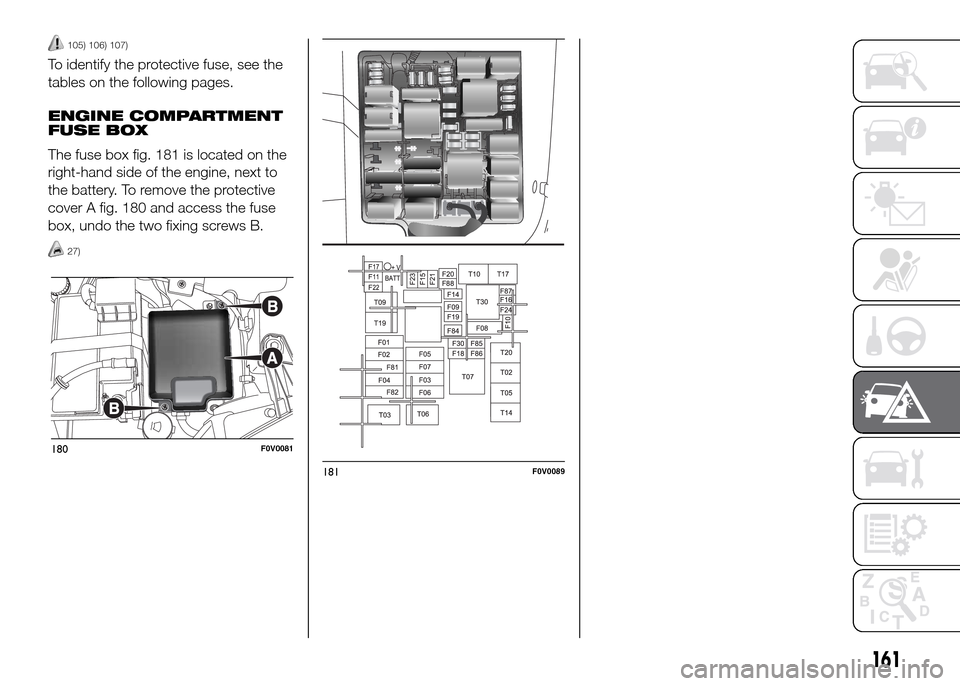
To identify the protective fuse, see the
tables on the following pages.
ENGINE COMPARTMENT
FUSE BOX
The fuse box fig. 181 is located on the
right-hand side of the engine, next to
the battery. To remove the protective
cover A fig. 180 and access the fuse
box, undo the two fixing screws B.
27)
180F0V0081
181F0V0089
161
Page 167 of 323
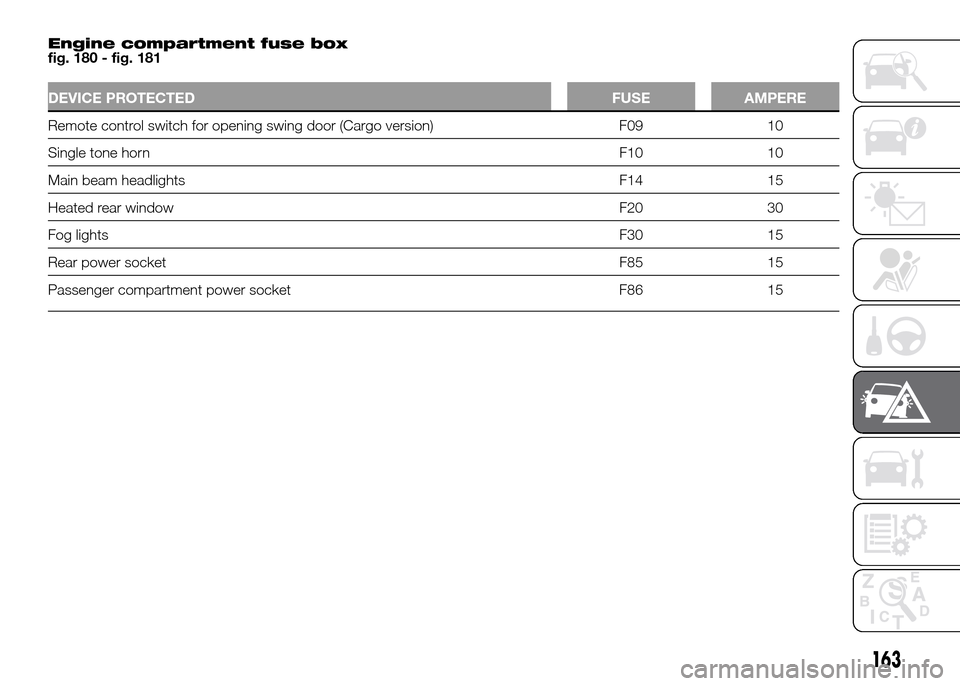
Engine compartment fuse box
fig. 180 - fig. 181
DEVICE PROTECTED FUSE AMPERE
Remote control switch for opening swing door (Cargo version) F09 10
Single tone hornF10 10
Main beam headlights F14 15
Heated rear window F20 30
Fog lightsF30 15
Rear power socket F85 15
Passenger compartment power socket F86 15
163
Page 169 of 323
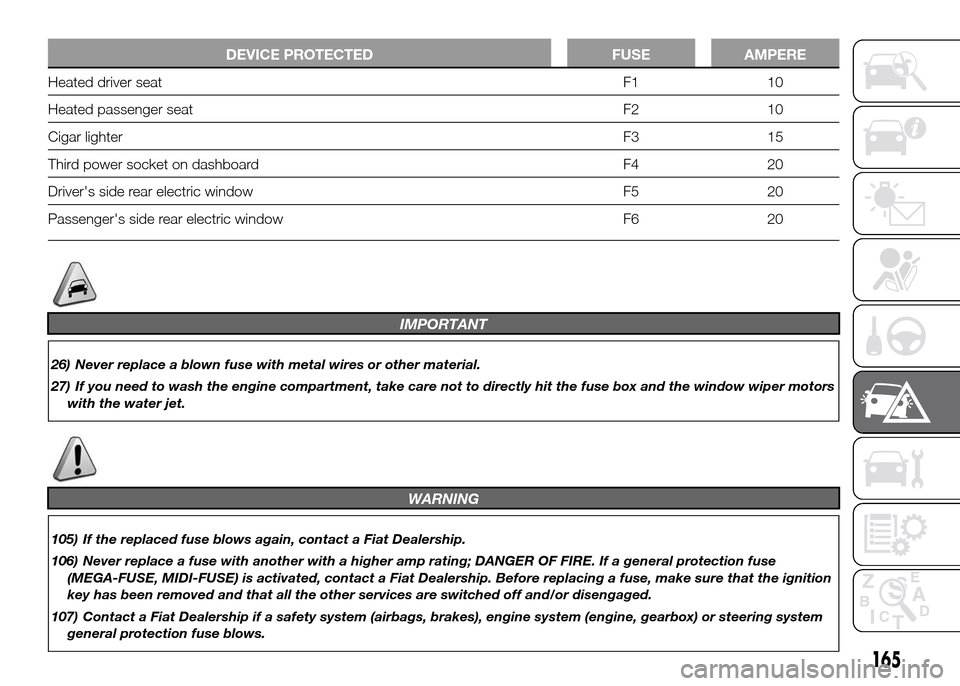
DEVICE PROTECTED FUSE AMPERE
Heated driver seat F1 10
Heated passenger seat F2 10
Cigar lighterF3 15
Third power socket on dashboard F4 20
Driver's side rear electric window F5 20
Passenger's side rear electric window F6 20
IMPORTANT
26) Never replace a blown fuse with metal wires or other material.
27) If you need to wash the engine compartment, take care not to directly hit the fuse box and the window wiper motors
with the water jet.
WARNING
105) If the replaced fuse blows again, contact a Fiat Dealership.
106) Never replace a fuse with another with a higher amp rating; DANGER OF FIRE. If a general protection fuse
(MEGA-FUSE, MIDI-FUSE) is activated, contact a Fiat Dealership. Before replacing a fuse, make sure that the ignition
key has been removed and that all the other services are switched off and/or disengaged.
107) Contact a Fiat Dealership if a safety system (airbags, brakes), engine system (engine, gearbox) or steering system
general protection fuse blows.
165
Page 170 of 323
CHANGING A WHEEL
The vehicle is originally equipped with
the Fix&Go automatic quick tyre repair
kit (see instructions in the next section).
As an alternative, the vehicle may
have a normal-sized spare wheel.
Wheel changing and correct use of the
jack and spare wheel call for some
precautions, as listed below.
108) 109) 110) 111)
Note for one-way tyres
One-way tyres have a few arrows
on the side indicating the rotation
direction. If a wheel is changed (when
punctured, for example) the direction of
the arrows on the spare wheel tyre
may not coincide with the rotation
direction of the wheel to be replaced.
In these conditions, too, the tyre still
maintains its safety features.
Anyway, it is recommended to have the
wheel repaired and refitted as soon as
possible, as the best performance is
achieved when the rotation direction of
all tyres coincides with the one
indicated by the arrows.
Please note that:
❒the jack weight is 4 kg;
❒the jack requires no adjustment;❒the jack cannot be repaired and in
the event of a fault it must be
replaced by another original one;
❒no tool other than its cranking device
may be fitted on the jack.
To change a wheel, proceed as follows:
❒stop the vehicle in a position that is
not dangerous for oncoming traffic
where you can change the wheel
safely. The ground should be flat
if possible, and sufficiently firm;
❒stop the engine and pull the
handbrake;
❒engage first gear or reverse;
❒wear the reflective safety jacket
(compulsory by law in certain
countries) before getting out of the
vehicle;
❒indicate that the vehicle has broken
down using the devices required by
the law in the current country (e.g.
warning triangle, hazard lights, etc.);
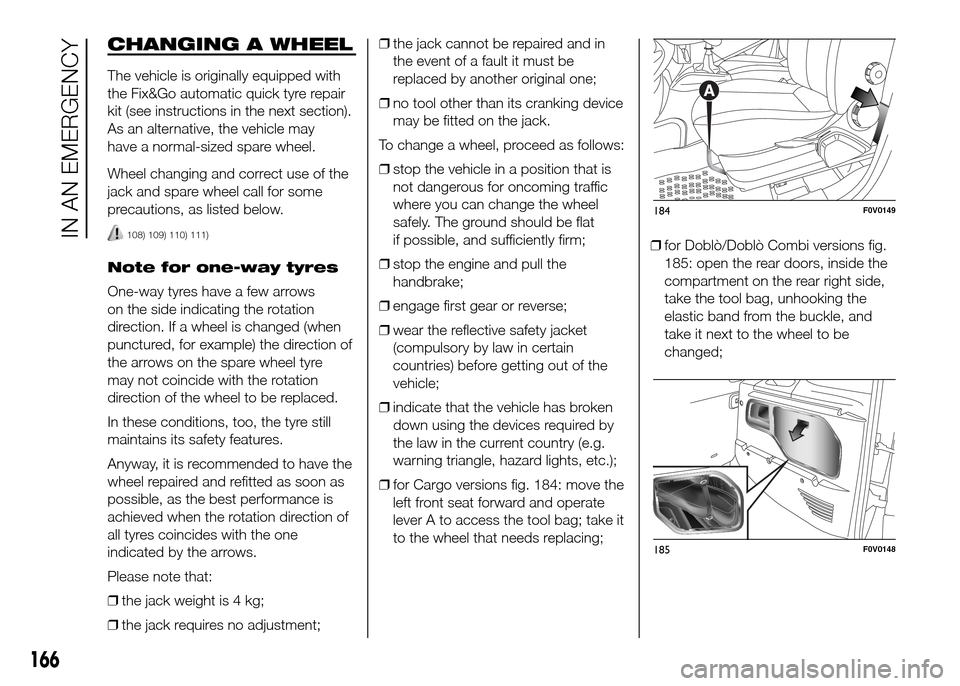
❒for Cargo versions fig. 184: move the
left front seat forward and operate
lever A to access the tool bag; take it
to the wheel that needs replacing;❒for Doblò/Doblò Combi versions fig.
185: open the rear doors, inside the
compartment on the rear right side,
take the tool bag, unhooking the
elastic band from the buckle, and
take it next to the wheel to be
changed;
184F0V0149
185F0V0148
166
IN AN EMERGENCY
Page 175 of 323
❒compressor D complete with
pressure gauge and connectors.
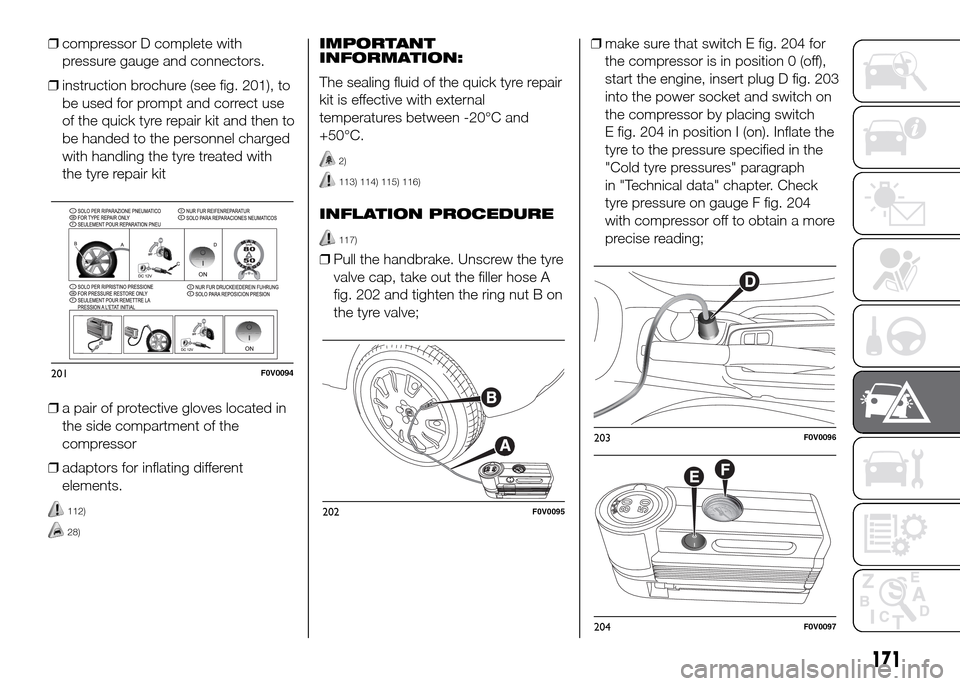
❒instruction brochure (see fig. 201), to
be used for prompt and correct use
of the quick tyre repair kit and then to
be handed to the personnel charged
with handling the tyre treated with
the tyre repair kit
❒a pair of protective gloves located in
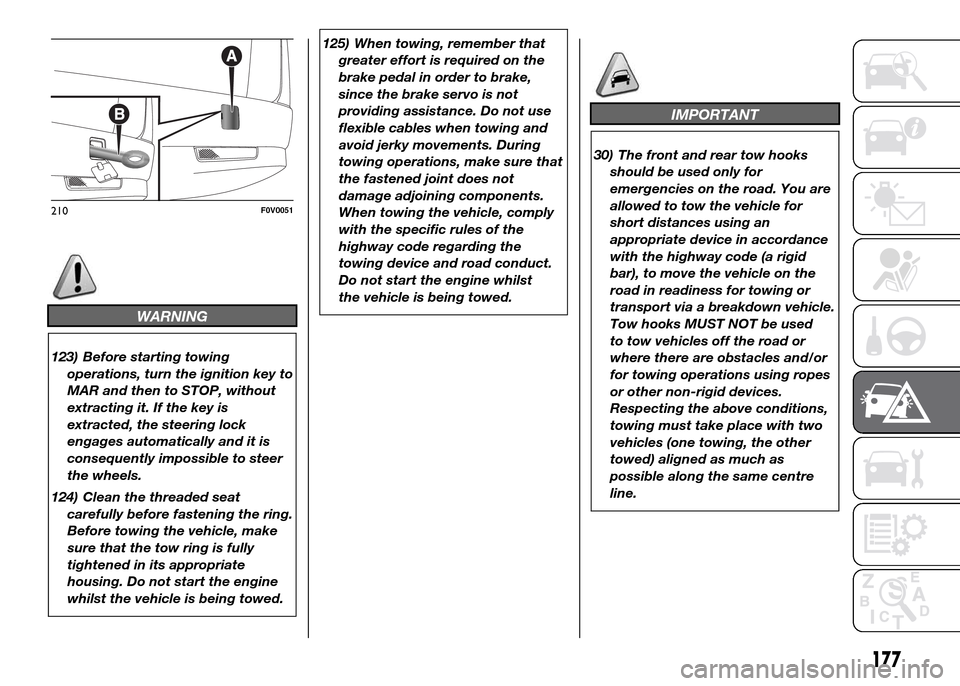
the side compartment of the
compressor
❒adaptors for inflating different
elements.
112)
28)
IMPORTANT
INFORMATION:
The sealing fluid of the quick tyre repair
kit is effective with external
temperatures between -20°C and
+50°C.
2)
113) 114) 115) 116)
INFLATION PROCEDURE
117)
❒Pull the handbrake. Unscrew the tyre
valve cap, take out the filler hose A
fig. 202 and tighten the ring nut B on
the tyre valve;❒make sure that switch E fig. 204 for
the compressor is in position 0 (off),
start the engine, insert plug D fig. 203
into the power socket and switch on
the compressor by placing switch
E fig. 204 in position I (on). Inflate the
tyre to the pressure specified in the
"Cold tyre pressures" paragraph
in "Technical data" chapter. Check
tyre pressure on gauge F fig. 204
with compressor off to obtain a more
precise reading;
201F0V0094
202F0V0095
203F0V0096
204F0V0097
171
Page 176 of 323
❒if after 5 minutes it is still impossible
to reach at least 1.5 bar, disengage
the compressor from the valve and
power socket, then move the vehicle
forwards by approx. 10 metres in
order to distribute the sealant inside
the tyre evenly, then repeat the
inflation operation;
❒if after this operation it is still
impossible after 5 minutes to reach at
least 1.8 bar, do not start driving
since the tyre is excessively damaged
and the quick tyre repair kit cannot
guarantee proper hold, contact a Fiat
Dealership;
❒if reaching the tyre pressure specified
in paragraph “Inflation pressure” in
chapter “Technical Data”, start driving
immediately;
118) 119) 120)
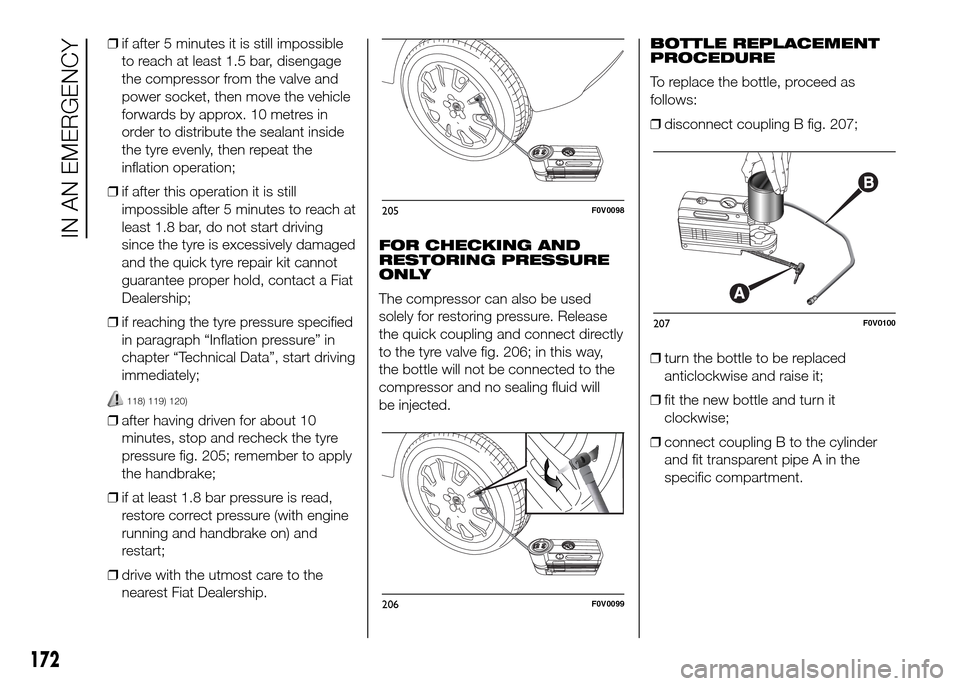
❒after having driven for about 10
minutes, stop and recheck the tyre
pressure fig. 205; remember to apply
the handbrake;
❒if at least 1.8 bar pressure is read,
restore correct pressure (with engine
running and handbrake on) and
restart;
❒drive with the utmost care to the
nearest Fiat Dealership.FOR CHECKING AND
RESTORING PRESSURE
ONLY
The compressor can also be used
solely for restoring pressure. Release
the quick coupling and connect directly
to the tyre valve fig. 206; in this way,
the bottle will not be connected to the
compressor and no sealing fluid will
be injected.BOTTLE REPLACEMENT
PROCEDURE
To replace the bottle, proceed as
follows:
❒disconnect coupling B fig. 207;
❒turn the bottle to be replaced
anticlockwise and raise it;
❒fit the new bottle and turn it
clockwise;
❒connect coupling B to the cylinder
and fit transparent pipe A in the
specific compartment.
205F0V0098
206F0V0099
207F0V0100
172
IN AN EMERGENCY
Page 178 of 323
IMPORTANT
2) Do not dispose of the can or the
sealing fluid as household waste.
Have them disposed of in
compliance with national and
local regulations.
EMERGENCY
STARTING
Go to a Fiat Dealership immediately if
warning light
stays on constantly on
the instrument panel.
JUMP STARTING
If the battery is flat, it is possible to start
the engine using an auxiliary battery
with the same capacity or a little higher
than the flat one.
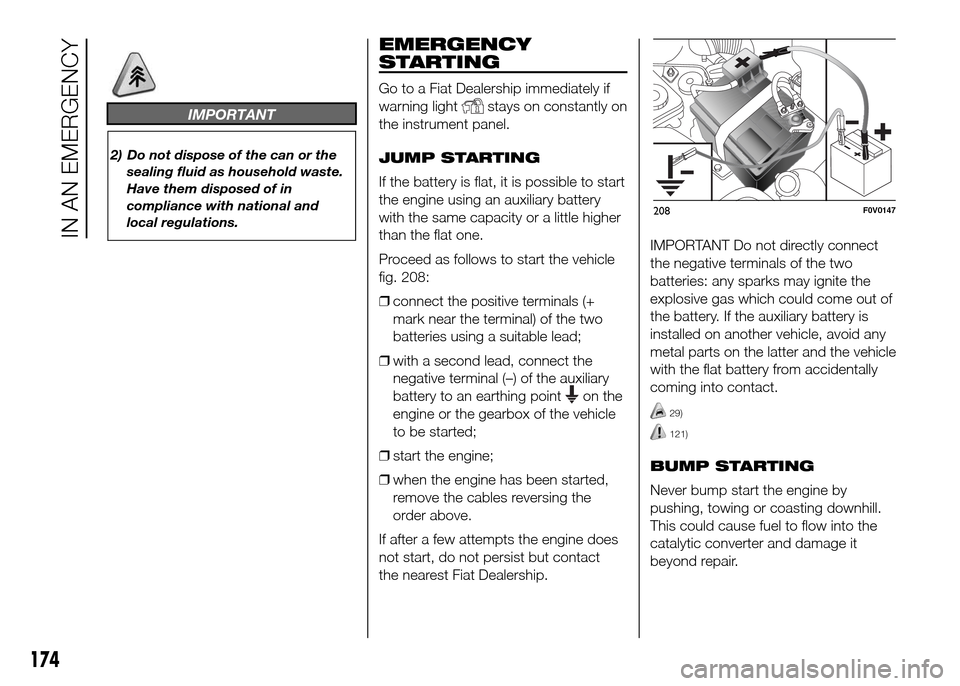
Proceed as follows to start the vehicle
fig. 208:
❒connect the positive terminals (+
mark near the terminal) of the two
batteries using a suitable lead;
❒with a second lead, connect the
negative terminal (–) of the auxiliary
battery to an earthing point
on the
engine or the gearbox of the vehicle
to be started;
❒start the engine;
❒when the engine has been started,
remove the cables reversing the
order above.
If after a few attempts the engine does
not start, do not persist but contact
the nearest Fiat Dealership.IMPORTANT Do not directly connect
the negative terminals of the two
batteries: any sparks may ignite the
explosive gas which could come out of
the battery. If the auxiliary battery is
installed on another vehicle, avoid any
metal parts on the latter and the vehicle
with the flat battery from accidentally
coming into contact.29)
121)
BUMP STARTING
Never bump start the engine by
pushing, towing or coasting downhill.
This could cause fuel to flow into the
catalytic converter and damage it
beyond repair.
208F0V0147
174
IN AN EMERGENCY
Page 179 of 323
IMPORTANT Remember that the brake
booster and the electric power steering
system are not active until the engine
is started, so you will need to apply
much more force to the brake pedal or
steering wheel.
IMPORTANT
29) Never use a fast battery-charger
for emergency starting of the
engine as this could damage the
electronic systems of your vehicle,
particularly the ignition and fuel
supply control units.
WARNING
121) This procedure must be
performed by qualified personnel
as incorrect actions may cause
high-intensity electrical discharge.
Furthermore, battery fluid is
poisonous and corrosive: avoid
contact with skin and eyes. Keep
naked flames away from the
battery. No smoking. Do not cause
sparks.
FUEL CUT-OFF
SYSTEM
This intervenes in the case of an impact
causing:
❒the fuel supply cut-off with the engine
consequently switching off;
❒the automatic unlocking of the doors;
❒the switching on of the interior lights;
❒switching on of the hazard warning
lights (to deactivate the lights press
the dedicated button on the
dashboard).
122)
When the system has been triggered,
the message “Fuel cut off, see
handbook” is displayed on some
versions.
Check carefully for fuel leaks, for
instance in the engine compartment,
under the vehicle or near the tank area.
After a collision, turn the ignition key
to STOP to prevent the battery from
running down.
The following procedure should be
carried out to restore the correct
operation of the vehicle:
❒turn the ignition key to the MAR
position;
❒activate the right direction indicator;
175
Page 181 of 323
WARNING
123) Before starting towing
operations, turn the ignition key to
MAR and then to STOP, without
extracting it. If the key is
extracted, the steering lock
engages automatically and it is
consequently impossible to steer
the wheels.
124) Clean the threaded seat
carefully before fastening the ring.
Before towing the vehicle, make
sure that the tow ring is fully
tightened in its appropriate
housing. Do not start the engine
whilst the vehicle is being towed.125) When towing, remember that
greater effort is required on the
brake pedal in order to brake,
since the brake servo is not
providing assistance. Do not use
flexible cables when towing and
avoid jerky movements. During
towing operations, make sure that
the fastened joint does not
damage adjoining components.
When towing the vehicle, comply
with the specific rules of the
highway code regarding the
towing device and road conduct.
Do not start the engine whilst
the vehicle is being towed.
IMPORTANT
30) The front and rear tow hooks
should be used only for
emergencies on the road. You are
allowed to tow the vehicle for
short distances using an
appropriate device in accordance
with the highway code (a rigid
bar), to move the vehicle on the
road in readiness for towing or
transport via a breakdown vehicle.
Tow hooks MUST NOT be used
to tow vehicles off the road or
where there are obstacles and/or
for towing operations using ropes
or other non-rigid devices.
Respecting the above conditions,
towing must take place with two
vehicles (one towing, the other
towed) aligned as much as
possible along the same centre
line.
210F0V0051
177
Page 183 of 323
SERVICING AND MAINTENANCE
Correct maintenance permits the
performance of the car to be
maintained over time, as well as limited
running costs and safeguarding the
efficiency of the safety systems.
This chapter explains how.SCHEDULED SERVICING ...............180
SCHEDULED SERVICING PLAN .....181
PERIODIC CHECKS ........................188
DEMANDING VEHICLE USE ...........188
ENGINE COMPARTMENT ...............189
AIR CLEANER/ POLLEN FILTER .....198
DIESEL FILTER................................199
BATTERY ........................................199
BATTERY RECHARGING ................201
WINDSCREEN/REAR WINDOW
WIPER ............................................202
WHEELS AND TYRES.....................204
RUBBER HOSES ............................205
PROLONGED VEHICLE
INACTIVITY .....................................206
BODYWORK ...................................206
INTERIORS .....................................208
179