light FIAT DOBLO PANORAMA 2016 2.G Owners Manual
[x] Cancel search | Manufacturer: FIAT, Model Year: 2016, Model line: DOBLO PANORAMA, Model: FIAT DOBLO PANORAMA 2016 2.GPages: 323, PDF Size: 25.46 MB
Page 191 of 323
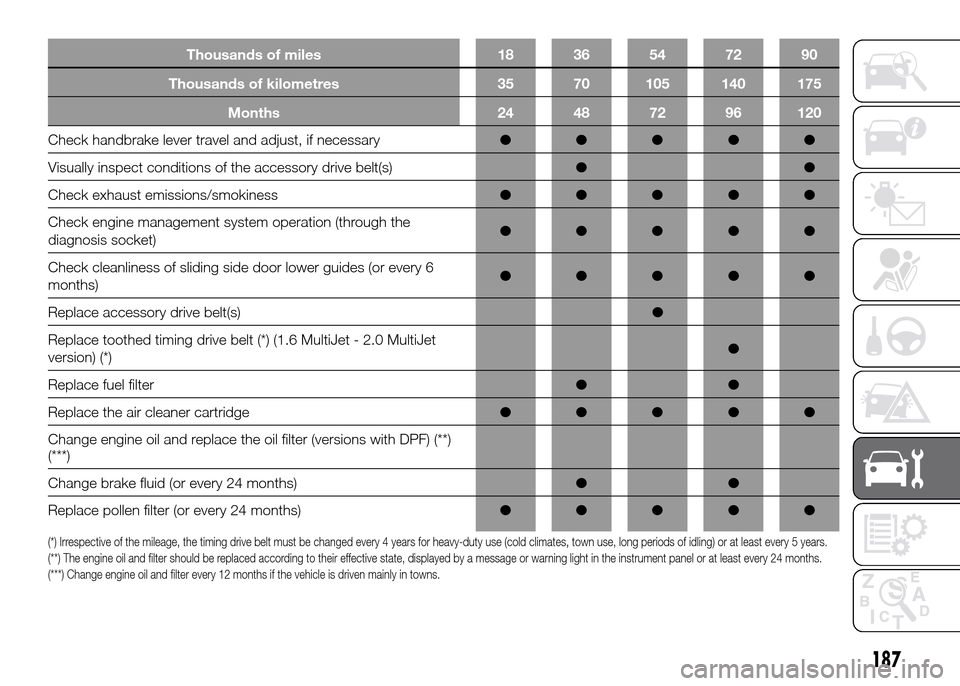
Thousands of miles 18 36 54 72 90
Thousands of kilometres 35 70 105 140 175
Months 24 48 72 96 120
Check handbrake lever travel and adjust, if necessary●●●●●
Visually inspect conditions of the accessory drive belt(s)●●
Check exhaust emissions/smokiness●●●●●
Check engine management system operation (through the
diagnosis socket)●●●●●
Check cleanliness of sliding side door lower guides (or every 6
months)●●●●●
Replace accessory drive belt(s)●
Replace toothed timing drive belt (*) (1.6 MultiJet - 2.0 MultiJet
version) (*)●
Replace fuel filter●●
Replace the air cleaner cartridge●●●●●
Change engine oil and replace the oil filter (versions with DPF) (**)
(***)
Change brake fluid (or every 24 months)●●
Replace pollen filter (or every 24 months)●●●●●
(*) Irrespective of the mileage, the timing drive belt must be changed every 4 years for heavy-duty use (cold climates, town use, long periods of idling) or at least every 5 years.
(**) The engine oil and filter should be replaced according to their effective state, displayed by a message or warning light in the instrument panel orat least every 24 months.
(***) Change engine oil and filter every 12 months if the vehicle is driven mainly in towns.
187
Page 192 of 323
PERIODIC CHECKS
Every 1,000 km or before long
journeys, check and, if necessary, top
up the following:
❒engine coolant level;
❒brake fluid level;
❒windscreen washer fluid level;
❒tyre inflation pressure and condition;
❒operation of lighting system
(headlights, direction indicators,
hazard warning lights, etc.);
❒operation of screen washer/wiper
system and positioning/wear of
windscreen/rear screen wiper blades
(for versions/markets where
provided);
Every 3,000 km check and top up if
required: engine oil level.
DEMANDING
VEHICLE USE
If the vehicle is mostly used in one of
the following conditions:
❒towing a trailer or motorhome;
❒dusty roads;
❒short, repeated journeys (less than
7-8 km) at sub-zero outside
temperatures;
❒engine often idling or driving long
distances at low speeds or long
periods of inactivity;
the following checks must be carried
out more often than indicated in the
Scheduled Servicing Plan:
❒check front disc brake pad condition
and wear;
❒check cleanliness of bonnet and
luggage compartment locks,
cleanliness and lubrication of linkage;
❒visually inspect condition of: engine,
gearbox, transmission, pipes and
hoses (exhaust - fuel system -
brakes) and rubber elements (boots -
sleeves - bushes - etc.);
❒check battery charge and battery
fluid level (electrolyte);
❒visually inspect conditions of the
auxiliary drive belts;❒check and, if necessary, change
engine oil and replace oil filter;
❒check and, if necessary, replace
pollen filter;
❒replacement of air cleaner cartridge
every 15,000 km.
188
SERVICING AND MAINTENANCE
Page 203 of 323
DIESEL FILTER
DRAINING
CONDENSATION
(MultiJet versions)
36)
IMPORTANT
36) The presence of water in the
supply circuit may cause severe
damage to the injection system
and irregular engine operation. If
the
warning light comes on,
go to a Fiat Dealership as soon as
possible to have the system bled.
If this problem is indicated
immediately after refuelling, water
may have entered the fuel tank.
In this case, immediately turn off
the engine and contact a Fiat
Dealership.
BATTERY
The battery is of the “limited
maintenance” type: under normal
conditions of use, the electrolyte does
not need topping up with distilled water.
It does, however, need to be checked
periodically at a Fiat Dealership or
by specialist personnel to make sure it
is working correctly.
133) 134)
REPLACING THE
BATTERY
If required, replace the battery with an
original spare part with the same
specifications.
If a battery with different specifications
is fitted, the service intervals given in
the “Scheduled Servicing Plan” will no
longer be valid.
Follow the battery manufacturer's
instructions for maintenance.
37) 38)
5)
135)
USEFUL TIPS FOR
EXTENDING BATTERY
LIFE
To avoid draining your battery and
make it last longer, observe the
following instructions:
❒when you park the vehicle, ensure
that the doors, tailgate and bonnet
are closed properly, to prevent any
roof lights from remaining on inside
the passenger's compartment;
❒switch off all roof lights inside the
vehicle: the vehicle is however
equipped with a system which
switches all internal lights off
automatically;
❒do not keep accessories (e.g. radio,
hazard warning lights, etc.) switched
on for a long time when the engine
is not running;
❒before performing any operation on
the electrical system, disconnect
the negative battery pole;
❒completely tighten the battery
terminals.
IMPORTANT If the charge level remains
under 50% for a long time, the battery
is damaged by sulphation, reducing
its capacity and efficiency at starting.
199
Page 210 of 323
PROLONGED
VEHICLE INACTIVITY
If the vehicle needs to be off the road
for longer than one month, the following
precautions must be taken:
❒park the vehicle indoors in a dry and,
if possible, well-ventilated place;
❒engage a gear and check that the
handbrake is not engaged;
❒disconnect the negative terminal from
the battery pole (see paragraph
“Vehicle inactivity” in the "Dashboard
and controls" chapter) and check
the charge conditions (see paragraph
“Battery” in the “Care and
maintenance” chapter);
❒clean and protect the painted parts
using protective wax;
❒clean and protect the shiny metal
parts using special compounds
available commercially;
❒sprinkle talcum powder on the
windscreen and rear window wiper
rubber blades and lift them off the
glass;
❒slightly open the windows;❒cover the vehicle with a piece of
fabric or perforated plastic sheet. Do
not use compact plastic tarpaulins,
which prevent humidity from
evaporating from the surface of the
vehicle;
❒inflate tyres to +0.5 bar above the
standard specified pressure and
check it at intervals;
❒do not drain the engine cooling
system.
BODYWORK
PROTECTION AGAINST
ATMOSPHERIC AGENTS
The main causes of corrosion are the
following:
❒atmospheric pollution;
❒salty air and humidity (coastal areas,
or hot humid climates);
❒seasonal environmental conditions.
The abrasive action of wind-borne
atmospheric dust and sand, as well as
mud and gravel raised by other cars
is also not to be underestimated.
On your vehicle, Fiat has implemented
the best manufacturing technologies
to effectively protect the bodywork
against corrosion.
These include:
❒painting products and systems which
give the vehicle particular resistance
to corrosion and abrasion;
❒use of galvanised (or pretreated)
sheet metal, with high resistance
to corrosion;
❒spraying the underbody, engine
compartment, wheelhouse internal
parts and other parts with highly
protective wax products;
206
SERVICING AND MAINTENANCE
Page 211 of 323
❒spraying of plastic parts, with a
protective function in the more
exposed points: underdoor, inner
wing, edges, etc.;
❒use of "open" boxed sections to
prevent condensation and pockets of
moisture from triggering rust inside.
VEHICLE EXTERIOR AND
UNDERBODY WARRANTY
Your vehicle is covered by warranty
against perforation due to corrosion of
any original element of the structure
or body.
For the general terms of this warranty,
refer to the Warranty Booklet.
ADVICE FOR
PRESERVING THE
BODYWORK
Paintwork
Paintwork does not only serve an
aesthetic purpose, but also protects the
underlying sheet metal.
Touch up abrasions and scratches
immediately to prevent rust formation.
Use only original paint products for
touch-ups (see “Bodywork paint
identification plate” in the “Technical
specifications” section).Normal maintenance of paintwork
consists in washing the vehicle: the
frequency depends on the conditions
and environment where the vehicle
is used.
For example, it is advisable to wash the
vehicle more often in areas with high
levels of environmental pollution or on
roads spread with salt.
To correctly wash the vehicle, proceed
as follows:
❒wash the bodywork using a low
pressure jet of water;
❒wipe a sponge with a slightly soapy
solution over the bodywork,
frequently rinsing the sponge;
❒rinse well with water and dry with a
jet of air or a chamois.
If you put the vehicle through a car
wash, follow these recommendations:
– remove the aerial from the roof so
it does not get damaged;
– water added to a soapy solution
should be used for washing;
– rinse thoroughly to avoid soap marks
staying on the bodywork or less visible
parts.
39)
Dry the less visible parts with special
care, such as the door frames, bonnet
and the headlight frames, where water
may stagnate more easily. It is a good
idea to leave the vehicle outdoors
for a while after washing it to give water
time to evaporate.
Do not wash the vehicle after it has
been left in the sun or with the bonnet
hot: this may alter the shine of the
paintwork.
Exterior plastic parts should be cleaned
in the same way as the rest of the
vehicle. Where possible, do not park
the vehicle under trees; the resinous
substances released by many species
give the paint a dull appearance and
increase the possibility of corrosion.
IMPORTANT Bird droppings should be
washed off immediately and thoroughly
as the acid they contain is particularly
aggressive.
6)
Windows
To clean glasses, use specific cleaning
products. Use clean cloths to avoid
scratching the glass or damaging the
transparency.
207
Page 212 of 323
IMPORTANT Wipe the inside surface of
the rear window gently with a cloth in
the direction of the filaments to avoid
damaging the heater coils.
Engine compartment
At the end of each winter, thoroughly
wash the engine compartment, taking
care to avoid spraying the water jet
directly onto the electronic control units
and the relay/fuse box on the left side
of the engine compartment (driving
direction). Have this operation
performed at a specialised workshop.
IMPORTANT The washing should
take place with the engine cold and the
ignition key in the STOP position. After
the washing operation, make sure
that the various protections (e.g. rubber
caps and guards) have not been
removed or damaged.
Headlights
IMPORTANT Never use aromatic
substances (e.g. petrol) or ketones (e.g.
acetone) for cleaning the plastic lenses
of the front headlights.
IMPORTANT
39) Some car washes with old-style
blades and/or in a poor state of
repair can damage the paintwork,
facilitating the formation of lines
that give the paint a dull/misty
appearance, especially on dark
colours. If this happens, lightly
polish the paintwork with
appropriate products.
IMPORTANT
6) Detergents cause water pollution.
The vehicle should be washed in
areas equipped for collecting
and purifying the liquid used in
the washing process.
INTERIORS
Regularly check that water is not
trapped under the mats (due to water
dripping off shoes, umbrellas, etc.),
as this could cause oxidation of the
sheet metal.
143) 144)
SEATS AND FABRIC
PARTS
Remove dust with a soft brush or a
vacuum cleaner. It is advisable to use a
moist brush on velvet upholstery.
Rub the seats with a sponge moistened
with a solution of water and mild soap.
PLASTIC PARTS
It is advisable to clean interior parts with
a moist cloth and a solution of water
and non-abrasive mild soap. Use
specific products for cleaning plastic,
without solvents and specifically
designed to prevent damage to the
appearance and colour of the treated
parts, to remove grease and tough
stains.
IMPORTANT Do not use alcohol,
petrols or their derivatives to clean the
instrument panel glass.
208
SERVICING AND MAINTENANCE
Page 213 of 323
LEATHER STEERING
WHEEL/GEAR
KNOB/HANDBRAKE
(for versions/markets, where provided)
These components must be cleaned
with mild soap and water only. Never
use alcohol or alcohol-based products.
Read the product label carefully before
using specific products for cleaning
the interiors: make sure the product
does not contain spirits or alcohol-
based substances.
If, when cleaning the windscreen with
special products, window cleaner
accidentally drips onto the leather of
the steering wheel/gear lever
knob/hand brake, wipe away
immediately and then wash the affected
area with mild soap and water.
IMPORTANT Be careful when using a
steering wheel locking device, to avoid
damaging the leather upholstery
through abrasion.
WARNING
143) Never use flammable products,
such as petroleum ether or
modified petrol, to clean the
inside of the vehicle. The
electrostatic charges which are
generated by rubbing during
the cleaning operation may cause
a fire.
144) Do not keep aerosol cans in the
vehicle: they might explode.
Aerosol cans must not be exposed
to a temperature exceeding 50°C.
When the vehicle is exposed to
sunlight, the internal temperature
can greatly exceed this value.
209
Page 231 of 323
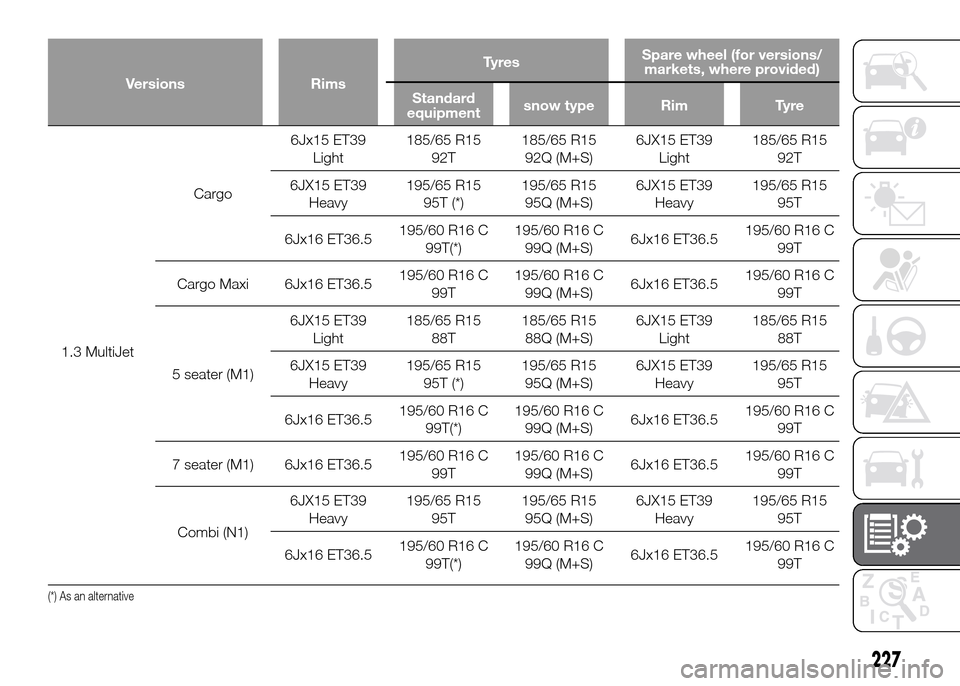
Versions RimsTy r e sSpare wheel (for versions/
markets, where provided)
Standard
equipmentsnow type Rim Tyre
1.3 MultiJetCargo6Jx15 ET39
Light185/65 R15
92T185/65 R15
92Q (M+S)6JX15 ET39
Light185/65 R15
92T
6JX15 ET39
Heavy195/65 R15
95T (*)195/65 R15
95Q (M+S)6JX15 ET39
Heavy195/65 R15
95T
6Jx16 ET36.5195/60 R16 C
99T(*)195/60 R16 C
99Q (M+S)6Jx16 ET36.5195/60 R16 C
99T
Cargo Maxi 6Jx16 ET36.5195/60 R16 C
99T195/60 R16 C
99Q (M+S)6Jx16 ET36.5195/60 R16 C
99T
5 seater (M1)6JX15 ET39
Light185/65 R15
88T185/65 R15
88Q (M+S)6JX15 ET39
Light185/65 R15
88T
6JX15 ET39
Heavy195/65 R15
95T (*)195/65 R15
95Q (M+S)6JX15 ET39
Heavy195/65 R15
95T
6Jx16 ET36.5195/60 R16 C
99T(*)195/60 R16 C
99Q (M+S)6Jx16 ET36.5195/60 R16 C
99T
7 seater (M1) 6Jx16 ET36.5195/60 R16 C
99T195/60 R16 C
99Q (M+S)6Jx16 ET36.5195/60 R16 C
99T
Combi (N1)6JX15 ET39
Heavy195/65 R15
95T195/65 R15
95Q (M+S)6JX15 ET39
Heavy195/65 R15
95T
6Jx16 ET36.5195/60 R16 C
99T(*)195/60 R16 C
99Q (M+S)6Jx16 ET36.5195/60 R16 C
99T
(*) As an alternative
227
Page 232 of 323
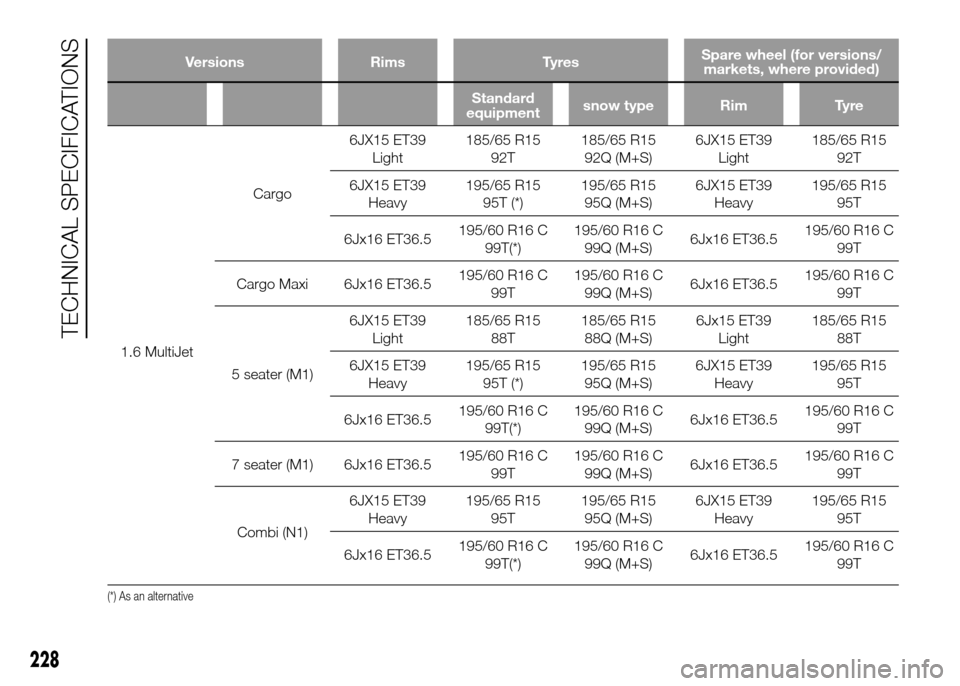
Versions Rims TyresSpare wheel (for versions/
markets, where provided)
Standard
equipmentsnow type Rim Tyre
1.6 MultiJetCargo6JX15 ET39
Light185/65 R15
92T185/65 R15
92Q (M+S)6JX15 ET39
Light185/65 R15
92T
6JX15 ET39
Heavy195/65 R15
95T (*)195/65 R15
95Q (M+S)6JX15 ET39
Heavy195/65 R15
95T
6Jx16 ET36.5195/60 R16 C
99T(*)195/60 R16 C
99Q (M+S)6Jx16 ET36.5195/60 R16 C
99T
Cargo Maxi 6Jx16 ET36.5195/60 R16 C
99T195/60 R16 C
99Q (M+S)6Jx16 ET36.5195/60 R16 C
99T
5 seater (M1)6JX15 ET39
Light185/65 R15
88T185/65 R15
88Q (M+S)6Jx15 ET39
Light185/65 R15
88T
6JX15 ET39
Heavy195/65 R15
95T (*)195/65 R15
95Q (M+S)6JX15 ET39
Heavy195/65 R15
95T
6Jx16 ET36.5195/60 R16 C
99T(*)195/60 R16 C
99Q (M+S)6Jx16 ET36.5195/60 R16 C
99T
7 seater (M1) 6Jx16 ET36.5195/60 R16 C
99T195/60 R16 C
99Q (M+S)6Jx16 ET36.5195/60 R16 C
99T
Combi (N1)6JX15 ET39
Heavy195/65 R15
95T195/65 R15
95Q (M+S)6JX15 ET39
Heavy195/65 R15
95T
6Jx16 ET36.5195/60 R16 C
99T(*)195/60 R16 C
99Q (M+S)6Jx16 ET36.5195/60 R16 C
99T
(*) As an alternative
228
TECHNICAL SPECIFICATIONS
Page 269 of 323
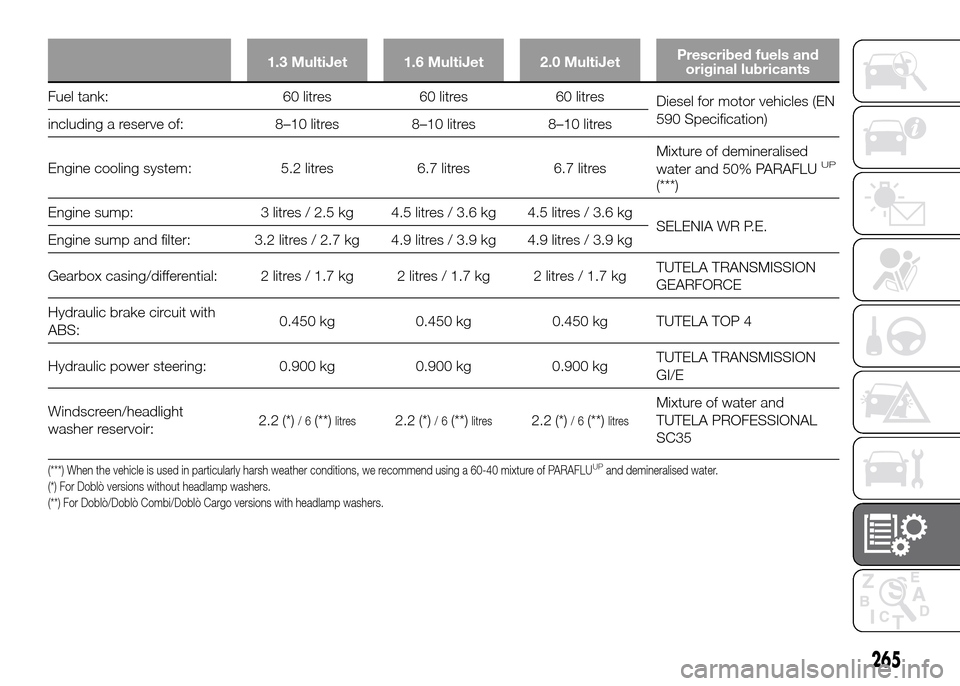
1.3 MultiJet 1.6 MultiJet 2.0 MultiJetPrescribed fuels and
original lubricants
Fuel tank: 60 litres 60 litres 60 litres
Diesel for motor vehicles (EN
590 Specification)
including a reserve of: 8–10 litres 8–10 litres 8–10 litres
Engine cooling system: 5.2 litres 6.7 litres 6.7 litresMixture of demineralised
water and 50% PARAFLU
UP
(***)
Engine sump: 3 litres / 2.5 kg 4.5 litres / 3.6 kg 4.5 litres / 3.6 kg
SELENIA WR P.E.
Engine sump and filter: 3.2 litres / 2.7 kg 4.9 litres / 3.9 kg 4.9 litres / 3.9 kg
Gearbox casing/differential: 2 litres / 1.7 kg 2 litres / 1.7 kg 2 litres / 1.7 kgTUTELA TRANSMISSION
GEARFORCE
Hydraulic brake circuit with
ABS:0.450 kg 0.450 kg 0.450 kg TUTELA TOP 4
Hydraulic power steering: 0.900 kg 0.900 kg 0.900 kgTUTELA TRANSMISSION
GI/E
Windscreen/headlight
washer reservoir:2.2 (*)
/6(**)litres2.2 (*)/6(**)litres2.2 (*)/6(**)litres
Mixture of water and
TUTELA PROFESSIONAL
SC35
(***) When the vehicle is used in particularly harsh weather conditions, we recommend using a 60-40 mixture of PARAFLUUPand demineralised water.
(*) For Doblò versions without headlamp washers.
(**) For Doblò/Doblò Combi/Doblò Cargo versions with headlamp washers.
265