light FIAT DOBLO PANORAMA 2016 2.G Repair Manual
[x] Cancel search | Manufacturer: FIAT, Model Year: 2016, Model line: DOBLO PANORAMA, Model: FIAT DOBLO PANORAMA 2016 2.GPages: 323, PDF Size: 25.46 MB
Page 117 of 323
PRETENSIONERS
To increase the protective efficiency of
the front seat belts, the vehicle is fitted
with pretensioners. These devices, in
the event of a violent head-on crash or
side impact, rewind the seat belts a
few centimetres. In this way, they
ensure that the belts fit tightly to the
wearer before the restraining action
begins.
The seat belt retractor locks to indicate
that the pretensioner has cut in; the
seat belt cannot be drawn back up
even when guided manually.
IMPORTANT To obtain the highest
degree of protection from the action of
the pretensioner, wear the seat belt
keeping it tight to the chest and pelvis.
A slight discharge of smoke may be
produced during the activation of the
pretensioner which is not harmful and
does not indicate any fire hazard.
The pretensioner does not require any
maintenance or lubrication. Anything
that modifies its original conditions
invalidates its efficiency. If, due to
unusual natural events (floods, sea
storms, etc.), the device has been
affected by water and mud, it must
absolutely be replaced.
66)
16)
LOAD LIMITERS
(for versions/markets, where provided)
To increase passenger safety, the
front and rear seat belt retractors (for
versions/markets where provided)
contain a load limiter which controls the
force acting on the chest and
shoulders during the belt restraining
action in the event of a frontal collision.
GENERAL WARNINGS
FOR USING THE SEAT
BELTS
The driver is responsible for respecting
(and ensuring that all the other
passengers also respect) the local laws
in force regarding the use of seat belts.
Always fasten the seat belts before
setting off.
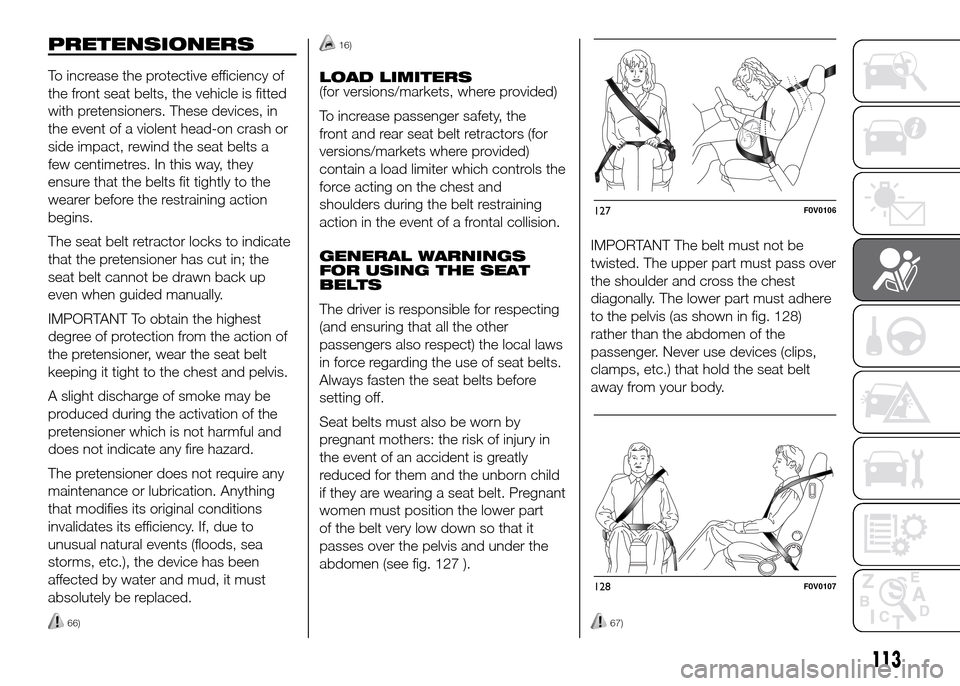
Seat belts must also be worn by
pregnant mothers: the risk of injury in
the event of an accident is greatly
reduced for them and the unborn child
if they are wearing a seat belt. Pregnant
women must position the lower part
of the belt very low down so that it
passes over the pelvis and under the
abdomen (see fig. 127 ).IMPORTANT The belt must not be
twisted. The upper part must pass over
the shoulder and cross the chest
diagonally. The lower part must adhere
to the pelvis (as shown in fig. 128)
rather than the abdomen of the
passenger. Never use devices (clips,
clamps, etc.) that hold the seat belt
away from your body.
67)
127F0V0106
128F0V0107
113
Page 121 of 323
PASSENGER SEAT COMPLIANCE WITH REGULATIONS ON UNIVERSAL CHILD
RESTRAINT SYSTEM USE
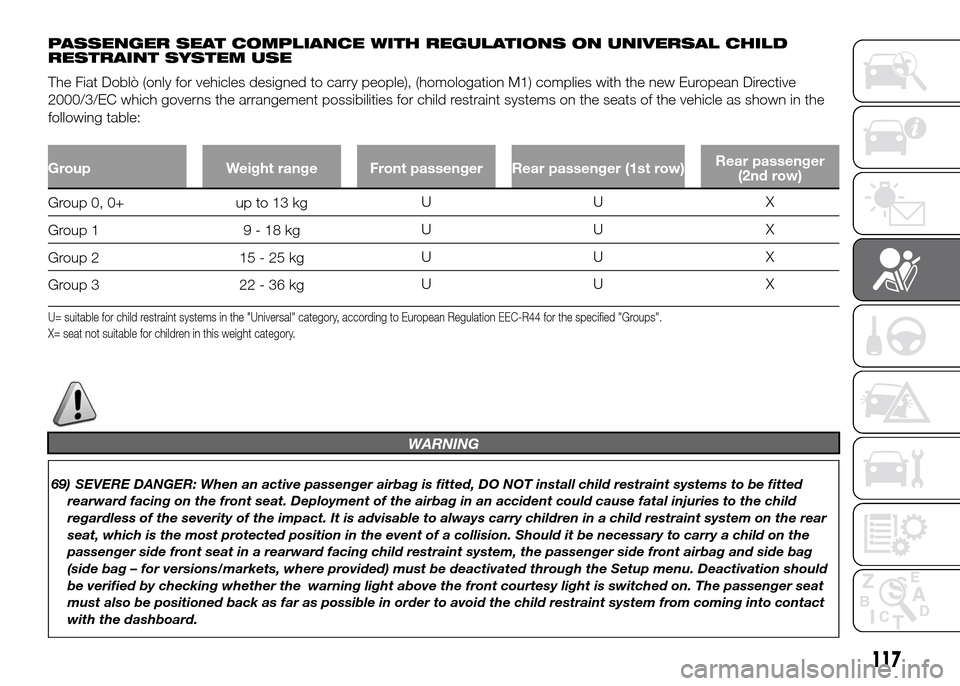
The Fiat Doblò (only for vehicles designed to carry people), (homologation M1) complies with the new European Directive
2000/3/EC which governs the arrangement possibilities for child restraint systems on the seats of the vehicle as shown in the
following table:
Group Weight range Front passenger Rear passenger (1st row)Rear passenger
(2nd row)
Group 0, 0+ up to 13 kgUU X
Group 1 9 - 18 kgUU X
Group 2 15 - 25 kgUU X
Group 3 22 - 36 kgUU X
U= suitable for child restraint systems in the "Universal" category, according to European Regulation EEC-R44 for the specified "Groups".
X= seat not suitable for children in this weight category.
WARNING
69) SEVERE DANGER: When an active passenger airbag is fitted, DO NOT install child restraint systems to be fitted
rearward facing on the front seat. Deployment of the airbag in an accident could cause fatal injuries to the child
regardless of the severity of the impact. It is advisable to always carry children in a child restraint system on the rear
seat, which is the most protected position in the event of a collision. Should it be necessary to carry a child on the
passenger side front seat in a rearward facing child restraint system, the passenger side front airbag and side bag
(side bag – for versions/markets, where provided) must be deactivated through the Setup menu. Deactivation should
be verified by checking whether the warning light above the front courtesy light is switched on. The passenger seat
must also be positioned back as far as possible in order to avoid the child restraint system from coming into contact
with the dashboard.
117
Page 125 of 323
Below is a summary of
the main safety rules to
be followed when
carrying children:
❒install the child restraint systems on
the rear seat, which is the most
protected position in the event of an
accident;
❒if you need to deactivate the
passenger airbag, always check that
the
warning light above the front
courtesy light is on constantly to
make sure that it has actually been
deactivated;
❒carefully follow the instructions that
came with the child restraint system,
which the manufacturer must supply
by law. Keep the instructions in the
vehicle along with the other papers
and this handbook. Do not install
second-hand child restraint systems
without instructions.
❒always check that the seat belt is well
fastened by pulling on it;
❒only one child is to be strapped into
each restraint system; never carry
two children using one child restraint
system;
❒always check that seat belts do not
rest on the child’s neck;
❒while travelling, do not let the child sit
incorrectly or release the belts;❒never carry children on your lap, even
newborns. No-one can hold a child in
the event of an accident.
❒in the event of an accident, replace
the child restraint system with a
new one.
73)
WARNING
72) Fit the child restraint system only
when the vehicle is stationary.
The child restraint system is
correctly fixed to the brackets
when you hear the click. Follow
the instructions for assembly,
disassembly and positioning that
the Manufacturer must supply
with the child restraint system.
73) When an active passenger
airbag is fitted, DO NOT install
rearward facing child restraint
systems on the front seat. Always
deactivate the passenger airbag
when a rearward facing child
restraint system is installed on the
front passenger seat.
FRONT AIRBAGS
The vehicle is fitted with front airbag for
the driver and, for versions/markets
where provided, front airbag for the
passenger.
FRONT AIRBAGS
The front driver/passenger airbags (for
versions/markets where provided)
have been designed to protect the
front-seat occupants in the event of
head-on crashes of medium-high
severity, by placing the bag between
the occupant and the steering wheel or
dashboard.
Non-activation in other types of crash
(side-on collisions, rear shunts,
roll-overs, etc.) is therefore not a sign of
system malfunction.
An electronic control unit will make the
bag inflate in the event of a frontal
impact.
The bag will inflate instantaneously
placing itself between the front
occupants' body and the structures
which could cause injury. It will deflate
immediately afterwards.
121
Page 127 of 323
Manual deactivation of
passenger side front
airbag and side bag for
chest/head protection
(for versions/markets, where provided)
For Doblò versions designed to carry
people (M1 type-approval), if a child
must of necessity be carried on the
front seat, sitting on a rearward facing
child restraint system, the passenger
front airbag and side bag for chest/
head protection (for versions/markets,
where provided) must be deactivated,
since, in the event of impact, airbag
activation may cause fatal injuries to the
child carried.
IMPORTANT To manually deactivate the
passenger's front and side airbags for
head and torso protection (for
versions/markets where provided), refer
to "Digital display" and “Multifunction
display” paragraph in the “Know your
vehicle” chapter.
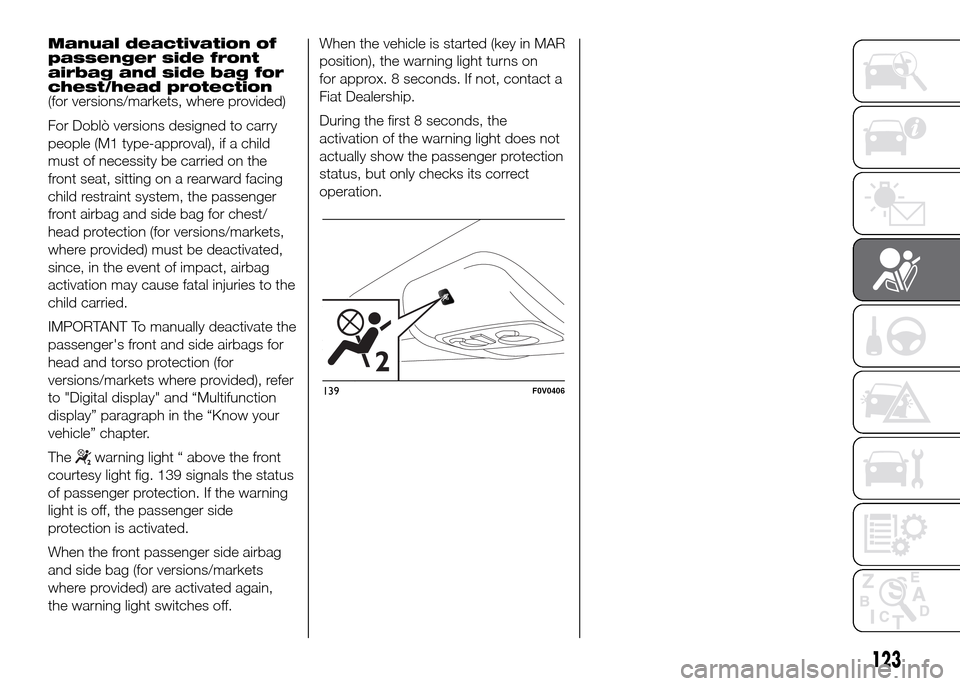
The
warning light “ above the front
courtesy light fig. 139 signals the status
of passenger protection. If the warning
light is off, the passenger side
protection is activated.
When the front passenger side airbag
and side bag (for versions/markets
where provided) are activated again,
the warning light switches off.When the vehicle is started (key in MAR
position), the warning light turns on
for approx. 8 seconds. If not, contact a
Fiat Dealership.
During the first 8 seconds, the
activation of the warning light does not
actually show the passenger protection
status, but only checks its correct
operation.
139F0V0406
123
Page 131 of 323
A small amount of dust will be released
when the airbags are deployed. The
dust is not harmful and does not
indicate the beginning of a fire.
Furthermore, the surface of the
deployed bag and the interior of the
vehicle may be covered in a dusty
residue: this may irritate your skin and
eyes. Wash with mild soap and water in
the event of exposure.
Should an accident occur in which any
of the safety devices are activated,
take the vehicle to a Fiat Dealership to
have the activated devices replaced
and to have the whole system checked.
Every control, repair and replacement
operation concerning the airbags must
be carried out only at Fiat Dealerships.
If you are having the vehicle scrapped,
have the system deactivated at a Fiat
Dealership first. If the vehicle changes
ownership, the new owner must be
informed of how to use the airbags and
the above warnings and also be given
this "Owner Handbook".
Pretensioners, front airbags and front
side bags are deployed differently
according to the type of collision.
Failure to deploy of one of the devices
does not necessarily indicate a system
malfunction.
76) 77)
WARNING
76) If thewarning light does not
turn on when the key is turned to
MAR, or if it stays on when
travelling (together with the
message on the display on some
versions), there could be a failure
in the restraint systems. If this
is the case, the airbags or
pretensioners may not trigger in
the event of an accident or, less
likely, they may trigger
accidentally. Before proceeding,
contact a Fiat Dealership
immediately to have the system
checked.
77) Do not travel carrying objects in
your lap, in front of your chest or
between your lips (pipe, pencils,
etc.): they could cause severe
injury if the airbag is deployed in
an accident.
127
Page 134 of 323
STARTING THE
ENGINE
The vehicle is fitted with an immobiliser:
if the engine fails to start, see the
paragraph on “The Fiat CODE system”
in the “Dashboard and controls”
section.
The engine may be noisier during the
first few seconds of operation,
especially after a long period of
inactivity. This is due to the hydraulic
tappets, the timing system chosen for
petrol engine versions to reduce the
number of servicing interventions, and
affects neither functionality nor reliability.
17) 18)
78)
PROCEDURE FOR
PETROL VERSIONS
Proceed as follows:
❒engage the handbrake;
❒put the gear lever into neutral;
❒fully depress the clutch pedal,
without touching the accelerator;
❒turn the ignition key to AVV and
release it as soon as the engine
starts.If the engine does not start at the first
attempt, return the ignition key to STOP
before repeating the starting procedure.
If, when the ignition key is on MAR,
the instrument panel warning light
remains on together with warning
light
, turn the key to STOP and
then back to MAR; if the warning light
remains on, try the other keys provided
with the vehicle. If you are still unable
to start the engine, perform the
emergency starting procedure (see
"Emergency starting" in the "In an
emergency" chapter) and contact a Fiat
Dealership.
PROCEDURE FOR DIESEL
VERSIONS
Proceed as follows:
❒engage the handbrake;
❒put the gear lever into neutral;
❒turn the ignition key to MAR: the
warning lights
andon
the instrument panel will turn on;
❒wait for the warning lights
and
to switch off. The hotter the
engine is, the quicker this will
happen;
❒fully depress the clutch pedal,
without touching the accelerator;❒turn the ignition key to AVV as soon
as warning light
switches off.
Waiting too long will waste the
heating work carried out by the glow
plugs.
Release the key as soon as the engine
starts.
IMPORTANT With the engine cold, the
accelerator pedal must be fully released
when you turn the ignition key to AVV.
If the engine does not start at the
first attempt, return the ignition key to
STOP before repeating the starting
procedure.
If, when the ignition key is at MAR the
warning light remains lit, turn the
key to STOP and then back to MAR; if
the warning light remains lit, try with the
other keys provided with the vehicle. If
you still cannot start the engine, contact
a Fiat Dealership.
19)
WARMING UP THE
ENGINE JUST AFTER IT
HAS STARTED
Proceed as follows:
❒drive off slowly, letting the engine turn
at medium revs. Do not accelerate
abruptly;
130
STARTING AND DRIVING
Page 135 of 323
❒do not demand full performance at
first. Wait until the engine coolant
temperature gauge starts moving.
EMERGENCY STARTING
If the instrument panel warning light
stays on steadily, you can perform
an emergency starting by using the
code on the CODE card (see the “In an
emergency” section).
20)
STOPPING THE ENGINE
Turn the ignition key to STOP while the
engine is idling.
IMPORTANT After a taxing drive, you
should allow the engine to “catch
its breath” before turning it off by letting
it idle to allow the temperature in the
engine compartment to fall.
IMPORTANT
17) It is advisable not to demand
maximum performance from
your vehicle (e.g. excessive
acceleration, long distances at
high speeds, excessively intense
braking, etc.) during the initial
period of use.
18) When the engine is off, do not
leave the key turned to MAR to
prevent unnecessary electrical
consumption from draining the
battery.
19) If the indicator flashes for 60
seconds after starting or
during an extended towing period,
this indicates a problem in the
glow plug preheating system.
Use the vehicle normally if the
engine starts, but contact a Fiat
Dealership as soon as possible.
20) Never start the engine by
pushing, towing or driving
downhill. This could cause fuel to
flow into the catalytic converter
and damage it beyond repair.
WARNING
78) It is dangerous to run the engine
in enclosed areas. The engine
takes in oxygen and releases
carbon dioxide, carbon monoxide
and other toxic gases.
131
Page 136 of 323
HANDBRAKE
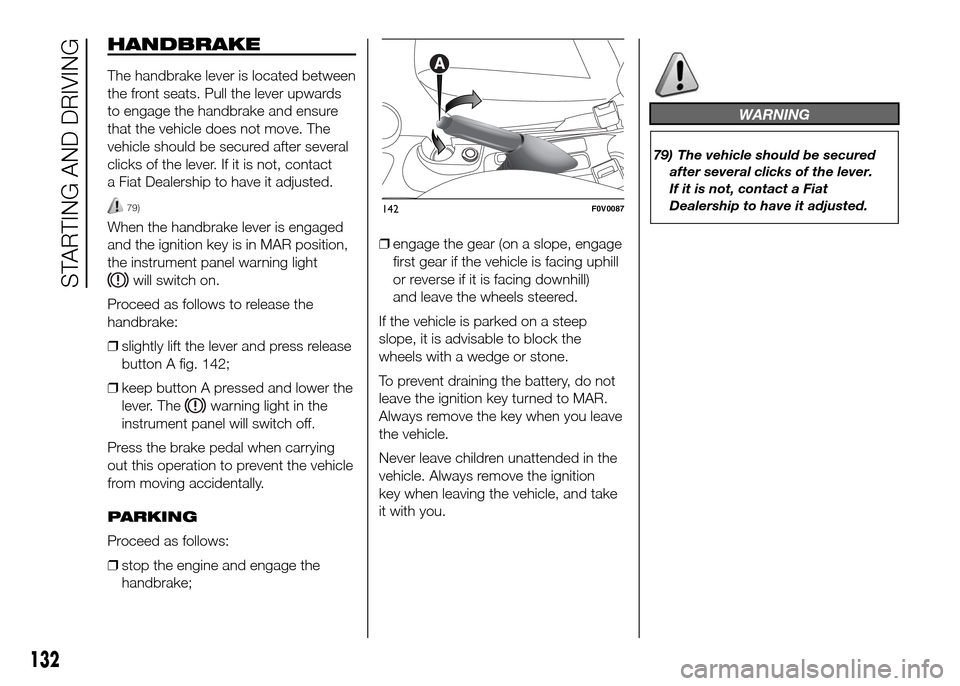
The handbrake lever is located between
the front seats. Pull the lever upwards
to engage the handbrake and ensure
that the vehicle does not move. The
vehicle should be secured after several
clicks of the lever. If it is not, contact
a Fiat Dealership to have it adjusted.
79)
When the handbrake lever is engaged
and the ignition key is in MAR position,
the instrument panel warning light
will switch on.
Proceed as follows to release the
handbrake:
❒slightly lift the lever and press release
button A fig. 142;
❒keep button A pressed and lower the
lever. The
warning light in the
instrument panel will switch off.
Press the brake pedal when carrying
out this operation to prevent the vehicle
from moving accidentally.
PARKING
Proceed as follows:
❒stop the engine and engage the
handbrake;❒engage the gear (on a slope, engage
first gear if the vehicle is facing uphill
or reverse if it is facing downhill)
and leave the wheels steered.
If the vehicle is parked on a steep
slope, it is advisable to block the
wheels with a wedge or stone.
To prevent draining the battery, do not
leave the ignition key turned to MAR.
Always remove the key when you leave
the vehicle.
Never leave children unattended in the
vehicle. Always remove the ignition
key when leaving the vehicle, and take
it with you.
WARNING
79) The vehicle should be secured
after several clicks of the lever.
If it is not, contact a Fiat
Dealership to have it adjusted.
142F0V0087
132
STARTING AND DRIVING
Page 137 of 323
USING THE
GEARBOX
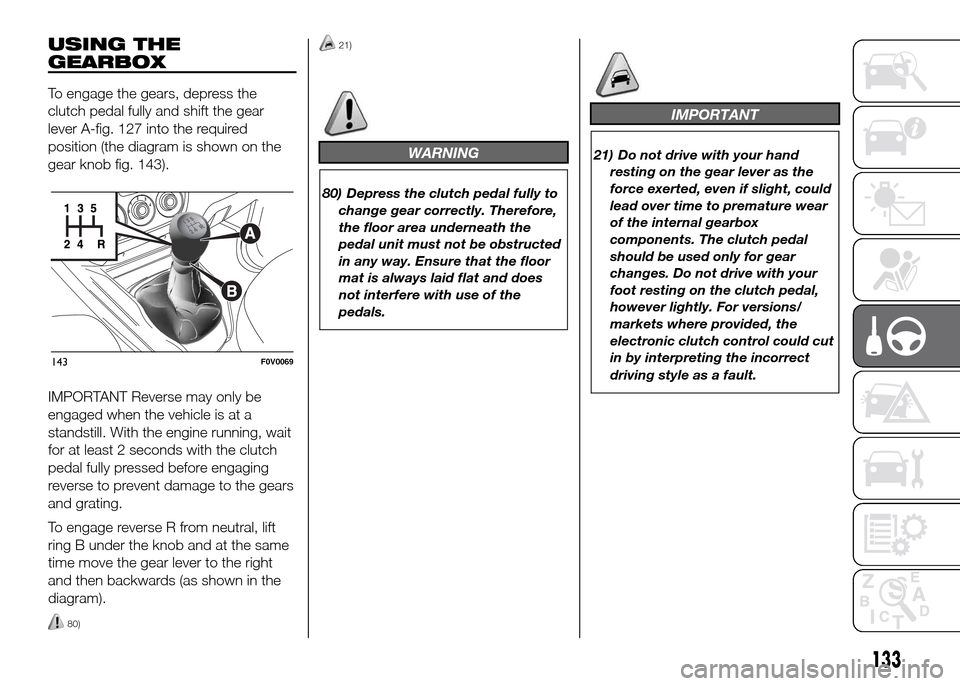
To engage the gears, depress the
clutch pedal fully and shift the gear
lever A-fig. 127 into the required
position (the diagram is shown on the
gear knob fig. 143).
IMPORTANT Reverse may only be
engaged when the vehicle is at a
standstill. With the engine running, wait
for at least 2 seconds with the clutch
pedal fully pressed before engaging
reverse to prevent damage to the gears
and grating.
To engage reverse R from neutral, lift
ring B under the knob and at the same
time move the gear lever to the right
and then backwards (as shown in the
diagram).
80)
21)
WARNING
80) Depress the clutch pedal fully to
change gear correctly. Therefore,
the floor area underneath the
pedal unit must not be obstructed
in any way. Ensure that the floor
mat is always laid flat and does
not interfere with use of the
pedals.
IMPORTANT
21) Do not drive with your hand
resting on the gear lever as the
force exerted, even if slight, could
lead over time to premature wear
of the internal gearbox
components. The clutch pedal
should be used only for gear
changes. Do not drive with your
foot resting on the clutch pedal,
however lightly. For versions/
markets where provided, the
electronic clutch control could cut
in by interpreting the incorrect
driving style as a fault.
143F0V0069
133
Page 139 of 323
ENGINE STOPPING
FAILURE CONDITIONS
With the device activated, for reasons
of comfort, limiting emissions and
safety, the engine does not stop in
certain conditions, including:
❒engine still cold;
❒particularly cold external
temperatures, if the corresponding
indication is provided;
❒battery not sufficiently charged;
❒particulate filter regeneration in
progress (diesel engines only);
❒driver's door not shut;
❒driver's seat belt not fastened;
❒reverse gear engaged (for example,
for parking manoeuvres);
❒automatic climate control, if a
suitable thermal comfort level has not
yet been reached or MAX-DEF
function activation;
❒during the first period of use, to
initialise the system.
In the above cases, the warning light
flashes fig. 103 and, where available,
there is a message in the display.RESTARTING
CONDITIONS
For reasons of comfort, limiting harmful
emissions and safety purposes, the
power unit can restart automatically
without any action by the driver if
certain conditions are met, including:
❒battery not sufficiently charged;
❒reduced braking system vacuum
(e.g. if the brake pedal is pressed
repeatedly);
❒vehicle in motion (e.g. when driving
on roads with a gradient);
❒stopping the engine through the
Start&Stop system for more than
about three minutes.
❒automatic climate control system for
adjusting the thermal comfort level or
to enable MAX-DEF function.
With a gear engaged, the engine can
be automatically restarted only by
fully depressing the clutch pedal. The
driver is asked to perform this operation
through the warning light flashing in
the instrument panel fig. 103 and,
where provided, the message in the
display.N.B.: If you stall the engine, for example
by releasing off the clutch pedal quickly
when in gear, if the Start&Stop system
is activated, the engine can be
restarted by fully depressing the clutch
pedal or by putting the gear lever into
neutral.
N.B.: If the clutch is not depressed
when the three minutes have elapsed
since the engine was stopped, the
engine can only be restarted using the
key.
SAFETY FUNCTIONS
In engine cut-out conditions through
the Start&Stop system, if the driver
unfastens his/her seat belt and opens
the driver's door or the passenger door,
the engine can be restarted only by
using the key.
The driver is notified of this condition by
a buzzer, through the fig. 144 warning
light flashing in the instrument panel
and, where provided, by a message in
the display.
135