climate control FIAT DOBLO PANORAMA 2016 2.G User Guide
[x] Cancel search | Manufacturer: FIAT, Model Year: 2016, Model line: DOBLO PANORAMA, Model: FIAT DOBLO PANORAMA 2016 2.GPages: 323, PDF Size: 25.46 MB
Page 58 of 323
❒switches on climate control
compressor when climatic conditions
are suitable;
❒sets air recirculation off;
❒sets maximum air temperature HI in
both areas;
❒sets the fan speed according to the
engine coolant temperature to limit
the flow of air that is not sufficiently
warm to demist the windows;
❒directs air flow to windscreen and
front side windows vents;
❒sets heated rear window on.
IMPORTANT The rapid demisting/
defrosting function for the windows
remains on for about 3 minutes from
when the engine coolant reaches the
appropriate temperature for a rapid
demisting of the windows.
When this function is active, the LED on
the corresponding button and the one
on the heated rear window button
switch on. The message FULL AUTO
goes off on the display.
You can only adjust the fan speed and
switch off the heated rear window
manually when this function is active.
To restore the previous operating
conditions, simply press button B, air
recirculation button G, compressor
button F or AUTO button A.Heated rear window and
door mirrors electric
control demisting/
defrosting button (L)
(for versions/markets, where provided)
Push this button to activate the
demisting/defrosting of the heated rear
window and electric door mirrors
When this function is active, the button
LED is on.
This function switches off automatically
after about 20 minutes or when you
push the button again, or when the
engine is turned off. It will not be
switched on automatically when the
engine is restarted.
IMPORTANT Do not affix decals to the
inside of the heated rear window over
the heating filaments, to avoid damage
that might cause them to stop working
properly.
Switching the system
OFF (E)
Press button E to switch the climate
control system off. The display will go
out.With the system off, the climate control
system conditions are as follows:
display off, temperature setting not
display, air recirculation on thereby
insulating the passenger compartment
from the outside (recirculation LED
on), climate control compressor off, fan
off. Press the AUTO button to switch
the climate control system back on
in full automatic mode.
54
KNOW YOUR VEHICLE
Page 78 of 323
SPEEDOMETER
This shows the speed at which the
vehicle is travelling.
REV COUNTER
The rev counter shows the engine rpm.
IMPORTANT The electronic injection
control system gradually shuts off
the flow of fuel when the engine
is “over-revving” resulting in a gradual
loss of engine power.
When the engine is idling, the rev
counter may indicate a gradual or
sudden increase of the speed.
This behaviour is standard as it takes
place during the activation of the
climate control system or the fan. It
should not be considered as a fault. In
such cases, a slight increase in engine
idle speed helps to sustain the battery
charge.
FUEL LEVEL GAUGE
This shows the amount of fuel left in the
fuel tank.
E tank empty.
F tank full (see the instructions provided
in the “Vehicle refuelling” paragraph).
The warning light on the gauge comes
on to indicate that approximately 8-10
litres of fuel are left in the tank.Do not travel with the fuel tank almost
empty: any gaps in fuel supply could
damage the catalytic converter.
IMPORTANT The needle will point to E
and warning light A will flash to indicate
a fault in the system. Contact a Fiat
Dealership to have the system
checked.
ENGINE COOLANT
TEMPERATURE
INDICATOR
This shows the temperature of the
engine coolant fluid and starts working
when the fluid temperature exceeds
approx. 50°C.
In normal usage, the needle should
hover around the middle of the scale.
C Low engine coolant temperature.
H High engine coolant temperature.
The warning light on the gauge may
light up (and a message on the
multifunction display may appear on
certain versions) to indicate that the
coolant fluid temperature is too high; in
this case, stop the engine and contact
a Fiat Dealership.
10)
IMPORTANT
10) If the needle for the engine
coolant temperature reaches the
red area, stop the engine
immediately and contact a Fiat
Dealership.
74
KNOWING THE INSTRUMENT PANEL
Page 80 of 323
Selecting a menu option
– briefly press theMENU
button to
select the menu option to set;
– press buttons
and(with single
presses) to select the new setting;
– press briefly theMENU
button to
store the new setting and go back to
the previous menu option.
Selecting “Set Clock”
– briefly press buttonMENU
to
select the first value to change (hours);
– press buttons
and(with single
presses) to select the new setting;
– briefly press theMENU
button to
store the new setting and go to the
next setup menu option (minutes);
– after setting the values with the same
procedure, go back to the previous
menu item.
Hold down theMENU
button
– to quit the setup menu if you are in
the menu;
– to quit to the menu if you are setting
an option;
– to save only the settings already
stored (and confirmed by pressing the
MENU
button).The environment of the Set Up menu is
timed; when the menu is exited due
to expiry of the time allowed, only the
changes already stored by the user
(confirmed beforehand by a brief press
of theMENU
button) will be saved.
Adjusting the vehicle
interior lighting (ILLU)
This function is available, with the
dipped headlamps on and at night, to
adjust the brightness of the instrument
panel, buttons, sound system display
and automatic climate control display.
During the daytime, and with the
dipped headlamps on, the instrument
panel, buttons and sound system
and automatic climate control displays
are set to maximum brightness.
❒press theMENU
button briefly:
the display will show the wording
ILLU;
❒press button
andto set the
required brightness level;
❒press theMENU
button briefly
to return to the menu screen or hold
the button down to return to the
standard screen without storing.Setting a speed limit
(SPEEd)
This function is used to set a speed
limit (km/h or mph); the driver is alerted
when this limit is exceeded (see
“Warning lights and messages”).
To set the desired speed limit, proceed
as follows:
- press theMENU
button briefly:
the display will show the wording
(SPEED) and the unit (km/h) or (mph)
previously set;
- press
orto select speed limit
activation (On) or deactivation (Off);
- if the function is on, press
orto
select the required speed limit and then
pressMENU
to confirm;
NOTE The speed may be set in the
range from 30 to 200 km/h, or from 20
to 125 mph according to the previously
chosen unit (see “Setting the distance
unit”) described below. The setting
will increase/decrease by five units each
time the
/button is pressed. Hold
down the
/button to automatically
increase/decrease the setting rapidly.
Complete the adjustment with single
presses of the button when you
approach the desired value.
76
KNOWING THE INSTRUMENT PANEL
Page 84 of 323
– press buttonsor(with single
presses) to select the new setting
for this submenu option;
– briefly press theMENU
button to
store the new setting and to go back
to the same submenu option selected
previously.
Adjusting the vehicle
interior lighting
This function is available, with the
dipped headlamps on and at night, to
adjust the brightness of the instrument
panel, buttons, sound system display
and automatic climate control display.
During the daytime, and with the
dipped headlamps on, the instrument
panel, buttons and sound system
and automatic climate control displays
are set to maximum brightness.
Proceed as follows to adjust the
brightness:
– press theMENU
button briefly to
make the display flash the previously
stored level;
– press button
andto set the
required brightness level;
– press theMENU
button briefly to
return to the menu screen or hold the
button down to return to the standard
screen without storing.Speed warning (Speed
limit)
This function enables setting of the
vehicle speed limit (km/h or mph).
When this limit is exceeded the driver is
immediately alerted (see section
“Warning lights and messages”).
To set the desired speed limit, proceed
as follows:
– briefly press theMENU
button:
the display will show the words (Speed
Beep);
– press the
orbutton to select
speed limit activation (On) or
deactivation (Off);
– if the function is on, press the
or
buttons to select the required speed
limit and then pressMENU
to
confirm;
NOTE The speed may be set anywhere
between 30 and 200 km/h or 20 and
125 mph, depending on the previously
chosen unit (see “Setting the unit of
measurement (Unit)”). The setting will
increase/decrease by 5 units each time
button
/is pressed. Hold down
the
/button to automatically
increase/decrease the setting rapidly.
Complete the adjustment with single
presses of the button when you
approach the desired value.– press theMENU
button briefly to
return to the menu screen or hold the
button down to return to the standard
screen without storing.
To cancel the setting, proceed as
follows:
– briefly press buttonMENU
, (On)
will flash on the display;
– press button
, (Off) will flash on the
display;
– press buttonMENU
briefly to
return to the menu screen or hold the
button down to return to the standard
screen without storing.
Trip B data (Activating
Trip B)
This function can be used to activate
(On) or deactivate (Off) the Trip B
display (partial trip).
For more information see the "Trip
computer" section.
Proceed as follows to switch the
function on/off:
– press theMENU
button briefly to
make the display flash On or Off
according to the previous setting;
– press the
orbutton to select;
80
KNOWING THE INSTRUMENT PANEL
Page 139 of 323
ENGINE STOPPING
FAILURE CONDITIONS
With the device activated, for reasons
of comfort, limiting emissions and
safety, the engine does not stop in
certain conditions, including:
❒engine still cold;
❒particularly cold external
temperatures, if the corresponding
indication is provided;
❒battery not sufficiently charged;
❒particulate filter regeneration in
progress (diesel engines only);
❒driver's door not shut;
❒driver's seat belt not fastened;
❒reverse gear engaged (for example,
for parking manoeuvres);
❒automatic climate control, if a
suitable thermal comfort level has not
yet been reached or MAX-DEF
function activation;
❒during the first period of use, to
initialise the system.
In the above cases, the warning light
flashes fig. 103 and, where available,
there is a message in the display.RESTARTING
CONDITIONS
For reasons of comfort, limiting harmful
emissions and safety purposes, the
power unit can restart automatically
without any action by the driver if
certain conditions are met, including:
❒battery not sufficiently charged;
❒reduced braking system vacuum
(e.g. if the brake pedal is pressed
repeatedly);
❒vehicle in motion (e.g. when driving
on roads with a gradient);
❒stopping the engine through the
Start&Stop system for more than
about three minutes.
❒automatic climate control system for
adjusting the thermal comfort level or
to enable MAX-DEF function.
With a gear engaged, the engine can
be automatically restarted only by
fully depressing the clutch pedal. The
driver is asked to perform this operation
through the warning light flashing in
the instrument panel fig. 103 and,
where provided, the message in the
display.N.B.: If you stall the engine, for example
by releasing off the clutch pedal quickly
when in gear, if the Start&Stop system
is activated, the engine can be
restarted by fully depressing the clutch
pedal or by putting the gear lever into
neutral.
N.B.: If the clutch is not depressed
when the three minutes have elapsed
since the engine was stopped, the
engine can only be restarted using the
key.
SAFETY FUNCTIONS
In engine cut-out conditions through
the Start&Stop system, if the driver
unfastens his/her seat belt and opens
the driver's door or the passenger door,
the engine can be restarted only by
using the key.
The driver is notified of this condition by
a buzzer, through the fig. 144 warning
light flashing in the instrument panel
and, where provided, by a message in
the display.
135
Page 141 of 323
EMERGENCY STARTING
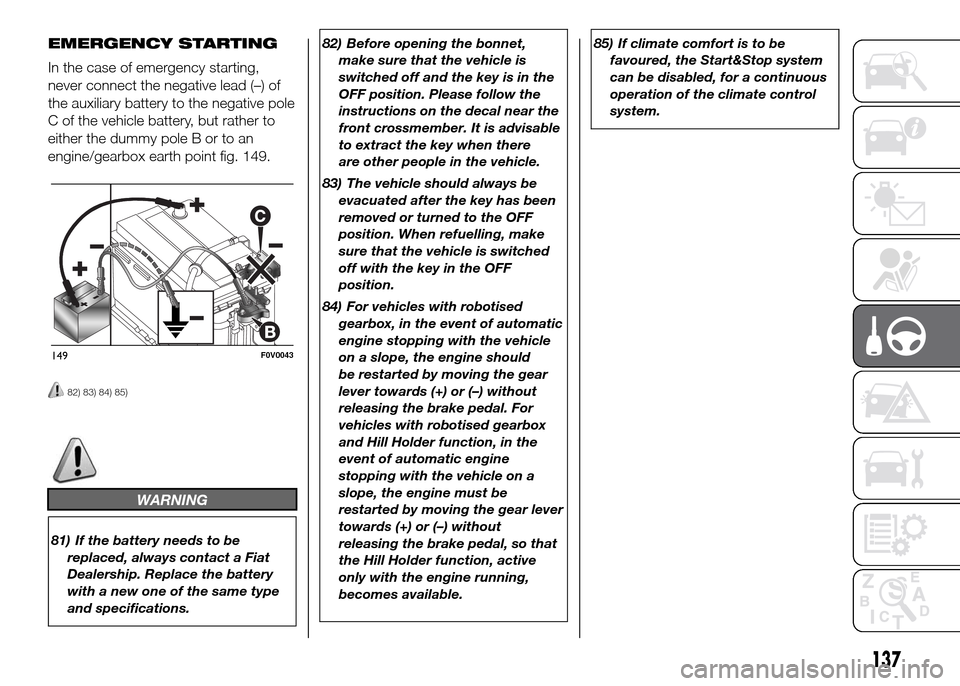
In the case of emergency starting,
never connect the negative lead (–) of
the auxiliary battery to the negative pole
C of the vehicle battery, but rather to
either the dummy pole B or to an
engine/gearbox earth point fig. 149.
82) 83) 84) 85)
WARNING
81) If the battery needs to be
replaced, always contact a Fiat
Dealership. Replace the battery
with a new one of the same type
and specifications.82) Before opening the bonnet,
make sure that the vehicle is
switched off and the key is in the
OFF position. Please follow the
instructions on the decal near the
front crossmember. It is advisable
to extract the key when there
are other people in the vehicle.
83) The vehicle should always be
evacuated after the key has been
removed or turned to the OFF
position. When refuelling, make
sure that the vehicle is switched
off with the key in the OFF
position.
84) For vehicles with robotised
gearbox, in the event of automatic
engine stopping with the vehicle
on a slope, the engine should
be restarted by moving the gear
lever towards (+) or (–) without
releasing the brake pedal. For
vehicles with robotised gearbox
and Hill Holder function, in the
event of automatic engine
stopping with the vehicle on a
slope, the engine must be
restarted by moving the gear lever
towards (+) or (–) without
releasing the brake pedal, so that
the Hill Holder function, active
only with the engine running,
becomes available.85) If climate comfort is to be
favoured, the Start&Stop system
can be disabled, for a continuous
operation of the climate control
system.
149F0V0043
137
Page 210 of 323
PROLONGED
VEHICLE INACTIVITY
If the vehicle needs to be off the road
for longer than one month, the following
precautions must be taken:
❒park the vehicle indoors in a dry and,
if possible, well-ventilated place;
❒engage a gear and check that the
handbrake is not engaged;
❒disconnect the negative terminal from
the battery pole (see paragraph
“Vehicle inactivity” in the "Dashboard
and controls" chapter) and check
the charge conditions (see paragraph
“Battery” in the “Care and
maintenance” chapter);
❒clean and protect the painted parts
using protective wax;
❒clean and protect the shiny metal
parts using special compounds
available commercially;
❒sprinkle talcum powder on the
windscreen and rear window wiper
rubber blades and lift them off the
glass;
❒slightly open the windows;❒cover the vehicle with a piece of
fabric or perforated plastic sheet. Do
not use compact plastic tarpaulins,
which prevent humidity from
evaporating from the surface of the
vehicle;
❒inflate tyres to +0.5 bar above the
standard specified pressure and
check it at intervals;
❒do not drain the engine cooling
system.
BODYWORK
PROTECTION AGAINST
ATMOSPHERIC AGENTS
The main causes of corrosion are the
following:
❒atmospheric pollution;
❒salty air and humidity (coastal areas,
or hot humid climates);
❒seasonal environmental conditions.
The abrasive action of wind-borne
atmospheric dust and sand, as well as
mud and gravel raised by other cars
is also not to be underestimated.
On your vehicle, Fiat has implemented
the best manufacturing technologies
to effectively protect the bodywork
against corrosion.
These include:
❒painting products and systems which
give the vehicle particular resistance
to corrosion and abrasion;
❒use of galvanised (or pretreated)
sheet metal, with high resistance
to corrosion;
❒spraying the underbody, engine
compartment, wheelhouse internal
parts and other parts with highly
protective wax products;
206
SERVICING AND MAINTENANCE
Page 274 of 323
FUEL
CONSUMPTION
The fuel consumption figures given in
the tables below are determined on the
basis of the type-approval tests laid
down by specific European Directives.
These consumption values refer to
basic vehicles without optionals.
The procedures below are followed for
measuring consumption:
❒urban cycle: begins with cold
starting, followed by driving
simulating the use of the vehicle in
town;
❒extra-urban cycle: driving that
simulates using the vehicle out of
town with frequent acceleration in all
gears; the speed varies from 0 to 120
km/h;
❒combined consumption: calculated
with a weighting of approximately
37% of the urban cycle and 63% of
the extra-urban cycle.IMPORTANT The type of route, traffic
situations, weather conditions, driving
style, general conditions of the vehicle,
trim level/equipment/accessories,
climate control system, vehicle load,
roof rack, other situations that affect air
drag may lead to different fuel
consumption levels than those
measured.IMPORTANT
In practice, fuel consumption may be
higher than the values obtained during
the approval tests.
Here are some of the major factors that
can lead to a difference between test
and real consumption.
1) Vehicle condition: inadequate
servicing, use of roof racks, trailers,
heavy loading, high usage of electrical
devices and the air conditioning.
2) Driving style: frequent cold starts for
short journeys, poor engine warming
technique, gear selection, high speeds,
sudden acceleration and braking.
3) Traffic and road conditions: driving in
traffic, steep hills or winding roads,
road surface conditions.
4) Atmospheric conditions: intemperate
weather, wind, rain, snow, high altitude.
5) Proportion of use in towns and
cities, in the country and on
motorways.
270
TECHNICAL SPECIFICATIONS
Page 319 of 323
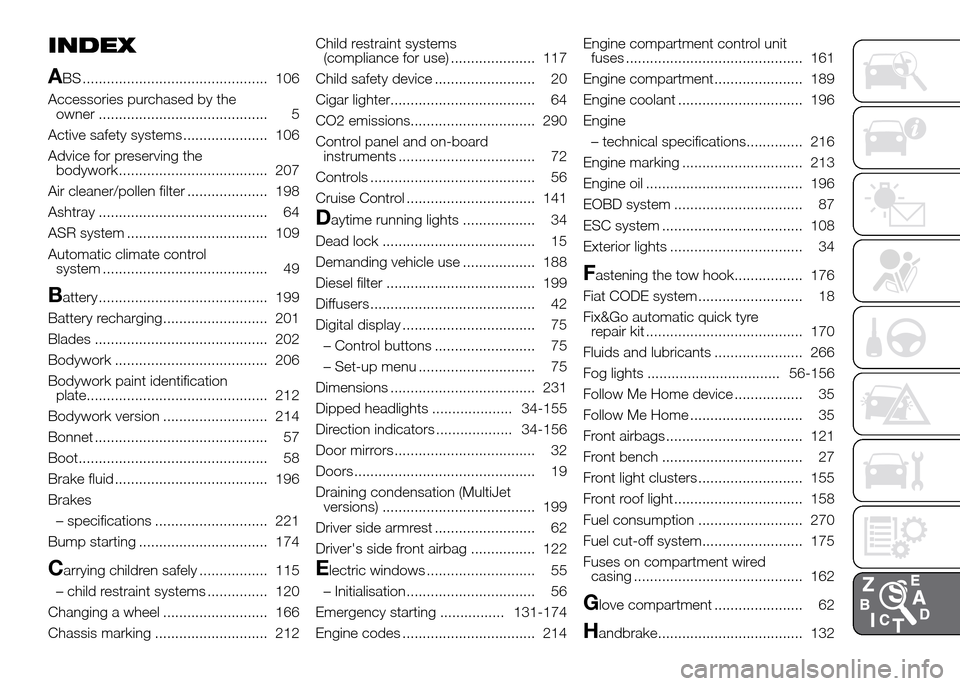
INDEX
A
BS .............................................. 106
Accessories purchased by the
owner .......................................... 5
Active safety systems ..................... 106
Advice for preserving the
bodywork..................................... 207
Air cleaner/pollen filter .................... 198
Ashtray .......................................... 64
ASR system ................................... 109
Automatic climate control
system ......................................... 49
Battery .......................................... 199
Battery recharging.......................... 201
Blades ........................................... 202
Bodywork ...................................... 206
Bodywork paint identification
plate............................................. 212
Bodywork version .......................... 214
Bonnet ........................................... 57
Boot............................................... 58
Brake fluid ...................................... 196
Brakes
– specifications ............................ 221
Bump starting ................................ 174
Carrying children safely ................. 115
– child restraint systems ............... 120
Changing a wheel .......................... 166
Chassis marking ............................ 212Child restraint systems
(compliance for use) ..................... 117
Child safety device ......................... 20
Cigar lighter.................................... 64
CO2 emissions............................... 290
Control panel and on-board
instruments .................................. 72
Controls ......................................... 56
Cruise Control ................................ 141
Daytime running lights .................. 34
Dead lock ...................................... 15
Demanding vehicle use .................. 188
Diesel filter ..................................... 199
Diffusers ......................................... 42
Digital display ................................. 75
– Control buttons ......................... 75
– Set-up menu ............................. 75
Dimensions .................................... 231
Dipped headlights .................... 34-155
Direction indicators ................... 34-156
Door mirrors ................................... 32
Doors ............................................. 19
Draining condensation (MultiJet
versions) ...................................... 199
Driver side armrest ......................... 62
Driver's side front airbag ................ 122
Electric windows ........................... 55
– Initialisation................................ 56
Emergency starting ................ 131-174
Engine codes ................................. 214Engine compartment control unit
fuses ............................................ 161
Engine compartment...................... 189
Engine coolant ............................... 196
Engine
– technical specifications.............. 216
Engine marking .............................. 213
Engine oil ....................................... 196
EOBD system ................................ 87
ESC system ................................... 108
Exterior lights ................................. 34
Fastening the tow hook................. 176
Fiat CODE system.......................... 18
Fix&Go automatic quick tyre
repair kit ....................................... 170
Fluids and lubricants ...................... 266
Fog lights ................................. 56-156
Follow Me Home device ................. 35
Follow Me Home ............................ 35
Front airbags .................................. 121
Front bench ................................... 27
Front light clusters .......................... 155
Front roof light ................................ 158
Fuel consumption .......................... 270
Fuel cut-off system......................... 175
Fuses on compartment wired
casing .......................................... 162
Glove compartment ...................... 62
Handbrake.................................... 132
Page 320 of 323
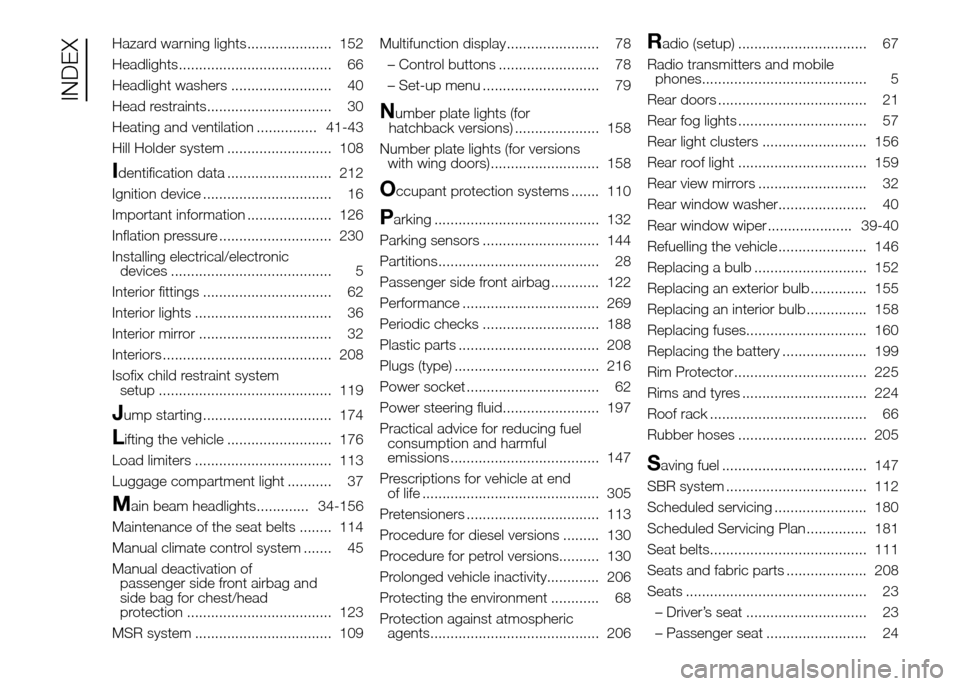
Hazard warning lights..................... 152
Headlights...................................... 66
Headlight washers ......................... 40
Head restraints............................... 30
Heating and ventilation ............... 41-43
Hill Holder system .......................... 108
Identification data .......................... 212
Ignition device ................................ 16
Important information ..................... 126
Inflation pressure ............................ 230
Installing electrical/electronic
devices ........................................ 5
Interior fittings ................................ 62
Interior lights .................................. 36
Interior mirror ................................. 32
Interiors .......................................... 208
Isofix child restraint system
setup ........................................... 119
Jump starting ................................ 174
Lifting the vehicle .......................... 176
Load limiters .................................. 113
Luggage compartment light ........... 37
Main beam headlights............. 34-156
Maintenance of the seat belts ........ 114
Manual climate control system ....... 45
Manual deactivation of
passenger side front airbag and
side bag for chest/head
protection .................................... 123
MSR system .................................. 109Multifunction display....................... 78
– Control buttons ......................... 78
– Set-up menu ............................. 79
Number plate lights (for
hatchback versions) ..................... 158
Number plate lights (for versions
with wing doors)........................... 158
Occupant protection systems ....... 110
Parking ......................................... 132
Parking sensors ............................. 144
Partitions........................................ 28
Passenger side front airbag ............ 122
Performance .................................. 269
Periodic checks ............................. 188
Plastic parts ................................... 208
Plugs (type) .................................... 216
Power socket ................................. 62
Power steering fluid........................ 197
Practical advice for reducing fuel
consumption and harmful
emissions ..................................... 147
Prescriptions for vehicle at end
of life ............................................ 305
Pretensioners ................................. 113
Procedure for diesel versions ......... 130
Procedure for petrol versions.......... 130
Prolonged vehicle inactivity............. 206
Protecting the environment ............ 68
Protection against atmospheric
agents.......................................... 206
Radio (setup) ................................ 67
Radio transmitters and mobile
phones......................................... 5
Rear doors ..................................... 21
Rear fog lights ................................ 57
Rear light clusters .......................... 156
Rear roof light ................................ 159
Rear view mirrors ........................... 32
Rear window washer...................... 40
Rear window wiper ..................... 39-40
Refuelling the vehicle ...................... 146
Replacing a bulb ............................ 152
Replacing an exterior bulb .............. 155
Replacing an interior bulb ............... 158
Replacing fuses.............................. 160
Replacing the battery ..................... 199
Rim Protector................................. 225
Rims and tyres ............................... 224
Roof rack ....................................... 66
Rubber hoses ................................ 205
Saving fuel .................................... 147
SBR system ................................... 112
Scheduled servicing ....................... 180
Scheduled Servicing Plan ............... 181
Seat belts....................................... 111
Seats and fabric parts .................... 208
Seats ............................................. 23
– Driver’s seat .............................. 23
– Passenger seat ......................... 24
INDEX