sensor FIAT DOBLO PANORAMA 2016 2.G User Guide
[x] Cancel search | Manufacturer: FIAT, Model Year: 2016, Model line: DOBLO PANORAMA, Model: FIAT DOBLO PANORAMA 2016 2.GPages: 323, PDF Size: 25.46 MB
Page 143 of 323
The TPMS continues to advise the
driver of the low tyre pressure condition
until this is corrected; the warning
continues until the pressure
corresponds or exceeds the pressure
prescribed for the cold tyres. When the
tyre low pressure control warning
light
switches on constantly, the
inflation pressure must be adjusted until
it reaches the pressure prescribed for
cold tyres. After the automatic update
of the system, the tyre pressure control
warning light switches off. You may
need to drive the vehicle for about 20
minutes at a speed higher than 20
km/h to allow the TPMS to receive this
information.
IMPORTANT In the case of deflation of
more than one tyre sequentially, without
switching off and on the engine, from
the second tyre involved the acoustic
signal is not activated, only the
dedicated signal is shown on the
display.
To prevent the signal from being stored
in the event of pressure loss of a
subsequent tyre (with deactivation of
the acoustic signal), the ignition key
must be turned to MAR and then to
STOP, each time pressure is restored.TPMS operation faults
The system fault is indicated by
warning light
which first flashes for
75 seconds and then stays on steadily.
This can occur in any of the following
situations:
❒interference caused by electronic
devices or radio frequency emissions
similar to those of the TPM sensors.
❒Application of tinted films which
interfere with the signals of the radio
waves.
❒Presence of snow or ice on the
wheels or the wheel arches.
❒Use of snow chains.
❒Use of wheels/tyres not equipped
with TPM sensors.
❒The space-saver wheel is not
equipped with the tyre pressure
control sensor. Therefore, the tyre
pressure is not controlled by the
system.
NOTE The vehicle may be equipped
with FiX&Go Automatic tyre repair
kit, space-saver wheel or full size spare
wheel (with or without original TPMS
sensor to measure tyre pressure).After the punctured tyre has been
repaired with the original tyre sealant
contained in the FiX&Go Automatic tyre
repair kit, the previous condition must
be restored, so that the
warning
light is off during normal driving.
Space-saver wheel (for versions/
markets, where provided): the
space-saver wheel is not equipped with
a TPMS sensor. Once fitted, while
driving normally, the warning light
comes on (flashing for about 75
seconds, and then constantly). This
condition lasts until a wheel equipped
with an original TPMS sensor is fitted
on the vehicle.
Normal spare wheel (without TPMS
sensor): once fitted, while driving
normally, the
warning light comes on
(flashing for about 75 seconds, and
then constantly). This condition lasts
until a wheel equipped with an original
TPMS sensor is fitted on the vehicle.
The system is then restored and the
warning light switches off.
Normal spare wheel (with TPMS
sensor): once fitted, while driving
normally, the
warning light switches
off.
139
Page 144 of 323
IMPORTANT In all the above-mentioned
cases, it is advisable to check the
spare wheel tyre pressure before
starting driving.
NOTE If the tyres are replaced, driving
the vehicle for short stretches, some
time might be needed before the
system is restored.
IMPORTANT
WARNING
86) The TPMS is optimised for the
original tyres and wheels
provided. TPMS pressures and
alerts have been defined
according to the size of the tyres
mounted on the vehicle. Using
equipment with different size,
type or kind may cause irregular
system operation or sensor
damage. Non-original spare
wheels can damage the sensor.
Do not use tyre sealant or
balancing weights if the vehicle is
equipped with TPMS as these
may damage the sensors.87) If the system signals a pressure
decrease on a specific tyre, it is
recommended to check the
pressure on all four tyres.
88) TPMS does not relieve the driver
from the obligation to check the
tyre pressure every month; it is
not to be considered a replacing
system for maintenance or a
safety system.
89) Tyre pressure must be checked
with tyres cold. Should it become
necessary for whatever reason
to check pressure with warm
tyres, do not reduce pressure
even if it is higher than the
prescribed value, but repeat the
check when tyres are cold.
90) The TPMS cannot indicate
sudden tyre pressure drops (for
example when a tyre bursts).
In this case, stop the vehicle,
braking with caution and avoiding
abrupt steering.
91) The system only warns that the
tyre pressure is low: it is not able
to inflate them.
92) Insufficient tyre inflation
increases fuel consumption,
reduces the tread duration and
may affect the capacity to drive
safely.93) Always refit the valve stem cap
after inspecting or adjusting tyre
pressure. This prevents dampness
or dirt from entering the valve
stem and thus the pressure
control sensor from being
damaged.
94) The tyre repair kit (Fix&Go)
provided with the vehicle (for
versions/markets, where
provided) is compatible with the
TPMS sensors; using sealants not
equivalent with that in the original
kit may adversely affect its
operation. If sealants not
equivalent with the original one
are used, it is recommended to
have the TPMS sensor operation
checked by a qualified repair
centre.
140
STARTING AND DRIVING
Page 148 of 323
PARKING SENSORS
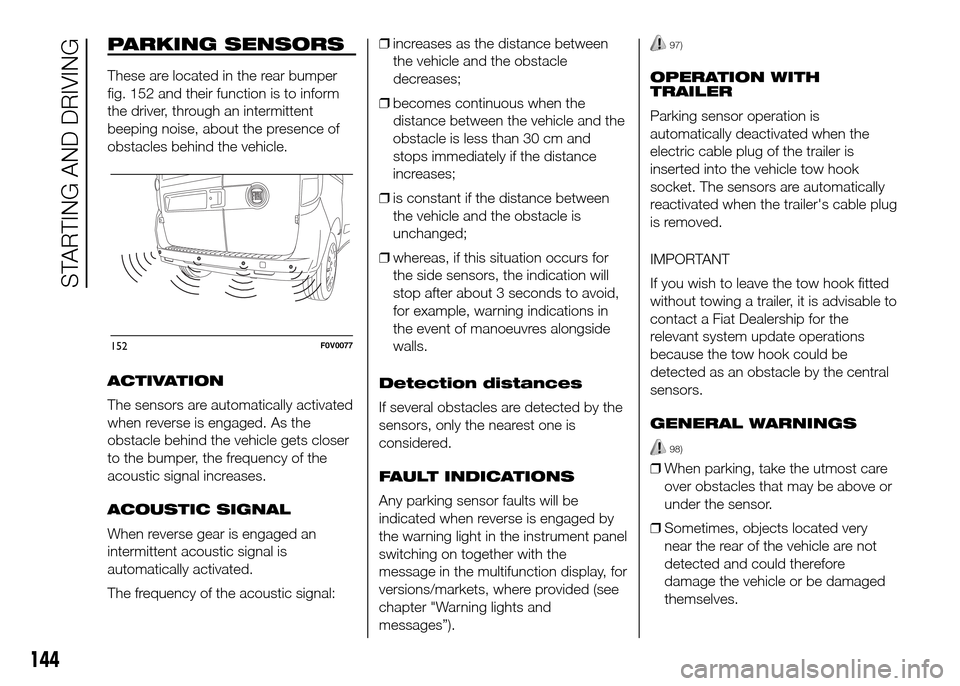
These are located in the rear bumper
fig. 152 and their function is to inform
the driver, through an intermittent
beeping noise, about the presence of
obstacles behind the vehicle.
ACTIVATION
The sensors are automatically activated
when reverse is engaged. As the
obstacle behind the vehicle gets closer
to the bumper, the frequency of the
acoustic signal increases.
ACOUSTIC SIGNAL
When reverse gear is engaged an
intermittent acoustic signal is
automatically activated.
The frequency of the acoustic signal:❒increases as the distance between
the vehicle and the obstacle
decreases;
❒becomes continuous when the
distance between the vehicle and the
obstacle is less than 30 cm and
stops immediately if the distance
increases;
❒is constant if the distance between
the vehicle and the obstacle is
unchanged;
❒whereas, if this situation occurs for
the side sensors, the indication will
stop after about 3 seconds to avoid,
for example, warning indications in
the event of manoeuvres alongside
walls.
Detection distances
If several obstacles are detected by the
sensors, only the nearest one is
considered.
FAULT INDICATIONS
Any parking sensor faults will be
indicated when reverse is engaged by
the warning light in the instrument panel
switching on together with the
message in the multifunction display, for
versions/markets, where provided (see
chapter "Warning lights and
messages”).
97)
OPERATION WITH
TRAILER
Parking sensor operation is
automatically deactivated when the
electric cable plug of the trailer is
inserted into the vehicle tow hook
socket. The sensors are automatically
reactivated when the trailer's cable plug
is removed.
IMPORTANT
If you wish to leave the tow hook fitted
without towing a trailer, it is advisable to
contact a Fiat Dealership for the
relevant system update operations
because the tow hook could be
detected as an obstacle by the central
sensors.
GENERAL WARNINGS
98)
❒When parking, take the utmost care
over obstacles that may be above or
under the sensor.
❒Sometimes, objects located very
near the rear of the vehicle are not
detected and could therefore
damage the vehicle or be damaged
themselves.
152F0V0077
144
STARTING AND DRIVING
Page 149 of 323
The following conditions may influence
the performance of the parking
assistance system:
❒Reduced sensor sensitivity and a
reduction in the parking assistance
system performance could be due to
the presence on the surface of the
sensor of: ice, snow, mud, thick
paint.
❒The sensor may detect a non-
existent obstacle (echo noise) due to
mechanical noises, for example
when washing the vehicle, in case of
rain, strong wind, hail.
❒The signals sent out by the sensors
can be altered by dirt, snow or ice
deposited on the sensors or by
ultrasound systems (e.g. truck
pneumatic brakes or pneumatic drills)
near the vehicle.
❒The performance of the parking
assistance system may also be
affected by the position of the
sensors. For example by a change in
the ride setting (caused by the wear
of the shock absorbers, suspension),
changing the tyres, overloading the
vehicle and carrying out specific
tuning operations that require the
vehicle to be lowered.❒Detection of obstacles in the upper
part of the vehicle (particularly in the
case of vans or chassis cabs) may
not be guaranteed because the
system detects obstacles that could
strike the lower part of the vehicle.
❒The parking sensors work properly
with the swing doors closed.
❒If they are open, they can cause the
system to send false signals: always
close the rear doors.
❒Do not apply stickers to the sensors.
WARNING
97) The sensors must be clean of
mud, dirt, snow and ice in order
for the system to work. Be careful
not to scratch or damage the
sensors while cleaning them.
Avoid using dry, rough or hard
cloths. The sensors must be
washed using clean water, with
the addition of car shampoo if
necessary. When using special
washing equipment such as high
pressure jets or steam cleaning,
clean the sensors very quickly
keeping the jet more than 10 cm
away.98) Parking manoeuvres, however,
are always the driver’s
responsibility. While carrying out
these manoeuvres, always make
sure that no people (especially
children) or animals are in the
area concerned. The parking
sensor is designed to assist
drivers, who must still never allow
their attention to lapse during
potentially dangerous
manoeuvres even if performed at
low speed.
145
Page 205 of 323
IMPORTANT
5) Batteries contain substances
which are very dangerous for the
environment. To replace your
battery, we recommend
contacting your Fiat Dealership to
dispose of your old battery in full
respect of the environment and in
compliance with all applicable
laws and regulations.
BATTERY
RECHARGING
IMPORTANT The battery recharging
procedure is given as information only.
This operation should be performed
at a Fiat Dealership.
Charging should be slow at a low
ampere rating for approximately 24
hours. Charging for a long time may
damage the battery.
To recharge, proceed as follows:
IN THE ABSENCE OF THE
START&STOP SYSTEM
❒disconnect the terminal from the
negative battery pole;
❒connect the charger cables to the
battery terminals, observing the
poles;
❒turn on the charger;
❒when you have finished, turn the
charger off before disconnecting
it from the battery;
❒reconnect the negative battery
terminal.WITH START&STOP
SYSTEM
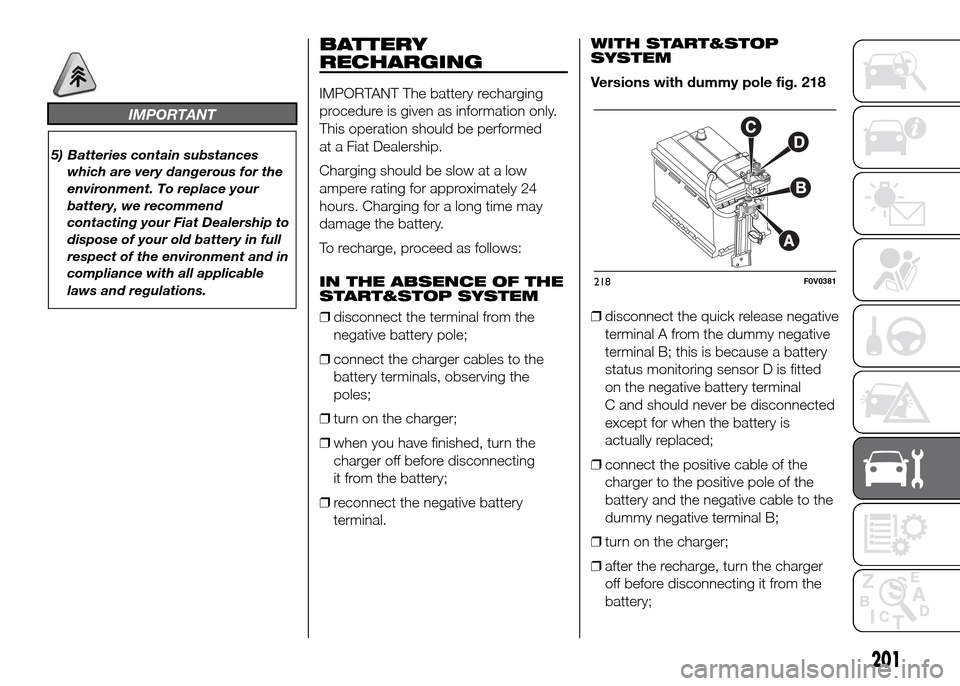
Versions with dummy pole fig. 218
❒disconnect the quick release negative
terminal A from the dummy negative
terminal B; this is because a battery
status monitoring sensor D is fitted
on the negative battery terminal
C and should never be disconnected
except for when the battery is
actually replaced;
❒connect the positive cable of the
charger to the positive pole of the
battery and the negative cable to the
dummy negative terminal B;
❒turn on the charger;
❒after the recharge, turn the charger
off before disconnecting it from the
battery;
218F0V0381
201
Page 206 of 323
❒after disconnecting the battery
charger, reconnect the quick-release
negative terminal A to the dummy
pole B.
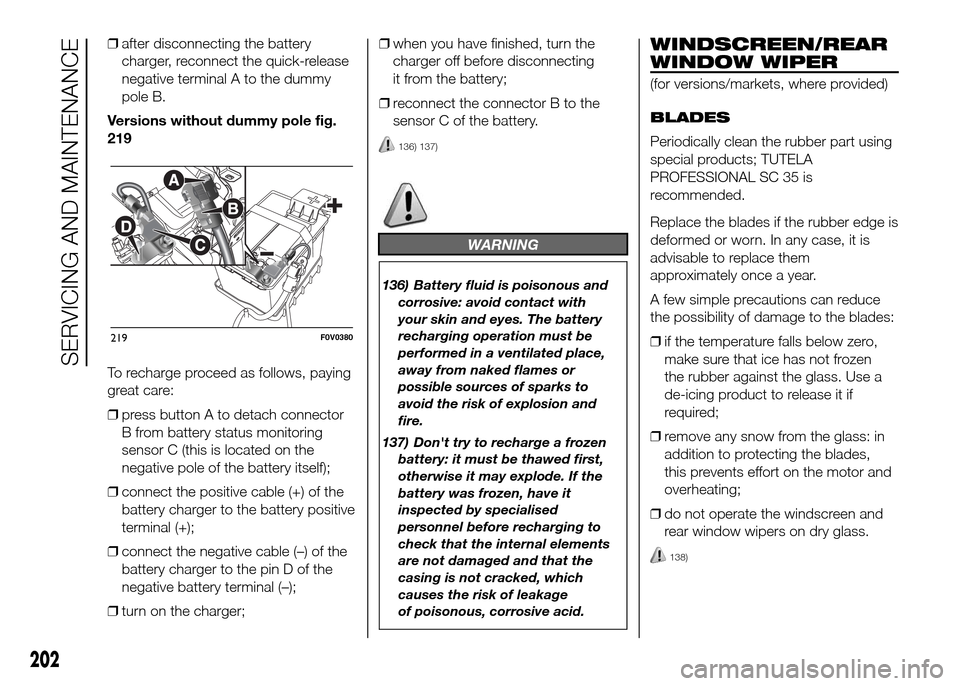
Versions without dummy pole fig.
219
To recharge proceed as follows, paying
great care:
❒press button A to detach connector
B from battery status monitoring
sensor C (this is located on the
negative pole of the battery itself);
❒connect the positive cable (+) of the
battery charger to the battery positive
terminal (+);
❒connect the negative cable (–) of the
battery charger to the pin D of the
negative battery terminal (–);
❒turn on the charger;❒when you have finished, turn the
charger off before disconnecting
it from the battery;
❒reconnect the connector B to the
sensor C of the battery.
136) 137)
WARNING
136) Battery fluid is poisonous and
corrosive: avoid contact with
your skin and eyes. The battery
recharging operation must be
performed in a ventilated place,
away from naked flames or
possible sources of sparks to
avoid the risk of explosion and
fire.
137) Don't try to recharge a frozen
battery: it must be thawed first,
otherwise it may explode. If the
battery was frozen, have it
inspected by specialised
personnel before recharging to
check that the internal elements
are not damaged and that the
casing is not cracked, which
causes the risk of leakage
of poisonous, corrosive acid.
WINDSCREEN/REAR
WINDOW WIPER
(for versions/markets, where provided)
BLADES
Periodically clean the rubber part using
special products; TUTELA
PROFESSIONAL SC 35 is
recommended.
Replace the blades if the rubber edge is
deformed or worn. In any case, it is
advisable to replace them
approximately once a year.
A few simple precautions can reduce
the possibility of damage to the blades:
❒if the temperature falls below zero,
make sure that ice has not frozen
the rubber against the glass. Use a
de-icing product to release it if
required;
❒remove any snow from the glass: in
addition to protecting the blades,
this prevents effort on the motor and
overheating;
❒do not operate the windscreen and
rear window wipers on dry glass.
138)
219F0V0380
202
SERVICING AND MAINTENANCE
Page 320 of 323
Hazard warning lights..................... 152
Headlights...................................... 66
Headlight washers ......................... 40
Head restraints............................... 30
Heating and ventilation ............... 41-43
Hill Holder system .......................... 108
Identification data .......................... 212
Ignition device ................................ 16
Important information ..................... 126
Inflation pressure ............................ 230
Installing electrical/electronic
devices ........................................ 5
Interior fittings ................................ 62
Interior lights .................................. 36
Interior mirror ................................. 32
Interiors .......................................... 208
Isofix child restraint system
setup ........................................... 119
Jump starting ................................ 174
Lifting the vehicle .......................... 176
Load limiters .................................. 113
Luggage compartment light ........... 37
Main beam headlights............. 34-156
Maintenance of the seat belts ........ 114
Manual climate control system ....... 45
Manual deactivation of
passenger side front airbag and
side bag for chest/head
protection .................................... 123
MSR system .................................. 109Multifunction display....................... 78
– Control buttons ......................... 78
– Set-up menu ............................. 79
Number plate lights (for
hatchback versions) ..................... 158
Number plate lights (for versions
with wing doors)........................... 158
Occupant protection systems ....... 110
Parking ......................................... 132
Parking sensors ............................. 144
Partitions........................................ 28
Passenger side front airbag ............ 122
Performance .................................. 269
Periodic checks ............................. 188
Plastic parts ................................... 208
Plugs (type) .................................... 216
Power socket ................................. 62
Power steering fluid........................ 197
Practical advice for reducing fuel
consumption and harmful
emissions ..................................... 147
Prescriptions for vehicle at end
of life ............................................ 305
Pretensioners ................................. 113
Procedure for diesel versions ......... 130
Procedure for petrol versions.......... 130
Prolonged vehicle inactivity............. 206
Protecting the environment ............ 68
Protection against atmospheric
agents.......................................... 206
Radio (setup) ................................ 67
Radio transmitters and mobile
phones......................................... 5
Rear doors ..................................... 21
Rear fog lights ................................ 57
Rear light clusters .......................... 156
Rear roof light ................................ 159
Rear view mirrors ........................... 32
Rear window washer...................... 40
Rear window wiper ..................... 39-40
Refuelling the vehicle ...................... 146
Replacing a bulb ............................ 152
Replacing an exterior bulb .............. 155
Replacing an interior bulb ............... 158
Replacing fuses.............................. 160
Replacing the battery ..................... 199
Rim Protector................................. 225
Rims and tyres ............................... 224
Roof rack ....................................... 66
Rubber hoses ................................ 205
Saving fuel .................................... 147
SBR system ................................... 112
Scheduled servicing ....................... 180
Scheduled Servicing Plan ............... 181
Seat belts....................................... 111
Seats and fabric parts .................... 208
Seats ............................................. 23
– Driver’s seat .............................. 23
– Passenger seat ......................... 24
INDEX