lock FIAT DUCATO 2006 3.G Service Manual
[x] Cancel search | Manufacturer: FIAT, Model Year: 2006, Model line: DUCATO, Model: FIAT DUCATO 2006 3.GPages: 258, PDF Size: 4.05 MB
Page 145 of 258
144IN AN EMERGENCY
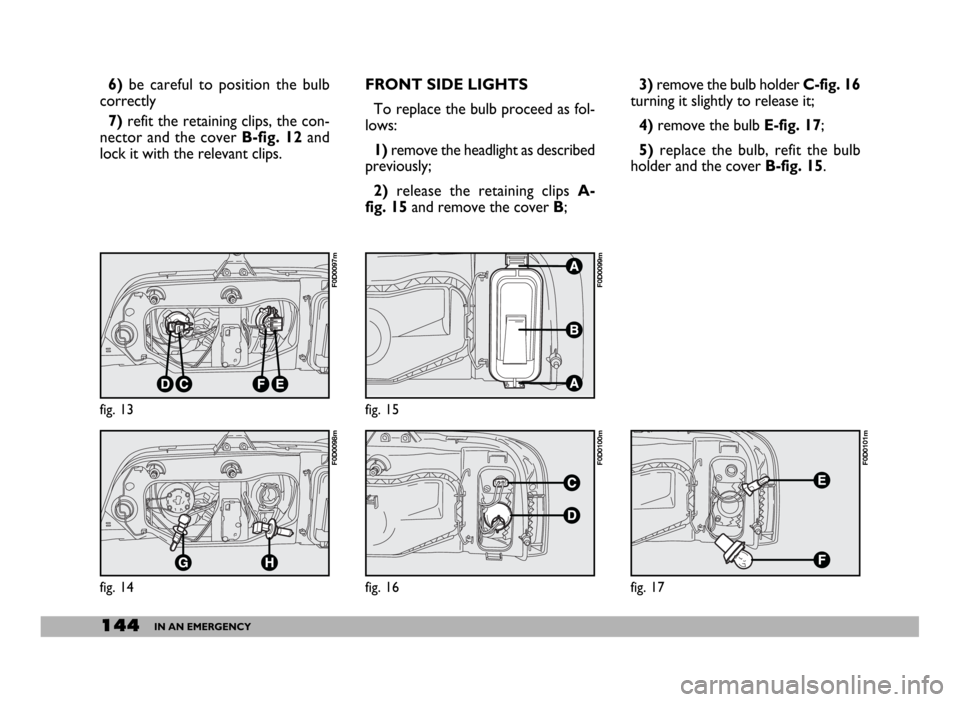
3)remove the bulb holder C-fig. 16
turning it slightly to release it;
4)remove the bulb E-fig. 17;
5) replace the bulb, refit the bulb
holder and the cover B-fig. 15. 6)be careful to position the bulb
correctly
7)refit the retaining clips, the con-
nector and the cover B-fig. 12and
lock it with the relevant clips.
fig. 15
F0D0099m
fig. 16
F0D0100m
fig. 17
F0D0101m
FRONT SIDE LIGHTS
To replace the bulb proceed as fol-
lows:
1)remove the headlight as described
previously;
2)release the retaining clips A-
fig. 15and remove the cover B;
fig. 13
F0D0097m
fig. 14
F0D0098m
Page 146 of 258
145IN AN EMERGENCY
REAR LIGHT CLUSTER
To replace a bulb proceed as follows:
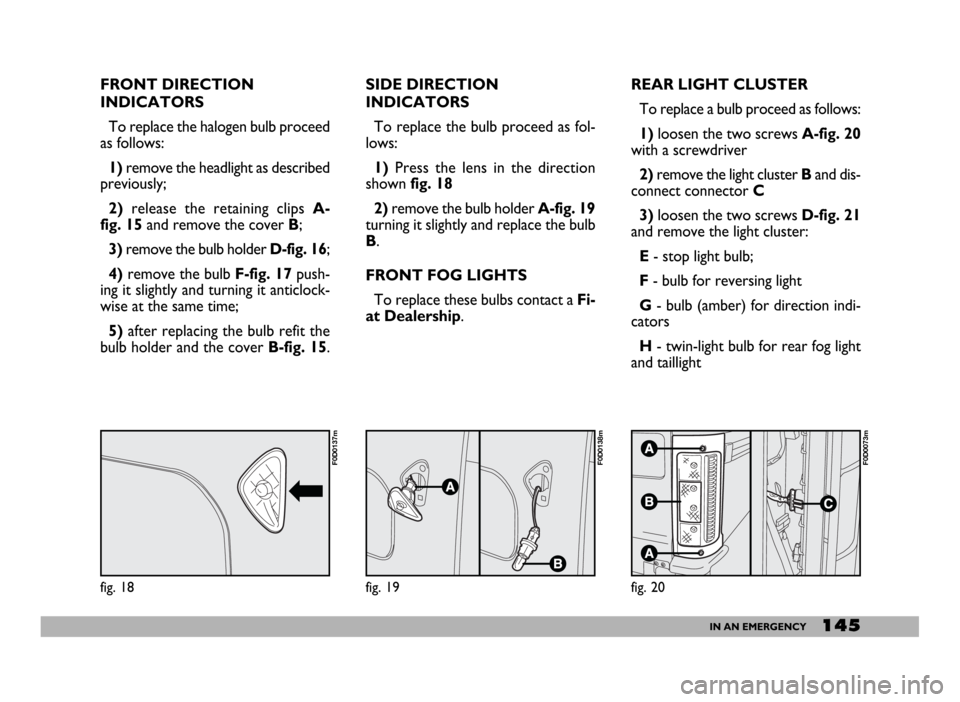
1)loosen the two screws A-fig. 20
with a screwdriver
2)remove the light cluster Band dis-
connect connector C
3)loosen the two screws D-fig. 21
and remove the light cluster:
E- stop light bulb;
F- bulb for reversing light
G - bulb (amber) for direction indi-
cators
H- twin-light bulb for rear fog light
and taillight
fig. 20
F0D0073m
FRONT DIRECTION
INDICATORS
To replace the halogen bulb proceed
as follows:
1) remove the headlight as described
previously;
2)release the retaining clips A-
fig. 15 and remove the cover B;
3)remove the bulb holder D-fig. 16;
4)remove the bulb F-fig. 17push-
ing it slightly and turning it anticlock-
wise at the same time;
5)after replacing the bulb refit the
bulb holder and the cover B-fig. 15.SIDE DIRECTION
INDICATORS
To replace the bulb proceed as fol-
lows:
1)Press the lens in the direction
shown fig. 18
2)remove the bulb holder A-fig. 19
turning it slightly and replace the bulb
B.
FRONT FOG LIGHTS
To replace these bulbs contact a Fi-
at Dealership.
fig. 18
F0D0137m
fig. 19
F0D0138m
Page 147 of 258
146IN AN EMERGENCY
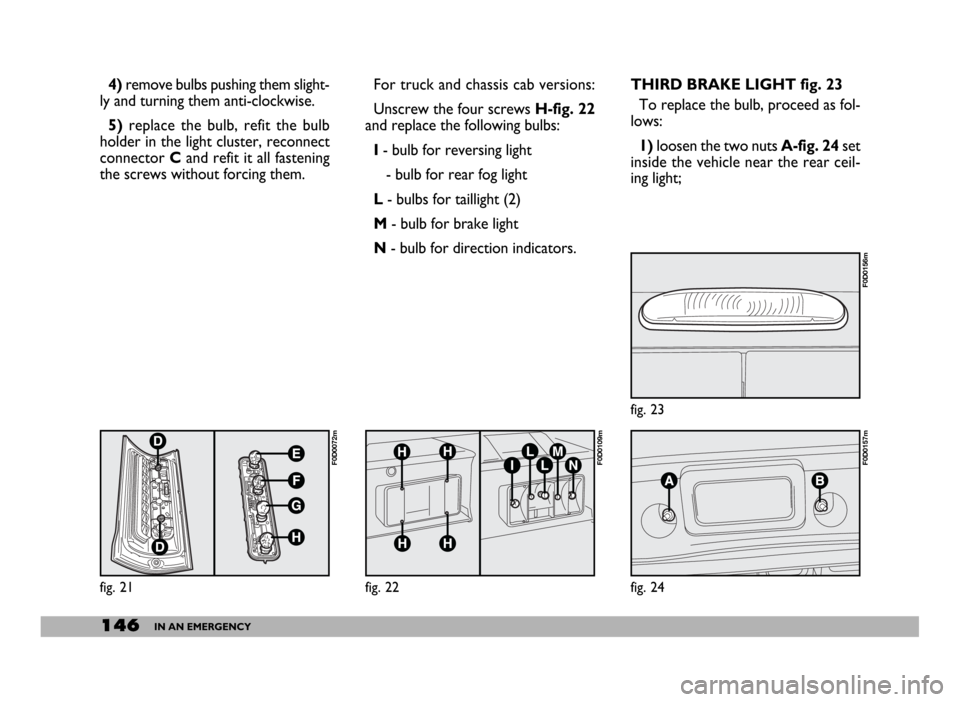
THIRD BRAKE LIGHT fig. 23
To replace the bulb, proceed as fol-
lows:
1)loosen the two nuts A-fig. 24set
inside the vehicle near the rear ceil-
ing light; 4)remove bulbs pushing them slight-
ly and turning them anti-clockwise.
5) replace the bulb, refit the bulb
holder in the light cluster, reconnect
connector Cand refit it all fastening
the screws without forcing them.For truck and chassis cab versions:
Unscrew the four screws H-fig. 22
and replace the following bulbs:
I- bulb for reversing light
- bulb for rear fog light
L- bulbs for taillight (2)
M- bulb for brake light
N- bulb for direction indicators.
fig. 21
F0D0072m
fig. 22
F0D0109m
fig. 23
F0D0156m
fig. 24
F0D0157m
Page 148 of 258
147IN AN EMERGENCY
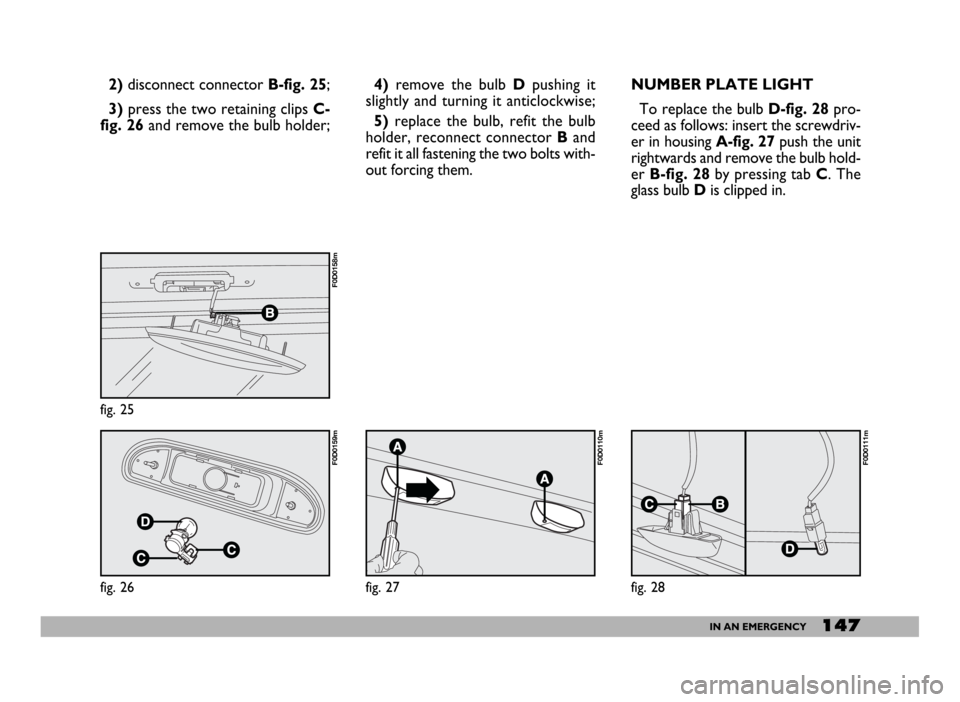
NUMBER PLATE LIGHT
To replace the bulb D-fig. 28pro-
ceed as follows: insert the screwdriv-
er in housing A-fig. 27push the unit
rightwards and remove the bulb hold-
er B-fig. 28by pressing tab C. The
glass bulb Dis clipped in. 2)disconnect connector B-fig. 25;
3)press the two retaining clips C-
fig. 26and remove the bulb holder;4)remove the bulb Dpushing it
slightly and turning it anticlockwise;
5)replace the bulb, refit the bulb
holder, reconnect connector Band
refit it all fastening the two bolts with-
out forcing them.
fig. 25
F0D0158m
fig. 26
F0D0159m
fig. 27
F0D0110m
fig. 28
F0D0111m
Page 154 of 258
153IN AN EMERGENCY
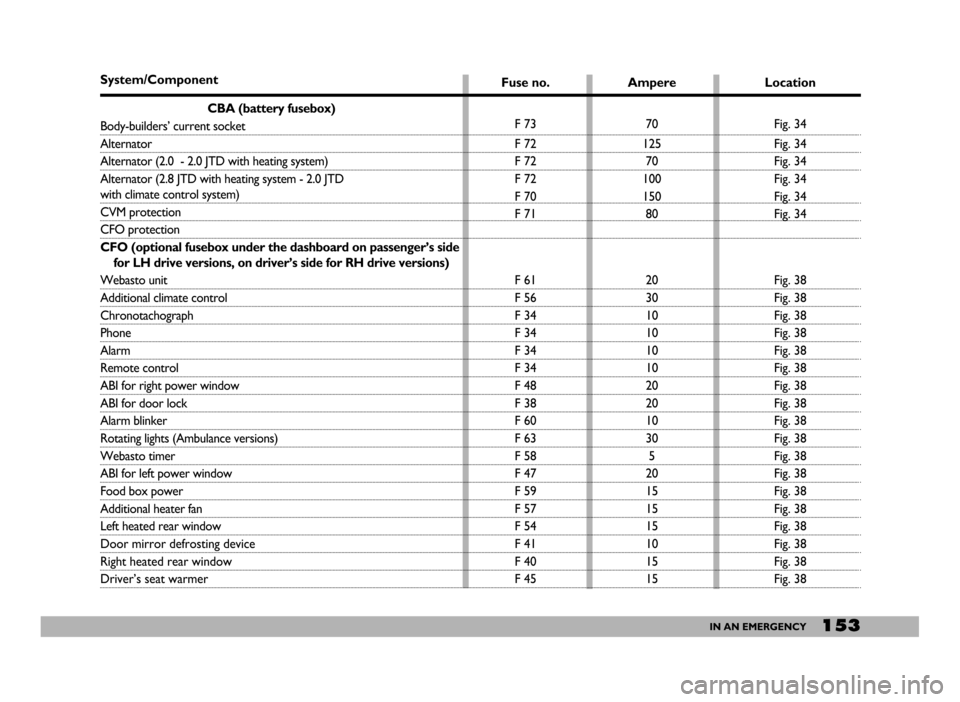
System/Component
CBA (battery fusebox)
Body-builders’ current socket
Alternator
Alternator (2.0 - 2.0 JTD with heating system)
Alternator (2.8 JTD with heating system - 2.0 JTD
with climate control system)
CVM protection
CFO protection
CFO (optional fusebox under the dashboard on passenger’s side
for LH drive versions, on driver’s side for RH drive versions)
Webasto unit
Additional climate control
Chronotachograph
Phone
Alarm
Remote control
ABI for right power window
ABI for door lock
Alarm blinker
Rotating lights (Ambulance versions)
Webasto timer
ABI for left power window
Food box power
Additional heater fan
Left heated rear window
Door mirror defrosting device
Right heated rear window
Driver’s seat warmerFuse no.
F 73
F 72
F 72
F 72
F 70
F 71
F 61
F 56
F 34
F 34
F 34
F 34
F 48
F 38
F 60
F 63
F 58
F 47
F 59
F 57
F 54
F 41
F 40
F 45Ampere
70
125
70
100
150
80
20
30
10
10
10
10
20
20
10
30
5
20
15
15
15
10
15
15Location
Fig. 34
Fig. 34
Fig. 34
Fig. 34
Fig. 34
Fig. 34
Fig. 38
Fig. 38
Fig. 38
Fig. 38
Fig. 38
Fig. 38
Fig. 38
Fig. 38
Fig. 38
Fig. 38
Fig. 38
Fig. 38
Fig. 38
Fig. 38
Fig. 38
Fig. 38
Fig. 38
Fig. 38
Page 160 of 258
159IN AN EMERGENCY
WITH A SHOP JACK
The vehicle can be raised on a shop
jack if it is empty. This is only possi-
ble from the side by placing the jack at
the points provided in the underbody
as indicated infig. 41.
WITH AN ARM HOIST
The vehicle must be raised by plac-
ing the ends of the arms at the points
indicated in fig. 41.TOWING THE
VEHICLE
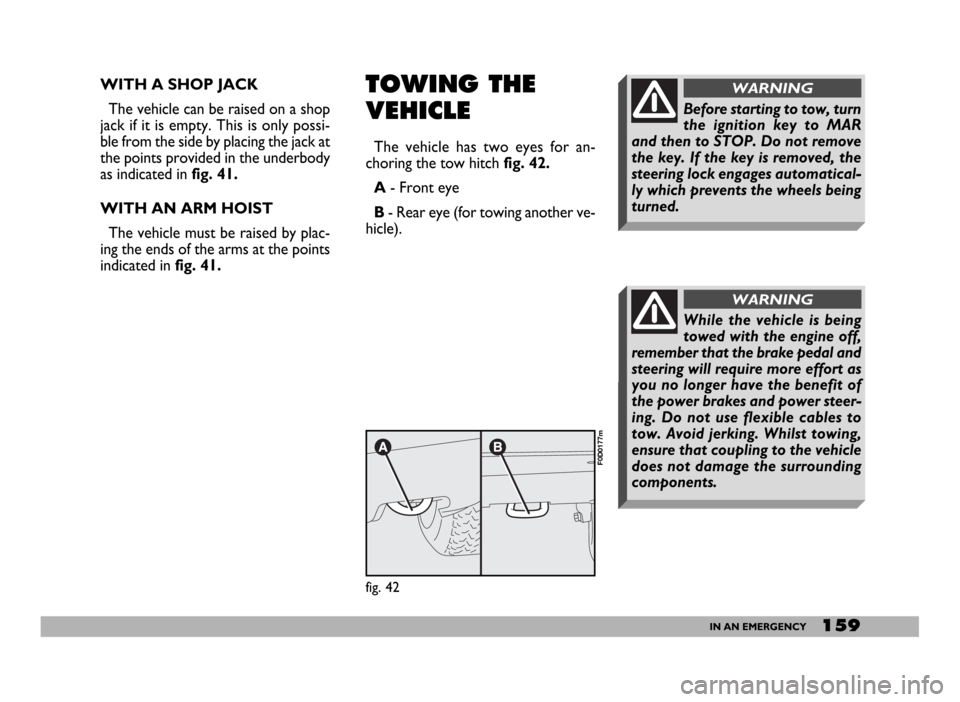
The vehicle has two eyes for an-
choring the tow hitch fig. 42.
A- Front eye
B- Rear eye (for towing another ve-
hicle).
fig. 42
F0D0177m
Before starting to tow, turn
the ignition key to MAR
and then to STOP. Do not remove
the key. If the key is removed, the
steering lock engages automatical-
ly which prevents the wheels being
turned.
WARNING
While the vehicle is being
towed with the engine off,
remember that the brake pedal and
steering will require more effort as
you no longer have the benefit of
the power brakes and power steer-
ing. Do not use flexible cables to
tow. Avoid jerking. Whilst towing,
ensure that coupling to the vehicle
does not damage the surrounding
components.
WARNING
Page 161 of 258
160IN AN EMERGENCY
IF AN ACCIDENT
OCCURS
– It is important to keep calm.
– If you are not directly involved in
the accident, stop at least ten metres
away from the accident.
– If you are on a motorway, do not
obstruct the emergency lane with
your vehicle.
– Turn the engine off and the haz-
ard lights on.
– At night, illuminate the scene of the
accident with your headlights.
– Act carefully, you must not risk be-
ing run over.
– Mark the accident by putting the
red triangle at the regulatory distance
from the vehicle where it can be clear-
ly see.
– If the doors are blocked, do not at-
tempt to smash the windscreen to get
out of the vehicle. It is made of layered
glass and is very hard. Side and rear
windows are much more easily bro-
ken. VEHICLE WITH AUTOMATIC
GEARBOX
If towing is not due to gearbox faults,
proceed as follows:
– gearshift lever to N;
– do not exceed 50 km/h;
– the vehicle should not be towed
for more than 200 km.
If towing is due to gearbox faults or
the vehicle should be towed for more
than 200 km, tow the vehicle raising
the front wheels from the ground.– Call for rescue making the infor-
mation you give as accurate as you
can.On the motorway use the special
column-mounted emergency phones.
– In pile-ups on the motorway, par-
ticularly when the visibility is bad,
there is a high risk of other vehicles
running into those already
stopped.Get out of the vehicle imme-
diately and take refuge behind the
guard rail.
– Remove the ignition keys from the
vehicles involved.
– If you can smell petrol or other
chemicals, do not smoke and make
sure all cigarettes are extinguished.
– Use a fire extinguisher, blanket, sand
or earth to put out fires no matter how
small they are. Never use water.
When towing the vehicle
you must comply with the
specific traffic regulations regard-
ing the tow hitch and how to tow
on the road.
WARNING
Page 163 of 258
162VEHICLE MAINTENANCE
V V
E E
H H
I I
C C
L L
E E
M M
A A
I I
N N
T T
E E
N N
A A
N N
C C
E E
SCHEDULED
SERVICING
Correct maintenance of the vehicle
is essential for ensuring it stays in tip-
top condition for a long time to come.
This is why Fiat has programmed a
number of service checks and opera-
tions carried out every 30,000 kilo-
metres.
It is however important to remem-
ber that "Scheduled Servicing" is not
all your vehicle requires. Regular
checks - also in the initial period be-
fore the 30,000 kilometre coupon and
later between coupons - ordinary care
is required, such as checking fluid lev-
els and topping up, checking tyre in-
flation pressure, checking cleanness of
bonnet and boot locks, cleaning and
lubricating levers, etc...If it is seen that further replacements
or repairs are necessary in addition to
the work being carried out, these will
only be done after the customer has
given his/her consent.
IMPORTANTYou are recom-
mended to get in touch with a Fiat
Dealershipimmediately if any small
running problems crop up without
waiting for the next coupon.
If the vehicle is fre-
quently used to tow trail-
ers, carry out the sched-
uled service operations more fre-
quently than shown.
IMPORTANTThe Manufacturer
requires the Service Schedule coupon
related checks to be carried out. Fail-
ure to do so could result in the war-
ranty being cancelled for those defects
that can be attributed to such failure.
Scheduled Servicing is performed at
all Fiat Dealershipsand there is a set
time scale for such operations.
Page 166 of 258
165VEHICLE MAINTENANCE
ANNUAL
INSPECTION
SCHEDULE
The following annual inspection
schedule is required for vehicles trav-
elling 15,000 Kmapprox. a year. The
schedule includes the following oper-
ations:
– check tyre condition and wear and
adjust pressure, if required (including
spare wheel);
– check operation of lights (head-
lights, direction indicators, hazard
lights, boot light, passenger compart-
ment light, instrument panel lights,
etc.);
– check windscreen wiper/washer
and adjust nozzles;
– check position and wear of wind-
screen/rear window wiper blades;
– check front pad conditions and
wear;
– check for bonnet and boot lock
cleanness, lever cleanness and lubri-
cation;– inspect conditions of: engine, gear-
box, transmission, piping (exhaust, fu-
el feed, brakes), rubber parts (boots,
sleeves, bushings, etc.), brake and fu-
el line hoses;
– check battery charge status;
– check conditions of various control
belts;
– check and top up fluid levels (en-
gine coolant, brakes, windscreen
washer, battery, etc.);
– check and top up engine oil;
– replace pollen filter.
ADDITIONAL
CHECKS
Every 1,000 km or before long
trips, check and top up as necessary:
– engine coolant level
– brake fluid level
– power steering fluid level
– battery electrolyte level
– windscreen washer fluid
– tyre pressure and conditions.
Every 3,000 km or before long
trips, check and top up as necessary:
engine oil
Every 10,000 kmor at cwarning
light coming on (diesel engines only):
bleed water from fuel filter.
You are recommended to use FL
Seleniaproducts designed and pro-
duced for Fiat vehicles (see the “Ca-
pacities” table in the “Technical Spec-
ifications” section).
Page 181 of 258
180VEHICLE MAINTENANCE
WINDSCREEN
WIPER
BLADES
Periodically clean the rubber part
with suitable products. We recom-
mend TUTELA PROFESSIONAL
SC35.
Change the blades if the rubber edge
is warped or worn out. You should in
any case change them approximately
once a year.Changing the windscreen
wiper blade
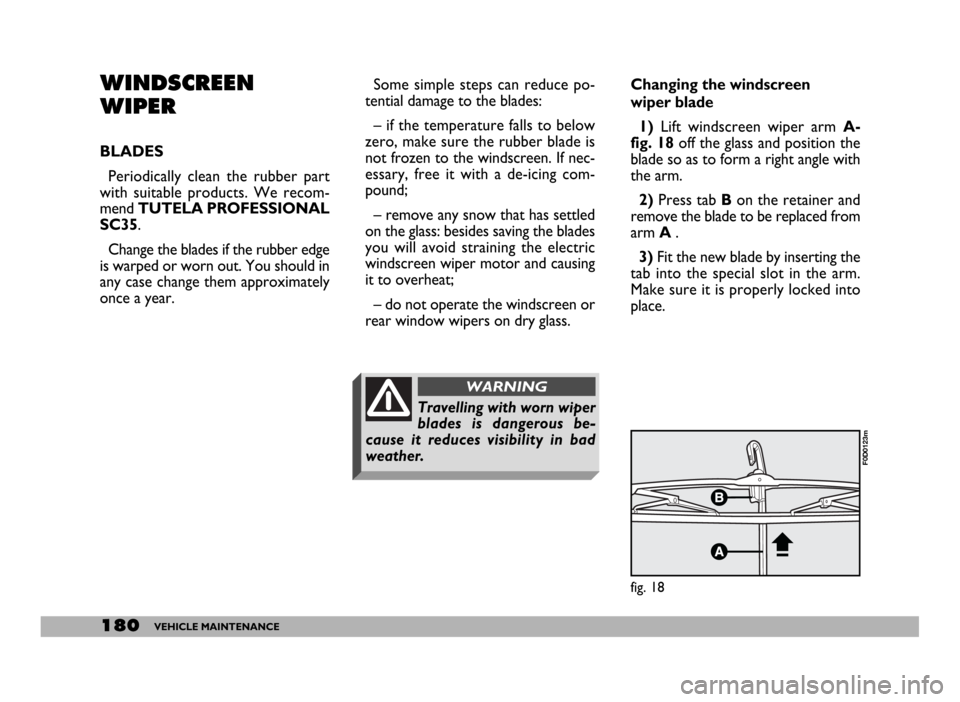
1)Lift windscreen wiper arm A-
fig. 18off the glass and position the
blade so as to form a right angle with
the arm.
2) Press tab Bon the retainer and
remove the blade to be replaced from
arm A .
3)Fit the new blade by inserting the
tab into the special slot in the arm.
Make sure it is properly locked into
place.
fig. 18
F0D0123m
Some simple steps can reduce po-
tential damage to the blades:
– if the temperature falls to below
zero, make sure the rubber blade is
not frozen to the windscreen. If nec-
essary, free it with a de-icing com-
pound;
– remove any snow that has settled
on the glass: besides saving the blades
you will avoid straining the electric
windscreen wiper motor and causing
it to overheat;
– do not operate the windscreen or
rear window wipers on dry glass.
Travelling with worn wiper
blades is dangerous be-
cause it reduces visibility in bad
weather.
WARNING