Light FIAT DUCATO 2006 3.G Workshop Manual
[x] Cancel search | Manufacturer: FIAT, Model Year: 2006, Model line: DUCATO, Model: FIAT DUCATO 2006 3.GPages: 258, PDF Size: 4.05 MB
Page 110 of 258
109GETTING THE BEST OUT OF YOUR VEHICLE
To release the handbrake:
1)slightly lift the handbrake and press
release button A-fig. 1;
2)keep the button pressed and low-
er the lever. Warning light xwill go
out;
3)press the brake pedal when car-
rying out this operation to prevent the
vehicle moving accidentally.
IMPORTANTPull the handbrake
lever only when the vehicle is at a
standstill, or when the vehicle is run-
ning, but however only in case of a fail-
ure of the hydraulic system.
Should the handbrake be exception-
ally used when the vehicle is running, it
is suggested to keep a moderate trac-
tion to avoid causing the rear axle
block, entailing vehicle side skidding.USING THE
MANUAL GEARBOX
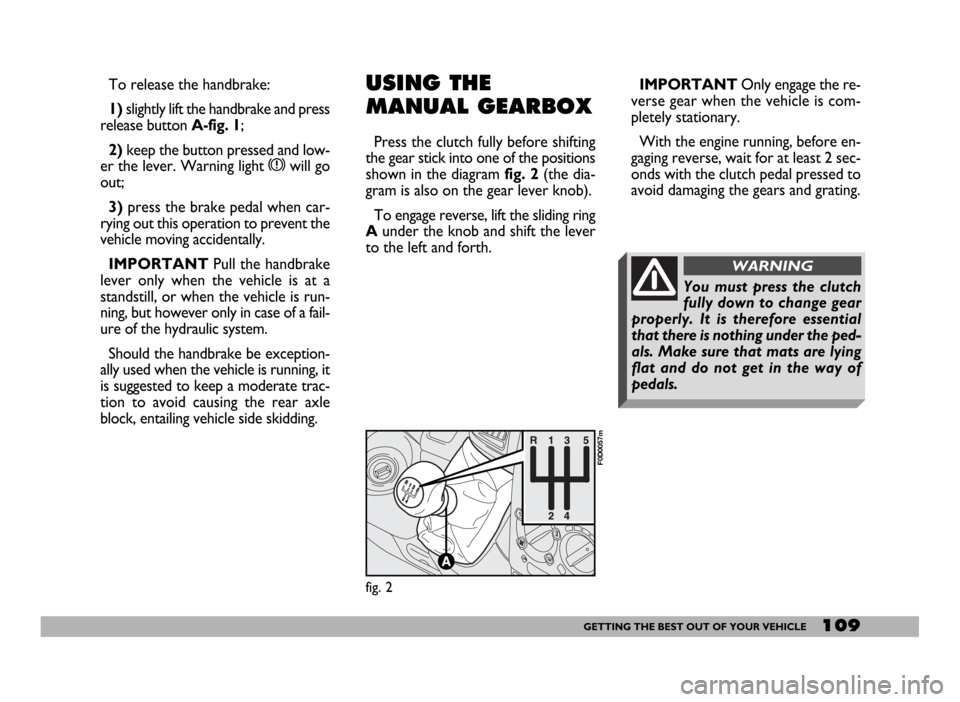
Press the clutch fully before shifting
the gear stick into one of the positions
shown in the diagram fig. 2(the dia-
gram is also on the gear lever knob).
To engage reverse, lift the sliding ring
Aunder the knob and shift the lever
to the left and forth.IMPORTANTOnly engage the re-
verse gear when the vehicle is com-
pletely stationary.
With the engine running, before en-
gaging reverse, wait for at least 2 sec-
onds with the clutch pedal pressed to
avoid damaging the gears and grating.
fig. 2
F0D0057m
You must press the clutch
fully down to change gear
properly. It is therefore essential
that there is nothing under the ped-
als. Make sure that mats are lying
flat and do not get in the way of
pedals.
WARNING
Page 113 of 258
112GETTING THE BEST OUT OF YOUR VEHICLE
IMPORTANTRemoving the igni-
tion key is only allowed with the
gearshift lever in position Pand for a
maximum time of 30 seconds from
when the engine is turned off P, when
the door is opened a buzzer will sound
for about 15 seconds to alert the dri-
ver.
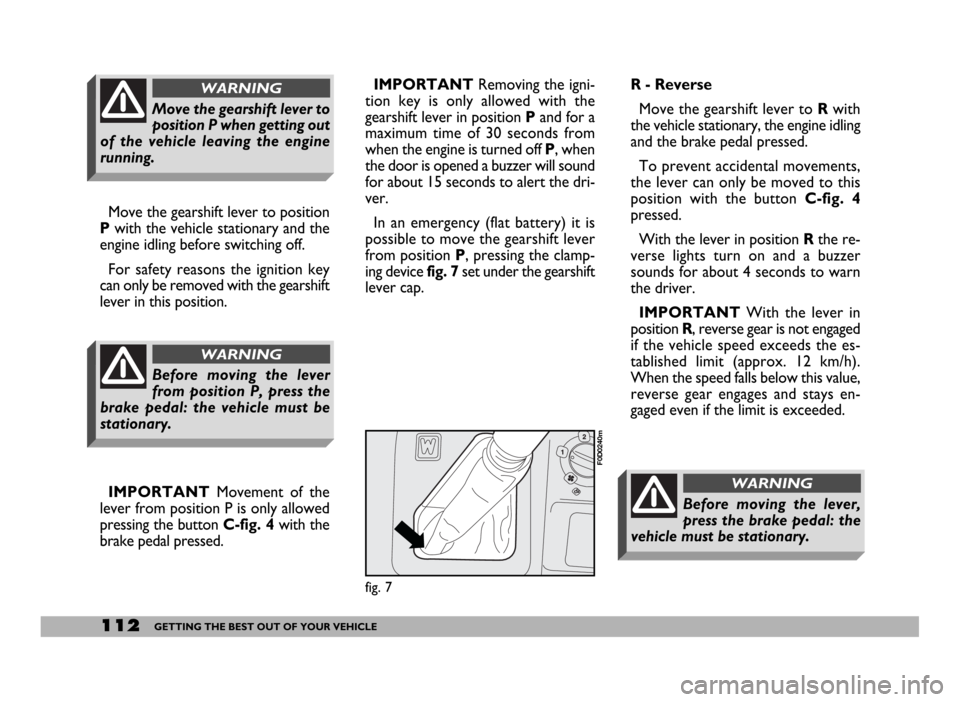
In an emergency (flat battery) it is
possible to move the gearshift lever
from position P, pressing the clamp-
ing device fig. 7set under the gearshift
lever cap.R - Reverse
Move the gearshift lever to Rwith
the vehicle stationary, the engine idling
and the brake pedal pressed.
To prevent accidental movements,
the lever can only be moved to this
position with the button C-fig. 4
pressed.
With the lever in position Rthe re-
verse lights turn on and a buzzer
sounds for about 4 seconds to warn
the driver.
IMPORTANTWith the lever in
position R, reverse gear is not engaged
if the vehicle speed exceeds the es-
tablished limit (approx. 12 km/h).
When the speed falls below this value,
reverse gear engages and stays en-
gaged even if the limit is exceeded.
fig. 7
F0D0240m
Before moving the lever,
press the brake pedal: the
vehicle must be stationary.
WARNING
Move the gearshift lever to position
Pwith the vehicle stationary and the
engine idling before switching off.
For safety reasons the ignition key
can only be removed with the gearshift
lever in this position.
IMPORTANTMovement of the
lever from position P is only allowed
pressing the button C-fig. 4with the
brake pedal pressed.
Move the gearshift lever to
position P when getting out
of the vehicle leaving the engine
running.
WARNING
Before moving the lever
from position P, press the
brake pedal: the vehicle must be
stationary.
WARNING
Page 116 of 258
115GETTING THE BEST OUT OF YOUR VEHICLE
Moving the lever back to position D
the gearbox instantly resumes the au-
tomatic mode selecting the ratio ac-
cording to the driving characteristics.
IMPORTANTThe electronic con-
trol unit is programmed to change
gear one at a time, therefore repeat-
ed fast actuations will not result in re-
peated engagements of the gears. The
higher or lower gear is engaged mov-
ing the lever to the (+) or (–) position
when the previous request has been
performed.
In the event of a fault to the sequen-
tial manual system, the system will se-
lect the automatic mode.FAILURE INDICATIONS
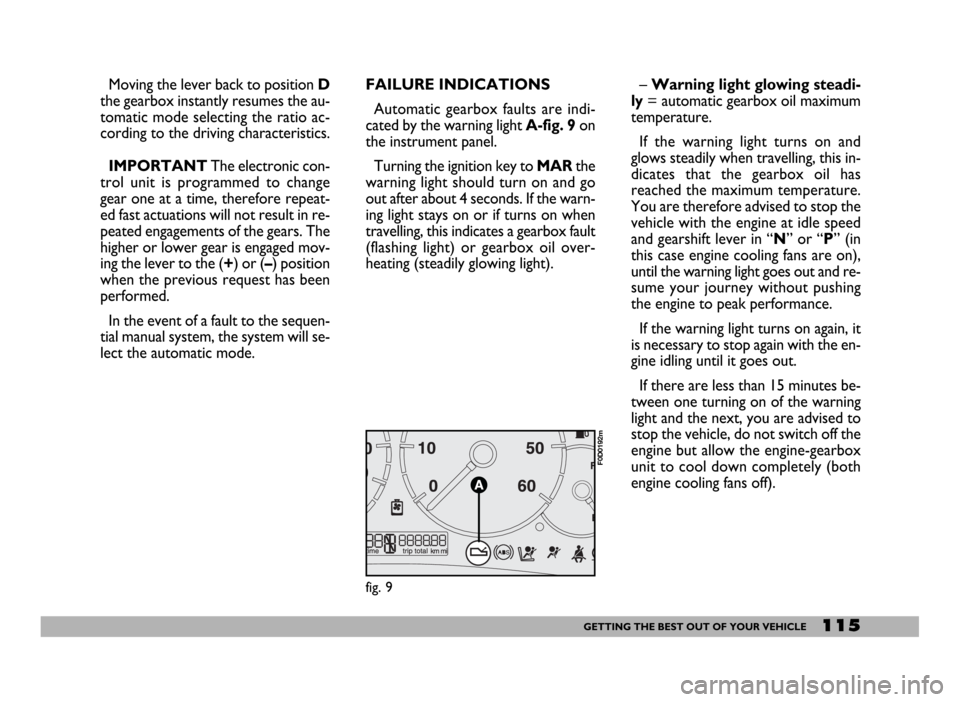
Automatic gearbox faults are indi-
cated by the warning light A-fig. 9 on
the instrument panel.
Turning the ignition key to MARthe
warning light should turn on and go
out after about 4 seconds. If the warn-
ing light stays on or if turns on when
travelling, this indicates a gearbox fault
(flashing light) or gearbox oil over-
heating (steadily glowing light).– Warning light glowing steadi-
ly= automatic gearbox oil maximum
temperature.
If the warning light turns on and
glows steadily when travelling, this in-
dicates that the gearbox oil has
reached the maximum temperature.
You are therefore advised to stop the
vehicle with the engine at idle speed
and gearshift lever in “N” or “P” (in
this case engine cooling fans are on),
until the warning light goes out and re-
sume your journey without pushing
the engine to peak performance.
If the warning light turns on again, it
is necessary to stop again with the en-
gine idling until it goes out.
If there are less than 15 minutes be-
tween one turning on of the warning
light and the next, you are advised to
stop the vehicle, do not switch off the
engine but allow the engine-gearbox
unit to cool down completely (both
engine cooling fans off).
fig. 9
F0D0192m
Page 117 of 258
116GETTING THE BEST OUT OF YOUR VEHICLE
BUMP STARTING
Starting by pushing or towing the ve-
hicle is not possible. In the event of an
emergency, when the battery is flat,
start the vehicle with a suitable emer-
gency battery, following the instruc-
tions given in section “In an emer-
gency” at paragraph “Jump starting”.
TOWING THE VEHICLE
IMPORTANTFor towing the ve-
hicle comply with current local regu-
lations and follow the instructions giv-
en in section “In an emergency” at
paragraph “Towing the vehicle”.If the vehicle is to be towed, adhere
to the following recommendations:
– if possible, carry the vehicle on the
floor of a rescue vehicle;
– if this is not possible, tow the ve-
hicle raising the driving wheels (front)
from the ground;
– if this, too, is not possible, the ve-
hicle should not be towed for more
than 200 km at a speed of no more
than 50 km/h.
When towing, the gearshift lever
should be at N.
Do not start the engine
while the vehicle is being
towed.
The failure to comply
with these instructions
may cause serious dam-
age to the automatic gearbox.
When travelling with the
gearbox faulty, drive with
the utmost care in consideration of
the limited performance (in terms
of acceleration and speed) that the
vehicle can offer.
WARNING
When travelling with the
gearbox faulty, the revers-
ing gear lock might not be active:
absolutely never move the lever to
the R position with the vehicle on
the move.
WARNING– Warning light flashing= auto-
matic gearbox fault.
Warning light flashing at starting or
when travelling indicates a fault in the
automatic gearbox.
The automatic control system sets
an “emergency programme” engaging
the 3
rdgear.
Switching the engine off and then on
again, the self-test system could ex-
clude the fault and therefore turn off
the warning light. The failure is how-
ever stored and the automatic gear-
box shall be checked at a Fiat Deal-
ership.
Page 121 of 258
120GETTING THE BEST OUT OF YOUR VEHICLE
BEFORE GETTING BEHIND
THE WHEEL
– Make sure all light, including the
headlights, are working properly;
– adjust the position of seats and dri-
ving and door mirrors properly for the
best driving position;
– make sure that nothing (mats, etc.)
gets in the way of the pedals when
they are pushed down;
– make sure that any child restraint
systems (child seats, cradles, etc.) are
properly fixed;
– place any objects in the load com-
partment in such a way that they can-
not be thrown forwards in the event
of an accident;
– light eating will help keep your re-
flexes prompt. Above all, do not have
anything alcoholic to drink.
Remember to periodically check:
– tyre pressure,
– engine oil level,
– engine coolant level and cooling
system conditions,– brake fluid level,
– windscreen washer fluid level.
WHEN TRAVELLING
– The first rule of safe driving is pru-
dence;
– prudence also means putting your-
self into a position where you can pre-
dict wrong or imprudent behaviour
from other drivers;
– stick closely to the rules of the
road in the particular country where
the vehicle is being driven and, above
all, do not exceed speed limits;
– ensure that, besides yourself, all the
other passengers in the vehicle have
their seat belts fastened, that children
are sitting in the appropriate child
seats and any animals in the vehicle are
placed in suitable compartment;
– you should be physically fit and
mentally alert before setting out on
long journeys.
Always fasten both front
and back seat belts
(Panorama, Minibus, Combi and
Crew Cab versions). Travelling with
the seat belts unfastened increas-
es the risk of injury or death if you
are in a collision.
WARNING
Driving while drunk or un-
der the influence of drugs
or certain medicines is dangerous
for both you and other road users.
WARNING
Page 122 of 258
121GETTING THE BEST OUT OF YOUR VEHICLE
– Do not drive too many hours at a
time but stop at intervals to stretch
your legs and recoup your energy;
– make sure the air in the passenger’s
compartment is being changed
continuously;
– never coast downhill (i.e. with the
engine off): if you do, you lose the aid
of engine braking, power brakes and
power steering so that braking re-
quires greater effort on the pedal and
steering requires greater effort on the
steering wheel.DRIVING AT NIGHT
These are the main rules to follow
when you are driving at night:
– drive especially carefully: it is hard-
er to drive at night;
– slow down especially if the road is
not lit;
– at the first signs of sleepiness, stop:
continuing would be a risk for yourself
and everybody else. Only start driving
again when you have had enough rest;
– keep a greater safety distance from
the vehicles in front of you than dur-
ing daylight hours: it is hard to judge
how fast other vehicles are going when
all you can see are their lights;
– make sure the headlights beams are
properly positioned: if they are too
low, they reduce visibility and strain
your eyes. If they are too high they can
dazzle other drivers. Adjust headlight
beam according to transported load;
– only use main beam headlights
when you are driving outside town
and when you are sure they do not an-
noy other drivers. dip your headlights
Water, ice or salt sprinkled
on the road can deposit on
the brake discs and reduce effi-
ciency of the first braking.
WARNING
Do not drive with objects
on the floor in front of the
driver’s seat: they could caught un-
der the pedals making braking or
accelerating impossible.
WARNING
Pay attention to the mats:
even a small problem to the
braking system may require in-
creased brake pedal stroke with re-
spect to normal.
WARNING
Page 123 of 258

122GETTING THE BEST OUT OF YOUR VEHICLE
as soon as you see vehicles coming in
the other direction and pass them with
the headlights dipped;
– keep all lights clean;
– be careful of animals crossing the
road when driving in the country. Slow
down to avoid the risk of running
them over.
DRIVING IN THE RAIN
Rain and wet road surfaces spell dan-
ger. All manoeuvres are more difficult
on a wet road because the grip of the
wheels on the tarmac is greatly re-
duced. This is why braking distances
are much longer and road-holding is
lower.
Here is some advice for driving in the
rain:
– reduce speed and maintain a
greater safety distance from the vehi-
cles in front;
– If it is raining particularly heavily,
visibility is also reduced. In these cas-
es, switch on the dipped headlights
even if it is still daylight so you can be
seen more easily;– Do not drive through puddles at
speed and hold on tightly to the wheel
if you do: a puddle taken at high speed
might cause you to lose control of the
vehicle (aquaplaning);
– Position the ventilation controls for
demisting (see section “Getting to
know your vehicle”), to prevent visi-
bility from worsening;
– Routinely check the conditions of
the windscreen wiper blades.
DRIVING IN FOG
– If the fog is thick, do not start out
on a journey unless you absolutely
have to.
If driving in mist, blanket fog or when
there is the danger of fog patches:
– keep your speed down;
– turn on the dipped headlights, rear
fog lights and front fog lights, if fitted,
even during the day. Do not drive with
your headlights at main beam.IMPORTANT On stretches of
road with good visibility, switch off
your rear foglights; the brightness of
these lights could annoy the people
travelling in the vehicles behind.
– Remember that fog also means the
taramac is wet and therefore ma-
noeuvres of all kinds are more difficult
and stopping distances are longer;
– keep a good distance from the ve-
hicles in front of you;
– as far as possible, avoid spurts of
speed or sudden deceleration;
– do not overtake other vehicles if
possible;
Page 124 of 258

123GETTING THE BEST OUT OF YOUR VEHICLE
– if you are forced to stop your ve-
hicle (breakdown, limited visibility,
etc.) try to stop off the road. Turn on
the hazard lights and, if possible, the
dipped beam headlights. Rhythmically
sound the horn if you release anoth-
er vehicle is coming.
DRIVING IN THE
MOUNTAINS
– Check fluid levels (oil, brake fluid,
coolant) and tyre wear before driving
in the mountains;
– when driving downhill use the en-
gine braking effect by engaging a low
gear so as not to overheat the brakes;
– under no circumstances should you
drive downhill with the engine off or
with the gear in neutral, let alone with
the ignition key out;
– drive at moderate speed and avoid
“cutting” corners;
– remember that overtaking while
going uphill is slower and therefore re-
quires more free road. If you are be-
ing overtaken while driving uphill,
make it easier for the other vehicle
to pass.DRIVING ON SNOW
AND ICE
Here are some tips for driving in
these conditions:
– keep your speed down;
– use chains if the roads are covered
with snow;
– do not park the vehicle with the
engine running for long periods of
time: snow could divert exhaust fumes
into the passenger compartment;
– mainly use the braking effect of the
engine and under all circumstances
avoid braking sharply;
– when braking a vehicle not fitted
with ABS, reduce the possibility of the
wheels locking by varying the pressure
you exert on the brake pedal;
– do not accelerate suddenly and
avoid swerving;– in the winter, even apparently dry
roads may have icy patches. Be care-
ful therefore when driving over
stretches that do not get much expo-
sure to the sun or are lined with trees
or rocks where ice might not have
melted;
– keep a good distance from the ve-
hicles in front.
DRIVING WITH ABS
– ABS is a braking system that es-
sentially offers two advantages:
1) It prevents wheel lock and con-
sequent skidding in emergency stops,
particularly when the road does not
offer much grip.
2) it makes it possible to brake and
steer at the same time and direct the
vehicle where you want while braking.
Page 125 of 258

124GETTING THE BEST OUT OF YOUR VEHICLE
To get the most out of ABS:
– During emergency stops or when
grip conditions are poor, you will feel
a slight pulsation on the brake pedal.
This is the sign that the ABS is work-
ing. Do not release the brake pedal but
continue to press so as not to inter-
rupt the braking action;
– ABS enables you to brake and steer
at the same time. If you meet an un-
expected obstacle you can therefore
steer around it;
– the ABS prevents the wheels from
locking but it does not increase actu-
al grip conditions between tyre and
road. Therefore, even if your vehicle
is fitted with ABS, keep a safe distance
from the vehicle in front of you and
keep your speed down when driving
into bends.
ABS serves to increase your control
over the vehicle, not to enable you to
go faster.Some suggestions which may help
you to keep the running costs of the
vehicle down and lower the amount
of toxic emissions released into the at-
mosphere are given below.
GENERAL
CONSIDERATIONS
Vehicle maintenance
Carry out the checks and adjust-
ments/regulations specified in the
“Service Schedule”.
Tyres
Check tyre inflation pressure regu-
larly. Tyres should be checked at least
once every four weeks: if the pressure
is too low, fuel consumption increas-
es as the resistance to the rolling
movement of the tyre is greater.Unnecessary loads
Do not travel with too much load.
The weight of the vehicle (specially in
urban traffic) and its trim greatly ef-
fects consumption and stability.
Roof rack/ski rack
Remove the roof or ski racks from
the vehicle as soon as they are no
longer needed. These accessories re-
duce the aerodynamic penetration of
the vehicle and will increase con-
sumption. When transporting partic-
ularly large objects, use a trailer,
where possible.CONTAINING RUNNING COSTS
Page 126 of 258

125GETTING THE BEST OUT OF YOUR VEHICLE
Electric devices
Use electric devices for the neces-
sary time only. The heated rear win-
dow, fog lights, windscreen wipers,
heater fan require large amounts of
electricity and increasing the request
for power will also increase fuel con-
sumption (up to +25% when driving in
towns).
Climate control system
The climate control system is an ad-
ditional load which greatly affects the
engine leading to higher consumption.
When the temperature outside the
vehicle allows it, use the air vents
where possible.
DRIVING STYLE
Starting
Do not warm the engine when the
vehicle is stationary or at high or low
speed: in this way the engine will warm
up gradually increasing consumption
and emissions. You should drive off
slowly straight away avoiding high revs
so that the engine will warm up more
quickly.Unnecessary actions
Avoid revving the engine when
stopped at traffic lights or before
switching off the engine and avoid dou-
bling the clutch as these actions have
no purpose on modern vehicles and
serve only to increase consumption
and pollution.
Gear selections
As soon as the traffic and road con-
ditions allow it, shift to a higher gear.
Using a low gear to liven up accelera-
tion greatly increases consumption. In
the same way improper use of high
gears will increase consumption, emis-
sions and engine wear.
On passenger transportation versions
fitted with 2.3, 2.8 JTD and 2.8 JTD
POWER engines, fuel consumption can
be optimised by starting (on level road)
in 2nd gear instead of 1st gear.Top speeds
Fuel consumption increases consid-
erably as speed increases. Your speed
should be kept as even as possible and
superfluous braking and acceleration
avoided as this increases both con-
sumption and emissions.
Acceleration
Accelerating violently increasing the
revs will greatly affect consumption
and emissions; acceleration should be
gradual and should not exceed the
maximum torque.