Front lights FIAT DUCATO 2007 3.G Repair Manual
[x] Cancel search | Manufacturer: FIAT, Model Year: 2007, Model line: DUCATO, Model: FIAT DUCATO 2007 3.GPages: 282, PDF Size: 4.71 MB
Page 182 of 282
181
WARNING
LIGHTS AND
MESSAGES
VEHICLE
MAINTENANCE
TECHNICAL
SPECIFICATIONS
INDEX
DASHBOARD
AND CONTROLS
SAFETY
DEVICES
CORRECT USE
OF THE
VEHICLE
IN AN
EMERGENCY
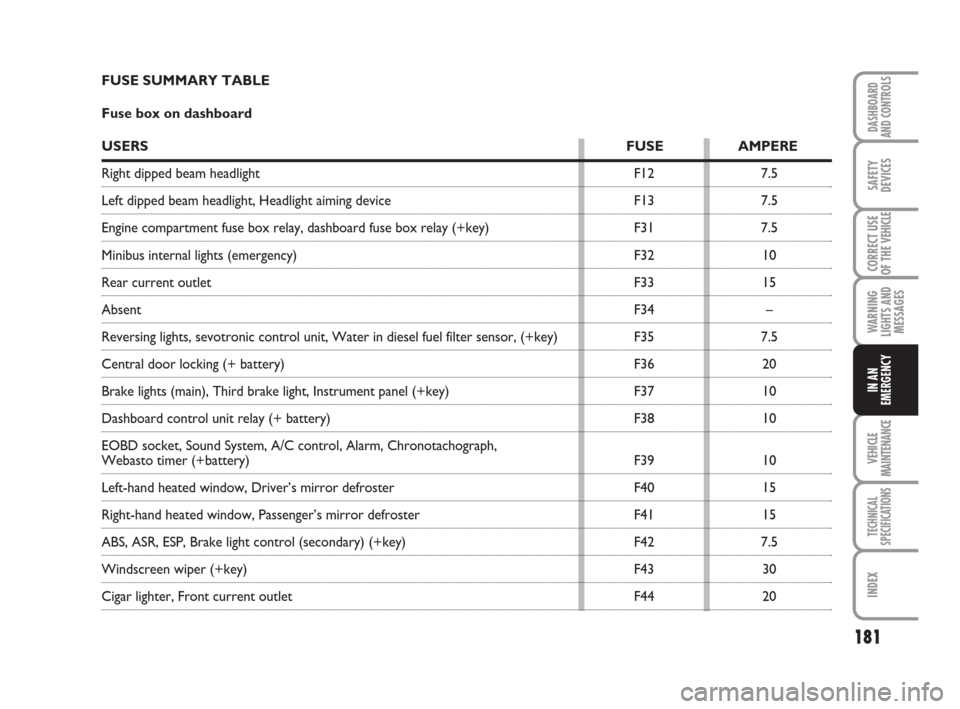
FUSE SUMMARY TABLE
Fuse box on dashboard
USERSFUSE AMPERE
Right dipped beam headlight F12 7.5
Left dipped beam headlight, Headlight aiming device F13 7.5
Engine compartment fuse box relay, dashboard fuse box relay (+key) F31 7.5
Minibus internal lights (emergency) F32 10
Rear current outlet F33 15
AbsentF34 –
Reversing lights, sevotronic control unit, Water in diesel fuel filter sensor, (+key) F35 7.5
Central door locking (+ battery) F36 20
Brake lights (main), Third brake light, Instrument panel (+key) F37 10
Dashboard control unit relay (+ battery) F38 10
EOBD socket, Sound System, A/C control, Alarm, Chronotachograph,
Webasto timer (+battery) F39 10
Left-hand heated window, Driver’s mirror defroster F40 15
Right-hand heated window, Passenger’s mirror defroster F41 15
ABS, ASR, ESP, Brake light control (secondary) (+key) F42 7.5
Windscreen wiper (+key) F43 30
Cigar lighter, Front current outlet F44 20
157-188 Ducato GB 6-11-2007 10:32 Pagina 181
Page 185 of 282
184
WARNING
LIGHTS AND
MESSAGES
VEHICLE
MAINTENANCE
TECHNICAL
SPECIFICATIONS
IINDEX
DASHBOARD
AND CONTROLS
SAFETY
DEVICES
CORRECT USE
OF THE
VEHICLE
IN AN
EMERGENCY
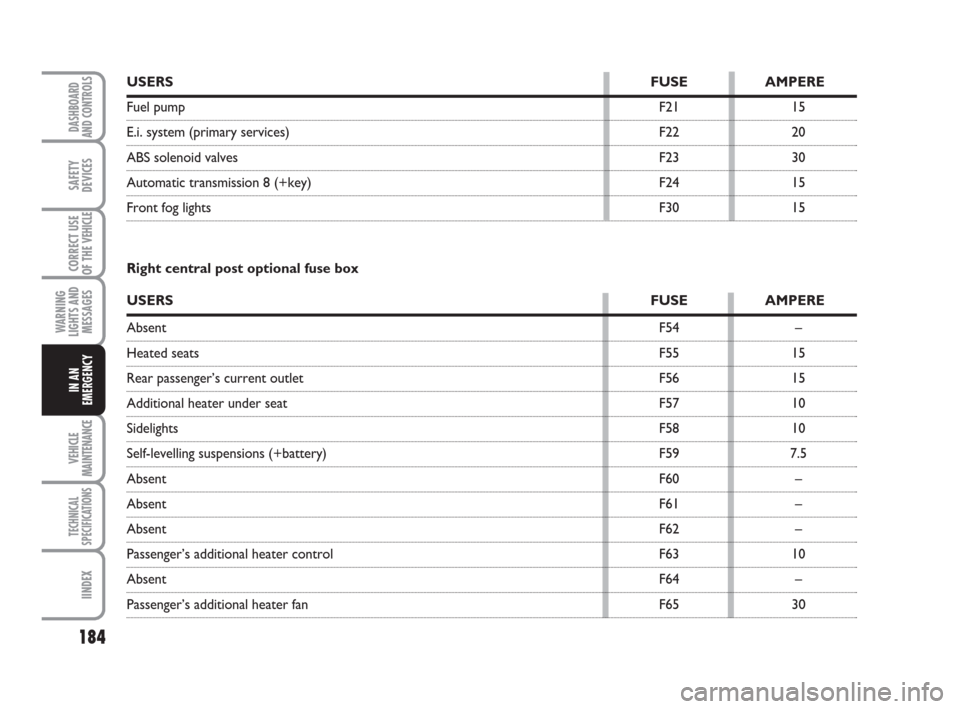
USERSFUSE AMPERE
Fuel pump F21 15
E.i. system (primary services) F22 20
ABS solenoid valves F23 30
Automatic transmission 8 (+key) F24 15
Front fog lightsF30 15
Right central post optional fuse box
USERSFUSE AMPERE
AbsentF54 –
Heated seatsF55 15
Rear passenger’s current outlet F56 15
Additional heater under seat F57 10
SidelightsF58 10
Self-levelling suspensions (+battery) F59 7.5
AbsentF60 –
AbsentF61 –
AbsentF62 –
Passenger’s additional heater control F63 10
AbsentF64 –
Passenger’s additional heater fan F65 30
157-188 Ducato GB 6-11-2007 10:32 Pagina 184
Page 188 of 282
187
WARNING
LIGHTS AND
MESSAGES
VEHICLE
MAINTENANCE
TECHNICAL
SPECIFICATIONS
INDEX
DASHBOARD
AND CONTROLS
SAFETY
DEVICES
CORRECT USE
OF THE
VEHICLE
IN AN
EMERGENCY
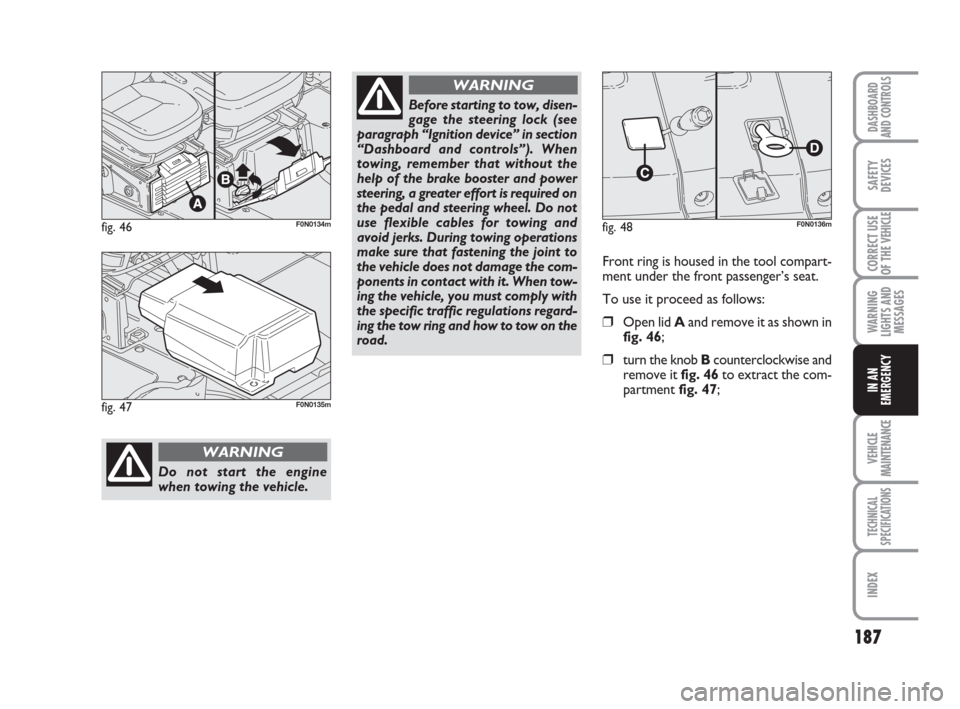
fig. 46F0N0134m
Do not start the engine
when towing the vehicle.
WARNING
Before starting to tow, disen-
gage the steering lock (see
paragraph “Ignition device” in section
“Dashboard and controls”). When
towing, remember that without the
help of the brake booster and power
steering, a greater effort is required on
the pedal and steering wheel. Do not
use flexible cables for towing and
avoid jerks. During towing operations
make sure that fastening the joint to
the vehicle does not damage the com-
ponents in contact with it. When tow-
ing the vehicle, you must comply with
the specific traffic regulations regard-
ing the tow ring and how to tow on the
road.
WARNING
fig. 47F0N0135m
fig. 48F0N0136m
Front ring is housed in the tool compart-
ment under the front passenger’s seat.
To use it proceed as follows:
❒Open lid Aand remove it as shown in
fig. 46;
❒turn the knob Bcounterclockwise and
remove it fig. 46 to extract the com-
partment fig. 47;
157-188 Ducato GB 6-11-2007 10:32 Pagina 187
Page 192 of 282
191
WARNING
LIGHTS AND
MESSAGES
TECHNICAL
SPECIFICATIONS
INDEX
DASHBOARD
AND CONTROLS
SAFETY
DEVICES
CORRECT USE
OF THE VEHICLE
IN AN
EMERGENCY
VEHICLE
MAINTENANCE
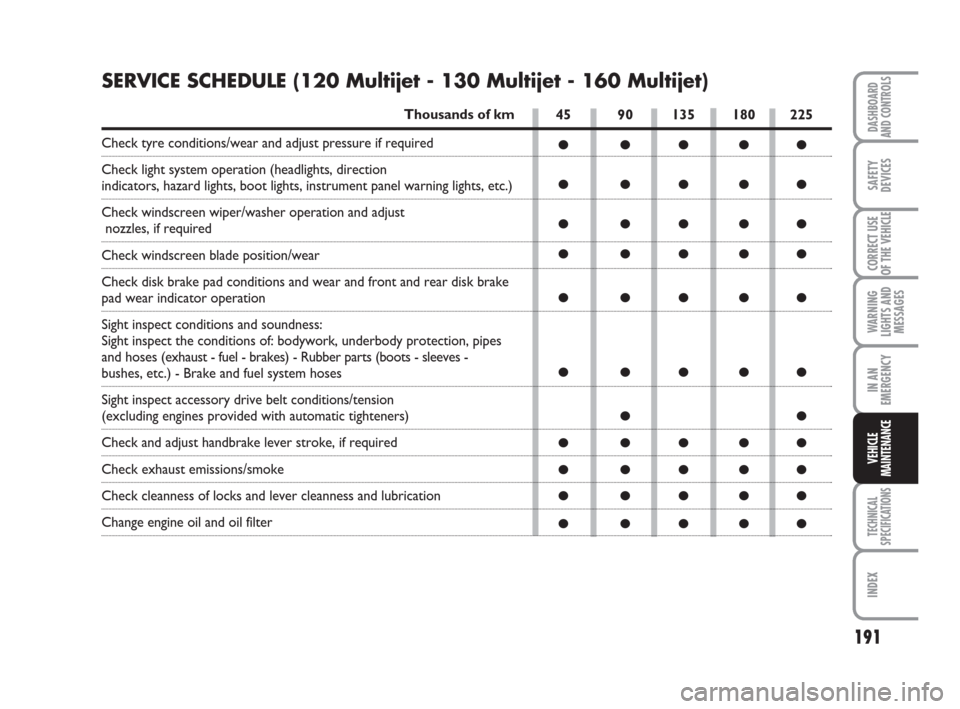
45 90 135 180 225
●●●●●
●●●●●
●●●●●
●●●●●
●●●●●
●●●●●
●●
●●●●●
●●●●●
●●●●●
●●●●●
SERVICE SCHEDULE (120 Multijet - 130 Multijet - 160 Multijet)
Thousands of km
Check tyre conditions/wear and adjust pressure if required
Check light system operation (headlights, direction
indicators, hazard lights, boot lights, instrument panel warning lights, etc.)
Check windscreen wiper/washer operation and adjust
nozzles, if required
Check windscreen blade position/wear
Check disk brake pad conditions and wear and front and rear disk brake
pad wear indicator operation
Sight inspect conditions and soundness:
Sight inspect the conditions of: bodywork, underbody protection, pipes
and hoses (exhaust - fuel - brakes) - Rubber parts (boots - sleeves -
bushes, etc.) - Brake and fuel system hoses
Sight inspect accessory drive belt conditions/tension
(excluding engines provided with automatic tighteners)
Check and adjust handbrake lever stroke, if required
Check exhaust emissions/smoke
Check cleanness of locks and lever cleanness and lubrication
Change engine oil and oil filter
189-210 Ducato GB 6-11-2007 10:34 Pagina 191
Page 194 of 282
193
WARNING
LIGHTS AND
MESSAGES
TECHNICAL
SPECIFICATIONS
INDEX
DASHBOARD
AND CONTROLS
SAFETY
DEVICES
CORRECT USE
OF THE VEHICLE
IN AN
EMERGENCY
VEHICLE
MAINTENANCE
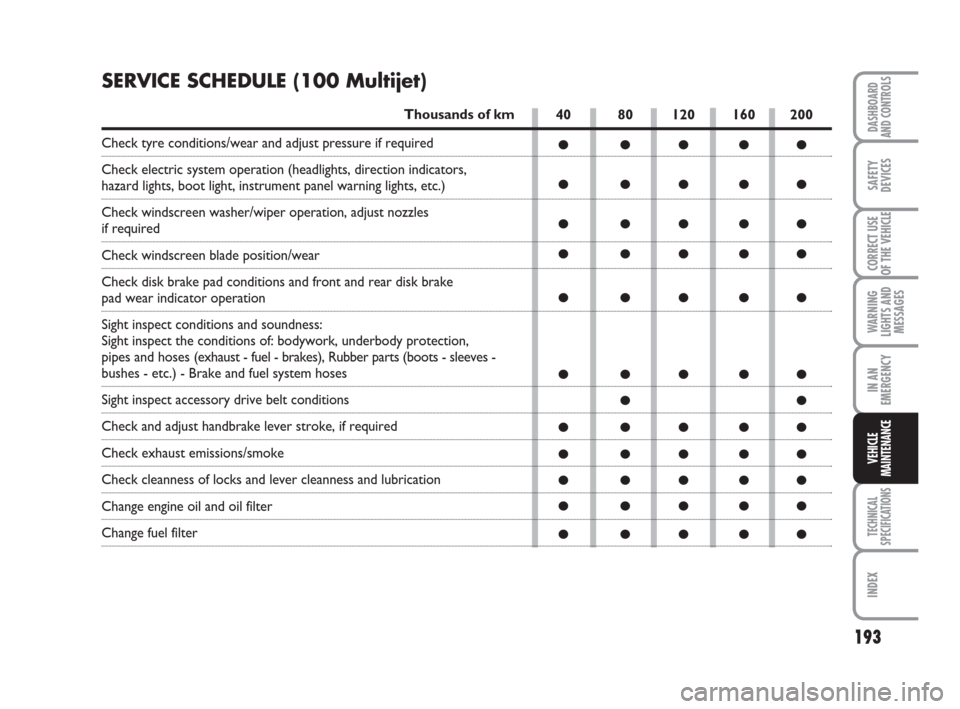
40 80 120 160 200
●●●●●
●●●●●
●●●●●
●●●●●
●●●●●
●●●●●
●●
●●●●●
●●●●●
●●●●●
●●●●●
●●●●●
SERVICE SCHEDULE (100 Multijet)
Thousands of km
Check tyre conditions/wear and adjust pressure if required
Check electric system operation (headlights, direction indicators,
hazard lights, boot light, instrument panel warning lights, etc.)
Check windscreen washer/wiper operation, adjust nozzles
if required
Check windscreen blade position/wear
Check disk brake pad conditions and front and rear disk brake
pad wear indicator operation
Sight inspect conditions and soundness:
Sight inspect the conditions of: bodywork, underbody protection,
pipes and hoses (exhaust - fuel - brakes), Rubber parts (boots - sleeves -
bushes - etc.) - Brake and fuel system hoses
Sight inspect accessory drive belt conditions
Check and adjust handbrake lever stroke, if required
Check exhaust emissions/smoke
Check cleanness of locks and lever cleanness and lubrication
Change engine oil and oil filter
Change fuel filter
189-210 Ducato GB 6-11-2007 10:34 Pagina 193
Page 196 of 282
195
WARNING
LIGHTS AND
MESSAGES
TECHNICAL
SPECIFICATIONS
INDEX
DASHBOARD
AND CONTROLS
SAFETY
DEVICES
CORRECT USE
OF THE VEHICLE
IN AN
EMERGENCY
VEHICLE
MAINTENANCE
HEAVY-DUTY
Should prevailing use of the vehicle be un-
der one of the following specially heavy
conditions:
❒trailer or caravan towing;
❒dusty roads;
❒short distances (less than 7-8 km) re-
peated and with external tempera-
tures below zero;
❒frequently idling engines or long dis-
tance low speed driving (e.g. door-to-
door deliveries) or in case of a long
term inactivity;
❒driving in the city;
carry out the following checks more fre-
quently than required in the Service
Schedule:
❒check front disk brake pad conditions
and wear;
❒check cleanness of locks, bonnet and
boot and lever cleanness and lubri-
cation;
❒sight inspect the conditions of: engine,
gearbox, transmission, pipes and
hoses (exhaust - fuel - brakes), rub-
ber parts (boots, sleeves, bushes,
etc.);
❒check battery charge and fluid level
(electrolyte);
❒visual check on various drive belt con-
ditions;
❒check and replace pollen filter, if re-
quired;
❒check and replace air cleaner, if re-
quired.
ROUTINE
MAINTENANCE
Every 1,000 km or before long journeys,
check and top up if required:
❒engine coolant fluid level;
❒brake fluid level;
❒windscreen washer fluid level;
❒tyre pressure and conditions;
❒light system operation (headlights, di-
rection indicators, hazard lights, etc.);
❒windscreen wiper/washer operation
and windscreen/rear window blade
position/wear;
Every 3,000 km check and top up if re-
quired: engine oil level.
You are recommended to use FL
Selenia, products, designed and pro-
duced specifically for Fiat vehicles (see
table “Capacities” in section “Technical
specifications”).
189-210 Ducato GB 6-11-2007 10:34 Pagina 195
Page 203 of 282
202
WARNING
LIGHTS AND
MESSAGES
TECHNICAL
SPECIFICATIONS
INDEX
DASHBOARD
AND CONTROLS
SAFETY
DEVICES
CORRECT USE
OF THE VEHICLE
IN AN
EMERGENCY
VEICHLE
MAINTENANCE
ATTENTION: Use a jet of air so as to
clean the air filter, do not use water or liq-
uid detergents.
Such filter is specific for the versions suit-
able for dusty areas; therefore it is advis-
able to seek help from the Fiat Assistance
Network for the substitution of the filter.
POLLEN FILTER
Pollen filter replacement shall be carried
out at Fiat Dealership.
BATTERY
The battery is of the “Limited mainte-
nance” type: under normal conditions of
use the electrolyte does not need topping
up with distilled water.
The battery is located inside the passen-
ger’s compartment in front of the pedal as-
sy. Remove the protection cover to find it.
Contact Fiat Dealership to have the bat-
tery checked/replaced.
CHECKING
THE CHARGE fig. 12
The battery charge may be checked
through the indicator A(where required)
set on the battery cover and acting ac-
cording to the colour the indicator shows.
The liquid in the battery is
poisonous and corrosive.
Avoid contact with eyes and skin. Do
not bring naked flames or possible
sources of sparks near the battery:
risk of fire and explosion.
WARNING
Running the battery with
low fluid level can damage
the battery beyond repair and could
also cause its explosion.
WARNING
Should the battery be not fitted with bat-
tery charge inspection device (optical elec-
trolyte indicator), inspection operations
shall be carried out by skilled personnel
only.
To check the battery charge, loosen the
two fastening screws and open the cov-
er. Then, close the cover accurately avoid-
ing pinching and short circuits.
Refer to the table below.
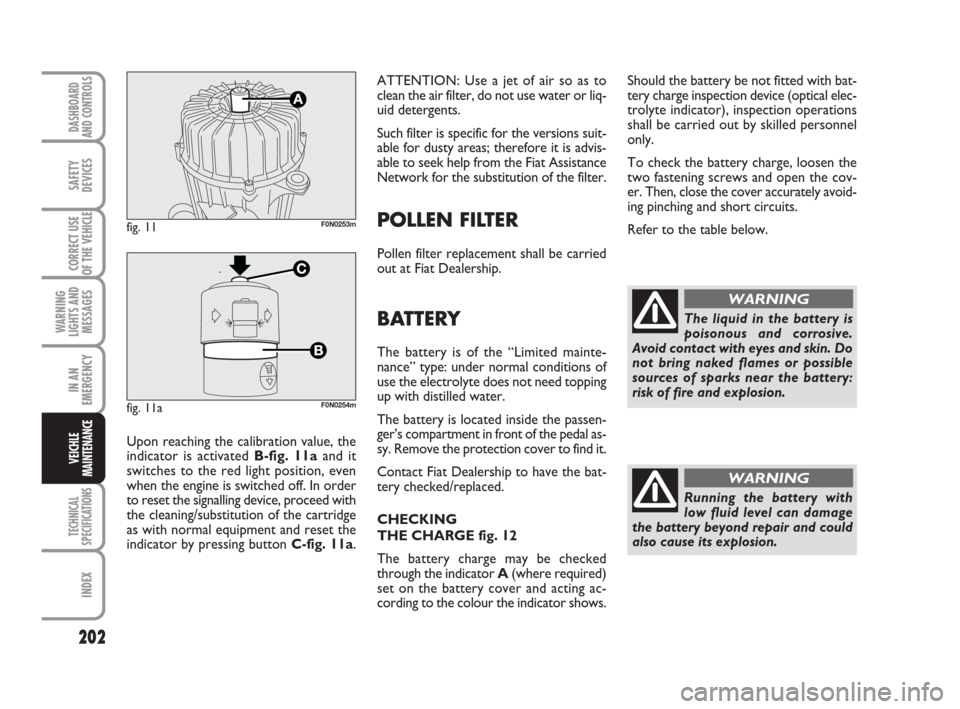
Upon reaching the calibration value, the
indicator is activated B-fig. 11aand it
switches to the red light position, even
when the engine is switched off. In order
to reset the signalling device, proceed with
the cleaning/substitution of the cartridge
as with normal equipment and reset the
indicator by pressing button C-fig. 11a.
fig. 11F0N0253m
fig. 11aF0N0254m
189-210 Ducato GB 6-11-2007 10:34 Pagina 202
Page 206 of 282
205
WARNING
LIGHTS AND
MESSAGES
TECHNICAL
SPECIFICATIONS
INDEX
DASHBOARD
AND CONTROLS
SAFETY
DEVICES
CORRECT USE
OF THE VEHICLE
IN AN
EMERGENCY
VEHICLE
MAINTENANCE
WHEELS AND TYRES
Check the pressure of each tyre, includ-
ing the spare, every two weeks and before
long journeys. The pressure should be
checked with the tyre rested and cold.
It is normal for pressure to rise when you
are driving. For the correct tyre inflation
pressure, see “Wheels” in section “Tech-
nical specifications”.
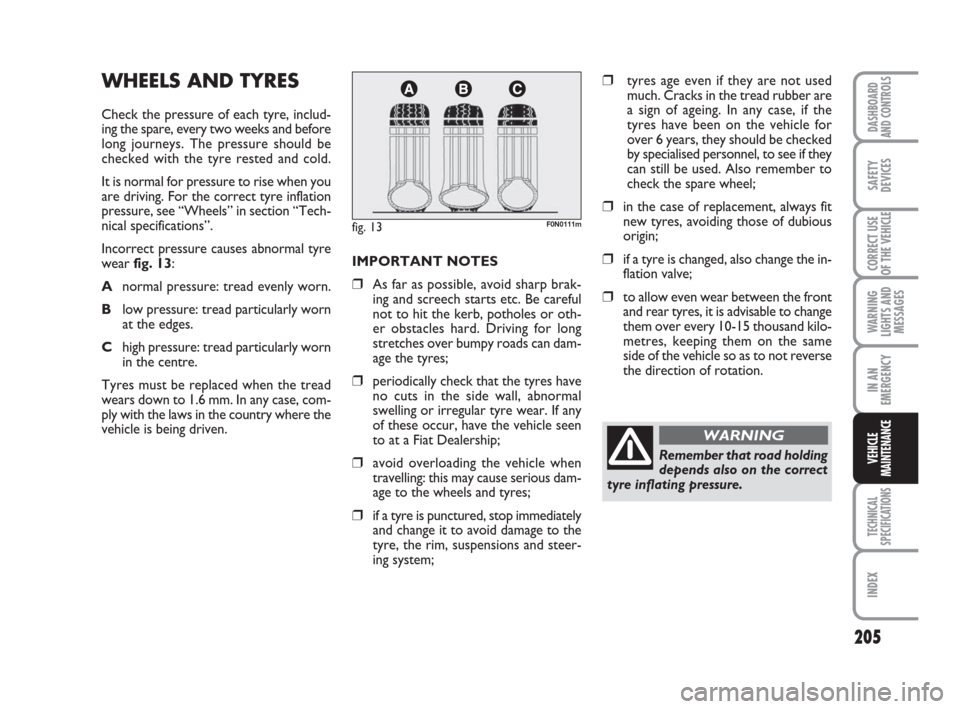
Incorrect pressure causes abnormal tyre
wearfig. 13:
Anormal pressure: tread evenly worn.
Blow pressure: tread particularly worn
at the edges.
Chigh pressure: tread particularly worn
in the centre.
Tyres must be replaced when the tread
wears down to 1.6 mm. In any case, com-
ply with the laws in the country where the
vehicle is being driven.
fig. 13F0N0111m
IMPORTANT NOTES
❒As far as possible, avoid sharp brak-
ing and screech starts etc. Be careful
not to hit the kerb, potholes or oth-
er obstacles hard. Driving for long
stretches over bumpy roads can dam-
age the tyres;
❒periodically check that the tyres have
no cuts in the side wall, abnormal
swelling or irregular tyre wear. If any
of these occur, have the vehicle seen
to at a Fiat Dealership;
❒avoid overloading the vehicle when
travelling: this may cause serious dam-
age to the wheels and tyres;
❒if a tyre is punctured, stop immediately
and change it to avoid damage to the
tyre, the rim, suspensions and steer-
ing system;
❒tyres age even if they are not used
much. Cracks in the tread rubber are
a sign of ageing. In any case, if the
tyres have been on the vehicle for
over 6 years, they should be checked
by specialised personnel, to see if they
can still be used. Also remember to
check the spare wheel;
❒in the case of replacement, always fit
new tyres, avoiding those of dubious
origin;
❒if a tyre is changed, also change the in-
flation valve;
❒to allow even wear between the front
and rear tyres, it is advisable to change
them over every 10-15 thousand kilo-
metres, keeping them on the same
side of the vehicle so as to not reverse
the direction of rotation.
Remember that road holding
depends also on the correct
tyre inflating pressure.
WARNING
189-210 Ducato GB 6-11-2007 10:34 Pagina 205
Page 210 of 282
209
WARNING
LIGHTS AND
MESSAGES
TECHNICAL
SPECIFICATIONS
INDEX
DASHBOARD
AND CONTROLS
SAFETY
DEVICES
CORRECT USE
OF THE VEHICLE
IN AN
EMERGENCY
VEHICLE
MAINTENANCE
To correctly wash the vehicle:
❒remove the aerial from the roof to
prevent damage to it if the vehicle is
washed in an automatic system;
❒wash the body using a low pressure jet
of water;
❒wipe a sponge with a slightly soapy so-
lution over the bodywork, frequently
rinsing with the sponge;
❒rinse well with water and dry with a
jet of air or a chamois leather.
When drying, take particular care with the
less visible parts like door surrounds, bon-
net and around the headlights where wa-
ter may stagnate. The vehicle should not
be taken to a closed area immediately, but
left in the open so that residual water can
evaporate.Do not wash the vehicle after it has been
left in the sun or with the bonnet hot: this
may alter the shine of the paintwork.
Exterior plastic parts must be cleaned in
the same way as the rest of the vehicle.
Where possible, do not park under trees;
the resinous substance many species re-
lease give the paint a dull appearance and
increase the possibility of triggering rust
processes.
For best paint protection, from time to
time polish the bodywork with special
waxes; when paint becomes mat due to
smog, polish the bodywork with polish
waxes that have also a light abrasive effect.
IMPORTANT Bird droppings must be
washed off immediately and thoroughly as
the acid they contain is particularly ag-
gressive.
Detergents cause water pollu-
tion. Therefore the engine
compartment should be
washed in areas equipped for
collecting and purifying the liquid used
in the washing process.
Windows
Use specific window cleaner products.
Use also clean cloths to avoid scratching
the glass or damaging the transparency.
IMPORTANT The inside of the rearscreen
should be wiped gently with a cloth in the
direction of the filaments to avoid damag-
ing the heating device.
Engine compartment
At the end of the winter the engine com-
partment should be carefully washed,
without directing the jet against electron-
ic control units. Contact a specialised
workshop to have this done.
IMPORTANT The vehicle should be
washed with the engine cold and the ig-
nition key at STOP. After washing make
sure that the various protections (e.g. rub-
ber caps and various covers) have not
been damaged or removed.
Front headlights
IMPORTANT Never use aromatic sub-
stances (e.g.: petrol) or ketones (e.g.: ace-
tone) for cleaning front headlight plastic
lens.
189-210 Ducato GB 6-11-2007 10:34 Pagina 209
Page 213 of 282
212
WARNING
LIGHTS AND
MESSAGES
INDEX
DASHBOARD
AND CONTROLS
SAFETY
DEVICES
CORRECT USE
OF THE
VEHICLE
IN AN
EMERGENCY
VEHICLE
MAINTENANCE
TECHNICAL
SPECIFICATIONS
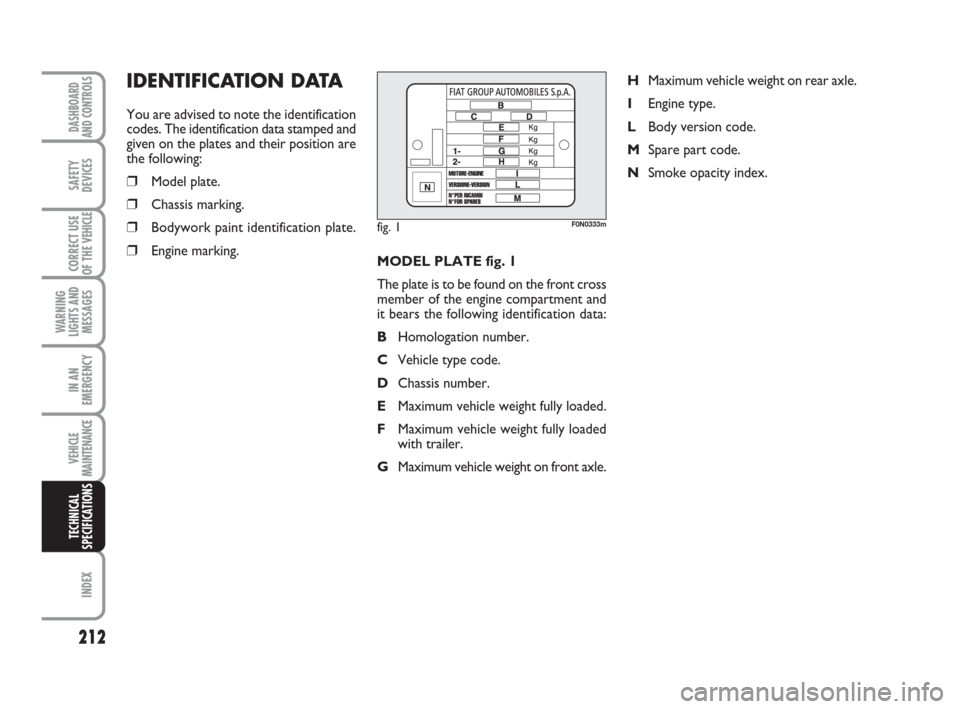
MODEL PLATE fig. 1
The plate is to be found on the front cross
member of the engine compartment and
it bears the following identification data:
BHomologation number.
CVehicle type code.
DChassis number.
EMaximum vehicle weight fully loaded.
FMaximum vehicle weight fully loaded
with trailer.
GMaximum vehicle weight on front axle.HMaximum vehicle weight on rear axle.
IEngine type.
LBody version code.
MSpare part code.
NSmoke opacity index.
IDENTIFICATION DATA
You are advised to note the identification
codes. The identification data stamped and
given on the plates and their position are
the following:
❒Model plate.
❒Chassis marking.
❒Bodywork paint identification plate.
❒Engine marking.
fig. 1F0N0333m
211-269 Ducato GB 6-11-2007 10:35 Pagina 212