condi FIAT DUCATO 2008 3.G Service Manual
[x] Cancel search | Manufacturer: FIAT, Model Year: 2008, Model line: DUCATO, Model: FIAT DUCATO 2008 3.GPages: 282, PDF Size: 4.55 MB
Page 151 of 282
150
IN AN
EMERGENCY
VEHICLE
MAINTENANCE
TECHNICAL
SPECIFICATIONS
INDEX
DASHBOARD
AND CONTROLS
SAFETY
DEVICES
CORRECT USE
OF THE
VEHICLE
WARNING
LIGHTS AND
MESSAGES
ç
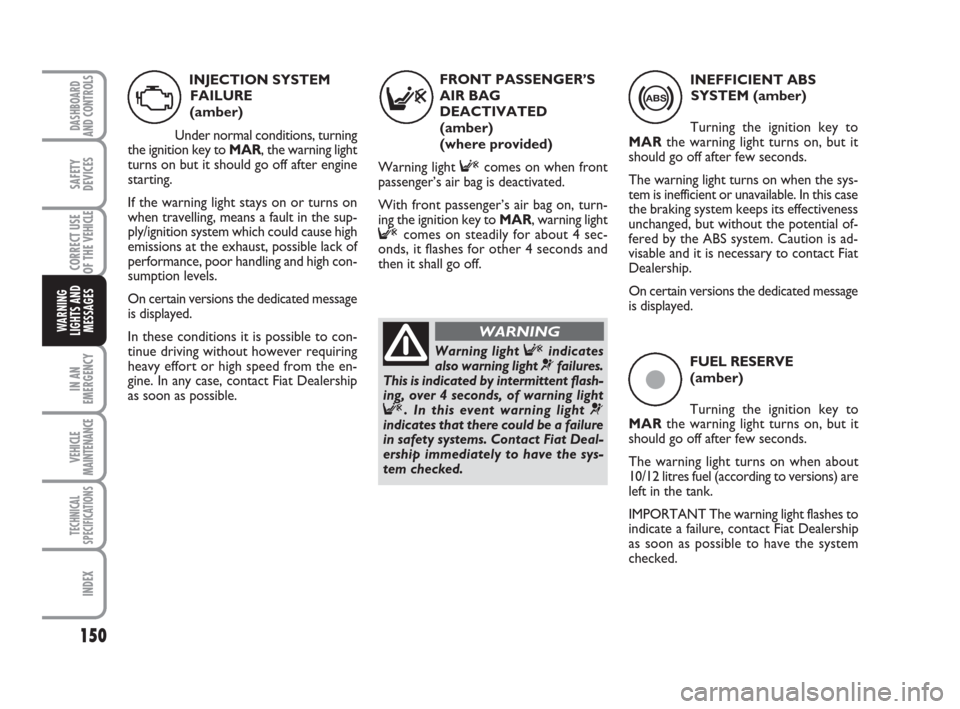
FUEL RESERVE
(amber)
Turning the ignition key to
MARthe warning light turns on, but it
should go off after few seconds.
The warning light turns on when about
10/12 litres fuel (according to versions) are
left in the tank.
IMPORTANT The warning light flashes to
indicate a failure, contact Fiat Dealership
as soon as possible to have the system
checked. INJECTION SYSTEM
FAILURE
(amber)
Under normal conditions, turning
the ignition key to MAR, the warning light
turns on but it should go off after engine
starting.
If the warning light stays on or turns on
when travelling, means a fault in the sup-
ply/ignition system which could cause high
emissions at the exhaust, possible lack of
performance, poor handling and high con-
sumption levels.
On certain versions the dedicated message
is displayed.
In these conditions it is possible to con-
tinue driving without however requiring
heavy effort or high speed from the en-
gine. In any case, contact Fiat Dealership
as soon as possible.
U
INEFFICIENT ABS
SYSTEM (amber)
Turning the ignition key to
MARthe warning light turns on, but it
should go off after few seconds.
The warning light turns on when the sys-
tem is inefficient or unavailable. In this case
the braking system keeps its effectiveness
unchanged, but without the potential of-
fered by the ABS system. Caution is ad-
visable and it is necessary to contact Fiat
Dealership.
On certain versions the dedicated message
is displayed.
>F
FRONT PASSENGER’S
AIR BAG
DEACTIVATED
(amber)
(where provided)
Warning light Fcomes on when front
passenger’s air bag is deactivated.
With front passenger’s air bag on, turn-
ing the ignition key to MAR, warning light
Fcomes on steadily for about 4 sec-
onds, it flashes for other 4 seconds and
then it shall go off.
Warning light Findicates
also warning light ¬failures.
This is indicated by intermittent flash-
ing, over 4 seconds, of warning light
F. In this event warning light ¬
indicates that there could be a failure
in safety systems. Contact Fiat Deal-
ership immediately to have the sys-
tem checked.
WARNING
Page 154 of 282
153
IN AN
EMERGENCY
VEHICLE
MAINTENANCE
TECHNICAL
SPECIFICATIONS
INDEX
DASHBOARD
AND CONTROLS
SAFETY
DEVICES
CORRECT USE
OF THE
VEHICLE
WARNING
LIGHTS AND
MESSAGES
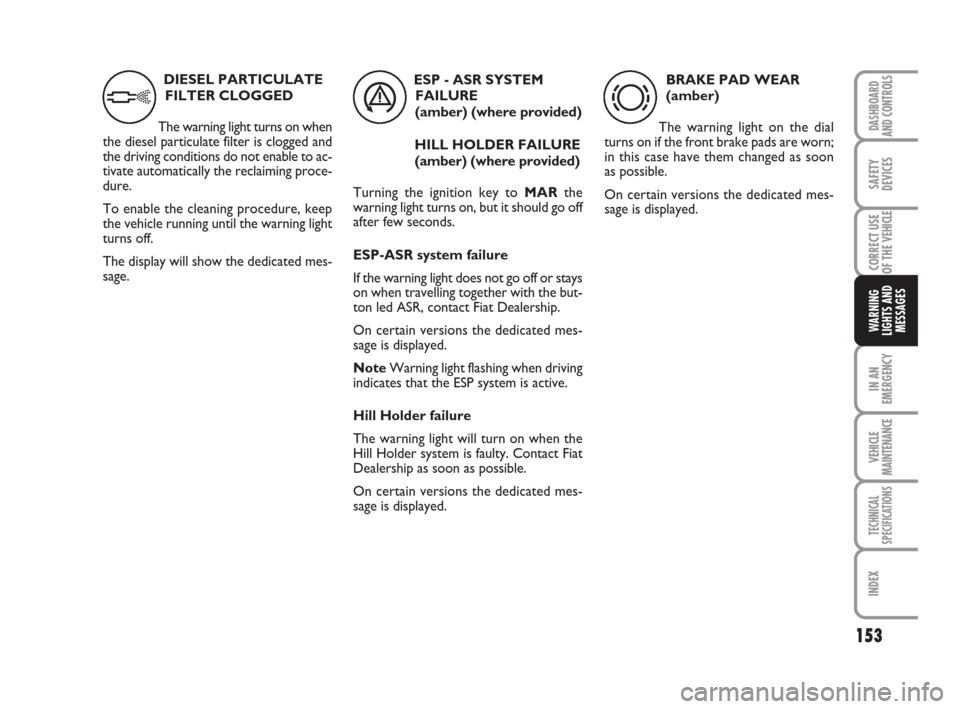
DIESEL PARTICULATE
FILTER CLOGGED
The warning light turns on when
the diesel particulate filter is clogged and
the driving conditions do not enable to ac-
tivate automatically the reclaiming proce-
dure.
To enable the cleaning procedure, keep
the vehicle running until the warning light
turns off.
The display will show the dedicated mes-
sage.ESP - ASR SYSTEM
FAILURE
(amber) (where provided)
HILL HOLDER FAILURE
(amber) (where provided)
Turning the ignition key to MARthe
warning light turns on, but it should go off
after few seconds.
ESP-ASR system failure
If the warning light does not go off or stays
on when travelling together with the but-
ton led ASR, contact Fiat Dealership.
On certain versions the dedicated mes-
sage is displayed.
NoteWarning light flashing when driving
indicates that the ESP system is active.
Hill Holder failure
The warning light will turn on when the
Hill Holder system is faulty. Contact Fiat
Dealership as soon as possible.
On certain versions the dedicated mes-
sage is displayed.
áh
BRAKE PAD WEAR
(amber)
The warning light on the dial
turns on if the front brake pads are worn;
in this case have them changed as soon
as possible.
On certain versions the dedicated mes-
sage is displayed.
d
Page 156 of 282
155
IN AN
EMERGENCY
VEHICLE
MAINTENANCE
TECHNICAL
SPECIFICATIONS
INDEX
DASHBOARD
AND CONTROLS
SAFETY
DEVICES
CORRECT USE
OF THE
VEHICLE
WARNING
LIGHTS AND
MESSAGES
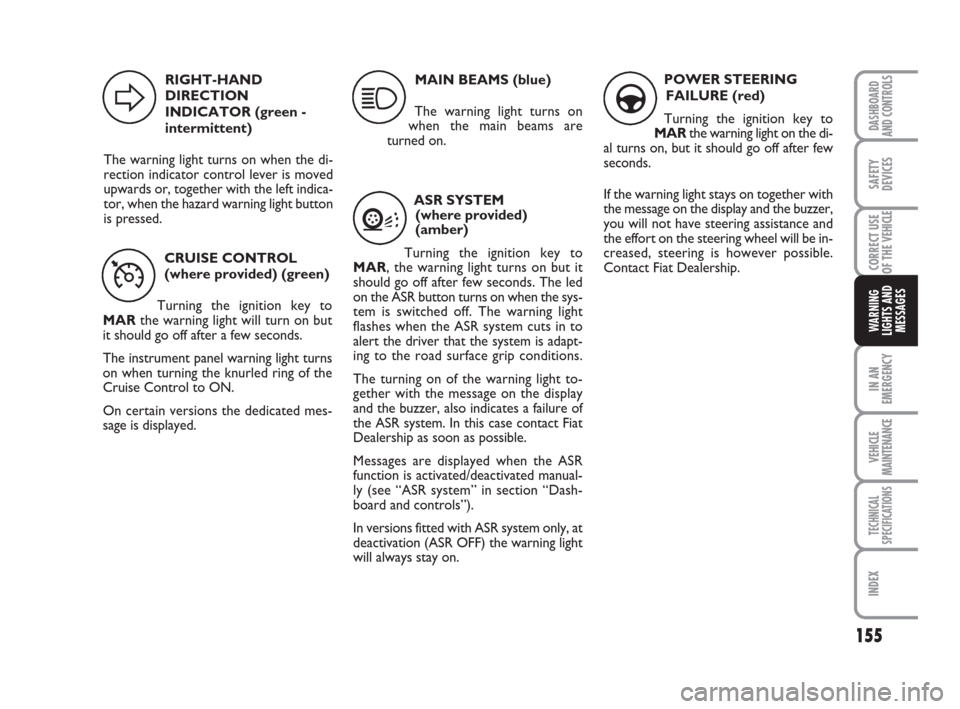
CRUISE CONTROL
(where provided) (green)
Turning the ignition key to
MARthe warning light will turn on but
it should go off after a few seconds.
The instrument panel warning light turns
on when turning the knurled ring of the
Cruise Control to ON.
On certain versions the dedicated mes-
sage is displayed.
Ü
MAIN BEAMS (blue)
The warning light turns on
when the main beams are
turned on.
1
RIGHT-HAND
DIRECTION
INDICATOR (green -
intermittent)
The warning light turns on when the di-
rection indicator control lever is moved
upwards or, together with the left indica-
tor, when the hazard warning light button
is pressed.
D
ASR SYSTEM
(where provided)
(amber)
Turning the ignition key to
MAR, the warning light turns on but it
should go off after few seconds. The led
on the ASR button turns on when the sys-
tem is switched off. The warning light
flashes when the ASR system cuts in to
alert the driver that the system is adapt-
ing to the road surface grip conditions.
The turning on of the warning light to-
gether with the message on the display
and the buzzer, also indicates a failure of
the ASR system. In this case contact Fiat
Dealership as soon as possible.
Messages are displayed when the ASR
function is activated/deactivated manual-
ly (see “ASR system” in section “Dash-
board and controls”).
In versions fitted with ASR system only, at
deactivation (ASR OFF) the warning light
will always stay on.
V
POWER STEERING
FAILURE (red)
Turning the ignition key to
MARthe warning light on the di-
al turns on, but it should go off after few
seconds.
If the warning light stays on together with
the message on the display and the buzzer,
you will not have steering assistance and
the effort on the steering wheel will be in-
creased, steering is however possible.
Contact Fiat Dealership.
g
Page 184 of 282
183
WARNING
LIGHTS AND
MESSAGES
VEHICLE
MAINTENANCE
TECHNICAL
SPECIFICATIONS
INDEX
DASHBOARD
AND CONTROLS
SAFETY
DEVICES
CORRECT USE
OF THE
VEHICLE
IN AN
EMERGENCY
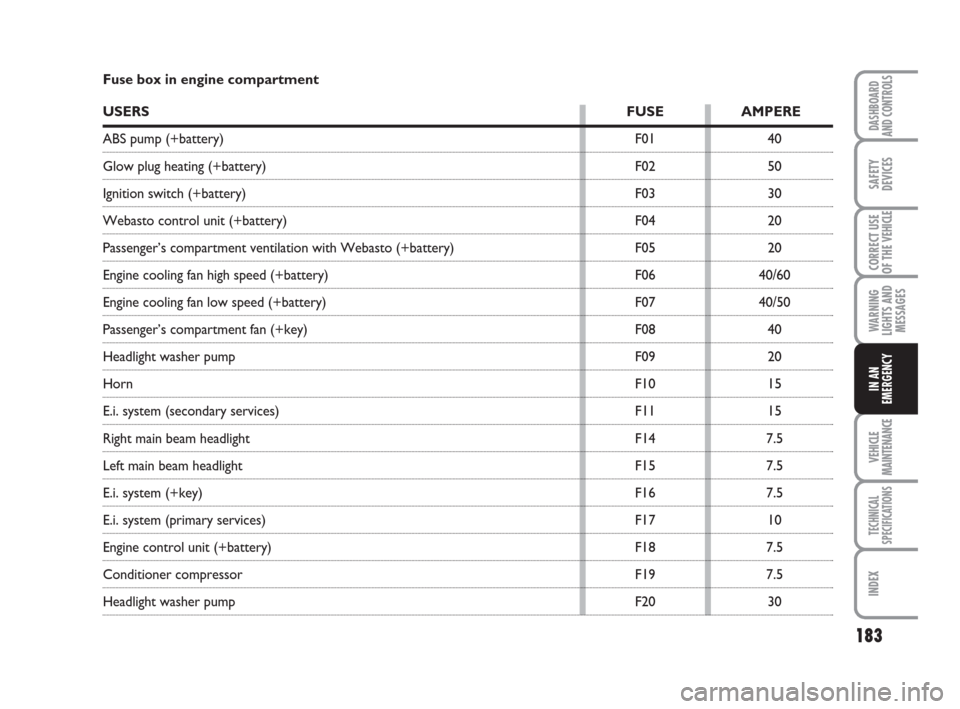
Fuse box in engine compartment
USERSFUSE AMPERE
ABS pump (+battery) F01 40
Glow plug heating (+battery) F02 50
Ignition switch (+battery) F03 30
Webasto control unit (+battery) F04 20
Passenger’s compartment ventilation with Webasto (+battery) F05 20
Engine cooling fan high speed (+battery) F06 40/60
Engine cooling fan low speed (+battery) F07 40/50
Passenger’s compartment fan (+key) F08 40
Headlight washer pump F09 20
HornF10 15
E.i. system (secondary services) F11 15
Right main beam headlight F14 7.5
Left main beam headlight F15 7.5
E.i. system (+key) F16 7.5
E.i. system (primary services) F17 10
Engine control unit (+battery) F18 7.5
Conditioner compressor F19 7.5
Headlight washer pump F20 30
Page 192 of 282
191
WARNING
LIGHTS AND
MESSAGES
TECHNICAL
SPECIFICATIONS
INDEX
DASHBOARD
AND CONTROLS
SAFETY
DEVICES
CORRECT USE
OF THE VEHICLE
IN AN
EMERGENCY
VEHICLE
MAINTENANCE
45 90 135 180 225
●●●●●
●●●●●
●●●●●
●●●●●
●●●●●
●●●●●
●●
●●●●●
●●●●●
●●●●●
●●●●●
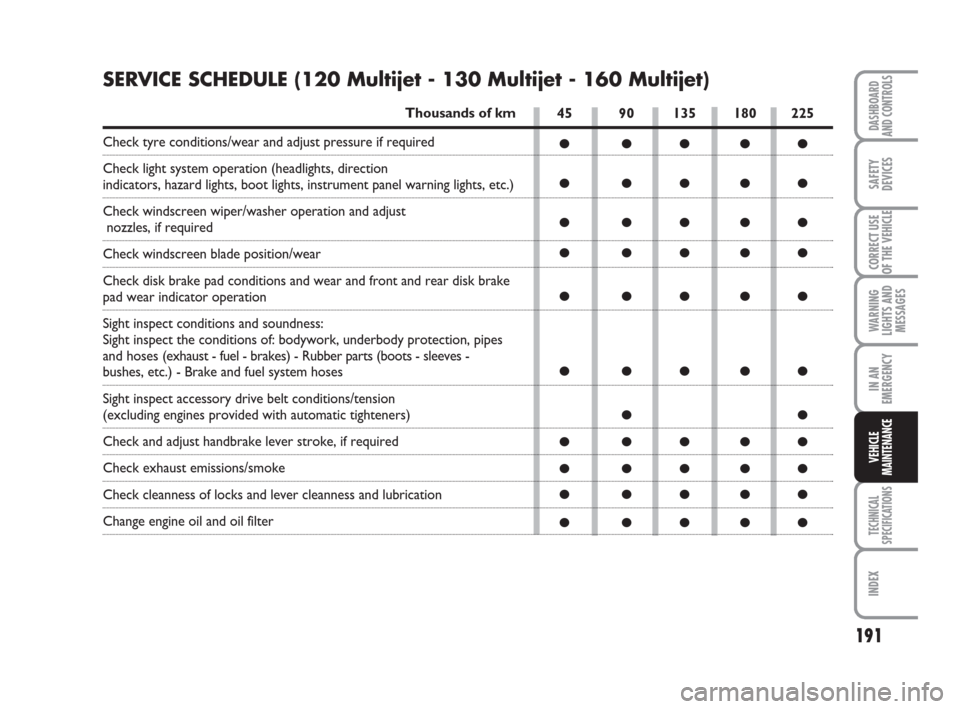
SERVICE SCHEDULE (120 Multijet - 130 Multijet - 160 Multijet)
Thousands of km
Check tyre conditions/wear and adjust pressure if required
Check light system operation (headlights, direction
indicators, hazard lights, boot lights, instrument panel warning lights, etc.)
Check windscreen wiper/washer operation and adjust
nozzles, if required
Check windscreen blade position/wear
Check disk brake pad conditions and wear and front and rear disk brake
pad wear indicator operation
Sight inspect conditions and soundness:
Sight inspect the conditions of: bodywork, underbody protection, pipes
and hoses (exhaust - fuel - brakes) - Rubber parts (boots - sleeves -
bushes, etc.) - Brake and fuel system hoses
Sight inspect accessory drive belt conditions/tension
(excluding engines provided with automatic tighteners)
Check and adjust handbrake lever stroke, if required
Check exhaust emissions/smoke
Check cleanness of locks and lever cleanness and lubrication
Change engine oil and oil filter
Page 194 of 282
193
WARNING
LIGHTS AND
MESSAGES
TECHNICAL
SPECIFICATIONS
INDEX
DASHBOARD
AND CONTROLS
SAFETY
DEVICES
CORRECT USE
OF THE VEHICLE
IN AN
EMERGENCY
VEHICLE
MAINTENANCE
40 80 120 160 200
●●●●●
●●●●●
●●●●●
●●●●●
●●●●●
●●●●●
●●
●●●●●
●●●●●
●●●●●
●●●●●
●●●●●
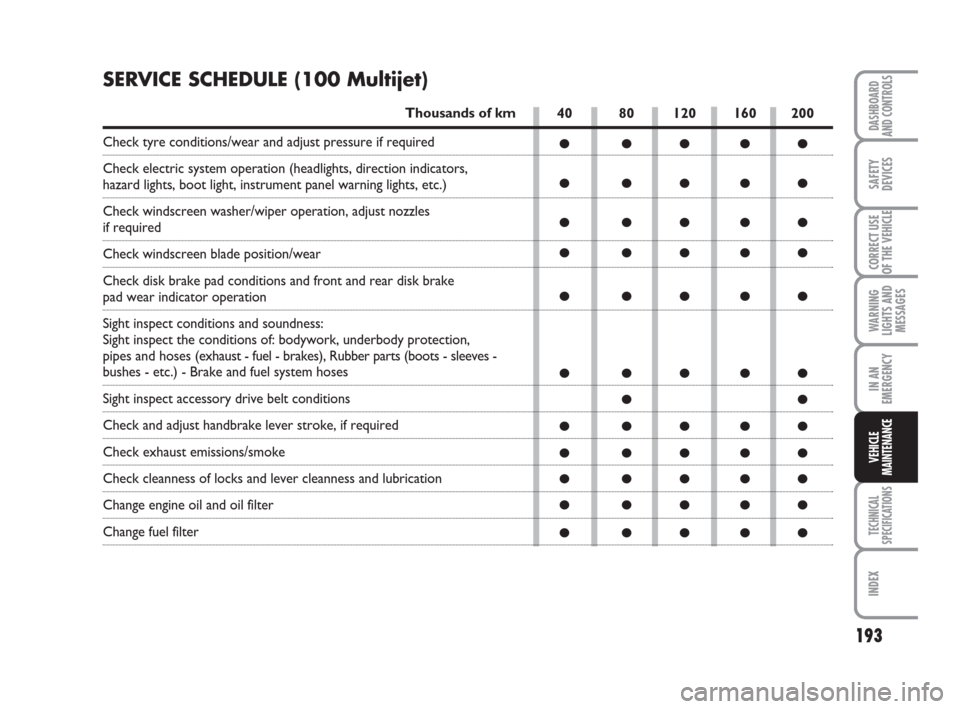
SERVICE SCHEDULE (100 Multijet)
Thousands of km
Check tyre conditions/wear and adjust pressure if required
Check electric system operation (headlights, direction indicators,
hazard lights, boot light, instrument panel warning lights, etc.)
Check windscreen washer/wiper operation, adjust nozzles
if required
Check windscreen blade position/wear
Check disk brake pad conditions and front and rear disk brake
pad wear indicator operation
Sight inspect conditions and soundness:
Sight inspect the conditions of: bodywork, underbody protection,
pipes and hoses (exhaust - fuel - brakes), Rubber parts (boots - sleeves -
bushes - etc.) - Brake and fuel system hoses
Sight inspect accessory drive belt conditions
Check and adjust handbrake lever stroke, if required
Check exhaust emissions/smoke
Check cleanness of locks and lever cleanness and lubrication
Change engine oil and oil filter
Change fuel filter
Page 195 of 282
194
WARNING
LIGHTS AND
MESSAGES
TECHNICAL
SPECIFICATIONS
INDEX
DASHBOARD
AND CONTROLS
SAFETY
DEVICES
CORRECT USE
OF THE VEHICLE
IN AN
EMERGENCY
VEICHLE
MAINTENANCE
40 80 120 160 200
●●●●●
●●●●●
●
●●●●●
●●
●●●●●
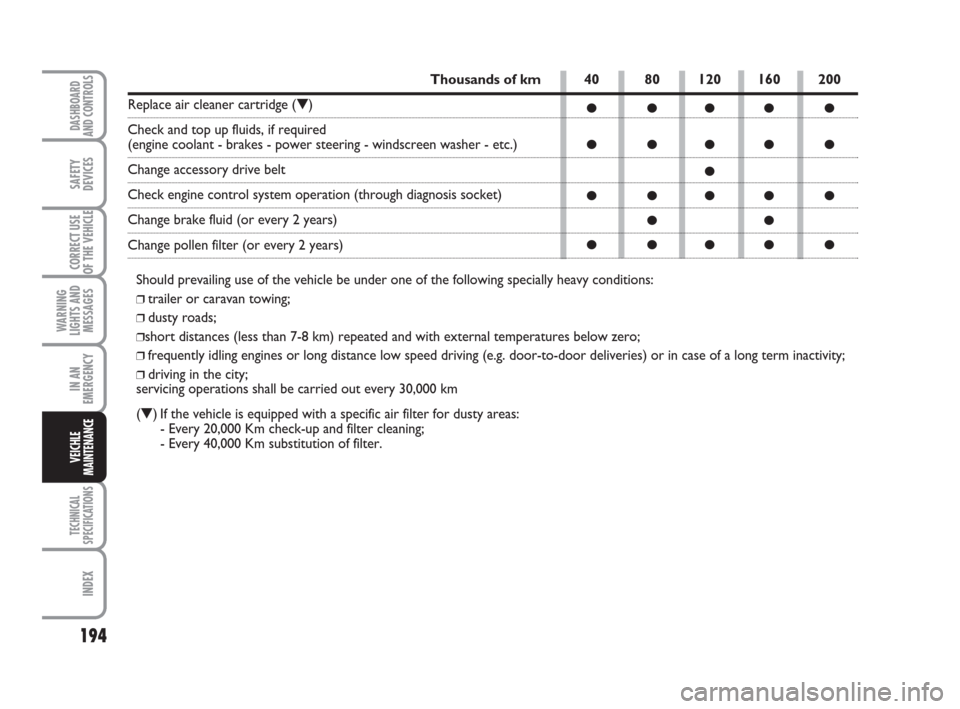
Thousands of km
Replace air cleaner cartridge (▼)
Check and top up fluids, if required
(engine coolant - brakes - power steering - windscreen washer - etc.)
Change accessory drive belt
Check engine control system operation (through diagnosis socket)
Change brake fluid (or every 2 years)
Change pollen filter (or every 2 years)
Should prevailing use of the vehicle be under one of the following specially heavy conditions:
❒trailer or caravan towing;
❒dusty roads;
❒short distances (less than 7-8 km) repeated and with external temperatures below zero;
❒frequently idling engines or long distance low speed driving (e.g. door-to-door deliveries) or in case of a long term inactivity;
❒driving in the city;
servicing operations shall be carried out every 30,000 km
(▼) If the vehicle is equipped with a specific air filter for dusty areas:
- Every 20,000 Km check-up and filter cleaning;
- Every 40,000 Km substitution of filter.
Page 196 of 282
195
WARNING
LIGHTS AND
MESSAGES
TECHNICAL
SPECIFICATIONS
INDEX
DASHBOARD
AND CONTROLS
SAFETY
DEVICES
CORRECT USE
OF THE VEHICLE
IN AN
EMERGENCY
VEHICLE
MAINTENANCE
HEAVY-DUTY
Should prevailing use of the vehicle be un-
der one of the following specially heavy
conditions:
❒trailer or caravan towing;
❒dusty roads;
❒short distances (less than 7-8 km) re-
peated and with external tempera-
tures below zero;
❒frequently idling engines or long dis-
tance low speed driving (e.g. door-to-
door deliveries) or in case of a long
term inactivity;
❒driving in the city;
carry out the following checks more fre-
quently than required in the Service
Schedule:
❒check front disk brake pad conditions
and wear;
❒check cleanness of locks, bonnet and
boot and lever cleanness and lubri-
cation;
❒sight inspect the conditions of: engine,
gearbox, transmission, pipes and
hoses (exhaust - fuel - brakes), rub-
ber parts (boots, sleeves, bushes,
etc.);
❒check battery charge and fluid level
(electrolyte);
❒visual check on various drive belt con-
ditions;
❒check and replace pollen filter, if re-
quired;
❒check and replace air cleaner, if re-
quired.
ROUTINE
MAINTENANCE
Every 1,000 km or before long journeys,
check and top up if required:
❒engine coolant fluid level;
❒brake fluid level;
❒windscreen washer fluid level;
❒tyre pressure and conditions;
❒light system operation (headlights, di-
rection indicators, hazard lights, etc.);
❒windscreen wiper/washer operation
and windscreen/rear window blade
position/wear;
Every 3,000 km check and top up if re-
quired: engine oil level.
You are recommended to use FL
Selenia, products, designed and pro-
duced specifically for Fiat vehicles (see
table “Capacities” in section “Technical
specifications”).
Page 199 of 282
198
WARNING
LIGHTS AND
MESSAGES
TECHNICAL
SPECIFICATIONS
INDEX
DASHBOARD
AND CONTROLS
SAFETY
DEVICES
CORRECT USE
OF THE VEHICLE
IN AN
EMERGENCY
VEICHLE
MAINTENANCE
ENGINE OIL CONSUMPTION
Max engine oil consumption is usually 400
grams every 1,000 km.
When the vehicle is new, the engine needs
to run in, therefore the engine oil con-
sumption can only be considered stabilised
after the first 5,000 - 6,000 km.
IMPORTANT The oil consumption de-
pends on driving style and the conditions
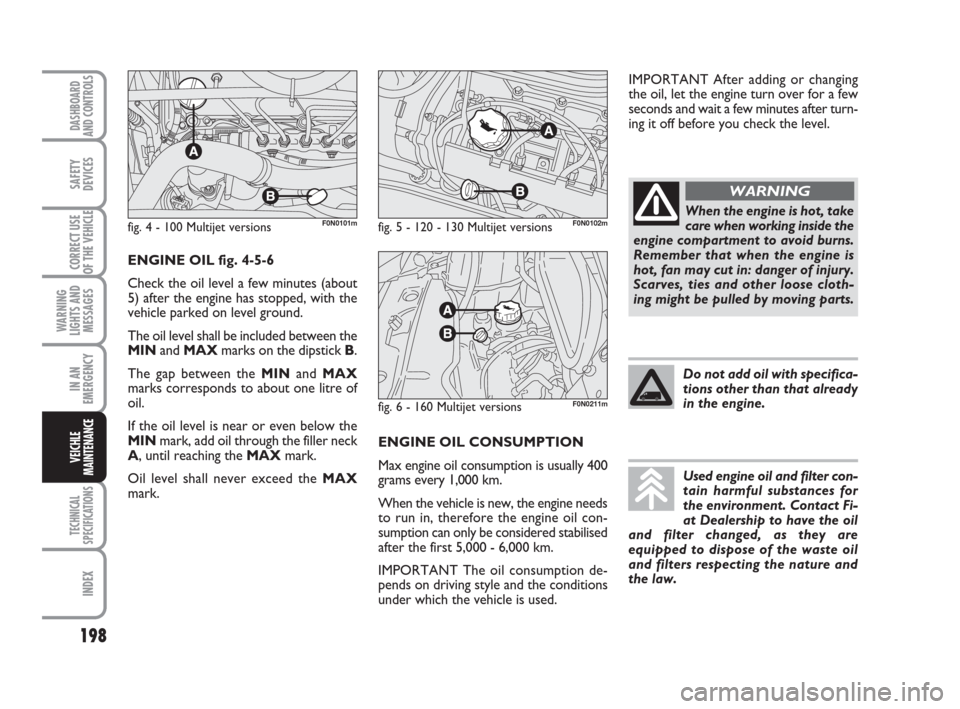
under which the vehicle is used. ENGINE OIL fig. 4-5-6
Check the oil level a few minutes (about
5) after the engine has stopped, with the
vehicle parked on level ground.
The oil level shall be included between the
MINand MAXmarks on the dipstick B.
The gap between the MINand MAX
marks corresponds to about one litre of
oil.
If the oil level is near or even below the
MINmark, add oil through the filler neck
A, until reaching the MAXmark.
Oil level shall never exceed the MAX
mark.
fig. 4 - 100 Multijet versionsF0N0101mfig. 5 - 120 - 130 Multijet versions
fig. 6 - 160 Multijet versionsF0N0102m
F0N0211m
When the engine is hot, take
care when working inside the
engine compartment to avoid burns.
Remember that when the engine is
hot, fan may cut in: danger of injury.
Scarves, ties and other loose cloth-
ing might be pulled by moving parts.
WARNING
Do not add oil with specifica-
tions other than that already
in the engine.
Used engine oil and filter con-
tain harmful substances for
the environment. Contact Fi-
at Dealership to have the oil
and filter changed, as they are
equipped to dispose of the waste oil
and filters respecting the nature and
the law.
IMPORTANT After adding or changing
the oil, let the engine turn over for a few
seconds and wait a few minutes after turn-
ing it off before you check the level.
Page 200 of 282
199
WARNING
LIGHTS AND
MESSAGES
TECHNICAL
SPECIFICATIONS
INDEX
DASHBOARD
AND CONTROLS
SAFETY
DEVICES
CORRECT USE
OF THE VEHICLE
IN AN
EMERGENCY
VEHICLE
MAINTENANCE
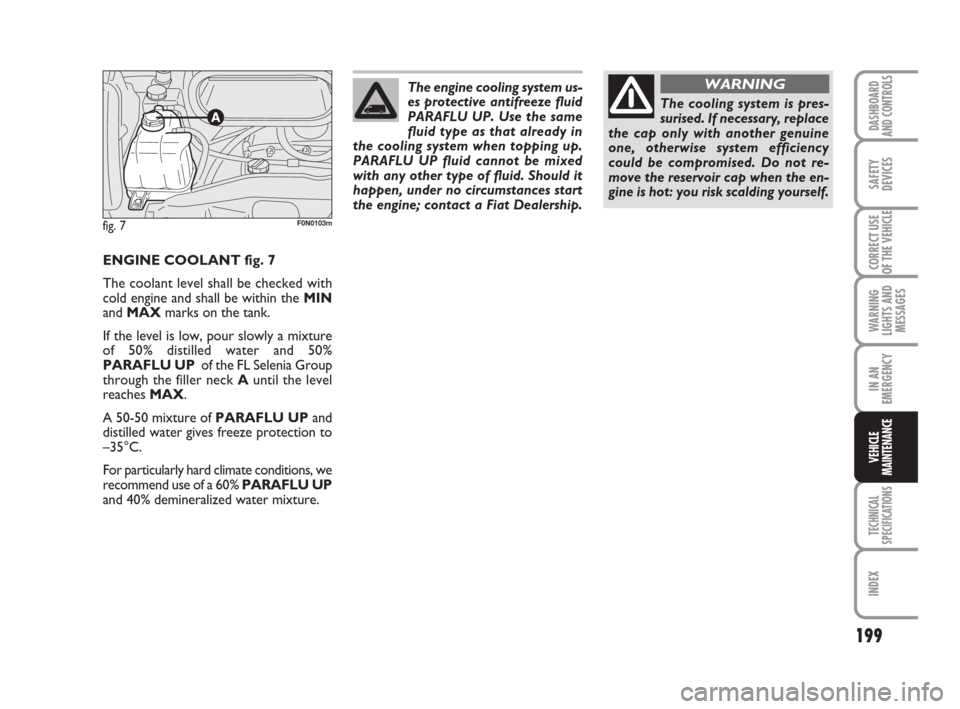
ENGINE COOLANT fig. 7
The coolant level shall be checked with
cold engine and shall be within the MIN
and MAXmarks on the tank.
If the level is low, pour slowly a mixture
of 50% distilled water and 50%
PARAFLU UP of the FL Selenia Group
through the filler neck Auntil the level
reaches MAX.
A 50-50 mixture of PARAFLU UPand
distilled water gives freeze protection to
–35°C.
For particularly hard climate conditions, we
recommend use of a 60% PARAFLU UP
and 40% demineralized water mixture.
fig. 7F0N0103m
The engine cooling system us-
es protective antifreeze fluid
PARAFLU UP. Use the same
fluid type as that already in
the cooling system when topping up.
PARAFLU UP fluid cannot be mixed
with any other type of fluid. Should it
happen, under no circumstances start
the engine; contact a Fiat Dealership.
The cooling system is pres-
surised. If necessary, replace
the cap only with another genuine
one, otherwise system efficiency
could be compromised. Do not re-
move the reservoir cap when the en-
gine is hot: you risk scalding yourself.
WARNING