air FIAT DUCATO 2008 3.G Workshop Manual
[x] Cancel search | Manufacturer: FIAT, Model Year: 2008, Model line: DUCATO, Model: FIAT DUCATO 2008 3.GPages: 282, PDF Size: 4.55 MB
Page 167 of 282
166
WARNING
LIGHTS AND
MESSAGES
VEHICLE
MAINTENANCE
TECHNICAL
SPECIFICATIONS
IINDEX
DASHBOARD
AND CONTROLS
SAFETY
DEVICES
CORRECT USE
OF THE
VEHICLE
IN AN
EMERGENCY
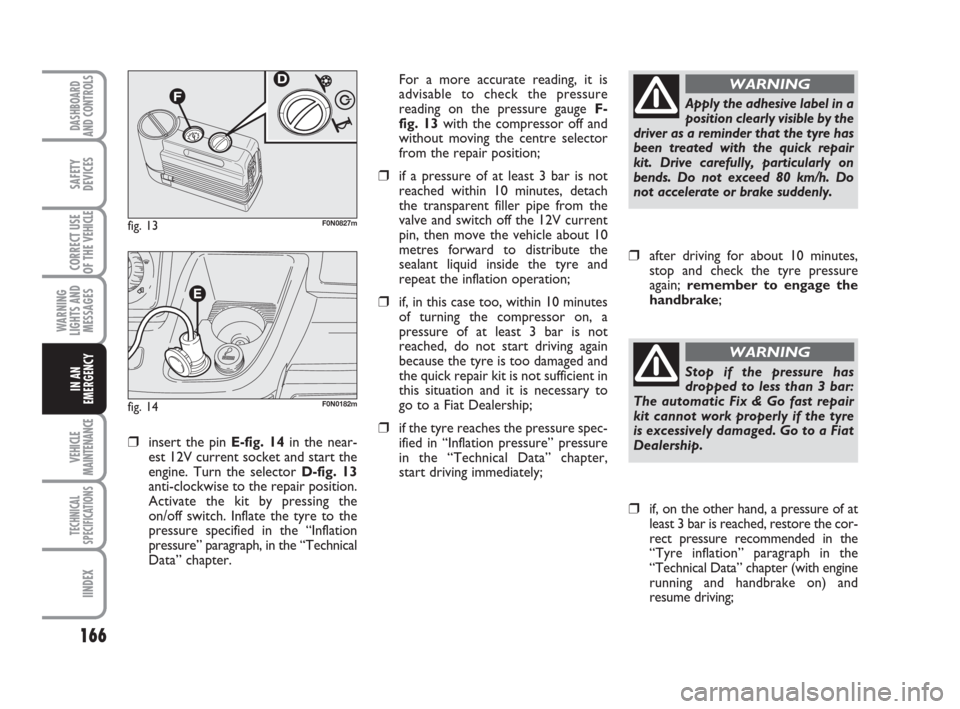
❒insert the pin E-fig. 14in the near-
est 12V current socket and start the
engine. Turn the selector D-fig. 13
anti-clockwise to the repair position.
Activate the kit by pressing the
on/off switch. Inflate the tyre to the
pressure specified in the “Inflation
pressure” paragraph, in the “Technical
Data” chapter.For a more accurate reading, it is
advisable to check the pressure
reading on the pressure gauge F-
fig. 13with the compressor off and
without moving the centre selector
from the repair position;
❒if a pressure of at least 3 bar is not
reached within 10 minutes, detach
the transparent filler pipe from the
valve and switch off the 12V current
pin, then move the vehicle about 10
metres forward to distribute the
sealant liquid inside the tyre and
repeat the inflation operation;
❒if, in this case too, within 10 minutes
of turning the compressor on, a
pressure of at least 3 bar is not
reached, do not start driving again
because the tyre is too damaged and
the quick repair kit is not sufficient in
this situation and it is necessary to
go to a Fiat Dealership;
❒if the tyre reaches the pressure spec-
ified in “Inflation pressure” pressure
in the “Technical Data” chapter,
start driving immediately;
fig. 13F0N0827m
fig. 14F0N0182m
Apply the adhesive label in a
position clearly visible by the
driver as a reminder that the tyre has
been treated with the quick repair
kit. Drive carefully, particularly on
bends. Do not exceed 80 km/h. Do
not accelerate or brake suddenly.
WARNING
❒after driving for about 10 minutes,
stop and check the tyre pressure
again; remember to engage the
handbrake;
❒if, on the other hand, a pressure of at
least 3 bar is reached, restore the cor-
rect pressure recommended in the
“Tyre inflation” paragraph in the
“Technical Data” chapter (with engine
running and handbrake on) and
resume driving;
Stop if the pressure has
dropped to less than 3 bar:
The automatic Fix & Go fast repair
kit cannot work properly if the tyre
is excessively damaged. Go to a Fiat
Dealership.
WARNING
Page 168 of 282
167
WARNING
LIGHTS AND
MESSAGES
VEHICLE
MAINTENANCE
TECHNICAL
SPECIFICATIONS
INDEX
DASHBOARD
AND CONTROLS
SAFETY
DEVICES
CORRECT USE
OF THE
VEHICLE
IN AN
EMERGENCY
❒drive with the utmost care to the
nearest Fiat Dealership.
FOR CHECKING AND
RESTORING PRESSURE ONLY
The compressor may also be used for
restoring pressure only.
❒Engage the handbrake
❒Undo the cap for the tyre valve, extract
the black pipe and tighten the ring nut
on the tyre valve.
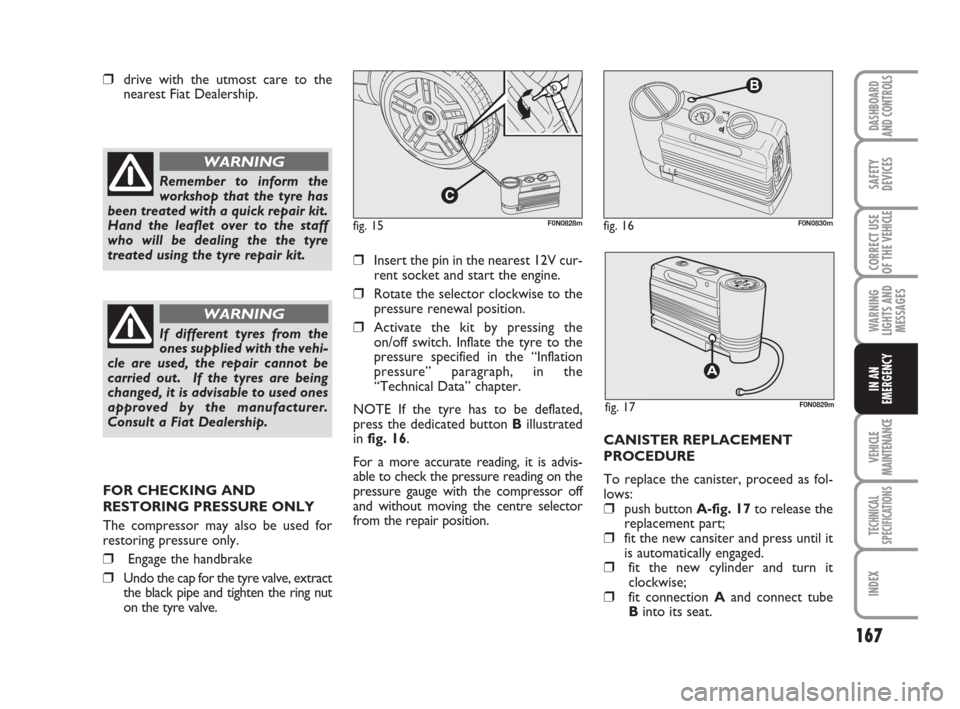
❒Insert the pin in the nearest 12V cur-
rent socket and start the engine.
❒Rotate the selector clockwise to the
pressure renewal position.
❒Activate the kit by pressing the
on/off switch. Inflate the tyre to the
pressure specified in the “Inflation
pressure” paragraph, in the
“Technical Data” chapter.
NOTE If the tyre has to be deflated,
press the dedicated button Billustrated
in fig. 16.
For a more accurate reading, it is advis-
able to check the pressure reading on the
pressure gauge with the compressor off
and without moving the centre selector
from the repair position.CANISTER REPLACEMENT
PROCEDURE
To replace the canister, proceed as fol-
lows:
❒push button A-fig. 17to release the
replacement part;
❒fit the new cansiter and press until it
is automatically engaged.
❒fit the new cylinder and turn it
clockwise;
❒fit connection Aand connect tube
Binto its seat.
Remember to inform the
workshop that the tyre has
been treated with a quick repair kit.
Hand the leaflet over to the staff
who will be dealing the the tyre
treated using the tyre repair kit.
WARNING
If different tyres from the
ones supplied with the vehi-
cle are used, the repair cannot be
carried out. If the tyres are being
changed, it is advisable to used ones
approved by the manufacturer.
Consult a Fiat Dealership.
WARNING
fig. 16
B
F0N0830m
fig. 17F0N0829m
fig. 15F0N0828m
Page 169 of 282
168
WARNING
LIGHTS AND
MESSAGES
VEHICLE
MAINTENANCE
TECHNICAL
SPECIFICATIONS
IINDEX
DASHBOARD
AND CONTROLS
SAFETY
DEVICES
CORRECT USE
OF THE
VEHICLE
IN AN
EMERGENCY
WHEN NEEDING TO
CHANGE A BULB
GENERAL INSTRUCTIONS
❒When a light is not working, check
that the corresponding fuse is intact
before changing a bulb. For the loca-
tion of fuses, refer to the paragraph “If
a fuse blows” in this section;
❒Before changing a bulb check the con-
tacts for oxidation;
❒Burnt bulbs must be replaced by oth-
ers of the same type and power;
❒Always check the height of the head-
light beam after changing a bulb.
IMPORTANT The headlight inner surface
may be lightly misted over: this is not a
fault but a natural fact due to low tem-
perature and the level of air humidity. It
will disappear as soon the headlights are
turned on. The presence of drops inside
the headlights means water infiltration,
therefore contact Fiat Dealership.
TYPES OF BULBS
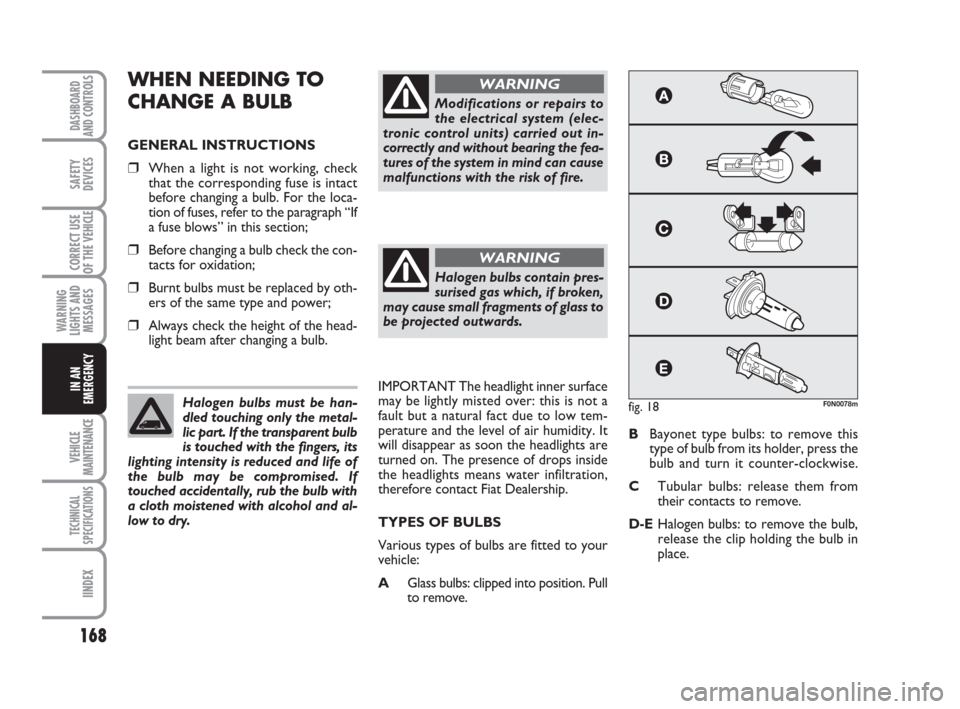
Various types of bulbs are fitted to your
vehicle:
AGlass bulbs: clipped into position. Pull
to remove.BBayonet type bulbs: to remove this
type of bulb from its holder, press the
bulb and turn it counter-clockwise.
CTubular bulbs: release them from
their contacts to remove.
D-EHalogen bulbs: to remove the bulb,
release the clip holding the bulb in
place. Halogen bulbs must be han-
dled touching only the metal-
lic part. If the transparent bulb
is touched with the fingers, its
lighting intensity is reduced and life of
the bulb may be compromised. If
touched accidentally, rub the bulb with
a cloth moistened with alcohol and al-
low to dry.
Modifications or repairs to
the electrical system (elec-
tronic control units) carried out in-
correctly and without bearing the fea-
tures of the system in mind can cause
malfunctions with the risk of fire.
WARNING
Halogen bulbs contain pres-
surised gas which, if broken,
may cause small fragments of glass to
be projected outwards.
WARNING
fig. 18F0N0078m
Page 178 of 282
177
WARNING
LIGHTS AND
MESSAGES
VEHICLE
MAINTENANCE
TECHNICAL
SPECIFICATIONS
INDEX
DASHBOARD
AND CONTROLS
SAFETY
DEVICES
CORRECT USE
OF THE
VEHICLE
IN AN
EMERGENCY
IF A FUSE BLOWS
GENERAL
The fuse is a protective device for the
electric system: it comes into action (i.e.
it cuts off) mainly due to a fault or im-
proper action on the system.
When a device does not work, check the
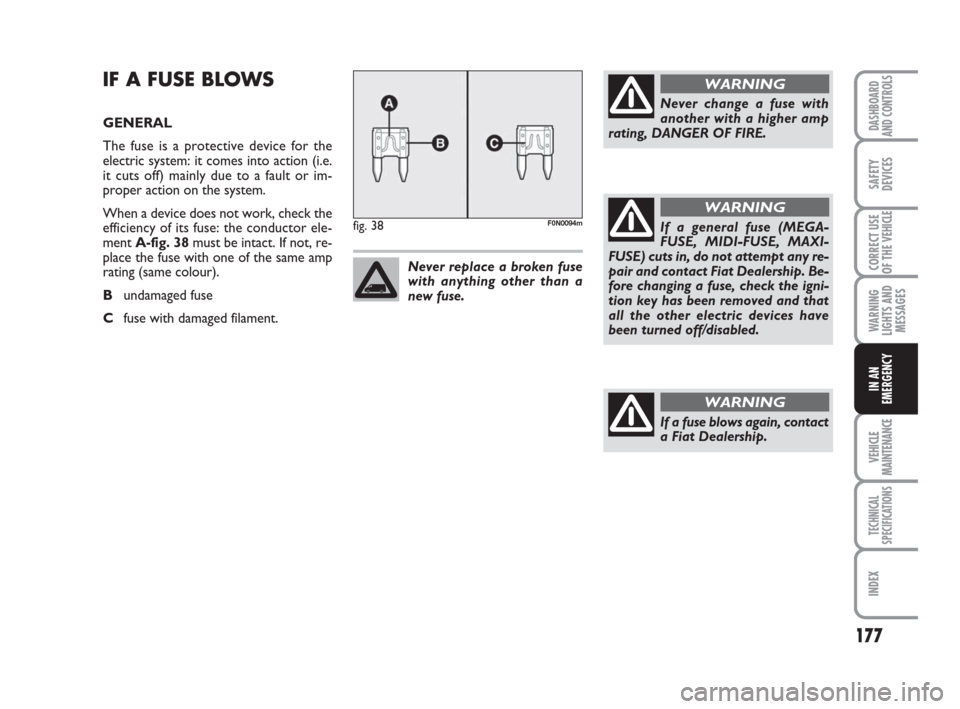
efficiency of its fuse: the conductor ele-
ment A-fig. 38must be intact. If not, re-
place the fuse with one of the same amp
rating (same colour).
Bundamaged fuse
Cfuse with damaged filament.
fig. 38F0N0094m
Never change a fuse with
another with a higher amp
rating, DANGER OF FIRE.
WARNING
Never replace a broken fuse
with anything other than a
new fuse.
If a general fuse (MEGA-
FUSE, MIDI-FUSE, MAXI-
FUSE) cuts in, do not attempt any re-
pair and contact Fiat Dealership. Be-
fore changing a fuse, check the igni-
tion key has been removed and that
all the other electric devices have
been turned off/disabled.
WARNING
If a fuse blows again, contact
a Fiat Dealership.
WARNING
Page 183 of 282
182
WARNING
LIGHTS AND
MESSAGES
VEHICLE
MAINTENANCE
TECHNICAL
SPECIFICATIONS
IINDEX
DASHBOARD
AND CONTROLS
SAFETY
DEVICES
CORRECT USE
OF THE
VEHICLE
IN AN
EMERGENCY
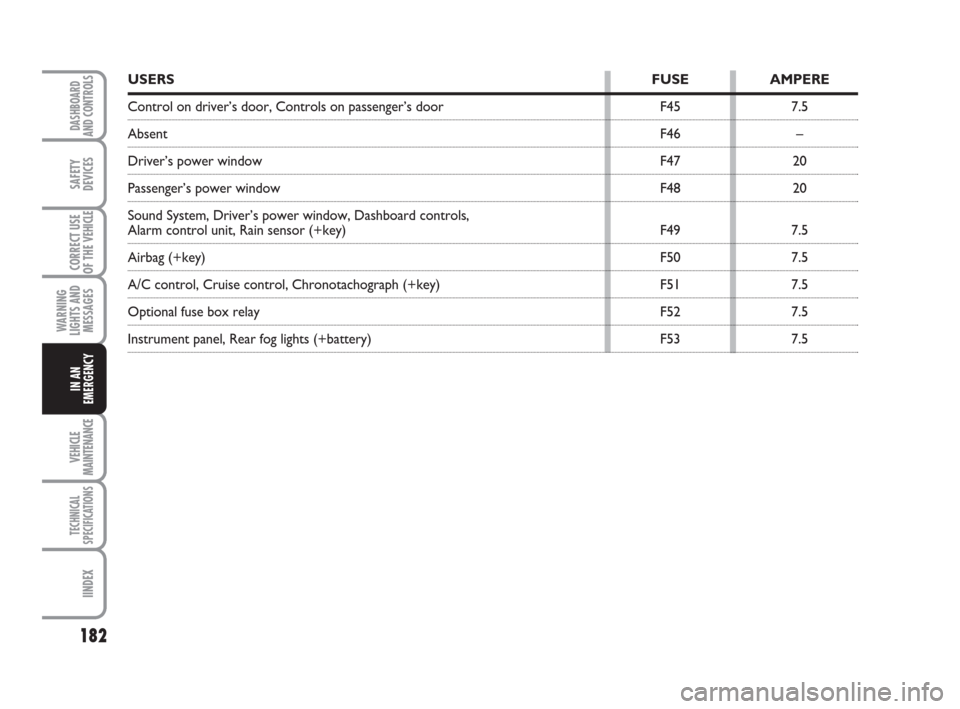
USERSFUSE AMPERE
Control on driver’s door, Controls on passenger’s door F45 7.5
AbsentF46 –
Driver’s power window F47 20
Passenger’s power window F48 20
Sound System, Driver’s power window, Dashboard controls,
Alarm control unit, Rain sensor (+key) F49 7.5
Airbag (+key)F50 7.5
A/C control, Cruise control, Chronotachograph (+key) F51 7.5
Optional fuse box relay F52 7.5
Instrument panel, Rear fog lights (+battery) F53 7.5
Page 190 of 282
189
WARNING
LIGHTS AND
MESSAGES
TECHNICAL
SPECIFICATIONS
INDEX
DASHBOARD
AND CONTROLS
SAFETY
DEVICES
CORRECT USE
OF THE VEHICLE
IN AN
EMERGENCY
VEHICLE
MAINTENANCE
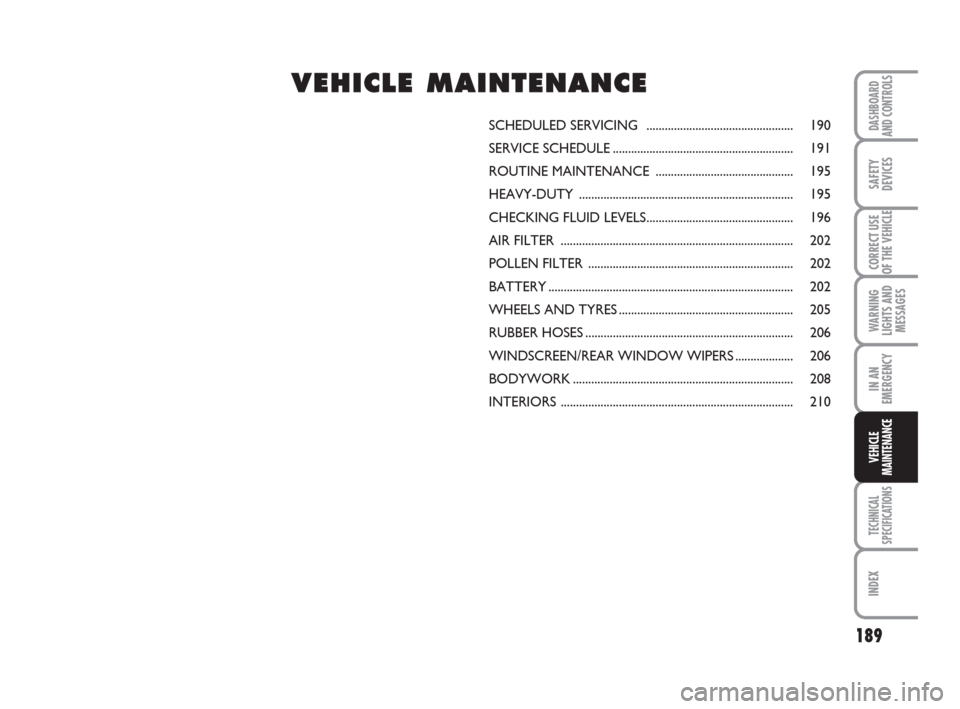
SCHEDULED SERVICING ................................................ 190
SERVICE SCHEDULE........................................................... 191
ROUTINE MAINTENANCE ............................................. 195
HEAVY-DUTY ...................................................................... 195
CHECKING FLUID LEVELS................................................ 196
AIR FILTER ............................................................................ 202
POLLEN FILTER ................................................................... 202
BATTERY................................................................................ 202
WHEELS AND TYRES......................................................... 205
RUBBER HOSES.................................................................... 206
WINDSCREEN/REAR WINDOW WIPERS................... 206
BODYWORK........................................................................ 208
INTERIORS ............................................................................ 210
VV V
E E
H H
I I
C C
L L
E E
M M
A A
I I
N N
T T
E E
N N
A A
N N
C C
E E
Page 191 of 282
190
WARNING
LIGHTS AND
MESSAGES
TECHNICAL
SPECIFICATIONS
INDEX
DASHBOARD
AND CONTROLS
SAFETY
DEVICES
CORRECT USE
OF THE VEHICLE
IN AN
EMERGENCY
VEICHLE
MAINTENANCE
IMPORTANT The Programmed Mainte-
nance coupons are specified by the Man-
ufacturer. The failure to have them car-
ried out may invalidate the warranty.
Scheduled Servicing is performed by all Fi-
at Dealership, at pre-established times.
If during each operation, in addition to the
ones programmed, the need arises for fur-
ther replacements or repairs, these may
be carried out only with the explicit agree-
ment of the Customer.IMPORTANT You are advised to contact
Fiat Dealership in the event of any minor
operating faults, without waiting for the
next service coupon.
If your vehicle is used frequently for tow-
ing, the interval between one service
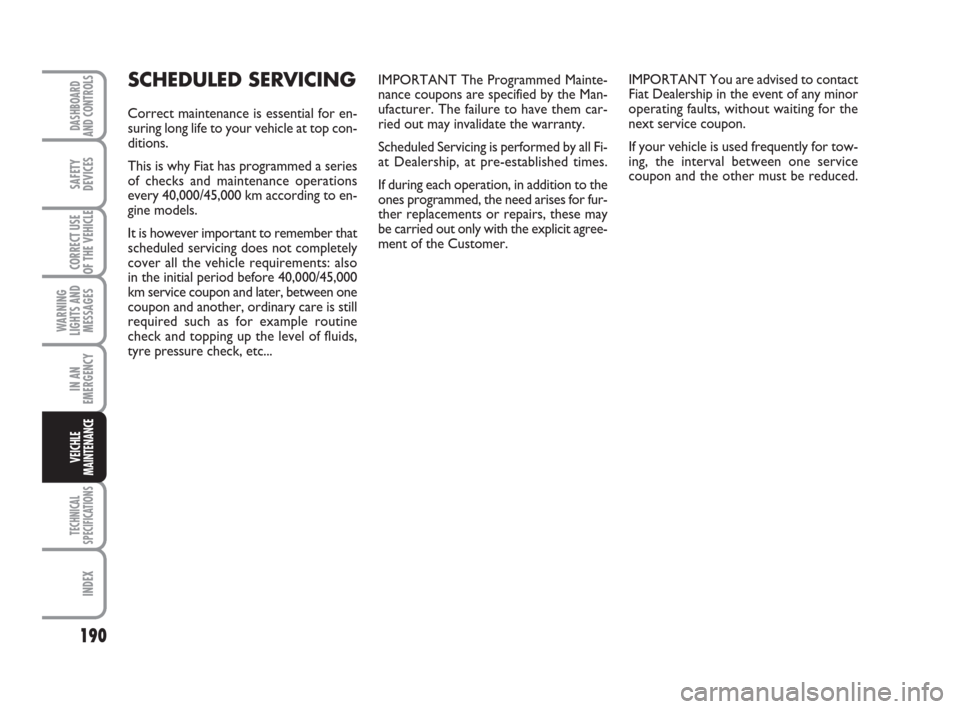
coupon and the other must be reduced.SCHEDULED SERVICING
Correct maintenance is essential for en-
suring long life to your vehicle at top con-
ditions.
This is why Fiat has programmed a series
of checks and maintenance operations
every 40,000/45,000 km according to en-
gine models.
It is however important to remember that
scheduled servicing does not completely
cover all the vehicle requirements: also
in the initial period before 40,000/45,000
km service coupon and later, between one
coupon and another, ordinary care is still
required such as for example routine
check and topping up the level of fluids,
tyre pressure check, etc...
Page 193 of 282
192
WARNING
LIGHTS AND
MESSAGES
TECHNICAL
SPECIFICATIONS
INDEX
DASHBOARD
AND CONTROLS
SAFETY
DEVICES
CORRECT USE
OF THE VEHICLE
IN AN
EMERGENCY
VEICHLE
MAINTENANCE
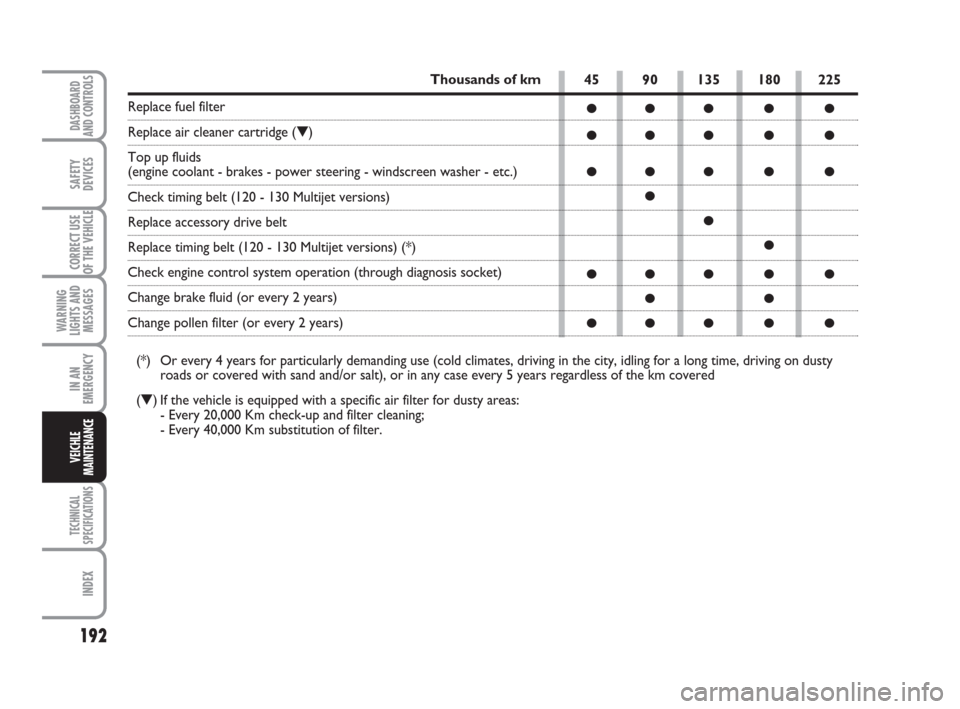
45 90 135 180 225
●●●●●
●●●●●
●●●●●
●
●
●
●●●●●
●●
●●●●●
Thousands of km
Replace fuel filter
Replace air cleaner cartridge (▼)
Top up fluids
(engine coolant - brakes - power steering - windscreen washer - etc.)
Check timing belt (120 - 130 Multijet versions)
Replace accessory drive belt
Replace timing belt (120 - 130 Multijet versions) (*)
Check engine control system operation (through diagnosis socket)
Change brake fluid (or every 2 years)
Change pollen filter (or every 2 years)
(*) Or every 4 years for particularly demanding use (cold climates, driving in the city, idling for a long time, driving on dusty
roads or covered with sand and/or salt), or in any case every 5 years regardless of the km covered
(▼) If the vehicle is equipped with a specific air filter for dusty areas:
- Every 20,000 Km check-up and filter cleaning;
- Every 40,000 Km substitution of filter.
Page 195 of 282
194
WARNING
LIGHTS AND
MESSAGES
TECHNICAL
SPECIFICATIONS
INDEX
DASHBOARD
AND CONTROLS
SAFETY
DEVICES
CORRECT USE
OF THE VEHICLE
IN AN
EMERGENCY
VEICHLE
MAINTENANCE
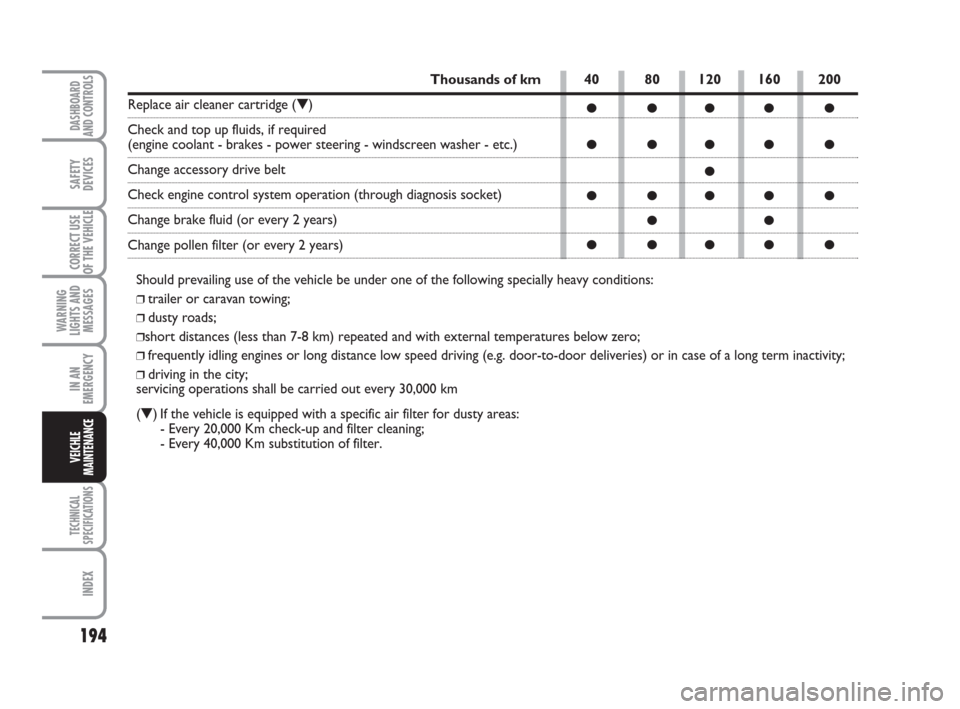
40 80 120 160 200
●●●●●
●●●●●
●
●●●●●
●●
●●●●●
Thousands of km
Replace air cleaner cartridge (▼)
Check and top up fluids, if required
(engine coolant - brakes - power steering - windscreen washer - etc.)
Change accessory drive belt
Check engine control system operation (through diagnosis socket)
Change brake fluid (or every 2 years)
Change pollen filter (or every 2 years)
Should prevailing use of the vehicle be under one of the following specially heavy conditions:
❒trailer or caravan towing;
❒dusty roads;
❒short distances (less than 7-8 km) repeated and with external temperatures below zero;
❒frequently idling engines or long distance low speed driving (e.g. door-to-door deliveries) or in case of a long term inactivity;
❒driving in the city;
servicing operations shall be carried out every 30,000 km
(▼) If the vehicle is equipped with a specific air filter for dusty areas:
- Every 20,000 Km check-up and filter cleaning;
- Every 40,000 Km substitution of filter.
Page 196 of 282
195
WARNING
LIGHTS AND
MESSAGES
TECHNICAL
SPECIFICATIONS
INDEX
DASHBOARD
AND CONTROLS
SAFETY
DEVICES
CORRECT USE
OF THE VEHICLE
IN AN
EMERGENCY
VEHICLE
MAINTENANCE
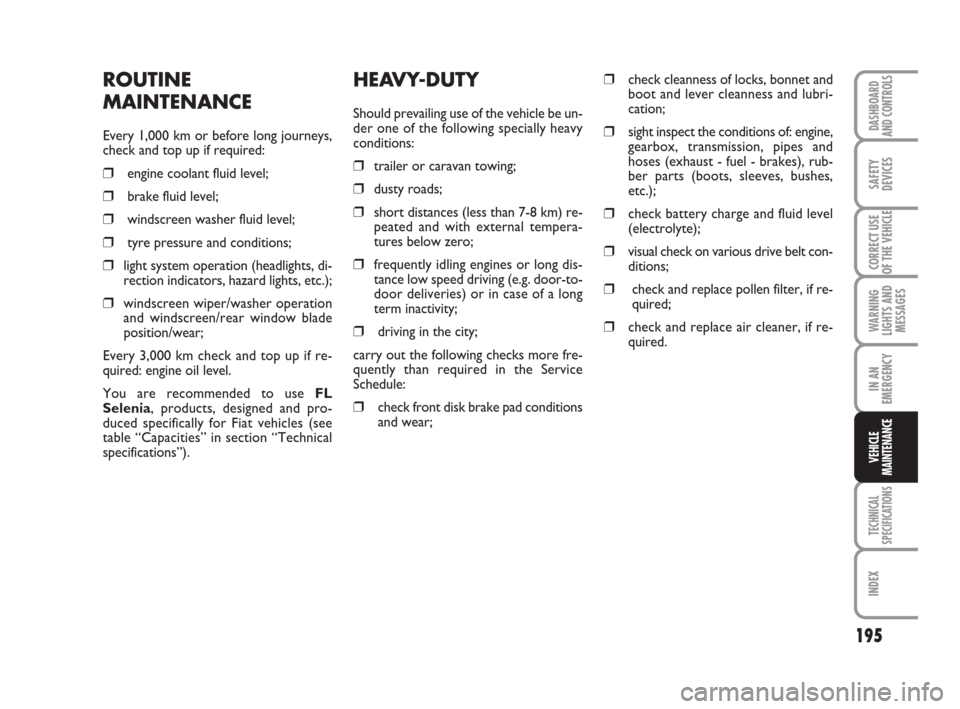
HEAVY-DUTY
Should prevailing use of the vehicle be un-
der one of the following specially heavy
conditions:
❒trailer or caravan towing;
❒dusty roads;
❒short distances (less than 7-8 km) re-
peated and with external tempera-
tures below zero;
❒frequently idling engines or long dis-
tance low speed driving (e.g. door-to-
door deliveries) or in case of a long
term inactivity;
❒driving in the city;
carry out the following checks more fre-
quently than required in the Service
Schedule:
❒check front disk brake pad conditions
and wear;
❒check cleanness of locks, bonnet and
boot and lever cleanness and lubri-
cation;
❒sight inspect the conditions of: engine,
gearbox, transmission, pipes and
hoses (exhaust - fuel - brakes), rub-
ber parts (boots, sleeves, bushes,
etc.);
❒check battery charge and fluid level
(electrolyte);
❒visual check on various drive belt con-
ditions;
❒check and replace pollen filter, if re-
quired;
❒check and replace air cleaner, if re-
quired.
ROUTINE
MAINTENANCE
Every 1,000 km or before long journeys,
check and top up if required:
❒engine coolant fluid level;
❒brake fluid level;
❒windscreen washer fluid level;
❒tyre pressure and conditions;
❒light system operation (headlights, di-
rection indicators, hazard lights, etc.);
❒windscreen wiper/washer operation
and windscreen/rear window blade
position/wear;
Every 3,000 km check and top up if re-
quired: engine oil level.
You are recommended to use FL
Selenia, products, designed and pro-
duced specifically for Fiat vehicles (see
table “Capacities” in section “Technical
specifications”).