air FIAT DUCATO 2008 3.G Repair Manual
[x] Cancel search | Manufacturer: FIAT, Model Year: 2008, Model line: DUCATO, Model: FIAT DUCATO 2008 3.GPages: 282, PDF Size: 4.55 MB
Page 202 of 282
201
WARNING
LIGHTS AND
MESSAGES
TECHNICAL
SPECIFICATIONS
INDEX
DASHBOARD
AND CONTROLS
SAFETY
DEVICES
CORRECT USE
OF THE VEHICLE
IN AN
EMERGENCY
VEHICLE
MAINTENANCE
Brake fluid is poisonous and
highly corrosive. In the event
of accidental contact, wash the parts
involved immediately with neutral
soap and water, then rinse thor-
oughly. Call the doctor immediately
if the fluid is swallowed.
WARNING
The symbol πon the con-
tainer indicates synthetic
brake fluid, distinguishing it from the
mineral kind. Using mineral fluids ir-
reversibly damages the special brak-
ing system rubber seals.
WARNING
POWER STEERING
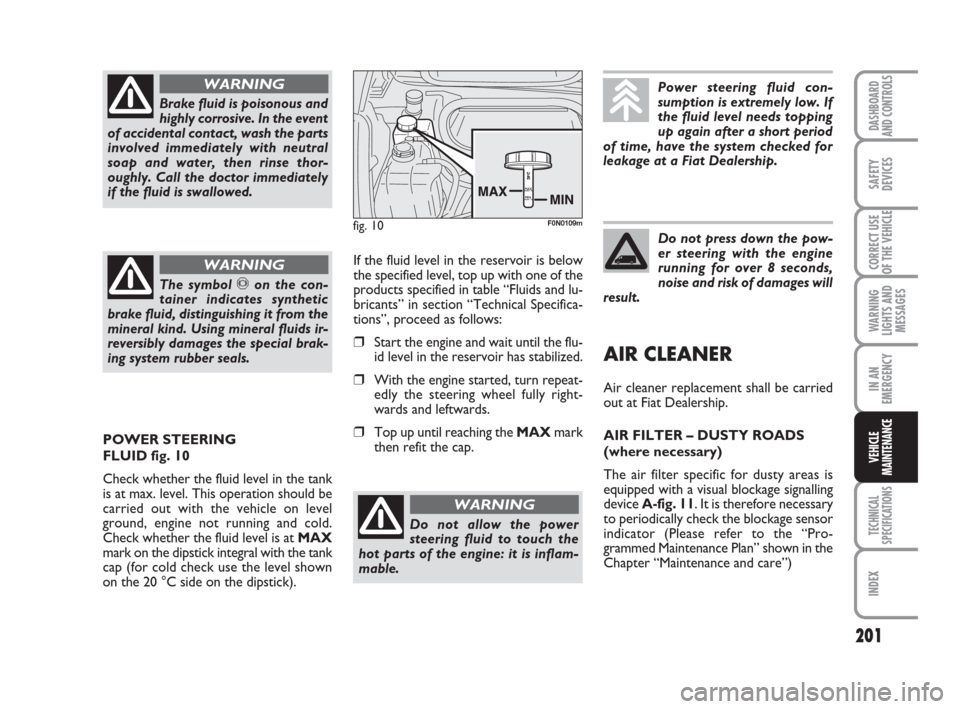
FLUID fig. 10
Check whether the fluid level in the tank
is at max. level. This operation should be
carried out with the vehicle on level
ground, engine not running and cold.
Check whether the fluid level is at MAX
mark on the dipstick integral with the tank
cap (for cold check use the level shown
on the 20 °C side on the dipstick).If the fluid level in the reservoir is below
the specified level, top up with one of the
products specified in table “Fluids and lu-
bricants” in section “Technical Specifica-
tions”, proceed as follows:
❒Start the engine and wait until the flu-
id level in the reservoir has stabilized.
❒With the engine started, turn repeat-
edly the steering wheel fully right-
wards and leftwards.
❒Top up until reaching the MAXmark
then refit the cap.
fig. 10F0N0109m
Do not allow the power
steering fluid to touch the
hot parts of the engine: it is inflam-
mable.
WARNING
Do not press down the pow-
er steering with the engine
running for over 8 seconds,
noise and risk of damages will
result.
Power steering fluid con-
sumption is extremely low. If
the fluid level needs topping
up again after a short period
of time, have the system checked for
leakage at a Fiat Dealership.
AIR CLEANER
Air cleaner replacement shall be carried
out at Fiat Dealership.
AIR FILTER – DUSTY ROADS
(where necessary)
The air filter specific for dusty areas is
equipped with a visual blockage signalling
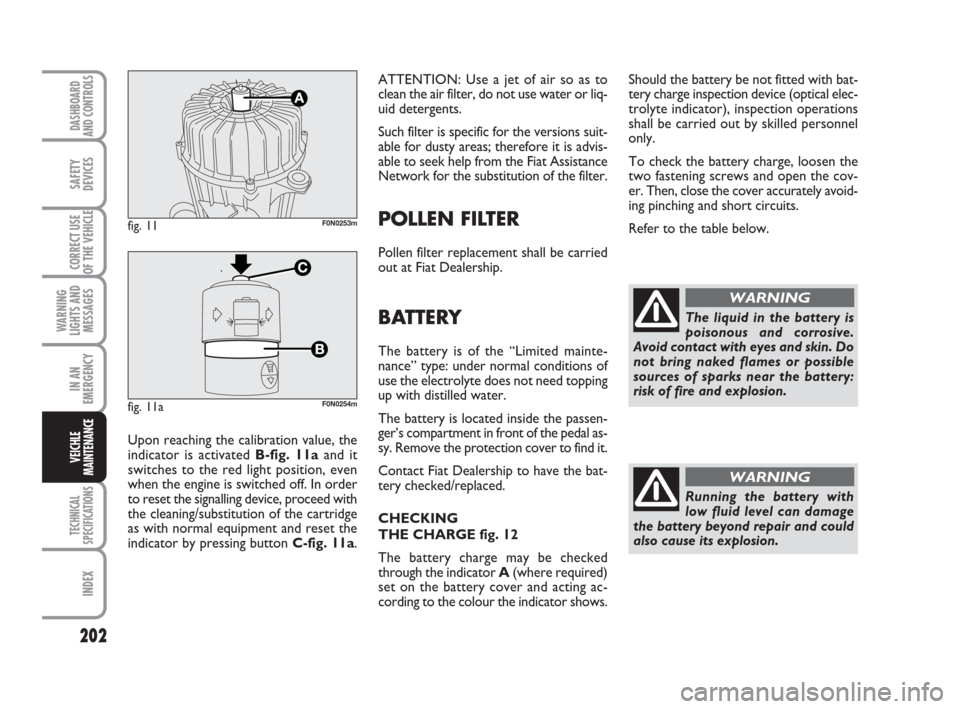
device A-fig. 11. It is therefore necessary
to periodically check the blockage sensor
indicator (Please refer to the “Pro-
grammed Maintenance Plan” shown in the
Chapter “Maintenance and care”)
Page 203 of 282
202
WARNING
LIGHTS AND
MESSAGES
TECHNICAL
SPECIFICATIONS
INDEX
DASHBOARD
AND CONTROLS
SAFETY
DEVICES
CORRECT USE
OF THE VEHICLE
IN AN
EMERGENCY
VEICHLE
MAINTENANCE
ATTENTION: Use a jet of air so as to
clean the air filter, do not use water or liq-
uid detergents.
Such filter is specific for the versions suit-
able for dusty areas; therefore it is advis-
able to seek help from the Fiat Assistance
Network for the substitution of the filter.
POLLEN FILTER
Pollen filter replacement shall be carried
out at Fiat Dealership.
BATTERY
The battery is of the “Limited mainte-
nance” type: under normal conditions of
use the electrolyte does not need topping
up with distilled water.
The battery is located inside the passen-
ger’s compartment in front of the pedal as-
sy. Remove the protection cover to find it.
Contact Fiat Dealership to have the bat-
tery checked/replaced.
CHECKING
THE CHARGE fig. 12
The battery charge may be checked
through the indicator A(where required)
set on the battery cover and acting ac-
cording to the colour the indicator shows.
The liquid in the battery is
poisonous and corrosive.
Avoid contact with eyes and skin. Do
not bring naked flames or possible
sources of sparks near the battery:
risk of fire and explosion.
WARNING
Running the battery with
low fluid level can damage
the battery beyond repair and could
also cause its explosion.
WARNING
Should the battery be not fitted with bat-
tery charge inspection device (optical elec-
trolyte indicator), inspection operations
shall be carried out by skilled personnel
only.
To check the battery charge, loosen the
two fastening screws and open the cov-
er. Then, close the cover accurately avoid-
ing pinching and short circuits.
Refer to the table below.
Upon reaching the calibration value, the
indicator is activated B-fig. 11aand it
switches to the red light position, even
when the engine is switched off. In order
to reset the signalling device, proceed with
the cleaning/substitution of the cartridge
as with normal equipment and reset the
indicator by pressing button C-fig. 11a.
fig. 11F0N0253m
fig. 11aF0N0254m
Page 207 of 282
206
WARNING
LIGHTS AND
MESSAGES
TECHNICAL
SPECIFICATIONS
INDEX
DASHBOARD
AND CONTROLS
SAFETY
DEVICES
CORRECT USE
OF THE VEHICLE
IN AN
EMERGENCY
VEICHLE
MAINTENANCE
WINDSCREEN
BLADES
Periodically clean the rubber part using
special products; TUTELA PROFES-
SIONAL SC 35is recommended.
If the rubber blades are bent or worn they
should be replaced. In any case they should
be changed once a year.
A few simple notions can reduce the pos-
sibility of damage to the blades:
❒if the temperature fall below zero,
make sure that ice has not frozen the
rubber against glass. If necessary, thaw
using an antifreeze product;
❒remove any snow from the glass: in ad-
dition to protecting the blades, this
prevents effort on the motor and
overheating;
❒do not operate the windscreen
wipers on dry glass.
Driving with worn wiper
blades is a serious hazard,
because visibility is reduced in bad
weather.
WARNING
RUBBER HOSES
As far as the brake system and fuel rubber
hoses are concerned, carefully follow the
“Service schedule” in this section.
Indeed ozone, high temperatures and pro-
longed lack of fluid in the system may
cause hardening and cracking of the hoses,
with possible leaks. Careful control is
therefore necessary.If the pressure is too low the
tyre overheats and this can
cause it serious damage.
WARNING
Do not cross switch the
tyres, moving them from the
right of the vehicle to the left and vice
versa.
WARNING
Never submit alloy rims to
repainting treatments re-
quiring to use temperatures exceed-
ing 150°C since the mechanical prop-
erties of the wheels could be im-
paired.
WARNING
Page 209 of 282
208
WARNING
LIGHTS AND
MESSAGES
TECHNICAL
SPECIFICATIONS
INDEX
DASHBOARD
AND CONTROLS
SAFETY
DEVICES
CORRECT USE
OF THE VEHICLE
IN AN
EMERGENCY
VEICHLE
MAINTENANCE
BODY AND UNDERBODY
WARRANTY
Your vehicle is covered by warranty
against perforation due to rust of any orig-
inal element of the structure or body.
For the general terms of this warranty, re-
fer to Fiat Warranty Booklet.
ADVICE FOR PRESERVING THE
BODYWORK
Paint
Paintwork does not only serve an aesteth-
ic purpose, but also protects the under-
lying sheet metal.
In the case of deep scrapes or scores, you
are advised to have the necessary touching
up carried out immediately to avoid the for-
mation of rust. For touching up use only
original products (see “Bodywork paint
identification plate” in section “Technical
specifications”).
Normal paint maintenance consists in
washing at intervals depending on the con-
ditions and environment of use. For exam-
ple, in highly polluted areas, or if the roads
are sprayed with salt, it is wise to wash the
vehicle more frequently. These include:
❒Painting products and systems which
give the vehicle particular resistance
to corrosion and abrasion;
❒Use of galvanised (or pretreated)
steel sheets, with high resistance to
corrosion;
❒Spraying the underbody, engine com-
partment, wheelhouse internal parts
and other parts with highly protective
wax products;
❒Spraying of plastic parts, with a pro-
tective function, in the more exposed
points: underdoor, inner fender parts,
edges, etc;
❒Use of “open” boxed sections to pre-
vent condensation and pockets of
moisture from triggering rust inside.
BODYWORK
PROTECTION FROM
ATMOSPHERIC AGENTS
The main causes of corrosion are the fol-
lowing:
❒atmospheric pollution;
❒salty air and humidity (coastal areas,
or hot humid climates);
❒seasonal environment conditions.
Not to be underestimated is also the abra-
sive action of wind-borne atmospheric
dust and sand and mud and gravel raised
by other vehicles.
On your vehicle, Fiat implemented the
best manufacturing technologies to effec-
tively protect the bodywork against cor-
rosion.
Page 210 of 282
209
WARNING
LIGHTS AND
MESSAGES
TECHNICAL
SPECIFICATIONS
INDEX
DASHBOARD
AND CONTROLS
SAFETY
DEVICES
CORRECT USE
OF THE VEHICLE
IN AN
EMERGENCY
VEHICLE
MAINTENANCE
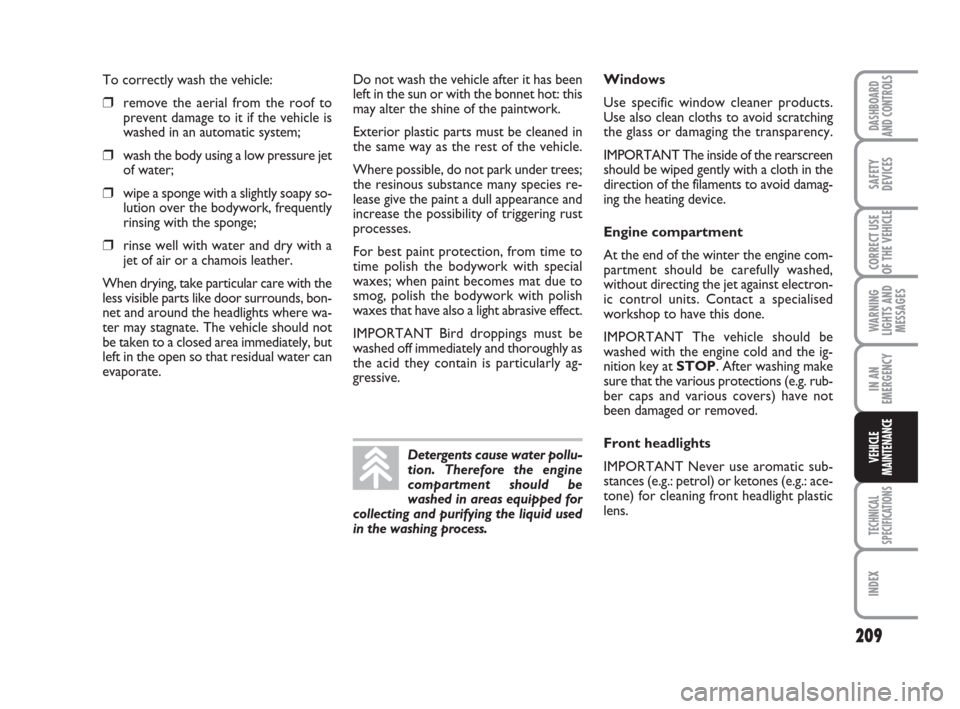
To correctly wash the vehicle:
❒remove the aerial from the roof to
prevent damage to it if the vehicle is
washed in an automatic system;
❒wash the body using a low pressure jet
of water;
❒wipe a sponge with a slightly soapy so-
lution over the bodywork, frequently
rinsing with the sponge;
❒rinse well with water and dry with a
jet of air or a chamois leather.
When drying, take particular care with the
less visible parts like door surrounds, bon-
net and around the headlights where wa-
ter may stagnate. The vehicle should not
be taken to a closed area immediately, but
left in the open so that residual water can
evaporate.Do not wash the vehicle after it has been
left in the sun or with the bonnet hot: this
may alter the shine of the paintwork.
Exterior plastic parts must be cleaned in
the same way as the rest of the vehicle.
Where possible, do not park under trees;
the resinous substance many species re-
lease give the paint a dull appearance and
increase the possibility of triggering rust
processes.
For best paint protection, from time to
time polish the bodywork with special
waxes; when paint becomes mat due to
smog, polish the bodywork with polish
waxes that have also a light abrasive effect.
IMPORTANT Bird droppings must be
washed off immediately and thoroughly as
the acid they contain is particularly ag-
gressive.
Detergents cause water pollu-
tion. Therefore the engine
compartment should be
washed in areas equipped for
collecting and purifying the liquid used
in the washing process.
Windows
Use specific window cleaner products.
Use also clean cloths to avoid scratching
the glass or damaging the transparency.
IMPORTANT The inside of the rearscreen
should be wiped gently with a cloth in the
direction of the filaments to avoid damag-
ing the heating device.
Engine compartment
At the end of the winter the engine com-
partment should be carefully washed,
without directing the jet against electron-
ic control units. Contact a specialised
workshop to have this done.
IMPORTANT The vehicle should be
washed with the engine cold and the ig-
nition key at STOP. After washing make
sure that the various protections (e.g. rub-
ber caps and various covers) have not
been damaged or removed.
Front headlights
IMPORTANT Never use aromatic sub-
stances (e.g.: petrol) or ketones (e.g.: ace-
tone) for cleaning front headlight plastic
lens.
Page 218 of 282
217
WARNING
LIGHTS AND
MESSAGES
INDEX
DASHBOARD
AND CONTROLS
SAFETY
DEVICES
CORRECT USE
OF THE
VEHICLE
IN AN
EMERGENCY
VEHICLE
MAINTENANCE
TECHNICAL
SPECIFICATIONS
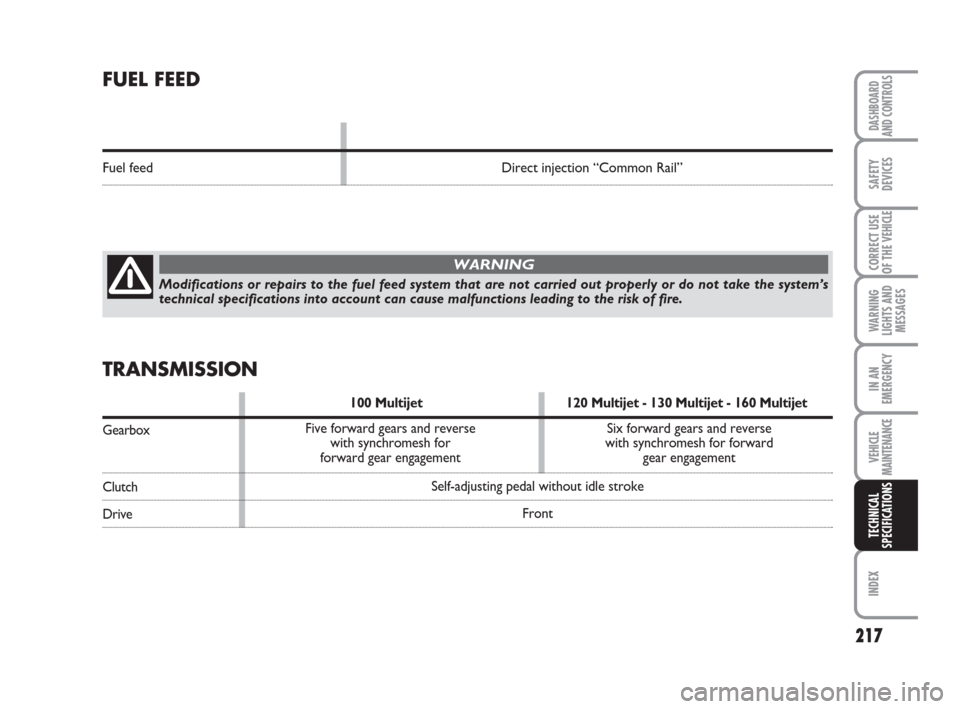
FUEL FEED
Fuel feed Direct injection “Common Rail”
Modifications or repairs to the fuel feed system that are not carried out properly or do not take the system’s
technical specifications into account can cause malfunctions leading to the risk of fire.
WARNING
TRANSMISSION
100 Multijet 120 Multijet - 130 Multijet - 160 Multijet
Gearbox
Clutch
DriveSelf-adjusting pedal without idle stroke
Front Five forward gears and reverse
with synchromesh for
forward gear engagementSix forward gears and reverse
with synchromesh for forward
gear engagement
Page 265 of 282
264
WARNING
LIGHTS AND
MESSAGES
INDEX
DASHBOARD
AND CONTROLS
SAFETY
DEVICES
CORRECT USE
OF THE
VEHICLE
IN AN
EMERGENCY
VEHICLE
MAINTENANCE
TECHNICAL
SPECIFICATIONS
❒extra-urban cycle: frequent acceler-
ating in all gears, simulating extraurban
use of the vehicle; the speed varies be-
tween 0 and 120 km/h;
❒combined consumption: is calculated
weighing about 37% of urban cycle
consumption and about 63% of ex-
traurban consumption.
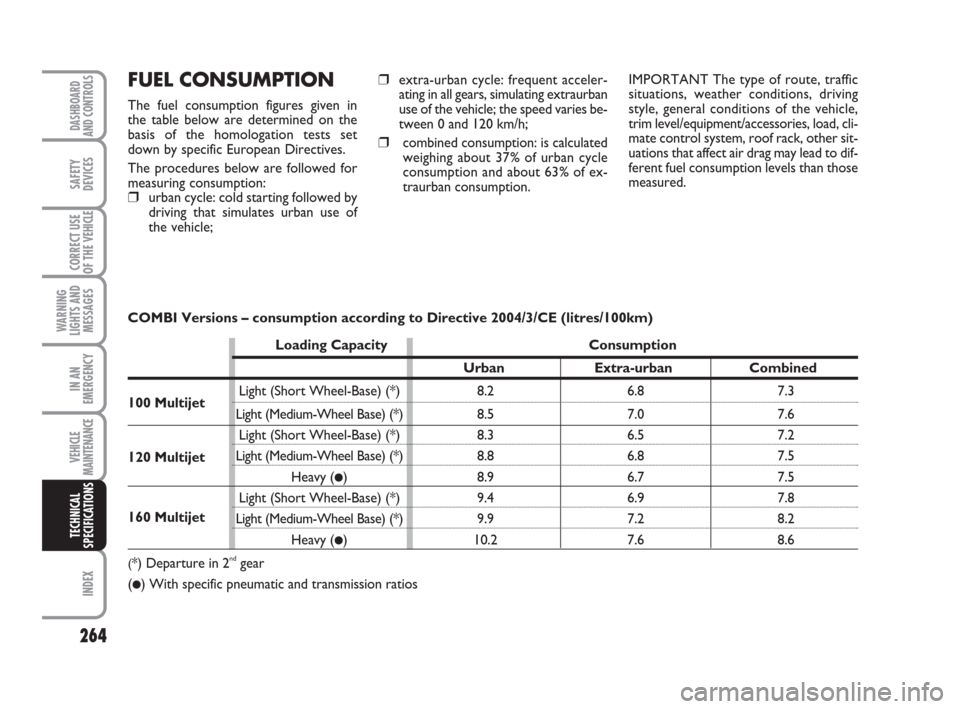
FUEL CONSUMPTION
The fuel consumption figures given in
the table below are determined on the
basis of the homologation tests set
down by specific European Directives.
The procedures below are followed for
measuring consumption:
❒urban cycle: cold starting followed by
driving that simulates urban use of
the vehicle;IMPORTANT The type of route, traffic
situations, weather conditions, driving
style, general conditions of the vehicle,
trim level/equipment/accessories, load, cli-
mate control system, roof rack, other sit-
uations that affect air drag may lead to dif-
ferent fuel consumption levels than those
measured.
Light (Short Wheel-Base) (*)
Light (Medium-Wheel Base) (*)
Light (Short Wheel-Base) (*)
Light (Medium-Wheel Base) (*)
Heavy (
●)
Light (Short Wheel-Base) (*)
Light (Medium-Wheel Base) (*)
Heavy (
●)8.2
8.5
8.3
8.8
8.9
9.4
9.9
10.26.8
7.0
6.5
6.8
6.7
6.9
7.2
7.67.3
7.6
7.2
7.5
7.5
7.8
8.2
8.6 100 Multijet
120 Multijet
160 Multijet COMBI Versions – consumption according to Directive 2004/3/CE (litres/100km)
Loading Capacity Consumption
Urban Extra-urban Combined
(*) Departure in 2ndgear
(
●) With specific pneumatic and transmission ratios
Page 271 of 282
270
WARNING
LIGHTS AND
MESSAGES
DASHBOARD
AND CONTROLS
SAFETY
DEVICES
CORRECT USE
OF THE
VEHICLE
IN AN
EMERGENCY
VEHICLE
MAINTENANCE
TECHNICAL
SPECIFICATIONS
INDEX
– jump starting .................................. 158
– recharging........................................ 185
– replacing ......................................... 202
– battery disconnection function ... 83
Bodywork
– maintenance .................................. 208
– version codes ................................ 212
Bonnet .................................................. 98
Brake Assist
(brake assist in an emergency) ....... 103
Brake fluid level.................................... 200
Brakes
– fluid level ........................................ 200
– technical data ................................ 218
Bulb (replacement)
– bulb types ....................................... 168
– general instructions....................... 168
Ceiling lights
– front................................................. 81
– rear................................................... 82
Chassis (marking) ............................... 213
Checking fluid levels............................ 196Child restraint systems
(specifications for use)..................... 119
Cigar lighter ......................................... 87
CO
2exhaust emissions ..................... 265
Code card............................................. 8
Consumption
– engine oil......................................... 198
– fuel.................................................... 264
Containing running costs................... 138
Controls ............................................... 82
Correct use of the vehicle................. 133
Cruise Control .................................... 79
Current outlet...................................... 88
Dashboard (left hand drive version) 5
Dashboard (right hand drive version) 6
Dashboard and controls..................... 4
Dead lock device
– activation/deactivation.................. 94
Digital display........................................ 20
Dimensions .......................................... 223
Dipped beam headlights
– bulb replacement .......................... 171
ABS ...................................................... 102
Accessories purchased by
the user .............................................. 109
Additional climate control system
(rear).................................................... 73
Additional rear heater........................ 72
Air bags (front)..................................... 123
Air bags (side)....................................... 125
Air cleaner............................................. 201
Air vents ............................................... 47
Armrest
– front................................................. 38
Ashtray................................................... 87
ASR ........................................................ 105
– activation/deactivation ................. 105
At the filling station............................. 125
Automatic climate control system .. 55
Automatic headlight sensor
(daylight sensor)................................ 92
Battery
– checking the charge ..................... 202
II I
N N
D D
E E
X X