instrument panel FIAT DUCATO 2016 3.G Owner's Guide
[x] Cancel search | Manufacturer: FIAT, Model Year: 2016, Model line: DUCATO, Model: FIAT DUCATO 2016 3.GPages: 296, PDF Size: 15.08 MB
Page 87 of 296
64)The HBA system is an aid for the driver,
who must always pay full attention while
driving. The responsibility always rests with
the driver. The features of the HBA system
must never be tested in imprudent or
dangerous ways, with the possibility of
putting the safety of the driver, occupants
or other road users at risk.
65)The performance of a vehicle with
ERM must never be tested in imprudent or
dangerous ways, with the possibility of
putting the safety of the driver or other
people at risk.
WARNING
12)Prolonged use of the system may
overheat the braking system. If the brakes
overheat, the HDC system, when active,
will be gradually deactivated after suitably
informing the driver (the LED on the button
turns off): it can be reactivated only when
the brakes have cooled sufficiently. The
distance you can travel depends on the
brake temperature and thus on the slope,
the load and the vehicle speed.
TRACTION PLUS
SYSTEM
(for versions/markets, where provided)
Traction Plus is a driving aid, useful
for setting off in poor grip conditions on
non-homogeneous road surfaces
(snow/asphalt, ice/asphalt, mud/
asphalt, etc.), which allows the drive
force to be distributed adequately
on the engine axle when one of the two
drive wheels slips.
Traction Plus acts by braking the wheel
with poor grip (or slipping more than
the others), thereby transferring the
drive force to that which has greater
grip on the ground.
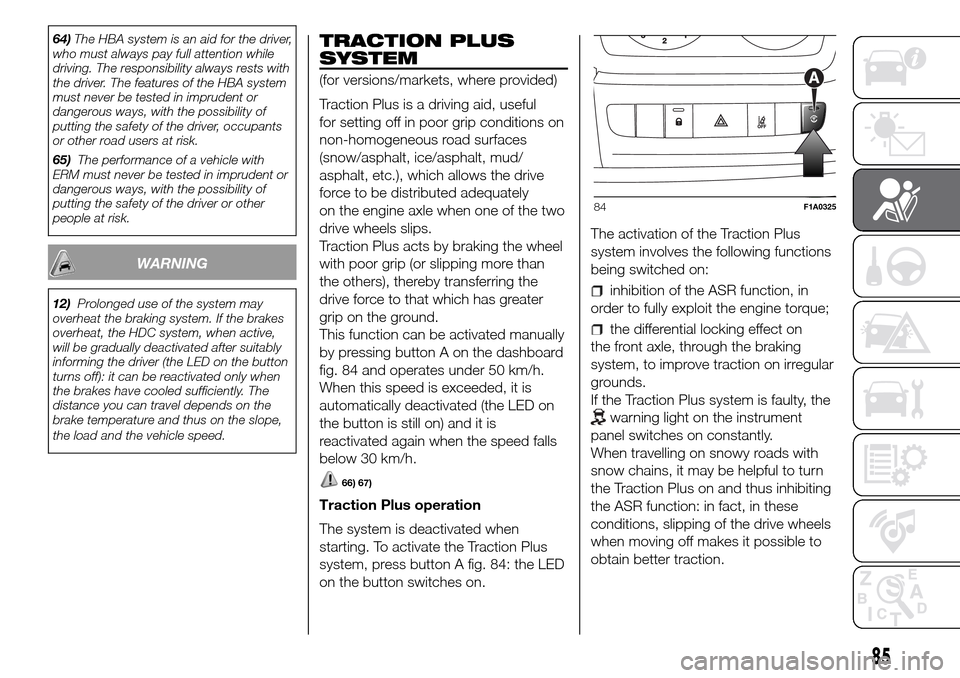
This function can be activated manually
by pressing button A on the dashboard
fig. 84 and operates under 50 km/h.
When this speed is exceeded, it is
automatically deactivated (the LED on
the button is still on) and it is
reactivated again when the speed falls
below 30 km/h.
66) 67)
Traction Plus operation
The system is deactivated when
starting. To activate the Traction Plus
system, press button A fig. 84: the LED
on the button switches on.The activation of the Traction Plus
system involves the following functions
being switched on:
inhibition of the ASR function, in
order to fully exploit the engine torque;
the differential locking effect on
the front axle, through the braking
system, to improve traction on irregular
grounds.
If the Traction Plus system is faulty, the
warning light on the instrument
panel switches on constantly.
When travelling on snowy roads with
snow chains, it may be helpful to turn
the Traction Plus on and thus inhibiting
the ASR function: in fact, in these
conditions, slipping of the drive wheels
when moving off makes it possible to
obtain better traction.
84F1A0325
85
Page 89 of 296
The TPMS does not replace the
correct tyre maintenance. It is up to the
driver to maintain the correct tyre
pressure level measuring it with
a suitable pressure switch. This is
necessary even if the decrease in the
inflation pressure value does not cause
the tyre pressure control warning light
to switch on.
The TPMS warns the driver of any
condition of insufficient tyre pressure
If this drops below the insufficient
pressure limit for any reason including
low temperature and normal pressure
loss of the tyre.
The seasonal temperature changes
affect tyre pressure.
The TPMS uses wireless devices with
electronic sensors mounted on the
wheel rims to constantly monitor the
value of tyre pressure. The sensors
mounted on each wheel as part of the
valve stem transmit various information
of the tyres to the receiver module, in
order to calculate the pressure.
IMPORTANT Monitoring and
maintaining the correct pressure in all
four tyres are particularly important.Tyre pressure monitoring system
low pressure warnings
The system warns the driver if one or
more tyres are flat by turning on the
warning light on the instrument
panel (together with a warning message
and an acoustic signal).
In this case, stop the vehicle as soon as
possible, check the inflation pressure
of each tyre and inflate to the cold tyre
pressure value prescribed for the
vehicle. The system will automatically
update and after receiving the tyre
pressure update the tyre pressure
control warning light switches off. You
may need to drive the vehicle for about
20 minutes at a speed higher than 20
km/h to allow the system to receive this
information.
TPMS operation faults
The system fault is indicated by the
corresponding warning light
, which
first flashes for 75 seconds and then
stays on continuously. This can occur in
any of the following situations:
interference caused by electronic
devices or radio frequency emissions
similar to those of the TPM sensors.
Application of tinted films which
interfere with the signals of the radio
waves.
Presence of snow or ice on the
wheels or the wheel arches.
Use of snow chains.
Use of wheels/tyres not equipped
with TPM sensors.
The space-saver wheel is not
equipped with the tyre pressure control
sensor. Therefore, the tyre pressure is
not controlled by the system.
If the space-saver wheel replaces a
tyre with a pressure lower than the
insufficient pressure limit, an acoustic
signal will be emitted and the
warning light will turn on at the next
start-up.
When the original tyre is repaired or
replaced and it is mounted back on
the vehicle to replace the space-saver
wheel, the TPMS will update
automatically and the warning light will
switch off, provided that the pressure of
none of the four tyres is below the
insufficient pressure limit. You may need
to drive the vehicle for about 20
minutes at a speed higher than 20
km/h to allow the TPMS to receive this
information.
87
Page 91 of 296
DRIVING ADVISOR
(lane crossing warning)
(for versions/markets, where provided)
77) 78) 79)The Driving Advisor is a warning system
that notifies the driver if he/she crosses
the lane because he/she has been
distracted.
A video sensor, fitted on the windscreen
near the interior rear view mirror,
detects the lane demarcation lines and
the position of the vehicle in relation
to them.
IMPORTANT On cars with Driving
Advisor, it is advisable to contact a Fiat
Dealership should the windscreen
need to be replaced. If the repair is
carried out at a specialist window
replacement centre, it is still necessary
to go to a Fiat Dealership to have the
camera calibrated.
OPERATION
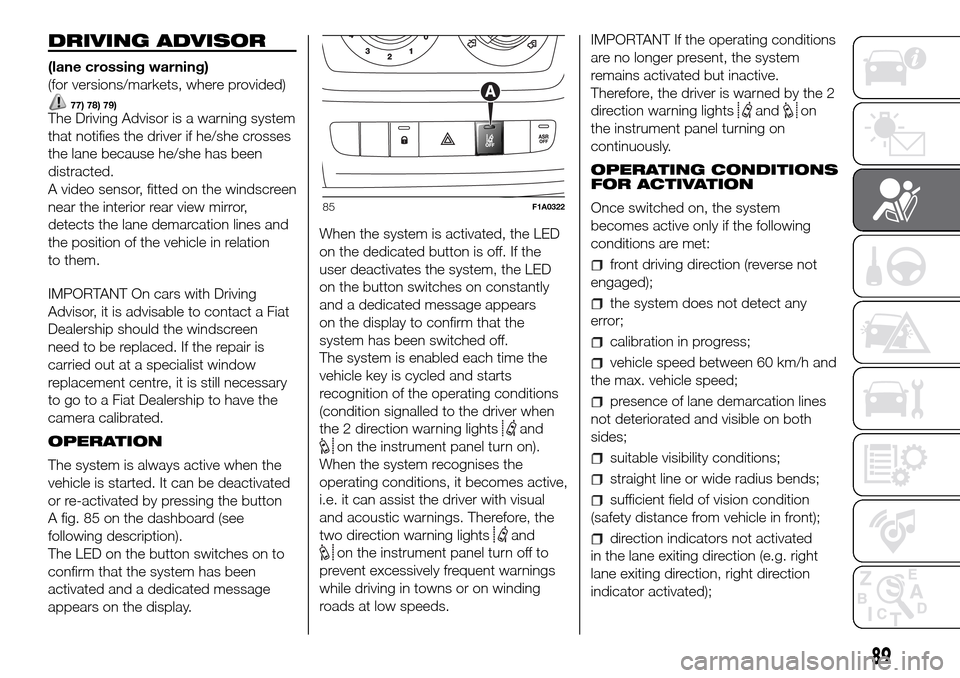
The system is always active when the
vehicle is started. It can be deactivated
or re-activated by pressing the button
A fig. 85 on the dashboard (see
following description).
The LED on the button switches on to
confirm that the system has been
activated and a dedicated message
appears on the display.When the system is activated, the LED
on the dedicated button is off. If the
user deactivates the system, the LED
on the button switches on constantly
and a dedicated message appears
on the display to confirm that the
system has been switched off.
The system is enabled each time the
vehicle key is cycled and starts
recognition of the operating conditions
(condition signalled to the driver when
the 2 direction warning lights
and
on the instrument panel turn on).
When the system recognises the
operating conditions, it becomes active,
i.e. it can assist the driver with visual
and acoustic warnings. Therefore, the
two direction warning lights
and
on the instrument panel turn off to
prevent excessively frequent warnings
while driving in towns or on winding
roads at low speeds.IMPORTANT If the operating conditions
are no longer present, the system
remains activated but inactive.
Therefore, the driver is warned by the 2
direction warning lights
andon
the instrument panel turning on
continuously.
OPERATING CONDITIONS
FOR ACTIVATION
Once switched on, the system
becomes active only if the following
conditions are met:
front driving direction (reverse not
engaged);
the system does not detect any
error;
calibration in progress;
vehicle speed between 60 km/h and
the max. vehicle speed;
presence of lane demarcation lines
not deteriorated and visible on both
sides;
suitable visibility conditions;
straight line or wide radius bends;
sufficient field of vision condition
(safety distance from vehicle in front);
direction indicators not activated
in the lane exiting direction (e.g. right
lane exiting direction, right direction
indicator activated);
85F1A0322
89
Page 96 of 296
WARNING
80)Never press button C fig. 86when
travelling.
81)The height of the seat belts must be
adjusted with the vehicle stationary.
82)After adjustment, always check that the
cursor to which the ring is fastened is
locked in one of the preset positions.
Release the grip and push downwards to
enable the locking device to click if the grip
has not been released in one of the
possible positions.
SBR SYSTEM
IN BRIEF
The vehicle is equipped with a
system called SBR. (Seat Belt
Reminder), composed of a buzzer
which, along with the flashing
warning light on the instrument
panel, warns the driver that their seat
belt or (for versions/markets, where
provided) the passenger's seat belt is
not correctly fastened.
For permanent deactivation, contact a
Fiat Dealership.
With multifunction display, the SBR
system can also be reactivated through
the set-up menu.
PRE-TENSIONERS
To increase the protective efficiency of
the front seat belts, the vehicle is fitted
with pretensioners. These devices, in
the event of a head-on crash or side
impact, rewind the seat belts a few
centimetres. In this way, they ensure
that the belts fit tightly to the wearer
before the restraining action begins.
It is evident that the pretensioners have
been activated when the belt withdraws
toward the retractor.
A slight discharge of smoke may be
produced during the activation of the
pretensioner which is not harmful and
does not involve any fire hazard.
The pretensioner does not require any
maintenance or lubrication. Any
changes to its original conditions will
invalidate its efficiency. If, due to
unusual natural events (floods, sea
storms, etc.), the device has been
affected by water or mud, contact a
Fiat Dealership to have it replaced.
83)
13)
IMPORTANT To obtain the highest
degree of protection from the action of
the pretensioner, wear the seat belt
tight to the chest and pelvis.
94
SAFETY
Page 102 of 296
Below is a summary of
the main safety rules to
be followed when
carrying children
The recommended position for
installing child restraint systems is on
the rear seat, as it is the most protected
area in the event of an impact.
Keep children in rearward-facing
child restraint systems for as long
as possible, ideally until they are 3–4
years old.
If the passenger front airbag is
deactivated, always check the
corresponding LED on the button
on
the instrument panel to make sure
that it has actually been deactivated.
Carefully follow the instructions that
come with the child seat, which the
manufacturer must supply. Keep the
instructions in the vehicle along with the
other papers and this handbook. Do
not use second-hand child seats
without instructions.
Always check that the seat belt is
well fastened by pulling on it.
Only one child is to be strapped into
each restraint system; never carry two
children using one child restraint
system.
Always check that seat belts do not
rest on the child’s neck.
While travelling, do not let the child
sit incorrectly or unfasten the belts.
Never carry children on your lap,
even newborns. No one can hold
a child in the case of an accident.
Never allow a child to put the belt's
diagonal section under an arm or
behind their back.
If the vehicle has been involved in a
road accident, replace the child
restraint system with a new one. In
addition, and depending on the type of
child restraint system installed, replace
the Isofix anchorages or the seat belt
with which the child restraint system
was connected.
The rear headrest can be removed if
needed to install a child restraint
system. The headrest must always be
fitted in the vehicle if the seat is used by
an adult passenger or a child sitting in
a restraint system without backrest.
WARNING
87)Do not place a rearward facing cradle
seat on the front seat if the passenger side
airbag is enabled. Deployment of the
airbag in an accident could cause fatal
injuries to the child regardless of the
severity of the impact. It is advisable to
always carry children in a child restraint
system on the rear seat, which is the most
protected position in the event of a
collision. If you need to carry a child on the
front passenger seat in a rearward facing
cradle seat, the passenger side airbags
(front and side bags for chest/pelvis
protection, for versions/markets, where
provided) must be deactivated using
the setup menu. It is important to check
the dedicated LED on button
on the
instrument panel to make sure that they
are actually deactivated. Move the
passenger's seat as far back as possible
to avoid contact between the child seat
and the dashboard.
88)On the sun visor there is a label with
suitable symbols reminding the user that it
is compulsory to deactivate the airbag if
a rearward facing child restraint system is
fitted. Always comply with the instructions
on the passenger side sun visor (see the
"Supplementary Restraint System (SRS)
- Airbag" paragraph).
89)Do not move the front or rear seat if a
child is seated on it or on the dedicated
child restraint system.
100
SAFETY
Page 110 of 296
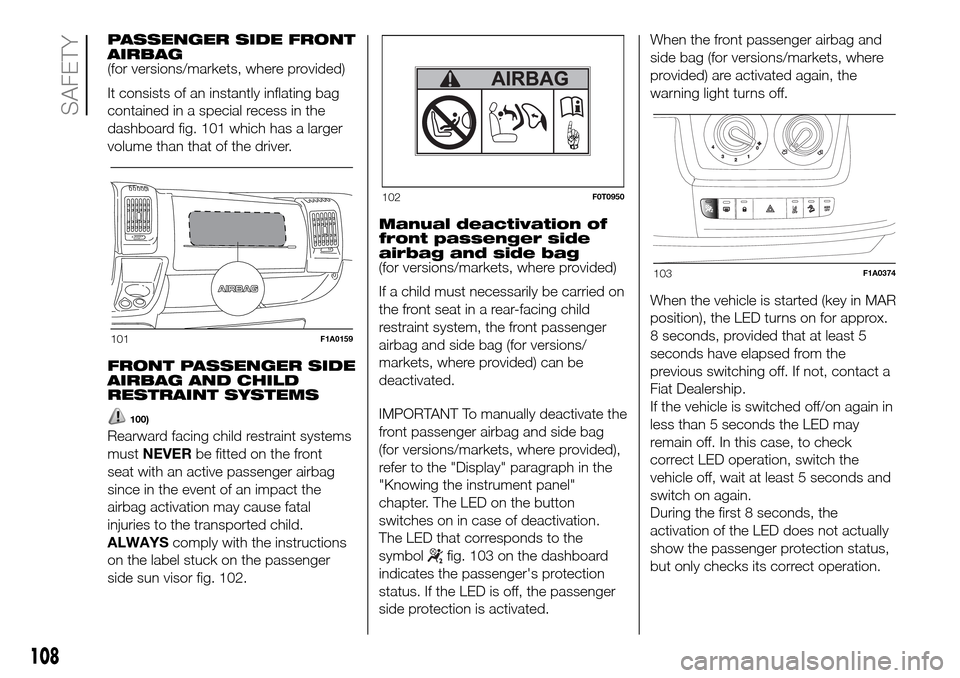
PASSENGER SIDE FRONT
AIRBAG
(for versions/markets, where provided)
It consists of an instantly inflating bag
contained in a special recess in the
dashboard fig. 101 which has a larger
volume than that of the driver.
FRONT PASSENGER SIDE
AIRBAG AND CHILD
RESTRAINT SYSTEMS
100)
Rearward facing child restraint systems
mustNEVERbe fitted on the front
seat with an active passenger airbag
since in the event of an impact the
airbag activation may cause fatal
injuries to the transported child.
ALWAYScomply with the instructions
on the label stuck on the passenger
side sun visor fig. 102.Manual deactivation of
front passenger side
airbag and side bag
(for versions/markets, where provided)
If a child must necessarily be carried on
the front seat in a rear-facing child
restraint system, the front passenger
airbag and side bag (for versions/
markets, where provided) can be
deactivated.
IMPORTANT To manually deactivate the
front passenger airbag and side bag
(for versions/markets, where provided),
refer to the "Display" paragraph in the
"Knowing the instrument panel"
chapter. The LED on the button
switches on in case of deactivation.
The LED that corresponds to the
symbol
fig. 103 on the dashboard
indicates the passenger's protection
status. If the LED is off, the passenger
side protection is activated.When the front passenger airbag and
side bag (for versions/markets, where
provided) are activated again, the
warning light turns off.
When the vehicle is started (key in MAR
position), the LED turns on for approx.
8 seconds, provided that at least 5
seconds have elapsed from the
previous switching off. If not, contact a
Fiat Dealership.
If the vehicle is switched off/on again in
less than 5 seconds the LED may
remain off. In this case, to check
correct LED operation, switch the
vehicle off, wait at least 5 seconds and
switch on again.
During the first 8 seconds, the
activation of the LED does not actually
show the passenger protection status,
but only checks its correct operation.
101F1A0159
102F0T0950
103F1A0374
108
SAFETY
Page 115 of 296
107)Airbags may be deployed if another
vehicle crashes into yours if the key is
inserted and on, even if the engine is not
running and your vehicle is standing.
Therefore, even if the car is stationary,
when an active front passenger airbag is
fitted, DO NOT install rear facing child
restraint systems on the front passenger
seat. Deployment of the airbag following an
impact could cause fatal injuries to the
child. Therefore, always deactivate the
passenger side airbag when a rearward
facing child restraint system is installed on
the front passenger seat. The front
passenger seat must also be positioned
back as far as possible in order to prevent
the child restraint system from coming
into contact with the dashboard.
Immediately reactivate the passenger
airbag as soon as the child restraint system
has been removed. Also remember that, if
the key is turned to STOP, none of the
safety devices (airbags or pretensioners)
will be deployed in the event of collision.
Non-deployment in such cases does
not indicate a system malfunction.
108)Have the airbag system checked by a
Fiat Dealership if the car was stolen, if
theft was attempted, or if the car was
subjected to vandalism or flooding.
109)By turning the ignition key to MAR
position, the LED on the
button located
on the dashboard lights up (the time it
stays lit up can vary depending on the
market), to check that the button LED is
working correctly.
110)Do not wash the seats with water or
pressurised steam (wash by hand or at
automatic seat washing stations).111)The front airbag is designed to be
deployed for impacts of a greater intensity
than for the pretensioners. For impacts
whose intensity falls between the two
levels, normally, only the pretensioners will
be activated.
112)Do not affix rigid objects to the
garment hooks or support handles.
113)The airbag does not replace seat
belts but increases their efficiency.
Furthermore, since front airbags are not
deployed in low-speed frontal impacts,
side impacts, rear shunts or roll-overs, the
passengers are protected only by the
seat belts which must therefore be
fastened at all times.
114)In some versions, in the event of a
LED
OFFfailure (located on the
dashboard trim), thewarning light on
the instrument panel turns on and the
passenger side bags are deactivated. In
some versions, in the event of a LED
ONfailure (located on the dashboard
trim), thelight on the console turns on.
113
Page 117 of 296
STARTING THE
ENGINE
The vehicle is fitted with an electronic
engine lock device: if the engine fails to
start, see the paragraph “The Fiat
CODE system” in section “Know your
vehicle”.
Before starting the vehicle, adjust the
seat, the interior rear view mirrors,
the door mirrors and fasten the seat
belts correctly. Never press the
accelerator pedal for starting the
engine.
115)
14) 15)
PROCEDURE FOR
VERSIONS WITH MANUAL
TRANSMISSION
Proceed as follows:
engage the handbrake;
put the gear lever into neutral;
turn the ignition key to theMAR
position: the warning lights
and
on the instrument panel will turn on;
wait for the warning lightsand
to turn off, which will happen faster
the warmer the engine is;
fully depress the clutch pedal
without touching the accelerator;
turn the ignition key to the AVV
position as soon as the warning light
turns off. Waiting too long will waste
the heating work carried out by the
plugs.
Release the key as soon as the engine
starts.
PROCEDURE FOR
VERSIONS WITH
COMFORT MATIC
TRANSMISSION
The system allows the engine to be
started both with a gear engaged and
with the gearbox in neutral (N);
however, the brake pedal must be
pressed first with a gear engaged.
It is advisable to place the gear lever in
neutral (N) before starting the engine.
16)
PROCEDURE FOR
NATURAL POWER
VERSIONS
(For versions/markets, where provided)
The various engine cranking methods
are described below:
METHANE tank not on reserve –
petrol tank not empty:
the engine is always started in methane
mode;
METHANE tank empty – petrol tank
not empty:the engine is forced to start on petrol
and it will not switch to methane until
the methane tank has been filled. At the
same time, the reserve warning light
will turn on and the "REFUELLING
REQUIRED" message will be shown on
the instrument panel display;
METHANE tank not on reserve –
petrol tank empty:
the engine is always started in methane
mode.
17) 18) 19) 20) 21)
WARNING
115)It is dangerous to run the engine in
enclosed areas. The engine takes in
oxygen and releases carbon dioxide,
carbon monoxide and other toxic gases.
WARNING
14)It is advisable not to demand maximum
performance from your vehicle (e.g.
excessive acceleration, long distances at
high speeds, excessive intense braking,
etc.) during the initial period of use.
15)When the engine is switched off never
leave the key turned to MAR-ON to prevent
useless current absorption from draining
the battery.
115
Page 118 of 296
16)If the engine fails to start with a gear
engaged, the potentially dangerous
situation due to the fact that the
transmission is automatically placed in
neutral will be signalled by a buzzer.
17)If the warning light
flashes for 60
seconds after starting or during an
extended towing period, this indicates a
problem in the glow plug preheating
system. Use the vehicle normally if the
engine starts, but contact a Fiat Dealership
as soon as possible.
18)Remember that the brake servo and
power steering are not operational until the
engine has been started, so you need to
apply much more force than usual to
the brake pedal and steering wheel.
19)Never bump start the engine by
pushing, towing or coasting downhill. This
could cause fuel to flow into the catalytic
converter and damage it beyond repair.
20)A quick burst on the accelerator before
stopping the engine serves no practical
purpose; it wastes fuel and is especially
damaging to turbocharged engines.
21)In some cases, when the engine
switches off, the fan could activate for max.
120 seconds.
WHEN PARKED
116)
22)
Proceed as follows when parking and
leaving the vehicle:
engage the gear (on a slope, engage
first gear if the vehicle is facing uphill
or reverse if it is facing downhill) and
leave the wheels steered;
stop the engine and engage the
handbrake;
always remove the ignition key.
If the vehicle is parked on a steep
slope, it is advisable to block the
wheels with a wedge or stone.
On versions equipped with automatic
transmission (Comfort matic), wait
for the letterPto appear on the display
before releasing the brake pedal.
IMPORTANTNEVERleave the vehicle
with the gearbox in neutral (or, on
versions equipped with automatic
(Comfort matic) transmission, before
putting the shift lever in thePposition).HANDBRAKE
Handbrake engagement:The
handbrake lever is located to the left of
the driver's seat. Pull the lever upwards
to engage the handbrake and ensure
that the vehicle does not move.
Handbrake disengagement:slightly
raise the lever, hold the button A
pressed and check that the
warning light switches off on the
instrument panel.
Press the brake pedal when carrying
out this operation to prevent the vehicle
from moving accidentally.
WARNING
116)Never leave children unattended in
the vehicle. Always remove the ignition key
when leaving the vehicle and take it out
with you.
WARNING
22)If the vehicle is equipped with
self-levelling air suspension, always check
that there is sufficient space above the roof
and around the vehicle when parking.
Indeed, the vehicle could raise (or lower)
automatically depending on load or
temperature changes.
116
STARTING AND DRIVING
Page 120 of 296
MANUAL MODE
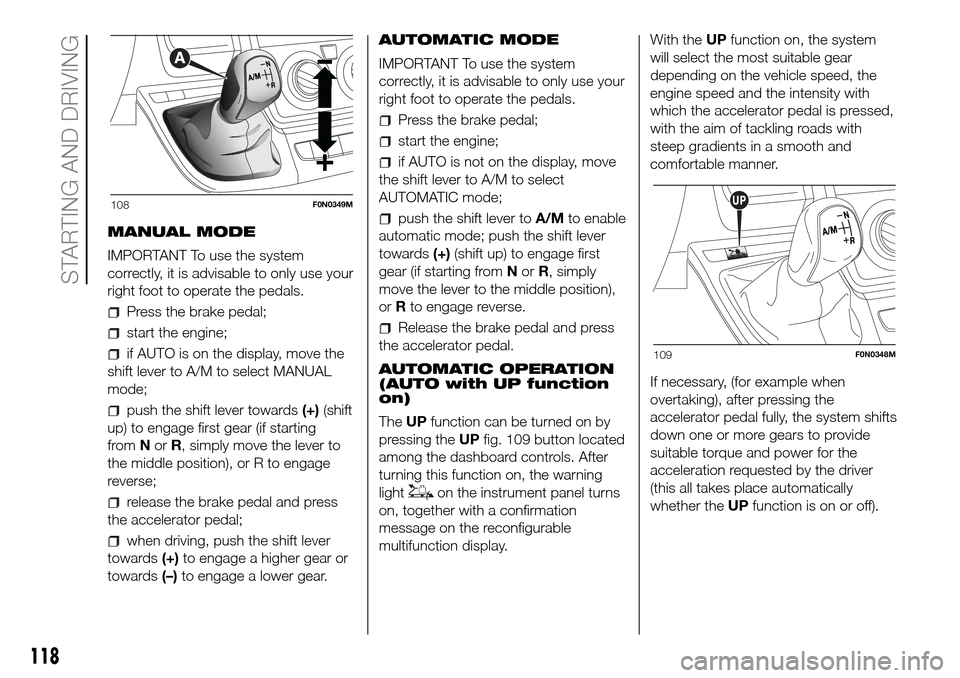
IMPORTANT To use the system
correctly, it is advisable to only use your
right foot to operate the pedals.
Press the brake pedal;
start the engine;
if AUTO is on the display, move the
shift lever to A/M to select MANUAL
mode;
push the shift lever towards(+)(shift
up) to engage first gear (if starting
fromNorR, simply move the lever to
the middle position), or R to engage
reverse;
release the brake pedal and press
the accelerator pedal;
when driving, push the shift lever
towards(+)to engage a higher gear or
towards(–)to engage a lower gear.AUTOMATIC MODE
IMPORTANT To use the system
correctly, it is advisable to only use your
right foot to operate the pedals.
Press the brake pedal;
start the engine;
if AUTO is not on the display, move
the shift lever to A/M to select
AUTOMATIC mode;
push the shift lever toA/Mto enable
automatic mode; push the shift lever
towards(+)(shift up) to engage first
gear (if starting fromNorR, simply
move the lever to the middle position),
orRto engage reverse.
Release the brake pedal and press
the accelerator pedal.
AUTOMATIC OPERATION
(AUTO with UP function
on)
TheUPfunction can be turned on by
pressing theUPfig. 109 button located
among the dashboard controls. After
turning this function on, the warning
light
on the instrument panel turns
on, together with a confirmation
message on the reconfigurable
multifunction display.With theUPfunction on, the system
will select the most suitable gear
depending on the vehicle speed, the
engine speed and the intensity with
which the accelerator pedal is pressed,
with the aim of tackling roads with
steep gradients in a smooth and
comfortable manner.
If necessary, (for example when
overtaking), after pressing the
accelerator pedal fully, the system shifts
down one or more gears to provide
suitable torque and power for the
acceleration requested by the driver
(this all takes place automatically
whether theUPfunction is on or off).
108F0N0349M
109F0N0348M
118
STARTING AND DRIVING