instrument panel FIAT DUCATO 2016 3.G Workshop Manual
[x] Cancel search | Manufacturer: FIAT, Model Year: 2016, Model line: DUCATO, Model: FIAT DUCATO 2016 3.GPages: 296, PDF Size: 15.08 MB
Page 176 of 296
146)The spare wheel supplied (for
versions/markets, where provided) is
specific for your vehicle. Therefore, it must
not be used on other models. Do not
use spare wheels of other models on your
vehicle. The wheel bolts are specific for
your vehicle: do not use them on different
models and do not use bolts from other
models on your car.
147)Repair and refit the standard wheel as
soon as possible. Do not apply grease to
the bolt threads before fitting: they could
come unscrewed.
148)Use the jack only to replace wheels
on the vehicle with which it is supplied
or on other vehicles of the same model.
Never use the jack for other purposes,
such as lifting other vehicle models. Never
use the jack to carry out repairs under
the vehicle. Incorrect positioning of the jack
may cause the lifted vehicle to fall. Do not
use the jack for loads higher than the
one shown on its label.
149)Never tamper with the inflation valve.
Never introduce tools of any kind between
rim and tyre. Check tyre and spare wheel
pressure regularly, referring to the values
shown in the "Technical specifications"
section.
150)No tools other than the crank
provided should be used with the spare
wheel lifting device; it should be operated
by hand only.
151)On versions equipped with self-
levelling air suspension, never introduce the
head or hands in the wheel arch: the
vehicle could raise or lower automatically
depending on possible load or temperature
changes.152)The device should only be operated
by hand, without using any type of tool
other than the crank provided like
pneumatic or electrical screwers.
153)The moving components of the jack
(screws and joints) can also cause injuries:
avoid touching them. If you come into
contact with lubricating grease, clean
yourself thoroughly.
154)At the end of the operation of
raising/locking the spare wheel, after
checking that the wheel is positioned
correctly under the platform (yellow notch
inside the window on the device), extract
the operating wrench. Take care not to turn
the wrench in the wrong direction (as in
fig. 166) to facilitate extracting it, to prevent
the attachment device from being
released and to ensure that the wheel
assembly remains safely fastened.
155)Each time the spare wheel is moved,
check that it is correctly positioned in its
housing under the platform. If it is not
correctly positioned, this could adversely
affect safety.
156)The spare wheel lifting device is
equipped with a clutch safety system for its
own protection; this could activated if an
excessive load is applied on the
maneuvering screw.FIX & GO
AUTOMATIC QUICK
TYRE REPAIR KIT
(for versions/markets, where provided)
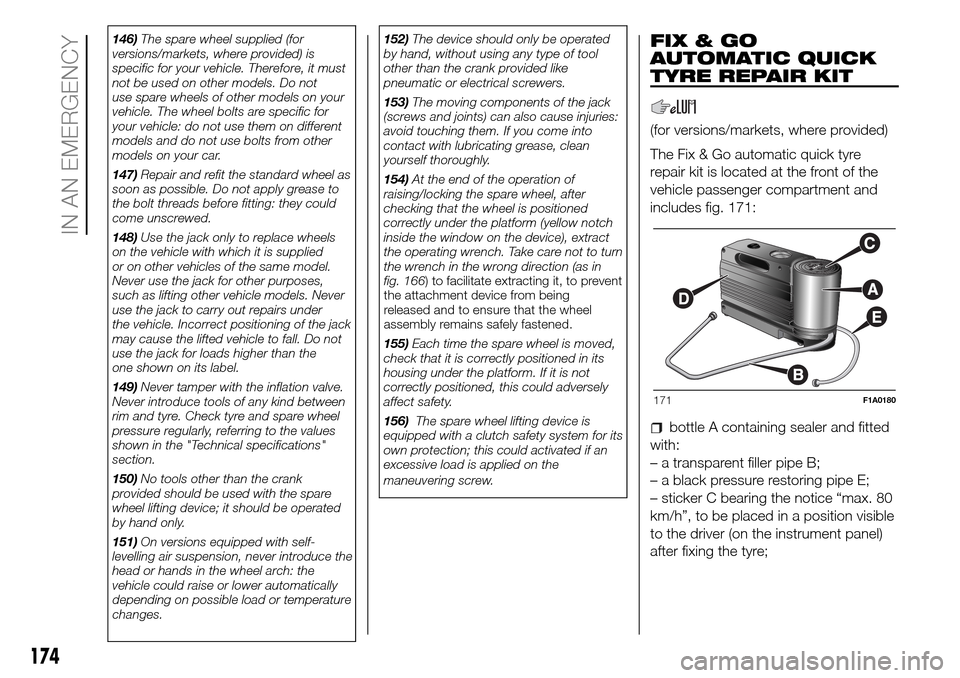
The Fix & Go automatic quick tyre
repair kit is located at the front of the
vehicle passenger compartment and
includes fig. 171:
bottle A containing sealer and fitted
with:
– a transparent filler pipe B;
– a black pressure restoring pipe E;
– sticker C bearing the notice “max. 80
km/h”, to be placed in a position visible
to the driver (on the instrument panel)
after fixing the tyre;
171F1A0180
174
IN AN EMERGENCY
Page 179 of 296
166)If different tyres from the ones
supplied with the vehicle are used, it may
not be possible to carry out the repair. If
the tyres are replaced, it is advisable to use
those approved by the manufacturer.
Consult a Fiat Dealership.
WARNING
48)In the event of a puncture caused by
foreign bodies, the kit may be used to
repair tyres showing damage on the tread
or shoulder up to max 4 mm diameter.
WARNING
3)Replace the bottle if the sealant has
expired. Dispose of the bottle and the
sealant properly. Have them disposed of in
compliance with national and local
regulations.
JUMP STARTING
If the warning lightremains on
continuously on the instrument panel,
contact the Fiat Dealership immediately.
JUMP STARTING
If the battery is flat, it is possible to start
the engine using an auxiliary battery
with the same capacity or a little higher
than the flat one.
It is advisable to contact a Fiat
Dealership to check/replace the battery.
167)
Proceed as follows to start the vehicle:
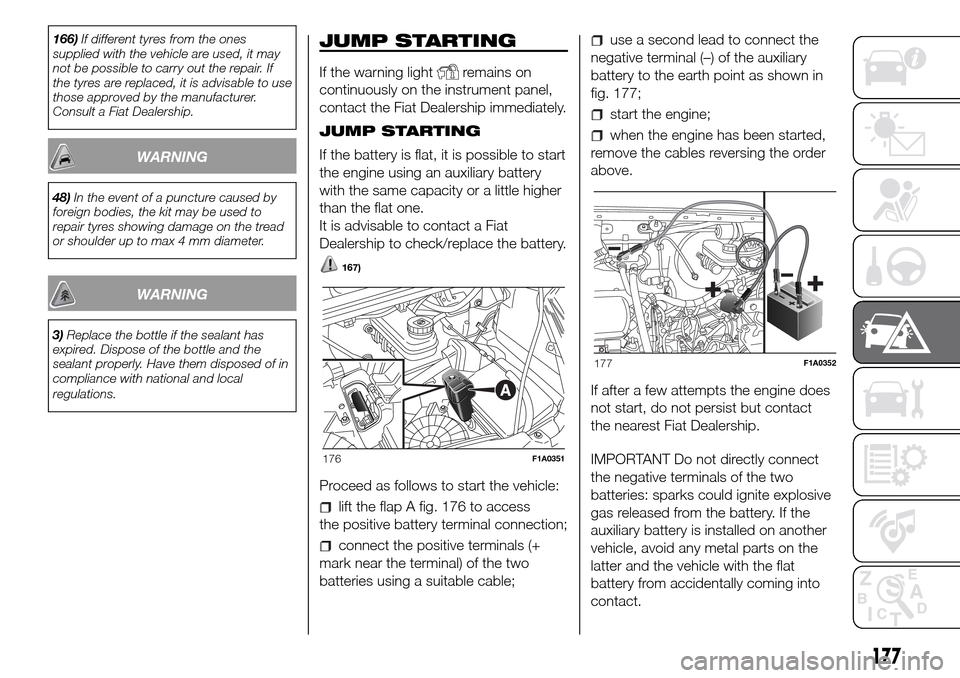
lift the flap A fig. 176 to access
the positive battery terminal connection;
connect the positive terminals (+
mark near the terminal) of the two
batteries using a suitable cable;
use a second lead to connect the
negative terminal (–) of the auxiliary
battery to the earth point as shown in
fig. 177;
start the engine;
when the engine has been started,
remove the cables reversing the order
above.
If after a few attempts the engine does
not start, do not persist but contact
the nearest Fiat Dealership.
IMPORTANT Do not directly connect
the negative terminals of the two
batteries: sparks could ignite explosive
gas released from the battery. If the
auxiliary battery is installed on another
vehicle, avoid any metal parts on the
latter and the vehicle with the flat
battery from accidentally coming into
contact.
176F1A0351
177F1A0352
177
Page 186 of 296
DEMANDING
VEHICLE USE
If the vehicle is mostly used in one of
the following conditions:
towing a trailer or caravan;
dusty roads;
short, repeated journeys (less than
7-8 km) at sub-zero outside
temperatures;
engine often idling or driving long
distances at low speeds or long periods
of inactivity;
the following checks must be carried
out more often than indicated in the
Scheduled Servicing Plan:
check front disc brake pad
conditions and wear;
check cleanliness of bonnet and
boot locks, cleanliness and lubrication
of linkage;
visually inspect conditions of:
engine, gearbox, transmission, pipes
and hoses (exhaust - fuel system -
brakes) and rubber elements (boots -
sleeves - bushes - etc.);
check battery charge and battery
fluid level (electrolyte);
visually inspect condition of the
accessory drive belts;
check and, if necessary, change
engine oil and replace oil filter;
Restore additive level for AdBlue
Diesel emissions (UREA) (for versions /
markets where applicable), at the
ignition of the lamp or the message on
the instrument panel;
check and, if necessary, replace
pollen filter.
184
SERVICING AND CARE
Page 187 of 296
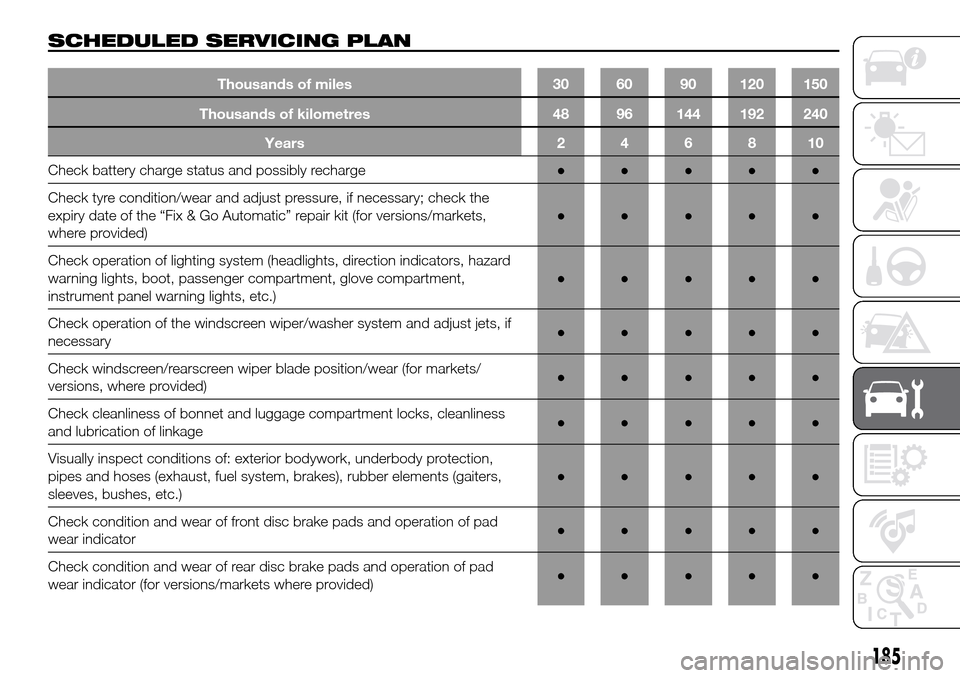
SCHEDULED SERVICING PLAN
Thousands of kilometres 48 96 144 192 240
Years 2 4 6 8 10
Check battery charge status and possibly recharge●●●●●
Check tyre condition/wear and adjust pressure, if necessary; check the
expiry date of the “Fix & Go Automatic” repair kit (for versions/markets,
where provided)●●●●●
Check operation of lighting system (headlights, direction indicators, hazard
warning lights, boot, passenger compartment, glove compartment,
instrument panel warning lights, etc.)●●●●●
Check operation of the windscreen wiper/washer system and adjust jets, if
necessary●●●●●
Check windscreen/rearscreen wiper blade position/wear (for markets/
versions, where provided)●●●●●
Check cleanliness of bonnet and luggage compartment locks, cleanliness
and lubrication of linkage●●●●●
Visually inspect conditions of: exterior bodywork, underbody protection,
pipes and hoses (exhaust, fuel system, brakes), rubber elements (gaiters,
sleeves, bushes, etc.)●●●●●
Check condition and wear of front disc brake pads and operation of pad
wear indicator●●●●●
Check condition and wear of rear disc brake pads and operation of pad
wear indicator (for versions/markets where provided)●●●●●
185
Thousands of miles 30 60 90 120 150
Page 188 of 296
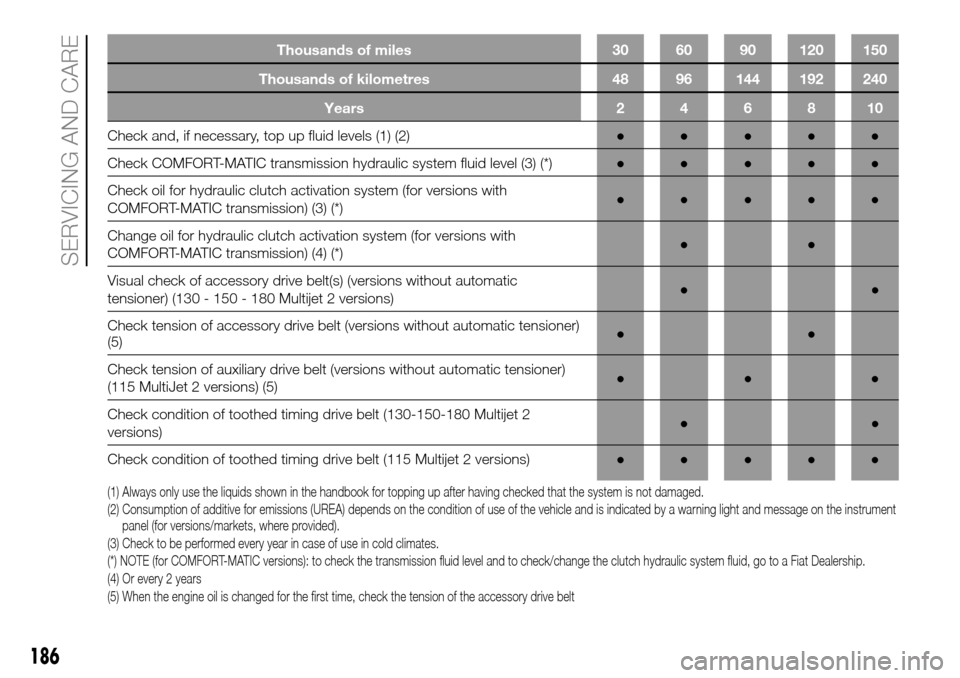
Thousands of kilometres 48 96 144 192 240
Years 2 4 6 8 10
Check and, if necessary, top up fluid levels (1) (2)●●●●●
Check COMFORT-MATIC transmission hydraulic system fluid level (3) (*)●●●●●
Check oil for hydraulic clutch activation system (for versions with
COMFORT-MATIC transmission) (3) (*)●●●●●
Change oil for hydraulic clutch activation system (for versions with
COMFORT-MATIC transmission) (4) (*)●●
Visual check of accessory drive belt(s) (versions without automatic
tensioner) (130 - 150 - 180 Multijet 2 versions)●●
Check tension of accessory drive belt (versions without automatic tensioner)
(5)●●
Check tension of auxiliary drive belt (versions without automatic tensioner)
(115 MultiJet 2 versions) (5)●●●
Check condition of toothed timing drive belt (130-150-180 Multijet 2
versions)●●
Check condition of toothed timing drive belt (115 Multijet 2 versions)●●●●●
(1) Always only use the liquids shown in the handbook for topping up after having checked that the system is not damaged.
(2) Consumption of additive for emissions (UREA) depends on the condition of use of the vehicle and is indicated by a warning light and message on the instrument
panel (for versions/markets, where provided).
(3) Check to be performed every year in case of use in cold climates.
(*) NOTE (for COMFORT-MATIC versions): to check the transmission fluid level and to check/change the clutch hydraulic system fluid, go to a Fiat Dealership.
(4) Or every 2 years
(5) When the engine oil is changed for the first time, check the tension of the accessory drive belt
186
SERVICING AND CARE
Thousands of miles 30 60 90 120 150
Page 190 of 296
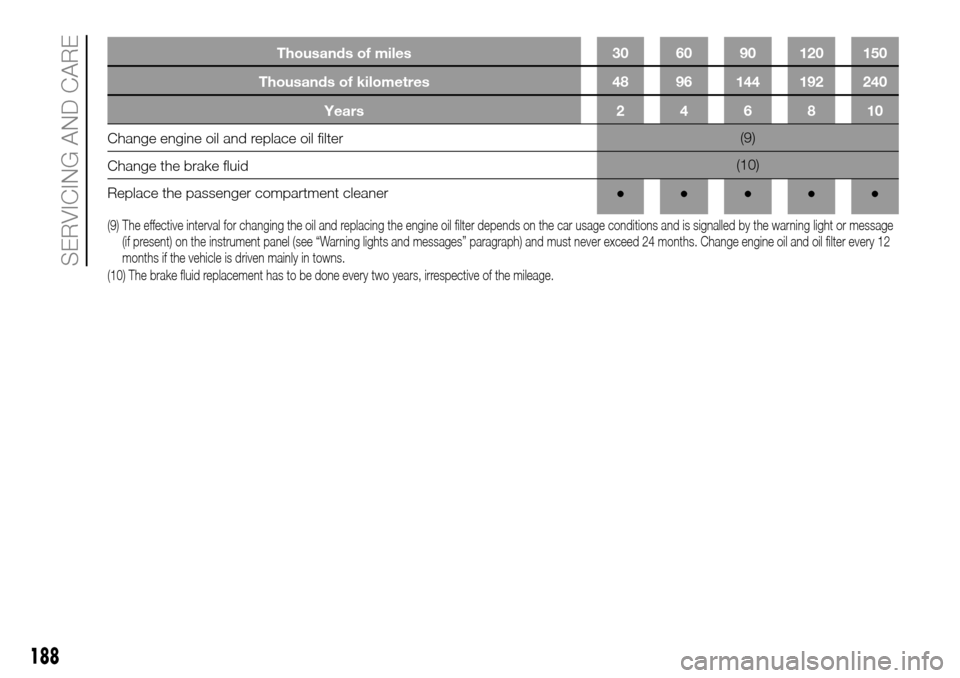
Thousands of kilometres 48 96 144 192 240
Years 2 4 6 8 10
Change engine oil and replace oil filter(9)
Change the brake fluid(10)
Replace the passenger compartment cleaner●●●●●
(9) The effective interval for changing the oil and replacing the engine oil filter depends on the car usage conditions and is signalled by the warning light or message
(if present) on the instrument panel (see “Warning lights and messages” paragraph) and must never exceed 24 months. Change engine oil and oil filter every 12
months if the vehicle is driven mainly in towns.
(10) The brake fluid replacement has to be done every two years, irrespective of the mileage.
188
SERVICING AND CARE
Thousands of miles 30 60 90 120 150
Page 191 of 296
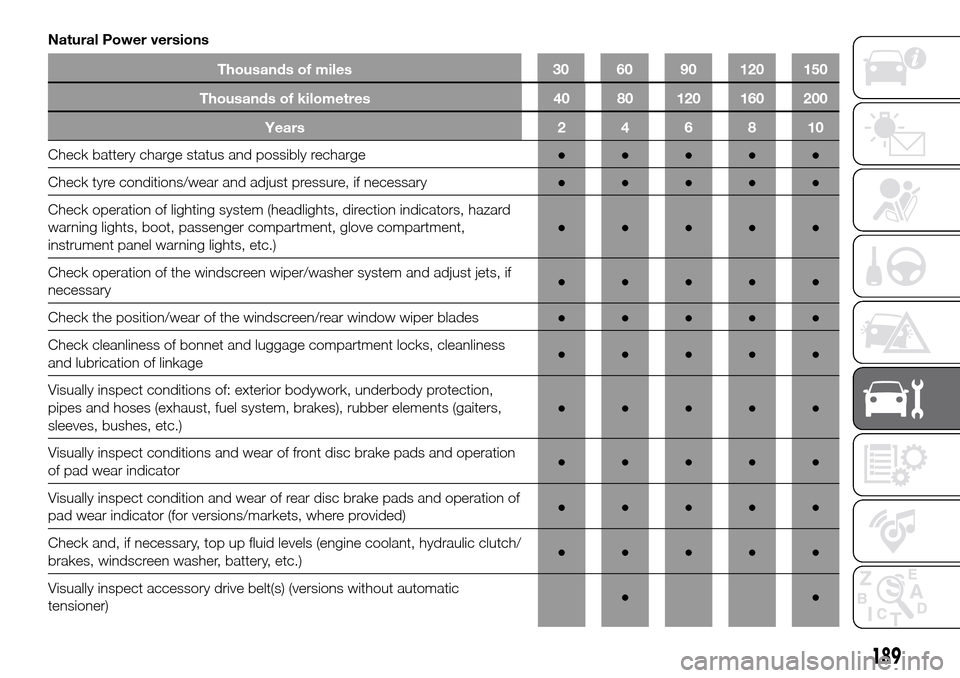
Natural Power versions
Thousands of kilometres 40 80 120 160 200
Years246810
Check battery charge status and possibly recharge●●●●●
Check tyre conditions/wear and adjust pressure, if necessary●●●●●
Check operation of lighting system (headlights, direction indicators, hazard
warning lights, boot, passenger compartment, glove compartment,
instrument panel warning lights, etc.)●●●●●
Check operation of the windscreen wiper/washer system and adjust jets, if
necessary●●●●●
Check the position/wear of the windscreen/rear window wiper blades●●●●●
Check cleanliness of bonnet and luggage compartment locks, cleanliness
and lubrication of linkage●●●●●
Visually inspect conditions of: exterior bodywork, underbody protection,
pipes and hoses (exhaust, fuel system, brakes), rubber elements (gaiters,
sleeves, bushes, etc.)●●●●●
Visually inspect conditions and wear of front disc brake pads and operation
of pad wear indicator●●●●●
Visually inspect condition and wear of rear disc brake pads and operation of
pad wear indicator (for versions/markets, where provided)●●●●●
Check and, if necessary, top up fluid levels (engine coolant, hydraulic clutch/
brakes, windscreen washer, battery, etc.)●●●●●
Visually inspect accessory drive belt(s) (versions without automatic
tensioner)●●
189
Thousands of miles 30 60 90 120 150
Page 208 of 296
WARNING
6)Detergents pollute the water. The
vehicle should be washed in areas
equipped for collecting and purifying the
liquid used in the washing process.
INTERIOR
Regularly check that water is not
trapped under the mats (due to water
dripping off shoes, umbrellas, etc.),
as this could cause oxidation of the
sheet metal.
201) 202)
SEATS AND FABRIC
PARTS
Remove dust with a soft brush or a
vacuum cleaner. It is advisable to use a
moist brush on velvet upholstery.
Rub the seats with a sponge moistened
with a solution of water and neutral
detergent.
PLASTIC PARTS
It is advisable to clean interior plastic
parts with a moist cloth and a solution
of water and non-abrasive mild soap.
Use specific products for cleaning
plastic, without solvents and specifically
designed to prevent damage to the
appearance and colour of the treated
parts, to remove grease and tough
stains.
IMPORTANT Do not use alcohol,
petrols or derivatives to clean
the instrument panel glass.LEATHER STEERING
WHEEL/GEAR LEVER
KNOB/HANDBRAKE
(for versions/markets, where provided)
These components must be cleaned
with mild soap and water only. Never
use alcohol or alcohol-based products.
WARNING
201)Never use flammable products, such
as petroleum ether or modified petrol, to
clean the inside of the car. The
electrostatic charges which are generated
by rubbing during the cleaning operation
may cause a fire.
202)Do not keep aerosol cans in the
vehicle: they might explode. Aerosol cans
must not be exposed to a temperature
exceeding 50°C. When the vehicle is
exposed to sunlight, the internal
temperature can greatly exceed this value.
206
SERVICING AND CARE
Page 292 of 296
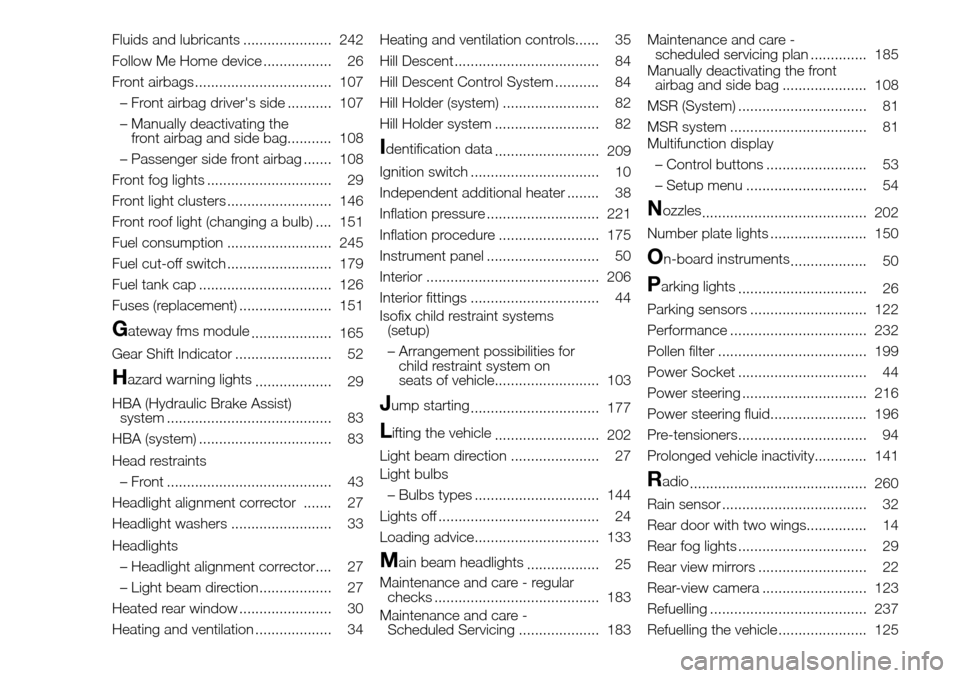
Fluids and lubricants ...................... 242
Follow Me Home device ................. 26
Front airbags .................................. 107
– Front airbag driver's side ........... 107
– Manually deactivating the
front airbag and side bag........... 108
– Passenger side front airbag ....... 108
Front fog lights ............................... 29
Front light clusters .......................... 146
Front roof light (changing a bulb) .... 151
Fuel consumption .......................... 245
Fuel cut-off switch .......................... 179
Fuel tank cap ................................. 126
Fuses (replacement) ....................... 151
Gateway fms module
.................... 165
Gear Shift Indicator ........................ 52
Hazard warning lights
................... 29
HBA (Hydraulic Brake Assist)
system ......................................... 83
HBA (system) ................................. 83
Head restraints
– Front ......................................... 43
Headlight alignment corrector ....... 27
Headlight washers ......................... 33
Headlights
– Headlight alignment corrector.... 27
– Light beam direction.................. 27
Heated rear window ....................... 30
Heating and ventilation ................... 34Heating and ventilation controls...... 35
Hill Descent .................................... 84
Hill Descent Control System ........... 84
Hill Holder (system) ........................ 82
Hill Holder system .......................... 82
Identification data
.......................... 209
Ignition switch ................................ 10
Independent additional heater ........ 38
Inflation pressure ............................ 221
Inflation procedure ......................... 175
Instrument panel ............................ 50
Interior ........................................... 206
Interior fittings ................................ 44
Isofix child restraint systems
(setup)
– Arrangement possibilities for
child restraint system on
seats of vehicle.......................... 103
Jump starting
................................ 177
Lifting the vehicle
.......................... 202
Light beam direction ...................... 27
Light bulbs
– Bulbs types ............................... 144
Lights off ........................................ 24
Loading advice............................... 133
Main beam headlights
.................. 25
Maintenance and care - regular
checks ......................................... 183
Maintenance and care -
Scheduled Servicing .................... 183Maintenance and care -
scheduled servicing plan .............. 185
Manually deactivating the front
airbag and side bag ..................... 108
MSR (System) ................................ 81
MSR system .................................. 81
Multifunction display
– Control buttons ......................... 53
– Setup menu .............................. 54
Nozzles
......................................... 202
Number plate lights ........................ 150
On-board instruments
................... 50
Parking lights
................................ 26
Parking sensors ............................. 122
Performance .................................. 232
Pollen filter ..................................... 199
Power Socket ................................ 44
Power steering ............................... 216
Power steering fluid........................ 196
Pre-tensioners................................ 94
Prolonged vehicle inactivity............. 141
Radio
............................................ 260
Rain sensor .................................... 32
Rear door with two wings............... 14
Rear fog lights ................................ 29
Rear view mirrors ........................... 22
Rear-view camera .......................... 123
Refuelling ....................................... 237
Refuelling the vehicle ...................... 125